DATA-BASE MANAGEMENT
Kappa statistics
DR. AMEY DHATRAK
Kappa statistics
◦ The kappa statistic is frequently used to test interrater reliability.(Measurement of the extent to
which data collectors (raters) assign the same score to the same.)
◦ Why we need Kappa???
◦ Some studies involve the need for some degree of subjective interpretation by observers and
often measurement differs with different ‘raters.
◦ intraobserver variation
◦ intrasubject variation
◦ For example:
◦ Interpreting x-ray results = Two radiologists reading same chest x-ray for signs of pneumoconiosis
◦ Two laboratory scientists counting radioactively marked cells from liver tissue
◦ Often same rater differs when measuring the same thing on a different occasion
Kappa- agreement
◦ Without good agreement results are difficult to interpret
◦ Measurements are unreliable or inconsistent
◦ Need measures of agreement - kappa
◦ Remember-
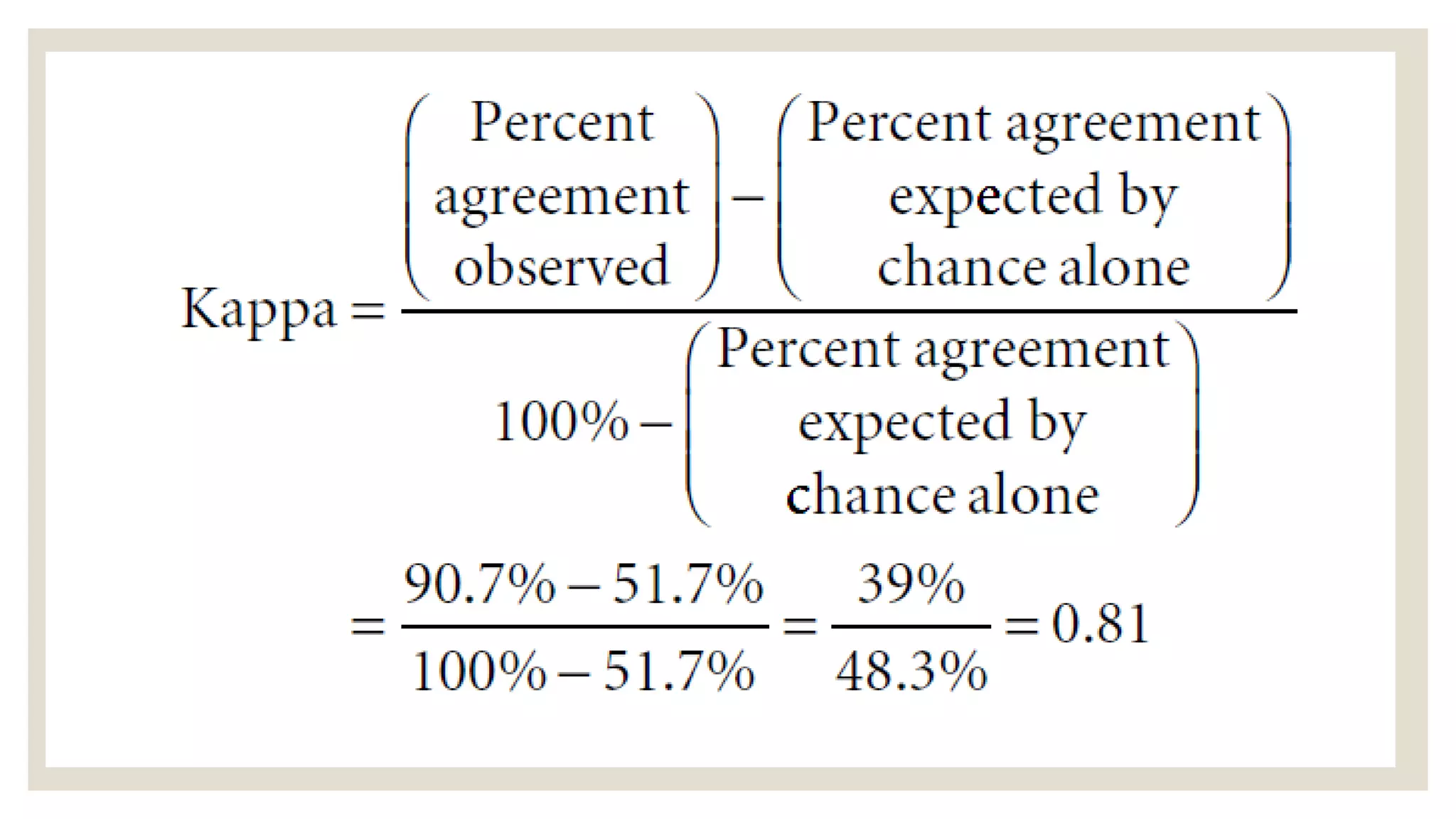
Extent to which the observed agreement exceeds that which would be expected by
chance alone (i.e., percent agreement observed − percent agreement expected by
chance alone) [numerator] relative to the maximum that the observers could hope to
improve their agreement (i.e., 100% − percent agreement expected by chance alone)
[denominator].
Formula



+
+
+
+
−
−
=
i
i
i
i
ii






1
Examples:-1
44*60/100= 26.4
31*40/100= 12.4
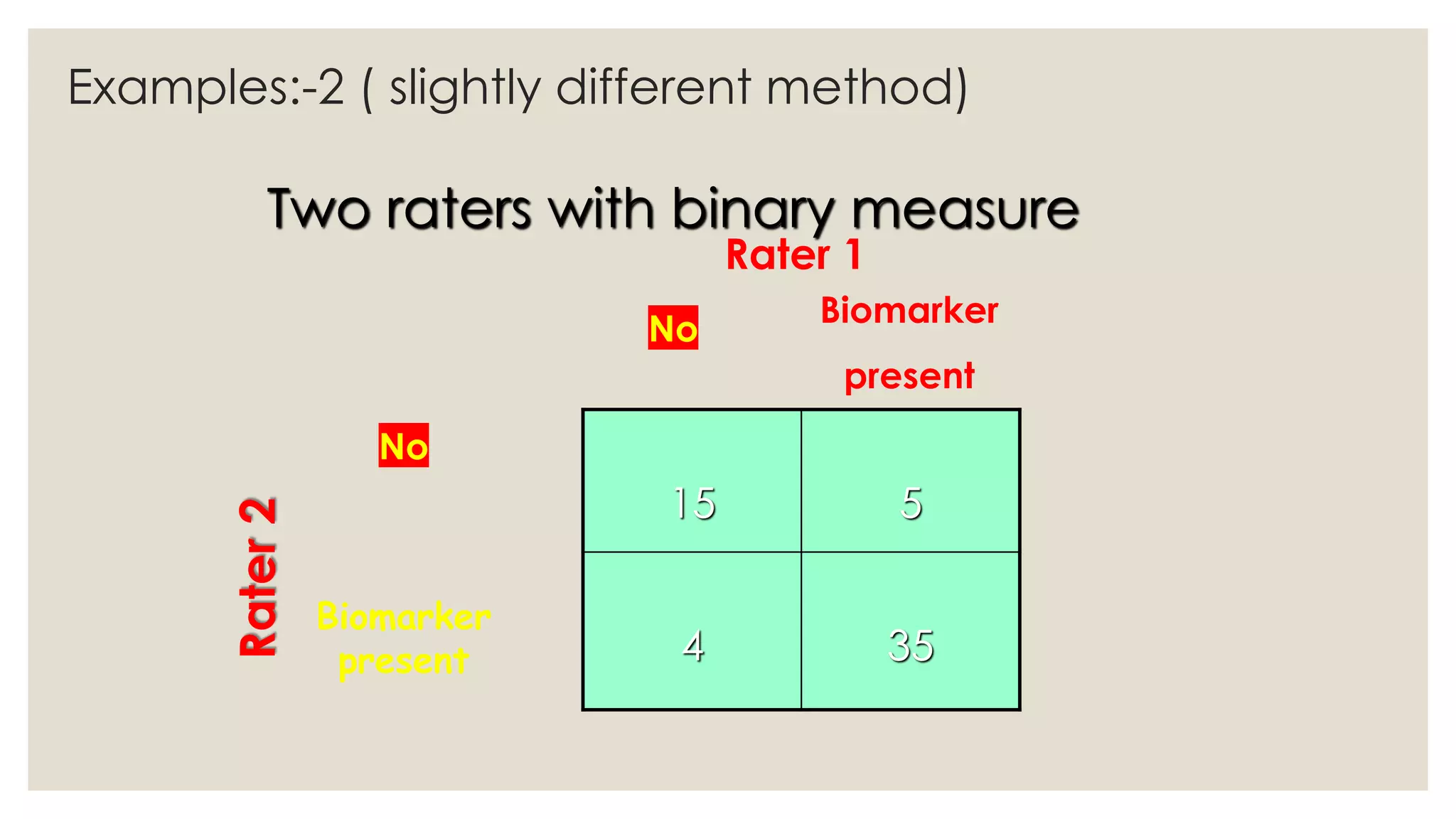
Two raters with binary measure
15 5
4 35
No
Biomarker
present
No
Biomarker
present
Rater 1
Rater
2
Examples:-2 ( slightly different method)
Cohen’s Kappa Statistic (κ)
Measures agreement between raters more than expected by chance



+
+
+
+
−
−
=
i
i
i
i
ii






1
 represents the marginal probabilities and i = 1,2 the score
Two raters with binary measure
15 5 20
4 35 39
19 40 59
No Biomarker
present
No
Biomarker
present
Rater 1
Rater
2
Marginal Total
Marginal
Total
Two raters with binary measure
15 5 20
4 35 39
19 40 59
ii = (15 + 35)/59
= 0.847
i++i = (20x19 + 40x39)/592
= 0.557
Two raters with binary measure
15 5 20
4 35 39
19 40 59
ii = 0.847
i++i = 0.557



+
+
+
+
−
−
=
i
i
i
i
ii






1
557
.
0
1
557
.
0
847
.
0
−
−
=
 654
.
0
=

Confidence intervals for kappa
◦ Given that the most frequent value desired is 95%, the formula uses
1.96 as the constant.
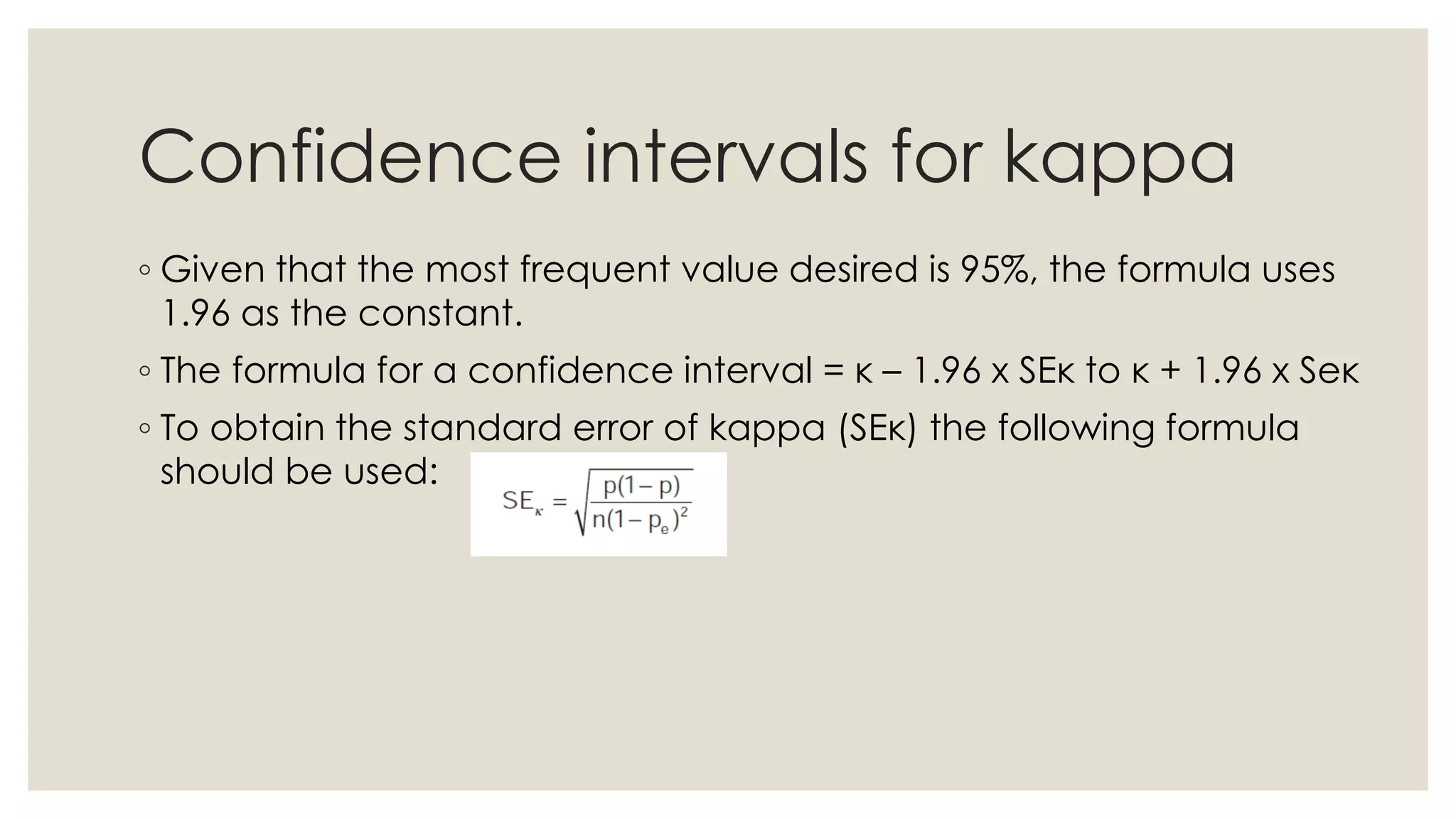
◦ The formula for a confidence interval = κ – 1.96 x SEκ to κ + 1.96 x Seκ
◦ To obtain the standard error of kappa (SEκ) the following formula
should be used:
Thank You

Kappa statistics

  • 1.
  • 2.
    Kappa statistics ◦ Thekappa statistic is frequently used to test interrater reliability.(Measurement of the extent to which data collectors (raters) assign the same score to the same.) ◦ Why we need Kappa??? ◦ Some studies involve the need for some degree of subjective interpretation by observers and often measurement differs with different ‘raters. ◦ intraobserver variation ◦ intrasubject variation ◦ For example: ◦ Interpreting x-ray results = Two radiologists reading same chest x-ray for signs of pneumoconiosis ◦ Two laboratory scientists counting radioactively marked cells from liver tissue ◦ Often same rater differs when measuring the same thing on a different occasion
  • 3.
    Kappa- agreement ◦ Withoutgood agreement results are difficult to interpret ◦ Measurements are unreliable or inconsistent ◦ Need measures of agreement - kappa ◦ Remember- Extent to which the observed agreement exceeds that which would be expected by chance alone (i.e., percent agreement observed − percent agreement expected by chance alone) [numerator] relative to the maximum that the observers could hope to improve their agreement (i.e., 100% − percent agreement expected by chance alone) [denominator].
  • 4.
  • 5.
  • 8.
    Two raters withbinary measure 15 5 4 35 No Biomarker present No Biomarker present Rater 1 Rater 2 Examples:-2 ( slightly different method)
  • 9.
    Cohen’s Kappa Statistic(κ) Measures agreement between raters more than expected by chance    + + + + − − = i i i i ii       1  represents the marginal probabilities and i = 1,2 the score
  • 10.
    Two raters withbinary measure 15 5 20 4 35 39 19 40 59 No Biomarker present No Biomarker present Rater 1 Rater 2 Marginal Total Marginal Total
  • 11.
    Two raters withbinary measure 15 5 20 4 35 39 19 40 59 ii = (15 + 35)/59 = 0.847 i++i = (20x19 + 40x39)/592 = 0.557
  • 12.
    Two raters withbinary measure 15 5 20 4 35 39 19 40 59 ii = 0.847 i++i = 0.557    + + + + − − = i i i i ii       1 557 . 0 1 557 . 0 847 . 0 − − =  654 . 0 = 
  • 14.
    Confidence intervals forkappa ◦ Given that the most frequent value desired is 95%, the formula uses 1.96 as the constant. ◦ The formula for a confidence interval = κ – 1.96 x SEκ to κ + 1.96 x Seκ ◦ To obtain the standard error of kappa (SEκ) the following formula should be used:
  • 17.