Special Topics in Biostatistics
            An Introduction to Survival Data Analysis

                                   Federico Rotolo
                   federico.rotolo@stat.unipd.it — federico.rotolo@uclouvain.be


                                                                     Visiting PhD student at
           PhD student at
Dipartmento di Scienze Statistiche                       Institut de Statistique, Biostatistique
                                                                 et Sciences Actuarielles


 Universit` degli Studi di Padova
          a                                                Universit´ Catholique de Louvain
                                                                    e


                                   March 30, 2011
F. Rotolo


      Survival Analysis
                                           Outline
          An example

          Peculiarities of Survival Data

          Notation and Basic Functions

          Survival Likelihood

          Parametric models

          Non-Parametric models

          Regression
      Complications of Survival Models

          Non-proportional hazards

          Informative censoring

          Dependent observations

          Multi-state phenomena

          Competing Risks
      References
STiB: Survival Data Analysis                           2/ 57
Survival Analysis                                                          F. Rotolo


                               Survival Analysis

          What is Survival Analysis?
      The field of statistics providing tools for handling duration data,
      i.e. continuous and positive numerical variables measuring the
      time from an origin event until the occurrence of an event of
      interest.


STiB: Survival Data Analysis                                                 3/ 57
Survival Analysis                                                          F. Rotolo


                               Survival Analysis

          What is Survival Analysis?
      The field of statistics providing tools for handling duration data,
      i.e. continuous and positive numerical variables measuring the
      time from an origin event until the occurrence of an event of
      interest.

         Why “Survival” Analysis?
      First works on this topic originated from the problem of studying
      death times, that is times from birth to death.


STiB: Survival Data Analysis                                                 3/ 57
Survival Analysis                                                                F. Rotolo


                               Survival Analysis

          What is Survival Analysis?
      The field of statistics providing tools for handling duration data,
      i.e. continuous and positive numerical variables measuring the
      time from an origin event until the occurrence of an event of
      interest.

         Why “Survival” Analysis?
      First works on this topic originated from the problem of studying
      death times, that is times from birth to death.

      Many ad-hoc statistical tools have been developed for survival
      data (Cox model, Kaplan–Meier estimator, Mantel–Haenszel test, etc.) and
      research interest in such problems has been increasing.
         Why is Survival Data Analysis so peculiar?

STiB: Survival Data Analysis                                                       3/ 57
Survival Analysis                                                         F. Rotolo


                                An example


           An example

      Consider a clinical trial with patients undergone tumour surgical
      removal.


STiB: Survival Data Analysis                                                4/ 57
Survival Analysis                                                         F. Rotolo


                                An example


           An example

      Consider a clinical trial with patients undergone tumour surgical
      removal.

      One can be interested in
      M: the level of a tumor marker after 6 months
        T : the time until recurrence of the disease

      In both cases the measured variable is continuous numerical and
      positive, so there is no apparent difference.


STiB: Survival Data Analysis                                                4/ 57
Survival Analysis                                                         F. Rotolo


                                An example


      Actually, other situations can perturb the experiment before the
      variable of interest is observed: the patient dies, gives up the
      study, migrates, another disease occurs, the study ends, etc. . .


STiB: Survival Data Analysis                                                5/ 57
Survival Analysis                                                         F. Rotolo


                                An example


      Actually, other situations can perturb the experiment before the
      variable of interest is observed: the patient dies, gives up the
      study, migrates, another disease occurs, the study ends, etc. . .

      In such cases
        M is missing
         T is missing and we know that T > s, with s the time of the
           “disturbing event”


STiB: Survival Data Analysis                                                5/ 57
Survival Analysis                                                       F. Rotolo


                               Peculiarities of Survival Data
                                          Censoring


      Then the most particular feature of survival data is censoring.


STiB: Survival Data Analysis                                              6/ 57
Survival Analysis                                                         F. Rotolo


                               Peculiarities of Survival Data
                                          Censoring


      Then the most particular feature of survival data is censoring.

      Right censoring (T > t) is very frequent and often unavoidable; all
      survival methods account for it.
      Interval censoring (T ∈ (l, r ]) is very frequent, too, but much more
      ignored in usual practice.
      Left censoring (T ≤ t) is very infrequent.


STiB: Survival Data Analysis                                                  6/ 57
Survival Analysis                                                            F. Rotolo


                               Peculiarities of Survival Data
                                          Censoring


      Then the most particular feature of survival data is censoring.

      Right censoring (T > t) is very frequent and often unavoidable; all
      survival methods account for it.
      Interval censoring (T ∈ (l, r ]) is very frequent, too, but much more
      ignored in usual practice.
      Left censoring (T ≤ t) is very infrequent.

      Left truncation is a different concept, concerning the selection
      bias introduced by including in the study only subjects having a
      survival time greater than a certain value, say t ∗ ; then we do not
      observe T but T = T |T > t ∗ .


STiB: Survival Data Analysis                                                   6/ 57
Survival Analysis                                                       F. Rotolo


                               Peculiarities of Survival Data
                                         Conditioning


      The second important feature of survival data is the concept of
      conditioning, even more important than censoring according to
      some authors (Hougaard, 2000).


STiB: Survival Data Analysis                                              7/ 57
Survival Analysis                                                           F. Rotolo


                               Peculiarities of Survival Data
                                         Conditioning


      The second important feature of survival data is the concept of
      conditioning, even more important than censoring according to
      some authors (Hougaard, 2000).

      As time passes, new information is available, not only for subjects
      dying, but also for those surviving.


STiB: Survival Data Analysis                                                  7/ 57
Survival Analysis                                                               F. Rotolo


                               Peculiarities of Survival Data
                                         Conditioning


      The second important feature of survival data is the concept of
      conditioning, even more important than censoring according to
      some authors (Hougaard, 2000).

      As time passes, new information is available, not only for subjects
      dying, but also for those surviving.

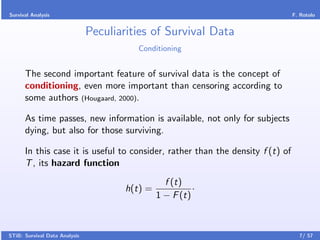
      In this case it is useful to consider, rather than the density f (t) of
      T , its hazard function
                                                  f (t)
                                       h(t) =             ·
                                                1 − F (t)


STiB: Survival Data Analysis                                                      7/ 57
Survival Analysis                                                        F. Rotolo


                                   Survival Analysis
                                 Notation and Basic Functions
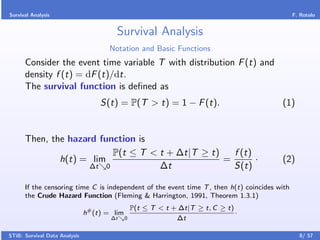
      Consider the event time variable T with distribution F (t) and
      density f (t) = dF (t)/dt.
      The survival function is defined as
                               S(t) = P(T > t) = 1 − F (t).            (1)


STiB: Survival Data Analysis                                                 8/ 57
Survival Analysis                                                                             F. Rotolo


                                        Survival Analysis
                                      Notation and Basic Functions
      Consider the event time variable T with distribution F (t) and
      density f (t) = dF (t)/dt.
      The survival function is defined as
                                    S(t) = P(T > t) = 1 − F (t).                        (1)


      Then, the hazard function is
                          P(t ≤ T < t + ∆t|T ≥ t)   f (t)
              h(t) = lim                          =       ·                             (2)
                     ∆t 0           ∆t              S(t)

      If the censoring time C is independent of the event time T , then h(t) coincides with
      the Crude Hazard Function (Fleming & Harrington, 1991, Theorem 1.3.1)
                                                  P(t ≤ T < t + ∆t|T ≥ t, C ≥ t)
                               h# (t) = lim                                      ·
                                       ∆t     0                ∆t

STiB: Survival Data Analysis                                                                    8/ 57
Survival Analysis                                               F. Rotolo


                                 Survival Analysis
                               Notation and Basic Functions


      The cumulative hazard functions is defined as
                                                t
                                  H(t) =            h(u)du.   (3)
                                            0


STiB: Survival Data Analysis                                        9/ 57
Survival Analysis                                               F. Rotolo


                                 Survival Analysis
                               Notation and Basic Functions


      The cumulative hazard functions is defined as
                                                t
                                  H(t) =            h(u)du.   (3)
                                            0


      Since f (t) = −dS(t)/dt, then

                                     S(t) = e −H(t)           (4)

      or, equivalently,
                                           d
                                h(t) = −      log{S(t)}.
                                           dt


STiB: Survival Data Analysis                                        9/ 57
Survival Analysis                                                                    F. Rotolo


                               Hazard and Conditioning

      The hazard function already contains conditioning. Then, it is
      particularly advantageous in a survival context, as shown by
      Hougaard (1999) in the following table.


                                                                In truncated
                                              In full            distribution
                       Quantity            distribution   given survival to time v
                       Survival function       S(t)              S(t)/S(v )
                       Density                 f (t)              f (t)/S(v )
                       Hazard function         h(t)                   h(t)


      Conditioning corresponds to considering only actually possible
      events, accounting for the past being fixed and known.


STiB: Survival Data Analysis                                                          10/ 57
Survival Analysis                                                                              F. Rotolo


                                    Survival Likelihood

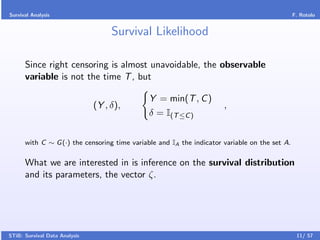
      Since right censoring is almost unavoidable, the observable
      variable is not the time T , but

                                              Y = min(T , C )
                               (Y , δ),                               ,
                                              δ = I(T ≤C )


      with C ∼ G (·) the censoring time variable and IA the indicator variable on the set A.


STiB: Survival Data Analysis                                                                    11/ 57
Survival Analysis                                                                              F. Rotolo


                                    Survival Likelihood

      Since right censoring is almost unavoidable, the observable
      variable is not the time T , but

                                              Y = min(T , C )
                               (Y , δ),                               ,
                                              δ = I(T ≤C )


      with C ∼ G (·) the censoring time variable and IA the indicator variable on the set A.

      What we are interested in is inference on the survival distribution
      and its parameters, the vector ζ.


STiB: Survival Data Analysis                                                                    11/ 57
Survival Analysis                                                                              F. Rotolo


                                    Survival Likelihood

      Since right censoring is almost unavoidable, the observable
      variable is not the time T , but

                                              Y = min(T , C )
                               (Y , δ),                               ,
                                              δ = I(T ≤C )


      with C ∼ G (·) the censoring time variable and IA the indicator variable on the set A.

      What we are interested in is inference on the survival distribution
      and its parameters, the vector ζ.

      What is the survival likelihood L(ζ; y )?


STiB: Survival Data Analysis                                                                    11/ 57
Survival Analysis                                                                  F. Rotolo


                                   Survival Likelihood
      The contribution of an event time yi to the likelihood is
                                                       T⊥
                                                        ⊥C
                    L(ζ; yi ) = (1 − G (yi ))f (yi ) ∝ f (yi ) = h(yi )S(yi ).


      The contribution of a right-censor time yi is
                                                      T⊥
                                                       ⊥C
                    L(ζ; yi ) = g (yi )(1 − F (yi )) ∝ (1 − F (yi )) = S(yi ).


      Under i.i.d. sampling of size n with T ⊥ C , the total likelihood is
                                             ⊥
                                               n
                                 L(ζ; y ) =         {h(yi )}δi S(yi ).           (5)
                                              i=1


STiB: Survival Data Analysis                                                           12/ 57
Survival Analysis                                                                   F. Rotolo


                                Parametric models

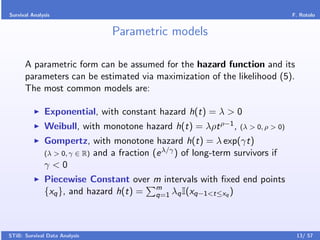
      A parametric form can be assumed for the hazard function and its
      parameters can be estimated via maximization of the likelihood (5).
      The most common models are:

              Exponential, with constant hazard h(t) = λ > 0
              Weibull, with monotone hazard h(t) = λρt ρ−1 ,       (λ > 0, ρ > 0)

              Gompertz, with monotone hazard h(t) = λ exp(γt)
              (λ > 0, γ ∈ R) and a fraction (e λ/γ ) of long-term survivors if
              γ<0
              Piecewise Constant over m intervals with fixed end points
              {xq }, and hazard h(t) = m λq I(xq−1<t≤xq )
                                       q=1


STiB: Survival Data Analysis                                                         13/ 57
Survival Analysis                                                                                          F. Rotolo


                                         Parametric models

      Comparison of parametric models (Hougaard, 2000, Table 2.6)

        Property                             Exponential        Weibull       Gompertz        Piecewise
                                                                                              constant
        Increasing hazard possible              No                Yes             Yes            Yes
        Continuous hazard                       Yes               Yes             Yes            No
        Estimate monotone                    (Constant)           Yes             Yes            No
        Non-zero initial hazard                 Yes               No              Yes            Yes
        Minimum stable                          Yes               Yes             No             No
        Explicit estimation                     Yes               No              No             Yes
        Needs choice of intervals               No                No              No             Yes
        No. of parameters                        1                 2               2              m
        Dim. of suff.stat.
          Complete data                            1                n             n               2m − 1
          Censored data                            2               2n             2n               2m
        n = number of observations; m + 1 = number of intervals in the piecewise constant model


STiB: Survival Data Analysis                                                                                14/ 57
Survival Analysis                                                    F. Rotolo


                               Non-Parametric models

      Non-parametric methods require no assumption on the form of
      survival function.

      In general, the most common NP estimator is the empirical
                             ˆ
      distribution function F (t), but censoring prevents its use.


STiB: Survival Data Analysis                                          15/ 57
Survival Analysis                                                    F. Rotolo


                               Non-Parametric models

      Non-parametric methods require no assumption on the form of
      survival function.

      In general, the most common NP estimator is the empirical
                             ˆ
      distribution function F (t), but censoring prevents its use.

      Two methods are very widely used:
                                       ˆ
         the Kaplan–Meier estimator SKM (t) of the Survival function
                                      ˆ
         the Nelson–Aalen estimator HNA (t) of the Cumulative
         Hazard

                ˆ              ˆ
      Note that SKM (t) = exp{−HNA (t)}.


STiB: Survival Data Analysis                                           15/ 57
Survival Analysis                                                                           F. Rotolo


                               Kaplan–Meier estimator
      The Kaplan–Meier Product Limit estimator                   (Kaplan & Meier, 1958)
      of the Survival Function is

                                ˆ                           Ni   ,
                                SKM (t) =              1−                               (6)
                                                            Ri
                                             i|ti ≤t


      with {ti }i the observed event times, Ni the number of events at time ti and Ri the
      number of survivors at time ti .


STiB: Survival Data Analysis                                                                  16/ 57
Survival Analysis                                                                              F. Rotolo


                               Kaplan–Meier estimator
      The Kaplan–Meier Product Limit estimator                        (Kaplan & Meier, 1958)
      of the Survival Function is

                                ˆ                                Ni   ,
                                SKM (t) =              1−                                 (6)
                                                                 Ri
                                             i|ti ≤t


      with {ti }i the observed event times, Ni the number of events at time ti and Ri the
      number of survivors at time ti .

      Its variance can be evaluated by the Greenwood’s formula
      (Greenwood, 1926; Meier, 1975):


                           ˆ          ˆ                               Ni
                         V SKM (t) = [SKM (t)]2                                ·
                                                                 Ri (Ri − Ni )
                                                       i|ti ≤t


STiB: Survival Data Analysis                                                                    16/ 57
Survival Analysis                                                                           F. Rotolo


                               Nelson–Aalen estimator
                                  Nelson (1969); Aalen (1976)

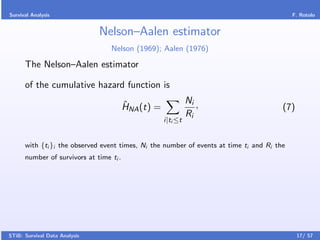
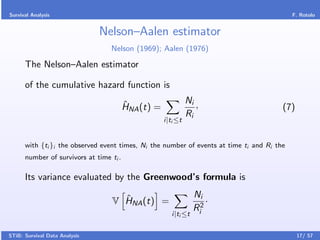
      The Nelson–Aalen estimator

      of the cumulative hazard function is

                                         ˆ                     Ni ,
                                         HNA (t) =                                      (7)
                                                               Ri
                                                     i|ti ≤t


      with {ti }i the observed event times, Ni the number of events at time ti and Ri the
      number of survivors at time ti .


STiB: Survival Data Analysis                                                                  17/ 57
Survival Analysis                                                                           F. Rotolo


                               Nelson–Aalen estimator
                                  Nelson (1969); Aalen (1976)

      The Nelson–Aalen estimator

      of the cumulative hazard function is

                                         ˆ                     Ni ,
                                         HNA (t) =                                      (7)
                                                               Ri
                                                     i|ti ≤t


      with {ti }i the observed event times, Ni the number of events at time ti and Ri the
      number of survivors at time ti .

      Its variance evaluated by the Greenwood’s formula is

                                     ˆ                            Ni
                                   V HNA (t) =                        ·
                                                                  Ri2
                                                        i|ti ≤t


STiB: Survival Data Analysis                                                                  17/ 57
Survival Analysis                                                        F. Rotolo


                           Cox proportional hazards model


      The most common and popular model in survival analysis is by far
      the Cox Regression Model (Cox, 1972).


STiB: Survival Data Analysis                                              18/ 57
Survival Analysis                                                          F. Rotolo


                           Cox proportional hazards model


      The most common and popular model in survival analysis is by far
      the Cox Regression Model (Cox, 1972).

      For a subject with covariates vector x, the hazard is expressed as
                                                    Tβ
                                  h(t; x) = h0 (t)e x    ,             (8)

      with β the linear regression parameters vector and h0 (t) the
      so-called baseline hazard function, corresponding to the hazard of
      a (hypothetical) reference subject with x = (0, . . . 0).


STiB: Survival Data Analysis                                                 18/ 57
Survival Analysis                                                           F. Rotolo


                           Cox proportional hazards model
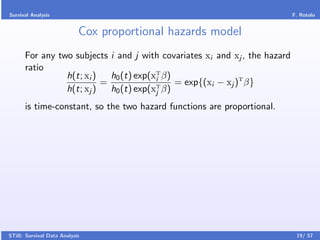
      For any two subjects i and j with covariates xi and xj , the hazard
      ratio
                h(t; xi )   h0 (t) exp(xT β)
                                        i
                          =                  = exp{(xi − xj )T β}
                h(t; xj )   h0 (t) exp(xT β)
                                        j

      is time-constant, so the two hazard functions are proportional.


STiB: Survival Data Analysis                                                 19/ 57
Survival Analysis                                                           F. Rotolo


                           Cox proportional hazards model
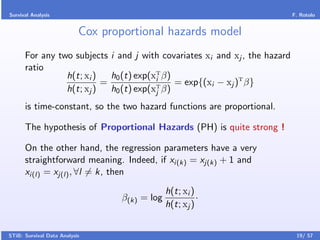
      For any two subjects i and j with covariates xi and xj , the hazard
      ratio
                h(t; xi )   h0 (t) exp(xT β)
                                        i
                          =                  = exp{(xi − xj )T β}
                h(t; xj )   h0 (t) exp(xT β)
                                        j

      is time-constant, so the two hazard functions are proportional.

      The hypothesis of Proportional Hazards (PH) is quite strong !

      On the other hand, the regression parameters have a very
      straightforward meaning. Indeed, if xi(k) = xj(k) + 1 and
      xi(l) = xj(l) , ∀l = k, then
                                               h(t; xi )
                                  β(k) = log             ·
                                               h(t; xj )


STiB: Survival Data Analysis                                                 19/ 57
Survival Analysis                                                                         F. Rotolo


                           Cox proportional hazards model
                                           Semiparametric approach

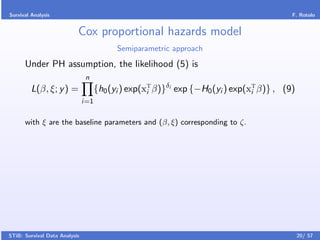
      Under PH assumption, the likelihood (5) is
                                n
         L(β, ξ; y ) =               {h0 (yi ) exp(xT β)}δi exp {−H0 (yi ) exp(xT β)} , (9)
                                                    i                           i
                               i=1


      with ξ are the baseline parameters and (β, ξ) corresponding to ζ.


STiB: Survival Data Analysis                                                                  20/ 57
Survival Analysis                                                                         F. Rotolo


                           Cox proportional hazards model
                                           Semiparametric approach

      Under PH assumption, the likelihood (5) is
                                n
         L(β, ξ; y ) =               {h0 (yi ) exp(xT β)}δi exp {−H0 (yi ) exp(xT β)} , (9)
                                                    i                           i
                               i=1


      with ξ are the baseline parameters and (β, ξ) corresponding to ζ.

      If the interest is in the covariates effect, the baseline hazard can
      be left unspecified and the likelihood can be profiled (Duchateau &
      Janssen, 2008, pg.’s 24–26) reducing to the Partial Likelihood
                                                n
                                                       exp (xT β)
                                                               i        ,
                                      L(β) =                                          (10)
                                                     j∈R(yi ) exp(xT β)
                                                                   j
                                               i=1


      where R(t) = {r |yr ≥ t} is the risk set at t.
STiB: Survival Data Analysis                                                                  20/ 57
Survival Analysis                                                     F. Rotolo


                           Accelerated failure times model
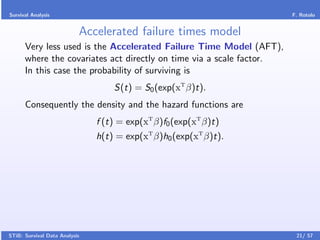
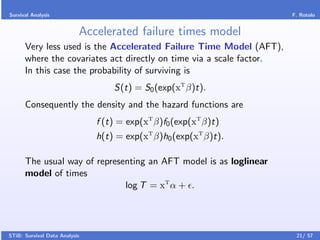
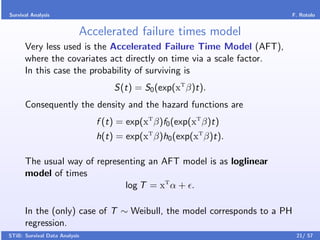
      Very less used is the Accelerated Failure Time Model (AFT),
      where the covariates act directly on time via a scale factor.
      In this case the probability of surviving is
                                 S(t) = S0 (exp(xT β)t).


STiB: Survival Data Analysis                                           21/ 57
Survival Analysis                                                     F. Rotolo


                           Accelerated failure times model
      Very less used is the Accelerated Failure Time Model (AFT),
      where the covariates act directly on time via a scale factor.
      In this case the probability of surviving is
                                   S(t) = S0 (exp(xT β)t).
      Consequently the density and the hazard functions are
                               f (t) = exp(xT β)f0 (exp(xT β)t)
                               h(t) = exp(xT β)h0 (exp(xT β)t).


STiB: Survival Data Analysis                                           21/ 57
Survival Analysis                                                     F. Rotolo


                           Accelerated failure times model
      Very less used is the Accelerated Failure Time Model (AFT),
      where the covariates act directly on time via a scale factor.
      In this case the probability of surviving is
                                   S(t) = S0 (exp(xT β)t).
      Consequently the density and the hazard functions are
                               f (t) = exp(xT β)f0 (exp(xT β)t)
                               h(t) = exp(xT β)h0 (exp(xT β)t).

      The usual way of representing an AFT model is as loglinear
      model of times
                              log T = xT α + .


STiB: Survival Data Analysis                                           21/ 57
Survival Analysis                                                     F. Rotolo


                           Accelerated failure times model
      Very less used is the Accelerated Failure Time Model (AFT),
      where the covariates act directly on time via a scale factor.
      In this case the probability of surviving is
                                   S(t) = S0 (exp(xT β)t).
      Consequently the density and the hazard functions are
                               f (t) = exp(xT β)f0 (exp(xT β)t)
                               h(t) = exp(xT β)h0 (exp(xT β)t).

      The usual way of representing an AFT model is as loglinear
      model of times
                              log T = xT α + .

      In the (only) case of T ∼ Weibull, the model corresponds to a PH
      regression.
STiB: Survival Data Analysis                                             21/ 57
Complications of Survival Models                   F. Rotolo


                                         Outline
      Survival Analysis


      Complications of Survival Models

           Non-proportional hazards

           Informative censoring

           Dependent observations

           Multi-state phenomena

           Competing Risks
                Incidence

                Covariates effect


      References
STiB: Survival Data Analysis                        22/ 57
Complications of Survival Models                                    F. Rotolo


                         Complications of Survival Models


      Most of the methods for Survival Data Analysis rest on some
      hypotheses, notably
          proportional hazards
              uninformative censoring
              independent observations
              one type of unavoidable event


STiB: Survival Data Analysis                                         23/ 57
Complications of Survival Models                                    F. Rotolo


                         Complications of Survival Models


      Most of the methods for Survival Data Analysis rest on some
      hypotheses, notably
          proportional hazards
              uninformative censoring
              independent observations
              one type of unavoidable event

          How to test for these assumptions?

          How to handle data not satisfying these assumptions?


STiB: Survival Data Analysis                                         23/ 57
Complications of Survival Models                                    F. Rotolo


                         Complications of Survival Models


      Most of the methods for Survival Data Analysis rest on some
      hypotheses, notably
          proportional hazards
              uninformative censoring
              independent observations
              one type of unavoidable event

          How to test for these assumptions?

          How to handle data not satisfying these assumptions?


STiB: Survival Data Analysis                                         23/ 57
Complications of Survival Models                                     F. Rotolo


                                   Non-proportional hazards
      Despite most of the survival methods are based on the cox model,
      there might happen that hazards are not proportional.


STiB: Survival Data Analysis                                             24/ 57
Complications of Survival Models                                       F. Rotolo


                                   Non-proportional hazards
      Despite most of the survival methods are based on the cox model,
      there might happen that hazards are not proportional.

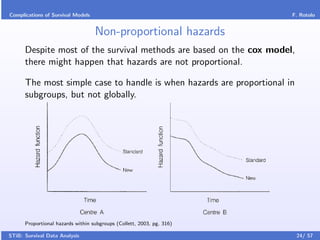
      The most simple case to handle is when hazards are proportional in
      subgroups, but not globally.


STiB: Survival Data Analysis                                               24/ 57
Complications of Survival Models                                       F. Rotolo


                                   Non-proportional hazards
      Despite most of the survival methods are based on the cox model,
      there might happen that hazards are not proportional.

      The most simple case to handle is when hazards are proportional in
      subgroups, but not globally.


      Proportional hazards within subgroups (Collett, 2003, pg. 316)

STiB: Survival Data Analysis                                               24/ 57
Complications of Survival Models                                  F. Rotolo


                                   Non-proportional hazards

      The effect of the treatment in the whole population is not
      multiplicative, despite it is so within each centre.


STiB: Survival Data Analysis                                       25/ 57
Complications of Survival Models                                           F. Rotolo


                                   Non-proportional hazards

      The effect of the treatment in the whole population is not
      multiplicative, despite it is so within each centre.

      What can be done is to use a stratified PH model

                                     hij (t) = h0j (t) exp(xT β),
                                                            ij

      where the hazard of patient i from center j is exp(xT β) times the
                                                          ij
      baseline h0j (t) of the stratum (center) at each time point.


STiB: Survival Data Analysis                                                25/ 57
Complications of Survival Models                                           F. Rotolo


                                   Non-proportional hazards

      The effect of the treatment in the whole population is not
      multiplicative, despite it is so within each centre.

      What can be done is to use a stratified PH model

                                     hij (t) = h0j (t) exp(xT β),
                                                            ij

      where the hazard of patient i from center j is exp(xT β) times the
                                                          ij
      baseline h0j (t) of the stratum (center) at each time point.

      Since different baselines are taken into account, the covariates
      effect is multiplicative and it can be estimated thanks to usual
      methods for PH cox models.


STiB: Survival Data Analysis                                                25/ 57
Complications of Survival Models                                    F. Rotolo


                                   Non-proportional hazards
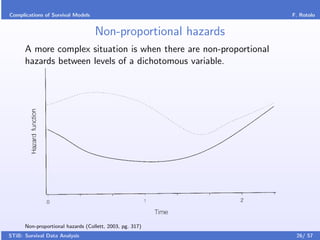
      A more complex situation is when there are non-proportional
      hazards between levels of a dichotomous variable.


      Non-proportional hazards (Collett, 2003, pg. 317)
STiB: Survival Data Analysis                                         26/ 57
Complications of Survival Models                                         F. Rotolo


                                   Non-proportional hazards
      A more complex situation is when there are non-proportional
      hazards between levels of a dichotomous variable.


      Non-proportional hazards modelled as PH (Collett, 2003, pg. 317)
STiB: Survival Data Analysis                                              26/ 57
Complications of Survival Models                                               F. Rotolo


                                   Non-proportional hazards
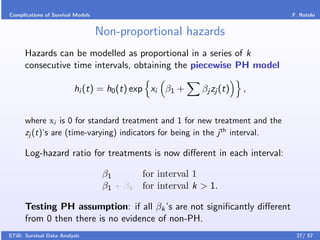
      Hazards can be modelled as proportional in a series of k
      consecutive time intervals, obtaining the piecewise PH model
                                                          
                                               k            
                 hi (t) = h0 (t) exp xi β1 +      βj zj (t) ,
                                                            
                                                    j=2


      where xi is 0 for standard treatment and 1 for new treatment and the
      zj (t)’s are (time-varying) indicators for being in the j th interval.


STiB: Survival Data Analysis                                                    27/ 57
Complications of Survival Models                                               F. Rotolo


                                   Non-proportional hazards
      Hazards can be modelled as proportional in a series of k
      consecutive time intervals, obtaining the piecewise PH model
                                                          
                                               k            
                 hi (t) = h0 (t) exp xi β1 +      βj zj (t) ,
                                                            
                                                         j=2


      where xi is 0 for standard treatment and 1 for new treatment and the
      zj (t)’s are (time-varying) indicators for being in the j th interval.

      Log-hazard ratio for treatments is now different in each interval:
                                    β1        for interval 1
                                    β1 + βk   for interval k > 1.


STiB: Survival Data Analysis                                                    27/ 57
Complications of Survival Models                                               F. Rotolo


                                   Non-proportional hazards
      Hazards can be modelled as proportional in a series of k
      consecutive time intervals, obtaining the piecewise PH model

                         hi (t) = h0 (t) exp xi β1 +         βj zj (t)   ,


      where xi is 0 for standard treatment and 1 for new treatment and the
      zj (t)’s are (time-varying) indicators for being in the j th interval.

      Log-hazard ratio for treatments is now different in each interval:

                                    β1        for interval 1
                                    β1 + βk   for interval k > 1.

      Testing PH assumption: if all βk ’s are not significantly different
      from 0 then there is no evidence of non-PH.
STiB: Survival Data Analysis                                                    27/ 57
Complications of Survival Models                                    F. Rotolo


                         Complications of Survival Models


      Most of the methods for Survival Data Analysis rest on some
      hypotheses, notably
          proportional hazards
              uninformative censoring
              independent observations
              one type of unavoidable event

          How to test for these assumptions?

          How to handle data not satisfying these assumptions?


STiB: Survival Data Analysis                                         28/ 57
Complications of Survival Models                                   F. Rotolo


                                   Informative censoring


      Most of the survival analysis methods are only valid under
      independent censoring hypothesis:

                                          Ci ⊥ Ti .
                                             ⊥


STiB: Survival Data Analysis                                        29/ 57
Complications of Survival Models                                        F. Rotolo


                                   Informative censoring


      Most of the survival analysis methods are only valid under
      independent censoring hypothesis:

                                          Ci ⊥ Ti .
                                             ⊥

      For censoring due to end of the study, independence is reasonable.
      For censoring due to loss to follow-up or competing risk it is much
      more questionable.


STiB: Survival Data Analysis                                                29/ 57
Complications of Survival Models                                            F. Rotolo


                                   Informative censoring

          Two typical situations        (Putter et al., 2007):


              Healthy participants feel less need for medical services offered
              by the study, and therefore quit.
                → C is negatively correlated with T
                   → Overestimation of event risk


STiB: Survival Data Analysis                                                    30/ 57
Complications of Survival Models                                             F. Rotolo


                                   Informative censoring

          Two typical situations        (Putter et al., 2007):


              Healthy participants feel less need for medical services offered
              by the study, and therefore quit.
                → C is negatively correlated with T
                   → Overestimation of event risk

              Persons with advanced disease progression have become too
              ill for further follow-up or they return to their country to
              spend the last period with their family.
                  → C is positively correlated with T
                     → Underestimation of event risk


STiB: Survival Data Analysis                                                    30/ 57
Complications of Survival Models                                     F. Rotolo


                                   Informative censoring
                                      Empirical evaluation

      An empirical way to check the uninformative censoring assumption
      is to plot observed survival times against each regressor,
      distinguishing censored and event times.


STiB: Survival Data Analysis                                             31/ 57
Complications of Survival Models                                                                                                                     F. Rotolo


                                                       Informative censoring
                                                                         Empirical evaluation

      An empirical way to check the uninformative censoring assumption
      is to plot observed survival times against each regressor,
      distinguishing censored and event times.
                                                       (a)                                                           (b)

                                                            +                                               +

                          +           +        +            +                                                 + + + +
                                                                    ++                                     +
                     50


                                                                                                50
                                                                                                            +
                                                             +                                               +
                                                   +                                                           + +
              Time


                                                                                         Time
                                          +
                     30


                                                                                                30
                                                       +             +                                     + +
                                  +                q                +                                      +       +                   q

                          +    + +q            q   q
                                                                         q
                                                                                                               ++ +
                                                                                                                       q
                                                                                                                                       q q   q
                     10


                                                                q
                                                                                                10                             q

                           + ++ + ++ ++ +                                                                 ++ + + + +
                                                                                                            + + +
                                                   q                                                                                   q
                                                                     q            q                              q         q


                              q       +                 q
                                                        q
                                                                     q
                                                                     q                                      +          q
                                                                                                                           q       q
                                                                                                                                   q             q


                          40              50           60            70         80                   40     50       60            70        80

                                          Age at diagnosis                                                  Age at diagnosis
                                                                             o = censored; + = event
            Example of data not suggesting (a) and suggesting (b) informative censoring
STiB: Survival Data Analysis                                                                                                                          31/ 57
Complications of Survival Models                                         F. Rotolo


                                   Informative censoring
                                   Bounding unobserved event times

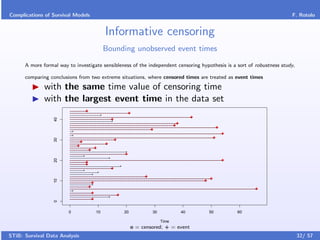
      A more formal way to investigate sensibleness of the independent
      censoring hypothesis is a sort of robustness study, comparing
      conclusions from two extreme situations, where censored times
      are treated as event times

              with the same time value of censoring time
              with the largest event time in the data set


STiB: Survival Data Analysis                                              32/ 57
Complications of Survival Models                                                                                                                                       F. Rotolo


                                                                    Informative censoring
                                                                    Bounding unobserved event times

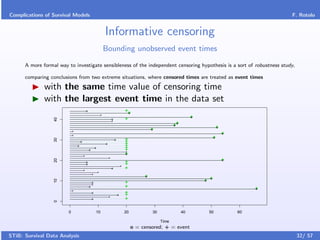
      A more formal way to investigate sensibleness of the independent censoring hypothesis is a sort of robustness study,

      comparing conclusions from two extreme situations, where censored times are treated as event times

              with the same time value of censoring time
              with the largest event time in the data set
                                            o
                                                                                                o
                                                                +
                                                                                                                                      o
                  40


                                                                            o
                                                                            +
                                                                                                                             o
                                                                                                                         o
                                                                                                                                                      o
                                                                                                             o
                            +
                                                                                                                                                          o
                            +
                                                                                                                                                  o
                  30


                                                                                o
                                    o
                                                                    o
                                o
                                                        o
                                                o
                                                                                            +
                                                                                            o
                                        +
                                                                        +
                  20


                                                                                                                                                          o
                                            o
                                            o
                                                                                        +
                                                                            o
                                        +
                                                            +
                                                    +
                                                                                                         o
                                                                                                                                              o
                  10


                                                                                                                                          o
                                                    o
                                                    +
                                                o
                                                                                                                                                                   o
                            +
                                                    o
                                                                                    o
                                                                        +
                                                    o
                  0


                        0                               10                                  20               30                  40           50              60

                                                                                                                  Time
                                                                                                    o = censored; + = event
STiB: Survival Data Analysis                                                                                                                                            32/ 57
Complications of Survival Models                                                                                                                  F. Rotolo


                                                          Informative censoring
                                                          Bounding unobserved event times

      A more formal way to investigate sensibleness of the independent censoring hypothesis is a sort of robustness study,

      comparing conclusions from two extreme situations, where censored times are treated as event times

              with the same time value of censoring time
              with the largest event time in the data set
                                          +
                                          o
                                                                                      +
                                                                                      o
                                                      +
                                                                  +                                                    +
                                                                                                                       o
                  40


                                                                  o
                                                                  +
                                                                                                            ++
                                                                                                              o
                                                                                                            o
                                                                                                +
                                                                                                o                                +
                                                                                                                                 o
                            +
                            +                                                                                                        +
                                                                                                                                     o

                                                                  +                                                          +
                                                                                                                             o
                  30


                                                                      o
                                  +
                                  o
                                                          +
                                                          o
                                +
                                o
                                          ++
                                            o
                                          o
                                                                                  +
                                      +                                           +
                                                                                  o
                                                              +
                                                                                                                                     +
                  20


                                                                                                                                     o
                                          +
                                          o
                                          +
                                          o
                                                                              +
                                      +                           +
                                                                  o
                                                  +
                                              +
                                                                                            +
                                                                                            o
                                                                                                                           ++
                                                                                                                             o
                  10


                                                                                                                           o
                                            +
                                            o
                                            +
                                          +
                                          o
                                                                                                                                              +
                                                                                                                                              o
                            +
                                            +
                                            o
                                                                          +
                                                                          o
                                                              +
                                            +
                                            o
                  0


                        0                         10                              20            30                40        50           60

                                                                                                     Time
                                                                                       o = censored; + = event
STiB: Survival Data Analysis                                                                                                                       32/ 57
Complications of Survival Models                                                                                                                            F. Rotolo


                                                                    Informative censoring
                                                                    Bounding unobserved event times

      A more formal way to investigate sensibleness of the independent censoring hypothesis is a sort of robustness study,

      comparing conclusions from two extreme situations, where censored times are treated as event times

              with the same time value of censoring time
              with the largest event time in the data set
                                            o                                               ++o
                                                                +
                                                                                            +                                    +
                                                                                                                                 o
                  40


                                                                            o
                                                                            +
                                                                                                                      ++
                                                                                                                      o
                                                                                                                        o
                                                                                                                                           +
                                                                                                                                           o
                            +
                                                                                                          +
                                                                                                          o

                            +
                                                                                                                                               +
                                                                                                                                               o

                                                                                            +                                          +
                                                                                                                                       o
                  30


                                                                                o
                                    o
                                                                    o
                                                                                            +
                                                                                            +
                                o
                                                        o
                                                                                            +
                                                                                            +
                                                o                                           +
                                                                                            +
                                        +
                                                                                            +
                                                                                            o
                                                                        +
                                                                                                                                               +
                  20


                                                                                                                                               o
                                            o
                                            o
                                                                                            +
                                                                                            +
                                                                                        +
                                        +
                                                                            o               +
                                                            +
                                                    +
                                                                                                      +
                                                                                                      o
                                                                                                                                     ++o
                  10


                                                                                                                                     o
                                                    o
                                                    +
                                                                                            +
                                                o                                           +                                                           +
                                                                                                                                                        o
                            +
                                                    o
                                                                                    o
                                                                                            +
                                                                                            +
                                                                        +
                                                    o                                       +
                  0


                        0                               10                                  20            30                40        50           60

                                                                                                               Time
                                                                                                 o = censored; + = event
STiB: Survival Data Analysis                                                                                                                                 32/ 57
Complications of Survival Models                                                                                                                                                F. Rotolo


                                   Informative censoring
                                   Bounding unobserved event times

      A more formal way to investigate sensibleness of the independent
      censoring hypothesis is a sort of robustness study, comparing
      conclusions from two extreme situations, where censored times
      are treated as event times

              with the same time value of censoring time
              with the largest event time in the data set
                                                                    o                                               ++o
                                                                                        +
                                                                                                                    +                                +
                                                                                                                                                     o
                                           40


                                                                                                    o
                                                                                                    +
                                                                                                                                          ++
                                                                                                                                          o
                                                                                                                                            o
                                                                                                                                                               +
                                                                                                                                                               o
                                                    +
                                                                                                                              +
                                                                                                                              o

                                                    +
                                                                                                                                                                   +
                                                                                                                                                                   o

                                                                                                                    +                                      +
                                                                                                                                                           o
                                           30


                                                                                                        o
                                                            o
                                                                                            o
                                                                                                                    +
                                                                                                                    +
                                                        o
                                                                                o
                                                                                                                    +
                                                                                                                    +
                                                                        o                                           +
                                                                                                                    +
                                                                +
                                                                                                                    +
                                                                                                                    o
                                                                                                +
                                                                                                                                                                   +
                                           20


                                                                                                                                                                   o
                                                                    o
                                                                    o
                                                                                                                    +
                                                                                                                    +
                                                                                                                +
                                                                +
                                                                                                    o               +
                                                                                    +
                                                                            +
                                                                                                                          +
                                                                                                                          o
                                                                                                                                                         ++o
                                           10


                                                                                                                                                         o
                                                                            o
                                                                            +
                                                                                                                    +
                                                                        o                                           +                                                       +
                                                                                                                                                                            o
                                                    +
                                                                            o
                                                                                                            o
                                                                                                                    +
                                                                                                                    +
                                                                                                +
                                                                            o                                       +
                                           0


                                                0                               10                                  20        30                40        50           60

                                                                                                                                   Time


      If essentially the same conclusions can be drawn from the
      original and these two models, then the censoring times can be
      safely treated as independent of the event times.
STiB: Survival Data Analysis                                                                                                                                                     32/ 57
Complications of Survival Models                                        F. Rotolo


                                   Informative censoring
                                       Logistic regression


      The most formal way of testing independent censoring hypothesis
      is to use a linear logistic model with censoring variable as
      response.


STiB: Survival Data Analysis                                             33/ 57
Complications of Survival Models                                        F. Rotolo


                                   Informative censoring
                                       Logistic regression


      The most formal way of testing independent censoring hypothesis
      is to use a linear logistic model with censoring variable as
      response.

        If any covariate results significant in predicting whether the
      event time is observed or censored, then the independence
      hypothesis is quite unlikely.


STiB: Survival Data Analysis                                             33/ 57
Complications of Survival Models                                        F. Rotolo


                                   Informative censoring
                                       Logistic regression


      The most formal way of testing independent censoring hypothesis
      is to use a linear logistic model with censoring variable as
      response.

        If any covariate results significant in predicting whether the
      event time is observed or censored, then the independence
      hypothesis is quite unlikely.

                                        What to do?


STiB: Survival Data Analysis                                             33/ 57
Complications of Survival Models                                        F. Rotolo


                                   Informative censoring
      Solutions are quite limited and no satisfactory way to overcome
      the problem exists.


STiB: Survival Data Analysis                                             34/ 57
Complications of Survival Models                                                                                                                                     F. Rotolo


                                                                     Informative censoring
      Solutions are quite limited and no satisfactory way to overcome
      the problem exists.

      Censoring all data before the first censored observation makes
      the censoring really independent of event times, but it is little
      useful if this occurs early.
                                             o
                                                                                                 o
                                                                 +
                                                                                                                                    o
                    40


                                                                             o
                                                                             +
                                                                                                                           o
                                                                                                                       o
                                                                                                                                                    o
                                                                                                           o
                             +
                                                                                                                                                        o
                             +
                                                                                                                                                o
                    30


                                                                                 o
                                     o
                                                                     o
                                 q
                                 o
                                                         o
                                                 o
                                                                                             +
                                                                                             o
                                         +
                                                                         +
                    20


                                                                                                                                                        o
                                             o
                                             o
                                                                                         +
                                                                             o
                                         +
                                                             +
                                                     +
                                                                                                       o
                                                                                                                                            o
                    10


                                                                                                                                        o
                                                     o
                                                     +
                                                 o
                                                                                                                                                                 o
                             +
                                                     o
                                                                                     o
                                                                         +
                                                     o
                    0


                         0                               10                                  20            30                  40           50              60

                                                                                                                Time
                                                                                                 o = censored; + = event
STiB: Survival Data Analysis                                                                                                                                          34/ 57
Complications of Survival Models                                                                                                                   F. Rotolo


                                                   Informative censoring
      Solutions are quite limited and no satisfactory way to overcome
      the problem exists.

      Censoring all data before the first censored observation makes
      the censoring really independent of event times, but it is little
      useful if this occurs early.
                                 o   o
                                 o                                             o
                                 o             +
                                 o                                                                                o
                    40


                                 o                         o
                                 o                         +
                                 o                                                                       o
                                 o                                                                   o
                                 o                                                                                                o
                                 o                                                       o
                             +
                                 o                                                                                                    o
                             +
                                 o                                                                                            o
                    30


                                 o                             o
                                 o o
                                 o                 o
                                 q
                                 o
                                 o         o
                                 o     o
                                 o                                         +
                                 o                                         o
                                 o +
                                 o                     +
                    20


                                 o                                                                                                    o
                                 o   o
                                 o   o
                                 o                                     +
                                 o                         o
                                 o +
                                 o           +
                                 o       +
                                 o                                                   o
                                 o                                                                                        o
                    10


                                 o                                                                                    o
                                 o       o
                                 o       +
                                 o     o
                                 o                                                                                                             o
                             +
                                 o       o
                                 o                                 o
                                 o                     +
                                 o       o
                    0


                         0                  10                             20            30                  40           50              60

                                                                                              Time
                                                                               o = censored; + = event
STiB: Survival Data Analysis                                                                                                                        34/ 57
Complications of Survival Models                                    F. Rotolo


                         Complications of Survival Models


      Most of the methods for Survival Data Analysis rest on some
      hypotheses, notably
          proportional hazards
              uninformative censoring
              independent observations
              one type of unavoidable event

          How to test for these assumptions?

          How to handle data not satisfying these assumptions?


STiB: Survival Data Analysis                                         35/ 57
Complications of Survival Models                                         F. Rotolo


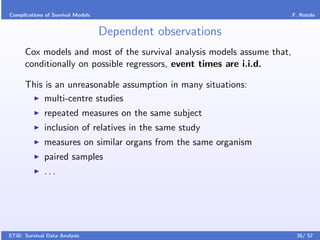
                                   Dependent observations
      Cox models and most of the survival analysis models assume that,
      conditionally on possible regressors, event times are i.i.d.


STiB: Survival Data Analysis                                              36/ 57
Complications of Survival Models                                         F. Rotolo


                                   Dependent observations
      Cox models and most of the survival analysis models assume that,
      conditionally on possible regressors, event times are i.i.d.

      This is an unreasonable assumption in many situations:
           multi-centre studies
              repeated measures on the same subject
              inclusion of relatives in the same study
              measures on similar organs from the same organism
              paired samples
              ...


STiB: Survival Data Analysis                                              36/ 57
Complications of Survival Models                                           F. Rotolo


                                   Dependent observations
      Cox models and most of the survival analysis models assume that,
      conditionally on possible regressors, event times are i.i.d.

      This is an unreasonable assumption in many situations:
           multi-centre studies
              repeated measures on the same subject
              inclusion of relatives in the same study
              measures on similar organs from the same organism
              paired samples
              ...

      If the group effect is of interest, the factor is inserted in the model
      as usual. More often one is only interested in controlling its
      effect in a parsimonious way in term of parameters.
STiB: Survival Data Analysis                                                   36/ 57
Complications of Survival Models                                           F. Rotolo


                                   Dependent observations

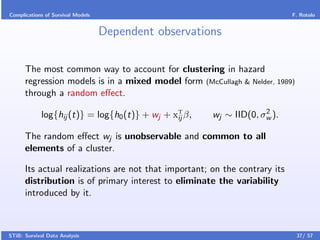
      The most common way to account for clustering in hazard
      regression models is in a mixed model form (McCullagh & Nelder, 1989)
      through a random effect.
                                                                    2
            log{hij (t)} = log{h0 (t)} + wj + xT β,
                                               ij      wj ∼ IID(0, σw ).


STiB: Survival Data Analysis                                                  37/ 57
Complications of Survival Models                                           F. Rotolo


                                   Dependent observations

      The most common way to account for clustering in hazard
      regression models is in a mixed model form (McCullagh & Nelder, 1989)
      through a random effect.
                                                                    2
            log{hij (t)} = log{h0 (t)} + wj + xT β,
                                               ij      wj ∼ IID(0, σw ).

      The random effect wj is unobservable and common to all
      elements of a cluster.


STiB: Survival Data Analysis                                                  37/ 57
Complications of Survival Models                                            F. Rotolo


                                   Dependent observations

      The most common way to account for clustering in hazard
      regression models is in a mixed model form (McCullagh & Nelder, 1989)
      through a random effect.
                                                                    2
            log{hij (t)} = log{h0 (t)} + wj + xT β,
                                               ij      wj ∼ IID(0, σw ).

      The random effect wj is unobservable and common to all
      elements of a cluster.

      Its actual realizations are not that important; on the contrary its
      distribution is of primary interest to eliminate the variability
      introduced by it.


STiB: Survival Data Analysis                                                  37/ 57
Complications of Survival Models                                                           F. Rotolo


                                   Dependent observations

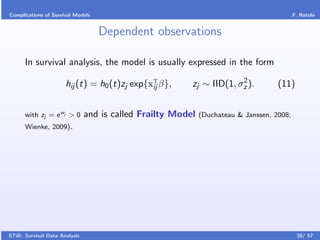
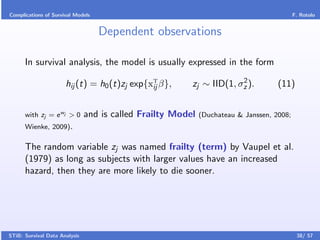
      In survival analysis, the model is usually expressed in the form
                                                                      2
                      hij (t) = h0 (t)zj exp{xT β},
                                              ij         zj ∼ IID(1, σz ).          (11)


      with zj = e wj > 0       and is called Frailty Model   (Duchateau & Janssen, 2008;
      Wienke, 2009).


STiB: Survival Data Analysis                                                                38/ 57
Complications of Survival Models                                                           F. Rotolo


                                   Dependent observations

      In survival analysis, the model is usually expressed in the form
                                                                      2
                      hij (t) = h0 (t)zj exp{xT β},
                                              ij         zj ∼ IID(1, σz ).          (11)


      with zj = e wj > 0       and is called Frailty Model   (Duchateau & Janssen, 2008;
      Wienke, 2009).

      The random variable zj was named frailty (term) by Vaupel et al.
      (1979) as long as subjects with larger values have an increased
      hazard, then they are more likely to die sooner.


STiB: Survival Data Analysis                                                                38/ 57
Complications of Survival Models                                                           F. Rotolo


                                   Dependent observations

      In survival analysis, the model is usually expressed in the form
                                                                      2
                      hij (t) = h0 (t)zj exp{xT β},
                                              ij         zj ∼ IID(1, σz ).          (11)


      with zj = e wj > 0       and is called Frailty Model   (Duchateau & Janssen, 2008;
      Wienke, 2009).

      The random variable zj was named frailty (term) by Vaupel et al.
      (1979) as long as subjects with larger values have an increased
      hazard, then they are more likely to die sooner.

      Note that the frailty is time-constant, so the hazard is increased or
      decreased at any time.


STiB: Survival Data Analysis                                                                38/ 57
Complications of Survival Models                                               F. Rotolo


                                   Dependent observations


      The main consequences of this approach are two:
          Dependence between event times in the same cluster
          Thanks to that Frailty Models can account for dependency!
              Non-proportionality of hazards in general
              Hazards are still proportional conditionally on frailty values


STiB: Survival Data Analysis                                                    39/ 57
Complications of Survival Models                                                   F. Rotolo


                                   Dependent observations


      The main consequences of this approach are two:
          Dependence between event times in the same cluster
          Thanks to that Frailty Models can account for dependency!
              Non-proportionality of hazards in general
              Hazards are still proportional conditionally on frailty values

      Clusters can also have dimension 1, in which case all methods are
      unchanged but their meaning and interpretation are quite
      different. (Univariate frailty models for overdispersion: Wienke, 2009, Chp. 3)


STiB: Survival Data Analysis                                                           39/ 57
Complications of Survival Models                                          F. Rotolo


                                   Dependent observations
      Many distributions can be used to model the frailty term; the most
      common (Duchateau & Janssen, 2008, Chp. 4) are
         Gamma, mathematically the most convenient: analytical
         integration, closed under truncation
              Log-Normal, the most consistent with the GLMM theory:
              the random effects wj are Normal
              Inverse-Gaussian, analytical integration
              Positive-Stable, analytical integration and very flexible:
              extends Gamma, Inverse-Gaussian, Positive-Stable and
              compound-Poisson
              Power-Variance-Function, very flexible: extends Gamma,
              Inverse-Gaussian, Positive-Stable and compound-Poisson.
              Closed under truncation

STiB: Survival Data Analysis                                               40/ 57
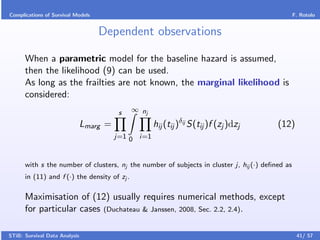
Complications of Survival Models                                           F. Rotolo


                                   Dependent observations

      When a parametric model for the baseline hazard is assumed,
      then the likelihood (9) can be used.
      As long as the frailties are not known, the marginal likelihood is
      considered:


STiB: Survival Data Analysis                                                41/ 57
Complications of Survival Models                                                                 F. Rotolo


                                   Dependent observations

      When a parametric model for the baseline hazard is assumed,
      then the likelihood (9) can be used.
      As long as the frailties are not known, the marginal likelihood is
      considered:
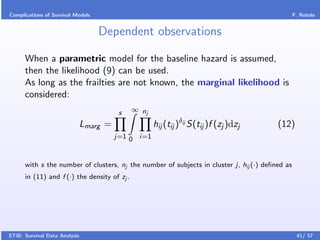
                                          s   ∞ nj

                               Lmarg =               hij (tij )δij S(tij )f (zj )dzj     (12)
                                         j=1 0 i=1


      with s the number of clusters, nj the number of subjects in cluster j, hij (·) defined as
      in (11) and f (·) the density of zj .


STiB: Survival Data Analysis                                                                      41/ 57
Complications of Survival Models                                                                 F. Rotolo


                                   Dependent observations

      When a parametric model for the baseline hazard is assumed,
      then the likelihood (9) can be used.
      As long as the frailties are not known, the marginal likelihood is
      considered:
                                          s   ∞ nj

                               Lmarg =               hij (tij )δij S(tij )f (zj )dzj     (12)
                                         j=1 0 i=1


      with s the number of clusters, nj the number of subjects in cluster j, hij (·) defined as
      in (11) and f (·) the density of zj .

      Maximisation of (12) usually requires numerical methods, except
      for particular cases (Duchateau & Janssen, 2008, Sec. 2.2, 2.4).

STiB: Survival Data Analysis                                                                      41/ 57
Complications of Survival Models                                          F. Rotolo


                                   Dependent observations


      Note: βk are coefficients of the conditional PH hazard model

                                             ⇓

      βk has to be interpreted as a log-hazard ratio conditionally on the
      frailty value, i.e. as a log-hazard ratio between two subjects in the
      same cluster.


STiB: Survival Data Analysis                                                  42/ 57
Complications of Survival Models                                    F. Rotolo


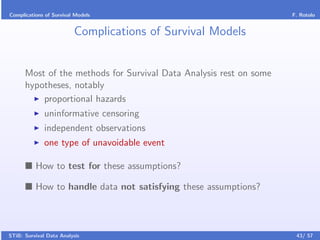
                         Complications of Survival Models


      Most of the methods for Survival Data Analysis rest on some
      hypotheses, notably
          proportional hazards
              uninformative censoring
              independent observations
              one type of unavoidable event

          How to test for these assumptions?

          How to handle data not satisfying these assumptions?


STiB: Survival Data Analysis                                         43/ 57
Complications of Survival Models                                       F. Rotolo


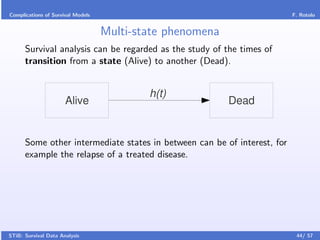
                                   Multi-state phenomena
      Survival analysis can be regarded as the study of the times of
      transition from a state (Alive) to another (Dead).


                                           h(t)
                      Alive                                Dead


STiB: Survival Data Analysis                                            44/ 57
Complications of Survival Models                                          F. Rotolo


                                   Multi-state phenomena
      Survival analysis can be regarded as the study of the times of
      transition from a state (Alive) to another (Dead).


                                           h(t)
                      Alive                                Dead


      Some other intermediate states in between can be of interest, for
      example the relapse of a treated disease.


STiB: Survival Data Analysis                                               44/ 57
Complications of Survival Models                                           F. Rotolo


                                   Multi-state phenomena
      Survival analysis can be regarded as the study of the times of
      transition from a state (Alive) to another (Dead).
      Some other intermediate states in between can be of interest, for
      example the relapse of a treated disease.

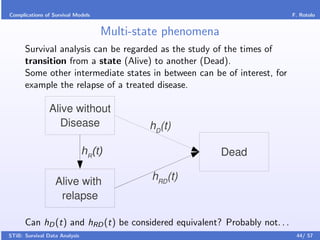
                Alive without
                   Disease                 hD(t)

                               hR(t)                       Dead

                  Alive with                hRD(t)
                   relapse

      Can hD (t) and hRD (t) be considered equivalent? Probably not. . .
STiB: Survival Data Analysis                                                44/ 57
Complications of Survival Models                                    F. Rotolo


                                   Multi-state phenomena
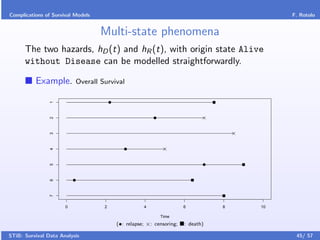
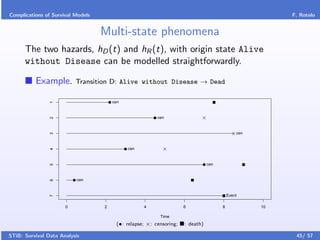
      The two hazards, hD (t) and hR (t), with origin state Alive
      without Disease can be modelled straightforwardly.


STiB: Survival Data Analysis                                         45/ 57
Complications of Survival Models                                                            F. Rotolo


                                   Multi-state phenomena
      The two hazards, hD (t) and hR (t), with origin state Alive
      without Disease can be modelled straightforwardly.

          Example.        Overall Survival

                                       q
                1


                                                          q
                2
                3


                                              q
                4


                                                                               q
                5


                          q
                6
                7


                      0            2                  4                 6          8   10

                                                              Time
                                           (•: relapse; ×: censoring;   : death)

STiB: Survival Data Analysis                                                                 45/ 57
Complications of Survival Models                                                                         F. Rotolo


                                   Multi-state phenomena
      The two hazards, hD (t) and hR (t), with origin state Alive
      without Disease can be modelled straightforwardly.

          Example.         Transition D: Alive without Disease → Dead

                                       q cen
                1


                                                           q cen
                2


                                                                                              cen
                3


                                               q cen
                4


                                                                              q cen
                5


                          q cen
                6


                                                                                          Event
                7


                      0            2                   4               6              8             10

                                                              Time
                                          (•: relapse; ×: censoring;   : death)

STiB: Survival Data Analysis                                                                              45/ 57
Complications of Survival Models                                                                                  F. Rotolo


                                    Multi-state phenomena
      The two hazards, hD (t) and hR (t), with origin state Alive
      without Disease can be modelled straightforwardly.

          Example.         Transition R: Alive without Disease → Alive with relapse

                                        q Event
                1


                                                                q Event
                2


                                                                                                      cens
                3


                                                  q Event
                4


                                                                                 q Event
                5


                          q Event
                6


                                                                                               cens
                7


                      0             2                       4             6                8                 10

                                                                   Time
                                            (•: relapse; ×: censoring;    : death)

STiB: Survival Data Analysis                                                                                       45/ 57
Complications of Survival Models                                                                                  F. Rotolo


                                   Multi-state phenomena
      The hazard hRD (t) requires considering life histories as truncated
      at the time of relapse, from which subjects begin being at risk.

          Example.           Transition RD: Alive with relapse → Dead

                                         q                                                   Event
                1


                                                            q                         cens
                2


                          cens
                3


                                                q                  cens
                4


                                                                                 q                   Event
                5


                           q                                                  Event
                6


                          cens
                7


                      0              2                  4                 6                     8            10

                                                                Time
                                             (•: relapse; ×: censoring;   : death)

STiB: Survival Data Analysis                                                                                       45/ 57
Complications of Survival Models                                   F. Rotolo


                                   Competing Risks

      A particular and common case of informative censoring is that
      due to the presence of competing risks (CRs) which have common
      causes with the event of interest.


STiB: Survival Data Analysis                                           46/ 57
Complications of Survival Models                                            F. Rotolo


                                   Competing Risks

      A particular and common case of informative censoring is that
      due to the presence of competing risks (CRs) which have common
      causes with the event of interest.

         Example. Consider patients after surgical excision of cancer.
      Interest is in distant metastasis (DM):
           can local recurrence (LR) be considered as non-informative
           censoring? Probably not!
              what would be the effect of reducing LR hazard, e.g. by
              radiotherapy? Probably it would increase DM incidence, even
              if its hazard is unchanged!


STiB: Survival Data Analysis                                                 46/ 57
Complications of Survival Models                                              F. Rotolo


                                   Competing Risks

      Depending on the endpoint of the study, two possible approaches
      (Pintilie, 2006) are possible:


              Considering different hazards simultaneously, taking into
              account the interactions between causes of failure
              → the aim is to model the incidence of each type of event,
              given the competition of the other events
              Considering each cause of failure independently of all the
              others, as if they didn’t exist
              → the aim is to get an insight into the biological process by
              modelling the pure effect of covariates on each hazard


STiB: Survival Data Analysis                                                   47/ 57
Complications of Survival Models                                                           F. Rotolo


                                      Competing Risks
                                             Incidence
      In order to account for CRs, Prentice et al. (1978) extended the
      definition of hazard (2), defining the cause-specific (C–S) hazard

                                 P(t ≤ T < t + ∆t, K = i|T ≥ t)   fi (t) ,
           hi (t) = lim                                         =                       (13)
                        ∆t     0              ∆t                  S(t)

      for i ∈ {1, . . . I }, with I the number of CRs and K the event type indicator.


STiB: Survival Data Analysis                                                                   48/ 57
Complications of Survival Models                                                           F. Rotolo


                                      Competing Risks
                                             Incidence
      In order to account for CRs, Prentice et al. (1978) extended the
      definition of hazard (2), defining the cause-specific (C–S) hazard

                                 P(t ≤ T < t + ∆t, K = i|T ≥ t)   fi (t) ,
           hi (t) = lim                                         =                       (13)
                        ∆t     0              ∆t                  S(t)

      for i ∈ {1, . . . I }, with I the number of CRs and K the event type indicator.

      The corresponding unconditional probability functions is

                                        fi (t) = hi (t)S(t)

      and is called subdensity function.

      Note: this is not a density since            R+ fi (t)dt   < 1.
STiB: Survival Data Analysis                                                                   48/ 57
Complications of Survival Models                                               F. Rotolo


                                           Competing Risks
                                                Incidence
      The corresponding subdistribution function is
                                       t
                        Fi (t) =           hi (u)S(u)du = P(T ≤ t, K = i)   (14)
                                   0

      also named cumulative incidence function (CIF).


STiB: Survival Data Analysis                                                       49/ 57
Complications of Survival Models                                                                F. Rotolo


                                                    Competing Risks
                                                             Incidence
      The corresponding subdistribution function is
                                                t
                        Fi (t) =                    hi (u)S(u)du = P(T ≤ t, K = i)           (14)
                                            0

      also named cumulative incidence function (CIF).

          Note that                                      ∞
                               Fi (∞) =                      fi (u)du = P(K = i) < 1
                                                     0

      and that
                          Fi (t) + Si (t) = P(K = i) < 1                      ∀t ≥ 0,

                                    t
      with Si (t) = exp{−          0    hi (u)du} the C–S survival function (see (3)–(4)).

STiB: Survival Data Analysis                                                                        49/ 57
Complications of Survival Models                                            F. Rotolo


                                     Competing Risks
                                               Incidence


      The expression (14) of the CIF
                                                    t
                                    Fi (t) =            hi (u)S(u)du
                                                0

      clearly shows that the incidence of failure from a given cause i
      depends not only on its C-S hazard hi (t), but also (inversely) on
      other causes’ hazards through
                                                    
                                                           I
                                   S(t) = exp −                Hj (t) .
                                                          j=1


STiB: Survival Data Analysis                                                 50/ 57
Complications of Survival Models                                                                    F. Rotolo


                                           Competing Risks
                                                  Incidence


          Example. The expression of the CIF for DM is
                                       t                 u                   u
                  FDM (t) =                hDM (u)e −   0    hLR (v )dv −
                                                                     e      0    hDM (v )dv
                                                                                              du.
                                   0

      Theerefore if, for instance, the C-S hazard of LR is increased of
      25%, then the incidence of DM will be reduced by a factor of
      e −0.25HLR (v ) .


STiB: Survival Data Analysis                                                                         51/ 57
Complications of Survival Models                                                            F. Rotolo


                                    Competing Risks
                                              Incidence
      MLE for the C-S hazard at the observed time tj is
                                       ˆ
                                       hi (tj ) = dij /nj ,
      with dij the number of events of type i at time tj and nj the number of subjects at
      risk at time tj (Marubini & Valsecchi, 2004, pg. 338).

      MLE for the total survival function S(t) are simply provided by
      K–M estimator (6).

      Thus, the MLE for the CIF          (Kalbfleisch, 1980, pg. 168)   results
                                   ˆ                    ˆ      dij
                                   Fi (t) =             SKM (t) ,
                                                               nj
                                              j|tj ≤t

      and its variance can be computed, as usual, via Greenwood’s
      formula (Greenwood, 1926).
STiB: Survival Data Analysis                                                                 52/ 57
Complications of Survival Models                                                  F. Rotolo


                                      Competing Risks
                                          Covariates effect
      The effect of covariates x can be accounted for by a regression
      model, usually a cox model of the C-S hazard

                       hi (t; x) = h0i (t) exp (xT βi ) ,    i ∈ {1, . . . I }.

      Both the baseline hazard h0i (t) and the coefficients βi are specific
      of each type of event.
      The model is fitted considering CR events as censored
      observations, then the βi coefficients must be interpreted as
      “pure” effects, as if no other risk existed.

      On the contrary, the covariate vector is the same: this is a
      recommendable practice because a covariate which is significant for
      an event is likely to influence also the others, even if it does not
      result significant.
STiB: Survival Data Analysis                                                       53/ 57
References                                                             F. Rotolo


                               References I

      Aalen, O. (1976). Nonparametric inference in connection with
       multiple decrement models. Scandinavian Journal of Statistics
       3, 15–27.
      Collett, D. (2003). Modelling survival data in medical research.
       CRC press.
      Cox, D. R. (1972). Regression models and life-tables. Journal of
       the Royal Statistical Society. Series B (Methodological) 34,
       187–220.
      Duchateau, L. & Janssen, P. (2008). The frailty model.
       Springer.
      Fleming, T. R. & Harrington, D. P. (1991). Counting
        processes and survival analysis, vol. 8. Wiley New York.

STiB: Survival Data Analysis                                             54/ 57
References                                                             F. Rotolo


                               References II
      Greenwood, M. (1926). The natural duration of cancer.
       Reports on public health and medical subjects 33, 1–26.
      Hougaard, P. (1999). Fundamentals of survival data.
       Biometrics 55, 13–22.
      Hougaard, P. (2000). Analysis of multivariate survival data.
       Springer Verlag.
      Kalbfleisch, J. D. (1980). The statistical analysis of failure
       time data, vol. 5. IEEE.
      Kaplan, E. L. & Meier, P. (1958). Nonparametric estimation
       from incomplete observations. Journal of the American
       statistical association 53, 457–481.
      Marubini, E. & Valsecchi, M. G. (2004). Analysing survival
       data from clinical trials and observational studies.
       Wiley-Interscience.

STiB: Survival Data Analysis                                            55/ 57
References                                                              F. Rotolo


                               References III
      McCullagh, P. & Nelder, J. A. (1989). Generalized linear
       models. Chapman & Hall/CRC.
      Meier, P. (1975). Estimation of a distribution function from
       incomplete observations. Perspectives in Probability and
       Statistics , 67–87.
      Nelson, W. (1969). Hazard plotting for incomplete failure data.
       Journal of Quality Technology 1, 27–52.
      Pintilie, M. (2006). Competing risks: a practical perspective.
        Wiley.
      Prentice, R. L., Kalbfleisch, J. D., Peterson, A. V.,
       Flournoy, N., Farewell, V. T. & Breslow, N. E.
       (1978). The analysis of failure times in the presence of
       competing risks. Biometrics 34, 541–554.


STiB: Survival Data Analysis                                             56/ 57
References                                                              F. Rotolo


                               References IV


      Putter, H., Fiocco, M. & Geskus, R. B. (2007). Tutorial in
       biostatistics: competing risks and multi-state models. Stat Med
       26, 2389–430.
      Vaupel, J. W., Manton, K. G. & Stallard, E. (1979).
        The impact of heterogeneity in individual frailty on the dynamics
        of mortality. Demography 16, 439–454.
      Wienke, A. (2009). Frailty Models in Survival Analysis.
       Chapman & Hall/CRC biostatistics series. Taylor and Francis.


STiB: Survival Data Analysis                                                57/ 57

Introduction To Survival Analysis

  • 1.
    Special Topics inBiostatistics An Introduction to Survival Data Analysis Federico Rotolo federico.rotolo@stat.unipd.it — federico.rotolo@uclouvain.be Visiting PhD student at PhD student at Dipartmento di Scienze Statistiche Institut de Statistique, Biostatistique et Sciences Actuarielles Universit` degli Studi di Padova a Universit´ Catholique de Louvain e March 30, 2011
  • 2.
    F. Rotolo Survival Analysis Outline An example Peculiarities of Survival Data Notation and Basic Functions Survival Likelihood Parametric models Non-Parametric models Regression Complications of Survival Models Non-proportional hazards Informative censoring Dependent observations Multi-state phenomena Competing Risks References STiB: Survival Data Analysis 2/ 57
  • 3.
    Survival Analysis F. Rotolo Survival Analysis What is Survival Analysis? The field of statistics providing tools for handling duration data, i.e. continuous and positive numerical variables measuring the time from an origin event until the occurrence of an event of interest. STiB: Survival Data Analysis 3/ 57
  • 4.
    Survival Analysis F. Rotolo Survival Analysis What is Survival Analysis? The field of statistics providing tools for handling duration data, i.e. continuous and positive numerical variables measuring the time from an origin event until the occurrence of an event of interest. Why “Survival” Analysis? First works on this topic originated from the problem of studying death times, that is times from birth to death. STiB: Survival Data Analysis 3/ 57
  • 5.
    Survival Analysis F. Rotolo Survival Analysis What is Survival Analysis? The field of statistics providing tools for handling duration data, i.e. continuous and positive numerical variables measuring the time from an origin event until the occurrence of an event of interest. Why “Survival” Analysis? First works on this topic originated from the problem of studying death times, that is times from birth to death. Many ad-hoc statistical tools have been developed for survival data (Cox model, Kaplan–Meier estimator, Mantel–Haenszel test, etc.) and research interest in such problems has been increasing. Why is Survival Data Analysis so peculiar? STiB: Survival Data Analysis 3/ 57
  • 6.
    Survival Analysis F. Rotolo An example An example Consider a clinical trial with patients undergone tumour surgical removal. STiB: Survival Data Analysis 4/ 57
  • 7.
    Survival Analysis F. Rotolo An example An example Consider a clinical trial with patients undergone tumour surgical removal. One can be interested in M: the level of a tumor marker after 6 months T : the time until recurrence of the disease In both cases the measured variable is continuous numerical and positive, so there is no apparent difference. STiB: Survival Data Analysis 4/ 57
  • 8.
    Survival Analysis F. Rotolo An example Actually, other situations can perturb the experiment before the variable of interest is observed: the patient dies, gives up the study, migrates, another disease occurs, the study ends, etc. . . STiB: Survival Data Analysis 5/ 57
  • 9.
    Survival Analysis F. Rotolo An example Actually, other situations can perturb the experiment before the variable of interest is observed: the patient dies, gives up the study, migrates, another disease occurs, the study ends, etc. . . In such cases M is missing T is missing and we know that T > s, with s the time of the “disturbing event” STiB: Survival Data Analysis 5/ 57
  • 10.
    Survival Analysis F. Rotolo Peculiarities of Survival Data Censoring Then the most particular feature of survival data is censoring. STiB: Survival Data Analysis 6/ 57
  • 11.
    Survival Analysis F. Rotolo Peculiarities of Survival Data Censoring Then the most particular feature of survival data is censoring. Right censoring (T > t) is very frequent and often unavoidable; all survival methods account for it. Interval censoring (T ∈ (l, r ]) is very frequent, too, but much more ignored in usual practice. Left censoring (T ≤ t) is very infrequent. STiB: Survival Data Analysis 6/ 57
  • 12.
    Survival Analysis F. Rotolo Peculiarities of Survival Data Censoring Then the most particular feature of survival data is censoring. Right censoring (T > t) is very frequent and often unavoidable; all survival methods account for it. Interval censoring (T ∈ (l, r ]) is very frequent, too, but much more ignored in usual practice. Left censoring (T ≤ t) is very infrequent. Left truncation is a different concept, concerning the selection bias introduced by including in the study only subjects having a survival time greater than a certain value, say t ∗ ; then we do not observe T but T = T |T > t ∗ . STiB: Survival Data Analysis 6/ 57
  • 13.
    Survival Analysis F. Rotolo Peculiarities of Survival Data Conditioning The second important feature of survival data is the concept of conditioning, even more important than censoring according to some authors (Hougaard, 2000). STiB: Survival Data Analysis 7/ 57
  • 14.
    Survival Analysis F. Rotolo Peculiarities of Survival Data Conditioning The second important feature of survival data is the concept of conditioning, even more important than censoring according to some authors (Hougaard, 2000). As time passes, new information is available, not only for subjects dying, but also for those surviving. STiB: Survival Data Analysis 7/ 57
  • 15.
    Survival Analysis F. Rotolo Peculiarities of Survival Data Conditioning The second important feature of survival data is the concept of conditioning, even more important than censoring according to some authors (Hougaard, 2000). As time passes, new information is available, not only for subjects dying, but also for those surviving. In this case it is useful to consider, rather than the density f (t) of T , its hazard function f (t) h(t) = · 1 − F (t) STiB: Survival Data Analysis 7/ 57
  • 16.
    Survival Analysis F. Rotolo Survival Analysis Notation and Basic Functions Consider the event time variable T with distribution F (t) and density f (t) = dF (t)/dt. The survival function is defined as S(t) = P(T > t) = 1 − F (t). (1) STiB: Survival Data Analysis 8/ 57
  • 17.
    Survival Analysis F. Rotolo Survival Analysis Notation and Basic Functions Consider the event time variable T with distribution F (t) and density f (t) = dF (t)/dt. The survival function is defined as S(t) = P(T > t) = 1 − F (t). (1) Then, the hazard function is P(t ≤ T < t + ∆t|T ≥ t) f (t) h(t) = lim = · (2) ∆t 0 ∆t S(t) If the censoring time C is independent of the event time T , then h(t) coincides with the Crude Hazard Function (Fleming & Harrington, 1991, Theorem 1.3.1) P(t ≤ T < t + ∆t|T ≥ t, C ≥ t) h# (t) = lim · ∆t 0 ∆t STiB: Survival Data Analysis 8/ 57
  • 18.
    Survival Analysis F. Rotolo Survival Analysis Notation and Basic Functions The cumulative hazard functions is defined as t H(t) = h(u)du. (3) 0 STiB: Survival Data Analysis 9/ 57
  • 19.
    Survival Analysis F. Rotolo Survival Analysis Notation and Basic Functions The cumulative hazard functions is defined as t H(t) = h(u)du. (3) 0 Since f (t) = −dS(t)/dt, then S(t) = e −H(t) (4) or, equivalently, d h(t) = − log{S(t)}. dt STiB: Survival Data Analysis 9/ 57
  • 20.
    Survival Analysis F. Rotolo Hazard and Conditioning The hazard function already contains conditioning. Then, it is particularly advantageous in a survival context, as shown by Hougaard (1999) in the following table. In truncated In full distribution Quantity distribution given survival to time v Survival function S(t) S(t)/S(v ) Density f (t) f (t)/S(v ) Hazard function h(t) h(t) Conditioning corresponds to considering only actually possible events, accounting for the past being fixed and known. STiB: Survival Data Analysis 10/ 57
  • 21.
    Survival Analysis F. Rotolo Survival Likelihood Since right censoring is almost unavoidable, the observable variable is not the time T , but Y = min(T , C ) (Y , δ), , δ = I(T ≤C ) with C ∼ G (·) the censoring time variable and IA the indicator variable on the set A. STiB: Survival Data Analysis 11/ 57
  • 22.
    Survival Analysis F. Rotolo Survival Likelihood Since right censoring is almost unavoidable, the observable variable is not the time T , but Y = min(T , C ) (Y , δ), , δ = I(T ≤C ) with C ∼ G (·) the censoring time variable and IA the indicator variable on the set A. What we are interested in is inference on the survival distribution and its parameters, the vector ζ. STiB: Survival Data Analysis 11/ 57
  • 23.
    Survival Analysis F. Rotolo Survival Likelihood Since right censoring is almost unavoidable, the observable variable is not the time T , but Y = min(T , C ) (Y , δ), , δ = I(T ≤C ) with C ∼ G (·) the censoring time variable and IA the indicator variable on the set A. What we are interested in is inference on the survival distribution and its parameters, the vector ζ. What is the survival likelihood L(ζ; y )? STiB: Survival Data Analysis 11/ 57
  • 24.
    Survival Analysis F. Rotolo Survival Likelihood The contribution of an event time yi to the likelihood is T⊥ ⊥C L(ζ; yi ) = (1 − G (yi ))f (yi ) ∝ f (yi ) = h(yi )S(yi ). The contribution of a right-censor time yi is T⊥ ⊥C L(ζ; yi ) = g (yi )(1 − F (yi )) ∝ (1 − F (yi )) = S(yi ). Under i.i.d. sampling of size n with T ⊥ C , the total likelihood is ⊥ n L(ζ; y ) = {h(yi )}δi S(yi ). (5) i=1 STiB: Survival Data Analysis 12/ 57
  • 25.
    Survival Analysis F. Rotolo Parametric models A parametric form can be assumed for the hazard function and its parameters can be estimated via maximization of the likelihood (5). The most common models are: Exponential, with constant hazard h(t) = λ > 0 Weibull, with monotone hazard h(t) = λρt ρ−1 , (λ > 0, ρ > 0) Gompertz, with monotone hazard h(t) = λ exp(γt) (λ > 0, γ ∈ R) and a fraction (e λ/γ ) of long-term survivors if γ<0 Piecewise Constant over m intervals with fixed end points {xq }, and hazard h(t) = m λq I(xq−1<t≤xq ) q=1 STiB: Survival Data Analysis 13/ 57
  • 26.
    Survival Analysis F. Rotolo Parametric models Comparison of parametric models (Hougaard, 2000, Table 2.6) Property Exponential Weibull Gompertz Piecewise constant Increasing hazard possible No Yes Yes Yes Continuous hazard Yes Yes Yes No Estimate monotone (Constant) Yes Yes No Non-zero initial hazard Yes No Yes Yes Minimum stable Yes Yes No No Explicit estimation Yes No No Yes Needs choice of intervals No No No Yes No. of parameters 1 2 2 m Dim. of suff.stat. Complete data 1 n n 2m − 1 Censored data 2 2n 2n 2m n = number of observations; m + 1 = number of intervals in the piecewise constant model STiB: Survival Data Analysis 14/ 57
  • 27.
    Survival Analysis F. Rotolo Non-Parametric models Non-parametric methods require no assumption on the form of survival function. In general, the most common NP estimator is the empirical ˆ distribution function F (t), but censoring prevents its use. STiB: Survival Data Analysis 15/ 57
  • 28.
    Survival Analysis F. Rotolo Non-Parametric models Non-parametric methods require no assumption on the form of survival function. In general, the most common NP estimator is the empirical ˆ distribution function F (t), but censoring prevents its use. Two methods are very widely used: ˆ the Kaplan–Meier estimator SKM (t) of the Survival function ˆ the Nelson–Aalen estimator HNA (t) of the Cumulative Hazard ˆ ˆ Note that SKM (t) = exp{−HNA (t)}. STiB: Survival Data Analysis 15/ 57
  • 29.
    Survival Analysis F. Rotolo Kaplan–Meier estimator The Kaplan–Meier Product Limit estimator (Kaplan & Meier, 1958) of the Survival Function is ˆ Ni , SKM (t) = 1− (6) Ri i|ti ≤t with {ti }i the observed event times, Ni the number of events at time ti and Ri the number of survivors at time ti . STiB: Survival Data Analysis 16/ 57
  • 30.
    Survival Analysis F. Rotolo Kaplan–Meier estimator The Kaplan–Meier Product Limit estimator (Kaplan & Meier, 1958) of the Survival Function is ˆ Ni , SKM (t) = 1− (6) Ri i|ti ≤t with {ti }i the observed event times, Ni the number of events at time ti and Ri the number of survivors at time ti . Its variance can be evaluated by the Greenwood’s formula (Greenwood, 1926; Meier, 1975): ˆ ˆ Ni V SKM (t) = [SKM (t)]2 · Ri (Ri − Ni ) i|ti ≤t STiB: Survival Data Analysis 16/ 57
  • 31.
    Survival Analysis F. Rotolo Nelson–Aalen estimator Nelson (1969); Aalen (1976) The Nelson–Aalen estimator of the cumulative hazard function is ˆ Ni , HNA (t) = (7) Ri i|ti ≤t with {ti }i the observed event times, Ni the number of events at time ti and Ri the number of survivors at time ti . STiB: Survival Data Analysis 17/ 57
  • 32.
    Survival Analysis F. Rotolo Nelson–Aalen estimator Nelson (1969); Aalen (1976) The Nelson–Aalen estimator of the cumulative hazard function is ˆ Ni , HNA (t) = (7) Ri i|ti ≤t with {ti }i the observed event times, Ni the number of events at time ti and Ri the number of survivors at time ti . Its variance evaluated by the Greenwood’s formula is ˆ Ni V HNA (t) = · Ri2 i|ti ≤t STiB: Survival Data Analysis 17/ 57
  • 33.
    Survival Analysis F. Rotolo Cox proportional hazards model The most common and popular model in survival analysis is by far the Cox Regression Model (Cox, 1972). STiB: Survival Data Analysis 18/ 57
  • 34.
    Survival Analysis F. Rotolo Cox proportional hazards model The most common and popular model in survival analysis is by far the Cox Regression Model (Cox, 1972). For a subject with covariates vector x, the hazard is expressed as Tβ h(t; x) = h0 (t)e x , (8) with β the linear regression parameters vector and h0 (t) the so-called baseline hazard function, corresponding to the hazard of a (hypothetical) reference subject with x = (0, . . . 0). STiB: Survival Data Analysis 18/ 57
  • 35.
    Survival Analysis F. Rotolo Cox proportional hazards model For any two subjects i and j with covariates xi and xj , the hazard ratio h(t; xi ) h0 (t) exp(xT β) i = = exp{(xi − xj )T β} h(t; xj ) h0 (t) exp(xT β) j is time-constant, so the two hazard functions are proportional. STiB: Survival Data Analysis 19/ 57
  • 36.
    Survival Analysis F. Rotolo Cox proportional hazards model For any two subjects i and j with covariates xi and xj , the hazard ratio h(t; xi ) h0 (t) exp(xT β) i = = exp{(xi − xj )T β} h(t; xj ) h0 (t) exp(xT β) j is time-constant, so the two hazard functions are proportional. The hypothesis of Proportional Hazards (PH) is quite strong ! On the other hand, the regression parameters have a very straightforward meaning. Indeed, if xi(k) = xj(k) + 1 and xi(l) = xj(l) , ∀l = k, then h(t; xi ) β(k) = log · h(t; xj ) STiB: Survival Data Analysis 19/ 57
  • 37.
    Survival Analysis F. Rotolo Cox proportional hazards model Semiparametric approach Under PH assumption, the likelihood (5) is n L(β, ξ; y ) = {h0 (yi ) exp(xT β)}δi exp {−H0 (yi ) exp(xT β)} , (9) i i i=1 with ξ are the baseline parameters and (β, ξ) corresponding to ζ. STiB: Survival Data Analysis 20/ 57
  • 38.
    Survival Analysis F. Rotolo Cox proportional hazards model Semiparametric approach Under PH assumption, the likelihood (5) is n L(β, ξ; y ) = {h0 (yi ) exp(xT β)}δi exp {−H0 (yi ) exp(xT β)} , (9) i i i=1 with ξ are the baseline parameters and (β, ξ) corresponding to ζ. If the interest is in the covariates effect, the baseline hazard can be left unspecified and the likelihood can be profiled (Duchateau & Janssen, 2008, pg.’s 24–26) reducing to the Partial Likelihood n exp (xT β) i , L(β) = (10) j∈R(yi ) exp(xT β) j i=1 where R(t) = {r |yr ≥ t} is the risk set at t. STiB: Survival Data Analysis 20/ 57
  • 39.
    Survival Analysis F. Rotolo Accelerated failure times model Very less used is the Accelerated Failure Time Model (AFT), where the covariates act directly on time via a scale factor. In this case the probability of surviving is S(t) = S0 (exp(xT β)t). STiB: Survival Data Analysis 21/ 57
  • 40.
    Survival Analysis F. Rotolo Accelerated failure times model Very less used is the Accelerated Failure Time Model (AFT), where the covariates act directly on time via a scale factor. In this case the probability of surviving is S(t) = S0 (exp(xT β)t). Consequently the density and the hazard functions are f (t) = exp(xT β)f0 (exp(xT β)t) h(t) = exp(xT β)h0 (exp(xT β)t). STiB: Survival Data Analysis 21/ 57
  • 41.
    Survival Analysis F. Rotolo Accelerated failure times model Very less used is the Accelerated Failure Time Model (AFT), where the covariates act directly on time via a scale factor. In this case the probability of surviving is S(t) = S0 (exp(xT β)t). Consequently the density and the hazard functions are f (t) = exp(xT β)f0 (exp(xT β)t) h(t) = exp(xT β)h0 (exp(xT β)t). The usual way of representing an AFT model is as loglinear model of times log T = xT α + . STiB: Survival Data Analysis 21/ 57
  • 42.
    Survival Analysis F. Rotolo Accelerated failure times model Very less used is the Accelerated Failure Time Model (AFT), where the covariates act directly on time via a scale factor. In this case the probability of surviving is S(t) = S0 (exp(xT β)t). Consequently the density and the hazard functions are f (t) = exp(xT β)f0 (exp(xT β)t) h(t) = exp(xT β)h0 (exp(xT β)t). The usual way of representing an AFT model is as loglinear model of times log T = xT α + . In the (only) case of T ∼ Weibull, the model corresponds to a PH regression. STiB: Survival Data Analysis 21/ 57
  • 43.
    Complications of SurvivalModels F. Rotolo Outline Survival Analysis Complications of Survival Models Non-proportional hazards Informative censoring Dependent observations Multi-state phenomena Competing Risks Incidence Covariates effect References STiB: Survival Data Analysis 22/ 57
  • 44.
    Complications of SurvivalModels F. Rotolo Complications of Survival Models Most of the methods for Survival Data Analysis rest on some hypotheses, notably proportional hazards uninformative censoring independent observations one type of unavoidable event STiB: Survival Data Analysis 23/ 57
  • 45.
    Complications of SurvivalModels F. Rotolo Complications of Survival Models Most of the methods for Survival Data Analysis rest on some hypotheses, notably proportional hazards uninformative censoring independent observations one type of unavoidable event How to test for these assumptions? How to handle data not satisfying these assumptions? STiB: Survival Data Analysis 23/ 57
  • 46.
    Complications of SurvivalModels F. Rotolo Complications of Survival Models Most of the methods for Survival Data Analysis rest on some hypotheses, notably proportional hazards uninformative censoring independent observations one type of unavoidable event How to test for these assumptions? How to handle data not satisfying these assumptions? STiB: Survival Data Analysis 23/ 57
  • 47.
    Complications of SurvivalModels F. Rotolo Non-proportional hazards Despite most of the survival methods are based on the cox model, there might happen that hazards are not proportional. STiB: Survival Data Analysis 24/ 57
  • 48.
    Complications of SurvivalModels F. Rotolo Non-proportional hazards Despite most of the survival methods are based on the cox model, there might happen that hazards are not proportional. The most simple case to handle is when hazards are proportional in subgroups, but not globally. STiB: Survival Data Analysis 24/ 57
  • 49.
    Complications of SurvivalModels F. Rotolo Non-proportional hazards Despite most of the survival methods are based on the cox model, there might happen that hazards are not proportional. The most simple case to handle is when hazards are proportional in subgroups, but not globally. Proportional hazards within subgroups (Collett, 2003, pg. 316) STiB: Survival Data Analysis 24/ 57
  • 50.
    Complications of SurvivalModels F. Rotolo Non-proportional hazards The effect of the treatment in the whole population is not multiplicative, despite it is so within each centre. STiB: Survival Data Analysis 25/ 57
  • 51.
    Complications of SurvivalModels F. Rotolo Non-proportional hazards The effect of the treatment in the whole population is not multiplicative, despite it is so within each centre. What can be done is to use a stratified PH model hij (t) = h0j (t) exp(xT β), ij where the hazard of patient i from center j is exp(xT β) times the ij baseline h0j (t) of the stratum (center) at each time point. STiB: Survival Data Analysis 25/ 57
  • 52.
    Complications of SurvivalModels F. Rotolo Non-proportional hazards The effect of the treatment in the whole population is not multiplicative, despite it is so within each centre. What can be done is to use a stratified PH model hij (t) = h0j (t) exp(xT β), ij where the hazard of patient i from center j is exp(xT β) times the ij baseline h0j (t) of the stratum (center) at each time point. Since different baselines are taken into account, the covariates effect is multiplicative and it can be estimated thanks to usual methods for PH cox models. STiB: Survival Data Analysis 25/ 57
  • 53.
    Complications of SurvivalModels F. Rotolo Non-proportional hazards A more complex situation is when there are non-proportional hazards between levels of a dichotomous variable. Non-proportional hazards (Collett, 2003, pg. 317) STiB: Survival Data Analysis 26/ 57
  • 54.
    Complications of SurvivalModels F. Rotolo Non-proportional hazards A more complex situation is when there are non-proportional hazards between levels of a dichotomous variable. Non-proportional hazards modelled as PH (Collett, 2003, pg. 317) STiB: Survival Data Analysis 26/ 57
  • 55.
    Complications of SurvivalModels F. Rotolo Non-proportional hazards Hazards can be modelled as proportional in a series of k consecutive time intervals, obtaining the piecewise PH model     k  hi (t) = h0 (t) exp xi β1 + βj zj (t) ,   j=2 where xi is 0 for standard treatment and 1 for new treatment and the zj (t)’s are (time-varying) indicators for being in the j th interval. STiB: Survival Data Analysis 27/ 57
  • 56.
    Complications of SurvivalModels F. Rotolo Non-proportional hazards Hazards can be modelled as proportional in a series of k consecutive time intervals, obtaining the piecewise PH model     k  hi (t) = h0 (t) exp xi β1 + βj zj (t) ,   j=2 where xi is 0 for standard treatment and 1 for new treatment and the zj (t)’s are (time-varying) indicators for being in the j th interval. Log-hazard ratio for treatments is now different in each interval: β1 for interval 1 β1 + βk for interval k > 1. STiB: Survival Data Analysis 27/ 57
  • 57.
    Complications of SurvivalModels F. Rotolo Non-proportional hazards Hazards can be modelled as proportional in a series of k consecutive time intervals, obtaining the piecewise PH model hi (t) = h0 (t) exp xi β1 + βj zj (t) , where xi is 0 for standard treatment and 1 for new treatment and the zj (t)’s are (time-varying) indicators for being in the j th interval. Log-hazard ratio for treatments is now different in each interval: β1 for interval 1 β1 + βk for interval k > 1. Testing PH assumption: if all βk ’s are not significantly different from 0 then there is no evidence of non-PH. STiB: Survival Data Analysis 27/ 57
  • 58.
    Complications of SurvivalModels F. Rotolo Complications of Survival Models Most of the methods for Survival Data Analysis rest on some hypotheses, notably proportional hazards uninformative censoring independent observations one type of unavoidable event How to test for these assumptions? How to handle data not satisfying these assumptions? STiB: Survival Data Analysis 28/ 57
  • 59.
    Complications of SurvivalModels F. Rotolo Informative censoring Most of the survival analysis methods are only valid under independent censoring hypothesis: Ci ⊥ Ti . ⊥ STiB: Survival Data Analysis 29/ 57
  • 60.
    Complications of SurvivalModels F. Rotolo Informative censoring Most of the survival analysis methods are only valid under independent censoring hypothesis: Ci ⊥ Ti . ⊥ For censoring due to end of the study, independence is reasonable. For censoring due to loss to follow-up or competing risk it is much more questionable. STiB: Survival Data Analysis 29/ 57
  • 61.
    Complications of SurvivalModels F. Rotolo Informative censoring Two typical situations (Putter et al., 2007): Healthy participants feel less need for medical services offered by the study, and therefore quit. → C is negatively correlated with T → Overestimation of event risk STiB: Survival Data Analysis 30/ 57
  • 62.
    Complications of SurvivalModels F. Rotolo Informative censoring Two typical situations (Putter et al., 2007): Healthy participants feel less need for medical services offered by the study, and therefore quit. → C is negatively correlated with T → Overestimation of event risk Persons with advanced disease progression have become too ill for further follow-up or they return to their country to spend the last period with their family. → C is positively correlated with T → Underestimation of event risk STiB: Survival Data Analysis 30/ 57
  • 63.
    Complications of SurvivalModels F. Rotolo Informative censoring Empirical evaluation An empirical way to check the uninformative censoring assumption is to plot observed survival times against each regressor, distinguishing censored and event times. STiB: Survival Data Analysis 31/ 57
  • 64.
    Complications of SurvivalModels F. Rotolo Informative censoring Empirical evaluation An empirical way to check the uninformative censoring assumption is to plot observed survival times against each regressor, distinguishing censored and event times. (a) (b) + + + + + + + + + + ++ + 50 50 + + + + + + Time Time + 30 30 + + + + + q + + + q + + +q q q q ++ + q q q q 10 q 10 q + ++ + ++ ++ + ++ + + + + + + + q q q q q q q + q q q q + q q q q q 40 50 60 70 80 40 50 60 70 80 Age at diagnosis Age at diagnosis o = censored; + = event Example of data not suggesting (a) and suggesting (b) informative censoring STiB: Survival Data Analysis 31/ 57
  • 65.
    Complications of SurvivalModels F. Rotolo Informative censoring Bounding unobserved event times A more formal way to investigate sensibleness of the independent censoring hypothesis is a sort of robustness study, comparing conclusions from two extreme situations, where censored times are treated as event times with the same time value of censoring time with the largest event time in the data set STiB: Survival Data Analysis 32/ 57
  • 66.
    Complications of SurvivalModels F. Rotolo Informative censoring Bounding unobserved event times A more formal way to investigate sensibleness of the independent censoring hypothesis is a sort of robustness study, comparing conclusions from two extreme situations, where censored times are treated as event times with the same time value of censoring time with the largest event time in the data set o o + o 40 o + o o o o + o + o 30 o o o o o o + o + + 20 o o o + o + + + o o 10 o o + o o + o o + o 0 0 10 20 30 40 50 60 Time o = censored; + = event STiB: Survival Data Analysis 32/ 57
  • 67.
    Complications of SurvivalModels F. Rotolo Informative censoring Bounding unobserved event times A more formal way to investigate sensibleness of the independent censoring hypothesis is a sort of robustness study, comparing conclusions from two extreme situations, where censored times are treated as event times with the same time value of censoring time with the largest event time in the data set + o + o + + + o 40 o + ++ o o + o + o + + + o + + o 30 o + o + o + o ++ o o + + + o + + 20 o + o + o + + + o + + + o ++ o 10 o + o + + o + o + + o + o + + o 0 0 10 20 30 40 50 60 Time o = censored; + = event STiB: Survival Data Analysis 32/ 57
  • 68.
    Complications of SurvivalModels F. Rotolo Informative censoring Bounding unobserved event times A more formal way to investigate sensibleness of the independent censoring hypothesis is a sort of robustness study, comparing conclusions from two extreme situations, where censored times are treated as event times with the same time value of censoring time with the largest event time in the data set o ++o + + + o 40 o + ++ o o + o + + o + + o + + o 30 o o o + + o o + + o + + + + o + + 20 o o o + + + + o + + + + o ++o 10 o o + + o + + o + o o + + + o + 0 0 10 20 30 40 50 60 Time o = censored; + = event STiB: Survival Data Analysis 32/ 57
  • 69.
    Complications of SurvivalModels F. Rotolo Informative censoring Bounding unobserved event times A more formal way to investigate sensibleness of the independent censoring hypothesis is a sort of robustness study, comparing conclusions from two extreme situations, where censored times are treated as event times with the same time value of censoring time with the largest event time in the data set o ++o + + + o 40 o + ++ o o + o + + o + + o + + o 30 o o o + + o o + + o + + + + o + + 20 o o o + + + + o + + + + o ++o 10 o o + + o + + o + o o + + + o + 0 0 10 20 30 40 50 60 Time If essentially the same conclusions can be drawn from the original and these two models, then the censoring times can be safely treated as independent of the event times. STiB: Survival Data Analysis 32/ 57
  • 70.
    Complications of SurvivalModels F. Rotolo Informative censoring Logistic regression The most formal way of testing independent censoring hypothesis is to use a linear logistic model with censoring variable as response. STiB: Survival Data Analysis 33/ 57
  • 71.
    Complications of SurvivalModels F. Rotolo Informative censoring Logistic regression The most formal way of testing independent censoring hypothesis is to use a linear logistic model with censoring variable as response. If any covariate results significant in predicting whether the event time is observed or censored, then the independence hypothesis is quite unlikely. STiB: Survival Data Analysis 33/ 57
  • 72.
    Complications of SurvivalModels F. Rotolo Informative censoring Logistic regression The most formal way of testing independent censoring hypothesis is to use a linear logistic model with censoring variable as response. If any covariate results significant in predicting whether the event time is observed or censored, then the independence hypothesis is quite unlikely. What to do? STiB: Survival Data Analysis 33/ 57
  • 73.
    Complications of SurvivalModels F. Rotolo Informative censoring Solutions are quite limited and no satisfactory way to overcome the problem exists. STiB: Survival Data Analysis 34/ 57
  • 74.
    Complications of SurvivalModels F. Rotolo Informative censoring Solutions are quite limited and no satisfactory way to overcome the problem exists. Censoring all data before the first censored observation makes the censoring really independent of event times, but it is little useful if this occurs early. o o + o 40 o + o o o o + o + o 30 o o o q o o o + o + + 20 o o o + o + + + o o 10 o o + o o + o o + o 0 0 10 20 30 40 50 60 Time o = censored; + = event STiB: Survival Data Analysis 34/ 57
  • 75.
    Complications of SurvivalModels F. Rotolo Informative censoring Solutions are quite limited and no satisfactory way to overcome the problem exists. Censoring all data before the first censored observation makes the censoring really independent of event times, but it is little useful if this occurs early. o o o o o + o o 40 o o o + o o o o o o o o + o o + o o 30 o o o o o o q o o o o o o + o o o + o + 20 o o o o o o o + o o o + o + o + o o o o 10 o o o o o + o o o o + o o o o o + o o 0 0 10 20 30 40 50 60 Time o = censored; + = event STiB: Survival Data Analysis 34/ 57
  • 76.
    Complications of SurvivalModels F. Rotolo Complications of Survival Models Most of the methods for Survival Data Analysis rest on some hypotheses, notably proportional hazards uninformative censoring independent observations one type of unavoidable event How to test for these assumptions? How to handle data not satisfying these assumptions? STiB: Survival Data Analysis 35/ 57
  • 77.
    Complications of SurvivalModels F. Rotolo Dependent observations Cox models and most of the survival analysis models assume that, conditionally on possible regressors, event times are i.i.d. STiB: Survival Data Analysis 36/ 57
  • 78.
    Complications of SurvivalModels F. Rotolo Dependent observations Cox models and most of the survival analysis models assume that, conditionally on possible regressors, event times are i.i.d. This is an unreasonable assumption in many situations: multi-centre studies repeated measures on the same subject inclusion of relatives in the same study measures on similar organs from the same organism paired samples ... STiB: Survival Data Analysis 36/ 57
  • 79.
    Complications of SurvivalModels F. Rotolo Dependent observations Cox models and most of the survival analysis models assume that, conditionally on possible regressors, event times are i.i.d. This is an unreasonable assumption in many situations: multi-centre studies repeated measures on the same subject inclusion of relatives in the same study measures on similar organs from the same organism paired samples ... If the group effect is of interest, the factor is inserted in the model as usual. More often one is only interested in controlling its effect in a parsimonious way in term of parameters. STiB: Survival Data Analysis 36/ 57
  • 80.
    Complications of SurvivalModels F. Rotolo Dependent observations The most common way to account for clustering in hazard regression models is in a mixed model form (McCullagh & Nelder, 1989) through a random effect. 2 log{hij (t)} = log{h0 (t)} + wj + xT β, ij wj ∼ IID(0, σw ). STiB: Survival Data Analysis 37/ 57
  • 81.
    Complications of SurvivalModels F. Rotolo Dependent observations The most common way to account for clustering in hazard regression models is in a mixed model form (McCullagh & Nelder, 1989) through a random effect. 2 log{hij (t)} = log{h0 (t)} + wj + xT β, ij wj ∼ IID(0, σw ). The random effect wj is unobservable and common to all elements of a cluster. STiB: Survival Data Analysis 37/ 57
  • 82.
    Complications of SurvivalModels F. Rotolo Dependent observations The most common way to account for clustering in hazard regression models is in a mixed model form (McCullagh & Nelder, 1989) through a random effect. 2 log{hij (t)} = log{h0 (t)} + wj + xT β, ij wj ∼ IID(0, σw ). The random effect wj is unobservable and common to all elements of a cluster. Its actual realizations are not that important; on the contrary its distribution is of primary interest to eliminate the variability introduced by it. STiB: Survival Data Analysis 37/ 57
  • 83.
    Complications of SurvivalModels F. Rotolo Dependent observations In survival analysis, the model is usually expressed in the form 2 hij (t) = h0 (t)zj exp{xT β}, ij zj ∼ IID(1, σz ). (11) with zj = e wj > 0 and is called Frailty Model (Duchateau & Janssen, 2008; Wienke, 2009). STiB: Survival Data Analysis 38/ 57
  • 84.
    Complications of SurvivalModels F. Rotolo Dependent observations In survival analysis, the model is usually expressed in the form 2 hij (t) = h0 (t)zj exp{xT β}, ij zj ∼ IID(1, σz ). (11) with zj = e wj > 0 and is called Frailty Model (Duchateau & Janssen, 2008; Wienke, 2009). The random variable zj was named frailty (term) by Vaupel et al. (1979) as long as subjects with larger values have an increased hazard, then they are more likely to die sooner. STiB: Survival Data Analysis 38/ 57
  • 85.
    Complications of SurvivalModels F. Rotolo Dependent observations In survival analysis, the model is usually expressed in the form 2 hij (t) = h0 (t)zj exp{xT β}, ij zj ∼ IID(1, σz ). (11) with zj = e wj > 0 and is called Frailty Model (Duchateau & Janssen, 2008; Wienke, 2009). The random variable zj was named frailty (term) by Vaupel et al. (1979) as long as subjects with larger values have an increased hazard, then they are more likely to die sooner. Note that the frailty is time-constant, so the hazard is increased or decreased at any time. STiB: Survival Data Analysis 38/ 57
  • 86.
    Complications of SurvivalModels F. Rotolo Dependent observations The main consequences of this approach are two: Dependence between event times in the same cluster Thanks to that Frailty Models can account for dependency! Non-proportionality of hazards in general Hazards are still proportional conditionally on frailty values STiB: Survival Data Analysis 39/ 57
  • 87.
    Complications of SurvivalModels F. Rotolo Dependent observations The main consequences of this approach are two: Dependence between event times in the same cluster Thanks to that Frailty Models can account for dependency! Non-proportionality of hazards in general Hazards are still proportional conditionally on frailty values Clusters can also have dimension 1, in which case all methods are unchanged but their meaning and interpretation are quite different. (Univariate frailty models for overdispersion: Wienke, 2009, Chp. 3) STiB: Survival Data Analysis 39/ 57
  • 88.
    Complications of SurvivalModels F. Rotolo Dependent observations Many distributions can be used to model the frailty term; the most common (Duchateau & Janssen, 2008, Chp. 4) are Gamma, mathematically the most convenient: analytical integration, closed under truncation Log-Normal, the most consistent with the GLMM theory: the random effects wj are Normal Inverse-Gaussian, analytical integration Positive-Stable, analytical integration and very flexible: extends Gamma, Inverse-Gaussian, Positive-Stable and compound-Poisson Power-Variance-Function, very flexible: extends Gamma, Inverse-Gaussian, Positive-Stable and compound-Poisson. Closed under truncation STiB: Survival Data Analysis 40/ 57
  • 89.
    Complications of SurvivalModels F. Rotolo Dependent observations When a parametric model for the baseline hazard is assumed, then the likelihood (9) can be used. As long as the frailties are not known, the marginal likelihood is considered: STiB: Survival Data Analysis 41/ 57
  • 90.
    Complications of SurvivalModels F. Rotolo Dependent observations When a parametric model for the baseline hazard is assumed, then the likelihood (9) can be used. As long as the frailties are not known, the marginal likelihood is considered: s ∞ nj Lmarg = hij (tij )δij S(tij )f (zj )dzj (12) j=1 0 i=1 with s the number of clusters, nj the number of subjects in cluster j, hij (·) defined as in (11) and f (·) the density of zj . STiB: Survival Data Analysis 41/ 57
  • 91.
    Complications of SurvivalModels F. Rotolo Dependent observations When a parametric model for the baseline hazard is assumed, then the likelihood (9) can be used. As long as the frailties are not known, the marginal likelihood is considered: s ∞ nj Lmarg = hij (tij )δij S(tij )f (zj )dzj (12) j=1 0 i=1 with s the number of clusters, nj the number of subjects in cluster j, hij (·) defined as in (11) and f (·) the density of zj . Maximisation of (12) usually requires numerical methods, except for particular cases (Duchateau & Janssen, 2008, Sec. 2.2, 2.4). STiB: Survival Data Analysis 41/ 57
  • 92.
    Complications of SurvivalModels F. Rotolo Dependent observations Note: βk are coefficients of the conditional PH hazard model ⇓ βk has to be interpreted as a log-hazard ratio conditionally on the frailty value, i.e. as a log-hazard ratio between two subjects in the same cluster. STiB: Survival Data Analysis 42/ 57
  • 93.
    Complications of SurvivalModels F. Rotolo Complications of Survival Models Most of the methods for Survival Data Analysis rest on some hypotheses, notably proportional hazards uninformative censoring independent observations one type of unavoidable event How to test for these assumptions? How to handle data not satisfying these assumptions? STiB: Survival Data Analysis 43/ 57
  • 94.
    Complications of SurvivalModels F. Rotolo Multi-state phenomena Survival analysis can be regarded as the study of the times of transition from a state (Alive) to another (Dead). h(t) Alive Dead STiB: Survival Data Analysis 44/ 57
  • 95.
    Complications of SurvivalModels F. Rotolo Multi-state phenomena Survival analysis can be regarded as the study of the times of transition from a state (Alive) to another (Dead). h(t) Alive Dead Some other intermediate states in between can be of interest, for example the relapse of a treated disease. STiB: Survival Data Analysis 44/ 57
  • 96.
    Complications of SurvivalModels F. Rotolo Multi-state phenomena Survival analysis can be regarded as the study of the times of transition from a state (Alive) to another (Dead). Some other intermediate states in between can be of interest, for example the relapse of a treated disease. Alive without Disease hD(t) hR(t) Dead Alive with hRD(t) relapse Can hD (t) and hRD (t) be considered equivalent? Probably not. . . STiB: Survival Data Analysis 44/ 57
  • 97.
    Complications of SurvivalModels F. Rotolo Multi-state phenomena The two hazards, hD (t) and hR (t), with origin state Alive without Disease can be modelled straightforwardly. STiB: Survival Data Analysis 45/ 57
  • 98.
    Complications of SurvivalModels F. Rotolo Multi-state phenomena The two hazards, hD (t) and hR (t), with origin state Alive without Disease can be modelled straightforwardly. Example. Overall Survival q 1 q 2 3 q 4 q 5 q 6 7 0 2 4 6 8 10 Time (•: relapse; ×: censoring; : death) STiB: Survival Data Analysis 45/ 57
  • 99.
    Complications of SurvivalModels F. Rotolo Multi-state phenomena The two hazards, hD (t) and hR (t), with origin state Alive without Disease can be modelled straightforwardly. Example. Transition D: Alive without Disease → Dead q cen 1 q cen 2 cen 3 q cen 4 q cen 5 q cen 6 Event 7 0 2 4 6 8 10 Time (•: relapse; ×: censoring; : death) STiB: Survival Data Analysis 45/ 57
  • 100.
    Complications of SurvivalModels F. Rotolo Multi-state phenomena The two hazards, hD (t) and hR (t), with origin state Alive without Disease can be modelled straightforwardly. Example. Transition R: Alive without Disease → Alive with relapse q Event 1 q Event 2 cens 3 q Event 4 q Event 5 q Event 6 cens 7 0 2 4 6 8 10 Time (•: relapse; ×: censoring; : death) STiB: Survival Data Analysis 45/ 57
  • 101.
    Complications of SurvivalModels F. Rotolo Multi-state phenomena The hazard hRD (t) requires considering life histories as truncated at the time of relapse, from which subjects begin being at risk. Example. Transition RD: Alive with relapse → Dead q Event 1 q cens 2 cens 3 q cens 4 q Event 5 q Event 6 cens 7 0 2 4 6 8 10 Time (•: relapse; ×: censoring; : death) STiB: Survival Data Analysis 45/ 57
  • 102.
    Complications of SurvivalModels F. Rotolo Competing Risks A particular and common case of informative censoring is that due to the presence of competing risks (CRs) which have common causes with the event of interest. STiB: Survival Data Analysis 46/ 57
  • 103.
    Complications of SurvivalModels F. Rotolo Competing Risks A particular and common case of informative censoring is that due to the presence of competing risks (CRs) which have common causes with the event of interest. Example. Consider patients after surgical excision of cancer. Interest is in distant metastasis (DM): can local recurrence (LR) be considered as non-informative censoring? Probably not! what would be the effect of reducing LR hazard, e.g. by radiotherapy? Probably it would increase DM incidence, even if its hazard is unchanged! STiB: Survival Data Analysis 46/ 57
  • 104.
    Complications of SurvivalModels F. Rotolo Competing Risks Depending on the endpoint of the study, two possible approaches (Pintilie, 2006) are possible: Considering different hazards simultaneously, taking into account the interactions between causes of failure → the aim is to model the incidence of each type of event, given the competition of the other events Considering each cause of failure independently of all the others, as if they didn’t exist → the aim is to get an insight into the biological process by modelling the pure effect of covariates on each hazard STiB: Survival Data Analysis 47/ 57
  • 105.
    Complications of SurvivalModels F. Rotolo Competing Risks Incidence In order to account for CRs, Prentice et al. (1978) extended the definition of hazard (2), defining the cause-specific (C–S) hazard P(t ≤ T < t + ∆t, K = i|T ≥ t) fi (t) , hi (t) = lim = (13) ∆t 0 ∆t S(t) for i ∈ {1, . . . I }, with I the number of CRs and K the event type indicator. STiB: Survival Data Analysis 48/ 57
  • 106.
    Complications of SurvivalModels F. Rotolo Competing Risks Incidence In order to account for CRs, Prentice et al. (1978) extended the definition of hazard (2), defining the cause-specific (C–S) hazard P(t ≤ T < t + ∆t, K = i|T ≥ t) fi (t) , hi (t) = lim = (13) ∆t 0 ∆t S(t) for i ∈ {1, . . . I }, with I the number of CRs and K the event type indicator. The corresponding unconditional probability functions is fi (t) = hi (t)S(t) and is called subdensity function. Note: this is not a density since R+ fi (t)dt < 1. STiB: Survival Data Analysis 48/ 57
  • 107.
    Complications of SurvivalModels F. Rotolo Competing Risks Incidence The corresponding subdistribution function is t Fi (t) = hi (u)S(u)du = P(T ≤ t, K = i) (14) 0 also named cumulative incidence function (CIF). STiB: Survival Data Analysis 49/ 57
  • 108.
    Complications of SurvivalModels F. Rotolo Competing Risks Incidence The corresponding subdistribution function is t Fi (t) = hi (u)S(u)du = P(T ≤ t, K = i) (14) 0 also named cumulative incidence function (CIF). Note that ∞ Fi (∞) = fi (u)du = P(K = i) < 1 0 and that Fi (t) + Si (t) = P(K = i) < 1 ∀t ≥ 0, t with Si (t) = exp{− 0 hi (u)du} the C–S survival function (see (3)–(4)). STiB: Survival Data Analysis 49/ 57
  • 109.
    Complications of SurvivalModels F. Rotolo Competing Risks Incidence The expression (14) of the CIF t Fi (t) = hi (u)S(u)du 0 clearly shows that the incidence of failure from a given cause i depends not only on its C-S hazard hi (t), but also (inversely) on other causes’ hazards through   I S(t) = exp − Hj (t) . j=1 STiB: Survival Data Analysis 50/ 57
  • 110.
    Complications of SurvivalModels F. Rotolo Competing Risks Incidence Example. The expression of the CIF for DM is t u u FDM (t) = hDM (u)e − 0 hLR (v )dv − e 0 hDM (v )dv du. 0 Theerefore if, for instance, the C-S hazard of LR is increased of 25%, then the incidence of DM will be reduced by a factor of e −0.25HLR (v ) . STiB: Survival Data Analysis 51/ 57
  • 111.
    Complications of SurvivalModels F. Rotolo Competing Risks Incidence MLE for the C-S hazard at the observed time tj is ˆ hi (tj ) = dij /nj , with dij the number of events of type i at time tj and nj the number of subjects at risk at time tj (Marubini & Valsecchi, 2004, pg. 338). MLE for the total survival function S(t) are simply provided by K–M estimator (6). Thus, the MLE for the CIF (Kalbfleisch, 1980, pg. 168) results ˆ ˆ dij Fi (t) = SKM (t) , nj j|tj ≤t and its variance can be computed, as usual, via Greenwood’s formula (Greenwood, 1926). STiB: Survival Data Analysis 52/ 57
  • 112.
    Complications of SurvivalModels F. Rotolo Competing Risks Covariates effect The effect of covariates x can be accounted for by a regression model, usually a cox model of the C-S hazard hi (t; x) = h0i (t) exp (xT βi ) , i ∈ {1, . . . I }. Both the baseline hazard h0i (t) and the coefficients βi are specific of each type of event. The model is fitted considering CR events as censored observations, then the βi coefficients must be interpreted as “pure” effects, as if no other risk existed. On the contrary, the covariate vector is the same: this is a recommendable practice because a covariate which is significant for an event is likely to influence also the others, even if it does not result significant. STiB: Survival Data Analysis 53/ 57
  • 113.
    References F. Rotolo References I Aalen, O. (1976). Nonparametric inference in connection with multiple decrement models. Scandinavian Journal of Statistics 3, 15–27. Collett, D. (2003). Modelling survival data in medical research. CRC press. Cox, D. R. (1972). Regression models and life-tables. Journal of the Royal Statistical Society. Series B (Methodological) 34, 187–220. Duchateau, L. & Janssen, P. (2008). The frailty model. Springer. Fleming, T. R. & Harrington, D. P. (1991). Counting processes and survival analysis, vol. 8. Wiley New York. STiB: Survival Data Analysis 54/ 57
  • 114.
    References F. Rotolo References II Greenwood, M. (1926). The natural duration of cancer. Reports on public health and medical subjects 33, 1–26. Hougaard, P. (1999). Fundamentals of survival data. Biometrics 55, 13–22. Hougaard, P. (2000). Analysis of multivariate survival data. Springer Verlag. Kalbfleisch, J. D. (1980). The statistical analysis of failure time data, vol. 5. IEEE. Kaplan, E. L. & Meier, P. (1958). Nonparametric estimation from incomplete observations. Journal of the American statistical association 53, 457–481. Marubini, E. & Valsecchi, M. G. (2004). Analysing survival data from clinical trials and observational studies. Wiley-Interscience. STiB: Survival Data Analysis 55/ 57
  • 115.
    References F. Rotolo References III McCullagh, P. & Nelder, J. A. (1989). Generalized linear models. Chapman & Hall/CRC. Meier, P. (1975). Estimation of a distribution function from incomplete observations. Perspectives in Probability and Statistics , 67–87. Nelson, W. (1969). Hazard plotting for incomplete failure data. Journal of Quality Technology 1, 27–52. Pintilie, M. (2006). Competing risks: a practical perspective. Wiley. Prentice, R. L., Kalbfleisch, J. D., Peterson, A. V., Flournoy, N., Farewell, V. T. & Breslow, N. E. (1978). The analysis of failure times in the presence of competing risks. Biometrics 34, 541–554. STiB: Survival Data Analysis 56/ 57
  • 116.
    References F. Rotolo References IV Putter, H., Fiocco, M. & Geskus, R. B. (2007). Tutorial in biostatistics: competing risks and multi-state models. Stat Med 26, 2389–430. Vaupel, J. W., Manton, K. G. & Stallard, E. (1979). The impact of heterogeneity in individual frailty on the dynamics of mortality. Demography 16, 439–454. Wienke, A. (2009). Frailty Models in Survival Analysis. Chapman & Hall/CRC biostatistics series. Taylor and Francis. STiB: Survival Data Analysis 57/ 57