
Mrs. Mali Vidhya Vijaykumar
Assistant Professor,
R. P. College of Pharmacy
Osmanabad.
Buccal drug delivery system
Contents
* Introduction
* What is BDDS?
* Advantages & disadvantages
* Basic concept and structure of oral
mucosa
* Buccal mucosa environment
* Types of BDDS
* Formulation Considerations
* Mechanism & transmucosal permeation
* Basic Components of BDDS
* Buccal mucoadhesive dosage forms
Introduction
 An ideal dosage regimen in the drug therapy of any
disease is the one, which immediately attains the
desired therapeutic concentration of drug in plasma
(or at the site of action) and maintains it constant
for the entire duration of treatment.
 Buccal region deals with an acceptable route of
administration for systemic drug delivery.
 Most convenient and easily approachable site for
drug delivery.
 Mucosa has rich blood supply so it is highly
What is BDDS?
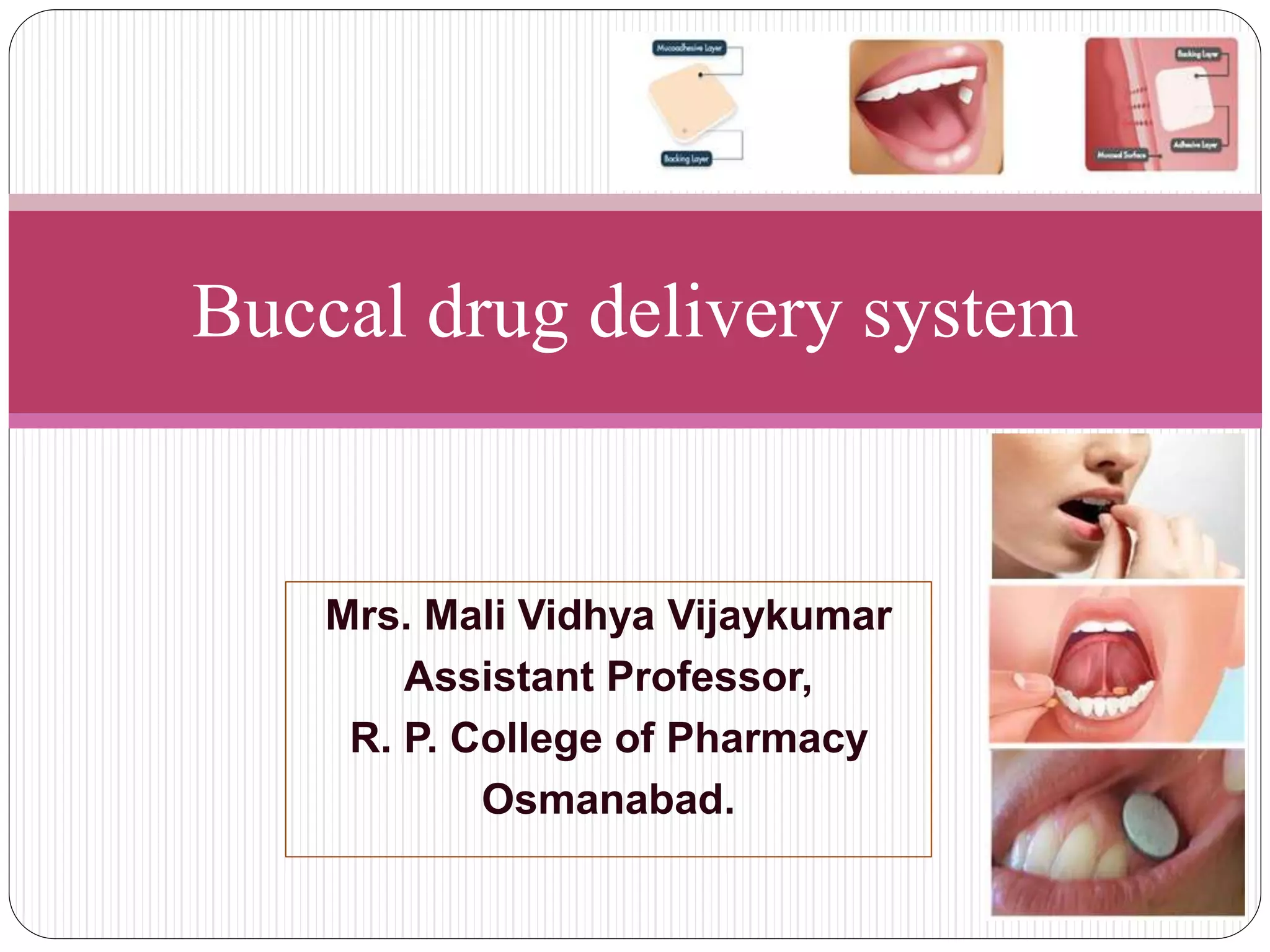
“The drug delivery system which involves
administration of the drug via buccal mucosa (lining
of cheeks) in the oral cavity to the systemic
circulation is defined as buccal drug delivery”.
 The buccal mucosa lies in the inner lining of cheeks.
 The product is Placed between upper gingiva (gums)
and cheeks.
 To treat various local & systemic conditions.
Advantages
 1. Relatively large surface area for administration
 2. Systemic absorption is rapid
 3. Rich blood Supply
 4. Selective use of therapeutic agents like
peptides, proteins, hormones and ionized species
can be achieved.
 5. Robust
 6. Prolonged residence time of drug
 7. Administration of drugs with short half life and
flexibility in shifting the position in buccal cavity.
Advantages
 8. Zero-order controlled release
 9. Ease of use and Lower intersubject variability.
 10. Avoids first pass metabolism.
 11. Ease of administration and termination.
 12. Drugs with poor bioavailability via oral route
can be administered conveniently.
 13. Low metabolic activity & improved patient
compliance.
 14. Intestinal alternative for various therapeutic
agents.
Disadvantages
1. Only drugs with small dose requirement can be
administered.
2. By mistake tablet can be swallowed.
3. Eating and drinking may be restricted.
4. Drugs which are unstable at buccal pH cannot be
administered.
5. Drugs which irritates mucosa or have bitter or
unpleasant taste cannot be administered.
6. Saliva may take some drug into gut.
7. Drugs absorbed by passive diffusion can be
administered by this route.
Basic concept and structure of oral
mucosa
The total surface area of oral cavity
100 cm2 and is lined with mucous
membranes.
Other several distinct areas:
1. the floor of mouth (sublingual),
2. the buccal mucosa (cheeks),
3. the gums (gingiva),
4. the palatal mucosa and the lining
of the lips.
Basic concept and structure of oral
mucosa
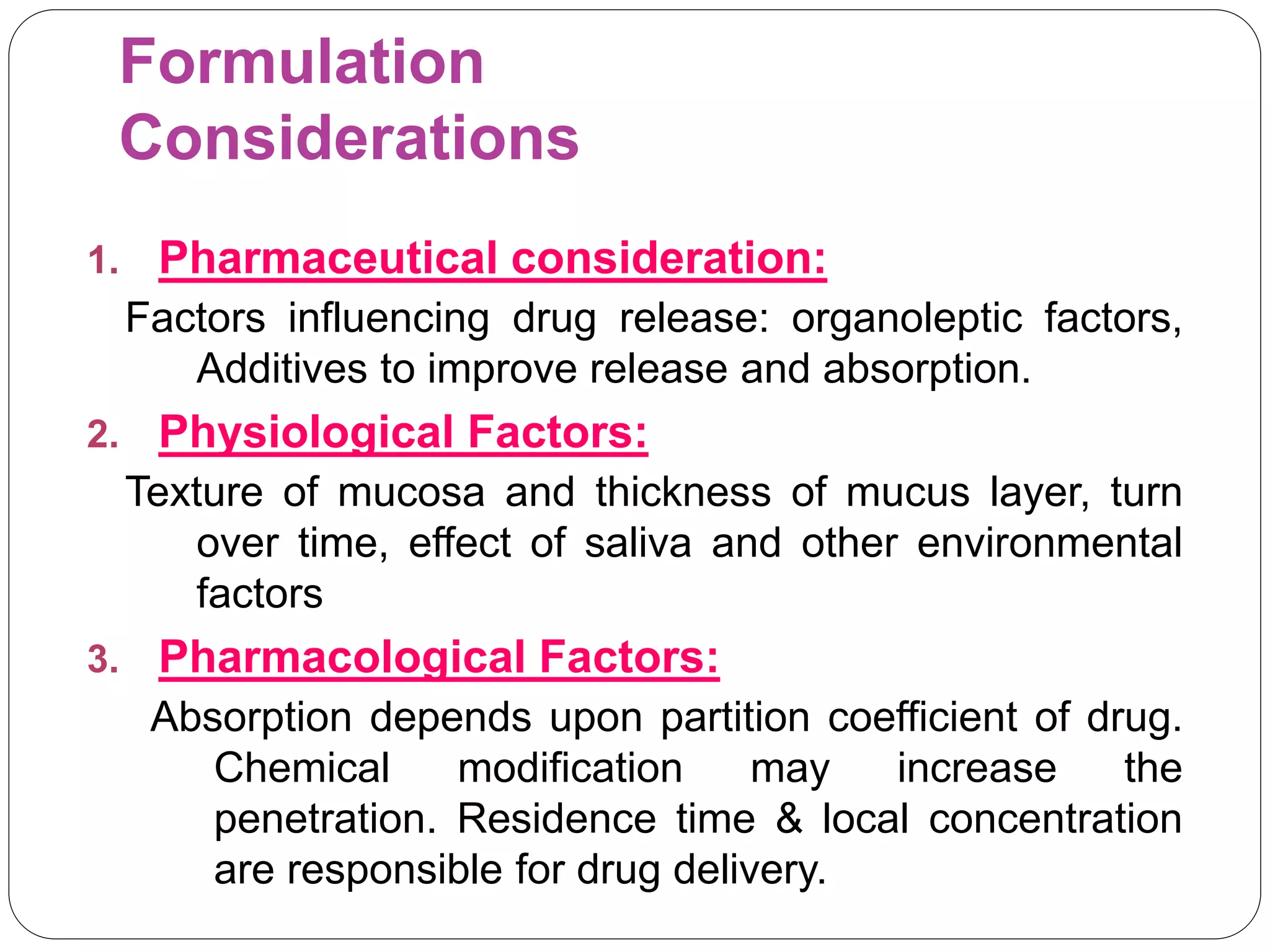
 Lamina propia constitute
continuous sheet of connective
tissue consist of collagen,
elastic fibers &cellular
components.
 Sub-mucosa as the innermost
layer of loose connective
tissue contains blood vessels,
lymphatic & nerves.
 The oral mucosa is composed of
 Oral epithelium consist of 40-50 layers of stratified
squamous epithelium.
 Basement membrane, layer of extracellular material.
Buccal mucosa environment
Role of Saliva
1. Protective fluid for all tissues of the oral Cavity.
2. Continuous mineralization of the tooth enamel.
3. To hydrate oral mucosal dosage forms.
Role of Mucus
1. Made up of proteins and carbohydrates.
2. Cell –cell adhesion.
3. Lubrication.
4. Bioadhesion of mucoadhesive drug delivery
system.
Types of BDDS
 Buccal Delivery: Administration of drug through buccal
mucosa drug is placed between the inner lining of cheeks
and gums.
 Sublingual Delivery: Administration of drug through
sublingual mucosa drug is placed below the tongue and
floor of the mouth.
 Local Delivery: For the treatment of conditions of oral
cavity (Topical) Principally ulcers, fungal infections and
periodontal diseases.
Formulation
Considerations
1. Pharmaceutical consideration:
Factors influencing drug release: organoleptic factors,
Additives to improve release and absorption.
2. Physiological Factors:
Texture of mucosa and thickness of mucus layer, turn
over time, effect of saliva and other environmental
factors
3. Pharmacological Factors:
Absorption depends upon partition coefficient of drug.
Chemical modification may increase the
penetration. Residence time & local concentration
are responsible for drug delivery.
Mechanism of BDDS
 Step 1 : Wetting and swelling of the polymer (contact stage).
 Step 2 : Interpenetration between the polymer chains and the
mucosal membrane (contact stage).
 Step 3 : Formation of bonds between the entangled chains
(consolidation stage).
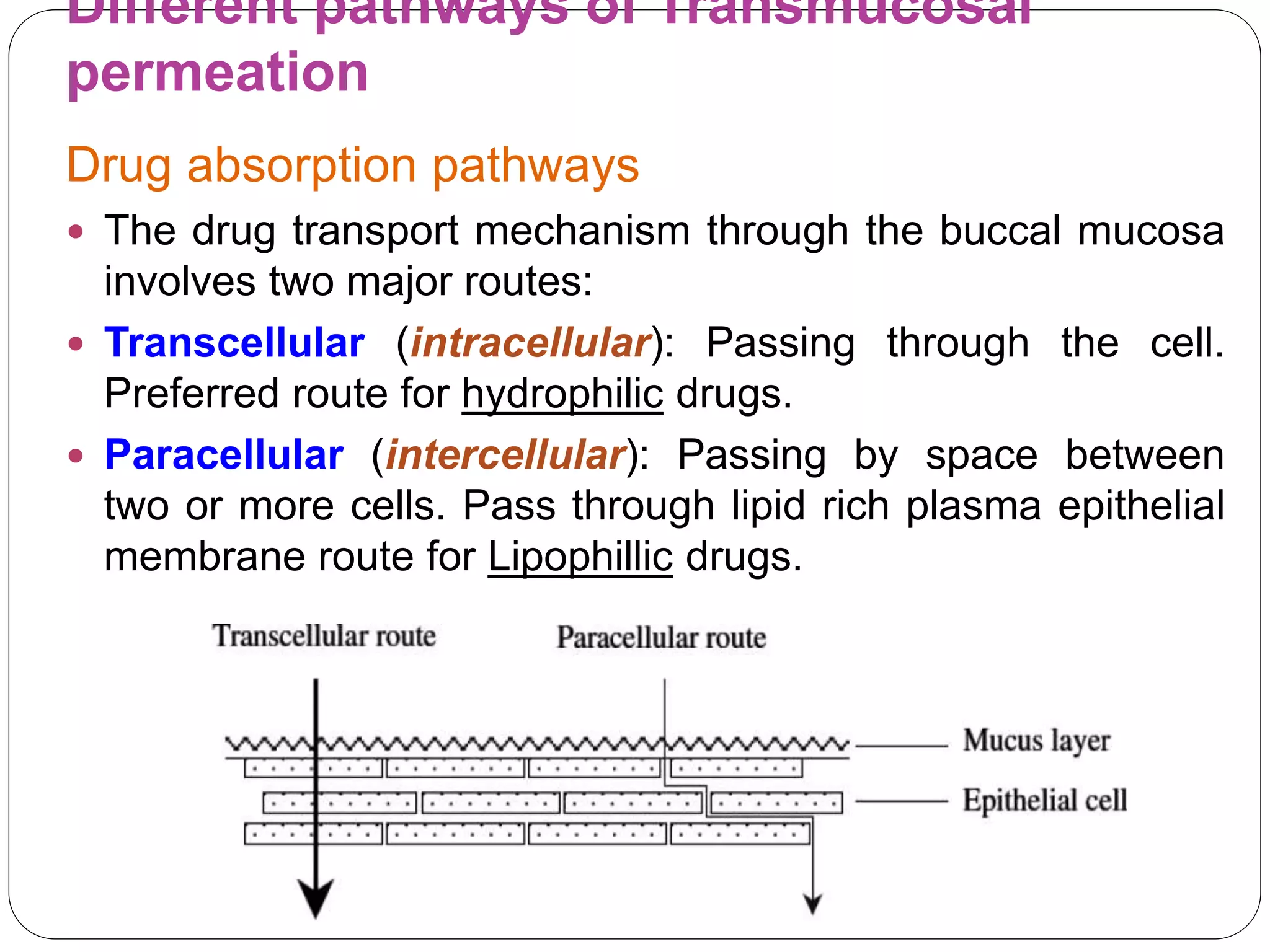
Different pathways of Transmucosal
permeation
Drug absorption pathways
 The drug transport mechanism through the buccal mucosa
involves two major routes:
 Transcellular (intracellular): Passing through the cell.
Preferred route for hydrophilic drugs.
 Paracellular (intercellular): Passing by space between
two or more cells. Pass through lipid rich plasma epithelial
membrane route for Lipophillic drugs.
Various routes of Transmucosal
permeation
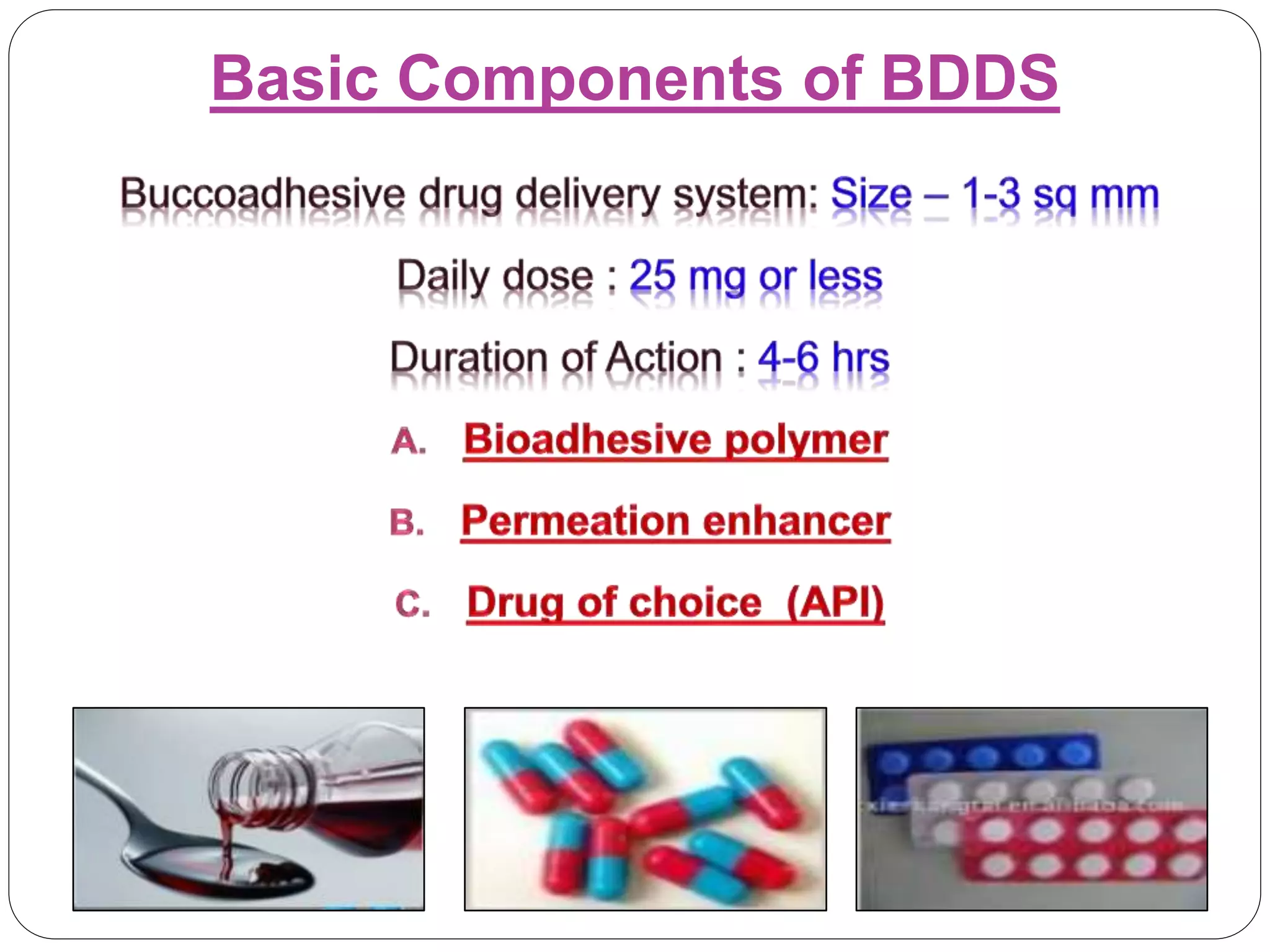
Basic Components of BDDS
An ideal Characteristics of bucoadhesive polymer
1. It should be inert and compatible with the
environment
2. The polymer and its degradation products should be
non-toxic absorbable from the mucous layer.
3. It should adhere quickly to moist tissue surface and
should possess some site specificity.
4. The polymer must not decompose on storage or
during the shelf life of the dosage form.
5. The polymer should be easily available in the market
and economical.
6. It should allow easy incorporation of drug in to the
formulation.
Continue…
Buccal mucoadhesive dosage forms
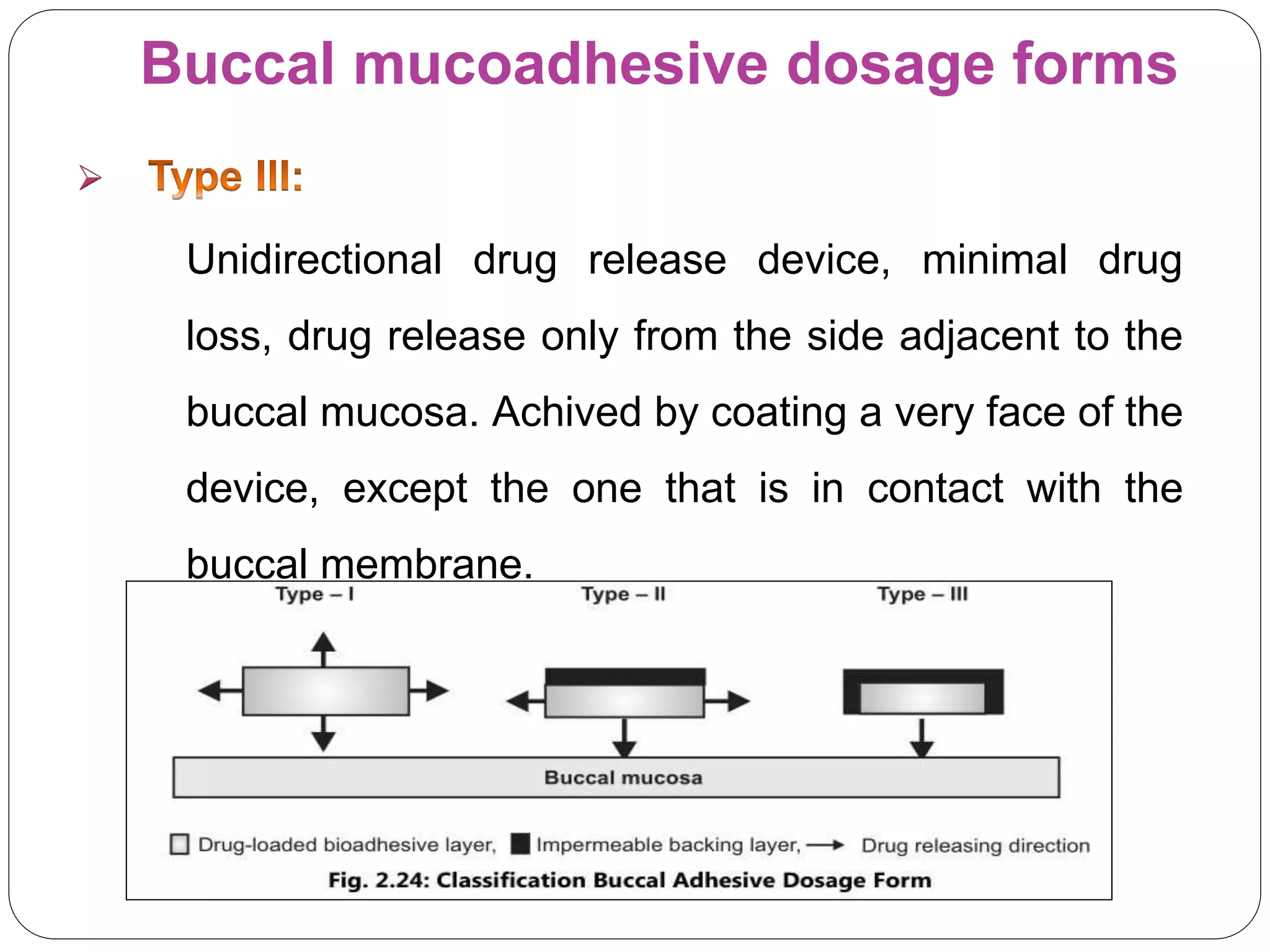
Based on their geometry Buccal dosage forms can be
categorized into three types:

Single layered device with multidirectional drug
release.

An impermeable backing membrane is placed on top
of the drug loaded bioadhesive layer, creating double
layered device & preventing drug loss from the top
Buccal mucoadhesive dosage forms

Unidirectional drug release device, minimal drug
loss, drug release only from the side adjacent to the
buccal mucosa. Achived by coating a very face of the
device, except the one that is in contact with the
buccal membrane.
Buccal mucoadhesive dosage
forms
The Buccal mucoadhesive dosage forms
can be categorized by:
 Solid buccal adhesive dosage forms.
 Semi-solid buccal adhesive dosage
forms.
 Gums
 Patches
 Liquid buccal adhesive dosage forms.
 Gel forming liquids and in-situ gel
Solid buccal adhesive dosage
forms.
Formulation of lozenges and tablets dosage forms
they may vary in shape and size.
o Open system of drug delivery.
o Method of delivery is simple for patients.
o Sweetening and flavouring agents are used to mask
the taste of drug.
Limitation:
1. Short residence time
2. Dissolution and disintegration can be controlled by
patiens
3. Smaller size leads to dissolve within 30 mins.
4. drug loss may possible due to Swallowing.
5. Variation in absorption and bioavailability
Solid buccal adhesive dosage
forms.
Mechanism:
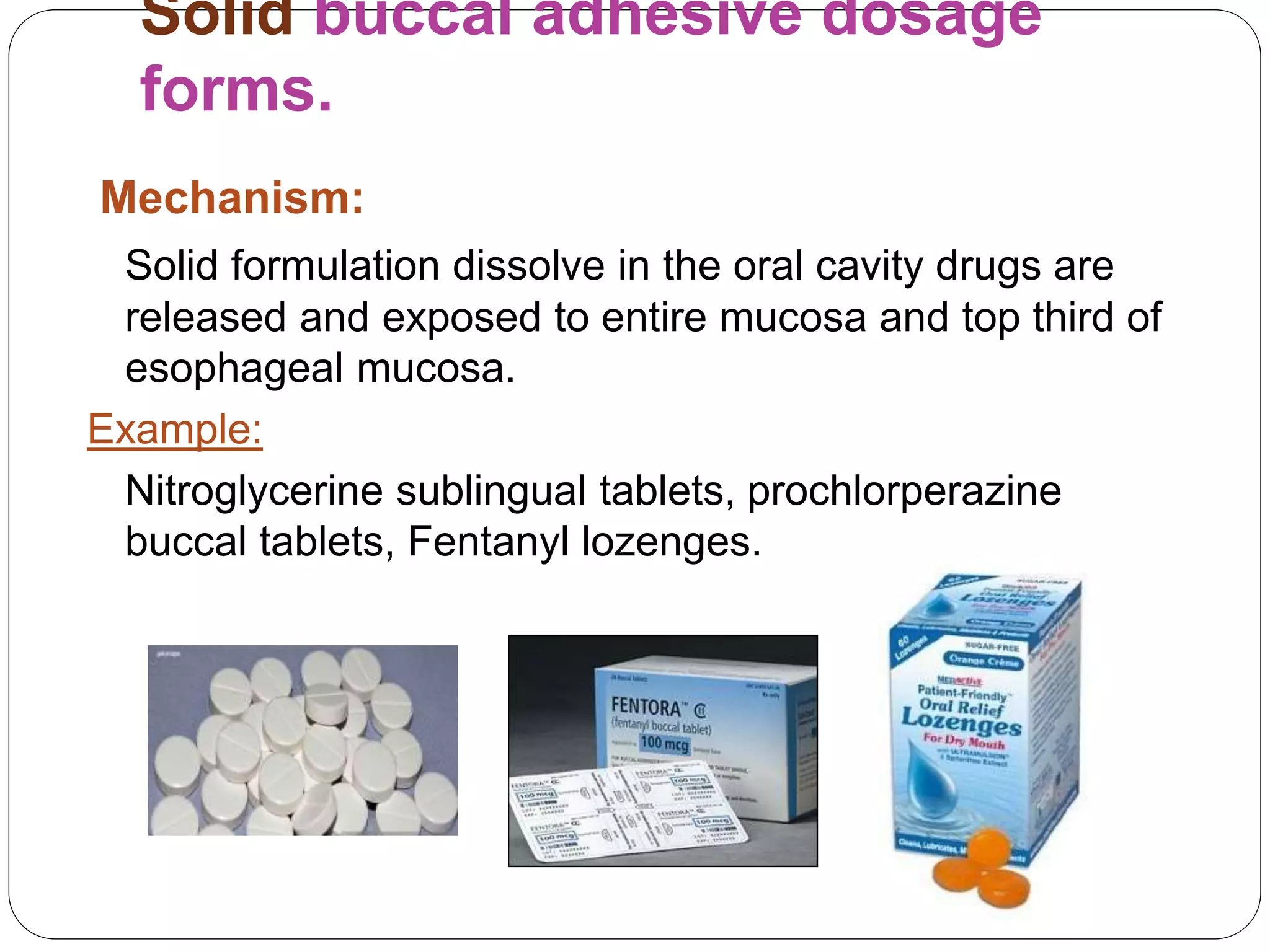
Solid formulation dissolve in the oral cavity drugs are
released and exposed to entire mucosa and top third of
esophageal mucosa.
Example:
Nitroglycerine sublingual tablets, prochlorperazine
buccal tablets, Fentanyl lozenges.
Semi-solid buccal adhesive dosage
forms.
Chewing gum is a modern approach to oral
transmucosal drug delivery.
Advantages:
1. Controlled drug release over an extended time.
2. Potential to improve variability in drug release & retention
time.
3. Convenient dosage form.
4. Drug intake may be controlled by simply changing the rate
and vigor of chewing or expelling the gum.
Limitations are same to other solid formulations
Semi-solid buccal adhesive dosage
forms.
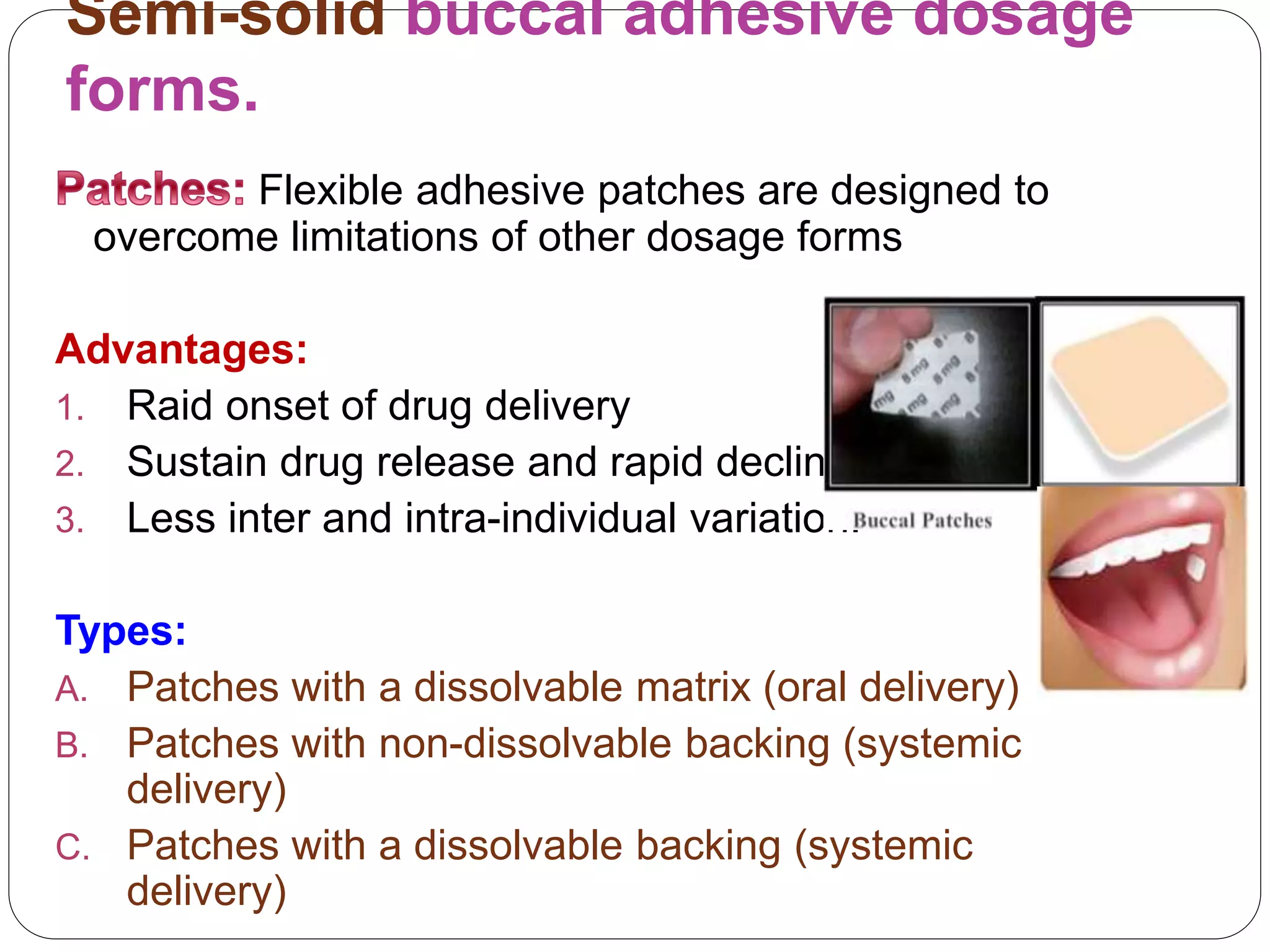
Flexible adhesive patches are designed to
overcome limitations of other dosage forms
Advantages:
1. Raid onset of drug delivery
2. Sustain drug release and rapid decline.
3. Less inter and intra-individual variation.
Types:
A. Patches with a dissolvable matrix (oral delivery)
B. Patches with non-dissolvable backing (systemic
delivery)
C. Patches with a dissolvable backing (systemic
delivery)
Liquid buccal adhesive dosage
forms.
 Viscous liquids are primarily designed to treat local
disorders like, motility dysfunction, fungal infection etc.
 Reflux can be avoided by coating the esophageal
surface with sodium alginate suspension & the drug can
be administered at damaged mucosa.
 For increasing retention time of many drugs.
Questions
 What is BDDS ?
 Explain the basic concepts and draw the structure of
oral mucosa.
 Explain the types of BDDS.
 Enlist advantages and disadvantages of BDDS.
 Explain various routes of transmucosal permeation.
 What are the mechanisms and pathways of
transmucosal permeation of drug ?
 Enlist the ideal requirements of suitable drug
candidates for buccal delivery.
 Write down the formulation consideration for BDDS.
 Explain the approaches used in the design of buccal
dosage forms.
 Classify and explain the designs of buccal dosage
forms.
Buccal Drug Delivery System Mali vv ppt

Buccal Drug Delivery System Mali vv ppt

  • 1.
    Mrs. Mali VidhyaVijaykumar Assistant Professor, R. P. College of Pharmacy Osmanabad. Buccal drug delivery system
  • 2.
    Contents * Introduction * Whatis BDDS? * Advantages & disadvantages * Basic concept and structure of oral mucosa * Buccal mucosa environment * Types of BDDS * Formulation Considerations * Mechanism & transmucosal permeation * Basic Components of BDDS * Buccal mucoadhesive dosage forms
  • 3.
    Introduction  An idealdosage regimen in the drug therapy of any disease is the one, which immediately attains the desired therapeutic concentration of drug in plasma (or at the site of action) and maintains it constant for the entire duration of treatment.  Buccal region deals with an acceptable route of administration for systemic drug delivery.  Most convenient and easily approachable site for drug delivery.  Mucosa has rich blood supply so it is highly
  • 4.
    What is BDDS? “Thedrug delivery system which involves administration of the drug via buccal mucosa (lining of cheeks) in the oral cavity to the systemic circulation is defined as buccal drug delivery”.  The buccal mucosa lies in the inner lining of cheeks.  The product is Placed between upper gingiva (gums) and cheeks.  To treat various local & systemic conditions.
  • 5.
    Advantages  1. Relativelylarge surface area for administration  2. Systemic absorption is rapid  3. Rich blood Supply  4. Selective use of therapeutic agents like peptides, proteins, hormones and ionized species can be achieved.  5. Robust  6. Prolonged residence time of drug  7. Administration of drugs with short half life and flexibility in shifting the position in buccal cavity.
  • 6.
    Advantages  8. Zero-ordercontrolled release  9. Ease of use and Lower intersubject variability.  10. Avoids first pass metabolism.  11. Ease of administration and termination.  12. Drugs with poor bioavailability via oral route can be administered conveniently.  13. Low metabolic activity & improved patient compliance.  14. Intestinal alternative for various therapeutic agents.
  • 7.
    Disadvantages 1. Only drugswith small dose requirement can be administered. 2. By mistake tablet can be swallowed. 3. Eating and drinking may be restricted. 4. Drugs which are unstable at buccal pH cannot be administered. 5. Drugs which irritates mucosa or have bitter or unpleasant taste cannot be administered. 6. Saliva may take some drug into gut. 7. Drugs absorbed by passive diffusion can be administered by this route.
  • 8.
    Basic concept andstructure of oral mucosa The total surface area of oral cavity 100 cm2 and is lined with mucous membranes. Other several distinct areas: 1. the floor of mouth (sublingual), 2. the buccal mucosa (cheeks), 3. the gums (gingiva), 4. the palatal mucosa and the lining of the lips.
  • 9.
    Basic concept andstructure of oral mucosa  Lamina propia constitute continuous sheet of connective tissue consist of collagen, elastic fibers &cellular components.  Sub-mucosa as the innermost layer of loose connective tissue contains blood vessels, lymphatic & nerves.  The oral mucosa is composed of  Oral epithelium consist of 40-50 layers of stratified squamous epithelium.  Basement membrane, layer of extracellular material.
  • 10.
    Buccal mucosa environment Roleof Saliva 1. Protective fluid for all tissues of the oral Cavity. 2. Continuous mineralization of the tooth enamel. 3. To hydrate oral mucosal dosage forms. Role of Mucus 1. Made up of proteins and carbohydrates. 2. Cell –cell adhesion. 3. Lubrication. 4. Bioadhesion of mucoadhesive drug delivery system.
  • 11.
    Types of BDDS Buccal Delivery: Administration of drug through buccal mucosa drug is placed between the inner lining of cheeks and gums.  Sublingual Delivery: Administration of drug through sublingual mucosa drug is placed below the tongue and floor of the mouth.  Local Delivery: For the treatment of conditions of oral cavity (Topical) Principally ulcers, fungal infections and periodontal diseases.
  • 12.
    Formulation Considerations 1. Pharmaceutical consideration: Factorsinfluencing drug release: organoleptic factors, Additives to improve release and absorption. 2. Physiological Factors: Texture of mucosa and thickness of mucus layer, turn over time, effect of saliva and other environmental factors 3. Pharmacological Factors: Absorption depends upon partition coefficient of drug. Chemical modification may increase the penetration. Residence time & local concentration are responsible for drug delivery.
  • 13.
    Mechanism of BDDS Step 1 : Wetting and swelling of the polymer (contact stage).  Step 2 : Interpenetration between the polymer chains and the mucosal membrane (contact stage).  Step 3 : Formation of bonds between the entangled chains (consolidation stage).
  • 14.
    Different pathways ofTransmucosal permeation Drug absorption pathways  The drug transport mechanism through the buccal mucosa involves two major routes:  Transcellular (intracellular): Passing through the cell. Preferred route for hydrophilic drugs.  Paracellular (intercellular): Passing by space between two or more cells. Pass through lipid rich plasma epithelial membrane route for Lipophillic drugs.
  • 15.
    Various routes ofTransmucosal permeation
  • 16.
  • 19.
    An ideal Characteristicsof bucoadhesive polymer 1. It should be inert and compatible with the environment 2. The polymer and its degradation products should be non-toxic absorbable from the mucous layer. 3. It should adhere quickly to moist tissue surface and should possess some site specificity. 4. The polymer must not decompose on storage or during the shelf life of the dosage form. 5. The polymer should be easily available in the market and economical. 6. It should allow easy incorporation of drug in to the formulation. Continue…
  • 22.
    Buccal mucoadhesive dosageforms Based on their geometry Buccal dosage forms can be categorized into three types:  Single layered device with multidirectional drug release.  An impermeable backing membrane is placed on top of the drug loaded bioadhesive layer, creating double layered device & preventing drug loss from the top
  • 23.
    Buccal mucoadhesive dosageforms  Unidirectional drug release device, minimal drug loss, drug release only from the side adjacent to the buccal mucosa. Achived by coating a very face of the device, except the one that is in contact with the buccal membrane.
  • 24.
    Buccal mucoadhesive dosage forms TheBuccal mucoadhesive dosage forms can be categorized by:  Solid buccal adhesive dosage forms.  Semi-solid buccal adhesive dosage forms.  Gums  Patches  Liquid buccal adhesive dosage forms.  Gel forming liquids and in-situ gel
  • 25.
    Solid buccal adhesivedosage forms. Formulation of lozenges and tablets dosage forms they may vary in shape and size. o Open system of drug delivery. o Method of delivery is simple for patients. o Sweetening and flavouring agents are used to mask the taste of drug. Limitation: 1. Short residence time 2. Dissolution and disintegration can be controlled by patiens 3. Smaller size leads to dissolve within 30 mins. 4. drug loss may possible due to Swallowing. 5. Variation in absorption and bioavailability
  • 26.
    Solid buccal adhesivedosage forms. Mechanism: Solid formulation dissolve in the oral cavity drugs are released and exposed to entire mucosa and top third of esophageal mucosa. Example: Nitroglycerine sublingual tablets, prochlorperazine buccal tablets, Fentanyl lozenges.
  • 27.
    Semi-solid buccal adhesivedosage forms. Chewing gum is a modern approach to oral transmucosal drug delivery. Advantages: 1. Controlled drug release over an extended time. 2. Potential to improve variability in drug release & retention time. 3. Convenient dosage form. 4. Drug intake may be controlled by simply changing the rate and vigor of chewing or expelling the gum. Limitations are same to other solid formulations
  • 28.
    Semi-solid buccal adhesivedosage forms. Flexible adhesive patches are designed to overcome limitations of other dosage forms Advantages: 1. Raid onset of drug delivery 2. Sustain drug release and rapid decline. 3. Less inter and intra-individual variation. Types: A. Patches with a dissolvable matrix (oral delivery) B. Patches with non-dissolvable backing (systemic delivery) C. Patches with a dissolvable backing (systemic delivery)
  • 29.
    Liquid buccal adhesivedosage forms.  Viscous liquids are primarily designed to treat local disorders like, motility dysfunction, fungal infection etc.  Reflux can be avoided by coating the esophageal surface with sodium alginate suspension & the drug can be administered at damaged mucosa.  For increasing retention time of many drugs.
  • 30.
    Questions  What isBDDS ?  Explain the basic concepts and draw the structure of oral mucosa.  Explain the types of BDDS.  Enlist advantages and disadvantages of BDDS.  Explain various routes of transmucosal permeation.  What are the mechanisms and pathways of transmucosal permeation of drug ?  Enlist the ideal requirements of suitable drug candidates for buccal delivery.  Write down the formulation consideration for BDDS.  Explain the approaches used in the design of buccal dosage forms.  Classify and explain the designs of buccal dosage forms.