By,
Aditya Sharma
Assistant Professor,
H R Patel Institute of Pharmaceutical Education and
Research, Shirpur
STERILE DOSAGE FORMS
By,
Mr. Aditya Sharma
Assistant Professor,
School of Pharmaceutical Sciences
IFTM University, Moradabad
Introduction:
- Parenteral preparation are the preparation that are given by other than
orally.
- Injections and transfusion fluids are come under the parental preparation.
- Injections should be sterile, isotonic, and free from the foreign particles, such
asdust, fibers etc.
- Injections are the sterile solution and suspension of drug in aqueous or oily
vehicle meant for introduction in to the body by means of an injectable
needle under or through one or more layer of skin or mucous membrane.
 Advantages of Parenteral Preparation:
- The drug which are can not be administered by oral route, can administered by thisroute.
- The patient who are vomiting or suffering form unconscious condition, can not able to take the
drugs by orally, can administered by this route.
- The drug action is quick and rapid
- Drug action can be prolonged by modifying the formulation
- Transfusion fluid are also contain nutritive like glucose and electrolytes.
 Disadvantages:
- The trained person is required toadministerthedrug
- Injection causesthepainatthesideof injection
- The administration of drug from wrong route of injection may very dangerous.
- The chances of sensitivity reaction or allergic reaction of the drug by an individual.
 Route of Administration:
- Intradermal/ Intracutaneous Injection (given between dermis and epidermis layer of skin)
- Hypodermis/ Subcutaneous Injection (given under the skin into subcutaneous tissue i.e. fatty
layer)
- Intramuscular Injection (injected deeply into muscular tissue)
- Intravenous Injection (directly into the patient's veins,)
- Intra ArterialInjection (given directly into the arteries)
- Intracardiac Injection (given into the heart muscle or ventricle in an emergency only)
- Intrathecal Injection (surrounding to spinalcord)
- Intracisternal Injection (between first & second cervical vertebrae for withdrawing cerebrospinal
fluid)
- Peridural Injection (between the duramater and inner aspect of vertebra)
- Intra-articular Injection (in bones joint)
- Intracerebral Injection (given into Cerebrum)
 Types of Parenteral Preparation:
- Solutionor Emulsionsof medicamentforsuitable injections
- Sterilesolids
- Sterile Suspension
- Transfusion Fluid
 General Requirement for Parenteral Preparation:
Parenteral Products required careful consideration of the following requirement:
- Stability
- Sterility
- Free from Pyrogen
- Free from foreignparticles
- Chemical purity
- Isotonicity
- Specific gravity
8
AQUEOUS VEHICLE:
Water For Injection (WFI) USP
 Highly purified water used as a vehicle for injective
preparations which will be subsequently sterilized.
 USP requirement include not more than 10 parts per million
of total solids.
 pH of 5.0 – 7.0 .
 WFI may be prepared by either distillation or reverse osmosis.
 Stored in chemically resistant tank.
FORMULATION OF PARENTERAL PREPARATIONS
Bacteriostatic WaterFor Injection
 This type of water used for making parenteral
solutions prepared under aseptic conditions and
not terminally sterilized.
 Need to meet USP sterility test.
 It can contain an added bacteriostatic agent
when in containers of 30 ml or less.
9
Sterile Water For Injection (SWFI)
 SWFI containing one or more suitable bacteriostatic
agent.
 Multiple-dose containers not exceeding 30 ml.
 They are permitted to contain higher levels of solid
than WFI because of possible leaching.
 Used for washing wounds, surgical incisions, or
body tissues.
10
Water Miscible Vehicles
 The number of solvents that are miscible with water
has been used as a portion of a vehicle.
 Primarily to affect solubility of drugs and to reduce
hydrolysis.
Examples:- Ethyl alcohol, Liquid propylene glycol, Glycerine,
11
NON – AQUEOUS VEHICLES
 Fixed oils (vegitable origin, liquid, and rancid resistance
,unsaturated, free fatty acid content )
Peanut oil
Corn oil
Cotton seed oil (depo-testosterone)
Sesame oil
Soyabean oil
Ethyl oleate
Isopropyl myristate.
12
Anti-bacterial Agents:-
These are added in multiple dose containers.
To prevent microorganism growth
Limitted concenteration of agents are used.
Phenyl mercuric nitrate and thiomersol 0.01%.
Benzethonium chloride & benzalkonium chloride 0.01%.
Phenol & cresol 0.05%.
Chlorobutanol 0.05%.
13
OTHER ADDITIVES
Buffers:-
 Added to maintain pH.
 To stabilize a solution from chemical degradation.
Examples:
Citrate and acetate buffer.
Sodium benzoate and benzoic acid
Sodium tartarate and tartaric acid
Phosphate buffer.
14
Anti-oxidants:-
To protect the formulation from oxidation
Two types
1. Reducing agents
Ascorbic acid
Sodium bisulfite 0.01%
Thiourea
2.Blocking agents
Tocopherol
15
Surfactants:-
 Solubilize the active ingredient
Polyoxythylene sorbitan monooleate & Sorbitan monooleate
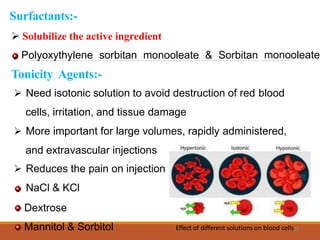
Tonicity Agents:-
 Need isotonic solution to avoid destruction of red blood
cells, irritation, and tissue damage
 More important for large volumes, rapidly administered,
and extravascular injections
 Reduces the pain on injection
NaCl & KCl
Dextrose
Mannitol & Sorbitol Effect of different solutions on blood cells25
ChelatingAgent:-
 To remove trace elements that catalyze oxidative degeneration
Ethylene diamine tetra acetic acid
 Improve solubility
 Prevent potential for hydrolysis
Co-solvents:-
BULKING AGENTS
 For freeze dried preparations(solids)
Mannitol
Lactose, sucrose
Dextran .
SUSPENDING AGENTS
CMC,
Methyl cellulose, Gelatin
Sorbitol .
EMULSIFYING AGENTS
Lecithin
Polysorbate 80 18
 A clear and colorless liquid; odorless.
 Water for injections is pyrogen -free.
 It contains no added substance.
 Water for injections is obtained from potable or Purified
water by distillation in an apparatus.
 The distillate is collected and stored in conditions
designed to prevent growth of microorganisms and to
avoid any other contamination.
19
 Evaluation of Parenteral Preparation:
- SterilityTest
- ClarityTest
- LeakageTest
- PyrogenTest
- Assay
 SterilityTest:
- All the Parenteral preparation are supplied in sterile form.
- The sterility test is strictly carried out under the aseptic
condition in order to avoid accidentalcontamination.
- The Sterility test is must be carried outeither by,
i. Membrane Filtration Method
ii. Direct Inoculation Method
 Steps of SterilityTesting:
- Selection of samplesize
- Selection of quantityof product to be used
- Method of testing
- Observation and result
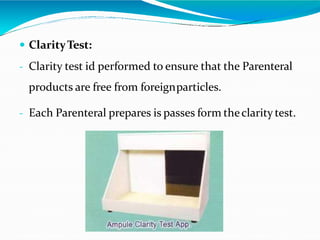
 ClarityTest:
- Clarity test id performed to ensure that the Parenteral
products are free from foreignparticles.
- Each Parenteral prepares is passes form theclarity test.
 Leakage Test:
- This test is performed only for the ampoules which have
been sealed by thefusion.
- Leak test is performed in the vacuum chamber, the
ampoules are dipped in methylene blue in vacuum
entered
chamber i.e. Leak testapparatus.
- Then vacuum isapplied.
- When vacuum is released the color solution will
with defectivesealing
- The presence of dyes in the ampoule, confirm the leakage
and hence rejected.
 PyrogenTest:
- These test is perform for the check the presence or
absence of pyrogen in the ParenteralPreparation.
- These test is involves the measurement of the rise in
body temperature of rabbits following intravenous
injection in marginal ear vein of a sterile solution of
Parenteral preparation isexamined.
 Assay:
- Assay is performed according to the method is given in
the monograph of that Parenteral Preparation in
pharmacopeia.
- Assay is done to check the quantity of medicament
present in thatpreparation
- A= abc
a (absobtivity), b (pathlength), c(Concentration)

Sterile Dosage Forms.pptx

  • 1.
    By, Aditya Sharma Assistant Professor, HR Patel Institute of Pharmaceutical Education and Research, Shirpur STERILE DOSAGE FORMS By, Mr. Aditya Sharma Assistant Professor, School of Pharmaceutical Sciences IFTM University, Moradabad
  • 2.
    Introduction: - Parenteral preparationare the preparation that are given by other than orally. - Injections and transfusion fluids are come under the parental preparation. - Injections should be sterile, isotonic, and free from the foreign particles, such asdust, fibers etc. - Injections are the sterile solution and suspension of drug in aqueous or oily vehicle meant for introduction in to the body by means of an injectable needle under or through one or more layer of skin or mucous membrane.
  • 3.
     Advantages ofParenteral Preparation: - The drug which are can not be administered by oral route, can administered by thisroute. - The patient who are vomiting or suffering form unconscious condition, can not able to take the drugs by orally, can administered by this route. - The drug action is quick and rapid - Drug action can be prolonged by modifying the formulation - Transfusion fluid are also contain nutritive like glucose and electrolytes.  Disadvantages: - The trained person is required toadministerthedrug - Injection causesthepainatthesideof injection - The administration of drug from wrong route of injection may very dangerous. - The chances of sensitivity reaction or allergic reaction of the drug by an individual.
  • 4.
     Route ofAdministration: - Intradermal/ Intracutaneous Injection (given between dermis and epidermis layer of skin) - Hypodermis/ Subcutaneous Injection (given under the skin into subcutaneous tissue i.e. fatty layer) - Intramuscular Injection (injected deeply into muscular tissue) - Intravenous Injection (directly into the patient's veins,) - Intra ArterialInjection (given directly into the arteries) - Intracardiac Injection (given into the heart muscle or ventricle in an emergency only) - Intrathecal Injection (surrounding to spinalcord) - Intracisternal Injection (between first & second cervical vertebrae for withdrawing cerebrospinal fluid) - Peridural Injection (between the duramater and inner aspect of vertebra) - Intra-articular Injection (in bones joint) - Intracerebral Injection (given into Cerebrum)
  • 6.
     Types ofParenteral Preparation: - Solutionor Emulsionsof medicamentforsuitable injections - Sterilesolids - Sterile Suspension - Transfusion Fluid
  • 7.
     General Requirementfor Parenteral Preparation: Parenteral Products required careful consideration of the following requirement: - Stability - Sterility - Free from Pyrogen - Free from foreignparticles - Chemical purity - Isotonicity - Specific gravity
  • 8.
    8 AQUEOUS VEHICLE: Water ForInjection (WFI) USP  Highly purified water used as a vehicle for injective preparations which will be subsequently sterilized.  USP requirement include not more than 10 parts per million of total solids.  pH of 5.0 – 7.0 .  WFI may be prepared by either distillation or reverse osmosis.  Stored in chemically resistant tank. FORMULATION OF PARENTERAL PREPARATIONS
  • 9.
    Bacteriostatic WaterFor Injection This type of water used for making parenteral solutions prepared under aseptic conditions and not terminally sterilized.  Need to meet USP sterility test.  It can contain an added bacteriostatic agent when in containers of 30 ml or less. 9
  • 10.
    Sterile Water ForInjection (SWFI)  SWFI containing one or more suitable bacteriostatic agent.  Multiple-dose containers not exceeding 30 ml.  They are permitted to contain higher levels of solid than WFI because of possible leaching.  Used for washing wounds, surgical incisions, or body tissues. 10
  • 11.
    Water Miscible Vehicles The number of solvents that are miscible with water has been used as a portion of a vehicle.  Primarily to affect solubility of drugs and to reduce hydrolysis. Examples:- Ethyl alcohol, Liquid propylene glycol, Glycerine, 11
  • 12.
    NON – AQUEOUSVEHICLES  Fixed oils (vegitable origin, liquid, and rancid resistance ,unsaturated, free fatty acid content ) Peanut oil Corn oil Cotton seed oil (depo-testosterone) Sesame oil Soyabean oil Ethyl oleate Isopropyl myristate. 12
  • 13.
    Anti-bacterial Agents:- These areadded in multiple dose containers. To prevent microorganism growth Limitted concenteration of agents are used. Phenyl mercuric nitrate and thiomersol 0.01%. Benzethonium chloride & benzalkonium chloride 0.01%. Phenol & cresol 0.05%. Chlorobutanol 0.05%. 13 OTHER ADDITIVES
  • 14.
    Buffers:-  Added tomaintain pH.  To stabilize a solution from chemical degradation. Examples: Citrate and acetate buffer. Sodium benzoate and benzoic acid Sodium tartarate and tartaric acid Phosphate buffer. 14
  • 15.
    Anti-oxidants:- To protect theformulation from oxidation Two types 1. Reducing agents Ascorbic acid Sodium bisulfite 0.01% Thiourea 2.Blocking agents Tocopherol 15
  • 16.
    Surfactants:-  Solubilize theactive ingredient Polyoxythylene sorbitan monooleate & Sorbitan monooleate Tonicity Agents:-  Need isotonic solution to avoid destruction of red blood cells, irritation, and tissue damage  More important for large volumes, rapidly administered, and extravascular injections  Reduces the pain on injection NaCl & KCl Dextrose Mannitol & Sorbitol Effect of different solutions on blood cells25
  • 17.
    ChelatingAgent:-  To removetrace elements that catalyze oxidative degeneration Ethylene diamine tetra acetic acid  Improve solubility  Prevent potential for hydrolysis Co-solvents:-
  • 18.
    BULKING AGENTS  Forfreeze dried preparations(solids) Mannitol Lactose, sucrose Dextran . SUSPENDING AGENTS CMC, Methyl cellulose, Gelatin Sorbitol . EMULSIFYING AGENTS Lecithin Polysorbate 80 18
  • 19.
     A clearand colorless liquid; odorless.  Water for injections is pyrogen -free.  It contains no added substance.  Water for injections is obtained from potable or Purified water by distillation in an apparatus.  The distillate is collected and stored in conditions designed to prevent growth of microorganisms and to avoid any other contamination. 19
  • 20.
     Evaluation ofParenteral Preparation: - SterilityTest - ClarityTest - LeakageTest - PyrogenTest - Assay
  • 21.
     SterilityTest: - Allthe Parenteral preparation are supplied in sterile form. - The sterility test is strictly carried out under the aseptic condition in order to avoid accidentalcontamination. - The Sterility test is must be carried outeither by, i. Membrane Filtration Method ii. Direct Inoculation Method
  • 22.
     Steps ofSterilityTesting: - Selection of samplesize - Selection of quantityof product to be used - Method of testing - Observation and result
  • 23.
     ClarityTest: - Claritytest id performed to ensure that the Parenteral products are free from foreignparticles. - Each Parenteral prepares is passes form theclarity test.
  • 24.
     Leakage Test: -This test is performed only for the ampoules which have been sealed by thefusion. - Leak test is performed in the vacuum chamber, the ampoules are dipped in methylene blue in vacuum entered chamber i.e. Leak testapparatus. - Then vacuum isapplied. - When vacuum is released the color solution will with defectivesealing - The presence of dyes in the ampoule, confirm the leakage and hence rejected.
  • 25.
     PyrogenTest: - Thesetest is perform for the check the presence or absence of pyrogen in the ParenteralPreparation. - These test is involves the measurement of the rise in body temperature of rabbits following intravenous injection in marginal ear vein of a sterile solution of Parenteral preparation isexamined.
  • 26.
     Assay: - Assayis performed according to the method is given in the monograph of that Parenteral Preparation in pharmacopeia. - Assay is done to check the quantity of medicament present in thatpreparation - A= abc a (absobtivity), b (pathlength), c(Concentration)