INDIAN COUNCIL OF MEDICAL RESEARCH
http://www.icmr.nic.in
Sagar Savale
Mr. Sagar Kishor Savale
[Department of Pharmaceutics]
avengersagar16@gmail.com
2015-2016
1 7/9/2016
Contents
 Introduction
 Governing Bodies
 Activities
 Fellowship & Schemes
 Functions
 References
Sagar Savale
2 7/9/2016
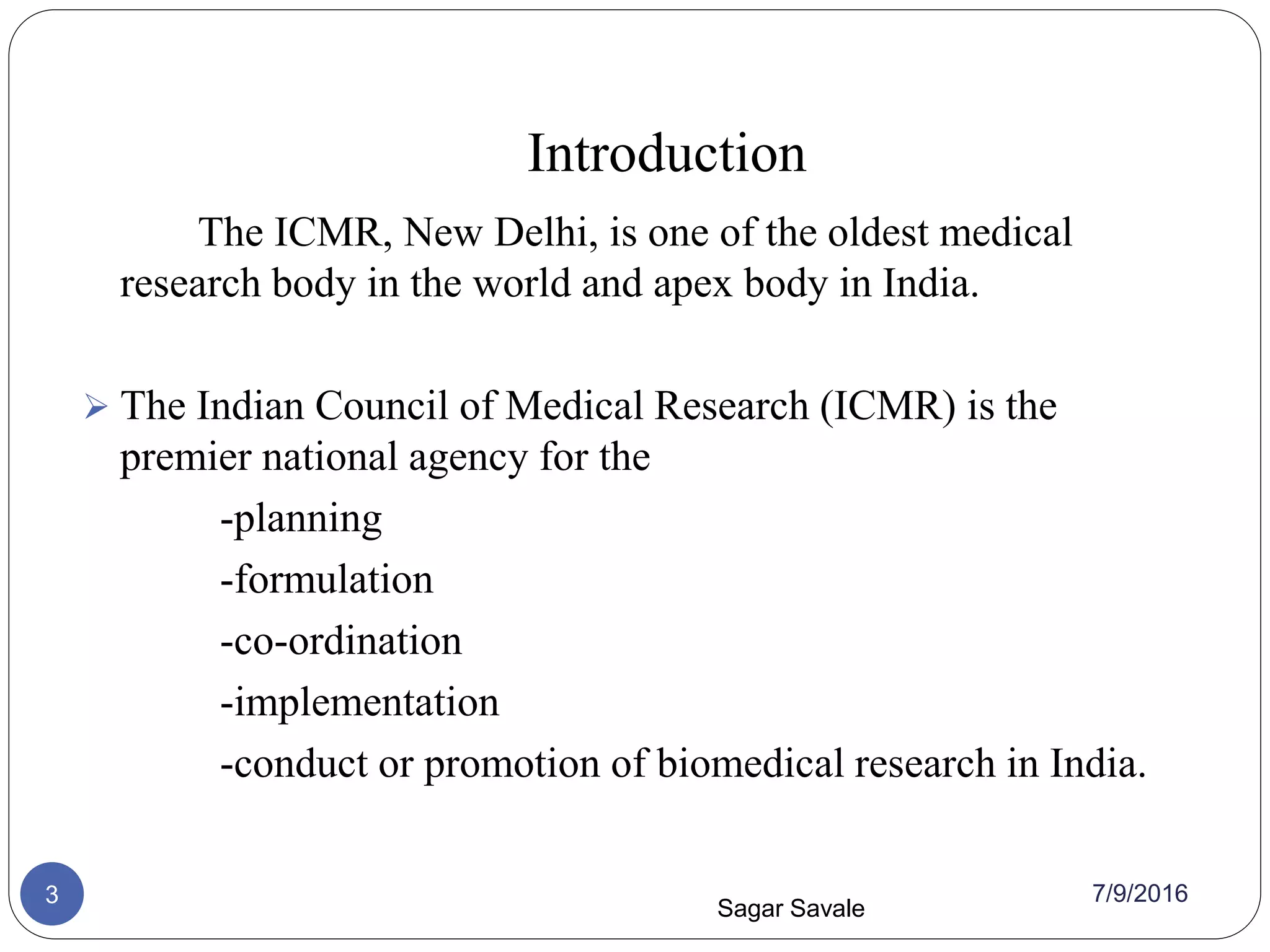
Introduction
The ICMR, New Delhi, is one of the oldest medical
research body in the world and apex body in India.
 The Indian Council of Medical Research (ICMR) is the
premier national agency for the
-planning
-formulation
-co-ordination
-implementation
-conduct or promotion of biomedical research in India.
Sagar Savale
3 7/9/2016
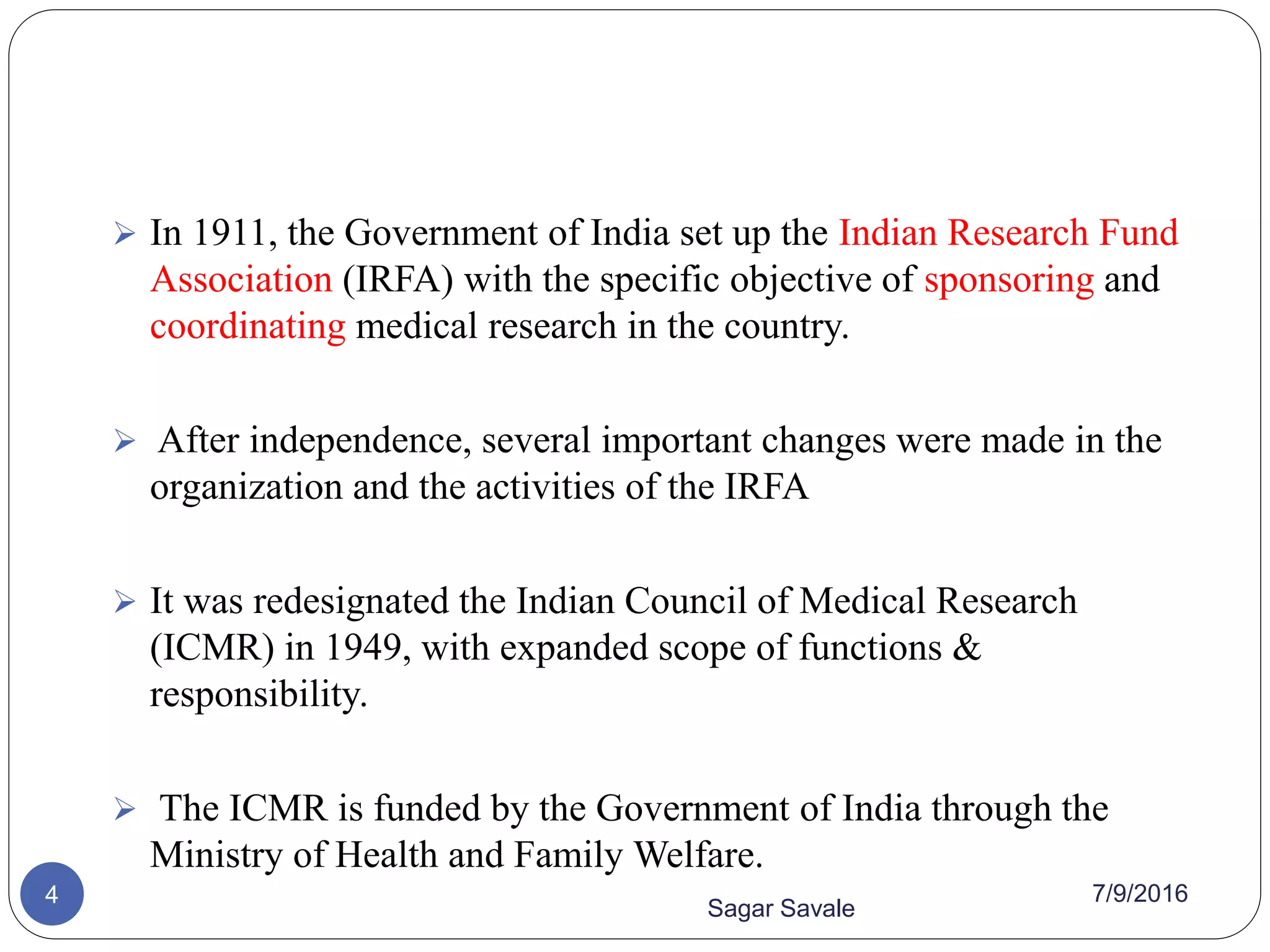
 In 1911, the Government of India set up the Indian Research Fund
Association (IRFA) with the specific objective of sponsoring and
coordinating medical research in the country.
 After independence, several important changes were made in the
organization and the activities of the IRFA
 It was redesignated the Indian Council of Medical Research
(ICMR) in 1949, with expanded scope of functions &
responsibility.
 The ICMR is funded by the Government of India through the
Ministry of Health and Family Welfare.
Sagar Savale
4 7/9/2016
 The council not only plans & promotes medical research & emerging
health problems of the country but also is expected to build strong
national group of professional persons in organization of skilled
biomedical scientists.
 Rapid advances in science & technology have brought in new
technologies to understand the disease process & find strategies for
prevention & cure.
Sagar Savale
5 7/9/2016
 The policies of ICMR coincide with national health policies such as
-control and management of communicable diseases,
-fertility control,
-maternal and child health,
-control of nutritional disorders,
-developing alternative strategies for health care delivery,
-safety limits of environmental and occupational health problems,
-Non-communicable diseases including cancer, cardiovascular,
neurological, ophthalmic and haematological disorders.
Sagar Savale
6 7/9/2016
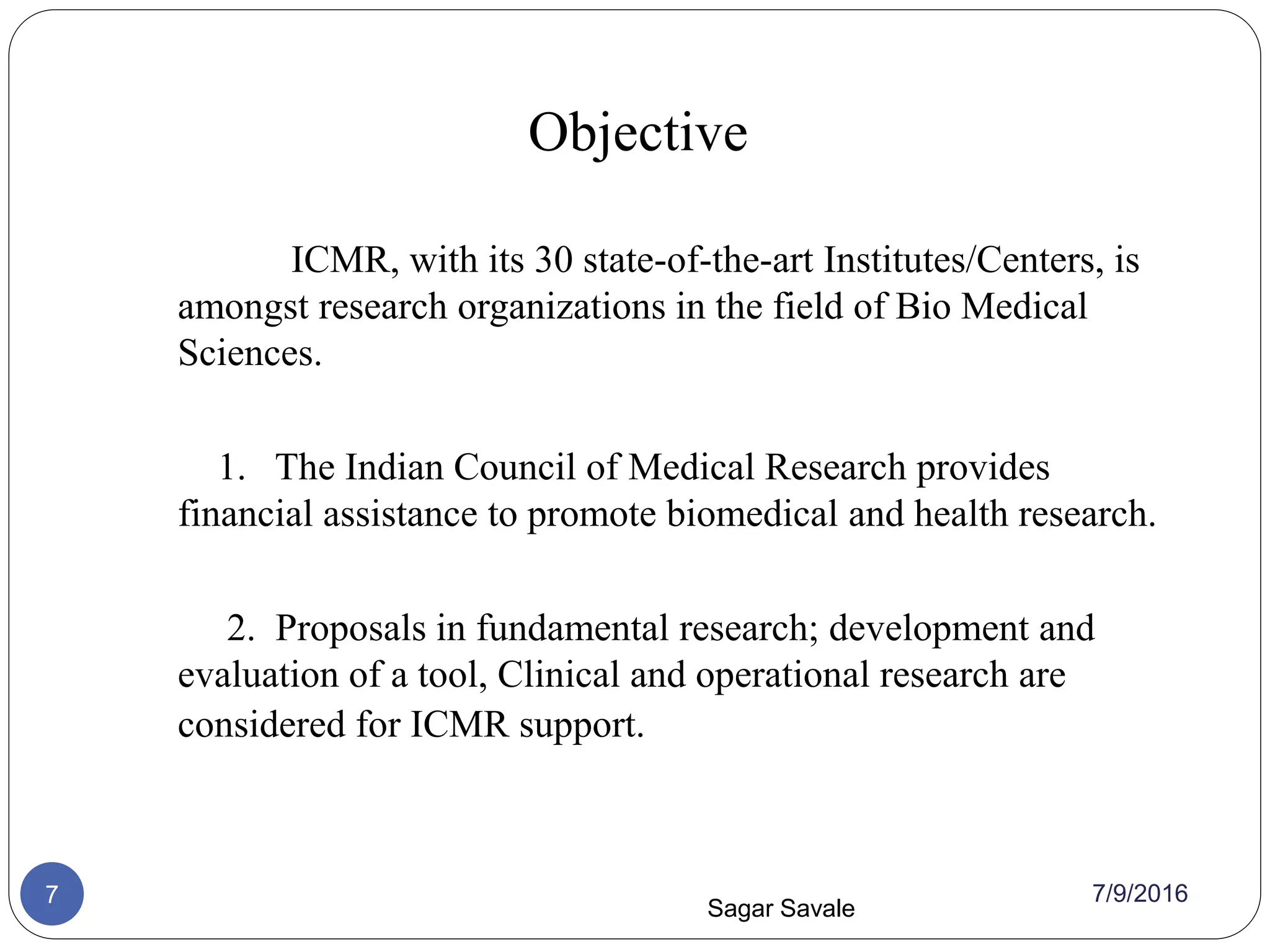
ICMR, with its 30 state-of-the-art Institutes/Centers, is
amongst research organizations in the field of Bio Medical
Sciences.
1. The Indian Council of Medical Research provides
financial assistance to promote biomedical and health research.
2. Proposals in fundamental research; development and
evaluation of a tool, Clinical and operational research are
considered for ICMR support.
Objective
Sagar Savale
7 7/9/2016
Indian Council Of Medical Research
Abbreviation ICMR
Type Professional
Organization
Headquarters New Delhi
Region served India
Secretary & Director
General
Dr. V.M. Katoch
Website http://www.icmr.nic.i
n/
Sagar Savale
8 7/9/2016
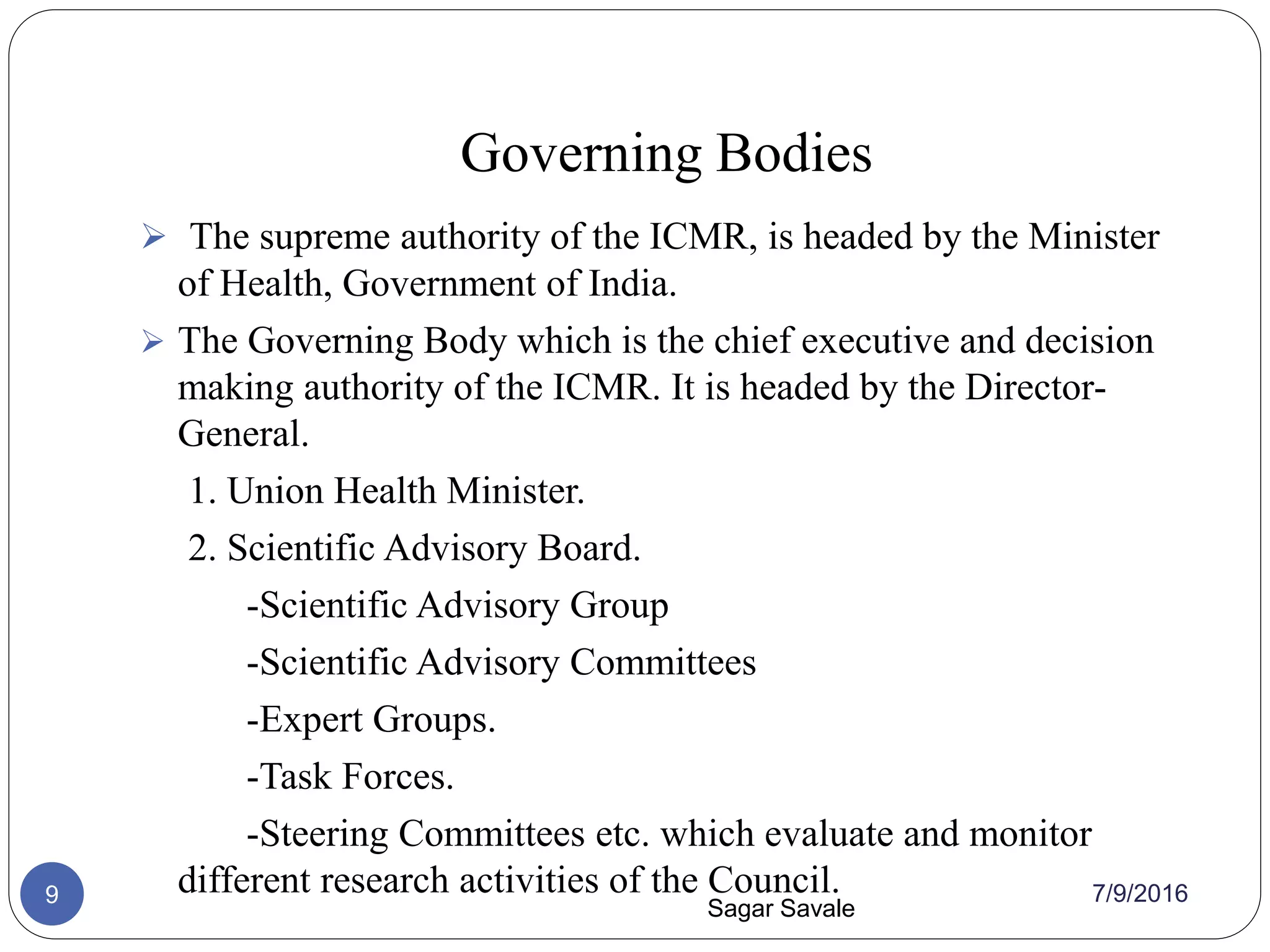
Governing Bodies
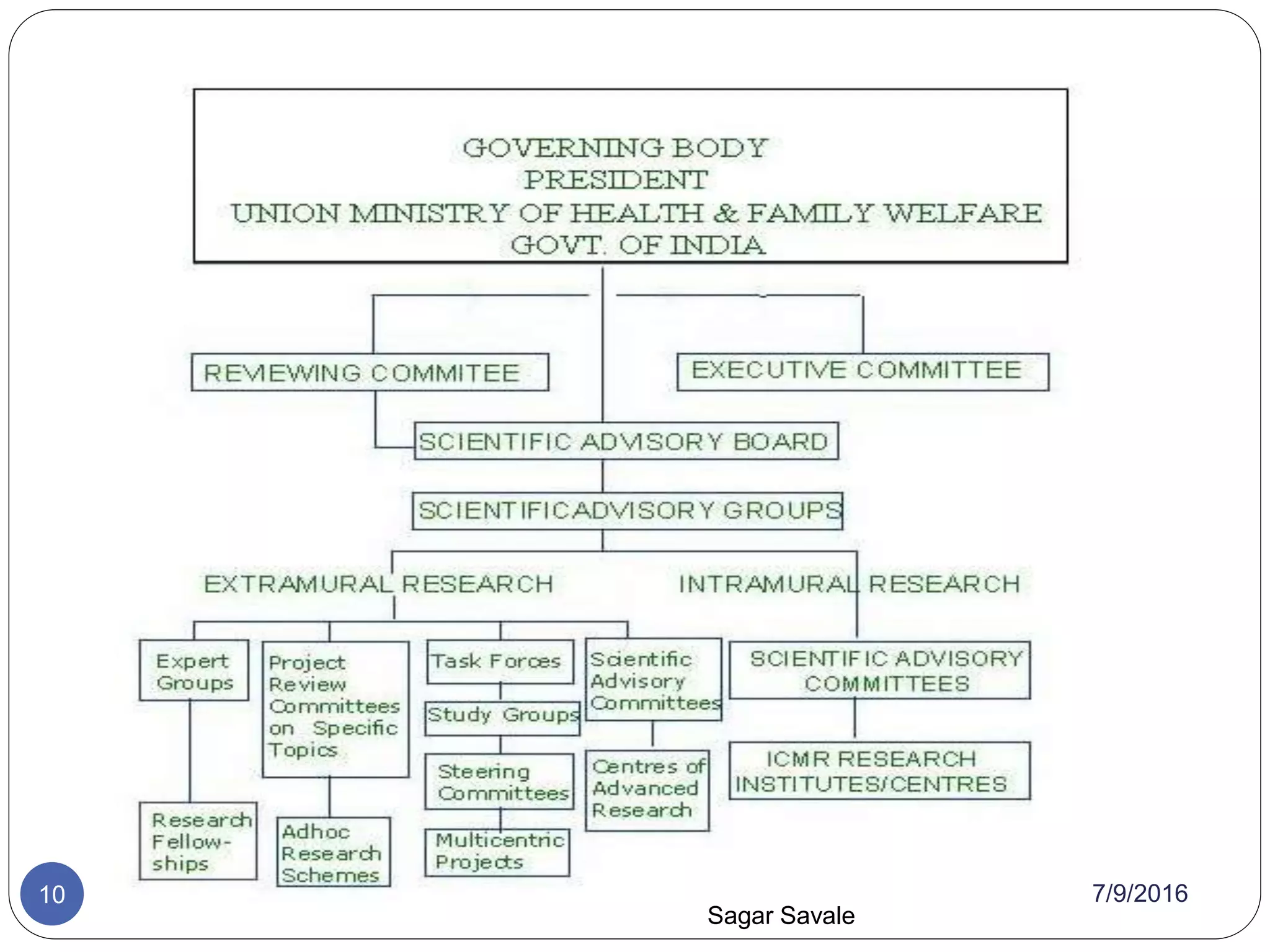
 The supreme authority of the ICMR, is headed by the Minister
of Health, Government of India.
 The Governing Body which is the chief executive and decision
making authority of the ICMR. It is headed by the Director-
General.
1. Union Health Minister.
2. Scientific Advisory Board.
-Scientific Advisory Group
-Scientific Advisory Committees
-Expert Groups.
-Task Forces.
-Steering Committees etc. which evaluate and monitor
different research activities of the Council.
Sagar Savale
9 7/9/2016
Sagar Savale
10 7/9/2016
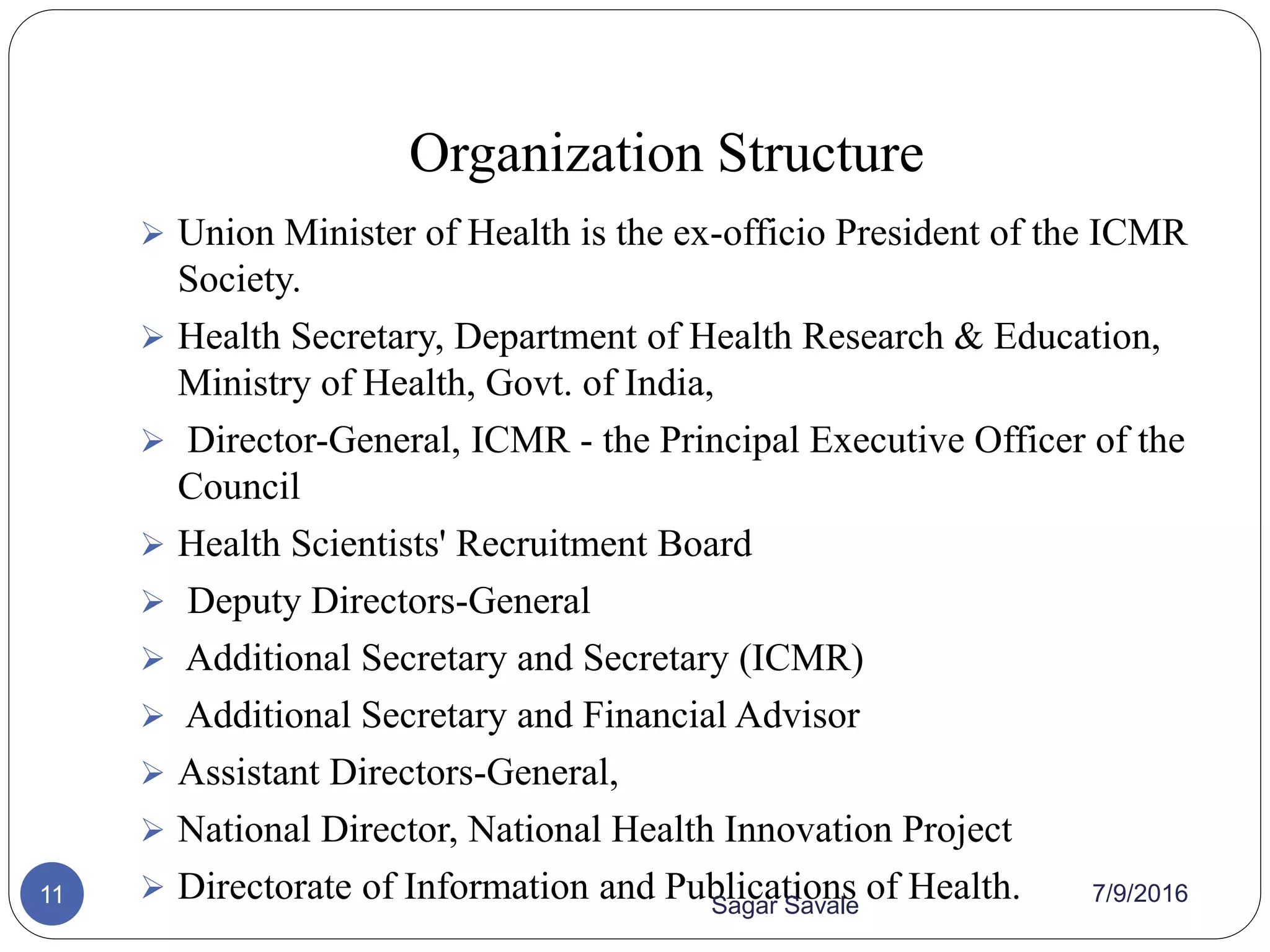
Organization Structure
 Union Minister of Health is the ex-officio President of the ICMR
Society.
 Health Secretary, Department of Health Research & Education,
Ministry of Health, Govt. of India,
 Director-General, ICMR - the Principal Executive Officer of the
Council
 Health Scientists' Recruitment Board
 Deputy Directors-General
 Additional Secretary and Secretary (ICMR)
 Additional Secretary and Financial Advisor
 Assistant Directors-General,
 National Director, National Health Innovation Project
 Directorate of Information and Publications of Health.Sagar Savale11 7/9/2016
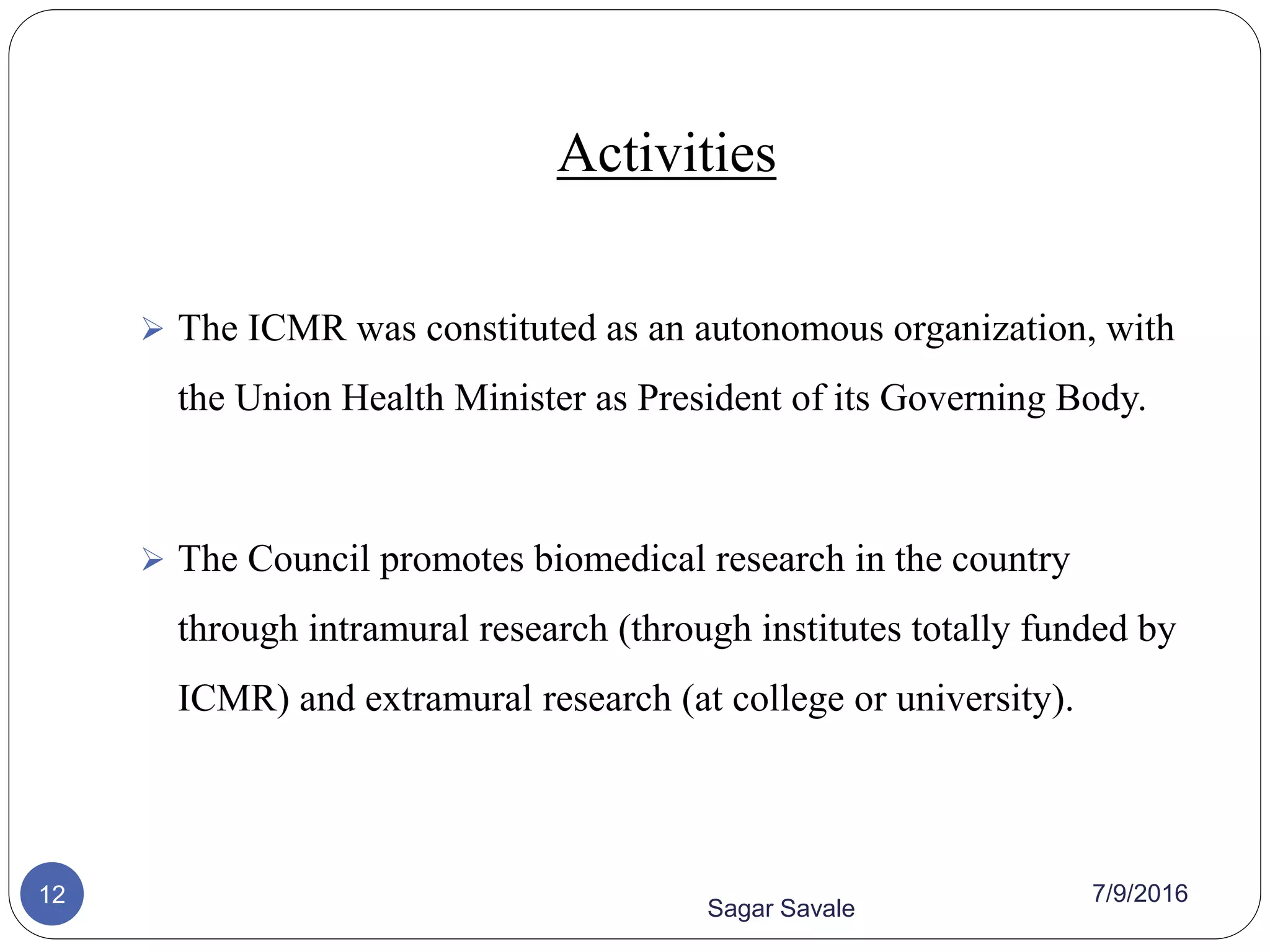
Activities
 The ICMR was constituted as an autonomous organization, with
the Union Health Minister as President of its Governing Body.
 The Council promotes biomedical research in the country
through intramural research (through institutes totally funded by
ICMR) and extramural research (at college or university).
Sagar Savale
12 7/9/2016
Intramural Research
Intramural research is carried out currently through the
Council's 30 Research Institutes/Centres.
These include
 19 mission-oriented national institutes :
 National Jalma institute for Leprosy & Other Mycobacterial
Diseases (NCJILOMD), Agra.
 National Institute of Occupational Health (NIOH), Ahmadabad.
 Tuberculosis Research Centre (TRC), Chennai
 National Institute of Malaria Research (NIMR), Delhi
 National Institute for Research in Tuberculosis (NIRT),Chennai
 National Institute of Pathology (NIP) ,Delhi
 National Institute of Medical Statistics (NIMS),Delhi.
Sagar Savale
13 7/9/2016
 National Institute for Research in Environmental Health
(NIREH),Bhopal
 National Centre for Disease Informatics and Research, Bangalore
 National Institute for Research in Reproductive Health
(NIRRH),Mumbai
 National Institute of Immunohaemotology (NIIH),Mumbai
 Enterovirus Research Centre (ERC),Mumbai
 Institute of Cytology and Preventive Oncology (ICPO), Noida
 Rajendra Memorial Research Institute of Medical Sciences
(RMRIMS), Patna
 Vector Control Research Centre (VCRC), Pondicherry
 National Institute of Virology (NIV),Pune
 National AIDS Research Institute (NARI),Pune.
Sagar Savale
14 7/9/2016
 6 Regional Medical Research Centres :
 Regional Medical Research Centre, Bhubaneswar
 Regional Medical Research Centre, Port Blair
 Regional Medical Research Centre, Jabalpur
 Desert Medicine Research Centre, Jodhpur
 Regional Medical Research Centre, Belgaum.
Sagar Savale
15 7/9/2016
 5 Unit/Centres :
 Food & Drug Toxicology Research Centre, Hyderabad
 National Centre of Laboratory Sciences, Hyderabad
 ICMR Virus Unit, Kolkata
 Genetic Research Centre, Mumbai
 Microbial Containment Complex, Pune.
Sagar Savale
16 7/9/2016
Extramural Research
Extramural research is promoted by ICMR through Setting up
 Centres for Advanced Research in selected departments of Medical
Colleges, Universities and other non-ICMR Research Institutes.
 Task force studies with goal-oriented approach with clearly defined
targets.
 Open-ended research in non-ICMR Research Institutes, Medical
colleges, Universities etc. located in different parts of the country.
Sagar Savale
17 7/9/2016
Fellowship & Schemes
The ICMR encourage human resources development in
biomedical research through various schemes such as
(1) Research Fellowships i.e. Junior and Senior Fellowships and
Research Associateships.
(2) Short-term Visiting Fellowships which allow scientists to learn
advanced research techniques from other well-established research
institutes in India.
(3) Short-term Research Studentships for undergraduate medical
students to encourage them to familiar themselves with research
methodologies and Techniques.
(4) Various Training Programme and Workshops conducted by ICMR
Institutes and Headquarters.
Sagar Savale
18 7/9/2016
National Health Programmes :
-National Malaria Eradication Programme
-National Filaria Control Programme
-National Leprosy Control Programme
-Diarrhoeal Diseases Control Programme
-National AIDS Control Programme
-National Cancer Control Programme
-Universal Immunization Programme
-National Tuberculosis Programme.
Sagar Savale
19 7/9/2016
Grant Schemes
 Studentships
Short Term Research Studentship
 Fellowships/ Associateships
Research Fellowships/ Associateships
Junior Research Fellowships
The schemes is aim at promoting good quality research in
medical colleges throught students persing post graduation
courses as well as improve visibility & accesslibility of their
research work.
Sagar Savale20 7/9/2016
Ethical Guidelines of ICMR
 Ethical Guidelines for Biomedical Research on Human
Participants.
 Executing research Policy.
 Guidelines for Good Clinical Laboratory Practices.
 National Guidelines for Accreditation, Supervision & Regulation
of ART Clinics in India.
 Cancer Management Guidelines.
 Guidelines for Stem Cell Research and Therapy .
Sagar Savale21 7/9/2016
 Guidelines for Management of Type 2 Diabetes.
 National Guidelines in the Management of Retinoblastoma.
 'ICMR-DBT' Guidelines for evaluation of probiotics in food.
 Dietary Guidelines.
ICMR should steer international collaborative health
research to ensure that the country derives maximum
Benefit and global goals are attained.
Sagar Savale22 7/9/2016
Periodical Publication
 Indian Journal of Medical Research
 ICMR Bulletins
 Annual Reports of ICMR Headquarters & Other ICMR
Institutes & Other Institutes.
 Health Research Policies
 Guidelines.
Sagar Savale23 7/9/2016
References
1. http://www.icmr.nic.in/guide.htm
Indian Council for Medical Research - Guidance for
International collaboration for research in biomedical science.
2. www.goggle.com
3. www.sciencedirect.com
Sagar Savale
24 7/9/2016
THANK YOU…
Sagar Savale25 7/9/2016

Indian council of medical research (ICMR)

  • 1.
    INDIAN COUNCIL OFMEDICAL RESEARCH http://www.icmr.nic.in Sagar Savale Mr. Sagar Kishor Savale [Department of Pharmaceutics] avengersagar16@gmail.com 2015-2016 1 7/9/2016
  • 2.
    Contents  Introduction  GoverningBodies  Activities  Fellowship & Schemes  Functions  References Sagar Savale 2 7/9/2016
  • 3.
    Introduction The ICMR, NewDelhi, is one of the oldest medical research body in the world and apex body in India.  The Indian Council of Medical Research (ICMR) is the premier national agency for the -planning -formulation -co-ordination -implementation -conduct or promotion of biomedical research in India. Sagar Savale 3 7/9/2016
  • 4.
     In 1911,the Government of India set up the Indian Research Fund Association (IRFA) with the specific objective of sponsoring and coordinating medical research in the country.  After independence, several important changes were made in the organization and the activities of the IRFA  It was redesignated the Indian Council of Medical Research (ICMR) in 1949, with expanded scope of functions & responsibility.  The ICMR is funded by the Government of India through the Ministry of Health and Family Welfare. Sagar Savale 4 7/9/2016
  • 5.
     The councilnot only plans & promotes medical research & emerging health problems of the country but also is expected to build strong national group of professional persons in organization of skilled biomedical scientists.  Rapid advances in science & technology have brought in new technologies to understand the disease process & find strategies for prevention & cure. Sagar Savale 5 7/9/2016
  • 6.
     The policiesof ICMR coincide with national health policies such as -control and management of communicable diseases, -fertility control, -maternal and child health, -control of nutritional disorders, -developing alternative strategies for health care delivery, -safety limits of environmental and occupational health problems, -Non-communicable diseases including cancer, cardiovascular, neurological, ophthalmic and haematological disorders. Sagar Savale 6 7/9/2016
  • 7.
    ICMR, with its30 state-of-the-art Institutes/Centers, is amongst research organizations in the field of Bio Medical Sciences. 1. The Indian Council of Medical Research provides financial assistance to promote biomedical and health research. 2. Proposals in fundamental research; development and evaluation of a tool, Clinical and operational research are considered for ICMR support. Objective Sagar Savale 7 7/9/2016
  • 8.
    Indian Council OfMedical Research Abbreviation ICMR Type Professional Organization Headquarters New Delhi Region served India Secretary & Director General Dr. V.M. Katoch Website http://www.icmr.nic.i n/ Sagar Savale 8 7/9/2016
  • 9.
    Governing Bodies  Thesupreme authority of the ICMR, is headed by the Minister of Health, Government of India.  The Governing Body which is the chief executive and decision making authority of the ICMR. It is headed by the Director- General. 1. Union Health Minister. 2. Scientific Advisory Board. -Scientific Advisory Group -Scientific Advisory Committees -Expert Groups. -Task Forces. -Steering Committees etc. which evaluate and monitor different research activities of the Council. Sagar Savale 9 7/9/2016
  • 10.
  • 11.
    Organization Structure  UnionMinister of Health is the ex-officio President of the ICMR Society.  Health Secretary, Department of Health Research & Education, Ministry of Health, Govt. of India,  Director-General, ICMR - the Principal Executive Officer of the Council  Health Scientists' Recruitment Board  Deputy Directors-General  Additional Secretary and Secretary (ICMR)  Additional Secretary and Financial Advisor  Assistant Directors-General,  National Director, National Health Innovation Project  Directorate of Information and Publications of Health.Sagar Savale11 7/9/2016
  • 12.
    Activities  The ICMRwas constituted as an autonomous organization, with the Union Health Minister as President of its Governing Body.  The Council promotes biomedical research in the country through intramural research (through institutes totally funded by ICMR) and extramural research (at college or university). Sagar Savale 12 7/9/2016
  • 13.
    Intramural Research Intramural researchis carried out currently through the Council's 30 Research Institutes/Centres. These include  19 mission-oriented national institutes :  National Jalma institute for Leprosy & Other Mycobacterial Diseases (NCJILOMD), Agra.  National Institute of Occupational Health (NIOH), Ahmadabad.  Tuberculosis Research Centre (TRC), Chennai  National Institute of Malaria Research (NIMR), Delhi  National Institute for Research in Tuberculosis (NIRT),Chennai  National Institute of Pathology (NIP) ,Delhi  National Institute of Medical Statistics (NIMS),Delhi. Sagar Savale 13 7/9/2016
  • 14.
     National Institutefor Research in Environmental Health (NIREH),Bhopal  National Centre for Disease Informatics and Research, Bangalore  National Institute for Research in Reproductive Health (NIRRH),Mumbai  National Institute of Immunohaemotology (NIIH),Mumbai  Enterovirus Research Centre (ERC),Mumbai  Institute of Cytology and Preventive Oncology (ICPO), Noida  Rajendra Memorial Research Institute of Medical Sciences (RMRIMS), Patna  Vector Control Research Centre (VCRC), Pondicherry  National Institute of Virology (NIV),Pune  National AIDS Research Institute (NARI),Pune. Sagar Savale 14 7/9/2016
  • 15.
     6 RegionalMedical Research Centres :  Regional Medical Research Centre, Bhubaneswar  Regional Medical Research Centre, Port Blair  Regional Medical Research Centre, Jabalpur  Desert Medicine Research Centre, Jodhpur  Regional Medical Research Centre, Belgaum. Sagar Savale 15 7/9/2016
  • 16.
     5 Unit/Centres:  Food & Drug Toxicology Research Centre, Hyderabad  National Centre of Laboratory Sciences, Hyderabad  ICMR Virus Unit, Kolkata  Genetic Research Centre, Mumbai  Microbial Containment Complex, Pune. Sagar Savale 16 7/9/2016
  • 17.
    Extramural Research Extramural researchis promoted by ICMR through Setting up  Centres for Advanced Research in selected departments of Medical Colleges, Universities and other non-ICMR Research Institutes.  Task force studies with goal-oriented approach with clearly defined targets.  Open-ended research in non-ICMR Research Institutes, Medical colleges, Universities etc. located in different parts of the country. Sagar Savale 17 7/9/2016
  • 18.
    Fellowship & Schemes TheICMR encourage human resources development in biomedical research through various schemes such as (1) Research Fellowships i.e. Junior and Senior Fellowships and Research Associateships. (2) Short-term Visiting Fellowships which allow scientists to learn advanced research techniques from other well-established research institutes in India. (3) Short-term Research Studentships for undergraduate medical students to encourage them to familiar themselves with research methodologies and Techniques. (4) Various Training Programme and Workshops conducted by ICMR Institutes and Headquarters. Sagar Savale 18 7/9/2016
  • 19.
    National Health Programmes: -National Malaria Eradication Programme -National Filaria Control Programme -National Leprosy Control Programme -Diarrhoeal Diseases Control Programme -National AIDS Control Programme -National Cancer Control Programme -Universal Immunization Programme -National Tuberculosis Programme. Sagar Savale 19 7/9/2016
  • 20.
    Grant Schemes  Studentships ShortTerm Research Studentship  Fellowships/ Associateships Research Fellowships/ Associateships Junior Research Fellowships The schemes is aim at promoting good quality research in medical colleges throught students persing post graduation courses as well as improve visibility & accesslibility of their research work. Sagar Savale20 7/9/2016
  • 21.
    Ethical Guidelines ofICMR  Ethical Guidelines for Biomedical Research on Human Participants.  Executing research Policy.  Guidelines for Good Clinical Laboratory Practices.  National Guidelines for Accreditation, Supervision & Regulation of ART Clinics in India.  Cancer Management Guidelines.  Guidelines for Stem Cell Research and Therapy . Sagar Savale21 7/9/2016
  • 22.
     Guidelines forManagement of Type 2 Diabetes.  National Guidelines in the Management of Retinoblastoma.  'ICMR-DBT' Guidelines for evaluation of probiotics in food.  Dietary Guidelines. ICMR should steer international collaborative health research to ensure that the country derives maximum Benefit and global goals are attained. Sagar Savale22 7/9/2016
  • 23.
    Periodical Publication  IndianJournal of Medical Research  ICMR Bulletins  Annual Reports of ICMR Headquarters & Other ICMR Institutes & Other Institutes.  Health Research Policies  Guidelines. Sagar Savale23 7/9/2016
  • 24.
    References 1. http://www.icmr.nic.in/guide.htm Indian Councilfor Medical Research - Guidance for International collaboration for research in biomedical science. 2. www.goggle.com 3. www.sciencedirect.com Sagar Savale 24 7/9/2016
  • 25.