Parathyroid gland
By: Sabir Abdulrahman
Objectives
• Anatomy
• Physiology
• Presenting problems
• Diseases of parathyroid
• Parathyroid neoplasms
Anatomy
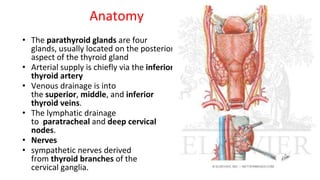
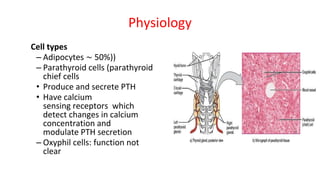
• The parathyroid glands are four
glands, usually located on the posterior
aspect of the thyroid gland
• Arterial supply is chiefly via the inferior
thyroid artery
• Venous drainage is into
the superior, middle, and inferior
thyroid veins.
• The lymphatic drainage
to paratracheal and deep cervical
nodes.
• Nerves
• sympathetic nerves derived
from thyroid branches of the
cervical ganglia.
Physiology
Cell types
– Adipocytes ∼ 50%))
– Parathyroid cells (parathyroid
chief cells
• Produce and secrete PTH
• Have calcium
sensing receptors which
detect changes in calcium
concentration and
modulate PTH secretion
– Oxyphil cells: function not
clear
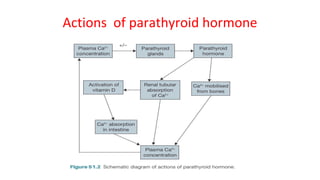
Actions of parathyroid hormone
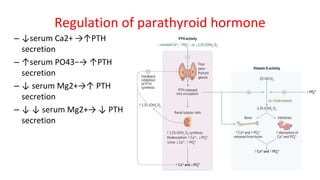
– ↓serum Ca2+ →↑PTH
secretion
– ↑serum PO43−→ ↑PTH
secretion
– ↓ serum Mg2+→↑ PTH
secretion
– ↓ ↓ serum Mg2+→ ↓ PTH
secretion
Regulation of parathyroid hormone
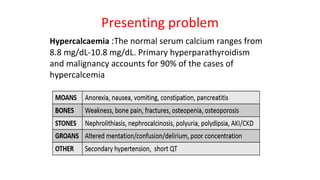
Presenting problem
Hypercalcaemia :The normal serum calcium ranges from
8.8 mg/dL-10.8 mg/dL. Primary hyperparathyroidism
and malignancy accounts for 90% of the cases of
hypercalcemia
Presenting problem
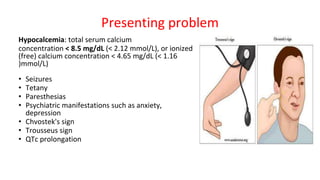
Hypocalcemia: total serum calcium
concentration < 8.5 mg/dL (< 2.12 mmol/L), or ionized
(free) calcium concentration < 4.65 mg/dL (< 1.16
)mmol/L)
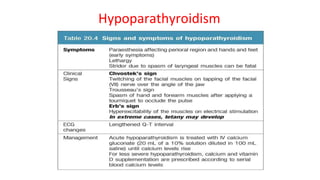
• Seizures
• Tetany
• Paresthesias
• Psychiatric manifestations such as anxiety,
depression
• Chvostek's sign
• Trousseus sign
• QTc prolongation
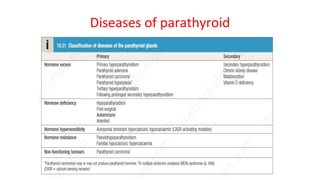
Diseases of parathyroid
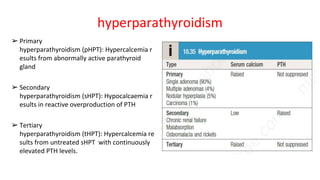
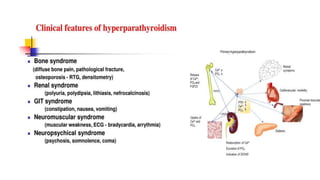
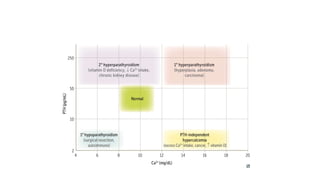
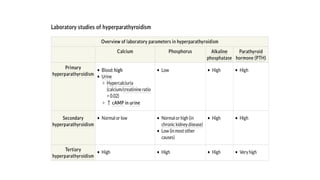
hyperparathyroidism
➢ Primary
hyperparathyroidism (pHPT): Hypercalcemia r
esults from abnormally active parathyroid
gland
➢ Secondary
hyperparathyroidism (sHPT): Hypocalcaemia r
esults in reactive overproduction of PTH
➢ Tertiary
hyperparathyroidism (tHPT): Hypercalcemia re
sults from untreated sHPT with continuously
elevated PTH levels.
Imaging
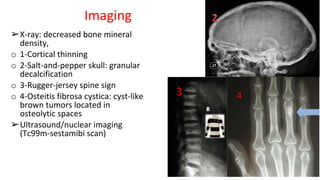
➢X-ray: decreased bone mineral
density,
o 1-Cortical thinning
o 2-Salt-and-pepper skull: granular
decalcification
o 3-Rugger-jersey spine sign
o 4-Osteitis fibrosa cystica: cyst-like
brown tumors located in
osteolytic spaces
➢Ultrasound/nuclear imaging
(Tc99m-sestamibi scan)
3 4
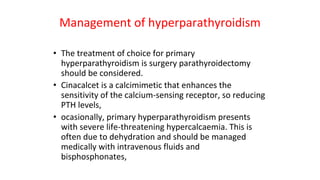
Management of hyperparathyroidism
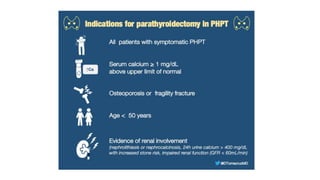
• The treatment of choice for primary
hyperparathyroidism is surgery parathyroidectomy
should be considered.
• Cinacalcet is a calcimimetic that enhances the
sensitivity of the calcium-sensing receptor, so reducing
PTH levels,
• ocasionally, primary hyperparathyroidism presents
with severe life-threatening hypercalcaemia. This is
often due to dehydration and should be managed
medically with intravenous fluids and
bisphosphonates,
Hypoparathyroidism
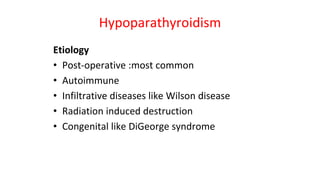
Etiology
• Post-operative :most common
• Autoimmune
• Infiltrative diseases like Wilson disease
• Radiation induced destruction
• Congenital like DiGeorge syndrome
Hypoparathyroidism
management of hypoparathyroidism
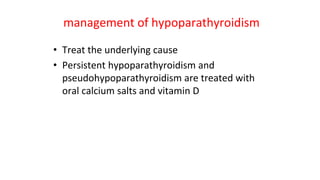
• Treat the underlying cause
• Persistent hypoparathyroidism and
pseudohypoparathyroidism are treated with
oral calcium salts and vitamin D
Familial Hypocalciuric Hypercalcemia
• Familial hypocalciuric hypercalcemia (FHH) is a rare
autosomal dominant condition. It occurs as a result
of mutations in the calcium-sensing receptor gene
(CASR) causing decreased receptor activity. Patients
have mild hypercalcemia, hypocalciuria,
hypermagnesemia, hypophosphatemia.
Parathyroid hormone is normal or mildly elevated
Familial hypocalciuric hypercalcaemia
Defective G-coupled Ca2+-sensing receptors in
multiple tissues (e.g., parathyroid, kidneys). Higher
than normal Ca2+ levels required to suppress PTH.
Excessive renal Ca2+ reabsorption mild hypercalcemia
and hypocalciuria with normal to PTH levels.
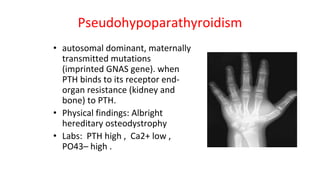
Pseudohypoparathyroidism
• autosomal dominant, maternally
transmitted mutations
(imprinted GNAS gene). when
PTH binds to its receptor end-
organ resistance (kidney and
bone) to PTH.
• Physical findings: Albright
hereditary osteodystrophy
• Labs: PTH high , Ca2+ low ,
PO43– high .
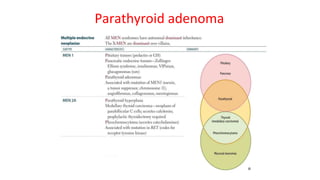
Parathyroid adenoma
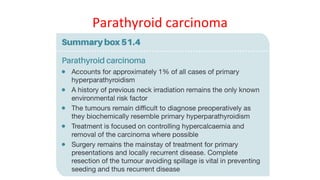
Parathyroid carcinoma
Parathyroid gland v2.pptx

Parathyroid gland v2.pptx

  • 1.
  • 2.
    Objectives • Anatomy • Physiology •Presenting problems • Diseases of parathyroid • Parathyroid neoplasms
  • 3.
    Anatomy • The parathyroidglands are four glands, usually located on the posterior aspect of the thyroid gland • Arterial supply is chiefly via the inferior thyroid artery • Venous drainage is into the superior, middle, and inferior thyroid veins. • The lymphatic drainage to paratracheal and deep cervical nodes. • Nerves • sympathetic nerves derived from thyroid branches of the cervical ganglia.
  • 4.
    Physiology Cell types – Adipocytes∼ 50%)) – Parathyroid cells (parathyroid chief cells • Produce and secrete PTH • Have calcium sensing receptors which detect changes in calcium concentration and modulate PTH secretion – Oxyphil cells: function not clear
  • 5.
  • 6.
    – ↓serum Ca2+→↑PTH secretion – ↑serum PO43−→ ↑PTH secretion – ↓ serum Mg2+→↑ PTH secretion – ↓ ↓ serum Mg2+→ ↓ PTH secretion Regulation of parathyroid hormone
  • 7.
    Presenting problem Hypercalcaemia :Thenormal serum calcium ranges from 8.8 mg/dL-10.8 mg/dL. Primary hyperparathyroidism and malignancy accounts for 90% of the cases of hypercalcemia
  • 8.
    Presenting problem Hypocalcemia: totalserum calcium concentration < 8.5 mg/dL (< 2.12 mmol/L), or ionized (free) calcium concentration < 4.65 mg/dL (< 1.16 )mmol/L) • Seizures • Tetany • Paresthesias • Psychiatric manifestations such as anxiety, depression • Chvostek's sign • Trousseus sign • QTc prolongation
  • 9.
  • 10.
    hyperparathyroidism ➢ Primary hyperparathyroidism (pHPT):Hypercalcemia r esults from abnormally active parathyroid gland ➢ Secondary hyperparathyroidism (sHPT): Hypocalcaemia r esults in reactive overproduction of PTH ➢ Tertiary hyperparathyroidism (tHPT): Hypercalcemia re sults from untreated sHPT with continuously elevated PTH levels.
  • 14.
    Imaging ➢X-ray: decreased bonemineral density, o 1-Cortical thinning o 2-Salt-and-pepper skull: granular decalcification o 3-Rugger-jersey spine sign o 4-Osteitis fibrosa cystica: cyst-like brown tumors located in osteolytic spaces ➢Ultrasound/nuclear imaging (Tc99m-sestamibi scan) 3 4
  • 15.
    Management of hyperparathyroidism •The treatment of choice for primary hyperparathyroidism is surgery parathyroidectomy should be considered. • Cinacalcet is a calcimimetic that enhances the sensitivity of the calcium-sensing receptor, so reducing PTH levels, • ocasionally, primary hyperparathyroidism presents with severe life-threatening hypercalcaemia. This is often due to dehydration and should be managed medically with intravenous fluids and bisphosphonates,
  • 17.
    Hypoparathyroidism Etiology • Post-operative :mostcommon • Autoimmune • Infiltrative diseases like Wilson disease • Radiation induced destruction • Congenital like DiGeorge syndrome
  • 18.
  • 19.
    management of hypoparathyroidism •Treat the underlying cause • Persistent hypoparathyroidism and pseudohypoparathyroidism are treated with oral calcium salts and vitamin D
  • 20.
    Familial Hypocalciuric Hypercalcemia •Familial hypocalciuric hypercalcemia (FHH) is a rare autosomal dominant condition. It occurs as a result of mutations in the calcium-sensing receptor gene (CASR) causing decreased receptor activity. Patients have mild hypercalcemia, hypocalciuria, hypermagnesemia, hypophosphatemia. Parathyroid hormone is normal or mildly elevated
  • 21.
    Familial hypocalciuric hypercalcaemia DefectiveG-coupled Ca2+-sensing receptors in multiple tissues (e.g., parathyroid, kidneys). Higher than normal Ca2+ levels required to suppress PTH. Excessive renal Ca2+ reabsorption mild hypercalcemia and hypocalciuria with normal to PTH levels.
  • 22.
    Pseudohypoparathyroidism • autosomal dominant,maternally transmitted mutations (imprinted GNAS gene). when PTH binds to its receptor end- organ resistance (kidney and bone) to PTH. • Physical findings: Albright hereditary osteodystrophy • Labs: PTH high , Ca2+ low , PO43– high .
  • 23.
  • 24.

Editor's Notes

  • #15 *Most commonly seen in primary hyperparathyroidism but can also occur in secondary hyperparathyroidism (↑ PTH → activation of osteoclasts
  • #23 GNAS1-inactivating mutation (coupled to PTH receptor) that encodes the Gs protein α subunit inactivation of adenylate cyclase