BY SHALVIN ABISEKH NAND
20180571
MBBS YR 2
CONTENTS
• Introduction
• History
• Pathophysiology
• Symptoms
• Complications
• Differential diagnosis
• Diagnosis
• Treatment
• Conclusion
• Reference
WHAT IS IT?
• Riedel thyroiditis (fibrous thyroiditis, RT) is a rare form of thyroiditis
leading to a gradual parenchymal transformation to connective tissue
causing compression and fibrosis of adjacent tissues
• It affects adjacent structures as the parathyroid glands, musculature in
the neck and cause vocal cord paralysis.
• It may be associated with fibrosis in other sites in the body, such as the
retroperitoneum, and appears to be another manifestation of a systemic
autoimmune IgG4-related disease, which is associated with fibrosis
and tissue infiltration by plasma cells producing IgG4
HISTORY
• It is named after Bernhard Riedel.
• In 1883 he first recognized the disease and later
in year 1896 published its description.
PATHOPHYSIOLOGY
• It is characterized by a replacement of the normal thyroid parenchyma
by a dense fibrosis that invades adjacent structures of the neck and
extends beyond the thyroid capsule.
• This process makes thyroid gland stone-hard and fixed to adjacent
structures.
• The inflammatory process infiltrates muscles and causes symptoms of
tracheal compression.
SYMPTOMS
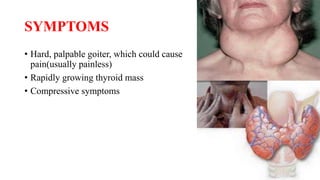
• Hard, palpable goiter, which could cause
pain(usually painless)
• Rapidly growing thyroid mass
• Compressive symptoms
COMPLICATIONS
• Airway obstruction
• Dysphonia
• Hoarseness
• Hypothyroidism
• Hypoparathyroidism
DIFFERENTIAL DIAGNOSIS
• De Quervain thyroiditis
• Goiter
• Hashimoto thyroiditis
• Thyroid lymphoma
• Anaplastic carcinoma
• Thyroditis, subacute
DIAGNOSIS
• Thyroid antibodies present in 2/3
• Biopsy often needed
TREATMENT
• Resection for compressive symptoms if severe
• Tamoxifen, methotrexate and steroids
• Thyroid hormone for hypothyroidism
CONCLUSION
• Riedel thyroiditis is a rare type of thyroiditis and often misdiagnosed.
Thus it is important to differentiate between different types of
thyroiditis for proper diagnosis.
REFERENCE
• KUMAR, V., ABBAS, A. K., ASTER, J. C., & ROBBINS, S. L.
(2013). Robbins basic pathology. Philadelphia, PA, Elsevier/Saunders.
• BRS Pathology
• https://www.researchgate.net/publication/322778584_Riedel's_thyroid
itis_clinical_presentation_treatment_and_outcomes
• https://www.ncbi.nlm.nih.gov/books/NBK537303/
• https://www.slideshare.net/drpradeeppande/thyroiditis-54573277
• https://emedicine.medscape.com/article/125243-overview

Riedel thyroiditis

  • 1.
    BY SHALVIN ABISEKHNAND 20180571 MBBS YR 2
  • 2.
    CONTENTS • Introduction • History •Pathophysiology • Symptoms • Complications • Differential diagnosis • Diagnosis • Treatment • Conclusion • Reference
  • 3.
    WHAT IS IT? •Riedel thyroiditis (fibrous thyroiditis, RT) is a rare form of thyroiditis leading to a gradual parenchymal transformation to connective tissue causing compression and fibrosis of adjacent tissues • It affects adjacent structures as the parathyroid glands, musculature in the neck and cause vocal cord paralysis. • It may be associated with fibrosis in other sites in the body, such as the retroperitoneum, and appears to be another manifestation of a systemic autoimmune IgG4-related disease, which is associated with fibrosis and tissue infiltration by plasma cells producing IgG4
  • 4.
    HISTORY • It isnamed after Bernhard Riedel. • In 1883 he first recognized the disease and later in year 1896 published its description.
  • 6.
    PATHOPHYSIOLOGY • It ischaracterized by a replacement of the normal thyroid parenchyma by a dense fibrosis that invades adjacent structures of the neck and extends beyond the thyroid capsule. • This process makes thyroid gland stone-hard and fixed to adjacent structures. • The inflammatory process infiltrates muscles and causes symptoms of tracheal compression.
  • 7.
    SYMPTOMS • Hard, palpablegoiter, which could cause pain(usually painless) • Rapidly growing thyroid mass • Compressive symptoms
  • 8.
    COMPLICATIONS • Airway obstruction •Dysphonia • Hoarseness • Hypothyroidism • Hypoparathyroidism
  • 9.
    DIFFERENTIAL DIAGNOSIS • DeQuervain thyroiditis • Goiter • Hashimoto thyroiditis • Thyroid lymphoma • Anaplastic carcinoma • Thyroditis, subacute
  • 10.
    DIAGNOSIS • Thyroid antibodiespresent in 2/3 • Biopsy often needed
  • 11.
    TREATMENT • Resection forcompressive symptoms if severe • Tamoxifen, methotrexate and steroids • Thyroid hormone for hypothyroidism
  • 12.
    CONCLUSION • Riedel thyroiditisis a rare type of thyroiditis and often misdiagnosed. Thus it is important to differentiate between different types of thyroiditis for proper diagnosis.
  • 13.
    REFERENCE • KUMAR, V.,ABBAS, A. K., ASTER, J. C., & ROBBINS, S. L. (2013). Robbins basic pathology. Philadelphia, PA, Elsevier/Saunders. • BRS Pathology • https://www.researchgate.net/publication/322778584_Riedel's_thyroid itis_clinical_presentation_treatment_and_outcomes • https://www.ncbi.nlm.nih.gov/books/NBK537303/ • https://www.slideshare.net/drpradeeppande/thyroiditis-54573277 • https://emedicine.medscape.com/article/125243-overview

Editor's Notes

  • #2 In Riedel thyroiditis, the thyroid is replaced by fibrous tissue and can clinically mimic carcinoma. Pg 231 Riedel thyroiditis, 495, 495f, 533, 988–989, 1010
  • #5 Riedel was a pioneer in the surgical treatment of appendicitis and cholecystitis. In 1888 he performed the first choledochoduodenostomy  Riedel's lobe: A tongue-shaped process of the liver, often found protruding over the gallbladder in cases of chronic cholecystitis. (1846-1916) Bernhard Moritz Carl Ludwig Riedel
  • #6 Gross pathology of Riedel thyroiditis Here’s another kind of thyroiditis: fibrosing (or Riedel) thyroiditis. This one is totally different than subacute granulomatous thyroiditis. In fibrosing thyroiditis, the thyroid becomes overrun by fibrous tissue (guess that’s why they picked that name). For some unkown reason, fibroblasts just start proliferating and laying down collagen. In the picture above, there is one pathetic-looking residual follicle, surrounded by lymphocytes, in a sea of fibrotic tissue. As the disease progresses, the thyroid becomes a rock-hard, woody mass. If it gets big enough, it can compress some of the important structures in the neck, like the trachea, and it may need to be removed.