Urinary tract infection
(UTI)
UoD - college of medicine
Contents
Introduction
Classification
Epidemiology
Etiology
Pathogenesis
Risk factors
Clinical features
Investigations
Treatment
Introduction
• urinary tract infection (UTI) is an infection in any
part of the urinary system —kidneys, ureters,
bladder and urethra
• UTI may be asymptomatic (subclinical infection)
or symptomatic (disease). Thus, the term UTI
encompasses a variety of clinical entities,
including asymptomatic bacteriuria (ABU),
urethritis, cystitis, prostatitis, and pyelonephritis.
• Urinary tract infection (UTI) is a common and
painful human illness that, fortunately, is
rapidly responsive to modern antibiotic
therapy. In the preantibiotic era, UTI caused
significant morbidity.
Classification
UTI
Upper
• Acute pyelonephritis
• Chronic pyelonephritis
• Interstitial pyelonephritis
• Renal/ perirenal abscess
Lower
• Cystitis
• Prostatitis
• Urethritis
Both are further divided into complicated and uncomplicated
UTI terminology
• Uncomplicated : UTI without underlying renal or
neurologic disaese
• Complicated: UTI with underlying structural,
medical or neurologic disease
• Recurrent: > 3 symptomatic UTIs within 12 months
following clinical therapy
• Reinfection: Recurrent UTI caused by a different
pathogen at any time
• Relapse: recurrent UTI caused by same species
causing original UTI within 2 weeks after therapy
Epidemiology
• Except among infants and the elderly, UTI occurs far
more commonly in females than in males.
• During the neonatal period, the incidence of UTI is
slightly higher among males because male infants more
commonly have congenital urinary tract anomalies.
• After 50 years of age, obstruction from prostatic
hypertrophy becomes common in men,
• Between 1 year and ∼50 years of age, UTI and recurrent
UTI are predominantly diseases of females.
• As many as 50–80% of women in the general population
acquire at least one UTI during their lifetime—
uncomplicated cystitis in most cases.
Etiology
• In acute uncomplicated cystitis in the United States, the
etiologic agents are highly predictable:
-E. coli accounts for 75–90% of isolates;
-Staphylococcus saprophyticus for 5–15%
-Klebsiella species, Proteus species, Enterococcus
species, Citrobacter species, and others for 5– 10%.
Similar etiologic agents are found in Europe and Brazil.
• The spectrum of agents causing uncomplicated
pyelonephritis is similar, with E. coli predominating.
Etiology cont..
• In complicated UTI (e.g., CAUTI), E. coli
remains the predominant organism, but other
aerobic gram-negative rods, such as Klebsiella
species, Proteus species…..etc, also are
frequently isolated.
• Gram-positive bacteria (e.g., enterococci and
Staphylococcus aureus) and yeasts are also
important pathogens in complicated UTI.
Pathogenesis
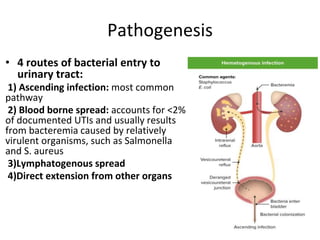
• 4 routes of bacterial entry to
urinary tract:
1) Ascending infection: most common
pathway
2) Blood borne spread: accounts for <2%
of documented UTIs and usually results
from bacteremia caused by relatively
virulent organisms, such as Salmonella
and S. aureus
3)Lymphatogenous spread
4)Direct extension from other organs
f
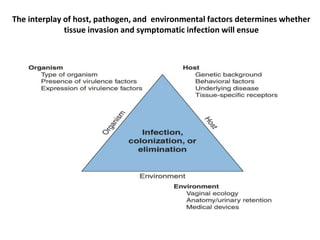
The interplay of host, pathogen, and environmental factors determines whether
tissue invasion and symptomatic infection will ensue
• For example, bacteria often enter the bladder after
sexual intercourse, but normal voiding and innate
host defense mechanisms in the bladder eliminate
these organisms.
• Any foreign body in the urinary tract, such as a
urinary catheter or stone, provides an inert surface
for bacterial colonization.
• Abnormal micturition and/or significant residual
urine volume promotes true infection.
• In the simplest of terms, anything that increases
the likelihood of bacteria entering the bladder and
staying there increases the risk of UTI.
Clinical features
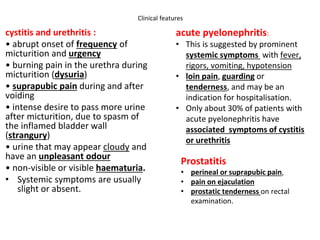
cystitis and urethritis :
• abrupt onset of frequency of
micturition and urgency
• burning pain in the urethra during
micturition (dysuria)
• suprapubic pain during and after
voiding
• intense desire to pass more urine
after micturition, due to spasm of
the inflamed bladder wall
(strangury)
• urine that may appear cloudy and
have an unpleasant odour
• non-visible or visible haematuria.
• Systemic symptoms are usually
slight or absent.
acute pyelonephritis:
• This is suggested by prominent
systemic symptoms with fever,
rigors, vomiting, hypotension
• loin pain, guarding or
tenderness, and may be an
indication for hospitalisation.
• Only about 30% of patients with
acute pyelonephritis have
associated symptoms of cystitis
or urethritis
Prostatitis
• perineal or suprapubic pain,
• pain on ejaculation
• prostatic tenderness on rectal
examination.
Treatment
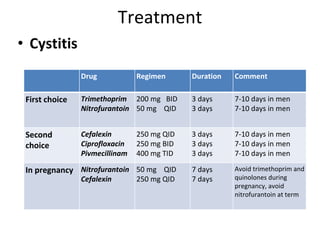
• Cystitis
Drug Regimen Duration Comment
First choice Trimethoprim
Nitrofurantoin
200 mg BID
50 mg QID
3 days
3 days
7-10 days in men
7-10 days in men
Second
choice
Cefalexin
Ciprofloxacin
Pivmecillinam
250 mg QID
250 mg BID
400 mg TID
3 days
3 days
3 days
7-10 days in men
7-10 days in men
7-10 days in men
In pregnancy Nitrofurantoin
Cefalexin
50 mg QID
250 mg QID
7 days
7 days
Avoid trimethoprim and
quinolones during
pregnancy, avoid
nitrofurantoin at term
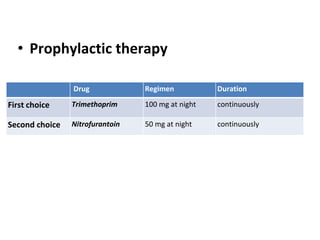
• Prophylactic therapy
Drug Regimen Duration
First choice Trimethoprim 100 mg at night continuously
Second choice Nitrofurantoin 50 mg at night continuously
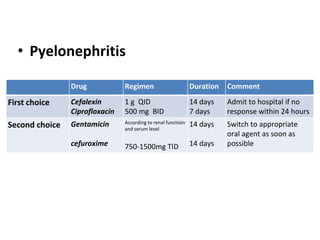
• Pyelonephritis
Drug Regimen Duration Comment
First choice Cefalexin
Ciprofloxacin
1 g QID
500 mg BID
14 days
7 days
Admit to hospital if no
response within 24 hours
Second choice Gentamicin
cefuroxime
According to renal functioin
and serum level
750-1500mg TID
14 days
14 days
Switch to appropriate
oral agent as soon as
possible
• References
• HARRISONS NEPHROLOGY AND ACID BASE BALANCE, 2nd edition
• DAVIDSONS PRINCIPLES AND PRACTICE OF MEDICINE , 23rd edition
• Slideshare website
Thank you

(UTI) presentation.pptx

  • 1.
    Urinary tract infection (UTI) UoD- college of medicine
  • 2.
  • 3.
    Introduction • urinary tractinfection (UTI) is an infection in any part of the urinary system —kidneys, ureters, bladder and urethra • UTI may be asymptomatic (subclinical infection) or symptomatic (disease). Thus, the term UTI encompasses a variety of clinical entities, including asymptomatic bacteriuria (ABU), urethritis, cystitis, prostatitis, and pyelonephritis.
  • 4.
    • Urinary tractinfection (UTI) is a common and painful human illness that, fortunately, is rapidly responsive to modern antibiotic therapy. In the preantibiotic era, UTI caused significant morbidity.
  • 5.
    Classification UTI Upper • Acute pyelonephritis •Chronic pyelonephritis • Interstitial pyelonephritis • Renal/ perirenal abscess Lower • Cystitis • Prostatitis • Urethritis Both are further divided into complicated and uncomplicated
  • 6.
    UTI terminology • Uncomplicated: UTI without underlying renal or neurologic disaese • Complicated: UTI with underlying structural, medical or neurologic disease • Recurrent: > 3 symptomatic UTIs within 12 months following clinical therapy • Reinfection: Recurrent UTI caused by a different pathogen at any time • Relapse: recurrent UTI caused by same species causing original UTI within 2 weeks after therapy
  • 7.
    Epidemiology • Except amonginfants and the elderly, UTI occurs far more commonly in females than in males. • During the neonatal period, the incidence of UTI is slightly higher among males because male infants more commonly have congenital urinary tract anomalies. • After 50 years of age, obstruction from prostatic hypertrophy becomes common in men, • Between 1 year and ∼50 years of age, UTI and recurrent UTI are predominantly diseases of females. • As many as 50–80% of women in the general population acquire at least one UTI during their lifetime— uncomplicated cystitis in most cases.
  • 8.
    Etiology • In acuteuncomplicated cystitis in the United States, the etiologic agents are highly predictable: -E. coli accounts for 75–90% of isolates; -Staphylococcus saprophyticus for 5–15% -Klebsiella species, Proteus species, Enterococcus species, Citrobacter species, and others for 5– 10%. Similar etiologic agents are found in Europe and Brazil. • The spectrum of agents causing uncomplicated pyelonephritis is similar, with E. coli predominating.
  • 9.
    Etiology cont.. • Incomplicated UTI (e.g., CAUTI), E. coli remains the predominant organism, but other aerobic gram-negative rods, such as Klebsiella species, Proteus species…..etc, also are frequently isolated. • Gram-positive bacteria (e.g., enterococci and Staphylococcus aureus) and yeasts are also important pathogens in complicated UTI.
  • 10.
    Pathogenesis • 4 routesof bacterial entry to urinary tract: 1) Ascending infection: most common pathway 2) Blood borne spread: accounts for <2% of documented UTIs and usually results from bacteremia caused by relatively virulent organisms, such as Salmonella and S. aureus 3)Lymphatogenous spread 4)Direct extension from other organs f
  • 11.
    The interplay ofhost, pathogen, and environmental factors determines whether tissue invasion and symptomatic infection will ensue
  • 12.
    • For example,bacteria often enter the bladder after sexual intercourse, but normal voiding and innate host defense mechanisms in the bladder eliminate these organisms. • Any foreign body in the urinary tract, such as a urinary catheter or stone, provides an inert surface for bacterial colonization. • Abnormal micturition and/or significant residual urine volume promotes true infection. • In the simplest of terms, anything that increases the likelihood of bacteria entering the bladder and staying there increases the risk of UTI.
  • 14.
    Clinical features cystitis andurethritis : • abrupt onset of frequency of micturition and urgency • burning pain in the urethra during micturition (dysuria) • suprapubic pain during and after voiding • intense desire to pass more urine after micturition, due to spasm of the inflamed bladder wall (strangury) • urine that may appear cloudy and have an unpleasant odour • non-visible or visible haematuria. • Systemic symptoms are usually slight or absent. acute pyelonephritis: • This is suggested by prominent systemic symptoms with fever, rigors, vomiting, hypotension • loin pain, guarding or tenderness, and may be an indication for hospitalisation. • Only about 30% of patients with acute pyelonephritis have associated symptoms of cystitis or urethritis Prostatitis • perineal or suprapubic pain, • pain on ejaculation • prostatic tenderness on rectal examination.
  • 16.
    Treatment • Cystitis Drug RegimenDuration Comment First choice Trimethoprim Nitrofurantoin 200 mg BID 50 mg QID 3 days 3 days 7-10 days in men 7-10 days in men Second choice Cefalexin Ciprofloxacin Pivmecillinam 250 mg QID 250 mg BID 400 mg TID 3 days 3 days 3 days 7-10 days in men 7-10 days in men 7-10 days in men In pregnancy Nitrofurantoin Cefalexin 50 mg QID 250 mg QID 7 days 7 days Avoid trimethoprim and quinolones during pregnancy, avoid nitrofurantoin at term
  • 17.
    • Prophylactic therapy DrugRegimen Duration First choice Trimethoprim 100 mg at night continuously Second choice Nitrofurantoin 50 mg at night continuously
  • 18.
    • Pyelonephritis Drug RegimenDuration Comment First choice Cefalexin Ciprofloxacin 1 g QID 500 mg BID 14 days 7 days Admit to hospital if no response within 24 hours Second choice Gentamicin cefuroxime According to renal functioin and serum level 750-1500mg TID 14 days 14 days Switch to appropriate oral agent as soon as possible
  • 19.
    • References • HARRISONSNEPHROLOGY AND ACID BASE BALANCE, 2nd edition • DAVIDSONS PRINCIPLES AND PRACTICE OF MEDICINE , 23rd edition • Slideshare website
  • 20.