Sympathetic and
Parasympathetic Nervous
Systems
EHS unit 4
Learning Targets
• Describe the opposing functions of the
parasympathetic and sympathetic
divisions of the autonomic nervous
system.
Autonomic Nervous System,
Review
• This is the automated system that controls
our vital functions.
– Modifies heart and respiratory rate
– Controls smooth muscles through out the
body
– Controls processes of digestive, urinary, and
reproductive systems.
– Controls functions of glands through out the
body.
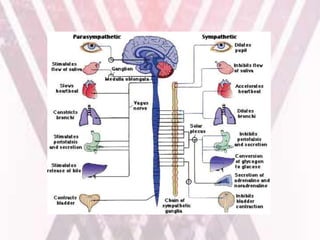
Parasympathetic Nervous System
• The “rest and digest” or “feed and breed”
system.
– Opposed by the sympathetic nervous system.
• Major pathways:
– Cranial nerves III, VII, IX
– Vagus Nerve**
– Pelvic Splanchnic Nerve
Neurotransmitters in the PSNS
• The PSNS uses Acetylcholine as it’s
primary neurotransmitter.
– It is used to stimulate the smooth muscles in
the vital organs.
– Other chemicals used to stimulate excretion
are used as well.
Functions of the PSNS
• Again, Rest and Digest + Feed and Breed.
– This is the “chill” nervous system.
• It encourages our digestive and urinary tracts to do
their jobs by increasing blood flow to them.
• It increases secretion in the mucous membranes.
• Sexual response is rooted in this system.
• Heart rate and respirations are slowed to resting rates.
• Helps to initiate sleep.
Sympathetic Nervous System
• This is the “freak out” or “fight/flight”
response system.
– This system is in control when we perceive
danger, urgency, or anxiety.
• Major Pathways for this system:
– Sympathetic Pathways are primarily from T1
(thoracic) to L2 (lumbar).
Neurotransmitters of the SNS
• The SNS relies on several
neurotransmitters to functions.
– Epinephrine and Norepinephrine
(adrenalines)
Adrenaline is a hormone and a
neurotransmitter.
– ACH is also used to stimulate sweat glands,
etc.
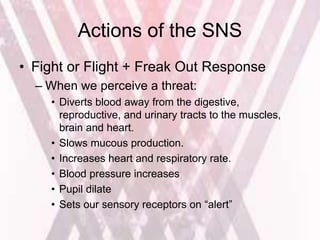
Actions of the SNS
• Fight or Flight + Freak Out Response
– When we perceive a threat:
• Diverts blood away from the digestive,
reproductive, and urinary tracts to the muscles,
brain and heart.
• Slows mucous production.
• Increases heart and respiratory rate.
• Blood pressure increases
• Pupil dilate
• Sets our sensory receptors on “alert”
Working Together for Homeostasis
• At any given time, both systems are working. But,
one may be “in charge” in the moment.
– Sympathetic response is necessary for our survival. It
also feels exciting. We sort of like it and getting
amped up is healthy from time to time.
– Too much “fight or flight” means the body cannot
digest, rest, and heal effectively. It also makes the
heart work too hard. Long term stress can disrupt the
body’s function.
– Too much “rest and digest” makes us lethargic, under
stimulated, and can lead to weight gain or depression.

Parasympathetic and Sympathetic Nervous System EHS Unit 4

  • 1.
  • 2.
    Learning Targets • Describethe opposing functions of the parasympathetic and sympathetic divisions of the autonomic nervous system.
  • 3.
    Autonomic Nervous System, Review •This is the automated system that controls our vital functions. – Modifies heart and respiratory rate – Controls smooth muscles through out the body – Controls processes of digestive, urinary, and reproductive systems. – Controls functions of glands through out the body.
  • 4.
    Parasympathetic Nervous System •The “rest and digest” or “feed and breed” system. – Opposed by the sympathetic nervous system. • Major pathways: – Cranial nerves III, VII, IX – Vagus Nerve** – Pelvic Splanchnic Nerve
  • 5.
    Neurotransmitters in thePSNS • The PSNS uses Acetylcholine as it’s primary neurotransmitter. – It is used to stimulate the smooth muscles in the vital organs. – Other chemicals used to stimulate excretion are used as well.
  • 6.
    Functions of thePSNS • Again, Rest and Digest + Feed and Breed. – This is the “chill” nervous system. • It encourages our digestive and urinary tracts to do their jobs by increasing blood flow to them. • It increases secretion in the mucous membranes. • Sexual response is rooted in this system. • Heart rate and respirations are slowed to resting rates. • Helps to initiate sleep.
  • 7.
    Sympathetic Nervous System •This is the “freak out” or “fight/flight” response system. – This system is in control when we perceive danger, urgency, or anxiety. • Major Pathways for this system: – Sympathetic Pathways are primarily from T1 (thoracic) to L2 (lumbar).
  • 8.
    Neurotransmitters of theSNS • The SNS relies on several neurotransmitters to functions. – Epinephrine and Norepinephrine (adrenalines) Adrenaline is a hormone and a neurotransmitter. – ACH is also used to stimulate sweat glands, etc.
  • 9.
    Actions of theSNS • Fight or Flight + Freak Out Response – When we perceive a threat: • Diverts blood away from the digestive, reproductive, and urinary tracts to the muscles, brain and heart. • Slows mucous production. • Increases heart and respiratory rate. • Blood pressure increases • Pupil dilate • Sets our sensory receptors on “alert”
  • 11.
    Working Together forHomeostasis • At any given time, both systems are working. But, one may be “in charge” in the moment. – Sympathetic response is necessary for our survival. It also feels exciting. We sort of like it and getting amped up is healthy from time to time. – Too much “fight or flight” means the body cannot digest, rest, and heal effectively. It also makes the heart work too hard. Long term stress can disrupt the body’s function. – Too much “rest and digest” makes us lethargic, under stimulated, and can lead to weight gain or depression.