Homeostatic Imbalance of the
Muscular System
HS EHS Unit 3
Learning Targets
• Discuss homeostatic imbalances and
relate them back to things we have
learned about the functions of the
muscular system.
Determining the cause of mobility
loss…
• As discussed, mobility is a function of 3 systems.
– When problems occur, HCPs are challenged to
determine where the root of the problem lies.
– For instance, if an elderly patient has begun to have
trouble walking, it could be one of several things.
• Joint degeneration (causing pain, poor ROM)
• Neurological issues (such as Parkinson’s)
• Muscular Issues (such as Myasthenia Gravis or atrophy)
– Differential Dx allows us to narrow down the cause
and eliminate options to find the problem.
Muscle Atrophy
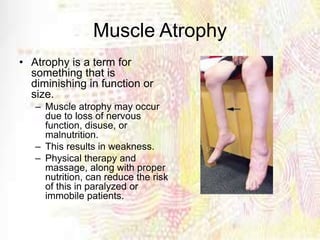
• Atrophy is a term for
something that is
diminishing in function or
size.
– Muscle atrophy may occur
due to loss of nervous
function, disuse, or
malnutrition.
– This results in weakness.
– Physical therapy and
massage, along with proper
nutrition, can reduce the risk
of this in paralyzed or
immobile patients.
Muscle Strain
• Probably the most common injury to
muscle tissue, AKA “pulled muscle”,
results from over stretching or even minor
tearing.
– We treat using the RICE method (rest, ice,
compression, elevation)
– Symptoms include soreness, pain, stiffness.
Dystonia
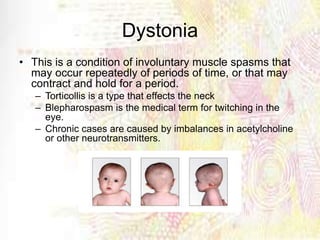
• This is a condition of involuntary muscle spasms that
may occur repeatedly of periods of time, or that may
contract and hold for a period.
– Torticollis is a type that effects the neck
– Blepharospasm is the medical term for twitching in the
eye.
– Chronic cases are caused by imbalances in acetylcholine
or other neurotransmitters.
Hernia
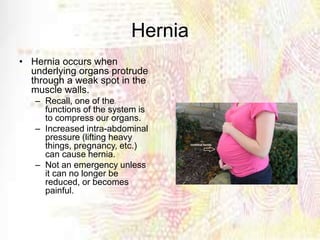
• Hernia occurs when
underlying organs protrude
through a weak spot in the
muscle walls.
– Recall, one of the
functions of the system is
to compress our organs.
– Increased intra-abdominal
pressure (lifting heavy
things, pregnancy, etc.)
can cause hernia.
– Not an emergency unless
it can no longer be
reduced, or becomes
painful.
Tetanus
• Tetanus is a prolonged, extreme
contraction of muscle caused by a
toxin produced a bacteria called
Clostridium tetani.
– It is very painful, and can be fatal in
babies, especially.
– It can be prevented by a vaccine.
– Commonly associated with severe
traumatic injuries that are open for 6
hours or longer, or puncture wounds.
Muscular Dystrophy
• Genetic defects cause muscle
cell degeneration with age.
– These occur more often in
males, and usually have onset
sometime in childhood or
adolescence. There are some
adult onset cases.
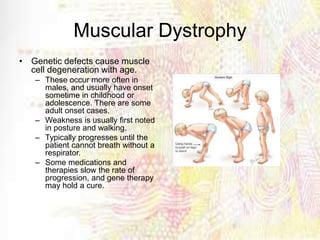
– Weakness is usually first noted
in posture and walking.
– Typically progresses until the
patient cannot breath without a
respirator.
– Some medications and
therapies slow the rate of
progression, and gene therapy
may hold a cure.
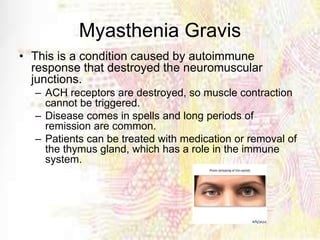
Myasthenia Gravis
• This is a condition caused by autoimmune
response that destroyed the neuromuscular
junctions.
– ACH receptors are destroyed, so muscle contraction
cannot be triggered.
– Disease comes in spells and long periods of
remission are common.
– Patients can be treated with medication or removal of
the thymus gland, which has a role in the immune
system.
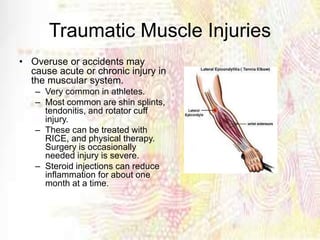
Traumatic Muscle Injuries
• Overuse or accidents may
cause acute or chronic injury in
the muscular system.
– Very common in athletes.
– Most common are shin splints,
tendonitis, and rotator cuff
injury.
– These can be treated with
RICE, and physical therapy.
Surgery is occasionally
needed injury is severe.
– Steroid injections can reduce
inflammation for about one
month at a time.

Homeostatic imbalance muscles

  • 1.
    Homeostatic Imbalance ofthe Muscular System HS EHS Unit 3
  • 2.
    Learning Targets • Discusshomeostatic imbalances and relate them back to things we have learned about the functions of the muscular system.
  • 3.
    Determining the causeof mobility loss… • As discussed, mobility is a function of 3 systems. – When problems occur, HCPs are challenged to determine where the root of the problem lies. – For instance, if an elderly patient has begun to have trouble walking, it could be one of several things. • Joint degeneration (causing pain, poor ROM) • Neurological issues (such as Parkinson’s) • Muscular Issues (such as Myasthenia Gravis or atrophy) – Differential Dx allows us to narrow down the cause and eliminate options to find the problem.
  • 4.
    Muscle Atrophy • Atrophyis a term for something that is diminishing in function or size. – Muscle atrophy may occur due to loss of nervous function, disuse, or malnutrition. – This results in weakness. – Physical therapy and massage, along with proper nutrition, can reduce the risk of this in paralyzed or immobile patients.
  • 5.
    Muscle Strain • Probablythe most common injury to muscle tissue, AKA “pulled muscle”, results from over stretching or even minor tearing. – We treat using the RICE method (rest, ice, compression, elevation) – Symptoms include soreness, pain, stiffness.
  • 6.
    Dystonia • This isa condition of involuntary muscle spasms that may occur repeatedly of periods of time, or that may contract and hold for a period. – Torticollis is a type that effects the neck – Blepharospasm is the medical term for twitching in the eye. – Chronic cases are caused by imbalances in acetylcholine or other neurotransmitters.
  • 7.
    Hernia • Hernia occurswhen underlying organs protrude through a weak spot in the muscle walls. – Recall, one of the functions of the system is to compress our organs. – Increased intra-abdominal pressure (lifting heavy things, pregnancy, etc.) can cause hernia. – Not an emergency unless it can no longer be reduced, or becomes painful.
  • 8.
    Tetanus • Tetanus isa prolonged, extreme contraction of muscle caused by a toxin produced a bacteria called Clostridium tetani. – It is very painful, and can be fatal in babies, especially. – It can be prevented by a vaccine. – Commonly associated with severe traumatic injuries that are open for 6 hours or longer, or puncture wounds.
  • 9.
    Muscular Dystrophy • Geneticdefects cause muscle cell degeneration with age. – These occur more often in males, and usually have onset sometime in childhood or adolescence. There are some adult onset cases. – Weakness is usually first noted in posture and walking. – Typically progresses until the patient cannot breath without a respirator. – Some medications and therapies slow the rate of progression, and gene therapy may hold a cure.
  • 10.
    Myasthenia Gravis • Thisis a condition caused by autoimmune response that destroyed the neuromuscular junctions. – ACH receptors are destroyed, so muscle contraction cannot be triggered. – Disease comes in spells and long periods of remission are common. – Patients can be treated with medication or removal of the thymus gland, which has a role in the immune system.
  • 11.
    Traumatic Muscle Injuries •Overuse or accidents may cause acute or chronic injury in the muscular system. – Very common in athletes. – Most common are shin splints, tendonitis, and rotator cuff injury. – These can be treated with RICE, and physical therapy. Surgery is occasionally needed injury is severe. – Steroid injections can reduce inflammation for about one month at a time.