PARAPHRASING
BORROWING LANGUAGE AND IDEAS
WHAT IS A PARAPHRASE?
DEFINITION:
Paraphrasing is when we borrow ideas,
language, or phrases from another
person’s text; we write these using our
own language and sentence patterns.
WHAT IS A PARAPHRASE?
continued
Paraphrasing a text (such as a movie, an
article, a book chapter, or a song) helps
the reader grasp the important parts
without having to read the source.
The writer is an expert in the content of that
one source, and she talks the research to
her reader.
ACTIVITY ONE:
Answer the following questions on a sheet of paper.
Do not answer with “I don’t know”; instead, talk about what you think
a writer does. It’s good to start with what we already know or
assume:
When do we paraphrase?
How do we paraphrase?
Can we switch words around?
How do we cite our paraphrases?
How is paraphrase different than quote?
Note: Please do not look anything up with this part. You are thinking
about what you already know or have heard about integrating
sources into your texts.
HERE ARE SOME INCORRECT ASSUMPTIONS STUDENT
WRITERS HAVE HAD ABOUT PARAPHRASING. COMPARE YOUR
ANSWERS FROM ACTIVITY ONE WITH THOSE BELOW.
--If we switch words around we are O.K.. NO
--If somebody did not “say it,” then they are my words. NO
--I have learned about the topic somewhere else; I don’t need to cite it.
NO
--This comes from my own expertise. NO
--I don’t know what the article is about, but I switched the words around
in this one part; they are my words. NO
--I don’t think we have to cite a paraphrase. We only cite quotes. NO
WHY DO WE PARAPHRASE?
Paraphrasing allows the reader to trust the writer. We walk away from our
reading informed, and we have confidence in the researcher because she
knows her source materials.
MOST
OF YOUR RESEARCH WRITING
WILL INCLUDE PARAPHRASING.
WHY DO WE PARAPHRASE?
PARAPHRASE IS USED MORE THAN SUMMARY AND QUOTES
BECAUSE:
PARAPHRASE GIVES MORE DETAIL THAN SUMMARY AND ALLOWS MORE
INSIGHT.
PARAPHRSE PREVENTS OVERRELIANCE ON QUOTING AND SHOWS AN
AUTHOR’S CAREFUL CONSIDERATION OF THE PARTICULAR SOURCE.
WE SHOULD ONLY QUOTE IN SPECIFIC INSTANCES
REVIEWING WHEN TO QUOTE
As a review, writers use quotes sparingly and only
with the following rules:
1. Quoting an authority (who is absolutely
necessary to include in the paper).
2. Using necessary dialogue.
3. Highlighting necessary bias or opposite
opinions.
4. Analyzing unusual language.
Ask your instructor for any other times to quote.
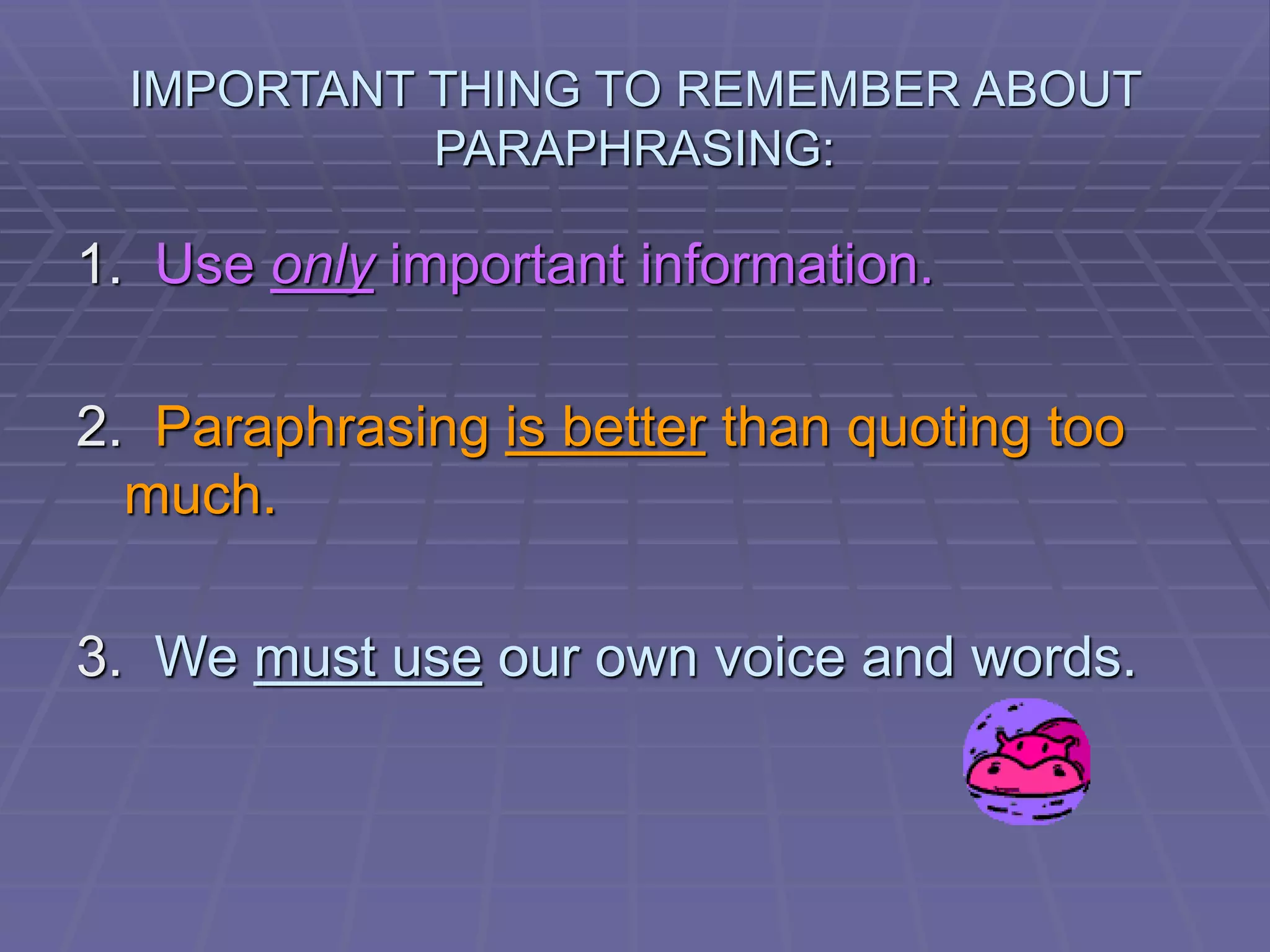
ACTIVITY #2:
LOOK AT THE PAPER YOU ARE WORKING ON.
1. HIGHLIGHT EVERY PLACE YOU QUOTE.
2. WRITE YES NEXT TO QUOTES THAT FOLLOW ONE OF THE
RULES, AND WRITE NO NEXT TO THOSE THAT DON’T.
3. FOR THOSE THAT DON’T FOLLOW ONE OF THE RULES
(AND THERE PROBABLY ARE SEVERAL YOU SHOULD
REVISE), THEN CONSIDER PARAPHRASING IN PLACE OF
THE QUOTE.
4. STAPLE THE DRAFT IN WHICH YOU HIGHLIGHTED ALL
QUOTES AND ON WHICH YOU WROTE YES OR NO TO THE
COMPLETED GPAW FOR YOUR INSTRUCTOR TO REVIEW.
IMPORTANT THING TO REMEMBER ABOUT
PARAPHRASING:
1. Use only important information.
2. Paraphrasing is better than quoting too
much.
3. We must use our own voice and words.
Three paraphrasing rules:
1. We are allowed to use common terms, such as the
author’s name or topic. No quotation marks are
necessary when we use these.
2. If we borrow any key words, we must put them in
quotations.
3. We must box in the source by introducing source first
and then citing at the end.
ACTIVITY #3 PRINT THIS SLIDE
AND USE IT AS A GUIDE AS WE PARAPHRASE
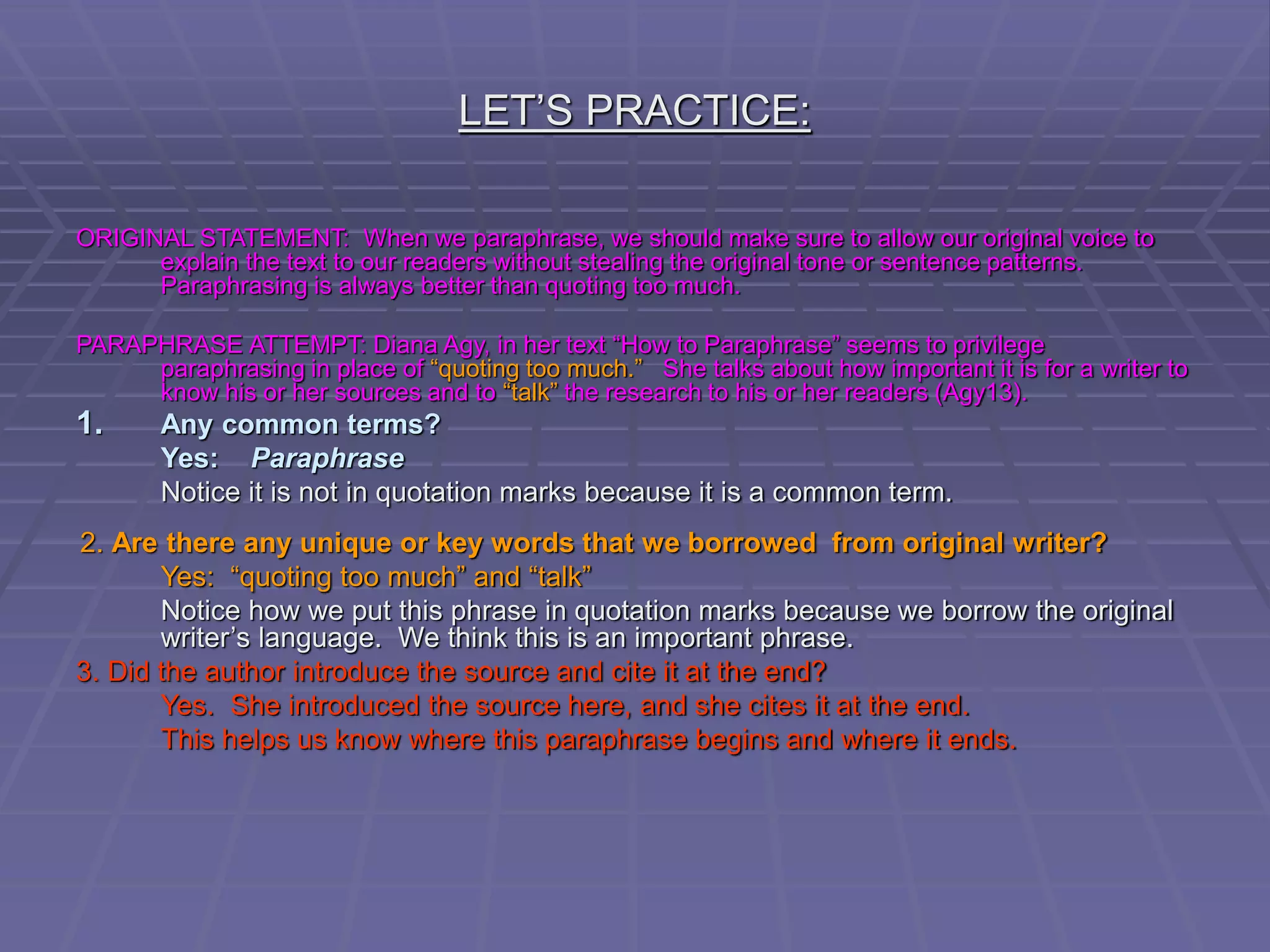
LET’S PRACTICE:
ORIGINAL STATEMENT: When we paraphrase, we should make sure to allow our original voice to
explain the text to our readers without stealing the original tone or sentence patterns.
Paraphrasing is always better than quoting too much.
PARAPHRASE ATTEMPT: Diana Agy, in her text “How to Paraphrase” seems to privilege
paraphrasing in place of “quoting too much.” She talks about how important it is for a writer to
know his or her sources and to “talk” the research to his or her readers (Agy13).
1. Any common terms?
Yes: Paraphrase
Notice it is not in quotation marks because it is a common term.
2. Are there any unique or key words that we borrowed from original writer?
Yes: “quoting too much” and “talk”
Notice how we put this phrase in quotation marks because we borrow the original
writer’s language. We think this is an important phrase.
3. Did the author introduce the source and cite it at the end?
Yes. She introduced the source here, and she cites it at the end.
This helps us know where this paraphrase begins and where it ends.
PRINT THIS SLIDE TO USE WITH
THE UPCOMING ACTIVITIES:
HERE IS AN ORIGINAL TEXT:
The more we write and talk about writing, the better writers
we become. The Writing Fellow Program provides an
outlet for students to chat with peers about any stage of
writing: prewriting, drafting, revising, close editing, etc…
Writing Fellows use redirection and sample writings to
help students better understand the whys of each writing
stage.
Text by Diana Agy.
INCORRECT PARAPHRASING:
Sample #1
Students can benefit from the Writing Fellow Program by
understanding redirection and considering sample
papers. The more students talk about writing, the
more skilled they become.
1. Did the writer use common terms?
Yes: “writing” and “students” . She did not need quotation for these common words.
2. Did the writer borrow key words and use quotations correctly?
YES, she borrowed key words,
BUT
She did not use quotations with borrowed language.
To correct, she should use quotation marks with “redirection”, “sample papers” and “talk about
writing”
3. Did the writer introduce the source and cite it at then end?
No. We do not know where the writer begins and ends and where the source begins and
ends.
ACTIVITY #4
EXPLAIN IN A PARAGRAPH WHY THE
PREVIOUS EXAMPLE WAS AN
INCORRECT PARAPHRASE. TALK TO
YOUR INSTRUCTOR ABOUT WHY THAT
PARAPHRASE IS PLAGIARIZED.
CORRECT PARAPHRASE:
Correct paraphrasing:
In the text by Diana Agy, she explains the importance of communication and social
activities centered around writing. She particularly targets a program she calls
“Writing Fellow Program,” and she explains how these tutors help engage their
tutees through various methods. Her text also highlights the importance of
understanding writing as a process and that we become better writers if we
understand the “whys” of various “writing stages” (qtd. In Paraphrase GPAW).
1. Does it use common terms:
Yes: writing (writers) , importance, understanding—no need for quotation marks.
2. Does it borrow key words and cite them with quotation marks?
Yes:”writing stages” and “whys”
3. Does it introduce and cite the source correctly?
Yes: In the text, and (qtd. In Paraphrase GPAW).
ACTIVITY #5
EXPLAIN IN ONE PARAGRAPH WHY THE
PREVIOUS SLIDE IS A CORRECT
PARAPHRASE. TALK TO YOUR INSTRUCTOR
ABOUT WHAT YOU ARE LEARNING ABOUT
PARAPHRASE.
NOTE: PLEASE DO NOT SIMPLY LIST THE
THREE RULES OVER AGAIN—TALK ABOUT
WHAT YOU ARE LEARNING ABOUT THE
PARAPHRASE FROM THIS LAST EXAMPLE.
THE MOST COMMON PROBLEM
The main problem is using the original source as a mirror.
Mirroring occurs when the writer imitates the original sentence patterns and
voice. Some writers have learned that as long as they replace the original
text with their own language, then all is well. But, they are mistaken!
 When we paraphrase we are putting someone else’s information in our
own sentence patterns. Not only must the wording be different, but
the rhythm and pattern must also be our own.
We think that we are paraphrasing when we are rearranging our source’s
sentences while we keep their original sentence patterns, BUT WE ARE
NOT.
Be very careful here. This is the most common form of plagiarism.
Consider this example:
Incorrect paraphrase--plagiarism
Original:
Ask not what your country can do for you. But ask what you can do for
your country.
Incorrect Paraphrase:
Don’t ask what your nation can give you; instead, consider what you are willing to do for
your country.
 Notice the rhythm, the sentence pattern, and the sound are exactly the same.
Notice also, although there are some word changes, the second example only
mimics the first—it does NOT paraphrase the first.
Correct Paraphrase:
John Kennedy’s introduction stresses the importance of citizens
becoming civically engaged in their country’s affairs.
ACTIVITY #6
WRITE A PARAGRAPH EXPLAINING THE
DIFFERENCE BETWEEN THE
INCORRECT PARAPHRASE AND THE
CORRECT PARAPHRASE IN THE
PREVIOUS SLIDE (slide #19).
BE SPECIFIC AS YOU TALK TO YOUR
TEACHER ABOUT WHAT YOU ARE
LEARNING.
ACTIVITY #7
CONSIDER THE NEXT EXAMPLE.
Read it carefully. Know it.
Students who submit plagiarized writing (purposefully or unintentionally
misquoting, incorrectly paraphrasing, or incorrectly citing sources) run the
risk of academic dishonesty and producing poor writing. Know the
research, and talk it to your reader. Understand the conventions of citing
sources, and understand the difference between quoting and paraphrasing.
Text by Joe Schmoe from page 23 in a book titled Sources.
1. Write an INCORRECT PARAPHRASE of the above text , and follow the
chart on slide #14. Go through each paraphrase process, and explain why
your incorrect paraphrase is incorrect.
2. Write a CORRECT PARAPHRASE of the above text, and follow the chart on
slide #16. Go through each paraphrase process, and explain why your
correct paraphrase is correct.
PARAPHRASE APPLICATION
ACTIVITY #8
Revisit your entire essay.
Write down each of your paraphrases.
Find the original article.
Highlight the sections where the paraphrases comes from.
Staple the original source text to your work so your instructor can scan it.
Answer the following questions.
Does your paraphrase
mirror the rhythm of the original?
have similar sentence patterns?
sound like the original?
simply substitute your source’s words for another?
If yes, you must revise!
Return to slide # 11 for reference.
Reflection:
ACTIVITY #9: PLEASE ANSWER IN 3-4 SENTENCES
EACH:
What have you learned from this workshop?
How will your writing change as a result of completing this workshop?
If you have any questions, please contact:
(jacobsgeraldii@jccmi.edu)
(agydianam@jccmi.edu)

paraphrasing

  • 1.
  • 2.
    WHAT IS APARAPHRASE? DEFINITION: Paraphrasing is when we borrow ideas, language, or phrases from another person’s text; we write these using our own language and sentence patterns.
  • 3.
    WHAT IS APARAPHRASE? continued Paraphrasing a text (such as a movie, an article, a book chapter, or a song) helps the reader grasp the important parts without having to read the source. The writer is an expert in the content of that one source, and she talks the research to her reader.
  • 4.
    ACTIVITY ONE: Answer thefollowing questions on a sheet of paper. Do not answer with “I don’t know”; instead, talk about what you think a writer does. It’s good to start with what we already know or assume: When do we paraphrase? How do we paraphrase? Can we switch words around? How do we cite our paraphrases? How is paraphrase different than quote? Note: Please do not look anything up with this part. You are thinking about what you already know or have heard about integrating sources into your texts.
  • 5.
    HERE ARE SOMEINCORRECT ASSUMPTIONS STUDENT WRITERS HAVE HAD ABOUT PARAPHRASING. COMPARE YOUR ANSWERS FROM ACTIVITY ONE WITH THOSE BELOW. --If we switch words around we are O.K.. NO --If somebody did not “say it,” then they are my words. NO --I have learned about the topic somewhere else; I don’t need to cite it. NO --This comes from my own expertise. NO --I don’t know what the article is about, but I switched the words around in this one part; they are my words. NO --I don’t think we have to cite a paraphrase. We only cite quotes. NO
  • 6.
    WHY DO WEPARAPHRASE? Paraphrasing allows the reader to trust the writer. We walk away from our reading informed, and we have confidence in the researcher because she knows her source materials. MOST OF YOUR RESEARCH WRITING WILL INCLUDE PARAPHRASING.
  • 7.
    WHY DO WEPARAPHRASE? PARAPHRASE IS USED MORE THAN SUMMARY AND QUOTES BECAUSE: PARAPHRASE GIVES MORE DETAIL THAN SUMMARY AND ALLOWS MORE INSIGHT. PARAPHRSE PREVENTS OVERRELIANCE ON QUOTING AND SHOWS AN AUTHOR’S CAREFUL CONSIDERATION OF THE PARTICULAR SOURCE. WE SHOULD ONLY QUOTE IN SPECIFIC INSTANCES
  • 8.
    REVIEWING WHEN TOQUOTE As a review, writers use quotes sparingly and only with the following rules: 1. Quoting an authority (who is absolutely necessary to include in the paper). 2. Using necessary dialogue. 3. Highlighting necessary bias or opposite opinions. 4. Analyzing unusual language. Ask your instructor for any other times to quote.
  • 9.
    ACTIVITY #2: LOOK ATTHE PAPER YOU ARE WORKING ON. 1. HIGHLIGHT EVERY PLACE YOU QUOTE. 2. WRITE YES NEXT TO QUOTES THAT FOLLOW ONE OF THE RULES, AND WRITE NO NEXT TO THOSE THAT DON’T. 3. FOR THOSE THAT DON’T FOLLOW ONE OF THE RULES (AND THERE PROBABLY ARE SEVERAL YOU SHOULD REVISE), THEN CONSIDER PARAPHRASING IN PLACE OF THE QUOTE. 4. STAPLE THE DRAFT IN WHICH YOU HIGHLIGHTED ALL QUOTES AND ON WHICH YOU WROTE YES OR NO TO THE COMPLETED GPAW FOR YOUR INSTRUCTOR TO REVIEW.
  • 10.
    IMPORTANT THING TOREMEMBER ABOUT PARAPHRASING: 1. Use only important information. 2. Paraphrasing is better than quoting too much. 3. We must use our own voice and words.
  • 11.
    Three paraphrasing rules: 1.We are allowed to use common terms, such as the author’s name or topic. No quotation marks are necessary when we use these. 2. If we borrow any key words, we must put them in quotations. 3. We must box in the source by introducing source first and then citing at the end. ACTIVITY #3 PRINT THIS SLIDE AND USE IT AS A GUIDE AS WE PARAPHRASE
  • 12.
    LET’S PRACTICE: ORIGINAL STATEMENT:When we paraphrase, we should make sure to allow our original voice to explain the text to our readers without stealing the original tone or sentence patterns. Paraphrasing is always better than quoting too much. PARAPHRASE ATTEMPT: Diana Agy, in her text “How to Paraphrase” seems to privilege paraphrasing in place of “quoting too much.” She talks about how important it is for a writer to know his or her sources and to “talk” the research to his or her readers (Agy13). 1. Any common terms? Yes: Paraphrase Notice it is not in quotation marks because it is a common term. 2. Are there any unique or key words that we borrowed from original writer? Yes: “quoting too much” and “talk” Notice how we put this phrase in quotation marks because we borrow the original writer’s language. We think this is an important phrase. 3. Did the author introduce the source and cite it at the end? Yes. She introduced the source here, and she cites it at the end. This helps us know where this paraphrase begins and where it ends.
  • 13.
    PRINT THIS SLIDETO USE WITH THE UPCOMING ACTIVITIES: HERE IS AN ORIGINAL TEXT: The more we write and talk about writing, the better writers we become. The Writing Fellow Program provides an outlet for students to chat with peers about any stage of writing: prewriting, drafting, revising, close editing, etc… Writing Fellows use redirection and sample writings to help students better understand the whys of each writing stage. Text by Diana Agy.
  • 14.
    INCORRECT PARAPHRASING: Sample #1 Studentscan benefit from the Writing Fellow Program by understanding redirection and considering sample papers. The more students talk about writing, the more skilled they become. 1. Did the writer use common terms? Yes: “writing” and “students” . She did not need quotation for these common words. 2. Did the writer borrow key words and use quotations correctly? YES, she borrowed key words, BUT She did not use quotations with borrowed language. To correct, she should use quotation marks with “redirection”, “sample papers” and “talk about writing” 3. Did the writer introduce the source and cite it at then end? No. We do not know where the writer begins and ends and where the source begins and ends.
  • 15.
    ACTIVITY #4 EXPLAIN INA PARAGRAPH WHY THE PREVIOUS EXAMPLE WAS AN INCORRECT PARAPHRASE. TALK TO YOUR INSTRUCTOR ABOUT WHY THAT PARAPHRASE IS PLAGIARIZED.
  • 16.
    CORRECT PARAPHRASE: Correct paraphrasing: Inthe text by Diana Agy, she explains the importance of communication and social activities centered around writing. She particularly targets a program she calls “Writing Fellow Program,” and she explains how these tutors help engage their tutees through various methods. Her text also highlights the importance of understanding writing as a process and that we become better writers if we understand the “whys” of various “writing stages” (qtd. In Paraphrase GPAW). 1. Does it use common terms: Yes: writing (writers) , importance, understanding—no need for quotation marks. 2. Does it borrow key words and cite them with quotation marks? Yes:”writing stages” and “whys” 3. Does it introduce and cite the source correctly? Yes: In the text, and (qtd. In Paraphrase GPAW).
  • 17.
    ACTIVITY #5 EXPLAIN INONE PARAGRAPH WHY THE PREVIOUS SLIDE IS A CORRECT PARAPHRASE. TALK TO YOUR INSTRUCTOR ABOUT WHAT YOU ARE LEARNING ABOUT PARAPHRASE. NOTE: PLEASE DO NOT SIMPLY LIST THE THREE RULES OVER AGAIN—TALK ABOUT WHAT YOU ARE LEARNING ABOUT THE PARAPHRASE FROM THIS LAST EXAMPLE.
  • 18.
    THE MOST COMMONPROBLEM The main problem is using the original source as a mirror. Mirroring occurs when the writer imitates the original sentence patterns and voice. Some writers have learned that as long as they replace the original text with their own language, then all is well. But, they are mistaken!  When we paraphrase we are putting someone else’s information in our own sentence patterns. Not only must the wording be different, but the rhythm and pattern must also be our own. We think that we are paraphrasing when we are rearranging our source’s sentences while we keep their original sentence patterns, BUT WE ARE NOT. Be very careful here. This is the most common form of plagiarism.
  • 19.
    Consider this example: Incorrectparaphrase--plagiarism Original: Ask not what your country can do for you. But ask what you can do for your country. Incorrect Paraphrase: Don’t ask what your nation can give you; instead, consider what you are willing to do for your country.  Notice the rhythm, the sentence pattern, and the sound are exactly the same. Notice also, although there are some word changes, the second example only mimics the first—it does NOT paraphrase the first. Correct Paraphrase: John Kennedy’s introduction stresses the importance of citizens becoming civically engaged in their country’s affairs.
  • 20.
    ACTIVITY #6 WRITE APARAGRAPH EXPLAINING THE DIFFERENCE BETWEEN THE INCORRECT PARAPHRASE AND THE CORRECT PARAPHRASE IN THE PREVIOUS SLIDE (slide #19). BE SPECIFIC AS YOU TALK TO YOUR TEACHER ABOUT WHAT YOU ARE LEARNING.
  • 21.
    ACTIVITY #7 CONSIDER THENEXT EXAMPLE. Read it carefully. Know it. Students who submit plagiarized writing (purposefully or unintentionally misquoting, incorrectly paraphrasing, or incorrectly citing sources) run the risk of academic dishonesty and producing poor writing. Know the research, and talk it to your reader. Understand the conventions of citing sources, and understand the difference between quoting and paraphrasing. Text by Joe Schmoe from page 23 in a book titled Sources. 1. Write an INCORRECT PARAPHRASE of the above text , and follow the chart on slide #14. Go through each paraphrase process, and explain why your incorrect paraphrase is incorrect. 2. Write a CORRECT PARAPHRASE of the above text, and follow the chart on slide #16. Go through each paraphrase process, and explain why your correct paraphrase is correct.
  • 22.
    PARAPHRASE APPLICATION ACTIVITY #8 Revisityour entire essay. Write down each of your paraphrases. Find the original article. Highlight the sections where the paraphrases comes from. Staple the original source text to your work so your instructor can scan it. Answer the following questions. Does your paraphrase mirror the rhythm of the original? have similar sentence patterns? sound like the original? simply substitute your source’s words for another? If yes, you must revise! Return to slide # 11 for reference.
  • 23.
    Reflection: ACTIVITY #9: PLEASEANSWER IN 3-4 SENTENCES EACH: What have you learned from this workshop? How will your writing change as a result of completing this workshop? If you have any questions, please contact: (jacobsgeraldii@jccmi.edu) (agydianam@jccmi.edu)