NarrativeWriting
Narrative writing tells a story.A story has certain elements that are not found in other types of writing.
Elements of a StoryExposition:The setting and characters
Elements of a StoryRising Action:Events that occur in the story that lead to the climax. During the rising action, CONFLICT should occur.
Elements of a StoryClimax:Usually the most exciting, dramatic, or emotional part of the story.This is where the action changes and is usually when the conflict comes to a head.
Elements of a StoryFalling Action:This is the part of the story where all the loose ends are wrapped up.
Elements of a StoryResolution:The ending of the story.They all live happily ever after!
Make a MIND MOVIEImagine the action in the story step-by-step.What do you see?What do you taste?What do you hear?What do you feel?
Make sure the story flows and makes sense.All stories should have a conflict or problem, a climax, and an ending.
There should be a good, but short, beginning (with a grabber) and end.The topic should be  mentioned in the beginning and end.
Transition words should be used throughout the passage.
Other Important Tips!
Be careful with dialogue:
All good writing begins with a PLANNER!
For a higher score, spelling and grammar are important, BUTThe writing content is more very important!
Organization is ImportantStudents should use their  organizers to decide when to make a new paragraph.Make sure paragraphs are indented!
Similes should make sense to ANY reader!
ExpositoryWriting
Expository WritingExpository writing explains or informs. Prompts for expository writing use words such as: explain, clarify, inform, describe.Expository writing has three main parts or sections.
In writing an expository paper, the student should:Read the prompt carefullyBrainstorm a list of ideasMake an outlineWrite an introductory paragraphWrite at least two or three body paragraphsWrite a concluding paragraph
BrainstormingAfter reading a prompt, students brainstorm ideas for their paper.Example:  The student is asked to write about pets.The student makes a list of Ideas for a paper about pets.
The next step is to make an OUTLINE.
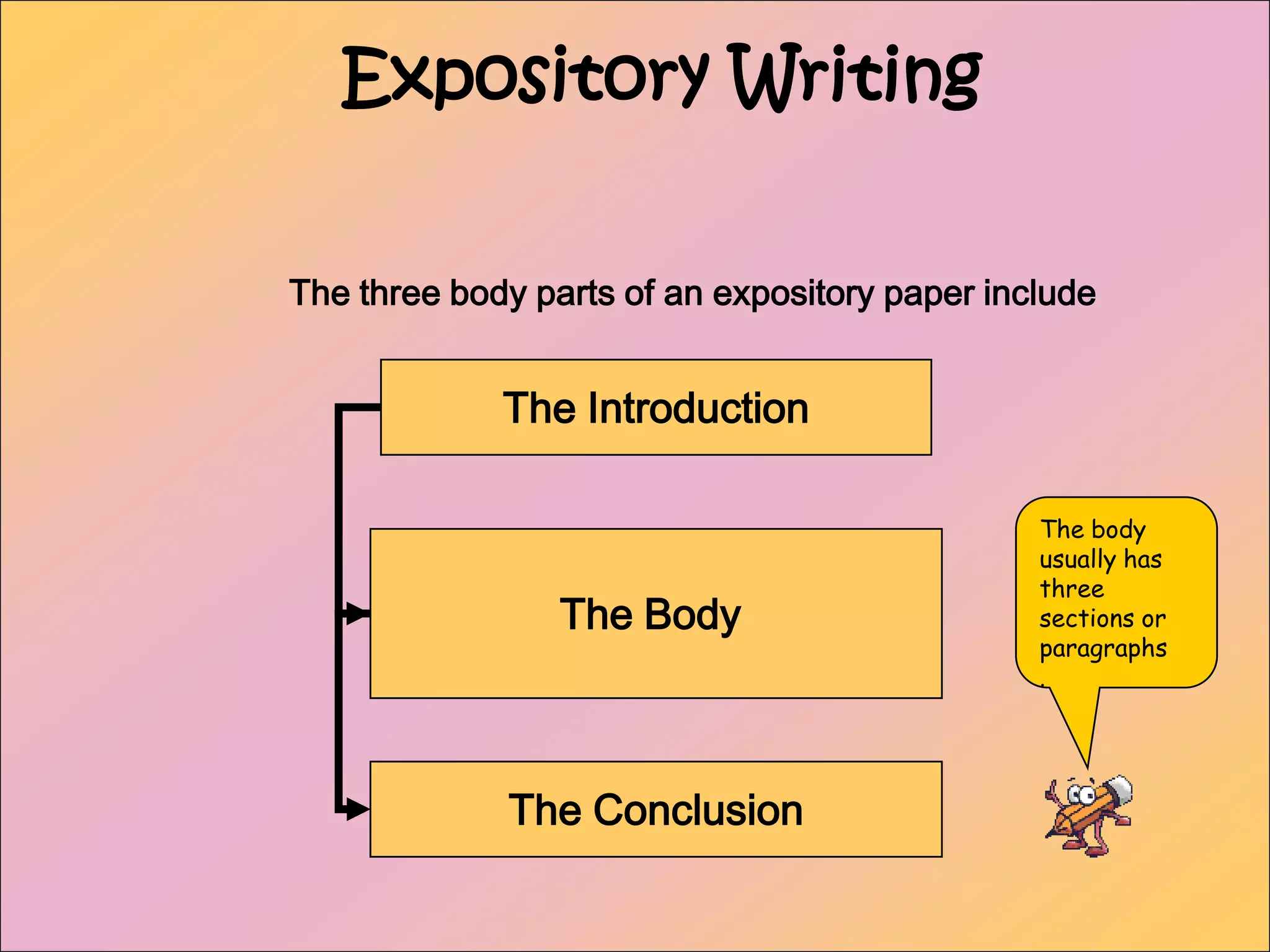
Expository WritingThe three body parts of an expository paper includeThe IntroductionThe body usually has three sections or paragraphs .The Body The Conclusion
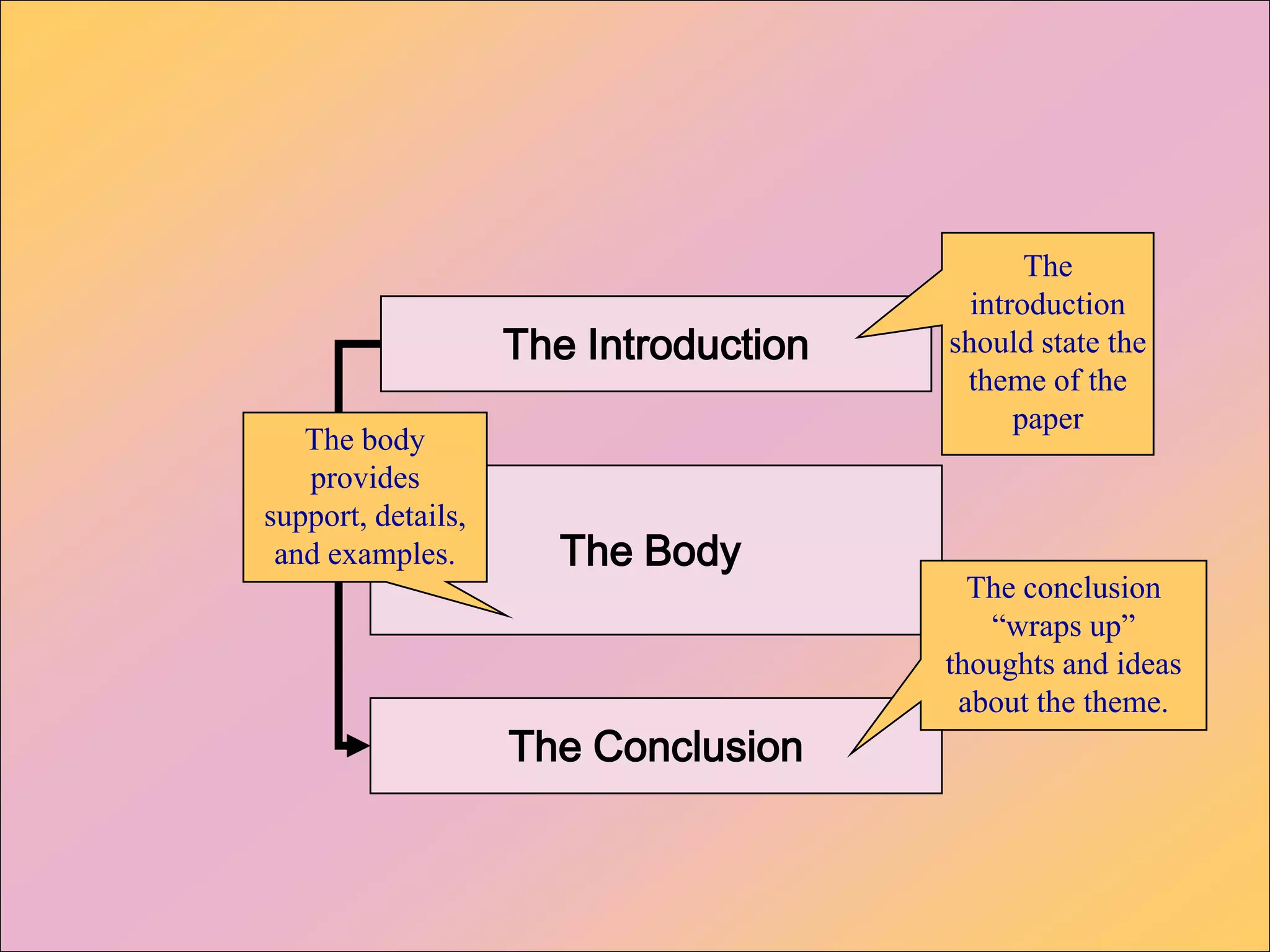
The introduction should state the theme of the paperThe IntroductionThe body provides support, details, and examples.The Body The conclusion “wraps up” thoughts and ideas about the theme.The Conclusion
Effective writing contains the same creativity skills whether it is narrative or expository.
Narrative Powerpoint

  • 1.
  • 2.
    Narrative writing tellsa story.A story has certain elements that are not found in other types of writing.
  • 3.
    Elements of aStoryExposition:The setting and characters
  • 4.
    Elements of aStoryRising Action:Events that occur in the story that lead to the climax. During the rising action, CONFLICT should occur.
  • 5.
    Elements of aStoryClimax:Usually the most exciting, dramatic, or emotional part of the story.This is where the action changes and is usually when the conflict comes to a head.
  • 6.
    Elements of aStoryFalling Action:This is the part of the story where all the loose ends are wrapped up.
  • 7.
    Elements of aStoryResolution:The ending of the story.They all live happily ever after!
  • 8.
    Make a MINDMOVIEImagine the action in the story step-by-step.What do you see?What do you taste?What do you hear?What do you feel?
  • 9.
    Make sure thestory flows and makes sense.All stories should have a conflict or problem, a climax, and an ending.
  • 10.
    There should bea good, but short, beginning (with a grabber) and end.The topic should be mentioned in the beginning and end.
  • 11.
    Transition words shouldbe used throughout the passage.
  • 12.
  • 13.
  • 14.
    All good writingbegins with a PLANNER!
  • 15.
    For a higherscore, spelling and grammar are important, BUTThe writing content is more very important!
  • 16.
    Organization is ImportantStudentsshould use their organizers to decide when to make a new paragraph.Make sure paragraphs are indented!
  • 17.
    Similes should makesense to ANY reader!
  • 18.
  • 19.
    Expository WritingExpository writingexplains or informs. Prompts for expository writing use words such as: explain, clarify, inform, describe.Expository writing has three main parts or sections.
  • 20.
    In writing anexpository paper, the student should:Read the prompt carefullyBrainstorm a list of ideasMake an outlineWrite an introductory paragraphWrite at least two or three body paragraphsWrite a concluding paragraph
  • 21.
    BrainstormingAfter reading aprompt, students brainstorm ideas for their paper.Example: The student is asked to write about pets.The student makes a list of Ideas for a paper about pets.
  • 22.
    The next stepis to make an OUTLINE.
  • 23.
    Expository WritingThe threebody parts of an expository paper includeThe IntroductionThe body usually has three sections or paragraphs .The Body The Conclusion
  • 24.
    The introduction shouldstate the theme of the paperThe IntroductionThe body provides support, details, and examples.The Body The conclusion “wraps up” thoughts and ideas about the theme.The Conclusion
  • 25.
    Effective writing containsthe same creativity skills whether it is narrative or expository.