This document outlines the four-part structure of a problem-solution essay: 1) situation/background information, 2) explicit identification and explanation of the problem, 3) proposed solutions, and 4) assessment of proposed solutions. It provides guidance on each part, noting important considerations like audience, purpose, and establishing credibility. Rubrics for grading are also discussed, awarding marks for identifying the problem, proposed solutions, language usage, structure, relevance and coherence.
Introduction to the problem-solution essay structure, detailing its 4 parts: Situation, Problem, Solution, and Evaluation. Outlines objectives for the lesson, highlighting audience consideration, purpose, and structure for effective essay writing.
Discusses rubrics for marking essays focusing on thesis and communication, and the importance of establishing writer credibility.
Emphasizes the necessity of clearly signaling the problem and establishing a unique perspective or niche in the discussion.
Explains the importance of a good introduction to preview content, structure, and maintain focus in the essay.
Details the steps of the essay: outlining the situation, clearly stating the problem, proposing solutions, and evaluating them.
Summarizes the conclusion's role in mirroring the introduction, reiterating the problem, and resolving it clearly.
Objectives
• By theend of this lesson students should be
able to:
• Identify the 4-part structure of a problem-
solution essay
• Demonstrate knowledge of the
development of each part of the essay
• Create a first draft of a problem-solution
essay
3.
4-Parts to problem-solution
•1. Situation – background information to
the problem
• 2. Problem – explicit identification of the
problem and explanation of
why the problem should be
solved
4.
4-Parts to problem-solution
3.Solution - proposed solution(s) to the
problem
4. Evaluation - assessment of the merits
of proposed solution(s)
5.
Important considerations:
• Whois your audience?
• What is the purpose of the task?
• Length of paper
• Thesis
• Structure of paper
6.
Rubrics - awardof marks
• An introduction must include a thesis
statement (problem) in order to merit marks
• Marks are awarded equally, for identifying
communication problems – and for
proposed solution/s
• Marks are also awarded for language
(includes grammar), structure, relevance
and coherence
7.
Establish credibility
• Indicateyour authority to write on the
subject
• Example 1 : As a first year medical student…
[this is your ‘authority’]
• Example 2: I have been a Registered Nurse
for more than 10 years and …
8.
The Problem
• Thewriter should signal early the problem
she/he intends to solve
9.
Establish a niche
•Explain ideas which have practical
implications
• or
• Provide solutions to practical ideas.
• Justify your need to add to the ideas
already expressed – “establish a niche."
10.
Brainstorm
• An introductionserves both the writer and
the reader
• It helps both stay on track
• The introduction serves as a contract or
promise which must be honored in the rest
of the text
11.
The Introduction
• Theintroduction forecasts the solution
• The solution will be proposed with a positive
evaluation
• This invites the reader to read on for
specifics
12.
A good introduction
•Previews the content of the article and
helps the reader find the content by
indicating the structure of the article
• Introductions are like maps
13.
Occupying the Niche
•Indicate by outlining how to solve the
problem
• At this stage the writer announces in
advance the technique or the manner in
which ideas can be applied
• Having ‘established’ the niche, now you
occupy the niche
14.
The steps –a reminder
• situation
• problem
• solution and
• evaluation
15.
The situation
• Thesituation (Introduction) indicates to the
reader that the author is going to deal with
important and generalized issues
16.
The problem
• Theproblem is often reintroduced in the
body of the article
• In this part of the paper the writer shows
that s/he shares readers' concerns
• This section describes the situation in
sufficient detail to provide a context for the
solution
17.
The solution
• Hereyou propose solutions to the problem
• As was the case with the problem section,
adjust paragraphs and sentences to
accommodate the new orientation – use
transitions here
Conclusion
• The conclusioncan be a mirror image of the
introduction
• Whereas the introduction starts from general
and moves to specific, the conclusion starts
with the specific study or technique described
in the article and moves to the general
20.
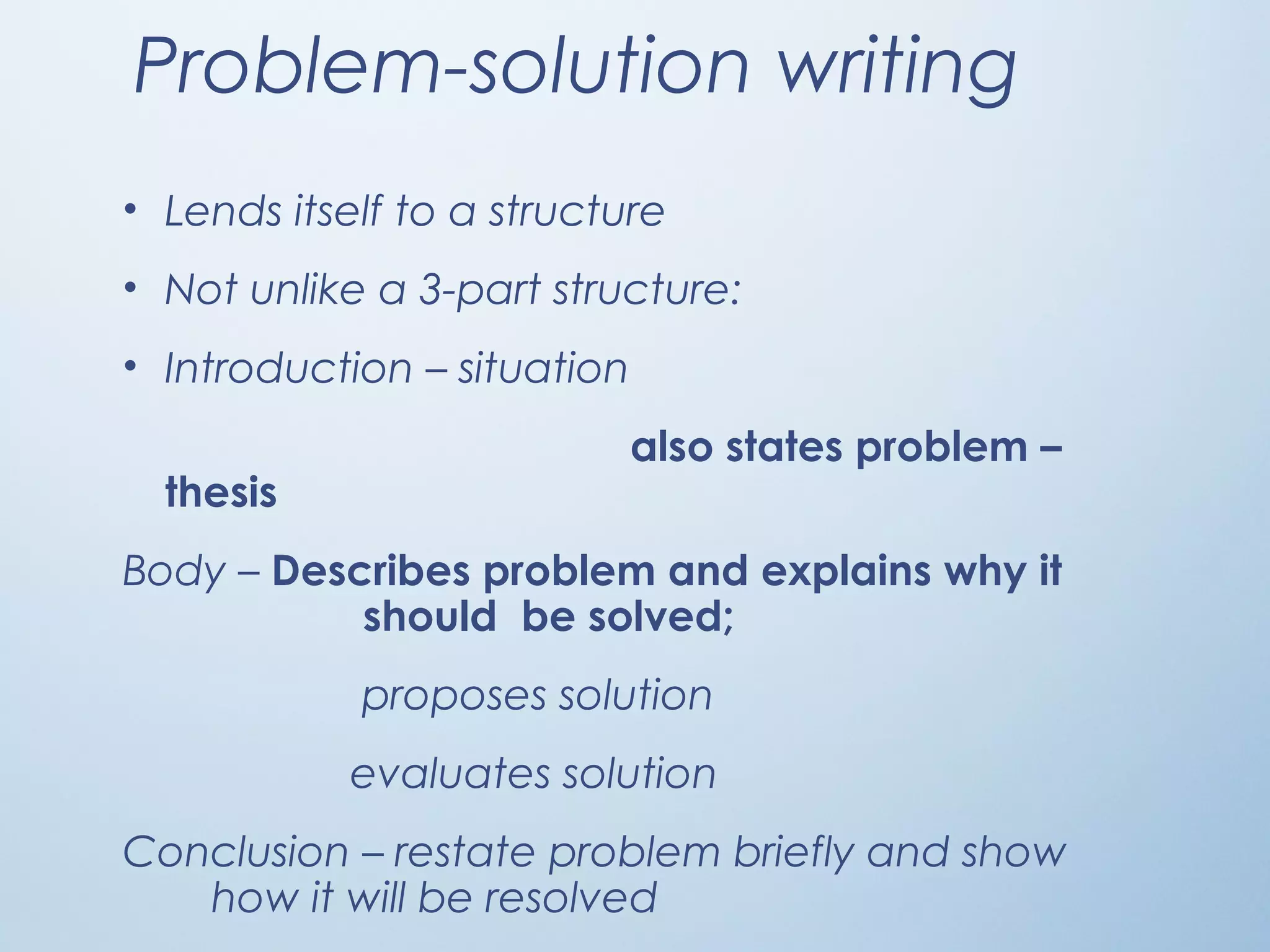
Problem-solution writing
• Lendsitself to a structure
• Not unlike a 3-part structure:
• Introduction – situation
also states problem –
thesis
Body – Describes problem and explains why it
should be solved;
proposes solution
evaluates solution
Conclusion – restate problem briefly and show
how it will be resolved
Editor's Notes
#4 The situation section indicates to the reader that the author is going to deal with important and generalized issues.
The problem is often reintroduced in the body of the article. The problem section is the part of the paper where the writer shows that s/he shares readers' concerns
#7 Students are penalised for restating the problem. You are required to read the case, analyse the communication situation therein – state/describe/explain (identify) the issues in the case.
Propose solutions –
Evaluate solutions
#11 Only develop idea that are used in introduction – don’t introduce any new ideas in the middle of the essay.
#13 The maps help the driver start out in the right direction. The better the map the less likely the readers will get lost as they speed through the text
#14 1 makes generalizations, Move 2 describes a more specific problem, and Move 3 offers a unique solution.
#20 If we consider the conclusion to be some sort of inverse of the introduction, we might expect the conclusion to evaluate a technique positively, and then move on to a more general situation.

![Establish credibility
• Indicate your authority to write on the
subject
• Example 1 : As a first year medical student…
[this is your ‘authority’]
• Example 2: I have been a Registered Nurse
for more than 10 years and …](https://image.slidesharecdn.com/problem-solutionessay-january20141-160527181748/75/Problem-solution-essay-7-2048.jpg)