Hematologic Disorders
LYMPHOMA
LYMPHOMA
The lymphomas are neoplasms of cells of lymphoid origin.
These tumors usually start in lymph nodes but can involve
lymphoid tissue in the spleen, GI tract (e.g. the wall of the
stomach), liver, or bone marrow. They are often classified
according to the degree of cell differentiation and the origin
of the predominant malignant cell. Lymphomas can be
broadly classified into two categories: Hodgkin lymphoma
and non-Hodgkin lymphoma (NHL).
What is the Lymphatic System?
• Made up of organs, such as the tonsils, spleen, liver,
bone marrow and a network of lymphatic vessels that
connect glands, called lymph nodes
• Lymph nodes located throughout the body
• Lymph nodes filter foreign particles out of the lymphatic
fluid
• Contain B and T lymphocytes
Three common lymphomas
• Follicular lymphoma
• Diffuse large B-cell lymphoma
• Hodgkin lymphoma
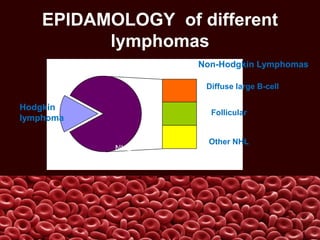
EPIDAMOLOGY of different
lymphomas
Hodgkin
lymphoma
NHL
Diffuse large B-cell
Follicular
Other NHL
Non-Hodgkin Lymphomas
Hodgkin lymphoma
Hodgkin lymphoma is a rare
malignancy that has an impressive cure
rate. It is somewhat more common in
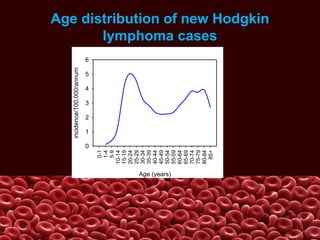
men than women and has two peaks of
incidence: one in the early 20 and the
other after 50-60 years of age
Age distribution of new Hodgkin
lymphoma cases
Age (years)
0-1
1-4
5-9
10-14
15-19
20-24
25-29
30-34
35-39
40-44
45-49
50-54
55-59
60-64
65-69
70-74
75-79
80-84
85+
incidence/100,000/annum
0
1
2
3
4
5
6
RISK FACTORES
-Disease occurrence has a familial pattern: First-degree
relatives have a higher-than-normal frequency of disease,
-Hodgkin lymphoma is seen more commonly in patients
receiving chronic immunosuppressive therapy (eg, for renal
transplant)
Pathophysiology
-The malignant cell of Hodgkin lymphoma is the
Reed-Sternberg cell it is tumor cell that is morphologically
unique and is thought to be of immature lymphoid origin.
-It is the pathologic hallmark and essential diagnostic criterion.
However, the tumor is very heterogeneous
-The cause of Hodgkin lymphoma is unknown, but a viral
etiology is suspected Although fragments of the Epstein-
Barr virus have been found in some Reed-Sternberg cells,
Clinical Manifestations
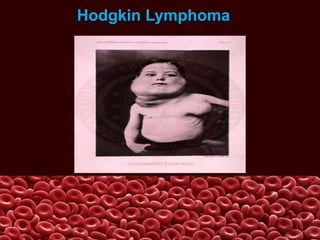
-painless enlargement of one or more lymph nodes on one side
of the neck usually firm but not hard cervical, supraclavicular,
and mediastinal nodes; involvement of the iliac or inguinal nodes
or spleen.
-A mediastinal mass the mass is large enough to compress the
trachea
and cause dyspnea.
-Pruritus is common.
-severe pain after drinking alcohol.
Hodgkin Lymphoma
Clinical Manifestations
- symptoms result from compression of organs by the tumor, such as
cough and pulmonary effusion (from pulmonary infiltrates),jaundice
(from hepatic involvement or bile duct obstruction), abdominal pain
(from splenomegaly or retroperitoneal adenopathy), or bone pain (from
skeletal involvement).
-Herpes zoster infections are common.
-Fever, drenching sweats.
weight loss of more than 10% of body weight.
Clinical Manifestations
-mild anemia
-leukocyte count may be elevated or decreased
-platelet count is typically normal, unless the tumor has
invaded the bone marrow
-impaired cellular immunity
-reaction to skin sensitivity tests absent or decreased
Criteria for diagnostic HL
-Because many manifestations are similar to those occurring
with infection, diagnostic studies are performed to rule out
an infectious origin for the disease.
1-During the health history, the patient is assessed for any symptoms.
2-Physical examination requires a careful, systematic
evaluation of the lymph node chains, as well as the
size of the spleen and liver.
3-A chest x-ray and a CT scan of the chest, abdomen, and pelvis are to
identify the extent of lymphadenopathy within these regions.
4-A positron emission tomography (PET) scan
may be the most sensitive imaging test in
identifying residual disease.
5- Laboratory tests include CBC, platelet count,
ESR, and liver and renal function studies.
6- A bone marrow biopsy is performed if there are
signs of marrow involvement,
7-Bone scans may be performed.
Medical Management
The general goal in the treatment of Hodgkin lymphoma is
cure. Treatment is determined primarily by the stage of the
disease, not the histologic type.
-Chemotherapy followed by radiation therapy to the specific
involved area.
-Transplant is used for advanced or refractory disease.
Nursing Management
Hodgkin lymphoma is often curable.
1-The nurse should encourage patients to reduce other factors that
increase the risk of developing cancers, such as use of tobacco
and alcohol and exposure to environmental carcinogens
and excessive sunlight.
2-Screening for late effects of treatment is necessary.
3-the nurse should provide education about relevant self-care
strategies and disease management.
4-education about side effect of drugs and management .
non-Hodgkin lymphomas
The non-Hodgkin lymphomas (NHLs) are a heterogeneous
group of cancers that originate from the neoplastic growth
of lymphoid tissue. the cells may vary morphologically.
Most NHLs involve malignant B lymphocytes; only 5%
involve T lymphocytes.
Lymph nodes from multiple sites may be infiltrated,
as may sites outside the lymphoid system (extranodal
tissue).
INCIDENCE
NHL is now the fifth most common type of cancer
diagnosed.
The incidence increases with each decade of life; the
median age at diagnosis
the incidence of NHL has increased in people with immuno
deficiencies or autoimmune disorders;
Clinical Manifestations
1-Lymphadenopathy is most common (66%) .
2-fever.
3-drenching night sweats.
4-unintentional weight loss.
5-masses can compromise organ function mass in the mediastinum
can cause respiratory distress; abdominal masses can compromise the
ureters, leading to renal dysfunction; and splenomegaly can cause
abdominal discomfort, nausea, anorexia, and weight loss.
Assessment and Diagnostic
Findings
-The actual diagnosis of NHL is categorized into a
highly complex classification system based on
histopathology(distributed in a follicular pattern)
-CT and PET scans
Diagnosis
Staging Studies
• Bone marrow aspiration and biopsy
• Radionuclide scans:
• x-rays
• Spinal fluid analysis
• CT scans
• Magnetic Resonance Imaging (MRI)
• Biopsy
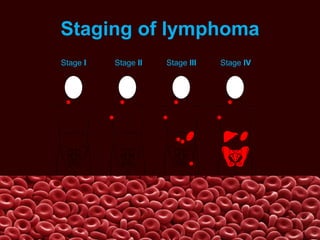
Stage I Stage II Stage III Stage IV
Staging of lymphoma
Medical Management
Non-Hodgkin’s Lymphoma is usually treated
by a team including hematologists, medical
oncologists and a radiation oncologist and
specialty nurse
Medical Management
• Chemotherapy.
• Radiation.
• Bone Marrow Transplantation.
• Surgery.
• Immunotherapy.
THANK YOU FOR
LISTEN

hl.ppt

  • 1.
  • 2.
    LYMPHOMA The lymphomas areneoplasms of cells of lymphoid origin. These tumors usually start in lymph nodes but can involve lymphoid tissue in the spleen, GI tract (e.g. the wall of the stomach), liver, or bone marrow. They are often classified according to the degree of cell differentiation and the origin of the predominant malignant cell. Lymphomas can be broadly classified into two categories: Hodgkin lymphoma and non-Hodgkin lymphoma (NHL).
  • 3.
    What is theLymphatic System? • Made up of organs, such as the tonsils, spleen, liver, bone marrow and a network of lymphatic vessels that connect glands, called lymph nodes • Lymph nodes located throughout the body • Lymph nodes filter foreign particles out of the lymphatic fluid • Contain B and T lymphocytes
  • 4.
    Three common lymphomas •Follicular lymphoma • Diffuse large B-cell lymphoma • Hodgkin lymphoma
  • 5.
    EPIDAMOLOGY of different lymphomas Hodgkin lymphoma NHL Diffuselarge B-cell Follicular Other NHL Non-Hodgkin Lymphomas
  • 6.
    Hodgkin lymphoma Hodgkin lymphomais a rare malignancy that has an impressive cure rate. It is somewhat more common in men than women and has two peaks of incidence: one in the early 20 and the other after 50-60 years of age
  • 7.
    Age distribution ofnew Hodgkin lymphoma cases Age (years) 0-1 1-4 5-9 10-14 15-19 20-24 25-29 30-34 35-39 40-44 45-49 50-54 55-59 60-64 65-69 70-74 75-79 80-84 85+ incidence/100,000/annum 0 1 2 3 4 5 6
  • 8.
    RISK FACTORES -Disease occurrencehas a familial pattern: First-degree relatives have a higher-than-normal frequency of disease, -Hodgkin lymphoma is seen more commonly in patients receiving chronic immunosuppressive therapy (eg, for renal transplant)
  • 9.
    Pathophysiology -The malignant cellof Hodgkin lymphoma is the Reed-Sternberg cell it is tumor cell that is morphologically unique and is thought to be of immature lymphoid origin. -It is the pathologic hallmark and essential diagnostic criterion. However, the tumor is very heterogeneous -The cause of Hodgkin lymphoma is unknown, but a viral etiology is suspected Although fragments of the Epstein- Barr virus have been found in some Reed-Sternberg cells,
  • 10.
    Clinical Manifestations -painless enlargementof one or more lymph nodes on one side of the neck usually firm but not hard cervical, supraclavicular, and mediastinal nodes; involvement of the iliac or inguinal nodes or spleen. -A mediastinal mass the mass is large enough to compress the trachea and cause dyspnea. -Pruritus is common. -severe pain after drinking alcohol.
  • 11.
  • 12.
    Clinical Manifestations - symptomsresult from compression of organs by the tumor, such as cough and pulmonary effusion (from pulmonary infiltrates),jaundice (from hepatic involvement or bile duct obstruction), abdominal pain (from splenomegaly or retroperitoneal adenopathy), or bone pain (from skeletal involvement). -Herpes zoster infections are common. -Fever, drenching sweats. weight loss of more than 10% of body weight.
  • 13.
    Clinical Manifestations -mild anemia -leukocytecount may be elevated or decreased -platelet count is typically normal, unless the tumor has invaded the bone marrow -impaired cellular immunity -reaction to skin sensitivity tests absent or decreased
  • 14.
    Criteria for diagnosticHL -Because many manifestations are similar to those occurring with infection, diagnostic studies are performed to rule out an infectious origin for the disease. 1-During the health history, the patient is assessed for any symptoms. 2-Physical examination requires a careful, systematic evaluation of the lymph node chains, as well as the size of the spleen and liver. 3-A chest x-ray and a CT scan of the chest, abdomen, and pelvis are to identify the extent of lymphadenopathy within these regions.
  • 15.
    4-A positron emissiontomography (PET) scan may be the most sensitive imaging test in identifying residual disease. 5- Laboratory tests include CBC, platelet count, ESR, and liver and renal function studies. 6- A bone marrow biopsy is performed if there are signs of marrow involvement, 7-Bone scans may be performed.
  • 16.
    Medical Management The generalgoal in the treatment of Hodgkin lymphoma is cure. Treatment is determined primarily by the stage of the disease, not the histologic type. -Chemotherapy followed by radiation therapy to the specific involved area. -Transplant is used for advanced or refractory disease.
  • 17.
    Nursing Management Hodgkin lymphomais often curable. 1-The nurse should encourage patients to reduce other factors that increase the risk of developing cancers, such as use of tobacco and alcohol and exposure to environmental carcinogens and excessive sunlight. 2-Screening for late effects of treatment is necessary. 3-the nurse should provide education about relevant self-care strategies and disease management. 4-education about side effect of drugs and management .
  • 18.
    non-Hodgkin lymphomas The non-Hodgkinlymphomas (NHLs) are a heterogeneous group of cancers that originate from the neoplastic growth of lymphoid tissue. the cells may vary morphologically. Most NHLs involve malignant B lymphocytes; only 5% involve T lymphocytes. Lymph nodes from multiple sites may be infiltrated, as may sites outside the lymphoid system (extranodal tissue).
  • 19.
    INCIDENCE NHL is nowthe fifth most common type of cancer diagnosed. The incidence increases with each decade of life; the median age at diagnosis the incidence of NHL has increased in people with immuno deficiencies or autoimmune disorders;
  • 20.
    Clinical Manifestations 1-Lymphadenopathy ismost common (66%) . 2-fever. 3-drenching night sweats. 4-unintentional weight loss. 5-masses can compromise organ function mass in the mediastinum can cause respiratory distress; abdominal masses can compromise the ureters, leading to renal dysfunction; and splenomegaly can cause abdominal discomfort, nausea, anorexia, and weight loss.
  • 21.
    Assessment and Diagnostic Findings -Theactual diagnosis of NHL is categorized into a highly complex classification system based on histopathology(distributed in a follicular pattern) -CT and PET scans
  • 22.
    Diagnosis Staging Studies • Bonemarrow aspiration and biopsy • Radionuclide scans: • x-rays • Spinal fluid analysis • CT scans • Magnetic Resonance Imaging (MRI) • Biopsy
  • 23.
    Stage I StageII Stage III Stage IV Staging of lymphoma
  • 24.
    Medical Management Non-Hodgkin’s Lymphomais usually treated by a team including hematologists, medical oncologists and a radiation oncologist and specialty nurse
  • 25.
    Medical Management • Chemotherapy. •Radiation. • Bone Marrow Transplantation. • Surgery. • Immunotherapy.
  • 26.