Loss Of
Loss Of
Consciousness
Consciousness
Dr. Mohamed El-Abiad
Approach to the Comatose Patient
Initial Treatment
 Circulation
 Airway
 Breathing
 ABC - identify and address life threatening
inadequacies
 Treat rapidly progressive metabolic disorders
 Evaluate for intracranial hypertension and
imminent herniation and treat
Dr. Mohamed El-Abiad
Management of the Comatose Patient
Circulation
 Is patient in shock?
 Check pulses, heart rate, blood pressure, perfusion
 Remember hypotension is late sign of shock
 Start treatment for shock
 Do not restrict fluids in comatose patient with
inadequate intravascular volume.
 Cardiac output and cerebral perfusion are much
more important than fluid restriction
Dr. Mohamed El-Abiad
 Use isotonic solutions and blood, as
indicated.
 Do not use hypotonic solutions to treat
shock, particularly patients with coma or
possible cerebral edema
 Identify life threatening hemorrhage and
control it.
Management of the Comatose Patient
Circulation
Dr. Mohamed El-Abiad
Management of the Comatose Patient
Airway
 Evaluate -- is airway patent. Can patient
move air without obstruction. Is there
trauma or foreign body obstructing airway
 Try chin lift to help open airway -- protect
cervical spine
 Place airway if indicated - nasal or oral
airway, intubation, or surgical airway
Dr. Mohamed El-Abiad
Management of the Comatose Patient
Breathing
 Evaluate - is patient moving adequate air,
is respiratory rate appropriate, is gas
exchange adequate, are breath sounds
adequate and symmetrical
 Must assure oxygenation and ventilation
 If intubated don’t forget to ventilate
 Identify and immediately treat problems -
pneumothorax, airway obstruction, etc..
Dr. Mohamed El-Abiad
Glasgow Coma Scale
Glasgow Coma Scale
Three components. Score derived
by adding the score for each
component.
• Eye opening (4 points)
• Verbal response (5points)
• Best motor response (6 points)
Dr. Mohamed El-Abiad
 Eye opening
• 4 - spontaneous
• 3 - to speech
• 2 - to pain
• 1 - none
 Verbal Response
• 5 - oriented
• 4 - confused conversation
• 3 - inappropriate words
• 2 - incomprehensible sounds
• 1 - none
 Best Motor Response
• 6 - obeys
• 5 - localizes
• 4 - withdraws
• 3 - abnormal flexion
• 2 - abnormal extension
• 1 - none
Glasgow Coma Scale
Glasgow Coma Scale
Dr. Mohamed El-Abiad
Glasgow Coma Scale
Glasgow Coma Scale
Score > 13 …… Fully Consciousness
Score < 3 …… Deeply Comatosed
Between 3-13 …… Disturbed Consciousness
Dr. Mohamed El-Abiad
Management and Evaluation of the Comatose Patient
Practicalities
 During ABC’s and Tests:
– Have someone start IV and obtain labs
 ABG’s
 Toxin screens
– As soon as IV in and give
 Glucose (D25, 2 - 4 cc per kilogram)
 Consider thiamin
Dr. Mohamed El-Abiad
Intra Cranial
Intra Cranial
Causes
Causes
Extra Cranial
Extra Cranial
Dr. Mohamed El-Abiad
Pupil Size
Pupil Direction
Deviation Of Angle Of mouth
Salivation
Buccinator Muscle
Hypotonia
Positive Babainiski Sign
Dr. Mohamed El-Abiad
Pulse
Pupil
Patient
Blood Pressure Dr. Mohamed El-Abiad
Pulse
Pupil
Patient
Blood Pressure Dr. Mohamed El-Abiad
Pulse
Pupil
Patient
Blood Pressure Dr. Mohamed El-Abiad
Pulse
Pupil
Patient
Blood Pressure Dr. Mohamed El-Abiad
Pulse
Pupil
Patient
Blood Pressure Dr. Mohamed El-Abiad
Hypertension
Hypertension
Dr. Mohamed El-Abiad
Edema
Edema
Hemorrhage
Hemorrhage
Dr. Mohamed El-Abiad
Subdural Hematoma
Subdural Hematoma
Dr. Mohamed El-Abiad
Acute epidural hematoma and midline shift
Dr. Mohamed El-Abiad
Herniation syndromes
Dr. Mohamed El-Abiad
Hypertension
Hypertension
Lasix
Capoten
Nitroglycerin
Dr. Mohamed El-Abiad
Diabetic
Diabetic
Dr. Mohamed El-Abiad
Diabetic
Diabetic
Dr. Mohamed El-Abiad
Hypoglycemia (Low Blood Sugar
(
(
CAUSES:
Too little food, too much insulin or diabetes
medicine, or extra exercise.
ONSET: Sudden, may progress to insulin shock.
BLOOD SUGAR: Below 70 mg/dL. Normal range: 70-115 mg/dL
WHAT CAN YOU DO?
Drink a cup of orange juice or milk or eat several
hard candies
Test Blood sugar
Within 30 minutes after symptoms go away, eat a
snack e.g. sandwich, and a glass of milk
Contact doctor if symptoms don't stop
Dr. Mohamed El-Abiad
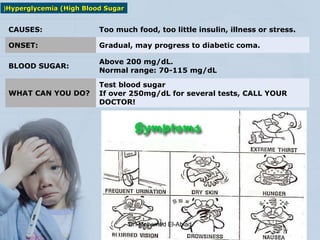
Hyperglycemia (High Blood Sugar
(
(
CAUSES: Too much food, too little insulin, illness or stress.
ONSET: Gradual, may progress to diabetic coma.
BLOOD SUGAR:
Above 200 mg/dL.
Normal range: 70-115 mg/dL
WHAT CAN YOU DO?
Test blood sugar
If over 250mg/dL for several tests, CALL YOUR
DOCTOR!
Dr. Mohamed El-Abiad
Diabetic ketoacidosis
Dr. Mohamed El-Abiad
Diabetic ketoacidosis
Symptoms
Nausea and vomiting
Fruity breath (breath odor(
Stomach pain
Deep, rapid breathing
Flushed face
Dry skin and mouth
Muscle stiffness or aching Headache
Shortness of breath Decreased consciousness
Decreased appetite Abdominal pain Fatigue
Breathing difficulty while lying down
Frequent urination or thirst for a day or more
Mental stupor that may progress to coma
Dr. Mohamed El-Abiad
Diabetic ketoacidosis
Dr. Mohamed El-Abiad
Testing for Diabetic Ketoacidosis
Ketone testing may be used in type 1 diabetes to screen for early ketoacidosis.
The ketones test is done using a urine sample.
Ketone testing is usually done at the following times:
•When the blood sugar is higher than 240 mg/dL
•During an illness such as pneumonia, heart attack, or stroke
•When nausea or vomiting occur
•During pregnancy
Other tests that may be done to
diagnose ketoacidosis include:
•Arterial blood gas
•Blood glucose test
•Blood pressure measurement
•Amylase blood test
•Potassium blood test
Dr. Mohamed El-Abiad
Ketoacidosis
Ketoacidosis
Insulin
NaHCO3
IV Fluids
Dr. Mohamed El-Abiad
Hepatic Encephalopathy
Dr. Mohamed El-Abiad
Causes
Causes
:
:
(1( Virus hepatitis
(2( Cirrhosis of liver,
(3( Biliary cirrhosis,
(4( Toxic hepatitis,
(5( Infantile cirrhosis of liver,
(6( Hepato toxic drugs,
(7( Carcinoma of liver,
(8( Portal hypertension,
(9( Toxic nitrogenous products are absorbed from the large gut
(10(Defective synthesis of urea in the liver, etc.
Dr. Mohamed El-Abiad
Triggered by
Triggered by
:
:
•Dehydration
•Eating too much protein
•Electrolyte abnormalities (especially a decrease in potassium(
from vomiting or taking diuretics
•Bleeding from the intestines, stomach, or esophagus
•Infections
•Kidney problems
•Low oxygen levels in the body
•Shunt placement or complications (portosystemic shunt (
•Surgery
•Use of medications that suppress the central nervous system
(such as barbiturates or benzodiazepine tranquilizers(
Dr. Mohamed El-Abiad
Signs and Symptoms
Signs and Symptoms
:
:
Symptoms many begin slowly and gradually worsen,
or they may begin suddenly and be severe from the start.
(
A( Stage of pre-coma
(
1
(
Alteration in behaviour
.
(2( Impairment of memory and other intellectual functions.
(3( Confusion and even delirium.
(4( Slurring of the speech.
(5( Inversibn of sleep rhythm.
(6( Convulsion—local or generalised.
(7( Restlessness
(8( Disorientation about space time and persons.
(9( Flapping tremor in the outstretched hand and fingers,
wrist and even in the shoulder (Bat’s wing tremor(.
Dr. Mohamed El-Abiad
Signs and Symptoms
Signs and Symptoms
:
:
(B( Stage of coma
(
1
(
Patient is in deep coma
,
(2( Muscles are flaccid.
(3( Planter may be extensor absent.
(4( Deep reflexes absent. [Cerebral disturbance (encephalopathy(]
Dr. Mohamed El-Abiad
Diagnosis
Diagnosis
:
:
• Complete blood count or hematocrit to check for anemia
• CT scan of the head
• EEG
• Liver function tests
• Prothrombin time
• Serum ammonia levels
• Sodium level in the blood
• Potassium level in the blood
• creatinine to see how the kidneys are working
Signs of liver disease, such as:
yellow skin
eyes (jaundice(
fluid collection in the abdomen (ascites(
occasionally a musty odor to the breath and urine
Tests may include
:
Dr. Mohamed El-Abiad
(1( Complete bed rest.
(2( Diet should contain more carbohydrate and less protein.
(3( Sedatives
(4( Good food and polyvitamins may be effective.
(5( Drugs—sedate cause of anxiety and treated
(6( Gastrointestinal bleeding must be stopped
(7( Infections, kidney failure, electrolyte abnormalities
(especially potassium( need to be treated.
(8( Life support may be necessary to help with breathing
or blood circulation, particularly if the person is in a coma.
(9( Lactulose may be given to prevent intestinal bacteria from
creating ammonia , and as a laxative to remove
blood from the intestines. Neomycin may also be used to
reduce ammonia production by intestinal bacteria.
(10( Medications containing ammonium (including certain antacids
should also be avoided.
Treatment
Treatment
Dr. Mohamed El-Abiad
Complications
Complications
Prognosis
Acute hepatic encephalopathy may be treatable.
Chronic forms of the disorder often keep getting
worse or continue to come back.
Both forms may result in irreversible coma and death.
Approximately 80% (8 out of 10 patients) die
if they go into a coma. Recovery and the risk of the condition
returning vary from patient to patient.
•Brain herniation
•Brain swelling
•Increased risk of:
•Cardiovascular collapse
•Kidney failure
•Respiratory failure
•Sepsis
•Permanent nervous system damage
•Progressive, irreversible coma
•Side effects of medications
Dr. Mohamed El-Abiad
Renal Failure
Earthy Looking
Puffiness of eyelid in the morning
Lower limb edema
Dr. Mohamed El-Abiad

coma-160807185638.pdf

  • 2.
  • 3.
    Approach to theComatose Patient Initial Treatment  Circulation  Airway  Breathing  ABC - identify and address life threatening inadequacies  Treat rapidly progressive metabolic disorders  Evaluate for intracranial hypertension and imminent herniation and treat Dr. Mohamed El-Abiad
  • 4.
    Management of theComatose Patient Circulation  Is patient in shock?  Check pulses, heart rate, blood pressure, perfusion  Remember hypotension is late sign of shock  Start treatment for shock  Do not restrict fluids in comatose patient with inadequate intravascular volume.  Cardiac output and cerebral perfusion are much more important than fluid restriction Dr. Mohamed El-Abiad
  • 5.
     Use isotonicsolutions and blood, as indicated.  Do not use hypotonic solutions to treat shock, particularly patients with coma or possible cerebral edema  Identify life threatening hemorrhage and control it. Management of the Comatose Patient Circulation Dr. Mohamed El-Abiad
  • 6.
    Management of theComatose Patient Airway  Evaluate -- is airway patent. Can patient move air without obstruction. Is there trauma or foreign body obstructing airway  Try chin lift to help open airway -- protect cervical spine  Place airway if indicated - nasal or oral airway, intubation, or surgical airway Dr. Mohamed El-Abiad
  • 7.
    Management of theComatose Patient Breathing  Evaluate - is patient moving adequate air, is respiratory rate appropriate, is gas exchange adequate, are breath sounds adequate and symmetrical  Must assure oxygenation and ventilation  If intubated don’t forget to ventilate  Identify and immediately treat problems - pneumothorax, airway obstruction, etc.. Dr. Mohamed El-Abiad
  • 8.
    Glasgow Coma Scale GlasgowComa Scale Three components. Score derived by adding the score for each component. • Eye opening (4 points) • Verbal response (5points) • Best motor response (6 points) Dr. Mohamed El-Abiad
  • 9.
     Eye opening •4 - spontaneous • 3 - to speech • 2 - to pain • 1 - none  Verbal Response • 5 - oriented • 4 - confused conversation • 3 - inappropriate words • 2 - incomprehensible sounds • 1 - none  Best Motor Response • 6 - obeys • 5 - localizes • 4 - withdraws • 3 - abnormal flexion • 2 - abnormal extension • 1 - none Glasgow Coma Scale Glasgow Coma Scale Dr. Mohamed El-Abiad
  • 10.
    Glasgow Coma Scale GlasgowComa Scale Score > 13 …… Fully Consciousness Score < 3 …… Deeply Comatosed Between 3-13 …… Disturbed Consciousness Dr. Mohamed El-Abiad
  • 11.
    Management and Evaluationof the Comatose Patient Practicalities  During ABC’s and Tests: – Have someone start IV and obtain labs  ABG’s  Toxin screens – As soon as IV in and give  Glucose (D25, 2 - 4 cc per kilogram)  Consider thiamin Dr. Mohamed El-Abiad
  • 12.
    Intra Cranial Intra Cranial Causes Causes ExtraCranial Extra Cranial Dr. Mohamed El-Abiad
  • 13.
    Pupil Size Pupil Direction DeviationOf Angle Of mouth Salivation Buccinator Muscle Hypotonia Positive Babainiski Sign Dr. Mohamed El-Abiad
  • 14.
  • 15.
  • 16.
  • 17.
  • 18.
  • 19.
  • 20.
  • 21.
  • 22.
    Acute epidural hematomaand midline shift Acute epidural hematoma and midline shift Dr. Mohamed El-Abiad
  • 23.
  • 24.
  • 25.
  • 26.
  • 27.
    Hypoglycemia (Low BloodSugar Hypoglycemia (Low Blood Sugar ( ( CAUSES: Too little food, too much insulin or diabetes medicine, or extra exercise. ONSET: Sudden, may progress to insulin shock. BLOOD SUGAR: Below 70 mg/dL. Normal range: 70-115 mg/dL WHAT CAN YOU DO? Drink a cup of orange juice or milk or eat several hard candies Test Blood sugar Within 30 minutes after symptoms go away, eat a snack e.g. sandwich, and a glass of milk Contact doctor if symptoms don't stop Dr. Mohamed El-Abiad
  • 28.
  • 29.
    Hyperglycemia (High BloodSugar Hyperglycemia (High Blood Sugar ( ( CAUSES: Too much food, too little insulin, illness or stress. ONSET: Gradual, may progress to diabetic coma. BLOOD SUGAR: Above 200 mg/dL. Normal range: 70-115 mg/dL WHAT CAN YOU DO? Test blood sugar If over 250mg/dL for several tests, CALL YOUR DOCTOR! Dr. Mohamed El-Abiad
  • 30.
  • 31.
    Diabetic ketoacidosis Diabetic ketoacidosis Symptoms Nauseaand vomiting Fruity breath (breath odor( Stomach pain Deep, rapid breathing Flushed face Dry skin and mouth Muscle stiffness or aching Headache Shortness of breath Decreased consciousness Decreased appetite Abdominal pain Fatigue Breathing difficulty while lying down Frequent urination or thirst for a day or more Mental stupor that may progress to coma Dr. Mohamed El-Abiad
  • 32.
  • 33.
    Testing for DiabeticKetoacidosis Testing for Diabetic Ketoacidosis Ketone testing may be used in type 1 diabetes to screen for early ketoacidosis. The ketones test is done using a urine sample. Ketone testing is usually done at the following times: •When the blood sugar is higher than 240 mg/dL •During an illness such as pneumonia, heart attack, or stroke •When nausea or vomiting occur •During pregnancy Other tests that may be done to diagnose ketoacidosis include: •Arterial blood gas •Blood glucose test •Blood pressure measurement •Amylase blood test •Potassium blood test Dr. Mohamed El-Abiad
  • 34.
  • 35.
  • 36.
    Causes Causes : : (1( Virus hepatitis (2(Cirrhosis of liver, (3( Biliary cirrhosis, (4( Toxic hepatitis, (5( Infantile cirrhosis of liver, (6( Hepato toxic drugs, (7( Carcinoma of liver, (8( Portal hypertension, (9( Toxic nitrogenous products are absorbed from the large gut (10(Defective synthesis of urea in the liver, etc. Dr. Mohamed El-Abiad
  • 37.
    Triggered by Triggered by : : •Dehydration •Eatingtoo much protein •Electrolyte abnormalities (especially a decrease in potassium( from vomiting or taking diuretics •Bleeding from the intestines, stomach, or esophagus •Infections •Kidney problems •Low oxygen levels in the body •Shunt placement or complications (portosystemic shunt ( •Surgery •Use of medications that suppress the central nervous system (such as barbiturates or benzodiazepine tranquilizers( Dr. Mohamed El-Abiad
  • 38.
    Signs and Symptoms Signsand Symptoms : : Symptoms many begin slowly and gradually worsen, or they may begin suddenly and be severe from the start. ( A( Stage of pre-coma ( 1 ( Alteration in behaviour . (2( Impairment of memory and other intellectual functions. (3( Confusion and even delirium. (4( Slurring of the speech. (5( Inversibn of sleep rhythm. (6( Convulsion—local or generalised. (7( Restlessness (8( Disorientation about space time and persons. (9( Flapping tremor in the outstretched hand and fingers, wrist and even in the shoulder (Bat’s wing tremor(. Dr. Mohamed El-Abiad
  • 39.
    Signs and Symptoms Signsand Symptoms : : (B( Stage of coma ( 1 ( Patient is in deep coma , (2( Muscles are flaccid. (3( Planter may be extensor absent. (4( Deep reflexes absent. [Cerebral disturbance (encephalopathy(] Dr. Mohamed El-Abiad
  • 40.
    Diagnosis Diagnosis : : • Complete bloodcount or hematocrit to check for anemia • CT scan of the head • EEG • Liver function tests • Prothrombin time • Serum ammonia levels • Sodium level in the blood • Potassium level in the blood • creatinine to see how the kidneys are working Signs of liver disease, such as: yellow skin eyes (jaundice( fluid collection in the abdomen (ascites( occasionally a musty odor to the breath and urine Tests may include : Dr. Mohamed El-Abiad
  • 41.
  • 42.
    (1( Complete bedrest. (2( Diet should contain more carbohydrate and less protein. (3( Sedatives (4( Good food and polyvitamins may be effective. (5( Drugs—sedate cause of anxiety and treated (6( Gastrointestinal bleeding must be stopped (7( Infections, kidney failure, electrolyte abnormalities (especially potassium( need to be treated. (8( Life support may be necessary to help with breathing or blood circulation, particularly if the person is in a coma. (9( Lactulose may be given to prevent intestinal bacteria from creating ammonia , and as a laxative to remove blood from the intestines. Neomycin may also be used to reduce ammonia production by intestinal bacteria. (10( Medications containing ammonium (including certain antacids should also be avoided. Treatment Treatment Dr. Mohamed El-Abiad
  • 43.
    Complications Complications Prognosis Acute hepatic encephalopathymay be treatable. Chronic forms of the disorder often keep getting worse or continue to come back. Both forms may result in irreversible coma and death. Approximately 80% (8 out of 10 patients) die if they go into a coma. Recovery and the risk of the condition returning vary from patient to patient. •Brain herniation •Brain swelling •Increased risk of: •Cardiovascular collapse •Kidney failure •Respiratory failure •Sepsis •Permanent nervous system damage •Progressive, irreversible coma •Side effects of medications Dr. Mohamed El-Abiad
  • 44.
    Renal Failure Earthy Looking Puffinessof eyelid in the morning Lower limb edema Dr. Mohamed El-Abiad
  • 45.