Author’s Purpose English I NCVPS
What does author’s purpose mean? Most simply put, an author’s purpose is his or her reason ~ or  purpose  ~ for writing.
There are four general purposes   The author may wish: to   entertain  to inform to describe to persuade Our task as readers is to determine this purpose.
How do we as readers know which purpose the author had in mind?
First, let’s look at the four different types of author’s purpose, one at a time.
To Entertain When writing to entertain, one goal may be to tell a story or to describe characters, places, or events (real or imaginary).  Examples of entertaining texts include plays, poems, stories, jokes, or even comic strips.  4th Grade Reading Florida Comprehensive Assessment Test  Produced by the  Florida Center for Instructional  Technology, College of Education, University of South Florida Š 2005
To Persuade When writing to persuade, the goal is to get the reader to agree with the writer's opinion. This type of writing is opinionated, but the author may provide facts and examples to support the opinion.  Examples of persuasive texts include commercials, advertisements, and editorials.    4th Grade Reading Florida Comprehensive Assessment Test Produced by the  Florida Center for Instructional Technology , College of Education, University of South Florida Š 2005
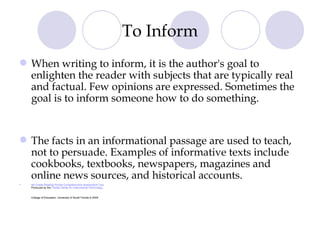
To Inform When writing to inform, it is the author's goal to enlighten the reader with subjects that are typically real and factual. Few opinions are expressed. Sometimes the goal is to inform someone how to do something. The facts in an informational passage are used to teach, not to persuade. Examples of informative texts include cookbooks, textbooks, newspapers, magazines and online news sources, and historical accounts.  4th Grade Reading Florida Comprehensive Assessment Test Produced by the  Florida Center for Instructional Technology , College of Education, University of South Florida Š 2005
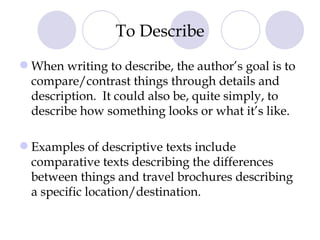
To Describe When writing to describe, the author’s goal is to compare/contrast things through details and description.  It could also be, quite simply, to describe how something looks or what it’s like. Examples of descriptive texts include comparative texts describing the differences between things and travel brochures describing a specific location/destination.
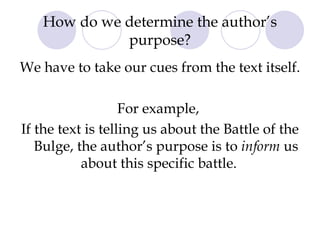
How do we determine the author’s purpose? We have to take our cues from the text itself. For example,  If the text is telling us about the Battle of the Bulge, the author’s purpose is to  inform  us about this specific battle.
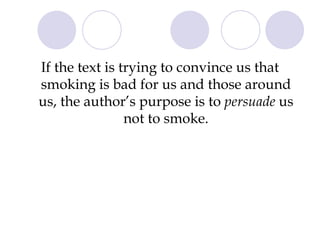
If the text is trying to convince us that smoking is bad for us and those around us, the author’s purpose is to  persuade  us not to smoke.
If the text is telling us all about the white sandy beaches, the warm sunshine 350 days of the year and the relaxing spa and pool, the author’s purpose is to  describe  a specific location in order to get us to want to go there!
If the text is   a short story, poem, or play, a comic strip or 2-line joke, no matter how long or short it may be, the author’s purpose is to  entertain  us.  It doesn’t have to be funny, either, to entertain us.  Drama, suspense, and mystery can be just as entertaining.
What’s next? Ok, now that you’ve learned about the four main purposes for why an author writes, you will read and answer some questions that look at author’s purpose. You will also take a test on this skill.  Feel free to review this power point at any time. Or, you can review your notes.

Author's purpose presentation

  • 1.
  • 2.
    What does author’spurpose mean? Most simply put, an author’s purpose is his or her reason ~ or purpose ~ for writing.
  • 3.
    There are fourgeneral purposes The author may wish: to entertain to inform to describe to persuade Our task as readers is to determine this purpose.
  • 4.
    How do weas readers know which purpose the author had in mind?
  • 5.
    First, let’s lookat the four different types of author’s purpose, one at a time.
  • 6.
    To Entertain Whenwriting to entertain, one goal may be to tell a story or to describe characters, places, or events (real or imaginary). Examples of entertaining texts include plays, poems, stories, jokes, or even comic strips. 4th Grade Reading Florida Comprehensive Assessment Test Produced by the Florida Center for Instructional Technology, College of Education, University of South Florida Š 2005
  • 7.
    To Persuade Whenwriting to persuade, the goal is to get the reader to agree with the writer's opinion. This type of writing is opinionated, but the author may provide facts and examples to support the opinion. Examples of persuasive texts include commercials, advertisements, and editorials. 4th Grade Reading Florida Comprehensive Assessment Test Produced by the Florida Center for Instructional Technology , College of Education, University of South Florida Š 2005
  • 8.
    To Inform Whenwriting to inform, it is the author's goal to enlighten the reader with subjects that are typically real and factual. Few opinions are expressed. Sometimes the goal is to inform someone how to do something. The facts in an informational passage are used to teach, not to persuade. Examples of informative texts include cookbooks, textbooks, newspapers, magazines and online news sources, and historical accounts. 4th Grade Reading Florida Comprehensive Assessment Test Produced by the Florida Center for Instructional Technology , College of Education, University of South Florida Š 2005
  • 9.
    To Describe Whenwriting to describe, the author’s goal is to compare/contrast things through details and description. It could also be, quite simply, to describe how something looks or what it’s like. Examples of descriptive texts include comparative texts describing the differences between things and travel brochures describing a specific location/destination.
  • 10.
    How do wedetermine the author’s purpose? We have to take our cues from the text itself. For example, If the text is telling us about the Battle of the Bulge, the author’s purpose is to inform us about this specific battle.
  • 11.
    If the textis trying to convince us that smoking is bad for us and those around us, the author’s purpose is to persuade us not to smoke.
  • 12.
    If the textis telling us all about the white sandy beaches, the warm sunshine 350 days of the year and the relaxing spa and pool, the author’s purpose is to describe a specific location in order to get us to want to go there!
  • 13.
    If the textis a short story, poem, or play, a comic strip or 2-line joke, no matter how long or short it may be, the author’s purpose is to entertain us. It doesn’t have to be funny, either, to entertain us. Drama, suspense, and mystery can be just as entertaining.
  • 14.
    What’s next? Ok,now that you’ve learned about the four main purposes for why an author writes, you will read and answer some questions that look at author’s purpose. You will also take a test on this skill. Feel free to review this power point at any time. Or, you can review your notes.