ACTIVITY
Scenario:
Imagine that you were standing in line at
the cafeteria and overheard the following
conversation
Source: https://www.scribd.com/document/123710224/Paraphrasing-Exercises
• Abby: Oh my god, so yesterday I was just sitting at the cafeteria
table and RAYMOND came over and sat next to me! He is SO
HOT.
• Jessica: You mean, Raymond the boyfriend of Penelope?
• Abby: Yep, exactly that Raymond! He was totally flirting with me
though.
• Jessica. No way! He was flirting with you?! You gotta be kidding.
Penelope sure wouldn’t be happy to hear that!
• Abby: Oh, he was definitely flirting. He asked me a ton of
questions about class that day. He was all “I missed class so could
you fill me in” but you KNOW that’s just an excuse! He was totally
trying to get to know me.
Source: https://www.scribd.com/document/123710224/Paraphrasing-Exercises
•Let’s say you’re friends with Penelope. Pretend
that you are talking to her about the
conversation. What would your
conversation be like?
Source: https://www.scribd.com/document/123710224/Paraphrasing-Exercises
•We tell someone about things we heard or
did every day, while using our own words.
That’s exactly what you do in a paraphrase!
Source: https://www.scribd.com/document/123710224/Paraphrasing-Exercises
• Me: So Penelope, how are things going with Raymond?
• Penelope: Great! Why?
• Me: I overheard a conversation between two girls about how “hot” he was, and one of
the girls seemed to think he was flirting with her, but I think she was just making up a
story. But I thought I’d check.
• Penelope: What?! Flirting with her??
• Me: Yeah, that’s what she said. But actually I think she was just exaggerating. It was
Abby, you know her? She’s always convinced that everyone’s in love with her. She said
that Raymond had come over to talk with her in the cafeteria and asked her about a
class they were taking, because he’d missed the class. Somehow she decided that this
was flirting!
• Penelope: Oh sheesh. Abby’s just crazy. Raymond told me about her. Hope she
doesn’t try any moves on him.
• Me: Yeah, well she didn’t sound really serious. I guess she’ll probably just get
distracted by someone else soon.
Source: https://www.scribd.com/document/123710224/Paraphrasing-Exercises
GROUP WORK
•You will be grouped into five.
•Each group will be given a sheet of paper
which contains two parts.
•Compare the two passages.
•Share your answer after the given time.
The original passage:
Students frequently overuse
direct quotation in taking notes, and
as a result they overuse quotations
in the final [research] paper.
Probably only about 10% of your
final manuscript should appear as
directly quoted matter. Therefore,
you should strive to limit the
amount of exact transcribing of
source materials while taking notes.
Lester, James D. Writing Research
Papers. 2nd ed. (1976): 46-47.
A legitimate paraphrase:
In research papers
students often quote excessively,
failing to keep quoted material
down to a desirable level. Since
the problem usually originates
during note taking, it is essential
to minimize the material recorded
verbatim (Lester 46-47).
Source:
https://owl.english.purdue.edu/owl/resource/619/
01/
ANSWER THE FOLLOWING QUESTIONS:
•What information is presented in each part of the
paper?
•Which is a paraphrase?
•What are some characteristics of a good
paraphrase?
•What may be the steps in paraphrasing?
PARAPHRASE
•a restatement of a text, passage, or work giving
the meaning in another form
•Example: The teacher asked the students to write
a paraphrase of the poem.
Source: https://www.merriam-webster.com/dictionary/paraphrase
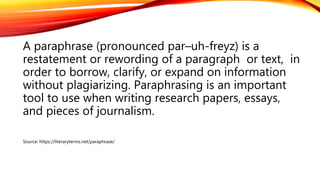
A paraphrase (pronounced par–uh-freyz) is a
restatement or rewording of a paragraph or text, in
order to borrow, clarify, or expand on information
without plagiarizing. Paraphrasing is an important
tool to use when writing research papers, essays,
and pieces of journalism.
Source: https://literaryterms.net/paraphrase/
PARAPHRASE WHEN:
• You want to use another writer’s words without
plagiarizing
• You want to use another writer’s words without the use
of quotes
• The ideas of the other writer are more important than
his/her style
• You think that the words of the other writer are too
difficult for your readers
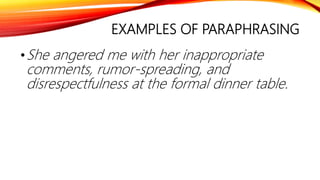
EXAMPLES OF PARAPHRASING
•She angered me with her inappropriate
comments, rumor-spreading, and
disrespectfulness at the formal dinner table.
Example 1
•She made me angry when she was rude at dinner.
This paraphrase is an example of a rewording which
shortens and simplifies while maintaining the same
meaning.
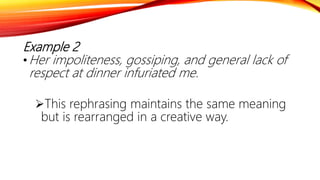
Example 2
•Her impoliteness, gossiping, and general lack of
respect at dinner infuriated me.
This rephrasing maintains the same meaning
but is rearranged in a creative way.
Example 3
•I was mad when she started spreading rumors,
making inappropriate comments, and
other guests at our dinner.
Another paraphrase, this rewording properly
and interestingly rearranges the information
provided in the original sentence.
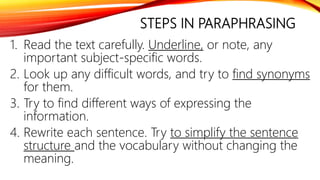
STEPS IN PARAPHRASING
1. Read the text carefully. Underline, or note, any
important subject-specific words.
2. Look up any difficult words, and try to find synonyms
for them.
3. Try to find different ways of expressing the
information.
4. Rewrite each sentence. Try to simplify the sentence
structure and the vocabulary without changing the
meaning.
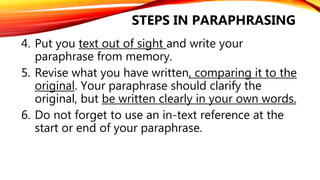
4. Put you text out of sight and write your
paraphrase from memory.
5. Revise what you have written, comparing it to the
original. Your paraphrase should clarify the
original, but be written clearly in your own words.
6. Do not forget to use an in-text reference at the
start or end of your paraphrase.
STEPS IN PARAPHRASING
Original Text (45 words) Paraphrased text (56 words)
Traditionally, in oral and written
discourses, the masculine
'he' was used as a pronoun to
to a person whose gender was
unknown or irrelevant to the
context. Recently, this usage has
come under criticism for
supporting gender-based
stereotypes and is increasingly
considered inappropriate (Smith,
2010, p. 24).
If the gender of a person was not
known or was unimportant to the
meaning of oral or written texts, it
was customary to use the
form of 'he' when a pronoun was
required; however, there has been
growing concern about this
in modern usage because it
to privilege stereotypes based on
gender (Smith, 2010, p. 24).
ASSESS YOUR PARAPHRASE
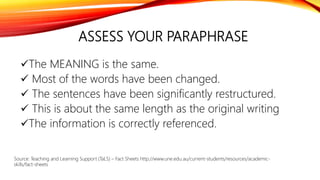
The MEANING is the same.
 Most of the words have been changed.
 The sentences have been significantly restructured.
 This is about the same length as the original writing
The information is correctly referenced.
Source: Teaching and Learning Support (TaLS) – Fact Sheets http://www.une.edu.au/current-students/resources/academic-
skills/fact-sheets
THE IMPORTANCE OF USING
PARAPHRASE
• Paraphrasing is a way of referencing a source without
directly quoting it or of further explaining a selected
quote. Correct paraphrasing is important in that poor
paraphrasing can result in accusations of plagiarism, or
copying from a source without correctly citing it.
Paraphrasing allows writers to examine the meaning of
others’ work, creatively rephrase their statements, and
craft information to suit an essay or composition’s goal
or focus.
RELATED TERMS
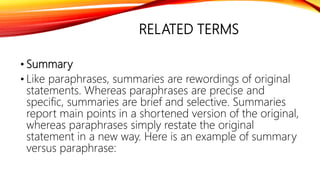
• Summary
• Like paraphrases, summaries are rewordings of original
statements. Whereas paraphrases are precise and
specific, summaries are brief and selective. Summaries
report main points in a shortened version of the original,
whereas paraphrases simply restate the original
statement in a new way. Here is an example of summary
versus paraphrase:
Original Statement:
• At the party we had delicious red punch, a bunch of different appetizers,
a cookout. Since it was at the park, we played volleyball, went swimming,
sunbathed for fun.
Summary:
• At the party we enjoyed food and drink and various outdoor activities.
Here, the summary purposefully shortens the original statement while
its major points.
Paraphrase:
• At the party we drank some punch, ate a handful of appetizers, and had a
cookout. The park allowed us to enjoy a number of enjoyable activities
volleyball to swimming to sunbathing.
Original Passage
• By and large Yosemite has been preserved as though it were a painting.
boundaries of the park are the gilt frame around a masterpiece, and within
the frame we are urged to take only pictures, leave only footprints. There
enormously important reasons to do so—there are too many people
to the park to do it any other way—and yet I cannot help feeling
is sadly missing from this experience of nature. Looking is a fine thing to do
to pictures, but hardly an adequate way to live in the world. It is nature as a
place in which we do not belong, a place in which we do not live, in which
are intruders. A tourist is by definition an outsider, a person who does not
belong, a stranger in paradise.
• -Solnit, Rebecca. Savage Dreams: A Journey into the Landscape Wars of the
American West. Berkeley: University of California Press, 1999. Print.
Plagiarized Version (creates a mosaic of copied language and
sentence structure)
• Yosemite has been preserved as though it were a framed
masterpiece. Within the frame of this masterpiece—within the
park boundaries—we are urged to take only pictures. Although
this is an important approach to take in visiting national parks, it
not an adequate way to live in relation to a place. When people
are told to look but not touch, they are sent the message that
is a place in which they are intruders, a message that may
preclude a healthy relationship with the natural world (Solnit
•What have you noticed with the plagiarized
version? Compare it with the original.
•How may plagiarism be avoided?
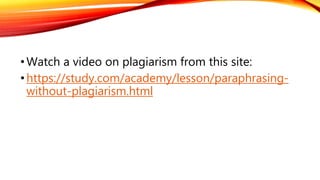
•Watch a video on plagiarism from this site:
•https://study.com/academy/lesson/paraphrasing-
without-plagiarism.html
WAYS TO AVOID PLAGIARISM
HOW TO PARAPHRASE A SOURCE
General advice
• When reading a passage, try first to understand it as a
whole, rather than pausing to write down specific ideas
or phrases.
• Be selective. Unless your assignment is to do a formal or
"literal" paraphrase, you usually don?t need to
paraphrase an entire passage; instead, choose and
summarize the material that helps you make a point in
your paper.
Source: https://writing.wisc.edu/handbook/qpa_paraphrase2.html
•Think of what "your own words" would be if you
were telling someone who's unfamiliar with your
subject (your mother, your brother, a friend) what
the original source said.
•Remember that you can use direct quotations of
phrases from the original within your paraphrase,
and that you don't need to change or put
quotation marks around shared language.
Source: https://writing.wisc.edu/handbook/qpa_paraphrase2.html
METHODS OF PARAPHRASING
•Look away from the source then write.
Read the text you want to paraphrase several times
until you feel that you understand it and can use
your own words to restate it to someone else.
Then, look away from the original and rewrite the
text in your own words.
Source: https://writing.wisc.edu/handbook/qpa_paraphrase2.html
•Take notes.
Take abbreviated notes; set the notes aside; then
paraphrase from the notes a day or so later, or when
you draft.
If you find that you can't do A or B, this may mean
that you don't understand the passage completely
or that you need to use a more structured process
until you have more experience in paraphrasing.
Why are the skills in paraphrasing
important?
APPLICATION
•You will be given paragraphs to paraphrase.
•After 30 minutes, you will post your output
for processing.
Source: https://www.tales2go.com/wp-content/uploads/2015/08/paraphrasing-rubric.pdf
THANK YOU VERY
MUCH!

Paraphrasing.pptx

  • 1.
    ACTIVITY Scenario: Imagine that youwere standing in line at the cafeteria and overheard the following conversation Source: https://www.scribd.com/document/123710224/Paraphrasing-Exercises
  • 2.
    • Abby: Ohmy god, so yesterday I was just sitting at the cafeteria table and RAYMOND came over and sat next to me! He is SO HOT. • Jessica: You mean, Raymond the boyfriend of Penelope? • Abby: Yep, exactly that Raymond! He was totally flirting with me though. • Jessica. No way! He was flirting with you?! You gotta be kidding. Penelope sure wouldn’t be happy to hear that! • Abby: Oh, he was definitely flirting. He asked me a ton of questions about class that day. He was all “I missed class so could you fill me in” but you KNOW that’s just an excuse! He was totally trying to get to know me. Source: https://www.scribd.com/document/123710224/Paraphrasing-Exercises
  • 3.
    •Let’s say you’refriends with Penelope. Pretend that you are talking to her about the conversation. What would your conversation be like? Source: https://www.scribd.com/document/123710224/Paraphrasing-Exercises
  • 4.
    •We tell someoneabout things we heard or did every day, while using our own words. That’s exactly what you do in a paraphrase! Source: https://www.scribd.com/document/123710224/Paraphrasing-Exercises
  • 5.
    • Me: SoPenelope, how are things going with Raymond? • Penelope: Great! Why? • Me: I overheard a conversation between two girls about how “hot” he was, and one of the girls seemed to think he was flirting with her, but I think she was just making up a story. But I thought I’d check. • Penelope: What?! Flirting with her?? • Me: Yeah, that’s what she said. But actually I think she was just exaggerating. It was Abby, you know her? She’s always convinced that everyone’s in love with her. She said that Raymond had come over to talk with her in the cafeteria and asked her about a class they were taking, because he’d missed the class. Somehow she decided that this was flirting! • Penelope: Oh sheesh. Abby’s just crazy. Raymond told me about her. Hope she doesn’t try any moves on him. • Me: Yeah, well she didn’t sound really serious. I guess she’ll probably just get distracted by someone else soon. Source: https://www.scribd.com/document/123710224/Paraphrasing-Exercises
  • 6.
    GROUP WORK •You willbe grouped into five. •Each group will be given a sheet of paper which contains two parts. •Compare the two passages. •Share your answer after the given time.
  • 7.
    The original passage: Studentsfrequently overuse direct quotation in taking notes, and as a result they overuse quotations in the final [research] paper. Probably only about 10% of your final manuscript should appear as directly quoted matter. Therefore, you should strive to limit the amount of exact transcribing of source materials while taking notes. Lester, James D. Writing Research Papers. 2nd ed. (1976): 46-47. A legitimate paraphrase: In research papers students often quote excessively, failing to keep quoted material down to a desirable level. Since the problem usually originates during note taking, it is essential to minimize the material recorded verbatim (Lester 46-47). Source: https://owl.english.purdue.edu/owl/resource/619/ 01/
  • 8.
    ANSWER THE FOLLOWINGQUESTIONS: •What information is presented in each part of the paper? •Which is a paraphrase? •What are some characteristics of a good paraphrase? •What may be the steps in paraphrasing?
  • 9.
    PARAPHRASE •a restatement ofa text, passage, or work giving the meaning in another form •Example: The teacher asked the students to write a paraphrase of the poem. Source: https://www.merriam-webster.com/dictionary/paraphrase
  • 10.
    A paraphrase (pronouncedpar–uh-freyz) is a restatement or rewording of a paragraph or text, in order to borrow, clarify, or expand on information without plagiarizing. Paraphrasing is an important tool to use when writing research papers, essays, and pieces of journalism. Source: https://literaryterms.net/paraphrase/
  • 11.
    PARAPHRASE WHEN: • Youwant to use another writer’s words without plagiarizing • You want to use another writer’s words without the use of quotes • The ideas of the other writer are more important than his/her style • You think that the words of the other writer are too difficult for your readers
  • 12.
    EXAMPLES OF PARAPHRASING •Sheangered me with her inappropriate comments, rumor-spreading, and disrespectfulness at the formal dinner table.
  • 13.
    Example 1 •She mademe angry when she was rude at dinner. This paraphrase is an example of a rewording which shortens and simplifies while maintaining the same meaning.
  • 14.
    Example 2 •Her impoliteness,gossiping, and general lack of respect at dinner infuriated me. This rephrasing maintains the same meaning but is rearranged in a creative way.
  • 15.
    Example 3 •I wasmad when she started spreading rumors, making inappropriate comments, and other guests at our dinner. Another paraphrase, this rewording properly and interestingly rearranges the information provided in the original sentence.
  • 16.
    STEPS IN PARAPHRASING 1.Read the text carefully. Underline, or note, any important subject-specific words. 2. Look up any difficult words, and try to find synonyms for them. 3. Try to find different ways of expressing the information. 4. Rewrite each sentence. Try to simplify the sentence structure and the vocabulary without changing the meaning.
  • 17.
    4. Put youtext out of sight and write your paraphrase from memory. 5. Revise what you have written, comparing it to the original. Your paraphrase should clarify the original, but be written clearly in your own words. 6. Do not forget to use an in-text reference at the start or end of your paraphrase. STEPS IN PARAPHRASING
  • 18.
    Original Text (45words) Paraphrased text (56 words) Traditionally, in oral and written discourses, the masculine 'he' was used as a pronoun to to a person whose gender was unknown or irrelevant to the context. Recently, this usage has come under criticism for supporting gender-based stereotypes and is increasingly considered inappropriate (Smith, 2010, p. 24). If the gender of a person was not known or was unimportant to the meaning of oral or written texts, it was customary to use the form of 'he' when a pronoun was required; however, there has been growing concern about this in modern usage because it to privilege stereotypes based on gender (Smith, 2010, p. 24).
  • 19.
    ASSESS YOUR PARAPHRASE TheMEANING is the same.  Most of the words have been changed.  The sentences have been significantly restructured.  This is about the same length as the original writing The information is correctly referenced. Source: Teaching and Learning Support (TaLS) – Fact Sheets http://www.une.edu.au/current-students/resources/academic- skills/fact-sheets
  • 20.
    THE IMPORTANCE OFUSING PARAPHRASE • Paraphrasing is a way of referencing a source without directly quoting it or of further explaining a selected quote. Correct paraphrasing is important in that poor paraphrasing can result in accusations of plagiarism, or copying from a source without correctly citing it. Paraphrasing allows writers to examine the meaning of others’ work, creatively rephrase their statements, and craft information to suit an essay or composition’s goal or focus.
  • 21.
    RELATED TERMS • Summary •Like paraphrases, summaries are rewordings of original statements. Whereas paraphrases are precise and specific, summaries are brief and selective. Summaries report main points in a shortened version of the original, whereas paraphrases simply restate the original statement in a new way. Here is an example of summary versus paraphrase:
  • 22.
    Original Statement: • Atthe party we had delicious red punch, a bunch of different appetizers, a cookout. Since it was at the park, we played volleyball, went swimming, sunbathed for fun. Summary: • At the party we enjoyed food and drink and various outdoor activities. Here, the summary purposefully shortens the original statement while its major points. Paraphrase: • At the party we drank some punch, ate a handful of appetizers, and had a cookout. The park allowed us to enjoy a number of enjoyable activities volleyball to swimming to sunbathing.
  • 23.
    Original Passage • Byand large Yosemite has been preserved as though it were a painting. boundaries of the park are the gilt frame around a masterpiece, and within the frame we are urged to take only pictures, leave only footprints. There enormously important reasons to do so—there are too many people to the park to do it any other way—and yet I cannot help feeling is sadly missing from this experience of nature. Looking is a fine thing to do to pictures, but hardly an adequate way to live in the world. It is nature as a place in which we do not belong, a place in which we do not live, in which are intruders. A tourist is by definition an outsider, a person who does not belong, a stranger in paradise. • -Solnit, Rebecca. Savage Dreams: A Journey into the Landscape Wars of the American West. Berkeley: University of California Press, 1999. Print.
  • 24.
    Plagiarized Version (createsa mosaic of copied language and sentence structure) • Yosemite has been preserved as though it were a framed masterpiece. Within the frame of this masterpiece—within the park boundaries—we are urged to take only pictures. Although this is an important approach to take in visiting national parks, it not an adequate way to live in relation to a place. When people are told to look but not touch, they are sent the message that is a place in which they are intruders, a message that may preclude a healthy relationship with the natural world (Solnit
  • 25.
    •What have younoticed with the plagiarized version? Compare it with the original. •How may plagiarism be avoided?
  • 26.
    •Watch a videoon plagiarism from this site: •https://study.com/academy/lesson/paraphrasing- without-plagiarism.html
  • 27.
    WAYS TO AVOIDPLAGIARISM
  • 28.
    HOW TO PARAPHRASEA SOURCE General advice • When reading a passage, try first to understand it as a whole, rather than pausing to write down specific ideas or phrases. • Be selective. Unless your assignment is to do a formal or "literal" paraphrase, you usually don?t need to paraphrase an entire passage; instead, choose and summarize the material that helps you make a point in your paper. Source: https://writing.wisc.edu/handbook/qpa_paraphrase2.html
  • 29.
    •Think of what"your own words" would be if you were telling someone who's unfamiliar with your subject (your mother, your brother, a friend) what the original source said. •Remember that you can use direct quotations of phrases from the original within your paraphrase, and that you don't need to change or put quotation marks around shared language. Source: https://writing.wisc.edu/handbook/qpa_paraphrase2.html
  • 30.
    METHODS OF PARAPHRASING •Lookaway from the source then write. Read the text you want to paraphrase several times until you feel that you understand it and can use your own words to restate it to someone else. Then, look away from the original and rewrite the text in your own words. Source: https://writing.wisc.edu/handbook/qpa_paraphrase2.html
  • 31.
    Source: https://writing.wisc.edu/handbook/qpa_paraphrase2.html •Take notes. Takeabbreviated notes; set the notes aside; then paraphrase from the notes a day or so later, or when you draft. If you find that you can't do A or B, this may mean that you don't understand the passage completely or that you need to use a more structured process until you have more experience in paraphrasing.
  • 32.
    Why are theskills in paraphrasing important?
  • 33.
    APPLICATION •You will begiven paragraphs to paraphrase. •After 30 minutes, you will post your output for processing.
  • 34.
  • 35.

Editor's Notes

  • #4 Ask participants to do a role play.
  • #5 The only difference is that you need to be more clear, in academic writing, about telling us exactly who said it and where (the citation). That’s like telling Penelope that you overheard some things Abby said in the cafeteria.
  • #6 An example answer is given above. Note that this paraphrase does not include EVERY thing that Abby said, but only the most important parts. It also includes information about the reliability of the person I’m quoting, my interpretation of their statement, and my reasons for telling Penelope (“the reader”) about the statement.
  • #9 the main purpose of academic writing is to develop and express new / your own ideas; that’s why we read what you wrote: to see what you’re thinking, and see if there’s a new way to think about or organize previous ideas/knowledge. So it’s important that you use others ideas only as a method of developing your own ideas or as support for your own ideas. Quotations should be used sparingly, and you need to always practice expressing yourself with your own words.
  • #11 Paraphrasing is re-writing another writer’s words or ideas in your own words without altering the meaning.  The paraphrase is about the same length as the original since the purpose is to rephrase without leaving out anything, and not to shorten.
  • #23 As this example shows, the paraphrase rephrases the original statement and keeps more of its original content than the summary.
  • #26 Paraphrasing is an important tool for nonfiction writers, journalists, and essayists alike. It is a common proponent of news and reporting. Correct paraphrasing protects writers from plagiarism and allows them to creatively rephrase original works, incorporating them into their own compositions.