Respiratory care modalities
Objective of the seminar
Describe the significance of physiotherapy
-
-Explain the effective technique related to the
physiotherapy
-Explain the nursing responsibility and
nursing management
CHEST PHYSIOTHERAPY
Chest physiotherapy (CPT) includes:
1.Postural drainage.
2.Chest percussion and vibration.
3.Breathing exercises.
4.Breathing retraining.
In addition teaching the patient effective coughing technique is an
important part of chest physiotherapy.
The goals
1- To remove bronchial secretions.
2- Improve ventilation And oxygenation .
3- Increase the efficiency of the respiratory muscles.
Postural Drainage
(Segmented Bronchial Drainage)
Postural drainage uses specific positions that
allow the force of gravity to assist in the
removal of bronchial secretions. The
secretions drain from the affected
bronchioles into the bronchi and trachea and
are removed by coughing or suctioning.
Postural drainage is used to prevent or
relieve bronchial obstruction caused by
accumulation of secretions.
Because the patient usually sits in an
upright position, secretions are likely to
accumulate in the lower parts of the
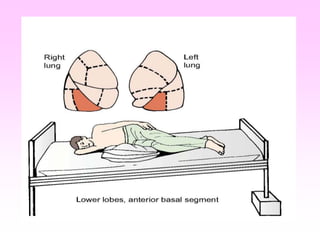
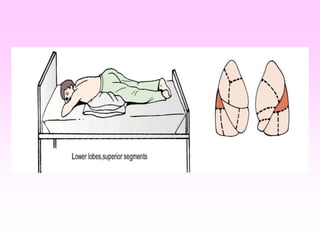
lungs. With postural drainage, different
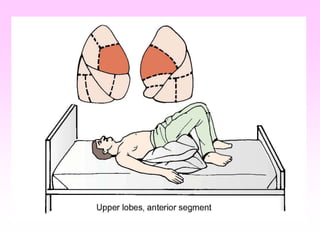
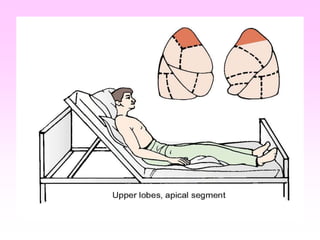
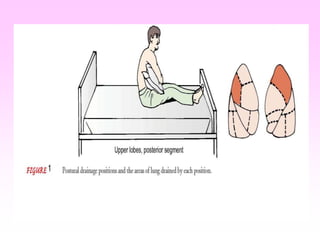
positions (Fig. -1-) are used so that the
force of gravity helps to move secretions
from the smaller bronchial airways to
the main bronchi and trachea. The
secretions then are removed by
coughing.
The nurse should instruct the patient to
inhale bronchodilators and mucolytic
agents, if prescribed, before postural
drainage because these medications
improve bronchial tree drainage.
Postural drainage exercises can be directed at any
of the segments of the lungs. The lower and
middle lobe bronchi drain more effectively when
the head is down; the upper lobe bronchi drain
more effectively when the head is up.
Frequently, five positions are used, one for
drainage of each lobe: head down, prone, right
and left lateral, and sitting upright.
Nursing Management
-The nurse should be aware of the patient’s diagnosis as
well as the lung lobes or segments involved, then cardiac
status, and any structural deformities of the chest wall
and spine. Auscultating the chest before and after the
procedure helps to identify the areas needing drainage
and to assess the effectiveness of treatment.
-The nurse teaches family members who will be assisting
the patient at home to evaluate breath sounds before and
after treatment.
-The nurse explores strategies that will enable the patient
to assume the indicated positions at home. This may
require the creative use of objects readily available at
home, such as pillows, cushions, or cardboard boxes.
-Postural drainage is usually performed two to four times
daily, before meals (to prevent nausea, vomiting, and
aspiration) and at bedtime. Prescribed bronchodilators,
water, or saline may be nebulized and inhaled before
postural drainage to dilate the bronchioles, reduce
bronchospasm, decrease the thickness of mucus and
sputum, and combat edema of the bronchial walls.
-Change the position of the pt. every 15 min
-If pt. can't cough the nurse my need to
suctions mechanically
-After procedure the nurse should notes the
amount and color viscosity and characteristic
of sputum
Chest Percussion and Vibration
Thick secretions that are difficult to cough up may be
loosened by tapping (percussing) and vibrating the chest.
Chest percussion and vibration help to dislodge mucus
adhering to the bronchioles and bronchi.
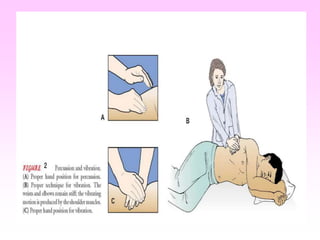
Percussion is carried out by cupping the hands and lightly
striking the chest wall in a rhythmic fashion over the
lung segment to be drained. The wrists are alternately
flexed and extended so that the chest is cupped or
clapped in a painless manner (Fig. 2).
-A soft cloth or towel may be placed over the segment of
the chest that is being cupped to prevent skin irritation and
redness from direct contact.
-Percussion, alternating with vibration, is performed for 3
to 5 minutes for each position. The patient uses
diaphragmatic breathing during this procedure to promote
relaxation (see “Breathing Retraining,” below).
-As a precaution, percussion over chest drainage tubes, the
sternum, spine, liver, kidneys, spleen, or breasts (in
women) is avoided.
-Percussion is performed cautiously in the elderly because
of their increased incidence of osteoporosis and risk of rib
fracture.
Nursing Management
-The nurse ensures that the patient is comfortable,
- Is not wearing restrictive clothing,
- And has not just eaten.
- The uppermost areas of the lung are treated first.
The nurse gives medication for pain, as prescribed, before
percussion and vibration and splints any scar, incision
and provides pillows for support as needed. The
positions are varied, but focus is placed on the affected
areas. On completion of the treatment, the nurse assists
the patient to assume a comfortable position.
The nurse must stop treatment if any of the
following occur:
1. Increased pain.
2. Increased shortness of breath.
3. Weakness, lightheadedness.
4. Hemoptysis.
Therapy is indicated until the patient has normal
respirations, can mobilize secretions, and has
normal breath sounds, and when the chest x-ray
findings are normal.
Breathing Retraining
Breathing retraining consists of :
1- Exercises .
2- Breathing practices.
designed to achieve more efficient and controlled
ventilation and to decrease the work of breathing.
Breathing retraining is especially indicated in
patients with COPD and dyspnea.
These exercises 1-promote maximal alveolar
inflation and 2-muscle relaxation, 3-relieve
anxiety, 4-eliminate ineffective and
uncoordinated patterns of respiratory muscle
activity, 5-slow the respiratory rate, and decrease
the work of breathing. Slow, relaxed, and
rhythmic breathing also helps to control the
anxiety that occurs with dyspnea.
Specific breathing exercises include diaphragmatic
and pursed-lip breathing
-The goal of diaphragmatic breathing is to use and
strengthen the diaphragm during breathing.
-Diaphragmatic breathing can become automatic
with sufficient practice and concentration.
-Pursed-lip breathing, which improves oxygen
transport, helps to induce a slow, deep breathing
pattern and assists the patient to control
breathing, even during periods of stress.
-This type of breathing helps prevent airway
collapse secondary to loss of lung elasticity in
emphysema.
-The goal of pursed-lip breathing is to train the
muscles of expiration to prolong exhalation and
increase airway pressure during expiration, thus
lessening the amount of airway trapping and
resistance
Nursing Instruction during Pursed-Lip Breathing
1. Inhale through the nose while counting to 3—the amount of time
needed to say “Smell a rose.”
2. Exhale slowly and evenly against pursed lips while tightening
the abdominal muscles. (Pursing the lips increases intratracheal
pressure; exhaling through the mouth offers less resistance to
expired air.)
3. Count to 7 while prolonging expiration through pursed lips—the
length of time to say “Blow out the candle.”
4. While sitting in a chair:
• Fold arms over the abdomen.
• Inhale through the nose while counting to 3.
• Bend forward and exhale slowly through pursed lips while
counting to 7.
5. While walking:
• Inhale while walking two steps.
• Exhale through pursed lips while walking four or five steps.
THANK FOR ALL

Respiratory Rehabilitation.ppt

  • 1.
  • 2.
    Objective of theseminar Describe the significance of physiotherapy - -Explain the effective technique related to the physiotherapy -Explain the nursing responsibility and nursing management
  • 3.
    CHEST PHYSIOTHERAPY Chest physiotherapy(CPT) includes: 1.Postural drainage. 2.Chest percussion and vibration. 3.Breathing exercises. 4.Breathing retraining. In addition teaching the patient effective coughing technique is an important part of chest physiotherapy.
  • 4.
    The goals 1- Toremove bronchial secretions. 2- Improve ventilation And oxygenation . 3- Increase the efficiency of the respiratory muscles.
  • 5.
    Postural Drainage (Segmented BronchialDrainage) Postural drainage uses specific positions that allow the force of gravity to assist in the removal of bronchial secretions. The secretions drain from the affected bronchioles into the bronchi and trachea and are removed by coughing or suctioning. Postural drainage is used to prevent or relieve bronchial obstruction caused by accumulation of secretions.
  • 6.
    Because the patientusually sits in an upright position, secretions are likely to accumulate in the lower parts of the lungs. With postural drainage, different positions (Fig. -1-) are used so that the force of gravity helps to move secretions from the smaller bronchial airways to the main bronchi and trachea. The secretions then are removed by coughing.
  • 7.
    The nurse shouldinstruct the patient to inhale bronchodilators and mucolytic agents, if prescribed, before postural drainage because these medications improve bronchial tree drainage.
  • 8.
    Postural drainage exercisescan be directed at any of the segments of the lungs. The lower and middle lobe bronchi drain more effectively when the head is down; the upper lobe bronchi drain more effectively when the head is up. Frequently, five positions are used, one for drainage of each lobe: head down, prone, right and left lateral, and sitting upright.
  • 15.
    Nursing Management -The nurseshould be aware of the patient’s diagnosis as well as the lung lobes or segments involved, then cardiac status, and any structural deformities of the chest wall and spine. Auscultating the chest before and after the procedure helps to identify the areas needing drainage and to assess the effectiveness of treatment. -The nurse teaches family members who will be assisting the patient at home to evaluate breath sounds before and after treatment.
  • 16.
    -The nurse exploresstrategies that will enable the patient to assume the indicated positions at home. This may require the creative use of objects readily available at home, such as pillows, cushions, or cardboard boxes. -Postural drainage is usually performed two to four times daily, before meals (to prevent nausea, vomiting, and aspiration) and at bedtime. Prescribed bronchodilators, water, or saline may be nebulized and inhaled before postural drainage to dilate the bronchioles, reduce bronchospasm, decrease the thickness of mucus and sputum, and combat edema of the bronchial walls.
  • 17.
    -Change the positionof the pt. every 15 min -If pt. can't cough the nurse my need to suctions mechanically -After procedure the nurse should notes the amount and color viscosity and characteristic of sputum
  • 18.
    Chest Percussion andVibration Thick secretions that are difficult to cough up may be loosened by tapping (percussing) and vibrating the chest. Chest percussion and vibration help to dislodge mucus adhering to the bronchioles and bronchi. Percussion is carried out by cupping the hands and lightly striking the chest wall in a rhythmic fashion over the lung segment to be drained. The wrists are alternately flexed and extended so that the chest is cupped or clapped in a painless manner (Fig. 2).
  • 20.
    -A soft clothor towel may be placed over the segment of the chest that is being cupped to prevent skin irritation and redness from direct contact. -Percussion, alternating with vibration, is performed for 3 to 5 minutes for each position. The patient uses diaphragmatic breathing during this procedure to promote relaxation (see “Breathing Retraining,” below). -As a precaution, percussion over chest drainage tubes, the sternum, spine, liver, kidneys, spleen, or breasts (in women) is avoided. -Percussion is performed cautiously in the elderly because of their increased incidence of osteoporosis and risk of rib fracture.
  • 21.
    Nursing Management -The nurseensures that the patient is comfortable, - Is not wearing restrictive clothing, - And has not just eaten. - The uppermost areas of the lung are treated first. The nurse gives medication for pain, as prescribed, before percussion and vibration and splints any scar, incision and provides pillows for support as needed. The positions are varied, but focus is placed on the affected areas. On completion of the treatment, the nurse assists the patient to assume a comfortable position.
  • 22.
    The nurse muststop treatment if any of the following occur: 1. Increased pain. 2. Increased shortness of breath. 3. Weakness, lightheadedness. 4. Hemoptysis. Therapy is indicated until the patient has normal respirations, can mobilize secretions, and has normal breath sounds, and when the chest x-ray findings are normal.
  • 23.
    Breathing Retraining Breathing retrainingconsists of : 1- Exercises . 2- Breathing practices. designed to achieve more efficient and controlled ventilation and to decrease the work of breathing. Breathing retraining is especially indicated in patients with COPD and dyspnea.
  • 24.
    These exercises 1-promotemaximal alveolar inflation and 2-muscle relaxation, 3-relieve anxiety, 4-eliminate ineffective and uncoordinated patterns of respiratory muscle activity, 5-slow the respiratory rate, and decrease the work of breathing. Slow, relaxed, and rhythmic breathing also helps to control the anxiety that occurs with dyspnea. Specific breathing exercises include diaphragmatic and pursed-lip breathing
  • 25.
    -The goal ofdiaphragmatic breathing is to use and strengthen the diaphragm during breathing. -Diaphragmatic breathing can become automatic with sufficient practice and concentration. -Pursed-lip breathing, which improves oxygen transport, helps to induce a slow, deep breathing pattern and assists the patient to control breathing, even during periods of stress.
  • 26.
    -This type ofbreathing helps prevent airway collapse secondary to loss of lung elasticity in emphysema. -The goal of pursed-lip breathing is to train the muscles of expiration to prolong exhalation and increase airway pressure during expiration, thus lessening the amount of airway trapping and resistance
  • 27.
    Nursing Instruction duringPursed-Lip Breathing 1. Inhale through the nose while counting to 3—the amount of time needed to say “Smell a rose.” 2. Exhale slowly and evenly against pursed lips while tightening the abdominal muscles. (Pursing the lips increases intratracheal pressure; exhaling through the mouth offers less resistance to expired air.) 3. Count to 7 while prolonging expiration through pursed lips—the length of time to say “Blow out the candle.” 4. While sitting in a chair: • Fold arms over the abdomen. • Inhale through the nose while counting to 3. • Bend forward and exhale slowly through pursed lips while counting to 7. 5. While walking: • Inhale while walking two steps. • Exhale through pursed lips while walking four or five steps.
  • 28.