MD.AZMERI LATIF BEG
M. Sc in Textile Engineering
Department of Textile Engineering,DIU
Towel:
A towel is a piece of absorbent
fabric or paper used for drying or
wiping. It draws moisture through
direct contact, often using a
blotting or a rubbing motion.
Common household textile towels
are made from cotton, rayon,
bamboo, nonwoven fibers or a few
other materials.
Types of Towel:
There are many types of towel.
Some are them given below:
Baby Towel
Bath Towel
Beach Towels
Golf Towels
Hand Towel
Hotel Towels
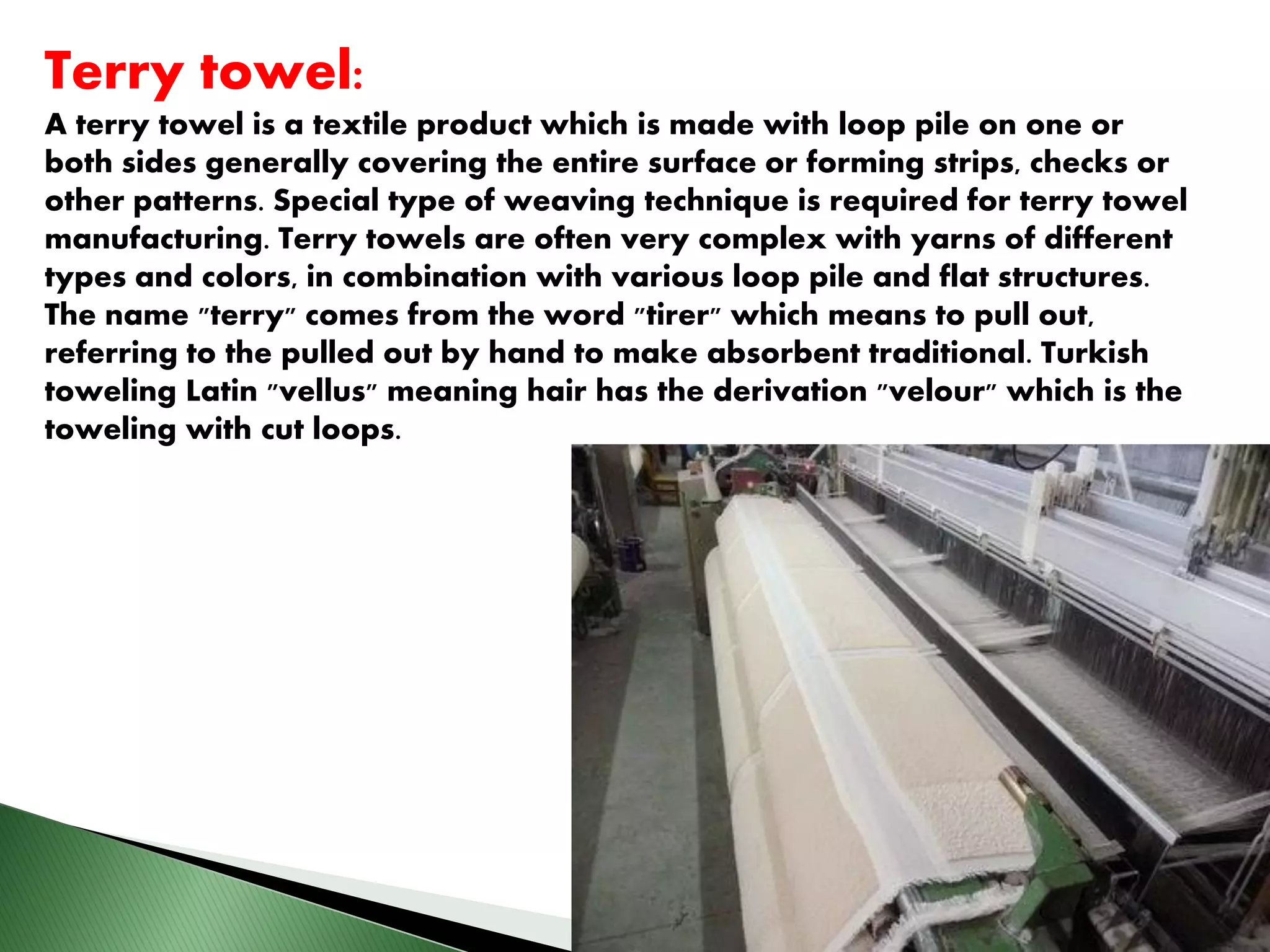
Terry towel:
A terry towel is a textile product which is made with loop pile on one or
both sides generally covering the entire surface or forming strips, checks or
other patterns. Special type of weaving technique is required for terry towel
manufacturing. Terry towels are often very complex with yarns of different
types and colors, in combination with various loop pile and flat structures.
The name "terry" comes from the word "tirer" which means to pull out,
referring to the pulled out by hand to make absorbent traditional. Turkish
toweling Latin "vellus" meaning hair has the derivation "velour" which is the
toweling with cut loops.
Process Flow Chart of Terry Towel Manufacturing
Warping (Direct)
↓
Sizing
↓
Weaving
↓
Greige Fabric Inspection
↓
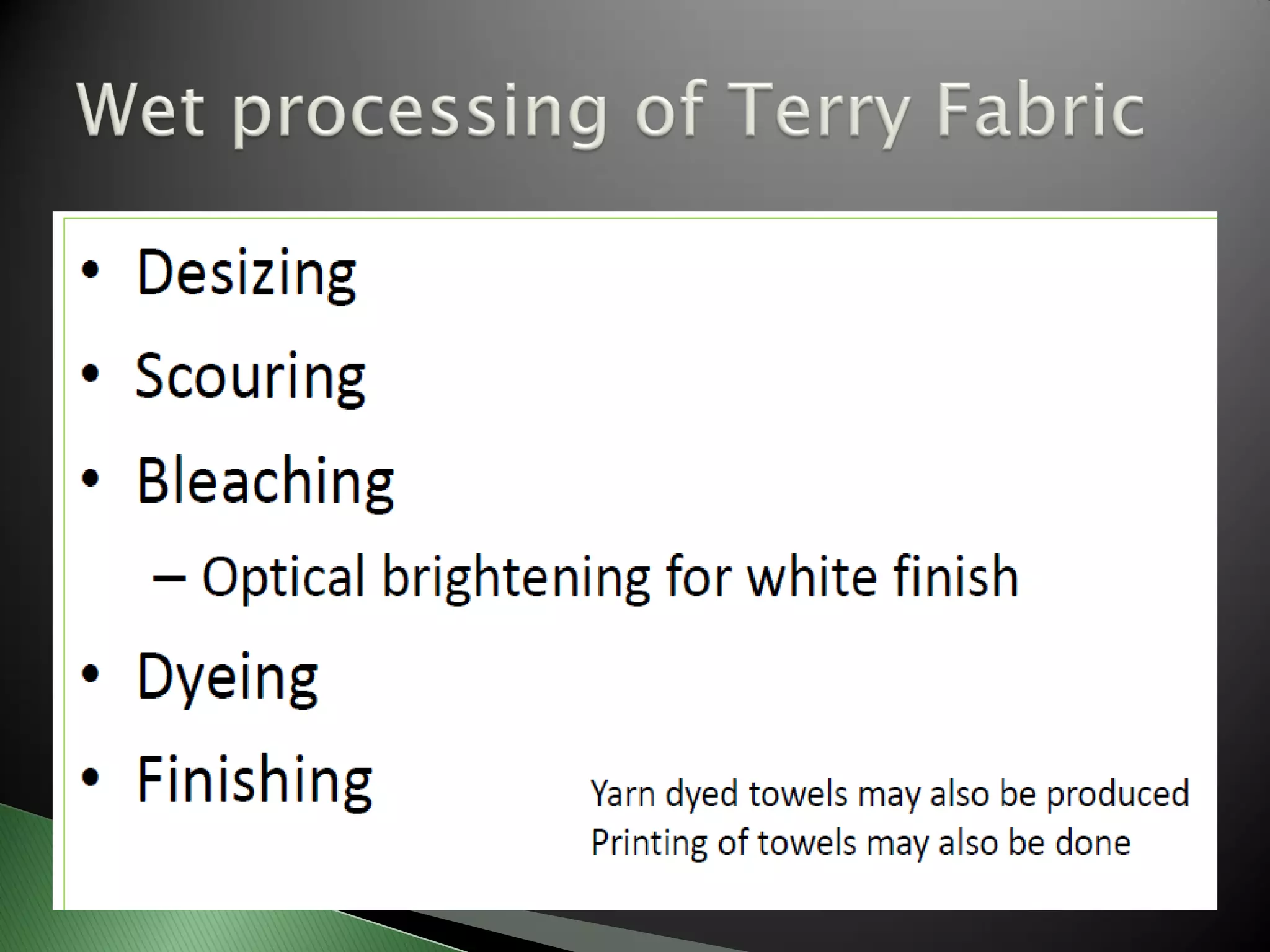
Wet Processing
↓
Inspection
↓
Stitching
↓
Final Inspection
↓
Packing & Cartooning
↓
Shipment
Absorbency :Depends on type of fiber,
yarn properties, fabric characteristics and
finishing
Softness: Depends on type of fiber, yarn
properties, fabric characteristics and
finishing
Heat insulation :Depends on thickness
and entrapped air
In order to choose fibre for manufacture a towel the following criterion are
considered important, (i) high absorbency (ii) high wet strength, (ii) ability to
dye well , (iii) good color fastness, (iv) wash ability, (v) softness , (vi) cost
and
(vii) availability. Considering these facts it seems that in manufacturing terry
towel cotton fibre is the most widely used fibre in the world. Apart from this
fibres like Modal. Lyocel, Bamboo, Flax, Microfibre and silk are widely used.
In some special cases fibres like soybean and corn are also used widely.
There are three types of yarns used in terry towel
namely
the ground warp yarn, the weft yarn and the pile
yarn. Though the yarn
parameters vary depending on the type towel but in
most cases the Warp
yarns are of carded 20/2 to 24/2 Ne count with 550
turns/metre.
The Pile warp yarns are either carded or combed
and count range is of 16/1 to 20/1 Ne, 240-255 tpi.
The Wet yarn
carded 16/1 or 20/1 Ne counts with 240-255
turns/metre twist and 15-25
picks/cm.Both ring and rotor yarns are used.
Where,
G: Ground Warp
FP: Front Face Pile Warp
BP: Back Face Pile Warp
The basic mechanism of terry towel lies in the formation of
a loop or uncut pile. The pile is a always a warp yarn and
distributed evenly between the ground warp yarns. There
can be pile either in one side or in both sides. The following
figure aboveshows the cross section of a terry towel along
warp i.e. across the weft yarns. In the figure green and the
yellow yarns represent the top and bottom piles
respectively. The red and the blue yarns represent two
ground warps of plain weave construction. Off course the
ground weave can be twill as well. The small circles
represent the weft yarns.
The way the pile is produced is that a gap (equal to loop
height) is created between fell of the cloth and a group of
three picks. This is done in such a way so that after
completion of a beat up two successive picks are inserted
but are not beaten up.
After insertion of the third pick the group of three picks is beaten up at
a time. The three picks we can call a set or group of three picks and
these are shown by vertical dotted lines in figure 2. In between two
dotted lines there are three picks. The first two picks are called loose
picks and the third or last pick is called fast pick. The weave is chosen
in such a way that during beat up of the group of three picks can easily
slide through the ground warps but the pile yarn is locked so that after
completion of the beat up a loop is produced. A group of three picks
weave of ground warp and pile warp is shown in figure.
Two loose picks and one fast pick are the simplest form of terry weave
and minimum requirements of terry formation. Figure 4A and 4B shows
weave structure of 3-picks terry structure. In weave A the ground warp
(Red & Blue) and pile warps (Green & Black) are shown alternatively while
in weave B the ground warps and the pile warps are shown together.
Both the repeats will result same towel. In the two repeats the red and
blue are the ground warp while the black and the green are the face and
back piles respectively. The number of loose picks always remains same
but for producing better quality towels the number fast picks varies.
Let off arrangement of Terry Loom
The let off arrangement of terry weaving is one of its main
features that assist in terry formation. In any terry loom there are
two let off mechanisms one for the ground warp which is just like
ordinary weaving, the other let off mechanism is intended for the
pile warp. Since the pile warp forms the pile therefore the let off
of the pile warp beam is very important to maintain equal pile
height as on the whole the quality of the towel. The let off of pile
warp is again can be of two types e.g. negative and positive. The
negative let off is used in the old version loom where the pile
beam is subjected with a very light weight and the warp is let off
deliberately due to the tension caused by beat up of the group of
three picks. In case of positive beat up, certain length of pile
yarn, which is equal to the pile height, is delivered deliberately by
the let off system. In case of negative let off there is possibility of
variation of pile height.
Normal beat up in Towel Heading
As is shown that in towel there is an area called border or towel heading.
In towel heading there is no pile and the pick density is very high so that
the beat up is carried out after every pick and therefore the let off of pile
warp require some adjustment in the border or towel heading. In case of
negative let off additional weights are required to prevent pile/loop
formation while for positive let off mechanism, deliberate delivery of the
pile is prevented and a normal let off is brought into action. In fact the
whole length of a single towel is like a repeat and a pattern chain controls
the production.
Special Beat up mechanism/Crammed mechanism
Therefore the special beat-up system has prevented its loose pick and fast
picks action and instead it has to work like ordinary beat up action. Apart
from the pick density of the towel heading also increases in the towel
heading. This special arrangement in the beat up is called crammed
mechanism.
Pick skip mechanism
Sometimes it is seen that certain length of fringe are kept
at the end of each towel. This is produced by allowing the
take up motion to wind certain length of the fabric without
inserting any weft in it.
Designing and Decoration of Terry Towel Textiles are
always associated with fashion. Towels are not different
from that. Towels can be decorated by dyeing, printing as
well as weaving. One of the most common form of
designing is alternate block of pile plain surface. This is
done by the changing the weave structure. Production of
pile in only one side is also part of this. Apart from this
there are dobby and jacquard designs used in terry
structure. A more complicated type of design is produced
by jacquard weaving where pile height varies to different
extent.
 Weight & GSM: Weight and GSM should be
same as required by customer.
 Softness/ Hand feel: It depends on properties
of the yarn used in pile, finishing chemicals
and too some extent on pile orientation.
 Pile Orientation: Totally depends on process
line.
 Lint: Lint are basically protruding fibers present
in a finished towel. It is measured by weight of
accumulated fiber collected from washing
machine and tumble drying machine during
testing.
 Absorbency: Terry towel should be highly water
absorbent.
 Dimensional Stability: How a towel is behaving
after washing is fall under dimensional stability
properties. Dimensional stability is measured by
the residual shrinkage % in a finished towel.
There are many types of towel. Baby Towel, Bath Towel,
Beach Towels, Golf Towels ,Hand Towel and Hotel Towels
now used commonly. At the moment there is no training
facility for technical experts working in the Towel
Factories. Like BGMEA, BTTLMEA (Bangladesh Terry Towel
and Linen Manufacturer and Exporters Association) may
establish a training and education center to educate the
experts of its member industries. Training is necessary in
the field of merchandising, weaving mechanism, weaving
design, production management, quality control etc. It is
expected that introduction of such training center would
reduce waste%, improve product quality, increase
production and reduce cost of production. Bangladesh is
mainly producing and exporting lower end that is cheaper
products. Attempts should be made to go for value added
products. In that case modern machines and Textile expert
will be required.
THANK YOU

Terry Towel Production

  • 1.
    MD.AZMERI LATIF BEG M.Sc in Textile Engineering Department of Textile Engineering,DIU
  • 3.
    Towel: A towel isa piece of absorbent fabric or paper used for drying or wiping. It draws moisture through direct contact, often using a blotting or a rubbing motion. Common household textile towels are made from cotton, rayon, bamboo, nonwoven fibers or a few other materials.
  • 4.
    Types of Towel: Thereare many types of towel. Some are them given below: Baby Towel Bath Towel Beach Towels Golf Towels Hand Towel Hotel Towels
  • 7.
    Terry towel: A terrytowel is a textile product which is made with loop pile on one or both sides generally covering the entire surface or forming strips, checks or other patterns. Special type of weaving technique is required for terry towel manufacturing. Terry towels are often very complex with yarns of different types and colors, in combination with various loop pile and flat structures. The name "terry" comes from the word "tirer" which means to pull out, referring to the pulled out by hand to make absorbent traditional. Turkish toweling Latin "vellus" meaning hair has the derivation "velour" which is the toweling with cut loops.
  • 8.
    Process Flow Chartof Terry Towel Manufacturing Warping (Direct) ↓ Sizing ↓ Weaving ↓ Greige Fabric Inspection ↓ Wet Processing ↓ Inspection ↓ Stitching ↓ Final Inspection ↓ Packing & Cartooning ↓ Shipment
  • 9.
    Absorbency :Depends ontype of fiber, yarn properties, fabric characteristics and finishing Softness: Depends on type of fiber, yarn properties, fabric characteristics and finishing Heat insulation :Depends on thickness and entrapped air
  • 11.
    In order tochoose fibre for manufacture a towel the following criterion are considered important, (i) high absorbency (ii) high wet strength, (ii) ability to dye well , (iii) good color fastness, (iv) wash ability, (v) softness , (vi) cost and (vii) availability. Considering these facts it seems that in manufacturing terry towel cotton fibre is the most widely used fibre in the world. Apart from this fibres like Modal. Lyocel, Bamboo, Flax, Microfibre and silk are widely used. In some special cases fibres like soybean and corn are also used widely.
  • 12.
    There are threetypes of yarns used in terry towel namely the ground warp yarn, the weft yarn and the pile yarn. Though the yarn parameters vary depending on the type towel but in most cases the Warp yarns are of carded 20/2 to 24/2 Ne count with 550 turns/metre. The Pile warp yarns are either carded or combed and count range is of 16/1 to 20/1 Ne, 240-255 tpi. The Wet yarn carded 16/1 or 20/1 Ne counts with 240-255 turns/metre twist and 15-25 picks/cm.Both ring and rotor yarns are used.
  • 14.
    Where, G: Ground Warp FP:Front Face Pile Warp BP: Back Face Pile Warp
  • 16.
    The basic mechanismof terry towel lies in the formation of a loop or uncut pile. The pile is a always a warp yarn and distributed evenly between the ground warp yarns. There can be pile either in one side or in both sides. The following figure aboveshows the cross section of a terry towel along warp i.e. across the weft yarns. In the figure green and the yellow yarns represent the top and bottom piles respectively. The red and the blue yarns represent two ground warps of plain weave construction. Off course the ground weave can be twill as well. The small circles represent the weft yarns. The way the pile is produced is that a gap (equal to loop height) is created between fell of the cloth and a group of three picks. This is done in such a way so that after completion of a beat up two successive picks are inserted but are not beaten up.
  • 17.
    After insertion ofthe third pick the group of three picks is beaten up at a time. The three picks we can call a set or group of three picks and these are shown by vertical dotted lines in figure 2. In between two dotted lines there are three picks. The first two picks are called loose picks and the third or last pick is called fast pick. The weave is chosen in such a way that during beat up of the group of three picks can easily slide through the ground warps but the pile yarn is locked so that after completion of the beat up a loop is produced. A group of three picks weave of ground warp and pile warp is shown in figure. Two loose picks and one fast pick are the simplest form of terry weave and minimum requirements of terry formation. Figure 4A and 4B shows weave structure of 3-picks terry structure. In weave A the ground warp (Red & Blue) and pile warps (Green & Black) are shown alternatively while in weave B the ground warps and the pile warps are shown together. Both the repeats will result same towel. In the two repeats the red and blue are the ground warp while the black and the green are the face and back piles respectively. The number of loose picks always remains same but for producing better quality towels the number fast picks varies.
  • 18.
    Let off arrangementof Terry Loom The let off arrangement of terry weaving is one of its main features that assist in terry formation. In any terry loom there are two let off mechanisms one for the ground warp which is just like ordinary weaving, the other let off mechanism is intended for the pile warp. Since the pile warp forms the pile therefore the let off of the pile warp beam is very important to maintain equal pile height as on the whole the quality of the towel. The let off of pile warp is again can be of two types e.g. negative and positive. The negative let off is used in the old version loom where the pile beam is subjected with a very light weight and the warp is let off deliberately due to the tension caused by beat up of the group of three picks. In case of positive beat up, certain length of pile yarn, which is equal to the pile height, is delivered deliberately by the let off system. In case of negative let off there is possibility of variation of pile height.
  • 19.
    Normal beat upin Towel Heading As is shown that in towel there is an area called border or towel heading. In towel heading there is no pile and the pick density is very high so that the beat up is carried out after every pick and therefore the let off of pile warp require some adjustment in the border or towel heading. In case of negative let off additional weights are required to prevent pile/loop formation while for positive let off mechanism, deliberate delivery of the pile is prevented and a normal let off is brought into action. In fact the whole length of a single towel is like a repeat and a pattern chain controls the production. Special Beat up mechanism/Crammed mechanism Therefore the special beat-up system has prevented its loose pick and fast picks action and instead it has to work like ordinary beat up action. Apart from the pick density of the towel heading also increases in the towel heading. This special arrangement in the beat up is called crammed mechanism.
  • 20.
    Pick skip mechanism Sometimesit is seen that certain length of fringe are kept at the end of each towel. This is produced by allowing the take up motion to wind certain length of the fabric without inserting any weft in it. Designing and Decoration of Terry Towel Textiles are always associated with fashion. Towels are not different from that. Towels can be decorated by dyeing, printing as well as weaving. One of the most common form of designing is alternate block of pile plain surface. This is done by the changing the weave structure. Production of pile in only one side is also part of this. Apart from this there are dobby and jacquard designs used in terry structure. A more complicated type of design is produced by jacquard weaving where pile height varies to different extent.
  • 28.
     Weight &GSM: Weight and GSM should be same as required by customer.  Softness/ Hand feel: It depends on properties of the yarn used in pile, finishing chemicals and too some extent on pile orientation.  Pile Orientation: Totally depends on process line.
  • 29.
     Lint: Lintare basically protruding fibers present in a finished towel. It is measured by weight of accumulated fiber collected from washing machine and tumble drying machine during testing.  Absorbency: Terry towel should be highly water absorbent.  Dimensional Stability: How a towel is behaving after washing is fall under dimensional stability properties. Dimensional stability is measured by the residual shrinkage % in a finished towel.
  • 30.
    There are manytypes of towel. Baby Towel, Bath Towel, Beach Towels, Golf Towels ,Hand Towel and Hotel Towels now used commonly. At the moment there is no training facility for technical experts working in the Towel Factories. Like BGMEA, BTTLMEA (Bangladesh Terry Towel and Linen Manufacturer and Exporters Association) may establish a training and education center to educate the experts of its member industries. Training is necessary in the field of merchandising, weaving mechanism, weaving design, production management, quality control etc. It is expected that introduction of such training center would reduce waste%, improve product quality, increase production and reduce cost of production. Bangladesh is mainly producing and exporting lower end that is cheaper products. Attempts should be made to go for value added products. In that case modern machines and Textile expert will be required.
  • 31.