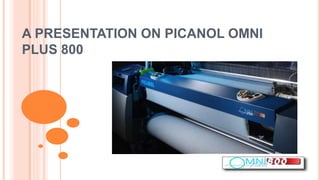
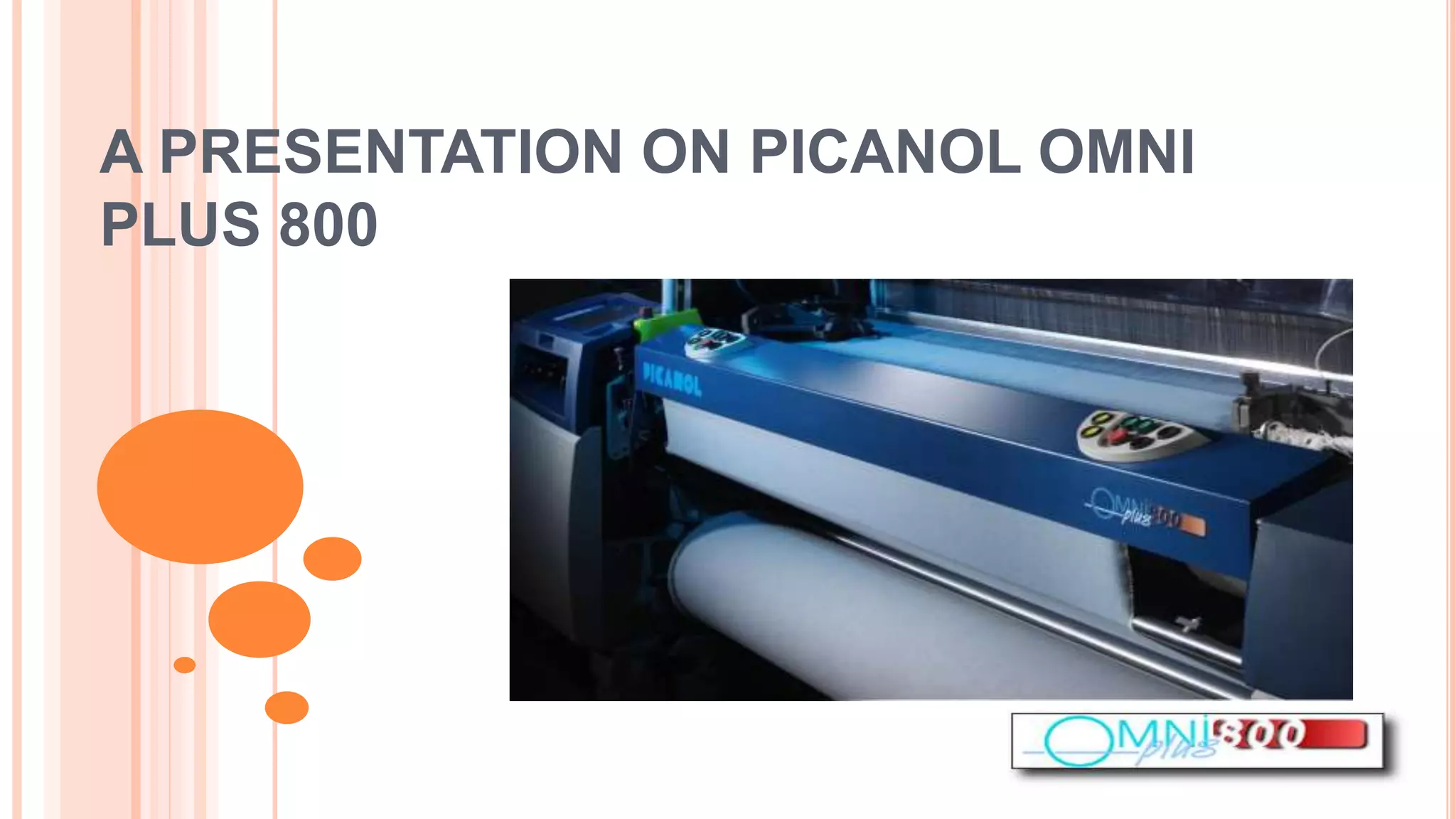
A PRESENTATION ON PICANOL OMNI
PLUS 800
MACHINE SPECIFICATION
 Machine Type – Plus
 Machine Sub Type- OMNI Plus 800
 Maximum machine speed- 850
 Leno Type: e- Leno
 AIC (Adaptive Incretion Control)
 PFT ( Programmable filling tensioner)
 Sand roller Circumference – 534 mm
MAIN PARTS
 Sumo motor
 Pre-winder( weft Feeder)
 Cam with cam box.
 Lever and Puller.
 Reed.
 Easing arm
 Back rest
 Take up roller
 Cloth roller
 Catch Cord
 Weft cutter
 Waste cutter
 Filling detector
 Disk type tensioner
 Drop wire and Dropper bar.
 Leno selvedge attachment (e- Leno)
 Main nozzle (Fixed & Movable)
 Relay nozzle
 Temple
 ELSY(Electric Leno Selvedge System)
 Batcher
 Pressure control regulator
 PFT
 Balloon Breaker
 Waste winder
 Bobbin break sensor
MAIN PARTS
Electrical boards
 MCB
 AIB
 TRIAX-2
 WEB X
 DDMP
 LDEC
 FDCB
 PB
MOTIONS
Primary motions
 Shedding
 Picking
 Beat Up
Secondary motions
 Let off
 Take up
Tertiary Motion
 Auto Warp stop Motion
 Auto Weft stop Motion
 Batcher motion
 Brake motion
SHEDDING
Keywords: Cam Shedding, Heald frame, Shed Angle,
Backrest hight, ELSY
SHEDDING
Possible Shedding
mechanisms in Picanol
Omni+ 800
 Cam Shedding
 Dobby Shedding
 Jacquard
Shedding Devices
 Heald Frame & Heald
Wire
 Shedding Cam
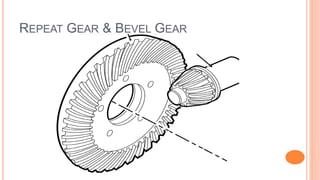
 Repeat gear
 Bevel gear
 ELSY (for selvedge)
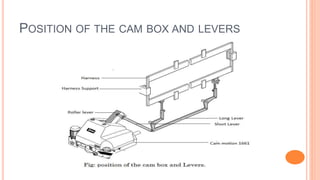
 Jack Lever
HEALD FRAME
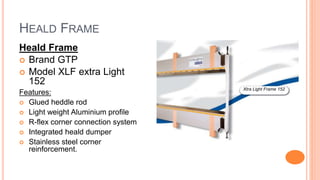
Heald Frame
 Brand GTP
 Model XLF extra Light
152
Features:
 Glued heddle rod
 Light weight Aluminium profile
 R-flex corner connection system
 Integrated heald dumper
 Stainless steel corner
reinforcement.
Xtra Light Frame 152
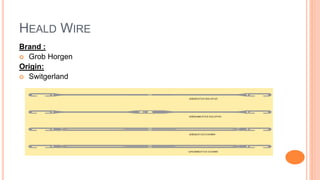
HEALD WIRE
Brand :
 Grob Horgen
Origin:
 Switgerland
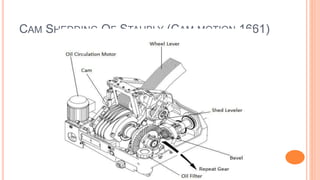
CAM SHEDDING OF STAUBLY (CAM MOTION 1661)
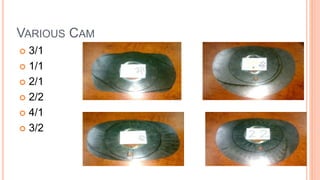
VARIOUS CAM
 3/1
 1/1
 2/1
 2/2
 4/1
 3/2
REPEAT GEAR & BEVEL GEAR
POSITION OF THE CAM BOX AND LEVERS
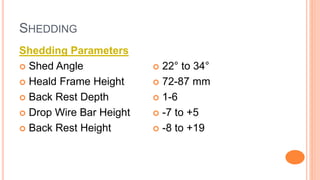
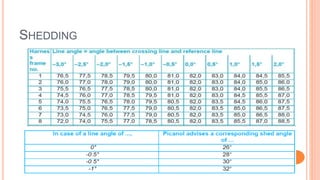
SHEDDING
Shedding Parameters
 Shed Angle
 Heald Frame Height
 Back Rest Depth
 Drop Wire Bar Height
 Back Rest Height
 22° to 34°
 72-87 mm
 1-6
 -7 to +5
 -8 to +19
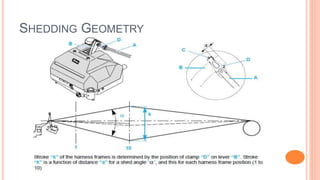
SHEDDING GEOMETRY
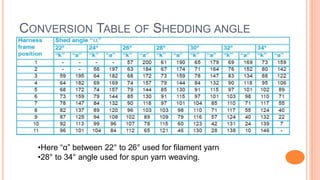
CONVERSION TABLE OF SHEDDING ANGLE
•Here “α” between 22° to 26° used for filament yarn
•28° to 34° angle used for spun yarn weaving.
SHEDDING
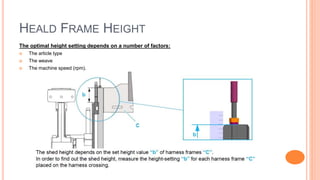
HEALD FRAME HEIGHT
The optimal height setting depends on a number of factors:
 The article type
 The weave
 The machine speed (rpm).
SUGGESTED HEALD FRAME HEIGHT
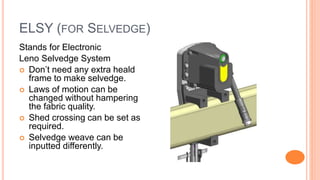
ELSY (FOR SELVEDGE)
Stands for Electronic
Leno Selvedge System
 Don’t need any extra heald
frame to make selvedge.
 Laws of motion can be
changed without hampering
the fabric quality.
 Shed crossing can be set as
required.
 Selvedge weave can be
inputted differently.
PICKING (WEFT INSERTION)
Keywords: Pre-winder, PFT, Valve, Q-nominal motor,
Nozzles, Filling cutter.
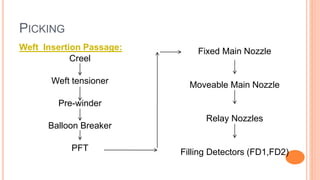
PICKING
Weft Insertion Passage:
Creel
Weft tensioner
Pre-winder
Balloon Breaker
PFT
Fixed Main Nozzle
Moveable Main Nozzle
Relay Nozzles
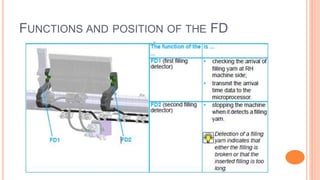
Filling Detectors (FD1,FD2)
PICKING
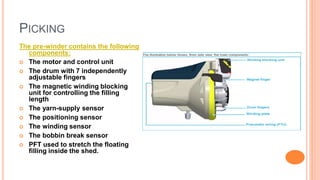
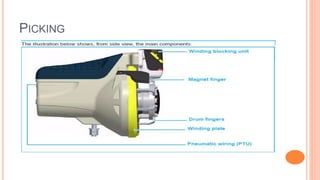
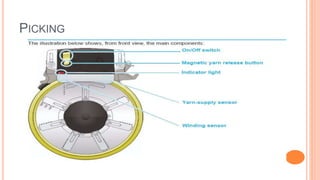
The pre-winder contains the following
components:
 The motor and control unit
 The drum with 7 independently
adjustable fingers
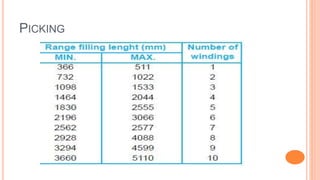
 The magnetic winding blocking
unit for controlling the filling
length
 The yarn-supply sensor
 The positioning sensor
 The winding sensor
 The bobbin break sensor
 PFT used to stretch the floating
filling inside the shed.
PICKING
PICKING
PICKING
PICKING
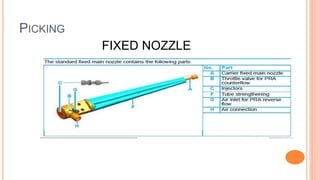
FIXED NOZZLE
PICKING
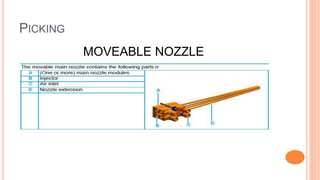
MOVEABLE NOZZLE
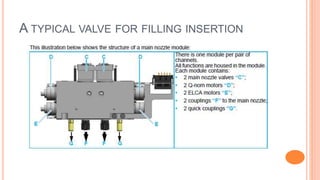
A TYPICAL VALVE FOR FILLING INSERTION
PICKING
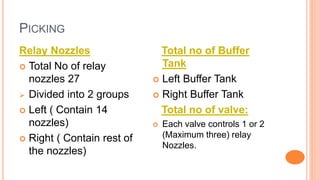
Relay Nozzles
 Total No of relay
nozzles 27
 Divided into 2 groups
 Left ( Contain 14
nozzles)
 Right ( Contain rest of
the nozzles)
Total no of Buffer
Tank
 Left Buffer Tank
 Right Buffer Tank
Total no of valve:
 Each valve controls 1 or 2
(Maximum three) relay
Nozzles.
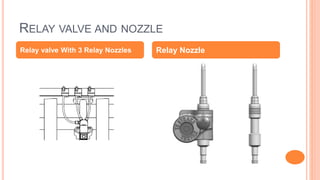
RELAY VALVE AND NOZZLE
Relay valve With 3 Relay Nozzles Relay Nozzle
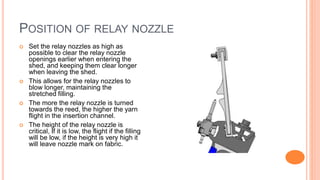
POSITION OF RELAY NOZZLE
 Set the relay nozzles as high as
possible to clear the relay nozzle
openings earlier when entering the
shed, and keeping them clear longer
when leaving the shed.
 This allows for the relay nozzles to
blow longer, maintaining the
stretched filling.
 The more the relay nozzle is turned
towards the reed, the higher the yarn
flight in the insertion channel.
 The height of the relay nozzle is
critical, If it is low, the flight if the filling
will be low, if the height is very high it
will leave nozzle mark on fabric.
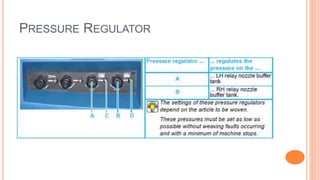
PRESSURE REGULATOR
PICKING
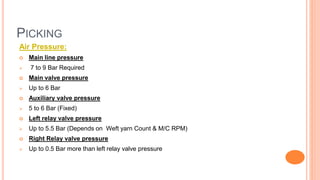
Air Pressure:
 Main line pressure
 7 to 9 Bar Required
 Main valve pressure
 Up to 6 Bar
 Auxiliary valve pressure
 5 to 6 Bar (Fixed)
 Left relay valve pressure
 Up to 5.5 Bar (Depends on Weft yarn Count & M/C RPM)
 Right Relay valve pressure
 Up to 0.5 Bar more than left relay valve pressure
FILLING CUTTER
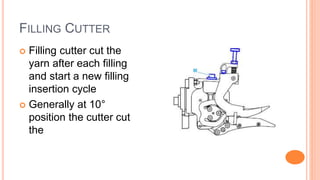
 Filling cutter cut the
yarn after each filling
and start a new filling
insertion cycle
 Generally at 10°
position the cutter cut
the
BEAT UP
Keywords: Cam Beat up, Profile Reed
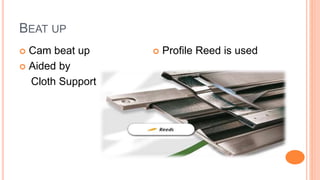
BEAT UP
 Cam beat up
 Aided by
Cloth Support
 Profile Reed is used
REED COUNT
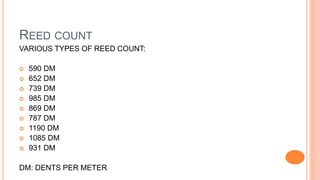
VARIOUS TYPES OF REED COUNT:
 590 DM
 652 DM
 739 DM
 985 DM
 869 DM
 787 DM
 1190 DM
 1085 DM
 931 DM
DM: DENTS PER METER
LET-OFF
Keywords: ELO, Servo Motor, Load Cell,
LET OFF
 Let off is done electrically.
 An electric motor is used to perform this
action.
 Let off motion is very important to maintain
accurate warp tension
 Speed of let off motor gradually increases
with the decrease of beam dia.
LET OFF
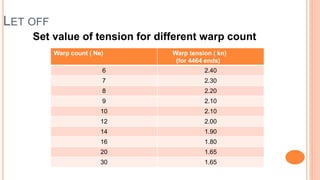
Set value of tension for different warp count
Warp count ( Ne) Warp tension ( kn)
(for 4464 ends)
6 2.40
7 2.30
8 2.20
9 2.10
10 2.10
12 2.00
14 1.90
16 1.80
20 1.65
30 1.65
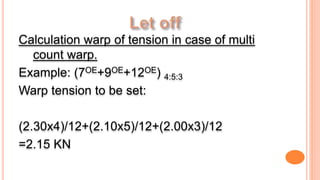
Calculation warp of tension in case of multi
count warp.
Example: (7OE+9OE+12OE) 4:5:3
Warp tension to be set:
(2.30x4)/12+(2.10x5)/12+(2.00x3)/12
=2.15 KN
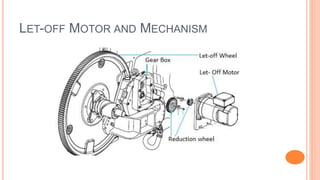
LET-OFF MOTOR AND MECHANISM
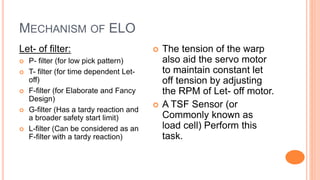
MECHANISM OF ELO
Let- of filter:
 P- filter (for low pick pattern)
 T- filter (for time dependent Let-
off)
 F-filter (for Elaborate and Fancy
Design)
 G-filter (Has a tardy reaction and
a broader safety start limit)
 L-filter (Can be considered as an
F-filter with a tardy reaction)
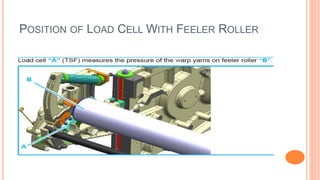
 The tension of the warp
also aid the servo motor
to maintain constant let
off tension by adjusting
the RPM of Let- off motor.
 A TSF Sensor (or
Commonly known as
load cell) Perform this
task.
POSITION OF LOAD CELL WITH FEELER ROLLER
TAKE UP
Keywords: Servo motor, Emery roller
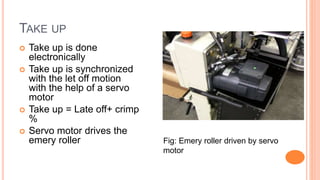
TAKE UP
 Take up is done
electronically
 Take up is synchronized
with the let off motion
with the help of a servo
motor
 Take up = Late off+ crimp
%
 Servo motor drives the
emery roller Fig: Emery roller driven by servo
motor
TERTIARY MOTIONS
Keywords: Warp Stop, Faller bar, Drop wire, FD, Photo
Electric Sensor,
STOP MOTION
Warp Stop motion
 It is constituted with drop
wire and electrode.
 When drop wire fall (due
to breakage of warp) on
the contact bar a
electronic circuit and
send a signal to stop the
machine
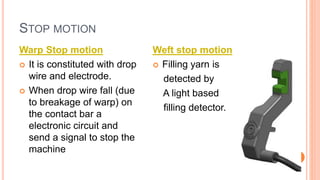
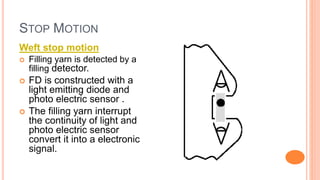
Weft stop motion
 Filling yarn is
detected by
A light based
filling detector.
STOP MOTION
Weft stop motion
 Filling yarn is detected by a
filling detector.
 FD is constructed with a
light emitting diode and
photo electric sensor .
 The filling yarn interrupt
the continuity of light and
photo electric sensor
convert it into a electronic
signal.
FUNCTIONS AND POSITION OF THE FD
STOP MOTION
Other stoppage:
 Bobbin breakage
 Leno breakage
 Catch cord breakage
 Batcher stop
 Machine brake
MOTORS OF THE AIR JET LOOM
VARIOUS MOTORS
 Sumo Motor
 Hydraulic Motor
 Cutter Motor
 ELCA Motor
 ELSY Motor
 PFT Motor
 ETU Motor
 ELO Motor
 E-leno Motor
 Q Nominal Motor
Thanking You
Md: Ishtiaque Parvez Ibne Emdad
ID: 2014-2-2-005
Department of Fabric Manufacturing Engineering
Bangladesh University Of Textiles

A presentation on picanol omni plus 800

  • 1.
    A PRESENTATION ONPICANOL OMNI PLUS 800
  • 2.
    MACHINE SPECIFICATION  MachineType – Plus  Machine Sub Type- OMNI Plus 800  Maximum machine speed- 850  Leno Type: e- Leno  AIC (Adaptive Incretion Control)  PFT ( Programmable filling tensioner)  Sand roller Circumference – 534 mm
  • 3.
    MAIN PARTS  Sumomotor  Pre-winder( weft Feeder)  Cam with cam box.  Lever and Puller.  Reed.  Easing arm  Back rest  Take up roller  Cloth roller  Catch Cord  Weft cutter  Waste cutter  Filling detector  Disk type tensioner  Drop wire and Dropper bar.  Leno selvedge attachment (e- Leno)  Main nozzle (Fixed & Movable)  Relay nozzle  Temple  ELSY(Electric Leno Selvedge System)  Batcher  Pressure control regulator  PFT  Balloon Breaker  Waste winder  Bobbin break sensor
  • 4.
    MAIN PARTS Electrical boards MCB  AIB  TRIAX-2  WEB X  DDMP  LDEC  FDCB  PB
  • 5.
    MOTIONS Primary motions  Shedding Picking  Beat Up Secondary motions  Let off  Take up Tertiary Motion  Auto Warp stop Motion  Auto Weft stop Motion  Batcher motion  Brake motion
  • 6.
    SHEDDING Keywords: Cam Shedding,Heald frame, Shed Angle, Backrest hight, ELSY
  • 7.
    SHEDDING Possible Shedding mechanisms inPicanol Omni+ 800  Cam Shedding  Dobby Shedding  Jacquard Shedding Devices  Heald Frame & Heald Wire  Shedding Cam  Repeat gear  Bevel gear  ELSY (for selvedge)  Jack Lever
  • 8.
    HEALD FRAME Heald Frame Brand GTP  Model XLF extra Light 152 Features:  Glued heddle rod  Light weight Aluminium profile  R-flex corner connection system  Integrated heald dumper  Stainless steel corner reinforcement. Xtra Light Frame 152
  • 9.
    HEALD WIRE Brand : Grob Horgen Origin:  Switgerland
  • 10.
    CAM SHEDDING OFSTAUBLY (CAM MOTION 1661)
  • 11.
    VARIOUS CAM  3/1 1/1  2/1  2/2  4/1  3/2
  • 12.
    REPEAT GEAR &BEVEL GEAR
  • 13.
    POSITION OF THECAM BOX AND LEVERS
  • 14.
    SHEDDING Shedding Parameters  ShedAngle  Heald Frame Height  Back Rest Depth  Drop Wire Bar Height  Back Rest Height  22° to 34°  72-87 mm  1-6  -7 to +5  -8 to +19
  • 15.
  • 16.
    CONVERSION TABLE OFSHEDDING ANGLE •Here “α” between 22° to 26° used for filament yarn •28° to 34° angle used for spun yarn weaving.
  • 17.
  • 18.
    HEALD FRAME HEIGHT Theoptimal height setting depends on a number of factors:  The article type  The weave  The machine speed (rpm).
  • 19.
  • 20.
    ELSY (FOR SELVEDGE) Standsfor Electronic Leno Selvedge System  Don’t need any extra heald frame to make selvedge.  Laws of motion can be changed without hampering the fabric quality.  Shed crossing can be set as required.  Selvedge weave can be inputted differently.
  • 21.
    PICKING (WEFT INSERTION) Keywords:Pre-winder, PFT, Valve, Q-nominal motor, Nozzles, Filling cutter.
  • 22.
    PICKING Weft Insertion Passage: Creel Wefttensioner Pre-winder Balloon Breaker PFT Fixed Main Nozzle Moveable Main Nozzle Relay Nozzles Filling Detectors (FD1,FD2)
  • 23.
    PICKING The pre-winder containsthe following components:  The motor and control unit  The drum with 7 independently adjustable fingers  The magnetic winding blocking unit for controlling the filling length  The yarn-supply sensor  The positioning sensor  The winding sensor  The bobbin break sensor  PFT used to stretch the floating filling inside the shed.
  • 24.
  • 25.
  • 26.
  • 27.
  • 28.
  • 29.
    A TYPICAL VALVEFOR FILLING INSERTION
  • 30.
    PICKING Relay Nozzles  TotalNo of relay nozzles 27  Divided into 2 groups  Left ( Contain 14 nozzles)  Right ( Contain rest of the nozzles) Total no of Buffer Tank  Left Buffer Tank  Right Buffer Tank Total no of valve:  Each valve controls 1 or 2 (Maximum three) relay Nozzles.
  • 31.
    RELAY VALVE ANDNOZZLE Relay valve With 3 Relay Nozzles Relay Nozzle
  • 32.
    POSITION OF RELAYNOZZLE  Set the relay nozzles as high as possible to clear the relay nozzle openings earlier when entering the shed, and keeping them clear longer when leaving the shed.  This allows for the relay nozzles to blow longer, maintaining the stretched filling.  The more the relay nozzle is turned towards the reed, the higher the yarn flight in the insertion channel.  The height of the relay nozzle is critical, If it is low, the flight if the filling will be low, if the height is very high it will leave nozzle mark on fabric.
  • 33.
  • 34.
    PICKING Air Pressure:  Mainline pressure  7 to 9 Bar Required  Main valve pressure  Up to 6 Bar  Auxiliary valve pressure  5 to 6 Bar (Fixed)  Left relay valve pressure  Up to 5.5 Bar (Depends on Weft yarn Count & M/C RPM)  Right Relay valve pressure  Up to 0.5 Bar more than left relay valve pressure
  • 35.
    FILLING CUTTER  Fillingcutter cut the yarn after each filling and start a new filling insertion cycle  Generally at 10° position the cutter cut the
  • 36.
    BEAT UP Keywords: CamBeat up, Profile Reed
  • 37.
    BEAT UP  Cambeat up  Aided by Cloth Support  Profile Reed is used
  • 38.
    REED COUNT VARIOUS TYPESOF REED COUNT:  590 DM  652 DM  739 DM  985 DM  869 DM  787 DM  1190 DM  1085 DM  931 DM DM: DENTS PER METER
  • 39.
  • 40.
    LET OFF  Letoff is done electrically.  An electric motor is used to perform this action.  Let off motion is very important to maintain accurate warp tension  Speed of let off motor gradually increases with the decrease of beam dia.
  • 41.
    LET OFF Set valueof tension for different warp count Warp count ( Ne) Warp tension ( kn) (for 4464 ends) 6 2.40 7 2.30 8 2.20 9 2.10 10 2.10 12 2.00 14 1.90 16 1.80 20 1.65 30 1.65
  • 42.
    Calculation warp oftension in case of multi count warp. Example: (7OE+9OE+12OE) 4:5:3 Warp tension to be set: (2.30x4)/12+(2.10x5)/12+(2.00x3)/12 =2.15 KN
  • 43.
  • 44.
    MECHANISM OF ELO Let-of filter:  P- filter (for low pick pattern)  T- filter (for time dependent Let- off)  F-filter (for Elaborate and Fancy Design)  G-filter (Has a tardy reaction and a broader safety start limit)  L-filter (Can be considered as an F-filter with a tardy reaction)  The tension of the warp also aid the servo motor to maintain constant let off tension by adjusting the RPM of Let- off motor.  A TSF Sensor (or Commonly known as load cell) Perform this task.
  • 45.
    POSITION OF LOADCELL WITH FEELER ROLLER
  • 46.
    TAKE UP Keywords: Servomotor, Emery roller
  • 47.
    TAKE UP  Takeup is done electronically  Take up is synchronized with the let off motion with the help of a servo motor  Take up = Late off+ crimp %  Servo motor drives the emery roller Fig: Emery roller driven by servo motor
  • 48.
    TERTIARY MOTIONS Keywords: WarpStop, Faller bar, Drop wire, FD, Photo Electric Sensor,
  • 49.
    STOP MOTION Warp Stopmotion  It is constituted with drop wire and electrode.  When drop wire fall (due to breakage of warp) on the contact bar a electronic circuit and send a signal to stop the machine Weft stop motion  Filling yarn is detected by A light based filling detector.
  • 50.
    STOP MOTION Weft stopmotion  Filling yarn is detected by a filling detector.  FD is constructed with a light emitting diode and photo electric sensor .  The filling yarn interrupt the continuity of light and photo electric sensor convert it into a electronic signal.
  • 51.
  • 52.
    STOP MOTION Other stoppage: Bobbin breakage  Leno breakage  Catch cord breakage  Batcher stop  Machine brake
  • 53.
    MOTORS OF THEAIR JET LOOM
  • 54.
    VARIOUS MOTORS  SumoMotor  Hydraulic Motor  Cutter Motor  ELCA Motor  ELSY Motor  PFT Motor  ETU Motor  ELO Motor  E-leno Motor  Q Nominal Motor
  • 55.
    Thanking You Md: IshtiaqueParvez Ibne Emdad ID: 2014-2-2-005 Department of Fabric Manufacturing Engineering Bangladesh University Of Textiles