
By:
AJAY KUMAR MANDAL
PROTOZOA
• Protozoa means first animals and includes
unicellular consumers.
• They are included under the kingdom protista.
• There are about 92,000 species of protozoans.
• Anton von leeuwenhoek was the first to
observe a protozoan (vorticella convellaria)
under a microscope.
• Goldfuss coined the term protozoa .
General characteristics
• The body is unicellular and this single cell performs all
functions and life activities.
• They exhibit protoplasmic grade of organization.
• They are either solitary or colonial , free living or symbiotic.
• Many forms go encystment to tide over unfavourable
conditions.
• Somatoplasm and germplasm are not differentiated hence
they are immortal
We are the
world ^__^
Body symmetry spherical , radial , bilateral or absent
locomotion Pseudopodia , cilia , flagella or myonemes
nutrition Holozoic , holophytic , osmotropic or
mixotropic
respiration Diffusion or anaerobic
excretion Diffusion or contactile vacuoles
Asexual reproduction Binnary fission , multiple fission ,
plasmotomy or budding
Sexual reproduction Syngamy or conjugation
digestion intracellular
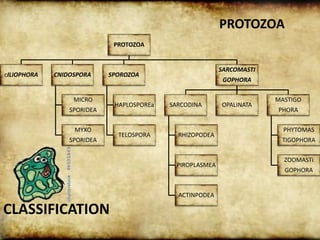
PROTOZOA
cILIOPHORA CNIDOSPORA
MICRO
SPORIDEA
MYXO
SPORIDEA
SPOROZOA
HAPLOSPOREa
TELOSPORA
SARCOMASTI
GOPHORA
SARCODINA
RHIZOPODEA
PIROPLASMEA
ACTINPODEA
OPALINATA
MASTIGO
PHORA
PHYTOMAS
TIGOPHORA
ZOOMASTi
GOPHORA
CLASSIFICATION
PROTOZOA
CILIOPHORA
•Complex protozoans.
•Cilia are useful in locomotion
and food capturing.
•Infraciliary system is present.
•Nuclear dimorphism is seen
where micronucleus is
reproductive and diploid and
macronucleus is vegetative and
polyploid.
•Sexual reproduction by
conjugation.
•Asexual reproduction by binary
fission or budding.
•Eg : paramecium
PARAMECIUM
CNIDOSPORA
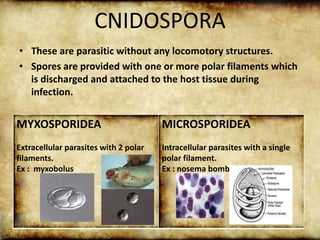
• These are parasitic without any locomotory structures.
• Spores are provided with one or more polar filaments which
is discharged and attached to the host tissue during
infection.
MYXOSPORIDEA
Extracellular parasites with 2 polar
filaments.
Ex : myxobolus
MICROSPORIDEA
Intracellular parasites with a single
polar filament.
Ex : nosema bombycis
SPOROZOA
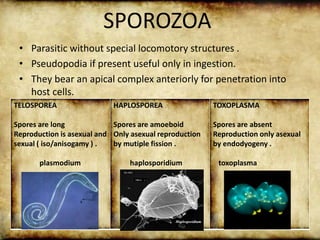
• Parasitic without special locomotory structures .
• Pseudopodia if present useful only in ingestion.
• They bear an apical complex anteriorly for penetration into
host cells.
TELOSPOREA
Spores are long
Reproduction is asexual and
sexual ( iso/anisogamy ) .
plasmodium
HAPLOSPOREA
Spores are amoeboid
Only asexual reproduction
by mutiple fission .
haplosporidium
TOXOPLASMA
Spores are absent
Reproduction only asexual
by endodyogeny .
toxoplasma
SARCOMASTIGOPHORA
• Locomotion is brought about by pseudopodia
or flagella.
• It is divided into 3 superclass : -
Mastigophora - locomotor organelles is flagella.
Opalinata - locomotor organelle is cilia.
Sarcodina - locomotor organelle is pseudopodia.
MASTIGOPHORA
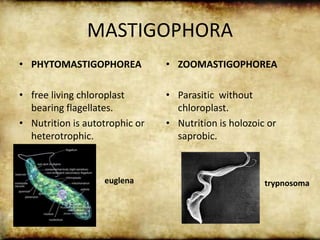
• PHYTOMASTIGOPHOREA
• free living chloroplast
bearing flagellates.
• Nutrition is autotrophic or
heterotrophic.
• ZOOMASTIGOPHOREA
• Parasitic without
chloroplast.
• Nutrition is holozoic or
saprobic.
euglena trypnosoma
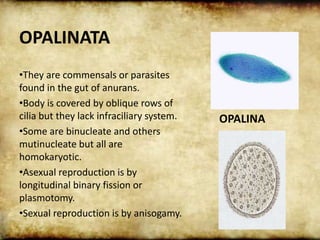
OPALINATA
•They are commensals or parasites
found in the gut of anurans.
•Body is covered by oblique rows of
cilia but they lack infraciliary system.
•Some are binucleate and others
mutinucleate but all are
homokaryotic.
•Asexual reproduction is by
longitudinal binary fission or
plasmotomy.
•Sexual reproduction is by anisogamy.
OPALINA
SARCODINA
• Locomotion is brought about by pseudopodia .
They are divided into 3 classes :
1. Rhizopodea – locomotion is by lobopodia or
filopodia (amoeba) or by reticulopodia
(foraminiferans).they are mostly free living.
2. Piroplasmea – locomotory structures are absent
as spores are absent. They are parasitic. Ex –
babesia.
3. Actinopodea – they have axopodia for locomtion
and they are marine or fresh water forms. Ex -
actinophrys
RHIZOPODEA PIROPLASMEA ACTINOPODEA
AMOEBA BABESIA ACTINOPHHRYS
Protozoa

Protozoa

  • 1.
  • 2.
    PROTOZOA • Protozoa meansfirst animals and includes unicellular consumers. • They are included under the kingdom protista. • There are about 92,000 species of protozoans. • Anton von leeuwenhoek was the first to observe a protozoan (vorticella convellaria) under a microscope. • Goldfuss coined the term protozoa .
  • 3.
    General characteristics • Thebody is unicellular and this single cell performs all functions and life activities. • They exhibit protoplasmic grade of organization. • They are either solitary or colonial , free living or symbiotic. • Many forms go encystment to tide over unfavourable conditions. • Somatoplasm and germplasm are not differentiated hence they are immortal We are the world ^__^
  • 4.
    Body symmetry spherical, radial , bilateral or absent locomotion Pseudopodia , cilia , flagella or myonemes nutrition Holozoic , holophytic , osmotropic or mixotropic respiration Diffusion or anaerobic excretion Diffusion or contactile vacuoles Asexual reproduction Binnary fission , multiple fission , plasmotomy or budding Sexual reproduction Syngamy or conjugation digestion intracellular
  • 5.
  • 6.
    CILIOPHORA •Complex protozoans. •Cilia areuseful in locomotion and food capturing. •Infraciliary system is present. •Nuclear dimorphism is seen where micronucleus is reproductive and diploid and macronucleus is vegetative and polyploid. •Sexual reproduction by conjugation. •Asexual reproduction by binary fission or budding. •Eg : paramecium PARAMECIUM
  • 7.
    CNIDOSPORA • These areparasitic without any locomotory structures. • Spores are provided with one or more polar filaments which is discharged and attached to the host tissue during infection. MYXOSPORIDEA Extracellular parasites with 2 polar filaments. Ex : myxobolus MICROSPORIDEA Intracellular parasites with a single polar filament. Ex : nosema bombycis
  • 8.
    SPOROZOA • Parasitic withoutspecial locomotory structures . • Pseudopodia if present useful only in ingestion. • They bear an apical complex anteriorly for penetration into host cells. TELOSPOREA Spores are long Reproduction is asexual and sexual ( iso/anisogamy ) . plasmodium HAPLOSPOREA Spores are amoeboid Only asexual reproduction by mutiple fission . haplosporidium TOXOPLASMA Spores are absent Reproduction only asexual by endodyogeny . toxoplasma
  • 9.
    SARCOMASTIGOPHORA • Locomotion isbrought about by pseudopodia or flagella. • It is divided into 3 superclass : - Mastigophora - locomotor organelles is flagella. Opalinata - locomotor organelle is cilia. Sarcodina - locomotor organelle is pseudopodia.
  • 10.
    MASTIGOPHORA • PHYTOMASTIGOPHOREA • freeliving chloroplast bearing flagellates. • Nutrition is autotrophic or heterotrophic. • ZOOMASTIGOPHOREA • Parasitic without chloroplast. • Nutrition is holozoic or saprobic. euglena trypnosoma
  • 11.
    OPALINATA •They are commensalsor parasites found in the gut of anurans. •Body is covered by oblique rows of cilia but they lack infraciliary system. •Some are binucleate and others mutinucleate but all are homokaryotic. •Asexual reproduction is by longitudinal binary fission or plasmotomy. •Sexual reproduction is by anisogamy. OPALINA
  • 12.
    SARCODINA • Locomotion isbrought about by pseudopodia . They are divided into 3 classes : 1. Rhizopodea – locomotion is by lobopodia or filopodia (amoeba) or by reticulopodia (foraminiferans).they are mostly free living. 2. Piroplasmea – locomotory structures are absent as spores are absent. They are parasitic. Ex – babesia. 3. Actinopodea – they have axopodia for locomtion and they are marine or fresh water forms. Ex - actinophrys
  • 13.