Kingdom Protista
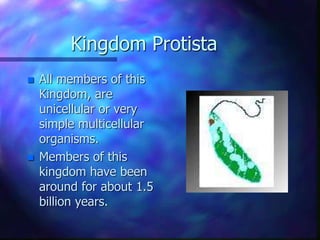
 All members of this
Kingdom, are
unicellular or very
simple multicellular
organisms.
 Members of this
kingdom have been
around for about 1.5
billion years.
Categories of Kingdom
Protista
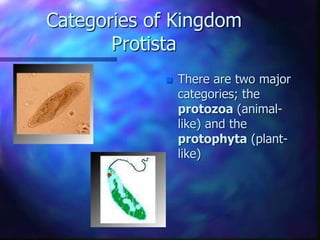
 There are two major
categories; the
protozoa (animal-
like) and the
protophyta (plant-
like)
General Characteristics of the
Protozoa
 1. One -celled
 2. Eukaryotic
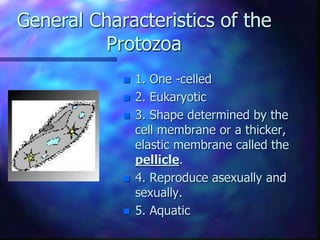
 3. Shape determined by the
cell membrane or a thicker,
elastic membrane called the
pellicle.
 4. Reproduce asexually and
sexually.
 5. Aquatic
General Characteristics of the
Protozoa continued
 6. Heterotrophic
 7. Many are motile-use cilia,
flagella or pseudopodia.
 8. Important role in food chain
and in the decay process.
 9. Dormant protozoa are
called cysts.
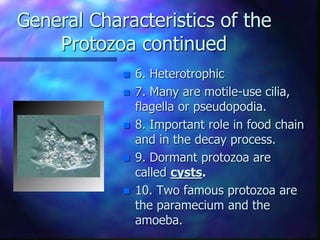
 10. Two famous protozoa are
the paramecium and the
amoeba.
General Characteristics of the
Protophyta
 1. One -celled, filaments and
colonies.
 2. Eukaryotic
 3. Shape determined by cell
wall.
 4. Reproduce asexually and
sexually.
 5. Aquatic
 6. Phototrophic
 7. Motile by cilia or drift in
water.
General Characteristics of the
Protophyta continued.
 8. Known for their role in the
food chain and for their
contribution to the Earth’s
oxygen supply.
 9. Dormant cells are called
spores.
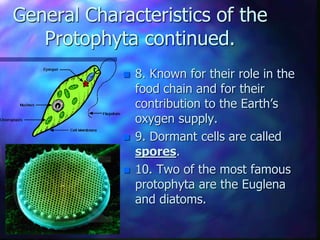
 10. Two of the most famous
protophyta are the Euglena
and diatoms.
The Ameba
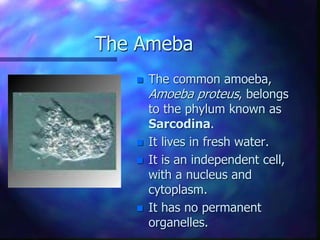
 The common amoeba,
Amoeba proteus, belongs
to the phylum known as
Sarcodina.
 It lives in fresh water.
 It is an independent cell,
with a nucleus and
cytoplasm.
 It has no permanent
organelles.
The Ameba continued
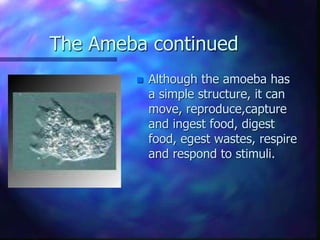
 Although the amoeba has
a simple structure, it can
move, reproduce,capture
and ingest food, digest
food, egest wastes, respire
and respond to stimuli.
The Amoeba-Movement
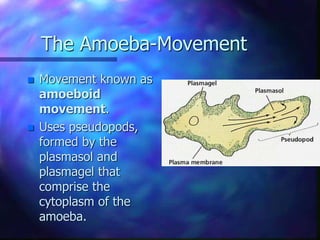
 Movement known as
amoeboid
movement.
 Uses pseudopods,
formed by the
plasmasol and
plasmagel that
comprise the
cytoplasm of the
amoeba.
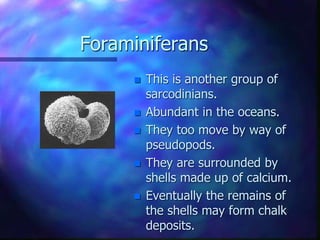
Foraminiferans
 This is another group of
sarcodinians.
 Abundant in the oceans.
 They too move by way of
pseudopods.
 They are surrounded by
shells made up of calcium.
 Eventually the remains of
the shells may form chalk
deposits.
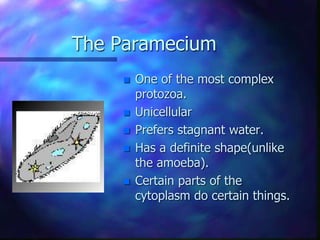
The Paramecium
 One of the most complex
protozoa.
 Unicellular
 Prefers stagnant water.
 Has a definite shape(unlike
the amoeba).
 Certain parts of the
cytoplasm do certain things.
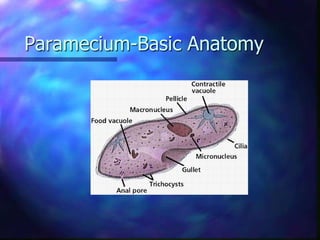
Paramecium-Basic Anatomy
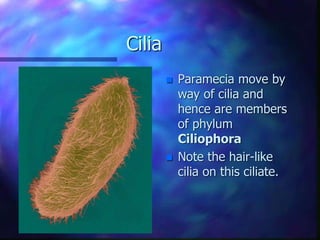
Cilia
 Paramecia move by
way of cilia and
hence are members
of phylum
Ciliophora
 Note the hair-like
cilia on this ciliate.
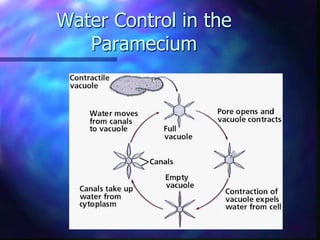
Water Control in the
Paramecium
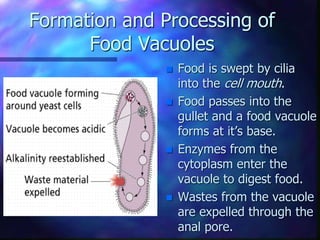
Formation and Processing of
Food Vacuoles
 Food is swept by cilia
into the cell mouth.
 Food passes into the
gullet and a food vacuole
forms at it’s base.
 Enzymes from the
cytoplasm enter the
vacuole to digest food.
 Wastes from the vacuole
are expelled through the
anal pore.
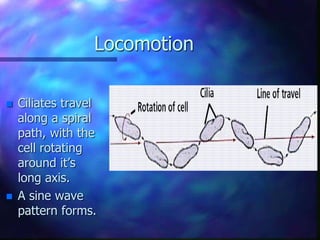
Locomotion
 Ciliates travel
along a spiral
path, with the
cell rotating
around it’s
long axis.
 A sine wave
pattern forms.
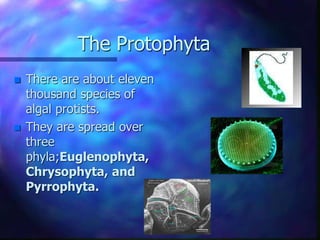
The Protophyta
 There are about eleven
thousand species of
algal protists.
 They are spread over
three
phyla;Euglenophyta,
Chrysophyta, and
Pyrrophyta.
Phylum Euglenophyta
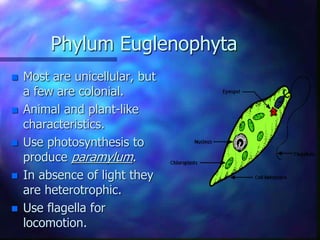
 Most are unicellular, but
a few are colonial.
 Animal and plant-like
characteristics.
 Use photosynthesis to
produce paramylum.
 In absence of light they
are heterotrophic.
 Use flagella for
locomotion.
Phylum Euglenophyta cont.
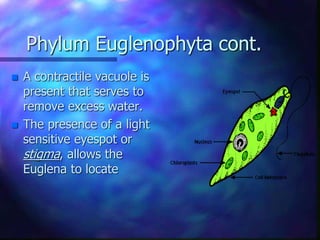
 A contractile vacuole is
present that serves to
remove excess water.
 The presence of a light
sensitive eyespot or
stigma, allows the
Euglena to locate
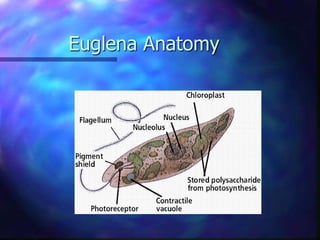
Euglena Anatomy
Phylum Pyrrophyta - The
Dinoflagellates
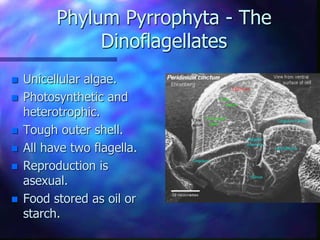
 Unicellular algae.
 Photosynthetic and
heterotrophic.
 Tough outer shell.
 All have two flagella.
 Reproduction is
asexual.
 Food stored as oil or
starch.
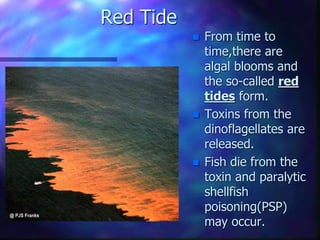
Red Tide
 From time to
time,there are
algal blooms and
the so-called red
tides form.
 Toxins from the
dinoflagellates are
released.
 Fish die from the
toxin and paralytic
shellfish
poisoning(PSP)
may occur.
Phylum Sporozoa
 Members of this phylum are non-motile
protozoa.
 An excellent example of a sporozoan is
Plasmodium vivax , the causative agent
of malaria.
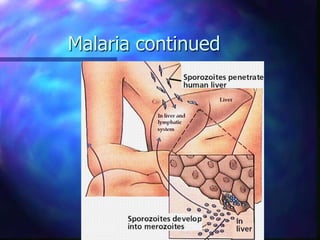
 There are two stages involved in the life
cycle of Plasmodium vivax ; Asexual
(in the human) and Sexual (in the
mosquito).
Phylum Sporozoa con’t.
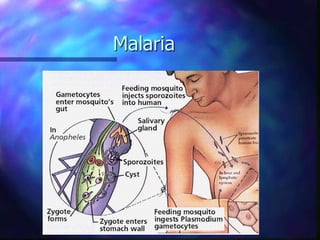
 When an infected mosquito bites a human,
spores enter the bloodstream and produce
gametes in the red blood cells.
 When an infected human is bitten by a
mosquito, gametes unite in the gut of the
mosquito to form a zygote.
 In the mosquito, the zygote matures into
more spores which are passed on to the
next human victim.
Malaria
Malaria continued
Interesting Facts About
Malaria
 In the days of British colonization of
India, soldiers contracted malaria.
 The treatment was to give the soldiers
quinine mixed with water (tonic water),
mixed with gin (to kill the taste).
 This gave rise to a popular drink
amongst the soldiers known as “Gin and
Tonic”.
More Interesting Facts About
Malaria
 War veterans who caught malaria
overseas, have had recurring episodes
of this disease.
 In fact, this has been observed in
patients in nursing homes right here in
Kings County.
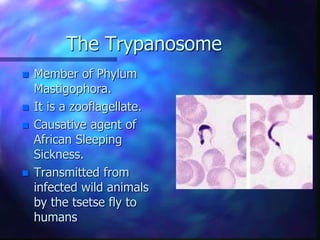
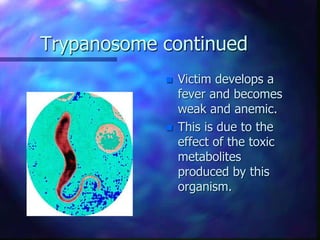
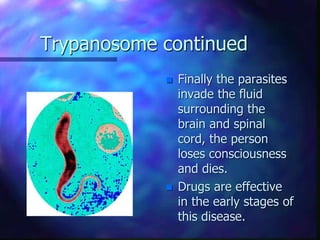
The Trypanosome
 Member of Phylum
Mastigophora.
 It is a zooflagellate.
 Causative agent of
African Sleeping
Sickness.
 Transmitted from
infected wild animals
by the tsetse fly to
humans
Trypanosome continued
 Victim develops a
fever and becomes
weak and anemic.
 This is due to the
effect of the toxic
metabolites
produced by this
organism.
Trypanosome continued
 Finally the parasites
invade the fluid
surrounding the
brain and spinal
cord, the person
loses consciousness
and dies.
 Drugs are effective
in the early stages of
this disease.

Pptkingdomprotista

  • 2.
    Kingdom Protista  Allmembers of this Kingdom, are unicellular or very simple multicellular organisms.  Members of this kingdom have been around for about 1.5 billion years.
  • 3.
    Categories of Kingdom Protista There are two major categories; the protozoa (animal- like) and the protophyta (plant- like)
  • 4.
    General Characteristics ofthe Protozoa  1. One -celled  2. Eukaryotic  3. Shape determined by the cell membrane or a thicker, elastic membrane called the pellicle.  4. Reproduce asexually and sexually.  5. Aquatic
  • 5.
    General Characteristics ofthe Protozoa continued  6. Heterotrophic  7. Many are motile-use cilia, flagella or pseudopodia.  8. Important role in food chain and in the decay process.  9. Dormant protozoa are called cysts.  10. Two famous protozoa are the paramecium and the amoeba.
  • 6.
    General Characteristics ofthe Protophyta  1. One -celled, filaments and colonies.  2. Eukaryotic  3. Shape determined by cell wall.  4. Reproduce asexually and sexually.  5. Aquatic  6. Phototrophic  7. Motile by cilia or drift in water.
  • 7.
    General Characteristics ofthe Protophyta continued.  8. Known for their role in the food chain and for their contribution to the Earth’s oxygen supply.  9. Dormant cells are called spores.  10. Two of the most famous protophyta are the Euglena and diatoms.
  • 8.
    The Ameba  Thecommon amoeba, Amoeba proteus, belongs to the phylum known as Sarcodina.  It lives in fresh water.  It is an independent cell, with a nucleus and cytoplasm.  It has no permanent organelles.
  • 9.
    The Ameba continued Although the amoeba has a simple structure, it can move, reproduce,capture and ingest food, digest food, egest wastes, respire and respond to stimuli.
  • 10.
    The Amoeba-Movement  Movementknown as amoeboid movement.  Uses pseudopods, formed by the plasmasol and plasmagel that comprise the cytoplasm of the amoeba.
  • 11.
    Foraminiferans  This isanother group of sarcodinians.  Abundant in the oceans.  They too move by way of pseudopods.  They are surrounded by shells made up of calcium.  Eventually the remains of the shells may form chalk deposits.
  • 12.
    The Paramecium  Oneof the most complex protozoa.  Unicellular  Prefers stagnant water.  Has a definite shape(unlike the amoeba).  Certain parts of the cytoplasm do certain things.
  • 13.
  • 14.
    Cilia  Paramecia moveby way of cilia and hence are members of phylum Ciliophora  Note the hair-like cilia on this ciliate.
  • 15.
    Water Control inthe Paramecium
  • 16.
    Formation and Processingof Food Vacuoles  Food is swept by cilia into the cell mouth.  Food passes into the gullet and a food vacuole forms at it’s base.  Enzymes from the cytoplasm enter the vacuole to digest food.  Wastes from the vacuole are expelled through the anal pore.
  • 17.
    Locomotion  Ciliates travel alonga spiral path, with the cell rotating around it’s long axis.  A sine wave pattern forms.
  • 18.
    The Protophyta  Thereare about eleven thousand species of algal protists.  They are spread over three phyla;Euglenophyta, Chrysophyta, and Pyrrophyta.
  • 19.
    Phylum Euglenophyta  Mostare unicellular, but a few are colonial.  Animal and plant-like characteristics.  Use photosynthesis to produce paramylum.  In absence of light they are heterotrophic.  Use flagella for locomotion.
  • 20.
    Phylum Euglenophyta cont. A contractile vacuole is present that serves to remove excess water.  The presence of a light sensitive eyespot or stigma, allows the Euglena to locate
  • 21.
  • 22.
    Phylum Pyrrophyta -The Dinoflagellates  Unicellular algae.  Photosynthetic and heterotrophic.  Tough outer shell.  All have two flagella.  Reproduction is asexual.  Food stored as oil or starch.
  • 23.
    Red Tide  Fromtime to time,there are algal blooms and the so-called red tides form.  Toxins from the dinoflagellates are released.  Fish die from the toxin and paralytic shellfish poisoning(PSP) may occur.
  • 24.
    Phylum Sporozoa  Membersof this phylum are non-motile protozoa.  An excellent example of a sporozoan is Plasmodium vivax , the causative agent of malaria.  There are two stages involved in the life cycle of Plasmodium vivax ; Asexual (in the human) and Sexual (in the mosquito).
  • 25.
    Phylum Sporozoa con’t. When an infected mosquito bites a human, spores enter the bloodstream and produce gametes in the red blood cells.  When an infected human is bitten by a mosquito, gametes unite in the gut of the mosquito to form a zygote.  In the mosquito, the zygote matures into more spores which are passed on to the next human victim.
  • 26.
  • 27.
  • 28.
    Interesting Facts About Malaria In the days of British colonization of India, soldiers contracted malaria.  The treatment was to give the soldiers quinine mixed with water (tonic water), mixed with gin (to kill the taste).  This gave rise to a popular drink amongst the soldiers known as “Gin and Tonic”.
  • 29.
    More Interesting FactsAbout Malaria  War veterans who caught malaria overseas, have had recurring episodes of this disease.  In fact, this has been observed in patients in nursing homes right here in Kings County.
  • 30.
    The Trypanosome  Memberof Phylum Mastigophora.  It is a zooflagellate.  Causative agent of African Sleeping Sickness.  Transmitted from infected wild animals by the tsetse fly to humans
  • 31.
    Trypanosome continued  Victimdevelops a fever and becomes weak and anemic.  This is due to the effect of the toxic metabolites produced by this organism.
  • 32.
    Trypanosome continued  Finallythe parasites invade the fluid surrounding the brain and spinal cord, the person loses consciousness and dies.  Drugs are effective in the early stages of this disease.