Person Authentication System with Quality Analysis
of Multimodal Biometrics
•Medical electronics presentation
•EEE4891
•Student ID:153414
Person Authentication System with Quality Analysis
of Multimodal Biometrics
• Introduction
• Person authentication system
• Sensor level fusion
• Score level fusion
• Decision level fusion
• Conclusion
Introduction
• Biometrics is an authentication mechanism that relies on the
automated identification or verification of an individual based on
unique physiological or behavioral characteristics
• Biometric technologies offer two means to determine an individual’s
identity
A. Verification
B. Identification
Verification confirms or denies a person’s claimed
Identification, also known as recognition, attempts to establish a
person’s identity.
Introduction
• Biometric systems can be classified into two types namely
A. Unimodal biometric systems
B. multi-modal biometric systems
• A unimodal biometric system is one in which, only a single type of the
constituent components is present
• multi-modal biometric system more than one type of the component
is present
The biometric system has the following two
modes of operation
• Enrollment mode
In this mode the system acquires the biometric of the user and stores
required data obtained from the people in the database. These
templates are tagged with the user’s identity to facilitate
authentication.
• Authentication mode
This mode also acquires the biometric of the person and uses it to
verify the claimed identity.
Information fusion for a multi-modal biometric
verification system can be classified into
•sensor-level fusion,
• feature-level fusion,
•score-level fusion and
• decision-level fusion
Person Authentication System
• This paper deals with multi-modal multi-biometric based Person
Authentication System (PAS) with JDL fusion framework.
• Multi-biometric systems helps in reducing false match and false non-
match errors compared to a single biometric device
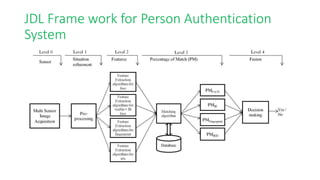
JDL Data Fusion Model
• In 1985, the data fusion work group of the Joint Directors of
Laboratories (JDL) organized to define a lexicon
• is defined as a “multilevel, multifaceted process dealing with the
automatic detection, association, correlation, estimation, and
combination of data and information from multiple sources
• JDL is comprised of 4 components: sources, database management,
Human-Computer Interaction (HCI) and processing component. The
processing component is further divided into 5 levels namely
• Sub-Object Data Assessment, Object Assessment, Situation
Assessment, Impact Assessment, and Process Refinement.
JDL Frame work for Person Authentication
System
Multi-Modal System Framework
• The recognition based on face biometric is more difficult, due to the
inherent variations in face with illumination and pose variations
• multiple sensors, multilevel fusion and multiple algorithms are taken
up for recognition based on face
• Registration of visible and thermal face images is performed using
Fourier based method and fusion is performed using Empirical Mode
Decomposition (EMD)
• is used for improved face recognition. The sensors used are visible
camera and IR camera
addresses three algorithms namely
• Block Independent Component Analysis (B-ICA) provides better features of face.
• Discrete Cosine Transform & Fishers Linear Discriminant (DCT-FLD) performs well for all
illumination conditions,
• Kalman Filter (KF). The multiple algorithms: Kalman method gives better performance for varying
pose of the face
• The recognition with another biometric Fingerprint, uses
• Field Orientation of Cross-Correlation (FOCC) method which combines field orientation with cross
correlation to get better accuracy even in case of damaged or partial fingerprint
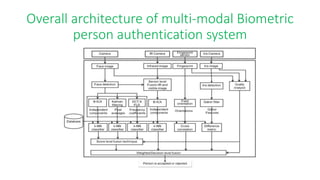
Overall architecture of multi-modal Biometric
person authentication system
Face Recognition System
• The first step in Face recognition is the detection of face part from the
captured image
• classifies the features using AdaBoost classifier and is proven to be a
highly robust face detection technique.
• Further after detection, proceeds with recognition algorithms to
extract primitives and to conclude the authentication based on face
biometric.
Block–Independent Component Analysis
• The Independent Component analysis (ICA) is a statistical learning
method; it captures sparse and independent higher order
components. In ICA
• the whole image is stretched into 1D vector resulting in increase in
dimensionality and computational complexity
• To overcome these difficulties, BICA was devised.
• In this approach, the image is subdivided into blocks of same size b1,
b2, … bn
Discrete Cosine Transform (DCT) with Fisher
Linear Discriminant (FLD) Classifier
• DCT has many advantages such as data independency and
illumination invariant when compared with the other face recognition
algorithms
• The first DCT coefficient represents the dc components of an image
which is solely related to the brightness of the image
• After obtaining the DCT coefficients, FLD is employed on to obtain the
most salient and invariant feature of the human faces
• The discriminating feature vector P from the DCT domain to optimal
subspace is obtained
Kalman Filter based Face Recognition
• Kalman filter based face recognition shows robustness towards the
pose-variations
• Kalman filter based face recognition shows robustness towards the
pose-variations
• From the averaged Kalman face, the feature vector is extracted by
fixing a threshold which eliminates the most variant pixel and retains
the invariant pixels in the image
Face Quality Estimation
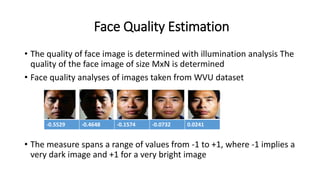
• The quality of face image is determined with illumination analysis The
quality of the face image of size MxN is determined
• Face quality analyses of images taken from WVU dataset
• The measure spans a range of values from -1 to +1, where -1 implies a
very dark image and +1 for a very bright image
-0.5529 -0.4648 -0.1574 -0.0732 0.0241
Fingerprint Recognition
• Fingerprint has been widely used for person identification in several
centuries
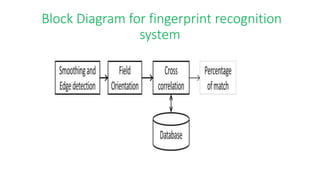
• The fingerprint recognition system uses orientation of the input
image and cross correlation of the field orientation images
• Field orientation extracts the directional properties of the image
• Orientation Field Methodology (OFM) has been used as a pre-
processing module, and it converts the images into a field pattern
based on the direction of ridges,
Block Diagram for fingerprint recognition
system
Decision Level Fusion
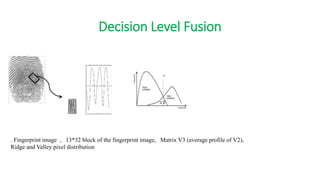
. Fingerprint image , 13*32 block of the fingerprint image, Matrix V3 (average profile of V2),
Ridge and Valley pixel distribution
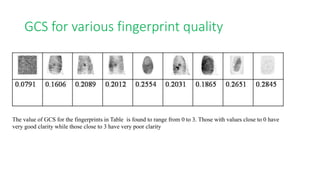
GCS for various fingerprint quality
The value of GCS for the fingerprints in Table is found to range from 0 to 3. Those with values close to 0 have
very good clarity while those close to 3 have very poor clarity
Iris Recognition
• The recognition with iris biometric uses Hough transform for
detection of Region of Interest (ROI) and Gabor transform for feature
extraction.
• The tasks in segmentation stage are iris boundary detection, eye pupil
detection, eyelash and eyelid removal.
• The circular Hough transform is employed to deduce the radius and
Centre coordinates of the pupil and iris regions
• A maximum point in the Hough space corresponds to the radius and
Centre coordinates of the circle is best defined by the edge points
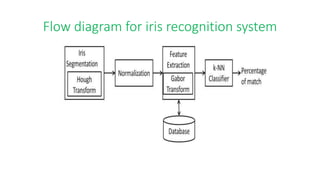
Flow diagram for iris recognition system
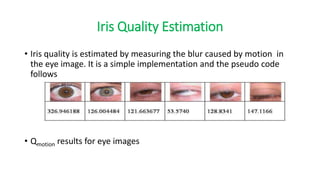
Iris Quality Estimation
• Iris quality is estimated by measuring the blur caused by motion in
the eye image. It is a simple implementation and the pseudo code
follows
• Qmotion results for eye images
Sensor Level Fusion
• Visible face images are obtained in the visible spectrum and the
clarity varies according to the luminance under which the images
have been taken.
• Thermal face images are acquired using an IR sensor camera in the far
IR region (8μm -12μm). Thermal
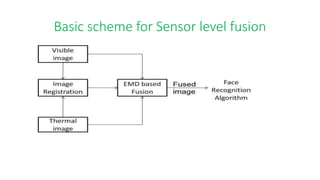
• registration is performed using Fourier based method while fusion of
visible and thermal images is performed using Empirical Mode
Decomposition
• The feature extraction and face recognition on the fused images is
implemented using Block Independent Component Analysis with k-
NN classifier
Basic scheme for Sensor level fusion
Score Level Fusion
• Distinct feature extraction algorithms for face recognition produces
varying percentage of match due to varying illumination pose and
other conditions
• Face recognition is carried out by multi-algorithmic approach. This
system identifies a person by a fusion methodology using weighted
average approach from the percentile obtained from three face
recognition algorithms,
• Block - Independent Component Analysis (BICA) Discrete Cosine
Transform with Fisher Linear Discriminant Classifier and Kalman filter
Dynamic Weighted Average Fusion
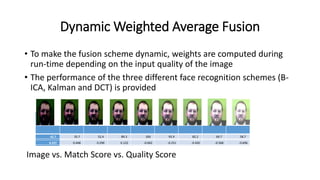
• To make the fusion scheme dynamic, weights are computed during
run-time depending on the input quality of the image
• The performance of the three different face recognition schemes (B-
ICA, Kalman and DCT) is provided
Image vs. Match Score vs. Quality Score
42.7 35.7 52.4 89.3 100 93.9 82.2 69.7 58.7
0.597 0.448 0.290 0.122 -0.062 -0.251 -0.420 -0.568 -0.696
Decision Level Fusion
• In decision level fusion, the match score of the independent modules
are combined to give a unanimous decision on the person’s identity
• . A dynamic weighted average fusion technique is formulated that
adjusts its weights to the recognition units based on the input image
quality
• . The match scores from the face recognition unit, iris recognition unit
and fingerprint recognition unit are fused to give a final score based
on which the decision about the person’s authenticity is taken.
Dynamic Weighted Average Fusion
• Dynamic decision level fusion is performed with the face, fingerprint
and iris quality estimates. As discussed
• the multi-algorithmic face recognition module has been made
approximately illumination invariant for a range of face illumination
quality from -0.4 to +0.4 by performing score level fusion
• For absolute values of quality greater than 0.4, the match scores of
authorized as well as unauthorized images tend to merge leading to
larger values for FRR and FAR, above 0.8 the images are either very
dark or very bright
Conclusion
• A JDL frame work for Person Authentication System has been
developed. This frame work consists of sensing different biometrics
(face, fingerprint, iris) using multiple sensors,
• multiple algorithms, multiple classifiers and multiple fusion level.
• The work has formulated a dynamic score level fusion scheme for a
multi-algorithmic face recognition module by incorporating quality as
an input for fusion.
• Score level fusion has been implemented to make use of the
complementarities of the algorithms thereby making the system
approximately illumination independent

person authentication

  • 1.
    Person Authentication Systemwith Quality Analysis of Multimodal Biometrics •Medical electronics presentation •EEE4891 •Student ID:153414
  • 2.
    Person Authentication Systemwith Quality Analysis of Multimodal Biometrics • Introduction • Person authentication system • Sensor level fusion • Score level fusion • Decision level fusion • Conclusion
  • 3.
    Introduction • Biometrics isan authentication mechanism that relies on the automated identification or verification of an individual based on unique physiological or behavioral characteristics • Biometric technologies offer two means to determine an individual’s identity A. Verification B. Identification Verification confirms or denies a person’s claimed Identification, also known as recognition, attempts to establish a person’s identity.
  • 4.
    Introduction • Biometric systemscan be classified into two types namely A. Unimodal biometric systems B. multi-modal biometric systems • A unimodal biometric system is one in which, only a single type of the constituent components is present • multi-modal biometric system more than one type of the component is present
  • 5.
    The biometric systemhas the following two modes of operation • Enrollment mode In this mode the system acquires the biometric of the user and stores required data obtained from the people in the database. These templates are tagged with the user’s identity to facilitate authentication. • Authentication mode This mode also acquires the biometric of the person and uses it to verify the claimed identity.
  • 6.
    Information fusion fora multi-modal biometric verification system can be classified into •sensor-level fusion, • feature-level fusion, •score-level fusion and • decision-level fusion
  • 7.
    Person Authentication System •This paper deals with multi-modal multi-biometric based Person Authentication System (PAS) with JDL fusion framework. • Multi-biometric systems helps in reducing false match and false non- match errors compared to a single biometric device
  • 8.
    JDL Data FusionModel • In 1985, the data fusion work group of the Joint Directors of Laboratories (JDL) organized to define a lexicon • is defined as a “multilevel, multifaceted process dealing with the automatic detection, association, correlation, estimation, and combination of data and information from multiple sources • JDL is comprised of 4 components: sources, database management, Human-Computer Interaction (HCI) and processing component. The processing component is further divided into 5 levels namely • Sub-Object Data Assessment, Object Assessment, Situation Assessment, Impact Assessment, and Process Refinement.
  • 9.
    JDL Frame workfor Person Authentication System
  • 10.
    Multi-Modal System Framework •The recognition based on face biometric is more difficult, due to the inherent variations in face with illumination and pose variations • multiple sensors, multilevel fusion and multiple algorithms are taken up for recognition based on face • Registration of visible and thermal face images is performed using Fourier based method and fusion is performed using Empirical Mode Decomposition (EMD) • is used for improved face recognition. The sensors used are visible camera and IR camera
  • 11.
    addresses three algorithmsnamely • Block Independent Component Analysis (B-ICA) provides better features of face. • Discrete Cosine Transform & Fishers Linear Discriminant (DCT-FLD) performs well for all illumination conditions, • Kalman Filter (KF). The multiple algorithms: Kalman method gives better performance for varying pose of the face • The recognition with another biometric Fingerprint, uses • Field Orientation of Cross-Correlation (FOCC) method which combines field orientation with cross correlation to get better accuracy even in case of damaged or partial fingerprint
  • 12.
    Overall architecture ofmulti-modal Biometric person authentication system
  • 13.
    Face Recognition System •The first step in Face recognition is the detection of face part from the captured image • classifies the features using AdaBoost classifier and is proven to be a highly robust face detection technique. • Further after detection, proceeds with recognition algorithms to extract primitives and to conclude the authentication based on face biometric.
  • 14.
    Block–Independent Component Analysis •The Independent Component analysis (ICA) is a statistical learning method; it captures sparse and independent higher order components. In ICA • the whole image is stretched into 1D vector resulting in increase in dimensionality and computational complexity • To overcome these difficulties, BICA was devised. • In this approach, the image is subdivided into blocks of same size b1, b2, … bn
  • 15.
    Discrete Cosine Transform(DCT) with Fisher Linear Discriminant (FLD) Classifier • DCT has many advantages such as data independency and illumination invariant when compared with the other face recognition algorithms • The first DCT coefficient represents the dc components of an image which is solely related to the brightness of the image • After obtaining the DCT coefficients, FLD is employed on to obtain the most salient and invariant feature of the human faces • The discriminating feature vector P from the DCT domain to optimal subspace is obtained
  • 16.
    Kalman Filter basedFace Recognition • Kalman filter based face recognition shows robustness towards the pose-variations • Kalman filter based face recognition shows robustness towards the pose-variations • From the averaged Kalman face, the feature vector is extracted by fixing a threshold which eliminates the most variant pixel and retains the invariant pixels in the image
  • 17.
    Face Quality Estimation •The quality of face image is determined with illumination analysis The quality of the face image of size MxN is determined • Face quality analyses of images taken from WVU dataset • The measure spans a range of values from -1 to +1, where -1 implies a very dark image and +1 for a very bright image -0.5529 -0.4648 -0.1574 -0.0732 0.0241
  • 18.
    Fingerprint Recognition • Fingerprinthas been widely used for person identification in several centuries • The fingerprint recognition system uses orientation of the input image and cross correlation of the field orientation images • Field orientation extracts the directional properties of the image • Orientation Field Methodology (OFM) has been used as a pre- processing module, and it converts the images into a field pattern based on the direction of ridges,
  • 19.
    Block Diagram forfingerprint recognition system
  • 20.
    Decision Level Fusion .Fingerprint image , 13*32 block of the fingerprint image, Matrix V3 (average profile of V2), Ridge and Valley pixel distribution
  • 21.
    GCS for variousfingerprint quality The value of GCS for the fingerprints in Table is found to range from 0 to 3. Those with values close to 0 have very good clarity while those close to 3 have very poor clarity
  • 22.
    Iris Recognition • Therecognition with iris biometric uses Hough transform for detection of Region of Interest (ROI) and Gabor transform for feature extraction. • The tasks in segmentation stage are iris boundary detection, eye pupil detection, eyelash and eyelid removal. • The circular Hough transform is employed to deduce the radius and Centre coordinates of the pupil and iris regions • A maximum point in the Hough space corresponds to the radius and Centre coordinates of the circle is best defined by the edge points
  • 23.
    Flow diagram foriris recognition system
  • 24.
    Iris Quality Estimation •Iris quality is estimated by measuring the blur caused by motion in the eye image. It is a simple implementation and the pseudo code follows • Qmotion results for eye images
  • 25.
    Sensor Level Fusion •Visible face images are obtained in the visible spectrum and the clarity varies according to the luminance under which the images have been taken. • Thermal face images are acquired using an IR sensor camera in the far IR region (8μm -12μm). Thermal • registration is performed using Fourier based method while fusion of visible and thermal images is performed using Empirical Mode Decomposition • The feature extraction and face recognition on the fused images is implemented using Block Independent Component Analysis with k- NN classifier
  • 26.
    Basic scheme forSensor level fusion
  • 27.
    Score Level Fusion •Distinct feature extraction algorithms for face recognition produces varying percentage of match due to varying illumination pose and other conditions • Face recognition is carried out by multi-algorithmic approach. This system identifies a person by a fusion methodology using weighted average approach from the percentile obtained from three face recognition algorithms, • Block - Independent Component Analysis (BICA) Discrete Cosine Transform with Fisher Linear Discriminant Classifier and Kalman filter
  • 28.
    Dynamic Weighted AverageFusion • To make the fusion scheme dynamic, weights are computed during run-time depending on the input quality of the image • The performance of the three different face recognition schemes (B- ICA, Kalman and DCT) is provided Image vs. Match Score vs. Quality Score 42.7 35.7 52.4 89.3 100 93.9 82.2 69.7 58.7 0.597 0.448 0.290 0.122 -0.062 -0.251 -0.420 -0.568 -0.696
  • 29.
    Decision Level Fusion •In decision level fusion, the match score of the independent modules are combined to give a unanimous decision on the person’s identity • . A dynamic weighted average fusion technique is formulated that adjusts its weights to the recognition units based on the input image quality • . The match scores from the face recognition unit, iris recognition unit and fingerprint recognition unit are fused to give a final score based on which the decision about the person’s authenticity is taken.
  • 30.
    Dynamic Weighted AverageFusion • Dynamic decision level fusion is performed with the face, fingerprint and iris quality estimates. As discussed • the multi-algorithmic face recognition module has been made approximately illumination invariant for a range of face illumination quality from -0.4 to +0.4 by performing score level fusion • For absolute values of quality greater than 0.4, the match scores of authorized as well as unauthorized images tend to merge leading to larger values for FRR and FAR, above 0.8 the images are either very dark or very bright
  • 31.
    Conclusion • A JDLframe work for Person Authentication System has been developed. This frame work consists of sensing different biometrics (face, fingerprint, iris) using multiple sensors, • multiple algorithms, multiple classifiers and multiple fusion level. • The work has formulated a dynamic score level fusion scheme for a multi-algorithmic face recognition module by incorporating quality as an input for fusion. • Score level fusion has been implemented to make use of the complementarities of the algorithms thereby making the system approximately illumination independent