Presented by:
HISTORY OF P&G
• P&G is an American multinational consumer
goods.
• Company Headquarter in Ohio , United States.
• P&G was founded in 1837 by William Procter and
James Gamble.
• William a Candle maker and James a Soap maker.
• On 31 October the Procter and Gamble company
was created.
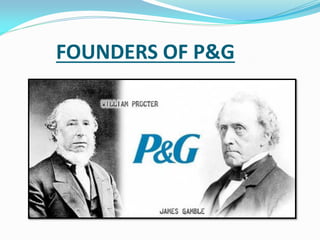
FOUNDERS OF P&G
P&G HISTORY: A LEGEND OF FIRSTS
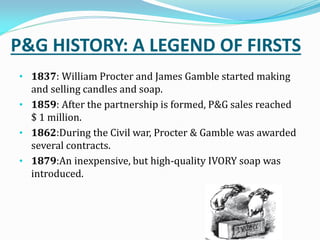
• 1837: William Procter and James Gamble started making
and selling candles and soap.
• 1859: After the partnership is formed, P&G sales reached
$ 1 million.
• 1862:During the Civil war, Procter & Gamble was awarded
several contracts.
• 1879:An inexpensive, but high-quality IVORY soap was
introduced.
P&G HISTORY: A LEGEND OF FIRSTS
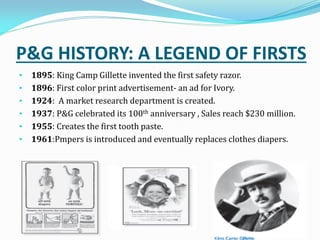
• 1895: King Camp Gillette invented the first safety razor.
• 1896: First color print advertisement- an ad for Ivory.
• 1924: A market research department is created.
• 1937: P&G celebrated its 100th anniversary , Sales reach $230 million.
• 1955: Creates the first tooth paste.
• 1961:Pmpers is introduced and eventually replaces clothes diapers.
P&G HISTORY: A LEGEND OF FIRSTS
• 1980: Sales reached $ 10 billion.
• 1987: P&G celebrated its 150th anniversary.
• 2002: P&G developed Naturally feminine pads.
• TODAY P&G operates in 80 countries world wide ,
employing more than 100,000.
• Its slogan is Touching and Improving Lives.
ORGANIZATIONAL STRUCTURE
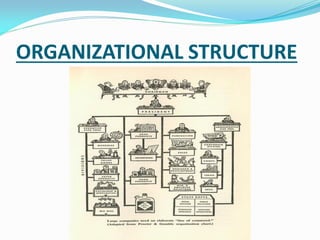
• It specifies the firm formal reporting relationships ,
procedures , controls and authority decision.
• It is comprised of Global business units , Selling and Market
operations , Global Business Service and Corporate
Functions.
• Global Business Units are responsible for developing
overall strategies.
• Selling and Market operations help in developing and
executing market plans at the local level .
• Global Business Services provides technology , processes
and standard data tool.
MEMBERSOF P&G
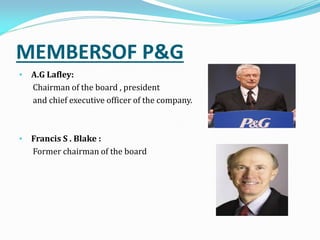
• A.G Lafley:
Chairman of the board , president
and chief executive officer of the company.
• Francis S . Blake :
Former chairman of the board
MEMBERSOF P&G
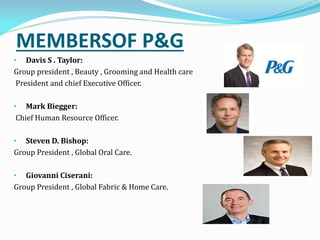
• Davis S . Taylor:
Group president , Beauty , Grooming and Health care
President and chief Executive Officer.
• Mark Biegger:
Chief Human Resource Officer.
• Steven D. Bishop:
Group President , Global Oral Care.
• Giovanni Ciserani:
Group President , Global Fabric & Home Care.
MEMBERSOF P&G
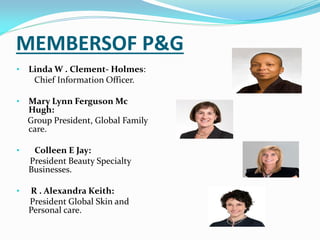
• Linda W . Clement- Holmes:
Chief Information Officer.
• Mary Lynn Ferguson Mc
Hugh:
Group President, Global Family
care.
• Colleen E Jay:
President Beauty Specialty
Businesses.
• R . Alexandra Keith:
President Global Skin and
Personal care.
EXTERNAL ENVIONMENT OF P&G
Economic:
 Adapted to the recession by lowering earning projections.
 Shed 15% of the management staff.
 Focus on the 43 best-selling brands
 Have to keep up with changing trends in consumer demand.
EXTERNAL ENVIRONMENT OF P&G
Demographic
Everybody will use most these products.
Middle to upper class consumers due to the higher
price of the brand name products.
Global – in more than 80 countries
EXTERNAL ENVIRONMENT OF P&G
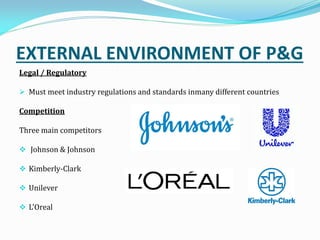
Legal / Regulatory
 Must meet industry regulations and standards inmany different countries
Competition
Three main competitors
 Johnson & Johnson
 Kimberly-Clark
 Unilever
 L'Oreal
EXTERNAL ENVIRONMENT OF P&G
Competitor Analysis:
Stiff competitors like Estee Lauder, Maybelline and
LOreal.
The cost of switching is very less.
The main competitors are the ones which manufacture
same range of cosmetics but at lower cost.
P&G products must be capable enough to put strong
competition to its opponent products.
EXTERNAL ENVIRONMENT OF P&G
Domestic Competition:
 New products coming with private labels in local
markets every now.
 P&G should follow some innovation.
 Introduce new and fresh products.
 Wal-Mart is the biggest buyer of P&G products.
 It has formed strategic alliances with it.
EXTERNAL ENVIRONMENT OF P&G
International Competitors:
 Most fit for survival across the international market.
 The huge global scale of P&G allows it to get an edge over
LOreal in developing countries.
Competitive Advantage:
 Has diversified product portfolio.
 The P&G has created brand awareness.
 By recession which is why it again gains an edge over
LOreal i.e. cosmetics range.
INTERNAL ENVIRONMENT OF P&G
P&G – Epitome of culture
• In P&G, they use we instead of I.
• Everyone at P&G is like a hand in a bucket of water-
when the hand is removed, the water closes in and
there is no trace.
• Conform and you succeed; questions and you are
gone.
• Research as an integral part of P&G thoroughness.
• It s aim is to produce products that consistently win
the consumers blind tests.
INTERNAL ENVIRONMENT OF P&G
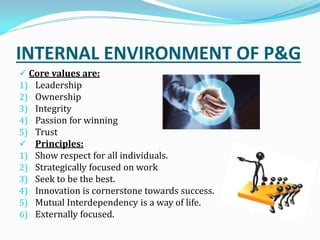
 Core values are:
1) Leadership
2) Ownership
3) Integrity
4) Passion for winning
5) Trust
 Principles:
1) Show respect for all individuals.
2) Strategically focused on work
3) Seek to be the best.
4) Innovation is cornerstone towards success.
5) Mutual Interdependency is a way of life.
6) Externally focused.
INTERNAL ENVIRONMENT OF P&G
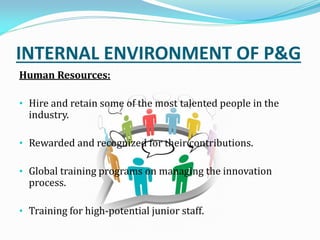
Human Resources:
• Hire and retain some of the most talented people in the
industry.
• Rewarded and recognized for their contributions.
• Global training programs on managing the innovation
process.
• Training for high-potential junior staff.
INTERNAL ENVIRONMENT OF P&G
P&G s internal strategy is to focus on core strengths to win the
customer products industry
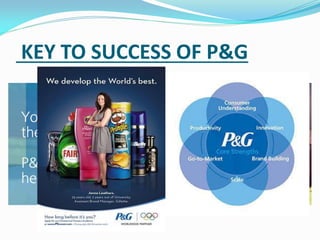
 Consumer Understanding:
P&G conducts over 20,000 research studies.
 Innovation:
Is recognized as the industry s global leader in innovation.
 Brand Building:
Portfolio of 50 leadership brands which make up 90% of sales .
 Go-to-Market Capabilities:
P&G is ranked as the preferred supplier by leading retailers.
 Scale:
Allocating resources more strategically and efficiently.
INTERNAL ENVIRONMENT OF P&G
Marketing:
 Constant emphasis on building brand recognition andbrand
value
 In the s it was one of the first companies to advertise
nationally.
 In the s, P&G was the first firm to develop the idea
of brand management.
 In the s they used their own soap operas and radio
programs for advertising.
INTERNAL ENVIRONMENT OF P&G
Research:
 World class R&D organization, with more than 7,500
scientists.
 This includes 1,250 Ph.D. scientists.
 Invest 4% of sales back into research & development.
 Lafley had an enormous impact on P&G in an attempt to
turn a stalling company around.
INTERNAL ENVIRONMENT OF P&G
Leadership
A.G. Lafley states that:
 To define and interpret the meaningful outside (external
environment).
 To answer the two-part question:
What business are we in and what business are we
noting?
 To balance sufficient yield in the present with investment in
the future.
 To shape the values and set the standards of the
organization.
WAS THIS THE ONE???
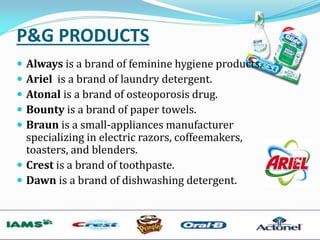
P&G PRODUCTS
 Always is a brand of feminine hygiene products.
 Ariel is a brand of laundry detergent.
 Atonal is a brand of osteoporosis drug.
 Bounty is a brand of paper towels.
 Braun is a small-appliances manufacturer
specializing in electric razors, coffeemakers,
toasters, and blenders.
 Crest is a brand of toothpaste.
 Dawn is a brand of dishwashing detergent.
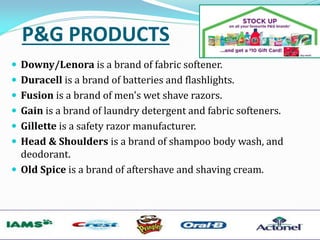
P&G PRODUCTS
 Downy/Lenora is a brand of fabric softener.
 Duracell is a brand of batteries and flashlights.
 Fusion is a brand of men's wet shave razors.
 Gain is a brand of laundry detergent and fabric softeners.
 Gillette is a safety razor manufacturer.
 Head & Shoulders is a brand of shampoo body wash, and
deodorant.
 Old Spice is a brand of aftershave and shaving cream.
P&G PRODUCTS
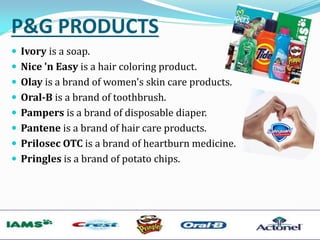
 Ivory is a soap.
 Nice 'n Easy is a hair coloring product.
 Olay is a brand of women's skin care products.
 Oral-B is a brand of toothbrush.
 Pampers is a brand of disposable diaper.
 Pantene is a brand of hair care products.
 Prilosec OTC is a brand of heartburn medicine.
 Pringles is a brand of potato chips.
P&G PRODUCTS
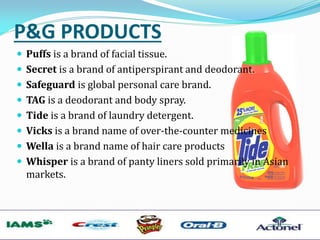
 Puffs is a brand of facial tissue.
 Secret is a brand of antiperspirant and deodorant.
 Safeguard is global personal care brand.
 TAG is a deodorant and body spray.
 Tide is a brand of laundry detergent.
 Vicks is a brand name of over-the-counter medicines
 Wella is a brand name of hair care products
 Whisper is a brand of panty liners sold primarily in Asian
markets.
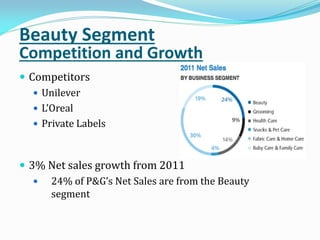
Beauty Segment
Competition and Growth
 Competitors
 Unilever
 LOreal
 Private Labels
 3% Net sales growth from 2011
 % of P&G s Net Sales are from the Beauty
segment
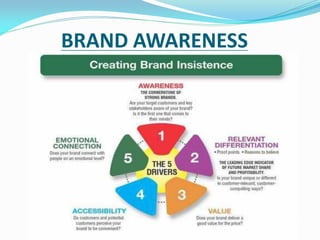
BRAND AWARENESS
BRAND AWARENESS
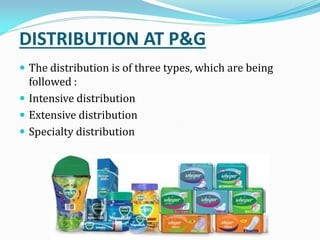
DISTRIBUTION AT P&G
 The distribution is of three types, which are being
followed :
 Intensive distribution
 Extensive distribution
 Specialty distribution
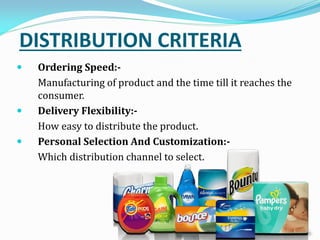
DISTRIBUTION CRITERIA
 Ordering Speed:-
Manufacturing of product and the time till it reaches the
consumer.
 Delivery Flexibility:-
How easy to distribute the product.
 Personal Selection And Customization:-
Which distribution channel to select.
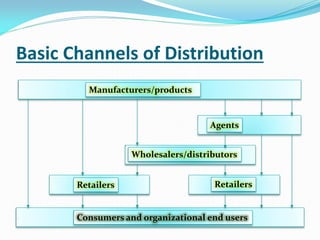
Basic Channels of Distribution
Manufacturers/products
Agents
Wholesalers/distributors
RetailersRetailers
Consumers and organizational end users
PROMOTION STRATEGY
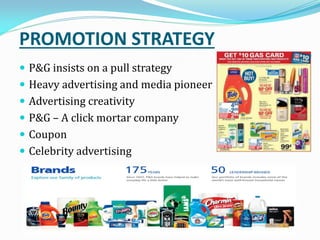
 P&G insists on a pull strategy
 Heavy advertising and media pioneer
 Advertising creativity
 P&G – A click mortar company
 Coupon
 Celebrity advertising
PRICING STRATEGIES
 Understand how companies find a set of prices that
maximizes the profits from the total product mix.
 Learn how companies adjust their prices to take into
account different types of customers and situations.
 Know the key issues related to initiating and
responding to price changes.
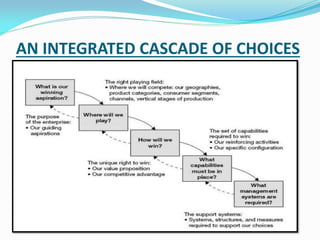
AN INTEGRATED CASCADE OF CHOICES
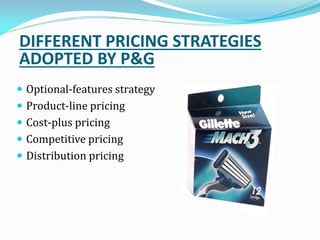
DIFFERENT PRICING STRATEGIES
ADOPTED BY P&G
 Optional-features strategy
 Product-line pricing
 Cost-plus pricing
 Competitive pricing
 Distribution pricing
ONLINE MARKETING
 The company has actively developed or sponsored
numerous online communities.
 As of 2000, the company had 72 "highly stylized
destination sites.
HR SYSTEM AND STRATEGIES
 The HR function at P&G isn t traditional support
function but a strategic function.
 P&G has unique Human Resource strategies e.g.
promote from with in philosophy.
 People are recruited at the entry level.
 Through continuous mentoring people with in the
company at highest levels.
HR PLANNING
 The HR planning in P&G is done by different
departments and business units.
 P&G hires people from base level and then promote
people from with in.
 P&G has strong policy of job rotation.
 The job analysis is based on success drivers.
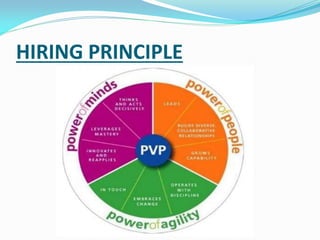
HIRING PRINCIPLE
HR DEPARTMENT OF P&G
 The HR department at P&G is a strategic function.
 The department helps form and implement strategies.
 HR here is a change and development agent and not
the policy of the organization.
 HR sits at the table while making policies, procedures,
goals, and strategies.
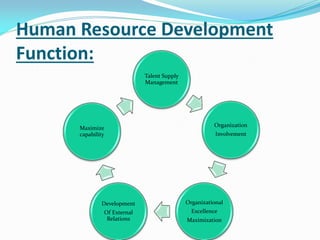
Human Resource Development
Function:
Talent Supply
Management
Organization
Involvement
Organizational
Excellence
Maximization
Development
Of External
Relations
Maximize
capability
RECRUITMENT & SELECTION AT
P&G:
Recruitment and selection is done in following steps:
Job structure and definition
Job description
Job specification
Job standards
Selection
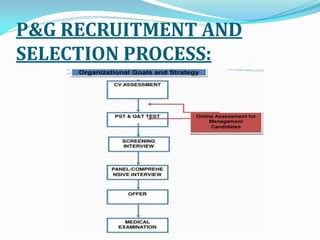
P&G RECRUITMENT AND
SELECTION PROCESS:
SELECTION PROCESS:
Application
Assessment
Initial Interview
Final Interview
Your offer and Your future
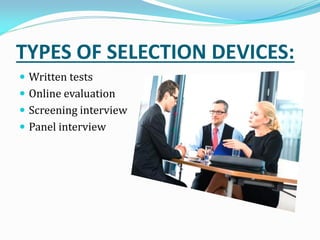
TYPES OF SELECTION DEVICES:
 Written tests
 Online evaluation
 Screening interview
 Panel interview
ORIENTATION:
Two type of orientation takes places at P&G:
 Work unit orientation
 Organization orientation
TRAINING AND DEVELOPMENT
APPROACHES:
 Basically there are two approaches for training and
development:
 On-the-job
 Job rotation
 Job Instruction training
 Coaching
 Off-the-job
 Warehouse Training
 Action Learning
IMPROVE PRODUCTIVITY IN ALL
AREAS
 Cost of Goods
 Reduce Raw Material costs
 Long-term contracts
 Increase Number of Suppliers
 Reduce excess inventory
 Develop partnerships (PGT Healthcare)
 Research & Development ~ $2 billion annually
 Continuous improvement
 Product Innovation
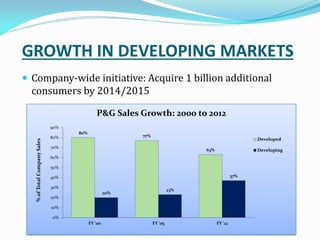
GROWTH IN DEVELOPING MARKETS
80%
77%
63%
20%
23%
37%
0%
10%
20%
30%
40%
50%
60%
70%
80%
90%
FY '00 FY '05 FY '12
%ofTotalCompanySales
P&G Sales Growth: 2000 to 2012
Developed
Developing
 Company-wide initiative: Acquire 1 billion additional
consumers by 2014/2015
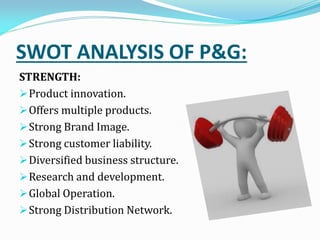
SWOT ANALYSIS OF P&G:
STRENGTH:
Product innovation.
Offers multiple products.
Strong Brand Image.
Strong customer liability.
Diversified business structure.
Research and development.
Global Operation.
Strong Distribution Network.
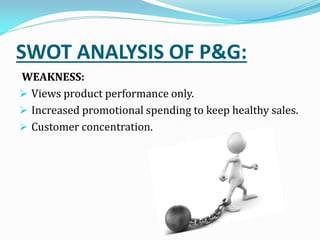
SWOT ANALYSIS OF P&G:
WEAKNESS:
 Views product performance only.
 Increased promotional spending to keep healthy sales.
 Customer concentration.
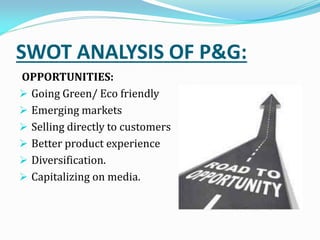
SWOT ANALYSIS OF P&G:
OPPORTUNITIES:
 Going Green/ Eco friendly
 Emerging markets
 Selling directly to customers
 Better product experience
 Diversification.
 Capitalizing on media.
SWOT ANALYSIS OF P&G:
THREATS:
Substitute of brands that have cheaper price.
Slow down in consumer spending.
Key competitors expanding their product portfolios
through acquisitions.
Increase cost of raw material.
Competition.
Government regulation.
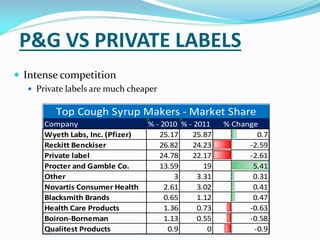
P&G VS PRIVATE LABELS
 Intense competition
 Private labels are much cheaper
Company % - 2010 % - 2011 % Change
Wyeth Labs, Inc. (Pfizer) 25.17 25.87 0.7
Reckitt Benckiser 26.82 24.23 -2.59
Private label 24.78 22.17 -2.61
Procter and Gamble Co. 13.59 19 5.41
Other 3 3.31 0.31
Novartis Consumer Health 2.61 3.02 0.41
Blacksmith Brands 0.65 1.12 0.47
Health Care Products 1.36 0.73 -0.63
Boiron-Borneman 1.13 0.55 -0.58
Qualitest Products 0.9 0 -0.9
Top Cough Syrup Makers - Market Share
ENVIRONMENT PROTECTION
• Environment suffers due to industrialization and
development.
• Development must be carried out keeping the
sustainability in mind.
• The P&G Co. today expanded its sustainability goals to
continue creating value.
• We continue to improve the environmental sustainability
of our products.
• Expanded its social sustainability work, touching and
improving the lives each year through:
 Children Safe Drinking Water
 Pamper UNICEF Partnership.
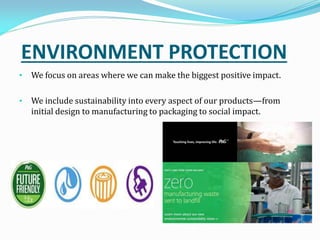
ENVIRONMENT PROTECTION
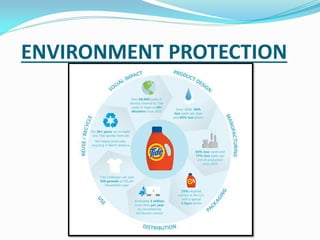
• We focus on areas where we can make the biggest positive impact.
• We include sustainability into every aspect of our products—from
initial design to manufacturing to packaging to social impact.
ENVIRONMENT PROTECTION
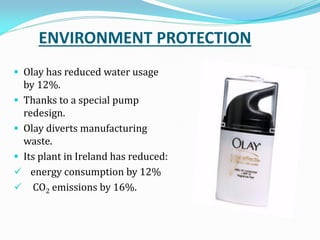
 Olay has reduced water usage
by 12%.
 Thanks to a special pump
redesign.
 Olay diverts manufacturing
waste.
 Its plant in Ireland has reduced:
 energy consumption by 12%
 CO2 emissions by 16%.
ENVIRONMENT PROTECTION
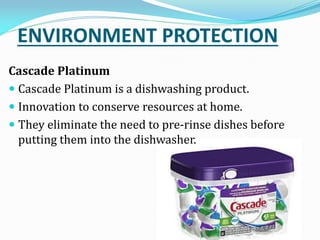
Cascade Platinum
 Cascade Platinum is a dishwashing product.
 Innovation to conserve resources at home.
 They eliminate the need to pre-rinse dishes before
putting them into the dishwasher.
ENVIRONMENT PROTECTION
• We see sustainability as an opportunity.
• Our objective is lead value with brands and products
that consumers prefer.
• We conserve resources, protect environment and
social conditions.
• Ensure our products, packaging and operations are
safe.
• Actively encourage reuse, recycling and composting.
P&G AWARDS AND ACHEIVEMENTS
National Association for Female Executives:
 Recognized by the National Association for Female
Executives as one of the Top 50 Companies for Executive
Women
 Ranked # on the World s Most Respected Companies
List
P&G AWARDS AND ACHEIVEMENTS
AC Nielsen Survey:
 Ranked # as the Employer of Choice across the
targeted campuses in a survey conducted by AC Nielsen.
Business Today:
 Business Today has rated P&G amongst the most
preferred companies by management students across
India.
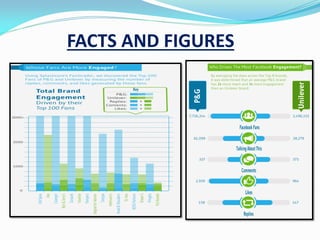
FACTS AND FIGURES
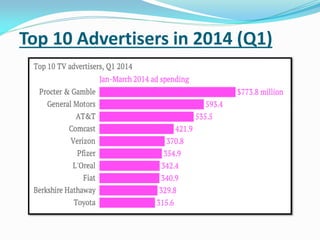
Top 10 Advertisers in 2014 (Q1)
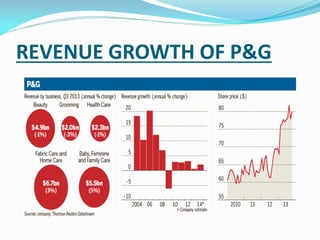
REVENUE GROWTH OF P&G
OLYMPIC GAMES SPONSERSHIP
KEY TO SUCCESS OF P&G
Procter and Gamble HRM report 2015 NAR

Procter and Gamble HRM report 2015 NAR

  • 2.
  • 3.
    HISTORY OF P&G •P&G is an American multinational consumer goods. • Company Headquarter in Ohio , United States. • P&G was founded in 1837 by William Procter and James Gamble. • William a Candle maker and James a Soap maker. • On 31 October the Procter and Gamble company was created.
  • 4.
  • 5.
    P&G HISTORY: ALEGEND OF FIRSTS • 1837: William Procter and James Gamble started making and selling candles and soap. • 1859: After the partnership is formed, P&G sales reached $ 1 million. • 1862:During the Civil war, Procter & Gamble was awarded several contracts. • 1879:An inexpensive, but high-quality IVORY soap was introduced.
  • 6.
    P&G HISTORY: ALEGEND OF FIRSTS • 1895: King Camp Gillette invented the first safety razor. • 1896: First color print advertisement- an ad for Ivory. • 1924: A market research department is created. • 1937: P&G celebrated its 100th anniversary , Sales reach $230 million. • 1955: Creates the first tooth paste. • 1961:Pmpers is introduced and eventually replaces clothes diapers.
  • 7.
    P&G HISTORY: ALEGEND OF FIRSTS • 1980: Sales reached $ 10 billion. • 1987: P&G celebrated its 150th anniversary. • 2002: P&G developed Naturally feminine pads. • TODAY P&G operates in 80 countries world wide , employing more than 100,000. • Its slogan is Touching and Improving Lives.
  • 8.
  • 9.
    ORGANIZATIONAL STRUCTURE • Itspecifies the firm formal reporting relationships , procedures , controls and authority decision. • It is comprised of Global business units , Selling and Market operations , Global Business Service and Corporate Functions. • Global Business Units are responsible for developing overall strategies. • Selling and Market operations help in developing and executing market plans at the local level . • Global Business Services provides technology , processes and standard data tool.
  • 10.
    MEMBERSOF P&G • A.GLafley: Chairman of the board , president and chief executive officer of the company. • Francis S . Blake : Former chairman of the board
  • 11.
    MEMBERSOF P&G • DavisS . Taylor: Group president , Beauty , Grooming and Health care President and chief Executive Officer. • Mark Biegger: Chief Human Resource Officer. • Steven D. Bishop: Group President , Global Oral Care. • Giovanni Ciserani: Group President , Global Fabric & Home Care.
  • 12.
    MEMBERSOF P&G • LindaW . Clement- Holmes: Chief Information Officer. • Mary Lynn Ferguson Mc Hugh: Group President, Global Family care. • Colleen E Jay: President Beauty Specialty Businesses. • R . Alexandra Keith: President Global Skin and Personal care.
  • 13.
    EXTERNAL ENVIONMENT OFP&G Economic:  Adapted to the recession by lowering earning projections.  Shed 15% of the management staff.  Focus on the 43 best-selling brands  Have to keep up with changing trends in consumer demand.
  • 14.
    EXTERNAL ENVIRONMENT OFP&G Demographic Everybody will use most these products. Middle to upper class consumers due to the higher price of the brand name products. Global – in more than 80 countries
  • 15.
    EXTERNAL ENVIRONMENT OFP&G Legal / Regulatory  Must meet industry regulations and standards inmany different countries Competition Three main competitors  Johnson & Johnson  Kimberly-Clark  Unilever  L'Oreal
  • 16.
    EXTERNAL ENVIRONMENT OFP&G Competitor Analysis: Stiff competitors like Estee Lauder, Maybelline and LOreal. The cost of switching is very less. The main competitors are the ones which manufacture same range of cosmetics but at lower cost. P&G products must be capable enough to put strong competition to its opponent products.
  • 17.
    EXTERNAL ENVIRONMENT OFP&G Domestic Competition:  New products coming with private labels in local markets every now.  P&G should follow some innovation.  Introduce new and fresh products.  Wal-Mart is the biggest buyer of P&G products.  It has formed strategic alliances with it.
  • 18.
    EXTERNAL ENVIRONMENT OFP&G International Competitors:  Most fit for survival across the international market.  The huge global scale of P&G allows it to get an edge over LOreal in developing countries. Competitive Advantage:  Has diversified product portfolio.  The P&G has created brand awareness.  By recession which is why it again gains an edge over LOreal i.e. cosmetics range.
  • 19.
    INTERNAL ENVIRONMENT OFP&G P&G – Epitome of culture • In P&G, they use we instead of I. • Everyone at P&G is like a hand in a bucket of water- when the hand is removed, the water closes in and there is no trace. • Conform and you succeed; questions and you are gone. • Research as an integral part of P&G thoroughness. • It s aim is to produce products that consistently win the consumers blind tests.
  • 20.
    INTERNAL ENVIRONMENT OFP&G  Core values are: 1) Leadership 2) Ownership 3) Integrity 4) Passion for winning 5) Trust  Principles: 1) Show respect for all individuals. 2) Strategically focused on work 3) Seek to be the best. 4) Innovation is cornerstone towards success. 5) Mutual Interdependency is a way of life. 6) Externally focused.
  • 21.
    INTERNAL ENVIRONMENT OFP&G Human Resources: • Hire and retain some of the most talented people in the industry. • Rewarded and recognized for their contributions. • Global training programs on managing the innovation process. • Training for high-potential junior staff.
  • 22.
    INTERNAL ENVIRONMENT OFP&G P&G s internal strategy is to focus on core strengths to win the customer products industry  Consumer Understanding: P&G conducts over 20,000 research studies.  Innovation: Is recognized as the industry s global leader in innovation.  Brand Building: Portfolio of 50 leadership brands which make up 90% of sales .  Go-to-Market Capabilities: P&G is ranked as the preferred supplier by leading retailers.  Scale: Allocating resources more strategically and efficiently.
  • 23.
    INTERNAL ENVIRONMENT OFP&G Marketing:  Constant emphasis on building brand recognition andbrand value  In the s it was one of the first companies to advertise nationally.  In the s, P&G was the first firm to develop the idea of brand management.  In the s they used their own soap operas and radio programs for advertising.
  • 24.
    INTERNAL ENVIRONMENT OFP&G Research:  World class R&D organization, with more than 7,500 scientists.  This includes 1,250 Ph.D. scientists.  Invest 4% of sales back into research & development.  Lafley had an enormous impact on P&G in an attempt to turn a stalling company around.
  • 25.
    INTERNAL ENVIRONMENT OFP&G Leadership A.G. Lafley states that:  To define and interpret the meaningful outside (external environment).  To answer the two-part question: What business are we in and what business are we noting?  To balance sufficient yield in the present with investment in the future.  To shape the values and set the standards of the organization.
  • 27.
  • 28.
    P&G PRODUCTS  Alwaysis a brand of feminine hygiene products.  Ariel is a brand of laundry detergent.  Atonal is a brand of osteoporosis drug.  Bounty is a brand of paper towels.  Braun is a small-appliances manufacturer specializing in electric razors, coffeemakers, toasters, and blenders.  Crest is a brand of toothpaste.  Dawn is a brand of dishwashing detergent.
  • 29.
    P&G PRODUCTS  Downy/Lenorais a brand of fabric softener.  Duracell is a brand of batteries and flashlights.  Fusion is a brand of men's wet shave razors.  Gain is a brand of laundry detergent and fabric softeners.  Gillette is a safety razor manufacturer.  Head & Shoulders is a brand of shampoo body wash, and deodorant.  Old Spice is a brand of aftershave and shaving cream.
  • 30.
    P&G PRODUCTS  Ivoryis a soap.  Nice 'n Easy is a hair coloring product.  Olay is a brand of women's skin care products.  Oral-B is a brand of toothbrush.  Pampers is a brand of disposable diaper.  Pantene is a brand of hair care products.  Prilosec OTC is a brand of heartburn medicine.  Pringles is a brand of potato chips.
  • 31.
    P&G PRODUCTS  Puffsis a brand of facial tissue.  Secret is a brand of antiperspirant and deodorant.  Safeguard is global personal care brand.  TAG is a deodorant and body spray.  Tide is a brand of laundry detergent.  Vicks is a brand name of over-the-counter medicines  Wella is a brand name of hair care products  Whisper is a brand of panty liners sold primarily in Asian markets.
  • 32.
    Beauty Segment Competition andGrowth  Competitors  Unilever  LOreal  Private Labels  3% Net sales growth from 2011  % of P&G s Net Sales are from the Beauty segment
  • 33.
  • 34.
  • 35.
    DISTRIBUTION AT P&G The distribution is of three types, which are being followed :  Intensive distribution  Extensive distribution  Specialty distribution
  • 36.
    DISTRIBUTION CRITERIA  OrderingSpeed:- Manufacturing of product and the time till it reaches the consumer.  Delivery Flexibility:- How easy to distribute the product.  Personal Selection And Customization:- Which distribution channel to select.
  • 37.
    Basic Channels ofDistribution Manufacturers/products Agents Wholesalers/distributors RetailersRetailers Consumers and organizational end users
  • 38.
    PROMOTION STRATEGY  P&Ginsists on a pull strategy  Heavy advertising and media pioneer  Advertising creativity  P&G – A click mortar company  Coupon  Celebrity advertising
  • 39.
    PRICING STRATEGIES  Understandhow companies find a set of prices that maximizes the profits from the total product mix.  Learn how companies adjust their prices to take into account different types of customers and situations.  Know the key issues related to initiating and responding to price changes.
  • 40.
  • 41.
    DIFFERENT PRICING STRATEGIES ADOPTEDBY P&G  Optional-features strategy  Product-line pricing  Cost-plus pricing  Competitive pricing  Distribution pricing
  • 42.
    ONLINE MARKETING  Thecompany has actively developed or sponsored numerous online communities.  As of 2000, the company had 72 "highly stylized destination sites.
  • 43.
    HR SYSTEM ANDSTRATEGIES  The HR function at P&G isn t traditional support function but a strategic function.  P&G has unique Human Resource strategies e.g. promote from with in philosophy.  People are recruited at the entry level.  Through continuous mentoring people with in the company at highest levels.
  • 44.
    HR PLANNING  TheHR planning in P&G is done by different departments and business units.  P&G hires people from base level and then promote people from with in.  P&G has strong policy of job rotation.  The job analysis is based on success drivers.
  • 45.
  • 46.
    HR DEPARTMENT OFP&G  The HR department at P&G is a strategic function.  The department helps form and implement strategies.  HR here is a change and development agent and not the policy of the organization.  HR sits at the table while making policies, procedures, goals, and strategies.
  • 47.
    Human Resource Development Function: TalentSupply Management Organization Involvement Organizational Excellence Maximization Development Of External Relations Maximize capability
  • 48.
    RECRUITMENT & SELECTIONAT P&G: Recruitment and selection is done in following steps: Job structure and definition Job description Job specification Job standards Selection
  • 49.
  • 50.
  • 51.
    TYPES OF SELECTIONDEVICES:  Written tests  Online evaluation  Screening interview  Panel interview
  • 52.
    ORIENTATION: Two type oforientation takes places at P&G:  Work unit orientation  Organization orientation
  • 53.
    TRAINING AND DEVELOPMENT APPROACHES: Basically there are two approaches for training and development:  On-the-job  Job rotation  Job Instruction training  Coaching  Off-the-job  Warehouse Training  Action Learning
  • 54.
    IMPROVE PRODUCTIVITY INALL AREAS  Cost of Goods  Reduce Raw Material costs  Long-term contracts  Increase Number of Suppliers  Reduce excess inventory  Develop partnerships (PGT Healthcare)  Research & Development ~ $2 billion annually  Continuous improvement  Product Innovation
  • 55.
    GROWTH IN DEVELOPINGMARKETS 80% 77% 63% 20% 23% 37% 0% 10% 20% 30% 40% 50% 60% 70% 80% 90% FY '00 FY '05 FY '12 %ofTotalCompanySales P&G Sales Growth: 2000 to 2012 Developed Developing  Company-wide initiative: Acquire 1 billion additional consumers by 2014/2015
  • 56.
    SWOT ANALYSIS OFP&G: STRENGTH: Product innovation. Offers multiple products. Strong Brand Image. Strong customer liability. Diversified business structure. Research and development. Global Operation. Strong Distribution Network.
  • 57.
    SWOT ANALYSIS OFP&G: WEAKNESS:  Views product performance only.  Increased promotional spending to keep healthy sales.  Customer concentration.
  • 58.
    SWOT ANALYSIS OFP&G: OPPORTUNITIES:  Going Green/ Eco friendly  Emerging markets  Selling directly to customers  Better product experience  Diversification.  Capitalizing on media.
  • 59.
    SWOT ANALYSIS OFP&G: THREATS: Substitute of brands that have cheaper price. Slow down in consumer spending. Key competitors expanding their product portfolios through acquisitions. Increase cost of raw material. Competition. Government regulation.
  • 60.
    P&G VS PRIVATELABELS  Intense competition  Private labels are much cheaper Company % - 2010 % - 2011 % Change Wyeth Labs, Inc. (Pfizer) 25.17 25.87 0.7 Reckitt Benckiser 26.82 24.23 -2.59 Private label 24.78 22.17 -2.61 Procter and Gamble Co. 13.59 19 5.41 Other 3 3.31 0.31 Novartis Consumer Health 2.61 3.02 0.41 Blacksmith Brands 0.65 1.12 0.47 Health Care Products 1.36 0.73 -0.63 Boiron-Borneman 1.13 0.55 -0.58 Qualitest Products 0.9 0 -0.9 Top Cough Syrup Makers - Market Share
  • 61.
    ENVIRONMENT PROTECTION • Environmentsuffers due to industrialization and development. • Development must be carried out keeping the sustainability in mind. • The P&G Co. today expanded its sustainability goals to continue creating value. • We continue to improve the environmental sustainability of our products. • Expanded its social sustainability work, touching and improving the lives each year through:  Children Safe Drinking Water  Pamper UNICEF Partnership.
  • 62.
    ENVIRONMENT PROTECTION • Wefocus on areas where we can make the biggest positive impact. • We include sustainability into every aspect of our products—from initial design to manufacturing to packaging to social impact.
  • 63.
  • 64.
  • 65.
    ENVIRONMENT PROTECTION  Olayhas reduced water usage by 12%.  Thanks to a special pump redesign.  Olay diverts manufacturing waste.  Its plant in Ireland has reduced:  energy consumption by 12%  CO2 emissions by 16%.
  • 66.
    ENVIRONMENT PROTECTION Cascade Platinum Cascade Platinum is a dishwashing product.  Innovation to conserve resources at home.  They eliminate the need to pre-rinse dishes before putting them into the dishwasher.
  • 67.
    ENVIRONMENT PROTECTION • Wesee sustainability as an opportunity. • Our objective is lead value with brands and products that consumers prefer. • We conserve resources, protect environment and social conditions. • Ensure our products, packaging and operations are safe. • Actively encourage reuse, recycling and composting.
  • 68.
    P&G AWARDS ANDACHEIVEMENTS National Association for Female Executives:  Recognized by the National Association for Female Executives as one of the Top 50 Companies for Executive Women  Ranked # on the World s Most Respected Companies List
  • 69.
    P&G AWARDS ANDACHEIVEMENTS AC Nielsen Survey:  Ranked # as the Employer of Choice across the targeted campuses in a survey conducted by AC Nielsen. Business Today:  Business Today has rated P&G amongst the most preferred companies by management students across India.
  • 70.
  • 71.
    Top 10 Advertisersin 2014 (Q1)
  • 72.
  • 73.
  • 74.