
MORGAN STANLEY
Investment Banking
SUBMITTED BY :
ABHISHEK SINGH
ANSHUMAN SAXENA
BERENDRA SINGH
MOHD. AAMIR
PIYUSH KUMAR
RICHA SHRIYA
SHAMBHAWI NANDA
Acknowledgement
We would like to express our special thanks of gratitude to our
professor Dr. Vasudha Sharma.
For her valuable guidance, encouragement and cooperation in
the research assignment work.
We are immensely grateful of her for giving us the opportunity
to work on such interesting case study.
The completion of this research assignment report is the result
of valuable suggestion and keen interest of Dr. Vasudha Sharma
(Professor of Doon Business School).
With sincere thanks
Abhishek Singh
Anshuman Saxena
Berendra Singh Bankoti
Mohd. Aamir
Piyush Kumar
Richa Shriya
Shambhawi Nanda
Content
 INTRODUCTION OF THE COMPANY-MORGAN STANLEY
 SUMMARY OF THE CASE STUDY
 PROBLEM STATEMENT
 MISSION & VISION OF THE COMPANY
 SWOT ANALYSIS OF ROB PARSON
 SWOT ANALYSIS OF PAUL NASR
 LEADERSHIP TRAITS OF PAUL NASR
 LEADERSHIP TRAITS OF ROB PARSON
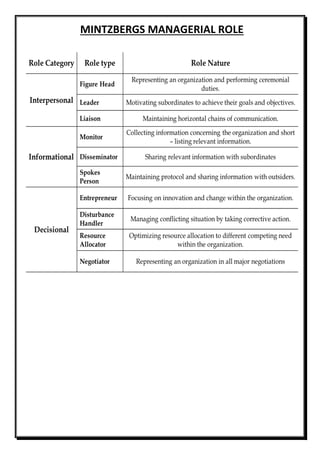
 MINTZBERGS MANAGERIAL ROLE
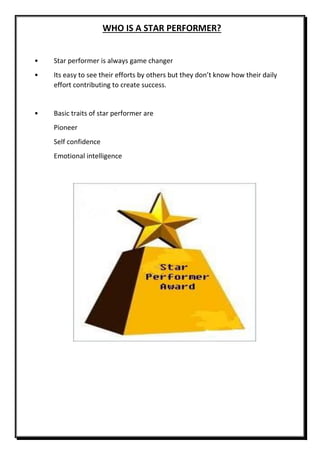
 WHO IS A STAR PERFORMER?
 WHY WAS ROB PARSON A STAR PERFORMER
 FEEDBACK
 IMPORTANCE OF FEEDBACK
 360 DEGREE APPRAISAL
 SHOUL ROB PARSON BE PROMTED OR NOT?
 GROUP RATINGS WITH GRAPH
ABOUT MORGAN STANLEY
organ Stanley is an American multinational financial services
corporation headquartered in the Morgan Stanley Building, Midtown
Manhattan, New York City. Morgan Stanley operates in 24 countries
and has more than 1300 offices and 60,000 employees. According to the Scorpio
Partnership Global Private Banking Benchmark, the company had $1.454 trillion of
assets under management (AUM) in 2014.
The corporation, formed by J.P. Morgan & Co. partners Henry S. Morgan
(grandson of J.P. Morgan), Harold Stanley and others, came into existence on
September 16, 1935, in response to the Glass-Steagall Act that required the
splitting of commercial and investment banking businesses. In its first year the
company operated with a 24% market share (US$1.1 billion) in public offerings and
private placements. The main areas of business for the firm today are Global
Wealth Management, Institutional Securities, and Investment Management.
M
SUMMARY OF THE CASE STUDY
hroughout his ten years of experience Rob parson had built strong
relationships with the important players in the banking and
insurance industries. He knew that he had acquired a strong
reputation, yet when he was approached by Nasr to join Morgan
Stanley, he was initially sceptical.
Parson started college at one of the New York state universities.
Somewhat of a rebel, he dropped out after a year and went to
California, spending his last ten year running a moped shop on a beach
near Los Angeles. Bored, he decided to go back to school and enrolled at
California State University, Long beach. After completing his
undergraduate degree he went to the University of Southern California
and did a 2-year MBA program in a year, “just to get it over with.”
Paul Nasr was offered a job and parson accepted the job and joined
Morgan Stanley as a market coverage professional in the capital markets
division focusing on financial institutions. He was assigned the title
“Principal” with the understanding that if he did a good job him would
be on the fast track to managing director.
The position that Parson was hired to fill had a reputation for being
notoriously difficult to perform and had seen a tremendous amount of
turnover at Morgan Stanley. Parson knew the position would be
challenging; however, as he reported in his self-evaluation, he initially
underestimated the magnitude of the challenge.
He didn’t have time to build consensus around what he wanted to do.
He thought that he knew more about his industry and had better market
knowledge than the (Morgan Stanley) people around him. And clients in
T
his sector wanted answers in a matter of minutes rather than hours. The
Morgan Stanley way was to build consensus. If he waited for consensus,
the business would have been transacted away. So basically Rob goes
from point A to point B within the time frame that the client has
imposed, fulfils the client’s demand, but in the meantime has broken
every rule within Morgan Stanley to get there. So, people say, Wow, this
guy is not following procedure. We work as a community, not
individually.
PROBLEM STATEMENT
The problem in the case study is that whether to promote Rob
parson or not which lies in the hands of Paul Nasr as he has to
take the decision to recommend rob parson for the promotion
of managing director. The root cause of the issue was the
difference between the thought process of rob parson and
corporate culture of the company.
This decision has to be taken by Paul Nasr who promised Rob
parson to make him Managing director, so he has to take fair
decision.
MISSION & VISION OF THE COMPANY
VISION
“ONE FIRM FIRM”
Means ‘Talent & Passion of People are Critical
to Success. Collectively, We Share a Common
Set of Values Rooted in Integrity & Excellence’.
MISSION
“Our goal is to be world best investment bank
and firm of choice for our clients, our people,
and our shareholders” Means ‘Win in the
Marketplace, Think Like an Owner, Keep Your
Balance, Put Client First & Leads with
Integrity’.
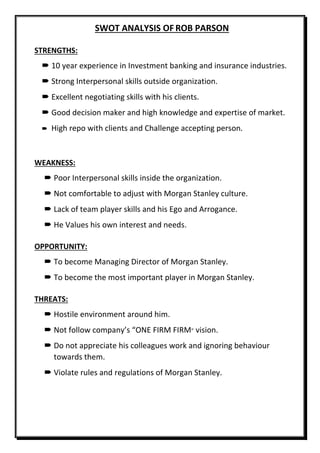
SWOT ANALYSIS OF ROB PARSON
STRENGTHS:
 10 year experience in Investment banking and insurance industries.
 Strong Interpersonal skills outside organization.
 Excellent negotiating skills with his clients.
 Good decision maker and high knowledge and expertise of market.
 High repo with clients and Challenge accepting person.
WEAKNESS:
 Poor Interpersonal skills inside the organization.
 Not comfortable to adjust with Morgan Stanley culture.
 Lack of team player skills and his Ego and Arrogance.
 He Values his own interest and needs.
OPPORTUNITY:
 To become Managing Director of Morgan Stanley.
 To become the most important player in Morgan Stanley.
THREATS:
 Hostile environment around him.
 Not follow company’s “ONE FIRM FIRM” vision.
 Do not appreciate his colleagues work and ignoring behaviour
towards them.
 Violate rules and regulations of Morgan Stanley.
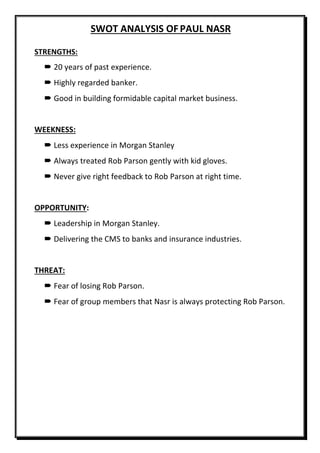
SWOT ANALYSIS OFPAUL NASR
STRENGTHS:
 20 years of past experience.
 Highly regarded banker.
 Good in building formidable capital market business.
WEEKNESS:
 Less experience in Morgan Stanley
 Always treated Rob Parson gently with kid gloves.
 Never give right feedback to Rob Parson at right time.
OPPORTUNITY:
 Leadership in Morgan Stanley.
 Delivering the CMS to banks and insurance industries.
THREAT:
 Fear of losing Rob Parson.
 Fear of group members that Nasr is always protecting Rob Parson.
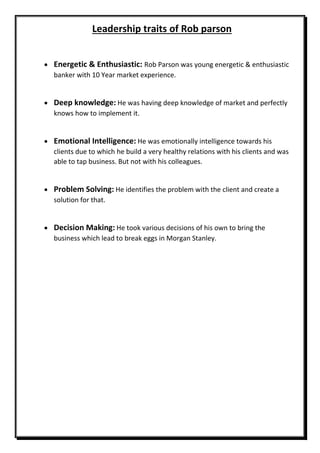
Leadership traits of Rob parson
 Energetic & Enthusiastic: Rob Parson was young energetic & enthusiastic
banker with 10 Year market experience.
 Deep knowledge: He was having deep knowledge of market and perfectly
knows how to implement it.
 Emotional Intelligence: He was emotionally intelligence towards his
clients due to which he build a very healthy relations with his clients and was
able to tap business. But not with his colleagues.
 Problem Solving: He identifies the problem with the client and create a
solution for that.
 Decision Making: He took various decisions of his own to bring the
business which lead to break eggs in Morgan Stanley.
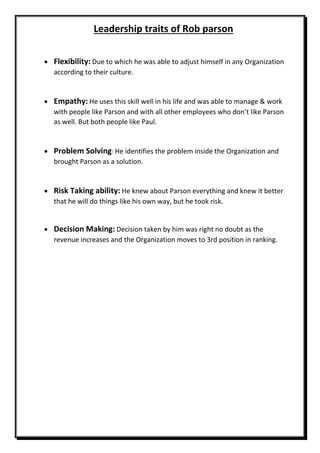
Leadership traits of Rob parson
 Flexibility: Due to which he was able to adjust himself in any Organization
according to their culture.
 Empathy: He uses this skill well in his life and was able to manage & work
with people like Parson and with all other employees who don’t like Parson
as well. But both people like Paul.
 Problem Solving: He identifies the problem inside the Organization and
brought Parson as a solution.
 Risk Taking ability: He knew about Parson everything and knew it better
that he will do things like his own way, but he took risk.
 Decision Making: Decision taken by him was right no doubt as the
revenue increases and the Organization moves to 3rd position in ranking.
MINTZBERGS MANAGERIAL ROLE
WHO IS A STAR PERFORMER?
• Star performer is always game changer
• Its easy to see their efforts by others but they don’t know how their daily
effort contributing to create success.
• Basic traits of star performer are
Pioneer
Self confidence
Emotional intelligence
WHY WAS ROB PARSON A STAR PERFORMER
 His track record and performance were outstanding and
untouchable. He made strong relationship with the important
players in the market.
 He always took initiative and he focused high on his tasks for
accomplishing the set target.
 Rob Parson was the only person recruited by Paul Nasr. Nasr has
20 year experience and he worked a lot with person and he knew
the ability, capacity, knowledge of Rob as he worked with him
previously that is the reason he recruited Rob Parson.
 He had high knowledge and expertise in his field.
 He has amazing decision making sense. He accept challenges and
comes up with solution on his own.
 He has generated high revenue for Morgan Stanley within one year
of his joining and took the company from 10th to 3rd rank.
 He was excellent in interpersonal skills with his clients. Nasr said
about Rob’s client relationship skill that he is the most wonderful
guy with his clients and they love him. In his client’s view he was
most amusing, entertaining, and interesting people to be with it.
 He had deep insight knowledge of market which others might not
have. He knew how to fetch the business from the market.
 He go out to his client situation where there is no business and
create a deal that might not happen if he do not go. In other
words, he create needs for his clients and pursuit business for
Morgan Stanley.
 He was star performer because he is scarce person i.e. Non-
substitute for Morgan Stanley
FEEDBACK
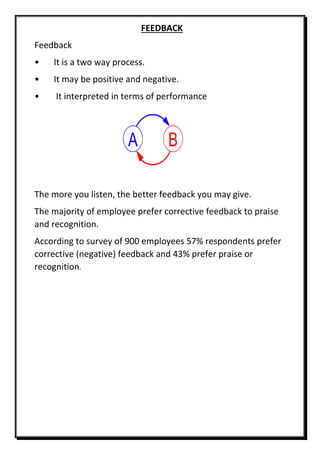
Feedback
• It is a two way process.
• It may be positive and negative.
• It interpreted in terms of performance
The more you listen, the better feedback you may give.
The majority of employee prefer corrective feedback to praise
and recognition.
According to survey of 900 employees 57% respondents prefer
corrective (negative) feedback and 43% prefer praise or
recognition.
IMPORTANCE OF FEEDBACK
• Decision making- Every day we face multiple of choice but it become easy to
take decision by concerning feedback.
• Improve performance-It require both specific feedback and specific goal.it is
helpful in improving long term performance. Sometime manager encourage
employee to work hard by giving feedback.
• Continue learning-feedback is easily understood and applied to future
performance.
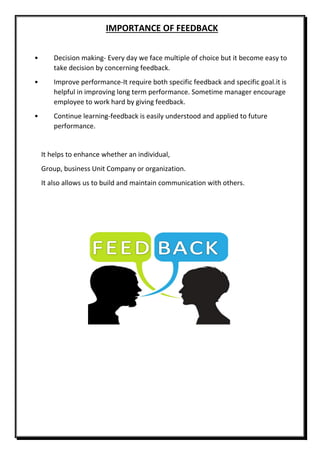
It helps to enhance whether an individual,
Group, business Unit Company or organization.
It also allows us to build and maintain communication with others.
360 DEGREE APPRAISAL
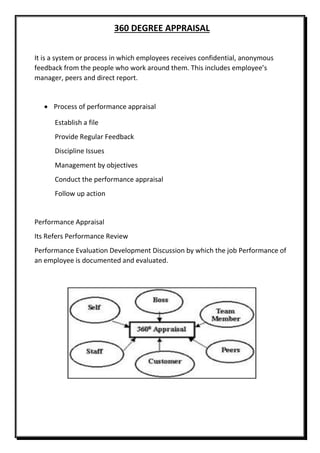
It is a system or process in which employees receives confidential, anonymous
feedback from the people who work around them. This includes employee’s
manager, peers and direct report.
 Process of performance appraisal
Establish a file
Provide Regular Feedback
Discipline Issues
Management by objectives
Conduct the performance appraisal
Follow up action
Performance Appraisal
Its Refers Performance Review
Performance Evaluation Development Discussion by which the job Performance of
an employee is documented and evaluated.
SHOUL ROB PARSON BE PROMTED OR NOT?
YES ,as per our group decided after analysing the case study of rob parson at
Morgan Stanley there should promote rob parson to the Managing director.
WHY?
There are some reasons why we have decided to promote Rob parson :
Having a great experience how to fetch business as an entrepreneur, innovative,
passionate, enthusiastic, game changer, negotiator, amazing liasioning skills,
qualities his outstanding performance in every field makes a huge difference from
other.
Disturbance handler,
an amazing quality to generate need to their clients,
when we talk about leadership qualities of an M.D.
As per Mintzberg managerial role most of the qualities which is needed as a leader
he was fit in most of the qualities.
How he handle their client by maintaining unforgettable relationship with them by
which we can see that his interpersonal skill was also good. But never feel to show
it into the organization.
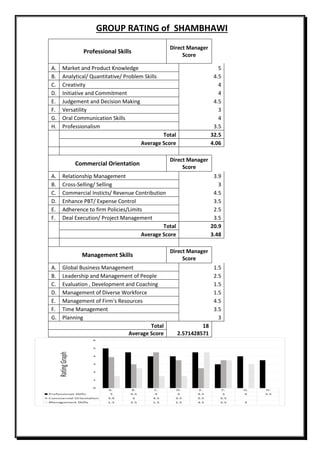
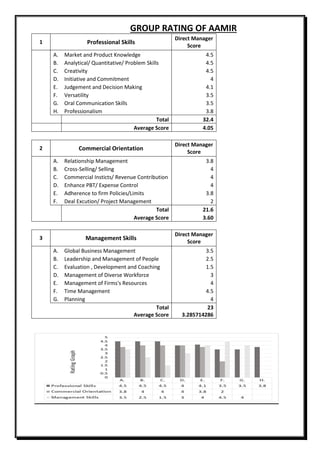
GROUP RATING of SHAMBHAWI
Professional Skills
Direct Manager
Score
A. Market and Product Knowledge 5
B. Analytical/ Quantitative/ Problem Skills 4.5
C. Creativity 4
D. Initiative and Commitment 4
E. Judgement and Decision Making 4.5
F. Versatility 3
G. Oral Communication Skills 4
H. Professionalism 3.5
Total 32.5
Average Score 4.06
Commercial Orientation
Direct Manager
Score
A. Relationship Management 3.9
B. Cross-Selling/ Selling 3
C. Commercial Insticts/ Revenue Contribution 4.5
D. Enhance PBT/ Expense Control 3.5
E. Adherence to firm Policies/Limits 2.5
F. Deal Execution/ Project Management 3.5
Total 20.9
Average Score 3.48
Management Skills
Direct Manager
Score
A. Global Business Management 1.5
B. Leadership and Management of People 2.5
C. Evaluation , Development and Coaching 1.5
D. Management of Diverse Workforce 1.5
E. Management of Firm's Resources 4.5
F. Time Management 3.5
G. Planning 3
Total 18
Average Score 2.571428571
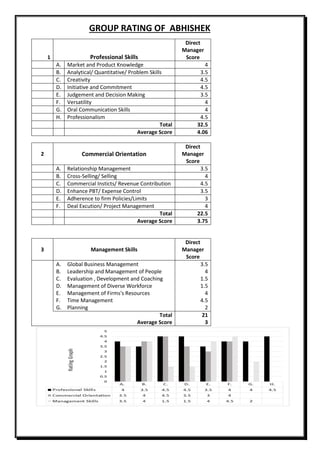
GROUP RATING OF ABHISHEK
1 Professional Skills
Direct
Manager
Score
A. Market and Product Knowledge 4
B. Analytical/ Quantitative/ Problem Skills 3.5
C. Creativity 4.5
D. Initiative and Commitment 4.5
E. Judgement and Decision Making 3.5
F. Versatility 4
G. Oral Communication Skills 4
H. Professionalism 4.5
Total 32.5
Average Score 4.06
2 Commercial Orientation
Direct
Manager
Score
A. Relationship Management 3.5
B. Cross-Selling/ Selling 4
C. Commercial Insticts/ Revenue Contribution 4.5
D. Enhance PBT/ Expense Control 3.5
E. Adherence to firm Policies/Limits 3
F. Deal Excution/ Project Management 4
Total 22.5
Average Score 3.75
3 Management Skills
Direct
Manager
Score
A. Global Business Management 3.5
B. Leadership and Management of People 4
C. Evaluation , Development and Coaching 1.5
D. Management of Diverse Workforce 1.5
E. Management of Firms's Resources 4
F. Time Management 4.5
G. Planning 2
Total 21
Average Score 3
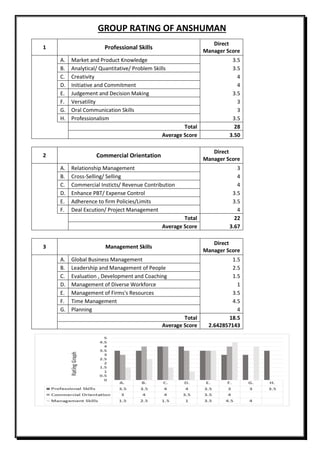
GROUP RATING OF ANSHUMAN
1 Professional Skills
Direct
Manager Score
A. Market and Product Knowledge 3.5
B. Analytical/ Quantitative/ Problem Skills 3.5
C. Creativity 4
D. Initiative and Commitment 4
E. Judgement and Decision Making 3.5
F. Versatility 3
G. Oral Communication Skills 3
H. Professionalism 3.5
Total 28
Average Score 3.50
2 Commercial Orientation
Direct
Manager Score
A. Relationship Management 3
B. Cross-Selling/ Selling 4
C. Commercial Insticts/ Revenue Contribution 4
D. Enhance PBT/ Expense Control 3.5
E. Adherence to firm Policies/Limits 3.5
F. Deal Excution/ Project Management 4
Total 22
Average Score 3.67
3 Management Skills
Direct
Manager Score
A. Global Business Management 1.5
B. Leadership and Management of People 2.5
C. Evaluation , Development and Coaching 1.5
D. Management of Diverse Workforce 1
E. Management of Firms's Resources 3.5
F. Time Management 4.5
G. Planning 4
Total 18.5
Average Score 2.642857143
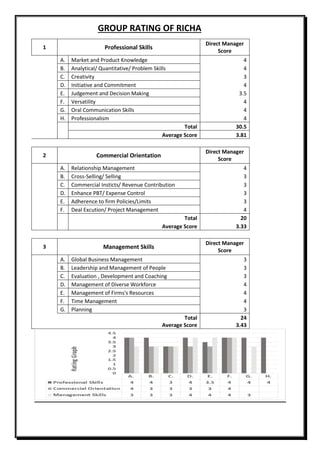
GROUP RATING OF RICHA
1 Professional Skills
Direct Manager
Score
A. Market and Product Knowledge 4
B. Analytical/ Quantitative/ Problem Skills 4
C. Creativity 3
D. Initiative and Commitment 4
E. Judgement and Decision Making 3.5
F. Versatility 4
G. Oral Communication Skills 4
H. Professionalism 4
Total 30.5
Average Score 3.81
2 Commercial Orientation
Direct Manager
Score
A. Relationship Management 4
B. Cross-Selling/ Selling 3
C. Commercial Insticts/ Revenue Contribution 3
D. Enhance PBT/ Expense Control 3
E. Adherence to firm Policies/Limits 3
F. Deal Excution/ Project Management 4
Total 20
Average Score 3.33
3 Management Skills
Direct Manager
Score
A. Global Business Management 3
B. Leadership and Management of People 3
C. Evaluation , Development and Coaching 3
D. Management of Diverse Workforce 4
E. Management of Firms's Resources 4
F. Time Management 4
G. Planning 3
Total 24
Average Score 3.43
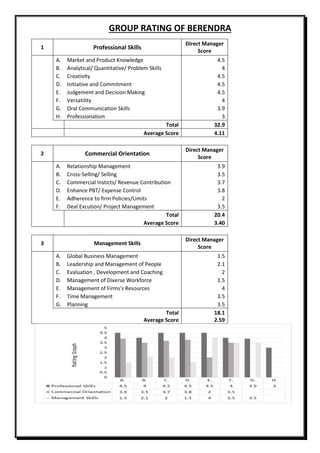
GROUP RATING OF BERENDRA
1 Professional Skills
Direct Manager
Score
A. Market and Product Knowledge 4.5
B. Analytical/ Quantitative/ Problem Skills 4
C. Creativity 4.5
D. Initiative and Commitment 4.5
E. Judgement and Decision Making 4.5
F. Versatility 4
G. Oral Communication Skills 3.9
H. Professionalism 3
Total 32.9
Average Score 4.11
2 Commercial Orientation
Direct Manager
Score
A. Relationship Management 3.9
B. Cross-Selling/ Selling 3.5
C. Commercial Insticts/ Revenue Contribution 3.7
D. Enhance PBT/ Expense Control 3.8
E. Adherence to firm Policies/Limits 2
F. Deal Excution/ Project Management 3.5
Total 20.4
Average Score 3.40
3 Management Skills
Direct Manager
Score
A. Global Business Management 1.5
B. Leadership and Management of People 2.1
C. Evaluation , Development and Coaching 2
D. Management of Diverse Workforce 1.5
E. Management of Firms's Resources 4
F. Time Management 3.5
G. Planning 3.5
Total 18.1
Average Score 2.59
GROUP RATING OF AAMIR
1 Professional Skills
Direct Manager
Score
A. Market and Product Knowledge 4.5
B. Analytical/ Quantitative/ Problem Skills 4.5
C. Creativity 4.5
D. Initiative and Commitment 4
E. Judgement and Decision Making 4.1
F. Versatility 3.5
G. Oral Communication Skills 3.5
H. Professionalism 3.8
Total 32.4
Average Score 4.05
2 Commercial Orientation
Direct Manager
Score
A. Relationship Management 3.8
B. Cross-Selling/ Selling 4
C. Commercial Insticts/ Revenue Contribution 4
D. Enhance PBT/ Expense Control 4
E. Adherence to firm Policies/Limits 3.8
F. Deal Excution/ Project Management 2
Total 21.6
Average Score 3.60
3 Management Skills
Direct Manager
Score
A. Global Business Management 3.5
B. Leadership and Management of People 2.5
C. Evaluation , Development and Coaching 1.5
D. Management of Diverse Workforce 3
E. Management of Firms's Resources 4
F. Time Management 4.5
G. Planning 4
Total 23
Average Score 3.285714286
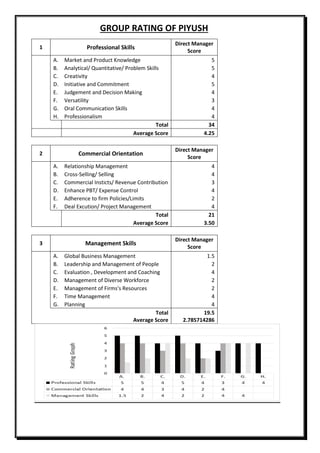
GROUP RATING OF PIYUSH
1 Professional Skills
Direct Manager
Score
A. Market and Product Knowledge 5
B. Analytical/ Quantitative/ Problem Skills 5
C. Creativity 4
D. Initiative and Commitment 5
E. Judgement and Decision Making 4
F. Versatility 3
G. Oral Communication Skills 4
H. Professionalism 4
Total 34
Average Score 4.25
2 Commercial Orientation
Direct Manager
Score
A. Relationship Management 4
B. Cross-Selling/ Selling 4
C. Commercial Insticts/ Revenue Contribution 3
D. Enhance PBT/ Expense Control 4
E. Adherence to firm Policies/Limits 2
F. Deal Excution/ Project Management 4
Total 21
Average Score 3.50
3 Management Skills
Direct Manager
Score
A. Global Business Management 1.5
B. Leadership and Management of People 2
C. Evaluation , Development and Coaching 4
D. Management of Diverse Workforce 2
E. Management of Firms's Resources 2
F. Time Management 4
G. Planning 4
Total 19.5
Average Score 2.785714286
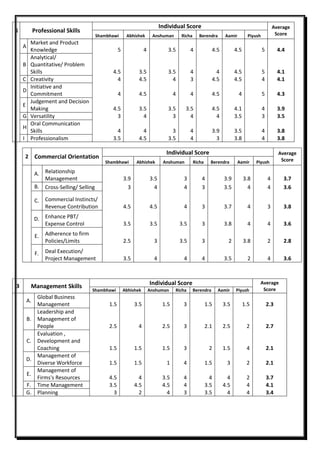
1 Professional Skills
Individual Score Average
ScoreShambhawi Abhishek Anshuman Richa Berendra Aamir Piyush
A
Market and Product
Knowledge 5 4 3.5 4 4.5 4.5 5 4.4
B
Analytical/
Quantitative/ Problem
Skills 4.5 3.5 3.5 4 4 4.5 5 4.1
C Creativity 4 4.5 4 3 4.5 4.5 4 4.1
D
Initiative and
Commitment 4 4.5 4 4 4.5 4 5 4.3
E
Judgement and Decision
Making 4.5 3.5 3.5 3.5 4.5 4.1 4 3.9
G Versatility 3 4 3 4 4 3.5 3 3.5
H
Oral Communication
Skills 4 4 3 4 3.9 3.5 4 3.8
I Professionalism 3.5 4.5 3.5 4 3 3.8 4 3.8
3 Management Skills Individual Score Average
ScoreShambhawi Abhishek Anshuman Richa Berendra Aamir Piyush
A.
Global Business
Management 1.5 3.5 1.5 3 1.5 3.5 1.5 2.3
B.
Leadership and
Management of
People 2.5 4 2.5 3 2.1 2.5 2 2.7
C.
Evaluation ,
Development and
Coaching 1.5 1.5 1.5 3 2 1.5 4 2.1
D.
Management of
Diverse Workforce 1.5 1.5 1 4 1.5 3 2 2.1
E.
Management of
Firms's Resources 4.5 4 3.5 4 4 4 2 3.7
F. Time Management 3.5 4.5 4.5 4 3.5 4.5 4 4.1
G. Planning 3 2 4 3 3.5 4 4 3.4
2 Commercial Orientation
Individual Score Average
ScoreShambhawi Abhishek Anshuman Richa Berendra Aamir Piyush
A. Relationship
Management 3.9 3.5 3 4 3.9 3.8 4 3.7
B. Cross-Selling/ Selling 3 4 4 3 3.5 4 4 3.6
C. Commercial Instincts/
Revenue Contribution 4.5 4.5 4 3 3.7 4 3 3.8
D. Enhance PBT/
Expense Control 3.5 3.5 3.5 3 3.8 4 4 3.6
E. Adherence to firm
Policies/Limits 2.5 3 3.5 3 2 3.8 2 2.8
F. Deal Execution/
Project Management 3.5 4 4 4 3.5 2 4 3.6
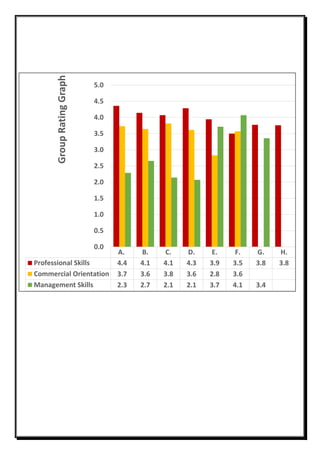
A. B. C. D. E. F. G. H.
Professional Skills 4.4 4.1 4.1 4.3 3.9 3.5 3.8 3.8
Commercial Orientation 3.7 3.6 3.8 3.6 2.8 3.6
Management Skills 2.3 2.7 2.1 2.1 3.7 4.1 3.4
0.0
0.5
1.0
1.5
2.0
2.5
3.0
3.5
4.0
4.5
5.0
GroupRatingGraph

Rob Parson At Morgan Stanley

  • 1.
    MORGAN STANLEY Investment Banking SUBMITTEDBY : ABHISHEK SINGH ANSHUMAN SAXENA BERENDRA SINGH MOHD. AAMIR PIYUSH KUMAR RICHA SHRIYA SHAMBHAWI NANDA
  • 2.
    Acknowledgement We would liketo express our special thanks of gratitude to our professor Dr. Vasudha Sharma. For her valuable guidance, encouragement and cooperation in the research assignment work. We are immensely grateful of her for giving us the opportunity to work on such interesting case study. The completion of this research assignment report is the result of valuable suggestion and keen interest of Dr. Vasudha Sharma (Professor of Doon Business School). With sincere thanks Abhishek Singh Anshuman Saxena Berendra Singh Bankoti Mohd. Aamir Piyush Kumar Richa Shriya Shambhawi Nanda
  • 3.
    Content  INTRODUCTION OFTHE COMPANY-MORGAN STANLEY  SUMMARY OF THE CASE STUDY  PROBLEM STATEMENT  MISSION & VISION OF THE COMPANY  SWOT ANALYSIS OF ROB PARSON  SWOT ANALYSIS OF PAUL NASR  LEADERSHIP TRAITS OF PAUL NASR  LEADERSHIP TRAITS OF ROB PARSON  MINTZBERGS MANAGERIAL ROLE  WHO IS A STAR PERFORMER?  WHY WAS ROB PARSON A STAR PERFORMER  FEEDBACK  IMPORTANCE OF FEEDBACK  360 DEGREE APPRAISAL  SHOUL ROB PARSON BE PROMTED OR NOT?  GROUP RATINGS WITH GRAPH
  • 4.
    ABOUT MORGAN STANLEY organStanley is an American multinational financial services corporation headquartered in the Morgan Stanley Building, Midtown Manhattan, New York City. Morgan Stanley operates in 24 countries and has more than 1300 offices and 60,000 employees. According to the Scorpio Partnership Global Private Banking Benchmark, the company had $1.454 trillion of assets under management (AUM) in 2014. The corporation, formed by J.P. Morgan & Co. partners Henry S. Morgan (grandson of J.P. Morgan), Harold Stanley and others, came into existence on September 16, 1935, in response to the Glass-Steagall Act that required the splitting of commercial and investment banking businesses. In its first year the company operated with a 24% market share (US$1.1 billion) in public offerings and private placements. The main areas of business for the firm today are Global Wealth Management, Institutional Securities, and Investment Management. M
  • 5.
    SUMMARY OF THECASE STUDY hroughout his ten years of experience Rob parson had built strong relationships with the important players in the banking and insurance industries. He knew that he had acquired a strong reputation, yet when he was approached by Nasr to join Morgan Stanley, he was initially sceptical. Parson started college at one of the New York state universities. Somewhat of a rebel, he dropped out after a year and went to California, spending his last ten year running a moped shop on a beach near Los Angeles. Bored, he decided to go back to school and enrolled at California State University, Long beach. After completing his undergraduate degree he went to the University of Southern California and did a 2-year MBA program in a year, “just to get it over with.” Paul Nasr was offered a job and parson accepted the job and joined Morgan Stanley as a market coverage professional in the capital markets division focusing on financial institutions. He was assigned the title “Principal” with the understanding that if he did a good job him would be on the fast track to managing director. The position that Parson was hired to fill had a reputation for being notoriously difficult to perform and had seen a tremendous amount of turnover at Morgan Stanley. Parson knew the position would be challenging; however, as he reported in his self-evaluation, he initially underestimated the magnitude of the challenge. He didn’t have time to build consensus around what he wanted to do. He thought that he knew more about his industry and had better market knowledge than the (Morgan Stanley) people around him. And clients in T
  • 6.
    his sector wantedanswers in a matter of minutes rather than hours. The Morgan Stanley way was to build consensus. If he waited for consensus, the business would have been transacted away. So basically Rob goes from point A to point B within the time frame that the client has imposed, fulfils the client’s demand, but in the meantime has broken every rule within Morgan Stanley to get there. So, people say, Wow, this guy is not following procedure. We work as a community, not individually.
  • 7.
    PROBLEM STATEMENT The problemin the case study is that whether to promote Rob parson or not which lies in the hands of Paul Nasr as he has to take the decision to recommend rob parson for the promotion of managing director. The root cause of the issue was the difference between the thought process of rob parson and corporate culture of the company. This decision has to be taken by Paul Nasr who promised Rob parson to make him Managing director, so he has to take fair decision.
  • 8.
    MISSION & VISIONOF THE COMPANY VISION “ONE FIRM FIRM” Means ‘Talent & Passion of People are Critical to Success. Collectively, We Share a Common Set of Values Rooted in Integrity & Excellence’. MISSION “Our goal is to be world best investment bank and firm of choice for our clients, our people, and our shareholders” Means ‘Win in the Marketplace, Think Like an Owner, Keep Your Balance, Put Client First & Leads with Integrity’.
  • 9.
    SWOT ANALYSIS OFROB PARSON STRENGTHS:  10 year experience in Investment banking and insurance industries.  Strong Interpersonal skills outside organization.  Excellent negotiating skills with his clients.  Good decision maker and high knowledge and expertise of market.  High repo with clients and Challenge accepting person. WEAKNESS:  Poor Interpersonal skills inside the organization.  Not comfortable to adjust with Morgan Stanley culture.  Lack of team player skills and his Ego and Arrogance.  He Values his own interest and needs. OPPORTUNITY:  To become Managing Director of Morgan Stanley.  To become the most important player in Morgan Stanley. THREATS:  Hostile environment around him.  Not follow company’s “ONE FIRM FIRM” vision.  Do not appreciate his colleagues work and ignoring behaviour towards them.  Violate rules and regulations of Morgan Stanley.
  • 10.
    SWOT ANALYSIS OFPAULNASR STRENGTHS:  20 years of past experience.  Highly regarded banker.  Good in building formidable capital market business. WEEKNESS:  Less experience in Morgan Stanley  Always treated Rob Parson gently with kid gloves.  Never give right feedback to Rob Parson at right time. OPPORTUNITY:  Leadership in Morgan Stanley.  Delivering the CMS to banks and insurance industries. THREAT:  Fear of losing Rob Parson.  Fear of group members that Nasr is always protecting Rob Parson.
  • 11.
    Leadership traits ofRob parson  Energetic & Enthusiastic: Rob Parson was young energetic & enthusiastic banker with 10 Year market experience.  Deep knowledge: He was having deep knowledge of market and perfectly knows how to implement it.  Emotional Intelligence: He was emotionally intelligence towards his clients due to which he build a very healthy relations with his clients and was able to tap business. But not with his colleagues.  Problem Solving: He identifies the problem with the client and create a solution for that.  Decision Making: He took various decisions of his own to bring the business which lead to break eggs in Morgan Stanley.
  • 12.
    Leadership traits ofRob parson  Flexibility: Due to which he was able to adjust himself in any Organization according to their culture.  Empathy: He uses this skill well in his life and was able to manage & work with people like Parson and with all other employees who don’t like Parson as well. But both people like Paul.  Problem Solving: He identifies the problem inside the Organization and brought Parson as a solution.  Risk Taking ability: He knew about Parson everything and knew it better that he will do things like his own way, but he took risk.  Decision Making: Decision taken by him was right no doubt as the revenue increases and the Organization moves to 3rd position in ranking.
  • 13.
  • 14.
    WHO IS ASTAR PERFORMER? • Star performer is always game changer • Its easy to see their efforts by others but they don’t know how their daily effort contributing to create success. • Basic traits of star performer are Pioneer Self confidence Emotional intelligence
  • 15.
    WHY WAS ROBPARSON A STAR PERFORMER  His track record and performance were outstanding and untouchable. He made strong relationship with the important players in the market.  He always took initiative and he focused high on his tasks for accomplishing the set target.  Rob Parson was the only person recruited by Paul Nasr. Nasr has 20 year experience and he worked a lot with person and he knew the ability, capacity, knowledge of Rob as he worked with him previously that is the reason he recruited Rob Parson.  He had high knowledge and expertise in his field.  He has amazing decision making sense. He accept challenges and comes up with solution on his own.  He has generated high revenue for Morgan Stanley within one year of his joining and took the company from 10th to 3rd rank.  He was excellent in interpersonal skills with his clients. Nasr said about Rob’s client relationship skill that he is the most wonderful guy with his clients and they love him. In his client’s view he was most amusing, entertaining, and interesting people to be with it.  He had deep insight knowledge of market which others might not have. He knew how to fetch the business from the market.  He go out to his client situation where there is no business and create a deal that might not happen if he do not go. In other words, he create needs for his clients and pursuit business for Morgan Stanley.  He was star performer because he is scarce person i.e. Non- substitute for Morgan Stanley
  • 16.
    FEEDBACK Feedback • It isa two way process. • It may be positive and negative. • It interpreted in terms of performance The more you listen, the better feedback you may give. The majority of employee prefer corrective feedback to praise and recognition. According to survey of 900 employees 57% respondents prefer corrective (negative) feedback and 43% prefer praise or recognition.
  • 17.
    IMPORTANCE OF FEEDBACK •Decision making- Every day we face multiple of choice but it become easy to take decision by concerning feedback. • Improve performance-It require both specific feedback and specific goal.it is helpful in improving long term performance. Sometime manager encourage employee to work hard by giving feedback. • Continue learning-feedback is easily understood and applied to future performance. It helps to enhance whether an individual, Group, business Unit Company or organization. It also allows us to build and maintain communication with others.
  • 18.
    360 DEGREE APPRAISAL Itis a system or process in which employees receives confidential, anonymous feedback from the people who work around them. This includes employee’s manager, peers and direct report.  Process of performance appraisal Establish a file Provide Regular Feedback Discipline Issues Management by objectives Conduct the performance appraisal Follow up action Performance Appraisal Its Refers Performance Review Performance Evaluation Development Discussion by which the job Performance of an employee is documented and evaluated.
  • 19.
    SHOUL ROB PARSONBE PROMTED OR NOT? YES ,as per our group decided after analysing the case study of rob parson at Morgan Stanley there should promote rob parson to the Managing director. WHY? There are some reasons why we have decided to promote Rob parson : Having a great experience how to fetch business as an entrepreneur, innovative, passionate, enthusiastic, game changer, negotiator, amazing liasioning skills, qualities his outstanding performance in every field makes a huge difference from other. Disturbance handler, an amazing quality to generate need to their clients, when we talk about leadership qualities of an M.D. As per Mintzberg managerial role most of the qualities which is needed as a leader he was fit in most of the qualities. How he handle their client by maintaining unforgettable relationship with them by which we can see that his interpersonal skill was also good. But never feel to show it into the organization.
  • 20.
    GROUP RATING ofSHAMBHAWI Professional Skills Direct Manager Score A. Market and Product Knowledge 5 B. Analytical/ Quantitative/ Problem Skills 4.5 C. Creativity 4 D. Initiative and Commitment 4 E. Judgement and Decision Making 4.5 F. Versatility 3 G. Oral Communication Skills 4 H. Professionalism 3.5 Total 32.5 Average Score 4.06 Commercial Orientation Direct Manager Score A. Relationship Management 3.9 B. Cross-Selling/ Selling 3 C. Commercial Insticts/ Revenue Contribution 4.5 D. Enhance PBT/ Expense Control 3.5 E. Adherence to firm Policies/Limits 2.5 F. Deal Execution/ Project Management 3.5 Total 20.9 Average Score 3.48 Management Skills Direct Manager Score A. Global Business Management 1.5 B. Leadership and Management of People 2.5 C. Evaluation , Development and Coaching 1.5 D. Management of Diverse Workforce 1.5 E. Management of Firm's Resources 4.5 F. Time Management 3.5 G. Planning 3 Total 18 Average Score 2.571428571
  • 21.
    GROUP RATING OFABHISHEK 1 Professional Skills Direct Manager Score A. Market and Product Knowledge 4 B. Analytical/ Quantitative/ Problem Skills 3.5 C. Creativity 4.5 D. Initiative and Commitment 4.5 E. Judgement and Decision Making 3.5 F. Versatility 4 G. Oral Communication Skills 4 H. Professionalism 4.5 Total 32.5 Average Score 4.06 2 Commercial Orientation Direct Manager Score A. Relationship Management 3.5 B. Cross-Selling/ Selling 4 C. Commercial Insticts/ Revenue Contribution 4.5 D. Enhance PBT/ Expense Control 3.5 E. Adherence to firm Policies/Limits 3 F. Deal Excution/ Project Management 4 Total 22.5 Average Score 3.75 3 Management Skills Direct Manager Score A. Global Business Management 3.5 B. Leadership and Management of People 4 C. Evaluation , Development and Coaching 1.5 D. Management of Diverse Workforce 1.5 E. Management of Firms's Resources 4 F. Time Management 4.5 G. Planning 2 Total 21 Average Score 3
  • 22.
    GROUP RATING OFANSHUMAN 1 Professional Skills Direct Manager Score A. Market and Product Knowledge 3.5 B. Analytical/ Quantitative/ Problem Skills 3.5 C. Creativity 4 D. Initiative and Commitment 4 E. Judgement and Decision Making 3.5 F. Versatility 3 G. Oral Communication Skills 3 H. Professionalism 3.5 Total 28 Average Score 3.50 2 Commercial Orientation Direct Manager Score A. Relationship Management 3 B. Cross-Selling/ Selling 4 C. Commercial Insticts/ Revenue Contribution 4 D. Enhance PBT/ Expense Control 3.5 E. Adherence to firm Policies/Limits 3.5 F. Deal Excution/ Project Management 4 Total 22 Average Score 3.67 3 Management Skills Direct Manager Score A. Global Business Management 1.5 B. Leadership and Management of People 2.5 C. Evaluation , Development and Coaching 1.5 D. Management of Diverse Workforce 1 E. Management of Firms's Resources 3.5 F. Time Management 4.5 G. Planning 4 Total 18.5 Average Score 2.642857143
  • 23.
    GROUP RATING OFRICHA 1 Professional Skills Direct Manager Score A. Market and Product Knowledge 4 B. Analytical/ Quantitative/ Problem Skills 4 C. Creativity 3 D. Initiative and Commitment 4 E. Judgement and Decision Making 3.5 F. Versatility 4 G. Oral Communication Skills 4 H. Professionalism 4 Total 30.5 Average Score 3.81 2 Commercial Orientation Direct Manager Score A. Relationship Management 4 B. Cross-Selling/ Selling 3 C. Commercial Insticts/ Revenue Contribution 3 D. Enhance PBT/ Expense Control 3 E. Adherence to firm Policies/Limits 3 F. Deal Excution/ Project Management 4 Total 20 Average Score 3.33 3 Management Skills Direct Manager Score A. Global Business Management 3 B. Leadership and Management of People 3 C. Evaluation , Development and Coaching 3 D. Management of Diverse Workforce 4 E. Management of Firms's Resources 4 F. Time Management 4 G. Planning 3 Total 24 Average Score 3.43
  • 24.
    GROUP RATING OFBERENDRA 1 Professional Skills Direct Manager Score A. Market and Product Knowledge 4.5 B. Analytical/ Quantitative/ Problem Skills 4 C. Creativity 4.5 D. Initiative and Commitment 4.5 E. Judgement and Decision Making 4.5 F. Versatility 4 G. Oral Communication Skills 3.9 H. Professionalism 3 Total 32.9 Average Score 4.11 2 Commercial Orientation Direct Manager Score A. Relationship Management 3.9 B. Cross-Selling/ Selling 3.5 C. Commercial Insticts/ Revenue Contribution 3.7 D. Enhance PBT/ Expense Control 3.8 E. Adherence to firm Policies/Limits 2 F. Deal Excution/ Project Management 3.5 Total 20.4 Average Score 3.40 3 Management Skills Direct Manager Score A. Global Business Management 1.5 B. Leadership and Management of People 2.1 C. Evaluation , Development and Coaching 2 D. Management of Diverse Workforce 1.5 E. Management of Firms's Resources 4 F. Time Management 3.5 G. Planning 3.5 Total 18.1 Average Score 2.59
  • 25.
    GROUP RATING OFAAMIR 1 Professional Skills Direct Manager Score A. Market and Product Knowledge 4.5 B. Analytical/ Quantitative/ Problem Skills 4.5 C. Creativity 4.5 D. Initiative and Commitment 4 E. Judgement and Decision Making 4.1 F. Versatility 3.5 G. Oral Communication Skills 3.5 H. Professionalism 3.8 Total 32.4 Average Score 4.05 2 Commercial Orientation Direct Manager Score A. Relationship Management 3.8 B. Cross-Selling/ Selling 4 C. Commercial Insticts/ Revenue Contribution 4 D. Enhance PBT/ Expense Control 4 E. Adherence to firm Policies/Limits 3.8 F. Deal Excution/ Project Management 2 Total 21.6 Average Score 3.60 3 Management Skills Direct Manager Score A. Global Business Management 3.5 B. Leadership and Management of People 2.5 C. Evaluation , Development and Coaching 1.5 D. Management of Diverse Workforce 3 E. Management of Firms's Resources 4 F. Time Management 4.5 G. Planning 4 Total 23 Average Score 3.285714286
  • 26.
    GROUP RATING OFPIYUSH 1 Professional Skills Direct Manager Score A. Market and Product Knowledge 5 B. Analytical/ Quantitative/ Problem Skills 5 C. Creativity 4 D. Initiative and Commitment 5 E. Judgement and Decision Making 4 F. Versatility 3 G. Oral Communication Skills 4 H. Professionalism 4 Total 34 Average Score 4.25 2 Commercial Orientation Direct Manager Score A. Relationship Management 4 B. Cross-Selling/ Selling 4 C. Commercial Insticts/ Revenue Contribution 3 D. Enhance PBT/ Expense Control 4 E. Adherence to firm Policies/Limits 2 F. Deal Excution/ Project Management 4 Total 21 Average Score 3.50 3 Management Skills Direct Manager Score A. Global Business Management 1.5 B. Leadership and Management of People 2 C. Evaluation , Development and Coaching 4 D. Management of Diverse Workforce 2 E. Management of Firms's Resources 2 F. Time Management 4 G. Planning 4 Total 19.5 Average Score 2.785714286
  • 27.
    1 Professional Skills IndividualScore Average ScoreShambhawi Abhishek Anshuman Richa Berendra Aamir Piyush A Market and Product Knowledge 5 4 3.5 4 4.5 4.5 5 4.4 B Analytical/ Quantitative/ Problem Skills 4.5 3.5 3.5 4 4 4.5 5 4.1 C Creativity 4 4.5 4 3 4.5 4.5 4 4.1 D Initiative and Commitment 4 4.5 4 4 4.5 4 5 4.3 E Judgement and Decision Making 4.5 3.5 3.5 3.5 4.5 4.1 4 3.9 G Versatility 3 4 3 4 4 3.5 3 3.5 H Oral Communication Skills 4 4 3 4 3.9 3.5 4 3.8 I Professionalism 3.5 4.5 3.5 4 3 3.8 4 3.8 3 Management Skills Individual Score Average ScoreShambhawi Abhishek Anshuman Richa Berendra Aamir Piyush A. Global Business Management 1.5 3.5 1.5 3 1.5 3.5 1.5 2.3 B. Leadership and Management of People 2.5 4 2.5 3 2.1 2.5 2 2.7 C. Evaluation , Development and Coaching 1.5 1.5 1.5 3 2 1.5 4 2.1 D. Management of Diverse Workforce 1.5 1.5 1 4 1.5 3 2 2.1 E. Management of Firms's Resources 4.5 4 3.5 4 4 4 2 3.7 F. Time Management 3.5 4.5 4.5 4 3.5 4.5 4 4.1 G. Planning 3 2 4 3 3.5 4 4 3.4 2 Commercial Orientation Individual Score Average ScoreShambhawi Abhishek Anshuman Richa Berendra Aamir Piyush A. Relationship Management 3.9 3.5 3 4 3.9 3.8 4 3.7 B. Cross-Selling/ Selling 3 4 4 3 3.5 4 4 3.6 C. Commercial Instincts/ Revenue Contribution 4.5 4.5 4 3 3.7 4 3 3.8 D. Enhance PBT/ Expense Control 3.5 3.5 3.5 3 3.8 4 4 3.6 E. Adherence to firm Policies/Limits 2.5 3 3.5 3 2 3.8 2 2.8 F. Deal Execution/ Project Management 3.5 4 4 4 3.5 2 4 3.6
  • 28.
    A. B. C.D. E. F. G. H. Professional Skills 4.4 4.1 4.1 4.3 3.9 3.5 3.8 3.8 Commercial Orientation 3.7 3.6 3.8 3.6 2.8 3.6 Management Skills 2.3 2.7 2.1 2.1 3.7 4.1 3.4 0.0 0.5 1.0 1.5 2.0 2.5 3.0 3.5 4.0 4.5 5.0 GroupRatingGraph