PROCTER & GAMBLE CO.Case Analysis
Prepared by : Rishabh Gupta
RCOEM
1
BRIEF INTRODUCTION
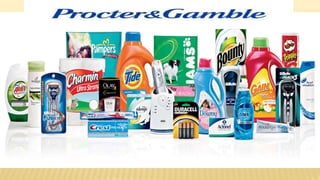
The Procter & Gamble Company (P&G) boasts boatloads of brands. The
world's top maker of household products courts market share and billion-dollar
names. It's divided into three global units: household care, beauty and grooming,
and health and well-being. The firm also makes pet food and water filters and
produces a soap opera. Two dozen of P&G's brands are billion-dollar sellers,
including Febreze, Fusion, Always, Braun, Bounty, Charmin, Crest, Downy/Lenor,
Gillette, Iams, Olay, Pampers, Pantene, Tide, and Wella, among others. P&G shed
its coffee in 2008 and it's selling Pringles. Being the acquisitive type, with Clairol and
Wella as notable conquests, P&G's biggest buy in company history was Gillette in
2005.
3
P&G HISTORY: A LEGEND OF FIRSTS1837 Brothers-in-law William Procter and James Gamble start a partnership, making and selling candles
and soap in Cincinnati
1859 P&G sales reach $1 million
1879 The inexpensive, but high-quality Ivory soap is introduced
1924 P&G is one of the first to create a market research department to study consumer preferences and
buying habits
1955 Crest, the first toothpaste with fluoride clinically proven to fight cavities, is introduced
1961 Pampers is introduced and eventually replaces cloth diapers
1980 Sales reach $10 billion
2002 P&G develops Naturally feminine pads specifically to meet the needs of low-income women in Latin
America.
2005 High Frequency Stores, Consisting of nearly 20 million stores across the world, FS represents a
particular opportunity in fast-growing low income markets.
Today P&G operates in 80 countries worldwide, employing more than 100,000.
Has 13 billion dollar brands in its portfolio: Charmin, Tide, Pantene, Iams, Folgers, Crest, Olay,
Always, Ariel, Bounty, Downy, Pringles, Pampers.
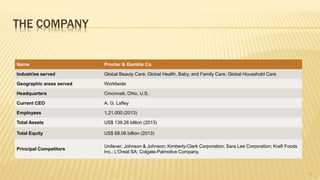
THE COMPANY
Name Procter & Gamble Co.
Industries served Global Beauty Care; Global Health, Baby, and Family Care; Global Household Care
Geographic areas served Worldwide
Headquarters Cincinnati, Ohio, U.S.
Current CEO A. G. Lafley
Employees 1,21,000 (2013)
Total Assets US$ 139.26 billion (2013)
Total Equity US$ 68.06 billion (2013)
Principal Competitors
Unilever; Johnson & Johnson; Kimberly-Clark Corporation; Sara Lee Corporation; Kraft Foods
Inc.; L'Oreal SA; Colgate-Palmolive Company.
5
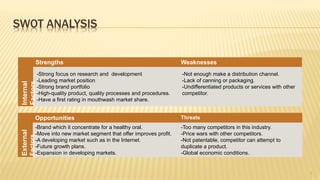
SWOT ANALYSISInternal
Factors
Strengths Weaknesses
-Strong focus on research and development
-Leading market position
-Strong brand portfolio
-High-quality product, quality processes and procedures.
-Have a first rating in mouthwash market share.
-Not enough make a distribution channel.
-Lack of canning or packaging.
-Undifferentiated products or services with other
competitor.
7
External
Factors
Opportunities Threats
-Brand which it concentrate for a healthy oral.
-Move into new market segment that offer improves profit.
-A developing market such as in the Internet.
-Future growth plans.
-Expansion in developing markets.
-Too many competitors in this industry.
-Price wars with other competitors.
-Not patentable, competitor can attempt to
duplicate a product.
-Global economic conditions.
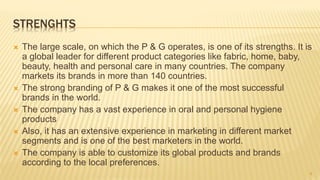
STRENGHTS
 The large scale, on which the P & G operates, is one of its strengths. It is
a global leader for different product categories like fabric, home, baby,
beauty, health and personal care in many countries. The company
markets its brands in more than 140 countries.
 The strong branding of P & G makes it one of the most successful
brands in the world.
 The company has a vast experience in oral and personal hygiene
products
 Also, it has an extensive experience in marketing in different market
segments and is one of the best marketers in the world.
 The company is able to customize its global products and brands
according to the local preferences.
8
WEAKNESSES
 The beauty and health products by P & G are mostly for
women.
 P & G does not make and offer any private label products for
the retail customers and is, missing an opportunity.
 The large scale operation of the company makes the culture
heavy and processes slow. This also leads to quality control
problems.
9
OPPORTUNITIES
 An opportunity for P & G is health and beauty products for
men.
 P & G has doubled its Environmental Goals for the year 2012
and thus, promises more value for the environment
concerned customers today.
 Using the online social networks and internet marketing
techniques is also an opportunity for P & G.
 Company is constantly trying to pursue growth overseas.
10
THREATS
 The competitors are making their product portfolios diverse
day by day and using different marketing and promotional
strategies to increase their market share.
 In the market many substitutes are available for P & G
products at cheaper prices.
 The private label growth is also a serious threat to the P &
G’s market share.
11
INDIA
 P&G is one of the largest and fastest growing
consumer goods companies in India.
 Established in 1964, P&G India now serves
over 650 million consumers across India.
Ambi Pur
Ariel
Duracell
Gillette
Head & Shoulders
Olay
Oral-B
Pampers
Pantene
Tide
Vicks
Wella
Whisper
 Its presence pans across the Beauty segment, the Household Care
segment as well as the Health care segment, with trusted brands
that are household names across India.
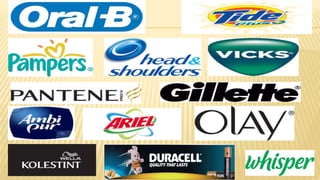
 These include Vicks, Ariel, Tide, Whisper, Olay, Gillette, Ambipur,
Pampers, Pantene, Oral-B, Head & Shoulders, Wella and Duracell.
BRANDS
PRODUCTIONS
 Procter & Gamble produced and sponsored the first radio
soap operas in the 1930s.
 Procter & Gamble also was the first company to produce
and sponsor a prime-time show.
ONLINE MARKETING
 The company has actively developed or sponsored
numerous online
communities, i.e. BeingGirl.com(launched in
2000),Women.com.
 As of 2000, the company had 72 "highly stylized
destination sites
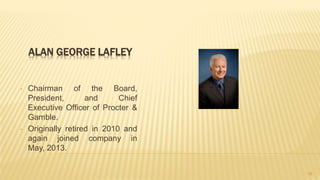
ALAN GEORGE LAFLEY
• Chairman of the Board,
President, and Chief
Executive Officer of Procter &
Gamble.
• Originally retired in 2010 and
again joined company in
May, 2013.
18
ABOUT A G LAFLEY
 A. G. Lafley describes himself a leader with high expactations and heart.
And he relies heavily on managers’ inputs as he develops new plans.
 Lafley was recently named one of America’s Best Leaders by
Harwards’s Kennedy School of Government & U.S. News & World
Report.
 Proctor & Gamble has had an amazing turn around under his
direction.He believes that his company’s planning and strategy will
succeed if he has his workers behind him.
 He says “They want to feel your commitment, and of course they want to
understand that the choice you’ve made is smart, rational, and will work.”
19
HOW LAFLEY PREDICTS FUTURE
 Lafley noted the importance of growth as a strategy.
 Instead of maintaining old growth, P&G must carefully move into
related markets and literally create new categories of business.
 To accomplish that goal requires innovation –in thinking, in
developing new products, and in marketing them.
 “So the name of the game is innovation” says Lafley, “We work
really hard to try to turn innovation into a strategy and a process
that’s a little more consistent, a little more reliable, so that we can
build a portfolio of innovations and get the yield we need to get
that $6 billion or $7 billion a year.”
20
LOGO
“CONNECT AND DEVELOP”
 Launching new products requires careful planning at all levels –strategic,
tactical, and operational.
 Lafley orchestrated a major shift in the way firm develoeped new
products.
 Instead of relying solely on a complex, bureaucratic research and
development organization, P&G now uses a new approach called
“Connect & Develop.”
 It is based on ideas P&G should gather and learn from innovations and
technologies that exists outside the company’s wall.
 All activities are aligned to create products that consumers want to use.
 Olay regenerist anti-aging products, Crest spinbrush toothbrush are the
yield of connect & develop programme.
22
23
ASSESSING OUTCOMES AND SEIZING OPPORTUNITIES
 Historically the giant told consumers what they needed and wanted, but
now Lafley has shifted its focus directly on consumers and asks for their
input up front.
 This new outlook drives all of P&G’s planning and strategy, which
includes broadcasting commercials created by consumers and building
online communities dedicated to consumers’ favourite P&G products.
 “Most of [these] Experiment don’t work all the time, but we have to be
out there, trying.” says Lafley.
 Lafley endorses the idea of pleasantly surprising consumers this way-
catching their attention when they least expect it and offering an
immediate solution to a problem.
 Briefly, P&G has found that consumers will build the brands themselves.
CONCLUDING
 The intense competition in particular market drives
businesses to evaluate their policies and effectiveness
regularly. Each company has its own business characteristic,
which certain policy is suitable fit for a company while others
could be unacceptable.
 Under A. G. Lafley’s deriction Procter & Gamble changed its
outlook towards consumers and they are at the heights of
their success.
24
25

Proctergambleco 140423222346-phpapp02

  • 1.
    PROCTER & GAMBLECO.Case Analysis Prepared by : Rishabh Gupta RCOEM 1
  • 3.
    BRIEF INTRODUCTION The Procter& Gamble Company (P&G) boasts boatloads of brands. The world's top maker of household products courts market share and billion-dollar names. It's divided into three global units: household care, beauty and grooming, and health and well-being. The firm also makes pet food and water filters and produces a soap opera. Two dozen of P&G's brands are billion-dollar sellers, including Febreze, Fusion, Always, Braun, Bounty, Charmin, Crest, Downy/Lenor, Gillette, Iams, Olay, Pampers, Pantene, Tide, and Wella, among others. P&G shed its coffee in 2008 and it's selling Pringles. Being the acquisitive type, with Clairol and Wella as notable conquests, P&G's biggest buy in company history was Gillette in 2005. 3
  • 4.
    P&G HISTORY: ALEGEND OF FIRSTS1837 Brothers-in-law William Procter and James Gamble start a partnership, making and selling candles and soap in Cincinnati 1859 P&G sales reach $1 million 1879 The inexpensive, but high-quality Ivory soap is introduced 1924 P&G is one of the first to create a market research department to study consumer preferences and buying habits 1955 Crest, the first toothpaste with fluoride clinically proven to fight cavities, is introduced 1961 Pampers is introduced and eventually replaces cloth diapers 1980 Sales reach $10 billion 2002 P&G develops Naturally feminine pads specifically to meet the needs of low-income women in Latin America. 2005 High Frequency Stores, Consisting of nearly 20 million stores across the world, FS represents a particular opportunity in fast-growing low income markets. Today P&G operates in 80 countries worldwide, employing more than 100,000. Has 13 billion dollar brands in its portfolio: Charmin, Tide, Pantene, Iams, Folgers, Crest, Olay, Always, Ariel, Bounty, Downy, Pringles, Pampers.
  • 5.
    THE COMPANY Name Procter& Gamble Co. Industries served Global Beauty Care; Global Health, Baby, and Family Care; Global Household Care Geographic areas served Worldwide Headquarters Cincinnati, Ohio, U.S. Current CEO A. G. Lafley Employees 1,21,000 (2013) Total Assets US$ 139.26 billion (2013) Total Equity US$ 68.06 billion (2013) Principal Competitors Unilever; Johnson & Johnson; Kimberly-Clark Corporation; Sara Lee Corporation; Kraft Foods Inc.; L'Oreal SA; Colgate-Palmolive Company. 5
  • 7.
    SWOT ANALYSISInternal Factors Strengths Weaknesses -Strongfocus on research and development -Leading market position -Strong brand portfolio -High-quality product, quality processes and procedures. -Have a first rating in mouthwash market share. -Not enough make a distribution channel. -Lack of canning or packaging. -Undifferentiated products or services with other competitor. 7 External Factors Opportunities Threats -Brand which it concentrate for a healthy oral. -Move into new market segment that offer improves profit. -A developing market such as in the Internet. -Future growth plans. -Expansion in developing markets. -Too many competitors in this industry. -Price wars with other competitors. -Not patentable, competitor can attempt to duplicate a product. -Global economic conditions.
  • 8.
    STRENGHTS  The largescale, on which the P & G operates, is one of its strengths. It is a global leader for different product categories like fabric, home, baby, beauty, health and personal care in many countries. The company markets its brands in more than 140 countries.  The strong branding of P & G makes it one of the most successful brands in the world.  The company has a vast experience in oral and personal hygiene products  Also, it has an extensive experience in marketing in different market segments and is one of the best marketers in the world.  The company is able to customize its global products and brands according to the local preferences. 8
  • 9.
    WEAKNESSES  The beautyand health products by P & G are mostly for women.  P & G does not make and offer any private label products for the retail customers and is, missing an opportunity.  The large scale operation of the company makes the culture heavy and processes slow. This also leads to quality control problems. 9
  • 10.
    OPPORTUNITIES  An opportunityfor P & G is health and beauty products for men.  P & G has doubled its Environmental Goals for the year 2012 and thus, promises more value for the environment concerned customers today.  Using the online social networks and internet marketing techniques is also an opportunity for P & G.  Company is constantly trying to pursue growth overseas. 10
  • 11.
    THREATS  The competitorsare making their product portfolios diverse day by day and using different marketing and promotional strategies to increase their market share.  In the market many substitutes are available for P & G products at cheaper prices.  The private label growth is also a serious threat to the P & G’s market share. 11
  • 12.
    INDIA  P&G isone of the largest and fastest growing consumer goods companies in India.  Established in 1964, P&G India now serves over 650 million consumers across India. Ambi Pur Ariel Duracell Gillette Head & Shoulders Olay Oral-B Pampers Pantene Tide Vicks Wella Whisper
  • 13.
     Its presencepans across the Beauty segment, the Household Care segment as well as the Health care segment, with trusted brands that are household names across India.  These include Vicks, Ariel, Tide, Whisper, Olay, Gillette, Ambipur, Pampers, Pantene, Oral-B, Head & Shoulders, Wella and Duracell.
  • 15.
  • 16.
    PRODUCTIONS  Procter &Gamble produced and sponsored the first radio soap operas in the 1930s.  Procter & Gamble also was the first company to produce and sponsor a prime-time show.
  • 17.
    ONLINE MARKETING  Thecompany has actively developed or sponsored numerous online communities, i.e. BeingGirl.com(launched in 2000),Women.com.  As of 2000, the company had 72 "highly stylized destination sites
  • 18.
    ALAN GEORGE LAFLEY •Chairman of the Board, President, and Chief Executive Officer of Procter & Gamble. • Originally retired in 2010 and again joined company in May, 2013. 18
  • 19.
    ABOUT A GLAFLEY  A. G. Lafley describes himself a leader with high expactations and heart. And he relies heavily on managers’ inputs as he develops new plans.  Lafley was recently named one of America’s Best Leaders by Harwards’s Kennedy School of Government & U.S. News & World Report.  Proctor & Gamble has had an amazing turn around under his direction.He believes that his company’s planning and strategy will succeed if he has his workers behind him.  He says “They want to feel your commitment, and of course they want to understand that the choice you’ve made is smart, rational, and will work.” 19
  • 20.
    HOW LAFLEY PREDICTSFUTURE  Lafley noted the importance of growth as a strategy.  Instead of maintaining old growth, P&G must carefully move into related markets and literally create new categories of business.  To accomplish that goal requires innovation –in thinking, in developing new products, and in marketing them.  “So the name of the game is innovation” says Lafley, “We work really hard to try to turn innovation into a strategy and a process that’s a little more consistent, a little more reliable, so that we can build a portfolio of innovations and get the yield we need to get that $6 billion or $7 billion a year.” 20
  • 21.
  • 22.
    “CONNECT AND DEVELOP” Launching new products requires careful planning at all levels –strategic, tactical, and operational.  Lafley orchestrated a major shift in the way firm develoeped new products.  Instead of relying solely on a complex, bureaucratic research and development organization, P&G now uses a new approach called “Connect & Develop.”  It is based on ideas P&G should gather and learn from innovations and technologies that exists outside the company’s wall.  All activities are aligned to create products that consumers want to use.  Olay regenerist anti-aging products, Crest spinbrush toothbrush are the yield of connect & develop programme. 22
  • 23.
    23 ASSESSING OUTCOMES ANDSEIZING OPPORTUNITIES  Historically the giant told consumers what they needed and wanted, but now Lafley has shifted its focus directly on consumers and asks for their input up front.  This new outlook drives all of P&G’s planning and strategy, which includes broadcasting commercials created by consumers and building online communities dedicated to consumers’ favourite P&G products.  “Most of [these] Experiment don’t work all the time, but we have to be out there, trying.” says Lafley.  Lafley endorses the idea of pleasantly surprising consumers this way- catching their attention when they least expect it and offering an immediate solution to a problem.  Briefly, P&G has found that consumers will build the brands themselves.
  • 24.
    CONCLUDING  The intensecompetition in particular market drives businesses to evaluate their policies and effectiveness regularly. Each company has its own business characteristic, which certain policy is suitable fit for a company while others could be unacceptable.  Under A. G. Lafley’s deriction Procter & Gamble changed its outlook towards consumers and they are at the heights of their success. 24
  • 25.