Abnormal Uterine
Bleeding: New FIGO
Classification
MAHMOUD MELEIS, MD
Agenda
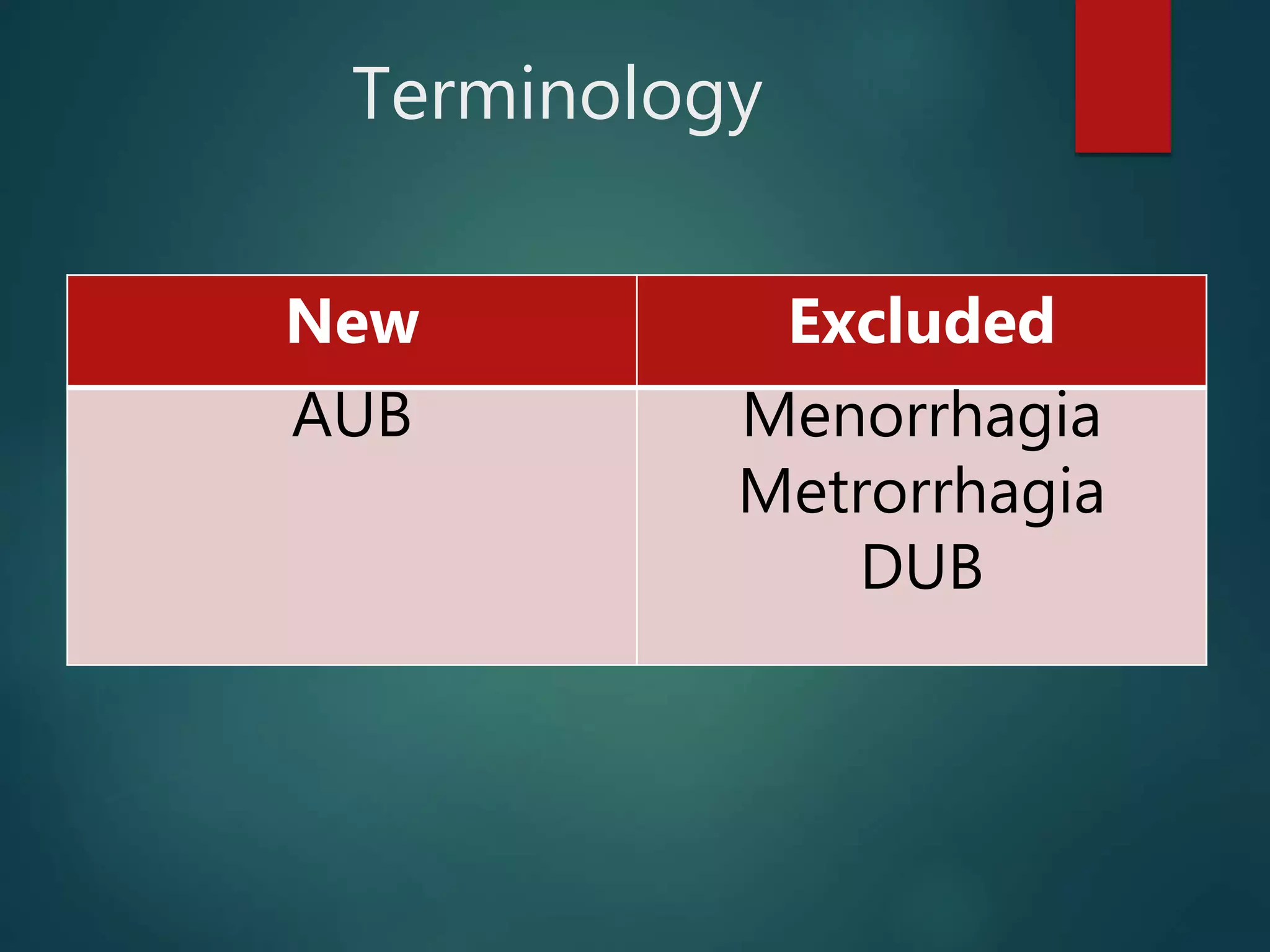
Terminology
New Excluded
AUB Menorrhagia
Metrorrhagia
DUB
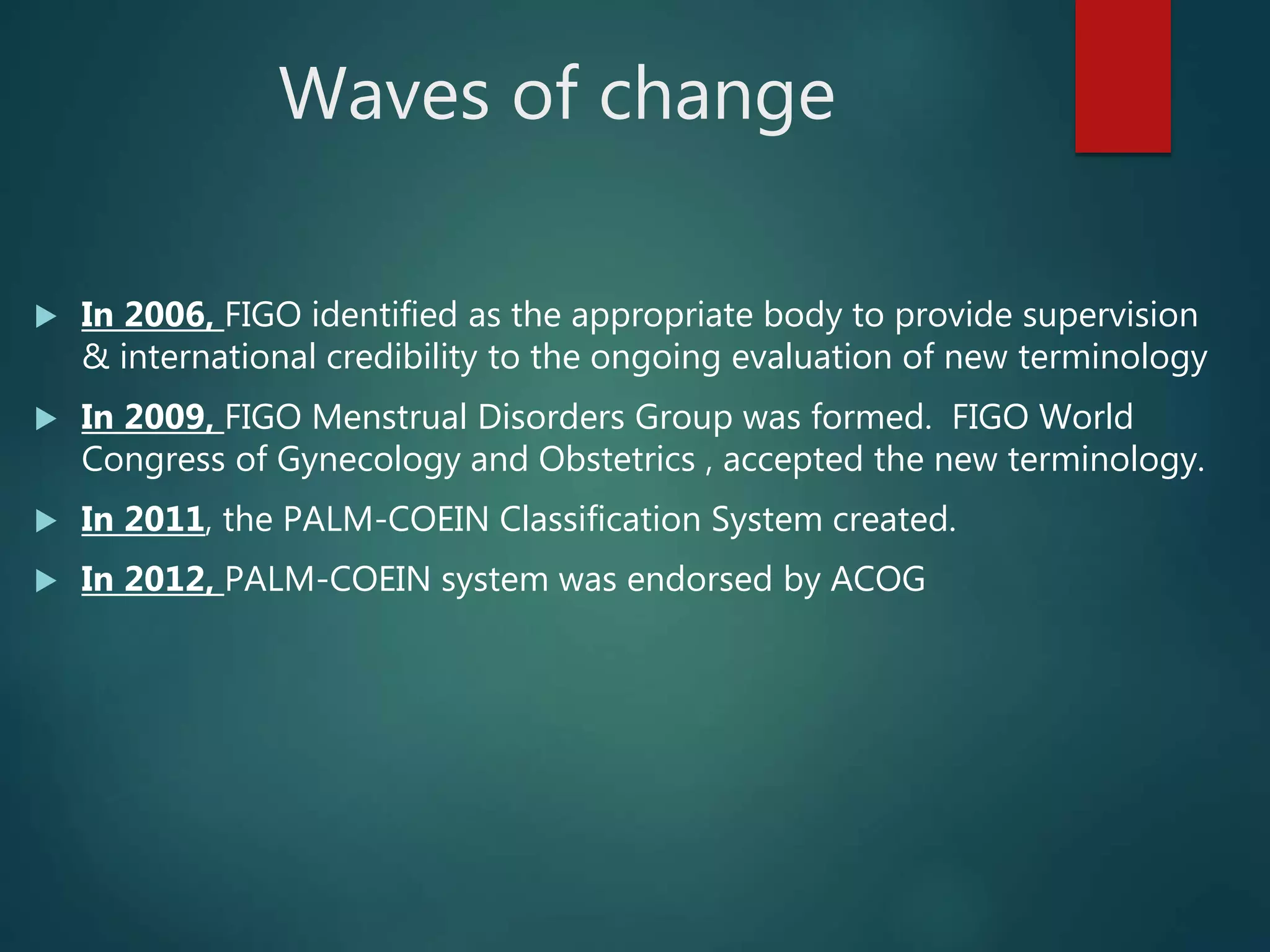
Waves of change
 In 2006, FIGO identified as the appropriate body to provide supervision
& international credibility to the ongoing evaluation of new terminology
 In 2009, FIGO Menstrual Disorders Group was formed. FIGO World
Congress of Gynecology and Obstetrics , accepted the new terminology.
 In 2011, the PALM-COEIN Classification System created.
 In 2012, PALM-COEIN system was endorsed by ACOG
Nomenclature & Classification of
AUB
AUB Validated Terminology
 AUB: Abnormal uterine bleeding
 Umbrella term for both regular and irregular bleeding
 HMB: Heavy menstrual bleeding
 Excessive menstrual bleeding
 IMB: Inter-menstrual bleeding
 Occurs between clearly defined cyclic and predictable menses
 Acute:
 Heavy bleeding that is of sufficient quantity to require immediate
intervention to prevent further blood loss
 Chronic:
 Heavy bleeding that is of sufficient quantity to require immediate
intervention to prevent further blood loss
AUB
Acute AUB
IMB HMB
Chronic
AUB
IMB HMB
 Chronic AUB;
 Bleeding from the uterine corpus that is abnormal in volume,
regularity and/or timing and has been present for the majority
the past 6 months
Menstrual parameters
Frequency
24-38 day
Frequent
Normal
Infrequent
Regularity
<20 D / 12 m
Absent
Regular
Irregular
Duration
4.5-8 days
Prolonged
Normal
Shortened
Volume
5-80 ml
Heavy
Normal
Light
Suggested “normal limits” for uterine bleeding in the mid-reproductive years
Munro MG. Rev Endocr Metab Disorder (2012) 13: 225-234
Structural Abnormalities
 P – Polyps – scored as Present or Absent
 A – Adenomyosis - scored as Present or Absent
 L – Leiomyoma
 Primary level – Present or Absent
 Secondary level – Distinguish between submucosal (SM) & others (O)
 Tertiary level – Detail location/size of uterine fibroids
 M – Malignancy & hyperplasia
AUB-P; Polyps (8-35 %)
 Diagnosis: US, SIS, hysteroscopy
 Further sub-classification: Dimensions, location & number
 Pre-menopausal polyps:
 64 – 88% have symptoms
 Present with HMB, AUB, IMB, or post-coital bleeding
 Symptoms do NOT correlate with number, diameter & site
 Post-menopausal polyps:
 Most are symptom free
 Cause for 21-28% of PMP bleeding
 Associated with cervical polyps in 24-27%
 Incidence of carcinoma varies between 0–4.8%
AUB-A; Adenomyosis
 Ectopic endometrial glands & stroma within the myometrium
 Hypertrophy & hyperplasia of surrounding myometrium
 Usual presentation: HMB, uterine enlargement, & dysmenorrhea
Adenomyosis
Linear Striations
80% PPV
71% Accurate
Heterogeneous
myometrium
81% PPV
69% Accurate
Sonographic findings of
Adenomyosis
Dueholm et al. Best Pract Res Clin Obstet Gynaecol 2006; 20: 569 82.
Color Doppler: vessels following normal
course through an indistinct mass
AUB-L; Leiomyoma
 1ry level: AUB-L
 2ry level:
 Submucosal – AUB-LSM
 Other – AUB-LO
 3ry level: Types 0-8
The three stage classification system for leiomyoma
AUB-M; Malignancy &
Hyperplasia
 Detected based upon results of office biopsy or curettage
 FIGO AUB Staged only as present or absent
 Use existing WHO and FIGO categorization
 Up to 40% of patients with a biopsy diagnosis of complex hyperplasia
with atypia will have a concomitant endometrial adenocarcinoma
present
Non-structural Abnormalities
 C – Coagulopathy
 O – Ovulatory Dysfunction
 E – Endometrial
 I – Iatrogenic
 N – Not yet classified
AUB-C; Coagulopathy
 Prevalence: 3% of women presenting with HMB
 Etiologies:
 Von Willebrand’s disease (10%)
 Platelet Dysfunction
 Factor XI deficiency
 Factor X deficiency
 Category includes patient’s taking anti-coagulants
Coagulopathy
History Screening
 HMB since menarche
 One of the following:
 PPH
 Surgical related bleeding
 Bleeding associated with dental work
 Two or more of the following:
 Bruising 1-2 times/month
 Epistaxis 1-2 times/ month
 Frequent gum bleeding
 Family history of bleeding symptoms
AUB-O; Ovulatory
Dysfunction
 Etiology:
 Polycystic Ovarian Syndrome (PCOS)
 Hypothyroidism
 Hyper-prolactinemia
 Mental stress
 Obesity
 Anorexia
 Weight loss
 Extreme exercise
 Adolescence
 Menopausal transition
AUB-E; Endometrial
 It is diagnosed by exclusion
 Etiology:
 Deficiencies of local production of vasoconstrictors
 Endothelin-1
 Prostaglandin F2a
 Excessive production of plasminogen activators
 Increased local production of vasodilators
 Prostaglandin E2
 Prostacyclin I2
 Disorders of endometrial repair (inflammation)
 Chlamydia
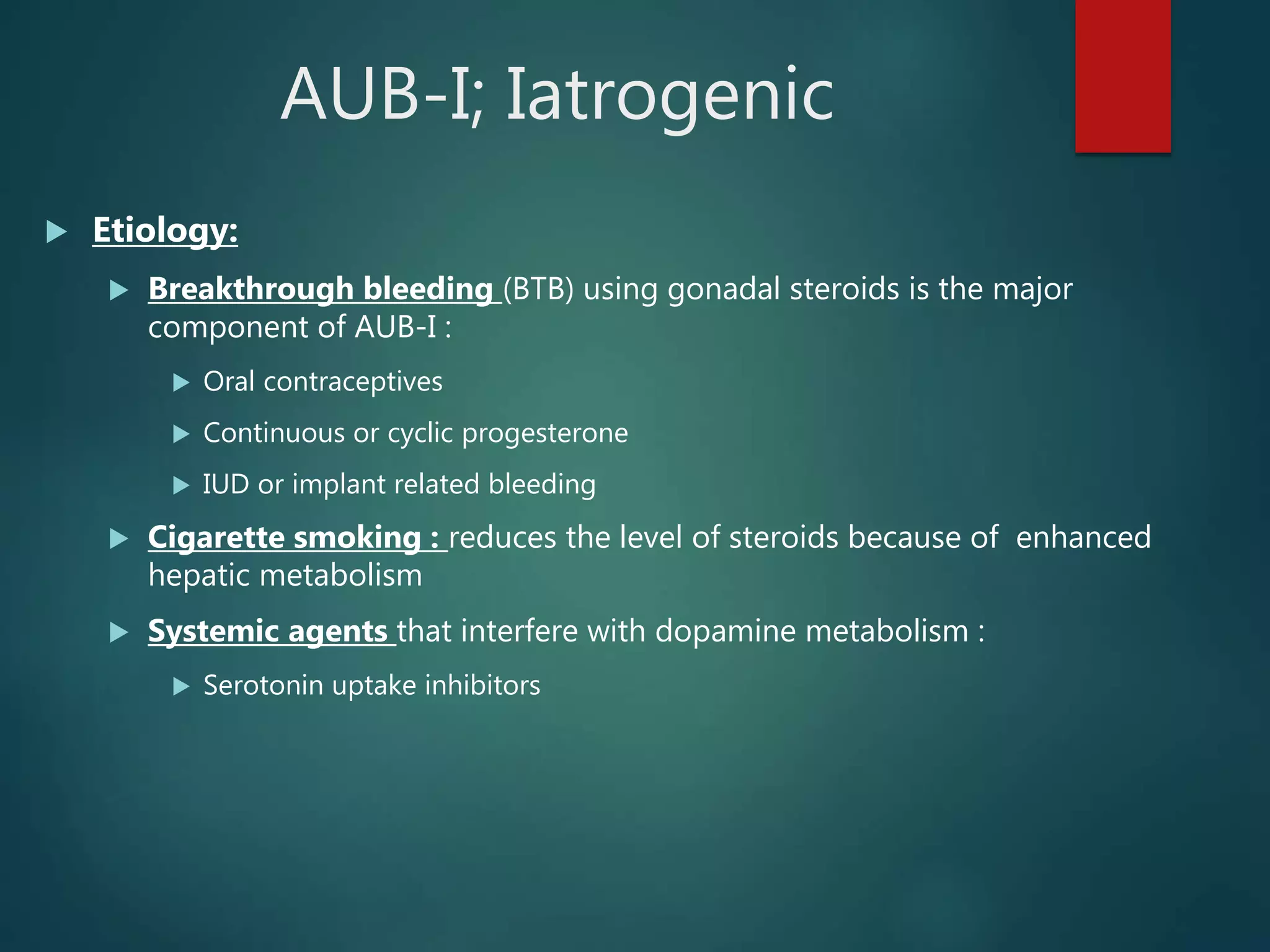
AUB-I; Iatrogenic
 Etiology:
 Breakthrough bleeding (BTB) using gonadal steroids is the major
component of AUB-I :
 Oral contraceptives
 Continuous or cyclic progesterone
 IUD or implant related bleeding
 Cigarette smoking : reduces the level of steroids because of enhanced
hepatic metabolism
 Systemic agents that interfere with dopamine metabolism :
 Serotonin uptake inhibitors
AUB-N; Not Yet Classified
 Disorders that would be identified or defined only by biochemical or
molecular biology assays
 Arterio-venous malformations
 Myometrial hypertrophy
 Category for new etiologies
 Pathological conditions of lower genital tract ??
Pathway overview
 When a woman presents with HMB :
 Take a proper history
 Decide whether the timing, amount of blood loss and/or duration of the
bleeding is out of the norm.
 Give it a name.
 Do a proper assessment/evaluation.
 Make a (provisional) diagnosis.
 Initiate treatment or referral
Guidelines for investigations
Guidelines
General assessment
Determine ovulatory
status
Screening for
haemostasis disorders
Evaluation of
endometrium
Evaluation of endometrial
cavity structure
Myometrial assessment
Guidelines for investigations
 1. General assessment
 Not related to pregnancy
 Not emanating from cervix or another location
 Evaluate for anaemia – Hb
 2. Determine ovulatory status
 Predictable cyclic menses every 22-35 days
 3. Screening for systemic disorders of haemostasis
 Structured history : 90% sensitivity
 Positive screen: von Willebrand factor, hematologist
Guidelines for investigations
 4. Evaluation of the endometrium
 Endometrial sampling if risk factors are persistent
 TVUS - endometrial thickness
 5. Evaluation of structure of endometrial cavity
 To identify polyps, submucous myomas
 TVUS is not 100% sensitive –small lesions undetectable
 If suboptimal –proceed to SIS or hysteroscopy
 6. Myometrial assessment
 US and +/- hysteroscopy
 MRI : leiomyoma - adenomyosis
Laboratory testing for evaluating Acute
AUB
Laboratory Evaluation Specific Laboratory Tests
• Initial laboratory testing • CBC
• Blood group
• Pregnancy test
• Initial laboratory evaluation for
disorders of hemostasis
• PTT & PT
• Activated partial thromboplastin time
• Fibrinogen
• Initial testing for von
Willebrand disease
• VWF antigen
• Ristocetin cofactor assay
• Factor VIII
• Other laboratory tests to
consider
• TSH
• Serum Fe, total Fe binding capacity,
and ferritin
• Liver function tests
• Chlamydia trachomatis
Imaging- US
 TVUS
 Assessment of myometrium, cervix, tubes, and ovaries
 Endometrial Polyps
 Adenomyosis
 Leiomyomas
 Uterine anomalies
 Endometrial thickening associated with hyperplasia and malignancy
Saline infusion Sonography
SIS
 Improves the diagnosis of intrauterine pathology - polyps and fibroids
 Better discrimination of location and relationship to the uterine cavity
 May be useful prior to hysteroscopic or laparoscopic procedure for
fibroids, polyps and uterine anomalies
MRI
 Rarely indicated
 Helps mapping the exact location of fibroids in planning surgery and
prior to embolization
 When TVS or instrumentation of the uterus (i.e. congenital anomalies)
cannot be performed
Hystroscopy
 Direct visualization of cavitary pathology
 Directed biopsy (main benefit over "blind" D&C)
Notation for AUB
 A patient may be found to have more than one potential entity
contributing to symptoms of AUB. A notation approach has been
designed to enable categorization.
 For example, if a patient is found to have endometrial hyperplasia and
ovulation dysfunction with no other abnormalities, she would be
categorized as follows:
 AUB P0 A0 L0 M1-C0 O1 E0 I0 N0
 May be abbreviated as : AUB – M,0
Notation: each case has 1 identified
abnormality
Classification Categorization
Single Entity Examples
Notation: >1 positive category
Classification Categorization
Multiple Entity Examples
Conclusion
Abnormal Uterine Bleeding
FIGO nomenclature
and
PALM-COEIN classification
FIGO nomenclature
&
PALM-COEIN classification
Simplified and unified terminology
Allows clear focus of treatment concepts
Facilitates clinical and scientific research
collaboration
Provides the basis to structure more effective
clinical teaching
Take home massage
 The term DUB should be replaced by coagulopathy, endometrial &
ovulatory disorders
 FIGO believes that the classification should be used widely in
undergraduate & post-graduate education to facilitate the
development of practitioners who are able to provide quality care for
women with AUB
Palm coein clasification

Palm coein clasification

  • 1.
    Abnormal Uterine Bleeding: NewFIGO Classification MAHMOUD MELEIS, MD
  • 2.
  • 3.
  • 4.
    Waves of change In 2006, FIGO identified as the appropriate body to provide supervision & international credibility to the ongoing evaluation of new terminology  In 2009, FIGO Menstrual Disorders Group was formed. FIGO World Congress of Gynecology and Obstetrics , accepted the new terminology.  In 2011, the PALM-COEIN Classification System created.  In 2012, PALM-COEIN system was endorsed by ACOG
  • 6.
  • 7.
    AUB Validated Terminology AUB: Abnormal uterine bleeding  Umbrella term for both regular and irregular bleeding  HMB: Heavy menstrual bleeding  Excessive menstrual bleeding  IMB: Inter-menstrual bleeding  Occurs between clearly defined cyclic and predictable menses  Acute:  Heavy bleeding that is of sufficient quantity to require immediate intervention to prevent further blood loss  Chronic:  Heavy bleeding that is of sufficient quantity to require immediate intervention to prevent further blood loss AUB Acute AUB IMB HMB Chronic AUB IMB HMB
  • 8.
     Chronic AUB; Bleeding from the uterine corpus that is abnormal in volume, regularity and/or timing and has been present for the majority the past 6 months
  • 9.
    Menstrual parameters Frequency 24-38 day Frequent Normal Infrequent Regularity <20D / 12 m Absent Regular Irregular Duration 4.5-8 days Prolonged Normal Shortened Volume 5-80 ml Heavy Normal Light Suggested “normal limits” for uterine bleeding in the mid-reproductive years Munro MG. Rev Endocr Metab Disorder (2012) 13: 225-234
  • 11.
    Structural Abnormalities  P– Polyps – scored as Present or Absent  A – Adenomyosis - scored as Present or Absent  L – Leiomyoma  Primary level – Present or Absent  Secondary level – Distinguish between submucosal (SM) & others (O)  Tertiary level – Detail location/size of uterine fibroids  M – Malignancy & hyperplasia
  • 12.
    AUB-P; Polyps (8-35%)  Diagnosis: US, SIS, hysteroscopy  Further sub-classification: Dimensions, location & number  Pre-menopausal polyps:  64 – 88% have symptoms  Present with HMB, AUB, IMB, or post-coital bleeding  Symptoms do NOT correlate with number, diameter & site  Post-menopausal polyps:  Most are symptom free  Cause for 21-28% of PMP bleeding  Associated with cervical polyps in 24-27%  Incidence of carcinoma varies between 0–4.8%
  • 14.
    AUB-A; Adenomyosis  Ectopicendometrial glands & stroma within the myometrium  Hypertrophy & hyperplasia of surrounding myometrium  Usual presentation: HMB, uterine enlargement, & dysmenorrhea
  • 15.
    Adenomyosis Linear Striations 80% PPV 71%Accurate Heterogeneous myometrium 81% PPV 69% Accurate
  • 16.
    Sonographic findings of Adenomyosis Dueholmet al. Best Pract Res Clin Obstet Gynaecol 2006; 20: 569 82. Color Doppler: vessels following normal course through an indistinct mass
  • 18.
    AUB-L; Leiomyoma  1rylevel: AUB-L  2ry level:  Submucosal – AUB-LSM  Other – AUB-LO  3ry level: Types 0-8
  • 20.
    The three stageclassification system for leiomyoma
  • 21.
    AUB-M; Malignancy & Hyperplasia Detected based upon results of office biopsy or curettage  FIGO AUB Staged only as present or absent  Use existing WHO and FIGO categorization  Up to 40% of patients with a biopsy diagnosis of complex hyperplasia with atypia will have a concomitant endometrial adenocarcinoma present
  • 23.
    Non-structural Abnormalities  C– Coagulopathy  O – Ovulatory Dysfunction  E – Endometrial  I – Iatrogenic  N – Not yet classified
  • 24.
    AUB-C; Coagulopathy  Prevalence:3% of women presenting with HMB  Etiologies:  Von Willebrand’s disease (10%)  Platelet Dysfunction  Factor XI deficiency  Factor X deficiency  Category includes patient’s taking anti-coagulants
  • 25.
    Coagulopathy History Screening  HMBsince menarche  One of the following:  PPH  Surgical related bleeding  Bleeding associated with dental work  Two or more of the following:  Bruising 1-2 times/month  Epistaxis 1-2 times/ month  Frequent gum bleeding  Family history of bleeding symptoms
  • 26.
    AUB-O; Ovulatory Dysfunction  Etiology: Polycystic Ovarian Syndrome (PCOS)  Hypothyroidism  Hyper-prolactinemia  Mental stress  Obesity  Anorexia  Weight loss  Extreme exercise  Adolescence  Menopausal transition
  • 27.
    AUB-E; Endometrial  Itis diagnosed by exclusion  Etiology:  Deficiencies of local production of vasoconstrictors  Endothelin-1  Prostaglandin F2a  Excessive production of plasminogen activators  Increased local production of vasodilators  Prostaglandin E2  Prostacyclin I2  Disorders of endometrial repair (inflammation)  Chlamydia
  • 28.
    AUB-I; Iatrogenic  Etiology: Breakthrough bleeding (BTB) using gonadal steroids is the major component of AUB-I :  Oral contraceptives  Continuous or cyclic progesterone  IUD or implant related bleeding  Cigarette smoking : reduces the level of steroids because of enhanced hepatic metabolism  Systemic agents that interfere with dopamine metabolism :  Serotonin uptake inhibitors
  • 29.
    AUB-N; Not YetClassified  Disorders that would be identified or defined only by biochemical or molecular biology assays  Arterio-venous malformations  Myometrial hypertrophy  Category for new etiologies  Pathological conditions of lower genital tract ??
  • 30.
    Pathway overview  Whena woman presents with HMB :  Take a proper history  Decide whether the timing, amount of blood loss and/or duration of the bleeding is out of the norm.  Give it a name.  Do a proper assessment/evaluation.  Make a (provisional) diagnosis.  Initiate treatment or referral
  • 31.
    Guidelines for investigations Guidelines Generalassessment Determine ovulatory status Screening for haemostasis disorders Evaluation of endometrium Evaluation of endometrial cavity structure Myometrial assessment
  • 32.
    Guidelines for investigations 1. General assessment  Not related to pregnancy  Not emanating from cervix or another location  Evaluate for anaemia – Hb  2. Determine ovulatory status  Predictable cyclic menses every 22-35 days  3. Screening for systemic disorders of haemostasis  Structured history : 90% sensitivity  Positive screen: von Willebrand factor, hematologist
  • 33.
    Guidelines for investigations 4. Evaluation of the endometrium  Endometrial sampling if risk factors are persistent  TVUS - endometrial thickness  5. Evaluation of structure of endometrial cavity  To identify polyps, submucous myomas  TVUS is not 100% sensitive –small lesions undetectable  If suboptimal –proceed to SIS or hysteroscopy  6. Myometrial assessment  US and +/- hysteroscopy  MRI : leiomyoma - adenomyosis
  • 35.
    Laboratory testing forevaluating Acute AUB Laboratory Evaluation Specific Laboratory Tests • Initial laboratory testing • CBC • Blood group • Pregnancy test • Initial laboratory evaluation for disorders of hemostasis • PTT & PT • Activated partial thromboplastin time • Fibrinogen • Initial testing for von Willebrand disease • VWF antigen • Ristocetin cofactor assay • Factor VIII • Other laboratory tests to consider • TSH • Serum Fe, total Fe binding capacity, and ferritin • Liver function tests • Chlamydia trachomatis
  • 36.
    Imaging- US  TVUS Assessment of myometrium, cervix, tubes, and ovaries  Endometrial Polyps  Adenomyosis  Leiomyomas  Uterine anomalies  Endometrial thickening associated with hyperplasia and malignancy
  • 37.
    Saline infusion Sonography SIS Improves the diagnosis of intrauterine pathology - polyps and fibroids  Better discrimination of location and relationship to the uterine cavity  May be useful prior to hysteroscopic or laparoscopic procedure for fibroids, polyps and uterine anomalies
  • 38.
    MRI  Rarely indicated Helps mapping the exact location of fibroids in planning surgery and prior to embolization  When TVS or instrumentation of the uterus (i.e. congenital anomalies) cannot be performed
  • 39.
    Hystroscopy  Direct visualizationof cavitary pathology  Directed biopsy (main benefit over "blind" D&C)
  • 40.
    Notation for AUB A patient may be found to have more than one potential entity contributing to symptoms of AUB. A notation approach has been designed to enable categorization.  For example, if a patient is found to have endometrial hyperplasia and ovulation dysfunction with no other abnormalities, she would be categorized as follows:  AUB P0 A0 L0 M1-C0 O1 E0 I0 N0  May be abbreviated as : AUB – M,0
  • 41.
    Notation: each casehas 1 identified abnormality
  • 42.
  • 43.
  • 44.
  • 45.
    Conclusion Abnormal Uterine Bleeding FIGOnomenclature and PALM-COEIN classification
  • 46.
    FIGO nomenclature & PALM-COEIN classification Simplifiedand unified terminology Allows clear focus of treatment concepts Facilitates clinical and scientific research collaboration Provides the basis to structure more effective clinical teaching
  • 47.
    Take home massage The term DUB should be replaced by coagulopathy, endometrial & ovulatory disorders  FIGO believes that the classification should be used widely in undergraduate & post-graduate education to facilitate the development of practitioners who are able to provide quality care for women with AUB

Editor's Notes

  • #10 Zabat el animation
  • #13 Add hyperlink to US, SIS