Abnormal UterineBleeding
AUB
DR K MANJU
PROFESSOR
(OBSTETRICS AND GYNAECOLOGY)
PMCH, PATNA
Abnormal Uterine Bleeding:
Introduction
• Common problem in FEMALES
• It has a substantial effect on health related quality of life
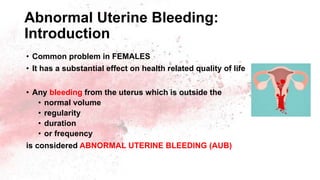
• Any bleeding from the uterus which is outside the
• normal volume
• regularity
• duration
• or frequency
is considered ABNORMAL UTERINE BLEEDING (AUB)
Normal Uterine Bleeding
• Normal uterine bleeding- Menstruation: cyclical
phenomenon regulated by HORMONES
• Reproductive aged women- From Menarche to Menopause
• Frequency – 21days to 35 days
• Duration – 2 to 8 days
• Flow –35 ml (20ml -80 ml)
• Pad used –3 to 6 pad /day
Blood loss-
Frequency
• Frequent: <21 days(>4/90
days)
• Normal:21-35 days
• Infrequent: >35 days (1-2/90
days)
Duration
• Prolonged:>8 days
• Normal:2-8 days
• Shortened:<2 days
Volume
• Heavy: >80 ml
• Normal: 20-80 ml
• Light: <20 ml
Key menstrual parameters
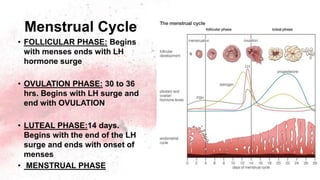
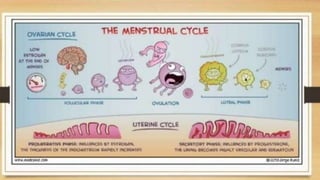
Menstrual Cycle
• FOLLICULAR PHASE: Begins
with menses ends with LH
hormone surge
• OVULATION PHASE: 30 to 36
hrs. Begins with LH surge and
end with OVULATION
• LUTEAL PHASE:14 days.
Begins with the end of the LH
surge and ends with onset of
menses
• MENSTRUAL PHASE
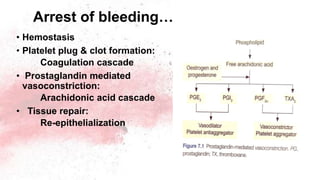
Arrest of bleeding…
• Hemostasis
• Platelet plug & clot formation:
Coagulation cascade
• Prostaglandin mediated
vasoconstriction:
Arachidonic acid cascade
• Tissue repair:
Re-epithelialization
Bleeding is abnormal if...
• It occur at interval of 21 days or less, or
35 days or more
• Last longer than 8 days
• Menstrual Blood Loss (MBL) of 80 or
more
Abnormal Uterine Bleeding: Incidence
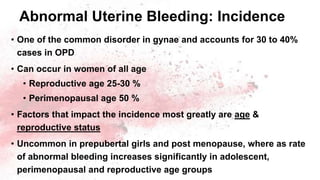
• One of the common disorder in gynae and accounts for 30 to 40%
cases in OPD
• Can occur in women of all age
• Reproductive age 25-30 %
• Perimenopausal age 50 %
• Factors that impact the incidence most greatly are age &
reproductive status
• Uncommon in prepubertal girls and post menopause, where as rate
of abnormal bleeding increases significantly in adolescent,
perimenopausal and reproductive age groups
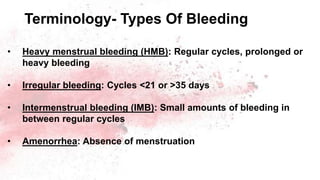
Terminology- Types Of Bleeding
• Heavy menstrual bleeding (HMB): Regular cycles, prolonged or
heavy bleeding
• Irregular bleeding: Cycles <21 or >35 days
• Intermenstrual bleeding (IMB): Small amounts of bleeding in
between regular cycles
• Amenorrhea: Absence of menstruation
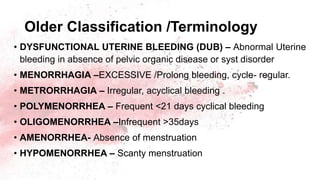
Older Classification /Terminology
• DYSFUNCTIONAL UTERINE BLEEDING (DUB) – Abnormal Uterine
bleeding in absence of pelvic organic disease or syst disorder
• MENORRHAGIA –EXCESSIVE /Prolong bleeding, cycle- regular.
• METRORRHAGIA – Irregular, acyclical bleeding .
• POLYMENORRHEA – Frequent <21 days cyclical bleeding
• OLIGOMENORRHEA –Infrequent >35days
• AMENORRHEA- Absence of menstruation
• HYPOMENORRHEA – Scanty menstruation
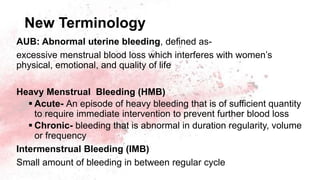
New Terminology
AUB: Abnormal uterine bleeding, defined as-
excessive menstrual blood loss which interferes with women’s
physical, emotional, and quality of life
Heavy Menstrual Bleeding (HMB)
 Acute- An episode of heavy bleeding that is of sufficient quantity
to require immediate intervention to prevent further blood loss
 Chronic- bleeding that is abnormal in duration regularity, volume
or frequency
Intermenstrual Bleeding (IMB)
Small amount of bleeding in between regular cycle
AUB Patterns described as..
AUB- HMB
- Menorrhagia replaced by Heavy menstrual bleeding
HMB
AUB- IMB
- Metrorrhagia replaced by –Intermenstrual bleeding
- IMB –Cyclical or acyclical
AUB: Classification
• By FIGO (International Federation of Gynecology and Obstetrics), 2011
• Approved by ACOG (American College of Obstetrics and Gynecology),
2013
• For non pregnant reproductive age women
• PALM-COEIN etiological classification system (ACRONYM)
• PALM- consists of structural abnormalities
• COEIN- includes conditions that are unrelated to structural abnormalities
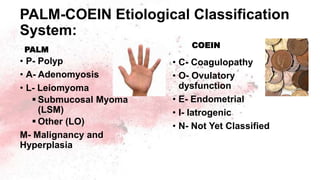
PALM-COEIN Etiological Classification
System:
PALM
• P- Polyp
• A- Adenomyosis
• L- Leiomyoma
 Submucosal Myoma
(LSM)
 Other (LO)
M- Malignancy and
Hyperplasia
COEIN
• C- Coagulopathy
• O- Ovulatory
dysfunction
• E- Endometrial
• I- Iatrogenic
• N- Not Yet Classified
AUB documentation as per PALM-COEIN
Etiological Classification
• AUB documented as
• PATHOLOGY being PRESENT – 1, or
• PATHOLOGY being ABSENT – O
• Multiple pathologies are documented simultaneously e.g.-
adenomyosis, hyperplasia and coagulopathy in a single
patient may be cited as –
• P0A1L0M1–C1O0E0I0N0, or
• Simplified- AUB-A,-M,-C
AUB Etiology- Structural causes
“PALM”
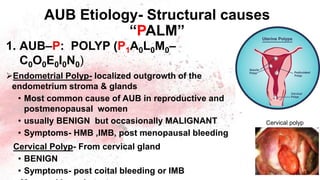
1. AUB–P: POLYP (P1A0L0M0–
C0O0E0I0N0)
Endometrial Polyp- localized outgrowth of the
endometrium stroma & glands
• Most common cause of AUB in reproductive and
postmenopausal women
• usually BENIGN but occasionally MALIGNANT
• Symptoms- HMB ,IMB, post menopausal bleeding
Cervical Polyp- From cervical gland
• BENIGN
• Symptoms- post coital bleeding or IMB
Cervical polyp
AUB–P (Polyp) PALM
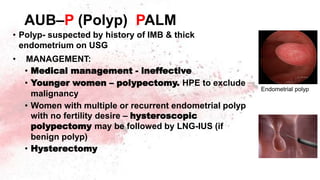
• Polyp- suspected by history of IMB & thick
endometrium on USG
• MANAGEMENT:
• Medical management - ineffective
• Younger women – polypectomy. HPE to exclude
malignancy
• Women with multiple or recurrent endometrial polyp
with no fertility desire – hysteroscopic
polypectomy may be followed by LNG-IUS (if
benign polyp)
• Hysterectomy
Endometrial polyp
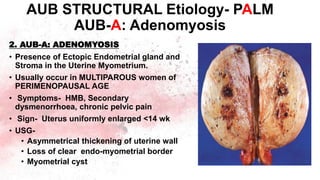
2. AUB-A: ADENOMYOSIS
• Presence of Ectopic Endometrial gland and
Stroma in the Uterine Myometrium.
• Usually occur in MULTIPAROUS women of
PERIMENOPAUSAL AGE
• Symptoms- HMB, Secondary
dysmenorrhoea, chronic pelvic pain
• Sign- Uterus uniformly enlarged <14 wk
• USG-
• Asymmetrical thickening of uterine wall
• Loss of clear endo-myometrial border
• Myometrial cyst
AUB STRUCTURAL Etiology- PALM
AUB-A: Adenomyosis
AUB-A (ADENOMYOSIS) PALM
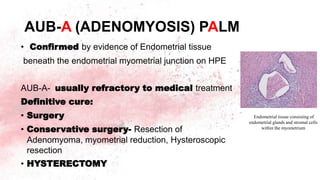
• Confirmed by evidence of Endometrial tissue
beneath the endometrial myometrial junction on HPE
AUB-A- usually refractory to medical treatment
Definitive cure:
• Surgery
• Conservative surgery- Resection of
Adenomyoma, myometrial reduction, Hysteroscopic
resection
• HYSTERECTOMY
Endometrial tissue consisting of
endometrial glands and stromal cells
within the myometrium
AUB-A (ADENOMYOSIS) PALM
Newer therapy -
• Endometrial ablation,
• UAE (Uterine Artery Embolization),
• MRg-FUS (Magnetic Resonance-Guided Focused Ultrasound)
• Medical- NSAIDs, COC (combined oral contraceptive), Danazol,
LNG-IUS, GnRH analogues, Aromatase inhibitor, Danazol loaded
IUS
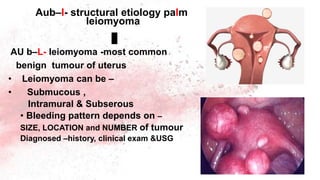
AU b–L- leiomyoma -most common
benign tumour of uterus
• Leiomyoma can be –
• Submucous ,
Intramural & Subserous
• Bleeding pattern depends on –
SIZE, LOCATION and NUMBER of tumour
Diagnosed –history, clinical exam &USG
Aub–l- structural etiology palm
leiomyoma
3. AUB-L: LEIOMYOMA
• Subclassified as
- those with at least ONE Submucous
leiomyoma, AUB-L-SM and
- those having NO Submucous
leiomyoma AUB-L-O [OTHER]
• Commonest cause of AUB in
Reproductive age
• Symptoms- HMB, IMB, irregular
bleeding
AUB STRUCTURAL Etiology- PALM
AUB-L: Leiomyoma
AUB-L (LEIOMYOMA) PALM
Management- Individualized
Medical-
- For small asymptomatic myoma at any age
- to control bleeding while waiting for surgery
- control bleeding (to correct anaemia)
- preoperative to reduce vascularity
- approaching menopause
Drugs- NSAID, COC, progestins- oral, LNG-IUS, Mifepristone, Danazol,
Gestrinone, SERM- Raloxifene & Ormeloxifene, SPERM- Ulipristal, GnRH
analogue- cabergoline , Aromatase inhibitor- anastrozole
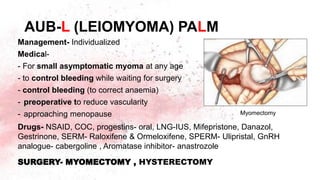
SURGERY- MYOMECTOMY , HYSTERECTOMY
Myomectomy
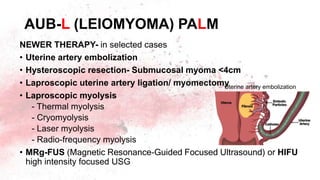
NEWER THERAPY- in selected cases
• Uterine artery embolization
• Hysteroscopic resection- Submucosal myoma <4cm
• Laproscopic uterine artery ligation/ myomectomy
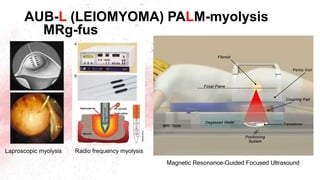
• Laproscopic myolysis
- Thermal myolysis
- Cryomyolysis
- Laser myolysis
- Radio-frequency myolysis
• MRg-FUS (Magnetic Resonance-Guided Focused Ultrasound) or HIFU
high intensity focused USG
AUB-L (LEIOMYOMA) PALM
Uterine artery embolization
AUB-L (LEIOMYOMA) PALM-myolysis
MRg-fus
Laproscopic myolysis Radio frequency myolysis
Magnetic Resonance-Guided Focused Ultrasound
AUB STRUCTURAL Etiology- PALM
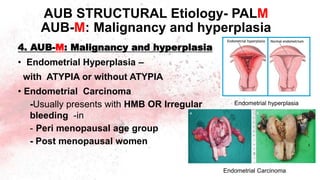
AUB-M: Malignancy and hyperplasia
4. AUB-M: Malignancy and hyperplasia
• Endometrial Hyperplasia –
with ATYPIA or without ATYPIA
• Endometrial Carcinoma
-Usually presents with HMB OR Irregular
bleeding -in
- Peri menopausal age group
- Post menopausal women
Endometrial hyperplasia
Endometrial Carcinoma
.Other cancer of genital tract – may present
with AUB
• Cervical cancer –Occur in younger age [mid
40s], associated with IMB, PCB
• Vulval, Vaginal cancer- RARE, but can present
with bleeding
AUB-M (Malignancy and hyperplasia)
PALM
Cervical Cancer
AUB-M (Malignancy and hyperplasia)
PALM
STANDARD PROTOCOL
• AUB-M with endometrial hyperplasia with ATYPIYA
- Hysterectomy- standard treatment
- Conservative treatment with high dose Progestin- exceptional case,
risk of carcinoma always
• AUB-M with endometrial hyperplasia without ATYPIA: Hormones
LNG IUS -first line
Progestin- oral MPA
• Preventive Hysterectomy- considered in high risk group:
older age, early age of menarche, diabetes, obesity,history of breast cancer,
family h/o of endometrial cancer
AUB Etiology: Not Associated with structural
Abnormalities “COEIN”
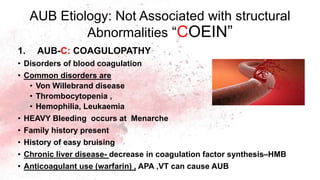
1. AUB-C: COAGULOPATHY
• Disorders of blood coagulation
• Common disorders are
• Von Willebrand disease
• Thrombocytopenia ,
• Hemophilia, Leukaemia
• HEAVY Bleeding occurs at Menarche
• Family history present
• History of easy bruising
• Chronic liver disease- decrease in coagulation factor synthesis–HMB
• Anticoagulant use (warfarin) , APA ,VT can cause AUB
AUB-C (COAGULOPATHY) COEIN
• Medical management - effective
• Tranexamic acid
• LNG-IUS
• NSAID -Contraindicated –can alter PLT function & liver
function
• IM Injectable preparation –contraindicated
• Consult Haematologist
AUB Etiology NON STRUCTURAL- COEIN
AUB-O: Ovulatory Dysfunction
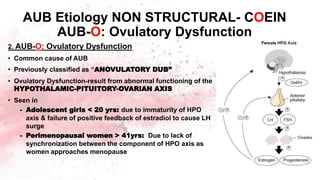
2. AUB-O: Ovulatory Dysfunction
• Common cause of AUB
• Previously classified as “ANOVULATORY DUB”
• Ovulatory Dysfunction-result from abnormal functioning of the
HYPOTHALAMIC-PITUITORY-OVARIAN AXIS
• Seen in
- Adolescent girls < 20 yrs: due to immaturity of HPO
axis & failure of positive feedback of estradiol to cause LH
surge
- Perimenopausal women > 41yrs: Due to lack of
synchronization between the component of HPO axis as
women approaches menopause
AUB-O (Ovulatory Dysfunction) COEIN
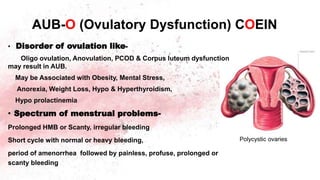
• Disorder of ovulation like-
Oligo ovulation, Anovulation, PCOD & Corpus luteum dysfunction
may result in AUB.
May be Associated with Obesity, Mental Stress,
Anorexia, Weight Loss, Hypo & Hyperthyroidism,
Hypo prolactinemia
• Spectrum of menstrual problems-
Prolonged HMB or Scanty, irregular bleeding
Short cycle with normal or heavy bleeding,
period of amenorrhea followed by painless, profuse, prolonged or
scanty bleeding
Polycystic ovaries
Contd..
Pathogenesis: ANOVULATION
• Low level of oestrogen→ No LH surge → NO OVULATION → NO corpus
luteum formation → NO PROGESTERON production → Decrease level of
PGF2α, other PGs & Thrombxanes → Increase Fibrinolysis → Painless
bleeding [no vasoconstrict]
• Presence of developing follicle → prolonged supply of Estrogen →
Endometrial proliferation & Hyperplasia → Fragile Endometrial with no
stromal support → continuous prolonged bleeding followed by → amenorrhea
AUB-O (Ovulatory Dysfunction) COEIN
No LH Surge
No ovulation
No corpus luteum
No progesterone
→
May be associated with –
- Follicular cyst of the ovary
- Endometrial hyperplasia
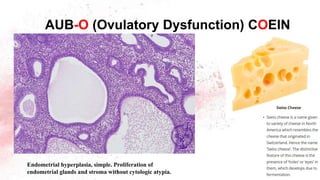
Prolonged amenorrhea- Endometrium shows CYSTIC
HYPERPLASIA, [SWISS CHEESE appearance]
“Metropathia hemorrhagica”, “Schroeder’s disease”
• Characteristic
- Hyperplastic gland &stroma
- Cystic or irregularly dilated gland
- Increase in Vascularization
- Necrosis of Superficial Endometrium
- Tortuous & Dilated SPIRAL ARTERIOLES and veins
AUB-O (Ovulatory Dysfunction) COEIN
Endometrial hyperplasia, simple. Proliferation of
endometrial glands and stroma without cytologic atypia.
AUB-O (Ovulatory Dysfunction) COEIN
• Combined Oral Contraceptive [COC]–first line treatment if
pregnancy not desired
• Cyclical Progesterone therapy-
• Cyclical Norethisterone for 21 days [day5 -25 ]x 3 cycle
• Cyclical Progestin luteal phase- for 10-14 days [ 15-25 ]-3
cycle
• LNG-IUS
Adolescent –both & Hormonal & non Hormonal treatment
AUB-O (Ovulatory Dysfunction) COEIN
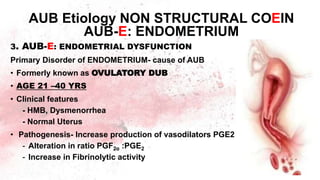
3. AUB-E: ENDOMETRIAL DYSFUNCTION
Primary Disorder of ENDOMETRIUM- cause of AUB
• Formerly known as OVULATORY DUB
• AGE 21 –40 YRS
• Clinical features
- HMB, Dysmenorrhea
- Normal Uterus
• Pathogenesis- Increase production of vasodilators PGE2
- Alteration in ratio PGF2α :PGE2
- Increase in Fibrinolytic activity
AUB Etiology NON STRUCTURAL COEIN
AUB-E: ENDOMETRIUM
• Diagnosis of EXCLUSION- after ruling out other identifiable abnormalities
in women with normal ovulatory cycle
• HPE: Endometrium reveals SECRETORY changes as OVULATION &
PROGESTERON normal
• Management: same as AUB –O, but only 21 days therapy is effective
• Chronic inflammation of the ENDOMETRIUM with or without associated
PID- Uncommon cause of AUB
AUB-E (ENDOMETRIAL Dysfunction)
COEIN
DUB may or may not be associated with OVULATION
• Anovular bleeding- 80%: AUB-O [Anovulatory DUB]
• Ovular bleeding - 20%: AUB-E [Ovulatory DUB]
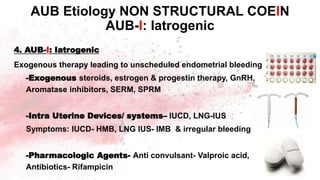
4. AUB-I: Iatrogenic
Exogenous therapy leading to unscheduled endometrial bleeding
-Exogenous steroids, estrogen & progestin therapy, GnRH,
Aromatase inhibitors, SERM, SPRM
-Intra Uterine Devices/ systems– IUCD, LNG-IUS
Symptoms: IUCD- HMB, LNG IUS- IMB & irregular bleeding
-Pharmacologic Agents- Anti convulsant- Valproic acid,
Antibiotics- Rifampicin
AUB Etiology NON STRUCTURAL COEIN
AUB-I: Iatrogenic
AUB –I (MANAGEMENT) COEIN
• Whenever possible: change Medication causing AUB
• Give Alternative therapy
• If Alternative not available – LNG-IUS can be used
5. AUB-N: Not yet classified/ ill defined cause
- Congenital or acquired A-V Malformation
- Caesarean scar Defect
- Endometrial pseudo aneurysm
- Chronic Endometritis
• Treatment-
• Hormonal: LNG-IUS, COC
• A-V Malformation- Uterine Artery Embolization
• Non Hormonal- NSAID, Tranexamic acid
• GnRH Agonist with ADD-BACK therapy
• Conservative surgery[Ablation] & Hysterectomy- last resort
AUB Etiology NON STRUCTURAL -COEIN
AUB-N: Not yet classified
All these can cause AUB
AUB: Clinical Evaluation
HISTORY & PHYSICAL EXAM- help in diagnosis
HISTORY - THOROUGH
- Age, Menarche, Parity
- Menstrual pattern- regularity, frequency, duration & volume
- Menstrual calendar for bleeding pattern
- Dysmenorrhea , vaginal Discharge
- Post coital bleeding – polyp, carcinoma cervix
- Dyspareunia – Adenomyosis
- Infertility, Abortion, IUCD ,OC Pill,
AUB- History
• Information about –use of any medication , likely
to be the cause for AUB
• Screen for coagulopathy –Positive screen test if-
History of heavy bleeding at MENARCHE
History of PPH or Bleeding associated with Dental or any other
surgery
• Two of the following symptoms
• ≥ one episode of bruising/month
• ≥ one episode of epistaxis/ month
• frequent Gum bleeding or family history of bleeding symptom
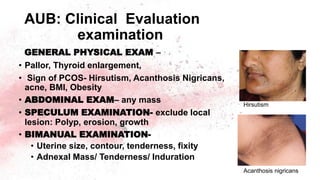
GENERAL PHYSICAL EXAM –
• Pallor, Thyroid enlargement,
• Sign of PCOS- Hirsutism, Acanthosis Nigricans,
acne, BMI, Obesity
• ABDOMINAL EXAM– any mass
• SPECULUM EXAMINATION- exclude local
lesion: Polyp, erosion, growth
• BIMANUAL EXAMINATION-
• Uterine size, contour, tenderness, fixity
• Adnexal Mass/ Tenderness/ Induration
AUB: Clinical Evaluation
examination
Acanthosis nigricans
Hirsutism
AUB: Investigation –LAB testing
• Complete blood count [CBC] –for all
• Coagulation profile- platelet count, Bleeding time
• Prothrombin time ,partial thromboplastin time
• - Indicated in all young girl & women with
Positive screen test for coagulopathies
• Testing for –Von Willebrand disease [Hematologist]
• Thyroid function test–young girl, if needed
• Hormonal assay- LH, FSH, TESTOSTERONE,17HP,
Androstenedione, Prolactin level
• Pregnancy test –exclude
AUB : Investigation -IMAGING
• ULTRASOUND – Evaluate: UTERUS, ADENEXA, ENDOMETRIUM
-to help in diagnosis of myoma, polyp, adenomyosis & endometrial
thickness.
• DOPPLER ULTRASONOGRAPHY- In Suspected A-V malformation
- Malignancy & to differentiate between FIBROID &ADENOMYOSIS
• 3D-USG-To evaluate Intra-cavitary & Myometrial lesion
• SALINE INFUSION SONOGRAPHY [SIS]- Suspected intra-cavitary
lesion e.g. polyp
- USG performed after introduction of saline in to the uterine cavity
[Sonohysterography]
Aub- investigation--HPE
• Endometrial sampling for Histopathology [HPE]-
Women > 40 yrs
Women < 40yrs –having high risk factor for MALIGNANCY
• Like –Irregular bleeding, obesity, Hypertension, PCOS,
• Endometrial thickness >12mm, Diabetes,
• Family History of Malignancy–ovary, breast ,endometrium, colon
• Use of Tamoxifen
• Late Menopause
• exposure to unopposed estrogen
• AUB –unresponsive to medical therapy
AUB: Investigation- HPE
Endometrial aspiration –preferred method OF
• Endometrial sampling for HPE
Devices like VABRA Aspirator PIPELLE or Karman’s canula no 4- used
Easy to use with adequate sampling, Minimally invasive tech esp in
perimenopausal women
Can detect > 90% of endometrial Cancer
Premenstrual phase –preferred for procedure
• Endometrial curettage & Biopsy –for sampling & HPE –not choice
• Hysteroscopic directed endometrial sampling
• HYSTEROSCOPY –Better evaluation of endometrial lesion
AUB –INVESTIGATION
• HYSTEROSCOPY- not in all cases
- Helpful for diagnosing intra-cavitary lesion, type of Myoma
 MRI- not superior to others in overall diagnostic potential
 CERVICAL CYTOLOGY- Performed in all women to exclude
CIN
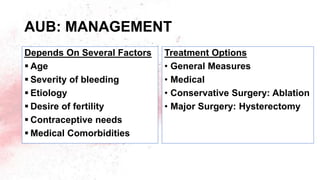
AUB: MANAGEMENT
Depends On Several Factors
 Age
 Severity of bleeding
 Etiology
 Desire of fertility
 Contraceptive needs
 Medical Comorbidities
Treatment Options
• General Measures
• Medical
• Conservative Surgery: Ablation
• Major Surgery: Hysterectomy
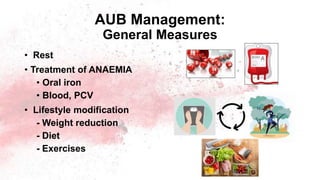
AUB Management:
General Measures
• Rest
• Treatment of ANAEMIA
• Oral iron
• Blood, PCV
• Lifestyle modification
- Weight reduction
- Diet
- Exercises
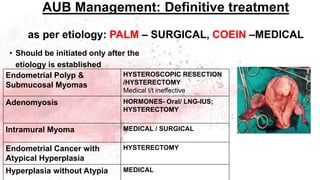
AUB Management: Definitive treatment
as per etiology: PALM – SURGICAL, COEIN –MEDICAL
• Should be initiated only after the
etiology is established
Endometrial Polyp &
Submucosal Myomas
HYSTEROSCOPIC RESECTION
/HYSTERECTOMY
Medical t/t ineffective
Adenomyosis HORMONES- Oral/ LNG-IUS;
HYSTERECTOMY
Intramural Myoma MEDICAL / SURGICAL
Endometrial Cancer with
Atypical Hyperplasia
HYSTERECTOMY
Hyperplasia without Atypia MEDICAL
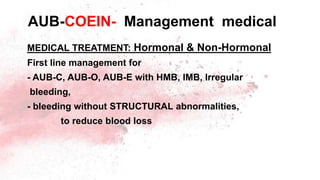
AUB-COEIN- Management medical
MEDICAL TREATMENT: Hormonal & Non-Hormonal
First line management for
- AUB-C, AUB-O, AUB-E with HMB, IMB, Irregular
bleeding,
- bleeding without STRUCTURAL abnormalities,
to reduce blood loss
AUB –coein MANAGEMENT
MEDICAL
management
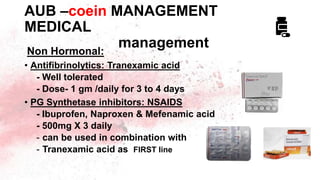
Non Hormonal:
• Antifibrinolytics: Tranexamic acid
- Well tolerated
- Dose- 1 gm /daily for 3 to 4 days
• PG Synthetase inhibitors: NSAIDS
- Ibuprofen, Naproxen & Mefenamic acid
- 500mg X 3 daily
- can be used in combination with
- Tranexamic acid as FIRST line
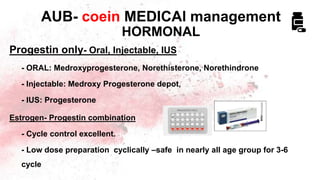
Progestin only- Oral, Injectable, IUS
- ORAL: Medroxyprogesterone, Norethisterone, Norethindrone
- Injectable: Medroxy Progesterone depot,
- IUS: Progesterone
Estrogen- Progestin combination
- Cycle control excellent.
- Low dose preparation cyclically –safe in nearly all age group for 3-6
cycle
AUB- coein MEDICAl management
HORMONAL
Estrogen only- seldom used, in AUB-O,
- young girl with atrophic endometrium
- conjugated equine oestrogen 25mg iv 6 hourly to prime endometrium
(usually not available)
- Ethinyl oestradiol 50 ug for 5days followed by combination O+P therapy
cyclically.
AUB MEDICAL -HORMONAL
Others:
• Danazol: antigonadotropin
- AUB- E100-200 mg daily x 3 month continuous
- if recurrent symptoms and those waiting for hysterectomy
• GnRH analogues
- Subtherapeutic dose- reduces blood loss, Therapeutic dose- amenorrhea
- Subcutaneously, intra nasally or im injection 3.6mg monthly
-only when waiting for surgery or to prepare endometrium for Ablative
Procedure
• Ormeloxifene-SERM- 60 mg x2 wkly- 3month –reduces blood loss
• Desmopressin – used in Von-willebrand’s disease & factor 8 deficiency
-
AUB MANAGEMENT: MEDICAL
HORMONAL
AUB-COEIN: GENERAL
MANAGEMNET GUIDELINE
• Tranexamic acid- first line therapy. Other non hormonal option- NSAIDs
• LNG-IUS – Desiring Contraception
• COC 2ND LINE therapy
• Cyclical oral Progestin [day 5-26] for 21days T/T of AUB-E
• Cyclical Luteal phase Progestin- orally10-14 days,[ day 15 to 25 ] for
AUB -O
• Ormeloxifene- Saheli: SERM- Where steroids contraindicated
• GnRH agonist with Add-back hormone- last resort
• Endometrial Ablation- if failure to medical or high risk for hysterectomy.-
Endo-Ablation replaced by LNG-IUS
• All AUB pts- HAEMATINICS to prevent ANAEMIA
AUB : SURGICAL-management
ABLATION /RESECTION
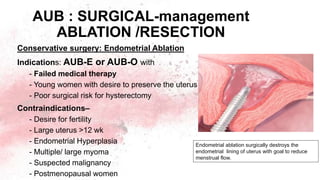
Conservative surgery: Endometrial Ablation
Indications: AUB-E or AUB-O with
- Failed medical therapy
- Young women with desire to preserve the uterus
- Poor surgical risk for hysterectomy
Contraindications–
- Desire for fertility
- Large uterus >12 wk
- Endometrial Hyperplasia
- Multiple/ large myoma
- Suspected malignancy
- Postmenopausal women
Endometrial ablation surgically destroys the
endometrial lining of uterus with goal to reduce
menstrual flow.
AUB Management:
Surgical- Ablation
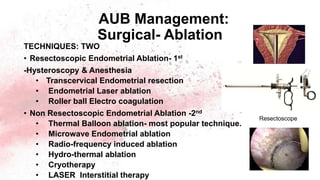
TECHNIQUES: TWO
• Resectoscopic Endometrial Ablation- 1st
-Hysteroscopy & Anesthesia
• Transcervical Endometrial resection
• Endometrial Laser ablation
• Roller ball Electro coagulation
• Non Resectoscopic Endometrial Ablation -2nd
• Thermal Balloon ablation- most popular technique.
• Microwave Endometrial ablation
• Radio-frequency induced ablation
• Hydro-thermal ablation
• Cryotherapy
• LASER Interstitial therapy
Resectoscope
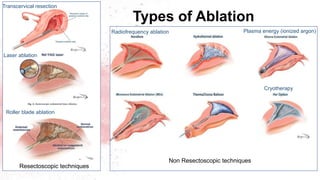
Radiofrequency ablation Plasma energy (ionized argon)
Cryotherapy
Types of Ablation
Resectoscopic techniques
Non Resectoscopic techniques
Transcervical resection
Laser ablation
Roller blade ablation
AUB Management : Ablation
Complications
• More with RESECTOSCOPE technique
• Efficacy of endometrial ablation is similar to LNG-IUS
(LNG-IUS has replaced Ablation)
• Complications –
- Uterine Perforation
- Haemorrhage
- Intrauterine scarring& hematometra
- Fluid overload & Pelvic infection
Also known as GLOBAL ABLATION technique, since entire endometrial
cavity is usually destroyed
DISADVANTAGES OF
RESECTOSCOPIC TECHNIQUES
 Long learning curve
 Requires general anaesthesia & skilled operator
 Has higher risk of complications
Demerits of Resectoscopic technology led to development
of Non Resectoscopic technique.
AUB Management:
Surgery- Hysterectomy
HYSTERECTOMY INDICATIONS:
 Failed Medical Therapy in perimenopausal
women
 Failed Endometrial Ablation
 Complex atypical hyperplasia in older women
 Other pelvic pathology needing concomitant
surgery
AUB MANAGEMENT: ACUTE
BLEEDING
• Treatment relies on- Etiology of bleeding, medical problem, fertility
desire & clinical stability. Pregnancy-EXCLUDE
• Medical therapy- Tranexamic acid, oral/ iv- 500- 1000mg [4gm/d]
• Progestin- oral norethisterone, Medroxyprogesterone- high dose
• COC (Combined Oral Contraceptive) cascade
• Conjugated equine estrogen iv 25 mg 4hrly
• Hospitalization – if unstable & serious
• Treat Anaemia
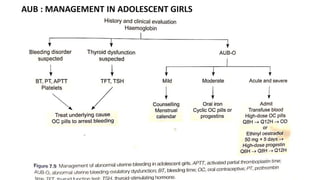
AUB : MANAGEMENT IN ADOLESCENT GIRLS
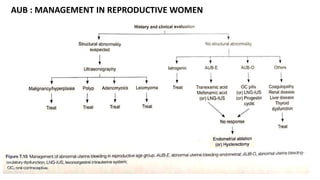
AUB : MANAGEMENT IN REPRODUCTIVE WOMEN
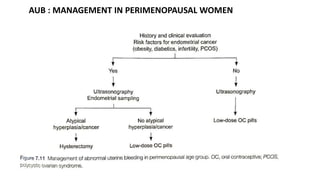
AUB : MANAGEMENT IN PERIMENOPAUSAL WOMEN

Abnormal uterine bleeding linkind.pptx

  • 1.
    Abnormal UterineBleeding AUB DR KMANJU PROFESSOR (OBSTETRICS AND GYNAECOLOGY) PMCH, PATNA
  • 2.
    Abnormal Uterine Bleeding: Introduction •Common problem in FEMALES • It has a substantial effect on health related quality of life • Any bleeding from the uterus which is outside the • normal volume • regularity • duration • or frequency is considered ABNORMAL UTERINE BLEEDING (AUB)
  • 3.
    Normal Uterine Bleeding •Normal uterine bleeding- Menstruation: cyclical phenomenon regulated by HORMONES • Reproductive aged women- From Menarche to Menopause • Frequency – 21days to 35 days • Duration – 2 to 8 days • Flow –35 ml (20ml -80 ml) • Pad used –3 to 6 pad /day
  • 4.
    Blood loss- Frequency • Frequent:<21 days(>4/90 days) • Normal:21-35 days • Infrequent: >35 days (1-2/90 days) Duration • Prolonged:>8 days • Normal:2-8 days • Shortened:<2 days Volume • Heavy: >80 ml • Normal: 20-80 ml • Light: <20 ml Key menstrual parameters
  • 5.
    Menstrual Cycle • FOLLICULARPHASE: Begins with menses ends with LH hormone surge • OVULATION PHASE: 30 to 36 hrs. Begins with LH surge and end with OVULATION • LUTEAL PHASE:14 days. Begins with the end of the LH surge and ends with onset of menses • MENSTRUAL PHASE
  • 7.
    Arrest of bleeding… •Hemostasis • Platelet plug & clot formation: Coagulation cascade • Prostaglandin mediated vasoconstriction: Arachidonic acid cascade • Tissue repair: Re-epithelialization
  • 8.
    Bleeding is abnormalif... • It occur at interval of 21 days or less, or 35 days or more • Last longer than 8 days • Menstrual Blood Loss (MBL) of 80 or more
  • 9.
    Abnormal Uterine Bleeding:Incidence • One of the common disorder in gynae and accounts for 30 to 40% cases in OPD • Can occur in women of all age • Reproductive age 25-30 % • Perimenopausal age 50 % • Factors that impact the incidence most greatly are age & reproductive status • Uncommon in prepubertal girls and post menopause, where as rate of abnormal bleeding increases significantly in adolescent, perimenopausal and reproductive age groups
  • 10.
    Terminology- Types OfBleeding • Heavy menstrual bleeding (HMB): Regular cycles, prolonged or heavy bleeding • Irregular bleeding: Cycles <21 or >35 days • Intermenstrual bleeding (IMB): Small amounts of bleeding in between regular cycles • Amenorrhea: Absence of menstruation
  • 11.
    Older Classification /Terminology •DYSFUNCTIONAL UTERINE BLEEDING (DUB) – Abnormal Uterine bleeding in absence of pelvic organic disease or syst disorder • MENORRHAGIA –EXCESSIVE /Prolong bleeding, cycle- regular. • METRORRHAGIA – Irregular, acyclical bleeding . • POLYMENORRHEA – Frequent <21 days cyclical bleeding • OLIGOMENORRHEA –Infrequent >35days • AMENORRHEA- Absence of menstruation • HYPOMENORRHEA – Scanty menstruation
  • 12.
    New Terminology AUB: Abnormaluterine bleeding, defined as- excessive menstrual blood loss which interferes with women’s physical, emotional, and quality of life Heavy Menstrual Bleeding (HMB)  Acute- An episode of heavy bleeding that is of sufficient quantity to require immediate intervention to prevent further blood loss  Chronic- bleeding that is abnormal in duration regularity, volume or frequency Intermenstrual Bleeding (IMB) Small amount of bleeding in between regular cycle
  • 13.
    AUB Patterns describedas.. AUB- HMB - Menorrhagia replaced by Heavy menstrual bleeding HMB AUB- IMB - Metrorrhagia replaced by –Intermenstrual bleeding - IMB –Cyclical or acyclical
  • 14.
    AUB: Classification • ByFIGO (International Federation of Gynecology and Obstetrics), 2011 • Approved by ACOG (American College of Obstetrics and Gynecology), 2013 • For non pregnant reproductive age women • PALM-COEIN etiological classification system (ACRONYM) • PALM- consists of structural abnormalities • COEIN- includes conditions that are unrelated to structural abnormalities
  • 15.
    PALM-COEIN Etiological Classification System: PALM •P- Polyp • A- Adenomyosis • L- Leiomyoma  Submucosal Myoma (LSM)  Other (LO) M- Malignancy and Hyperplasia COEIN • C- Coagulopathy • O- Ovulatory dysfunction • E- Endometrial • I- Iatrogenic • N- Not Yet Classified
  • 16.
    AUB documentation asper PALM-COEIN Etiological Classification • AUB documented as • PATHOLOGY being PRESENT – 1, or • PATHOLOGY being ABSENT – O • Multiple pathologies are documented simultaneously e.g.- adenomyosis, hyperplasia and coagulopathy in a single patient may be cited as – • P0A1L0M1–C1O0E0I0N0, or • Simplified- AUB-A,-M,-C
  • 17.
    AUB Etiology- Structuralcauses “PALM” 1. AUB–P: POLYP (P1A0L0M0– C0O0E0I0N0) Endometrial Polyp- localized outgrowth of the endometrium stroma & glands • Most common cause of AUB in reproductive and postmenopausal women • usually BENIGN but occasionally MALIGNANT • Symptoms- HMB ,IMB, post menopausal bleeding Cervical Polyp- From cervical gland • BENIGN • Symptoms- post coital bleeding or IMB Cervical polyp
  • 18.
    AUB–P (Polyp) PALM •Polyp- suspected by history of IMB & thick endometrium on USG • MANAGEMENT: • Medical management - ineffective • Younger women – polypectomy. HPE to exclude malignancy • Women with multiple or recurrent endometrial polyp with no fertility desire – hysteroscopic polypectomy may be followed by LNG-IUS (if benign polyp) • Hysterectomy Endometrial polyp
  • 19.
    2. AUB-A: ADENOMYOSIS •Presence of Ectopic Endometrial gland and Stroma in the Uterine Myometrium. • Usually occur in MULTIPAROUS women of PERIMENOPAUSAL AGE • Symptoms- HMB, Secondary dysmenorrhoea, chronic pelvic pain • Sign- Uterus uniformly enlarged <14 wk • USG- • Asymmetrical thickening of uterine wall • Loss of clear endo-myometrial border • Myometrial cyst AUB STRUCTURAL Etiology- PALM AUB-A: Adenomyosis
  • 20.
    AUB-A (ADENOMYOSIS) PALM •Confirmed by evidence of Endometrial tissue beneath the endometrial myometrial junction on HPE AUB-A- usually refractory to medical treatment Definitive cure: • Surgery • Conservative surgery- Resection of Adenomyoma, myometrial reduction, Hysteroscopic resection • HYSTERECTOMY Endometrial tissue consisting of endometrial glands and stromal cells within the myometrium
  • 21.
    AUB-A (ADENOMYOSIS) PALM Newertherapy - • Endometrial ablation, • UAE (Uterine Artery Embolization), • MRg-FUS (Magnetic Resonance-Guided Focused Ultrasound) • Medical- NSAIDs, COC (combined oral contraceptive), Danazol, LNG-IUS, GnRH analogues, Aromatase inhibitor, Danazol loaded IUS
  • 22.
    AU b–L- leiomyoma-most common benign tumour of uterus • Leiomyoma can be – • Submucous , Intramural & Subserous • Bleeding pattern depends on – SIZE, LOCATION and NUMBER of tumour Diagnosed –history, clinical exam &USG Aub–l- structural etiology palm leiomyoma
  • 23.
    3. AUB-L: LEIOMYOMA •Subclassified as - those with at least ONE Submucous leiomyoma, AUB-L-SM and - those having NO Submucous leiomyoma AUB-L-O [OTHER] • Commonest cause of AUB in Reproductive age • Symptoms- HMB, IMB, irregular bleeding AUB STRUCTURAL Etiology- PALM AUB-L: Leiomyoma
  • 24.
    AUB-L (LEIOMYOMA) PALM Management-Individualized Medical- - For small asymptomatic myoma at any age - to control bleeding while waiting for surgery - control bleeding (to correct anaemia) - preoperative to reduce vascularity - approaching menopause Drugs- NSAID, COC, progestins- oral, LNG-IUS, Mifepristone, Danazol, Gestrinone, SERM- Raloxifene & Ormeloxifene, SPERM- Ulipristal, GnRH analogue- cabergoline , Aromatase inhibitor- anastrozole SURGERY- MYOMECTOMY , HYSTERECTOMY Myomectomy
  • 25.
    NEWER THERAPY- inselected cases • Uterine artery embolization • Hysteroscopic resection- Submucosal myoma <4cm • Laproscopic uterine artery ligation/ myomectomy • Laproscopic myolysis - Thermal myolysis - Cryomyolysis - Laser myolysis - Radio-frequency myolysis • MRg-FUS (Magnetic Resonance-Guided Focused Ultrasound) or HIFU high intensity focused USG AUB-L (LEIOMYOMA) PALM Uterine artery embolization
  • 26.
    AUB-L (LEIOMYOMA) PALM-myolysis MRg-fus Laproscopicmyolysis Radio frequency myolysis Magnetic Resonance-Guided Focused Ultrasound
  • 27.
    AUB STRUCTURAL Etiology-PALM AUB-M: Malignancy and hyperplasia 4. AUB-M: Malignancy and hyperplasia • Endometrial Hyperplasia – with ATYPIA or without ATYPIA • Endometrial Carcinoma -Usually presents with HMB OR Irregular bleeding -in - Peri menopausal age group - Post menopausal women Endometrial hyperplasia Endometrial Carcinoma
  • 28.
    .Other cancer ofgenital tract – may present with AUB • Cervical cancer –Occur in younger age [mid 40s], associated with IMB, PCB • Vulval, Vaginal cancer- RARE, but can present with bleeding AUB-M (Malignancy and hyperplasia) PALM Cervical Cancer
  • 29.
    AUB-M (Malignancy andhyperplasia) PALM STANDARD PROTOCOL • AUB-M with endometrial hyperplasia with ATYPIYA - Hysterectomy- standard treatment - Conservative treatment with high dose Progestin- exceptional case, risk of carcinoma always • AUB-M with endometrial hyperplasia without ATYPIA: Hormones LNG IUS -first line Progestin- oral MPA • Preventive Hysterectomy- considered in high risk group: older age, early age of menarche, diabetes, obesity,history of breast cancer, family h/o of endometrial cancer
  • 30.
    AUB Etiology: NotAssociated with structural Abnormalities “COEIN” 1. AUB-C: COAGULOPATHY • Disorders of blood coagulation • Common disorders are • Von Willebrand disease • Thrombocytopenia , • Hemophilia, Leukaemia • HEAVY Bleeding occurs at Menarche • Family history present • History of easy bruising • Chronic liver disease- decrease in coagulation factor synthesis–HMB • Anticoagulant use (warfarin) , APA ,VT can cause AUB
  • 31.
    AUB-C (COAGULOPATHY) COEIN •Medical management - effective • Tranexamic acid • LNG-IUS • NSAID -Contraindicated –can alter PLT function & liver function • IM Injectable preparation –contraindicated • Consult Haematologist
  • 32.
    AUB Etiology NONSTRUCTURAL- COEIN AUB-O: Ovulatory Dysfunction 2. AUB-O: Ovulatory Dysfunction • Common cause of AUB • Previously classified as “ANOVULATORY DUB” • Ovulatory Dysfunction-result from abnormal functioning of the HYPOTHALAMIC-PITUITORY-OVARIAN AXIS • Seen in - Adolescent girls < 20 yrs: due to immaturity of HPO axis & failure of positive feedback of estradiol to cause LH surge - Perimenopausal women > 41yrs: Due to lack of synchronization between the component of HPO axis as women approaches menopause
  • 33.
    AUB-O (Ovulatory Dysfunction)COEIN • Disorder of ovulation like- Oligo ovulation, Anovulation, PCOD & Corpus luteum dysfunction may result in AUB. May be Associated with Obesity, Mental Stress, Anorexia, Weight Loss, Hypo & Hyperthyroidism, Hypo prolactinemia • Spectrum of menstrual problems- Prolonged HMB or Scanty, irregular bleeding Short cycle with normal or heavy bleeding, period of amenorrhea followed by painless, profuse, prolonged or scanty bleeding Polycystic ovaries
  • 34.
    Contd.. Pathogenesis: ANOVULATION • Lowlevel of oestrogen→ No LH surge → NO OVULATION → NO corpus luteum formation → NO PROGESTERON production → Decrease level of PGF2α, other PGs & Thrombxanes → Increase Fibrinolysis → Painless bleeding [no vasoconstrict] • Presence of developing follicle → prolonged supply of Estrogen → Endometrial proliferation & Hyperplasia → Fragile Endometrial with no stromal support → continuous prolonged bleeding followed by → amenorrhea AUB-O (Ovulatory Dysfunction) COEIN No LH Surge No ovulation No corpus luteum No progesterone →
  • 35.
    May be associatedwith – - Follicular cyst of the ovary - Endometrial hyperplasia Prolonged amenorrhea- Endometrium shows CYSTIC HYPERPLASIA, [SWISS CHEESE appearance] “Metropathia hemorrhagica”, “Schroeder’s disease” • Characteristic - Hyperplastic gland &stroma - Cystic or irregularly dilated gland - Increase in Vascularization - Necrosis of Superficial Endometrium - Tortuous & Dilated SPIRAL ARTERIOLES and veins AUB-O (Ovulatory Dysfunction) COEIN
  • 36.
    Endometrial hyperplasia, simple.Proliferation of endometrial glands and stroma without cytologic atypia. AUB-O (Ovulatory Dysfunction) COEIN
  • 37.
    • Combined OralContraceptive [COC]–first line treatment if pregnancy not desired • Cyclical Progesterone therapy- • Cyclical Norethisterone for 21 days [day5 -25 ]x 3 cycle • Cyclical Progestin luteal phase- for 10-14 days [ 15-25 ]-3 cycle • LNG-IUS Adolescent –both & Hormonal & non Hormonal treatment AUB-O (Ovulatory Dysfunction) COEIN
  • 38.
    3. AUB-E: ENDOMETRIALDYSFUNCTION Primary Disorder of ENDOMETRIUM- cause of AUB • Formerly known as OVULATORY DUB • AGE 21 –40 YRS • Clinical features - HMB, Dysmenorrhea - Normal Uterus • Pathogenesis- Increase production of vasodilators PGE2 - Alteration in ratio PGF2α :PGE2 - Increase in Fibrinolytic activity AUB Etiology NON STRUCTURAL COEIN AUB-E: ENDOMETRIUM
  • 39.
    • Diagnosis ofEXCLUSION- after ruling out other identifiable abnormalities in women with normal ovulatory cycle • HPE: Endometrium reveals SECRETORY changes as OVULATION & PROGESTERON normal • Management: same as AUB –O, but only 21 days therapy is effective • Chronic inflammation of the ENDOMETRIUM with or without associated PID- Uncommon cause of AUB AUB-E (ENDOMETRIAL Dysfunction) COEIN DUB may or may not be associated with OVULATION • Anovular bleeding- 80%: AUB-O [Anovulatory DUB] • Ovular bleeding - 20%: AUB-E [Ovulatory DUB]
  • 40.
    4. AUB-I: Iatrogenic Exogenoustherapy leading to unscheduled endometrial bleeding -Exogenous steroids, estrogen & progestin therapy, GnRH, Aromatase inhibitors, SERM, SPRM -Intra Uterine Devices/ systems– IUCD, LNG-IUS Symptoms: IUCD- HMB, LNG IUS- IMB & irregular bleeding -Pharmacologic Agents- Anti convulsant- Valproic acid, Antibiotics- Rifampicin AUB Etiology NON STRUCTURAL COEIN AUB-I: Iatrogenic
  • 41.
    AUB –I (MANAGEMENT)COEIN • Whenever possible: change Medication causing AUB • Give Alternative therapy • If Alternative not available – LNG-IUS can be used
  • 42.
    5. AUB-N: Notyet classified/ ill defined cause - Congenital or acquired A-V Malformation - Caesarean scar Defect - Endometrial pseudo aneurysm - Chronic Endometritis • Treatment- • Hormonal: LNG-IUS, COC • A-V Malformation- Uterine Artery Embolization • Non Hormonal- NSAID, Tranexamic acid • GnRH Agonist with ADD-BACK therapy • Conservative surgery[Ablation] & Hysterectomy- last resort AUB Etiology NON STRUCTURAL -COEIN AUB-N: Not yet classified All these can cause AUB
  • 43.
    AUB: Clinical Evaluation HISTORY& PHYSICAL EXAM- help in diagnosis HISTORY - THOROUGH - Age, Menarche, Parity - Menstrual pattern- regularity, frequency, duration & volume - Menstrual calendar for bleeding pattern - Dysmenorrhea , vaginal Discharge - Post coital bleeding – polyp, carcinoma cervix - Dyspareunia – Adenomyosis - Infertility, Abortion, IUCD ,OC Pill,
  • 44.
    AUB- History • Informationabout –use of any medication , likely to be the cause for AUB • Screen for coagulopathy –Positive screen test if- History of heavy bleeding at MENARCHE History of PPH or Bleeding associated with Dental or any other surgery • Two of the following symptoms • ≥ one episode of bruising/month • ≥ one episode of epistaxis/ month • frequent Gum bleeding or family history of bleeding symptom
  • 45.
    GENERAL PHYSICAL EXAM– • Pallor, Thyroid enlargement, • Sign of PCOS- Hirsutism, Acanthosis Nigricans, acne, BMI, Obesity • ABDOMINAL EXAM– any mass • SPECULUM EXAMINATION- exclude local lesion: Polyp, erosion, growth • BIMANUAL EXAMINATION- • Uterine size, contour, tenderness, fixity • Adnexal Mass/ Tenderness/ Induration AUB: Clinical Evaluation examination Acanthosis nigricans Hirsutism
  • 46.
    AUB: Investigation –LABtesting • Complete blood count [CBC] –for all • Coagulation profile- platelet count, Bleeding time • Prothrombin time ,partial thromboplastin time • - Indicated in all young girl & women with Positive screen test for coagulopathies • Testing for –Von Willebrand disease [Hematologist] • Thyroid function test–young girl, if needed • Hormonal assay- LH, FSH, TESTOSTERONE,17HP, Androstenedione, Prolactin level • Pregnancy test –exclude
  • 47.
    AUB : Investigation-IMAGING • ULTRASOUND – Evaluate: UTERUS, ADENEXA, ENDOMETRIUM -to help in diagnosis of myoma, polyp, adenomyosis & endometrial thickness. • DOPPLER ULTRASONOGRAPHY- In Suspected A-V malformation - Malignancy & to differentiate between FIBROID &ADENOMYOSIS • 3D-USG-To evaluate Intra-cavitary & Myometrial lesion • SALINE INFUSION SONOGRAPHY [SIS]- Suspected intra-cavitary lesion e.g. polyp - USG performed after introduction of saline in to the uterine cavity [Sonohysterography]
  • 48.
    Aub- investigation--HPE • Endometrialsampling for Histopathology [HPE]- Women > 40 yrs Women < 40yrs –having high risk factor for MALIGNANCY • Like –Irregular bleeding, obesity, Hypertension, PCOS, • Endometrial thickness >12mm, Diabetes, • Family History of Malignancy–ovary, breast ,endometrium, colon • Use of Tamoxifen • Late Menopause • exposure to unopposed estrogen • AUB –unresponsive to medical therapy
  • 49.
    AUB: Investigation- HPE Endometrialaspiration –preferred method OF • Endometrial sampling for HPE Devices like VABRA Aspirator PIPELLE or Karman’s canula no 4- used Easy to use with adequate sampling, Minimally invasive tech esp in perimenopausal women Can detect > 90% of endometrial Cancer Premenstrual phase –preferred for procedure • Endometrial curettage & Biopsy –for sampling & HPE –not choice • Hysteroscopic directed endometrial sampling • HYSTEROSCOPY –Better evaluation of endometrial lesion
  • 50.
    AUB –INVESTIGATION • HYSTEROSCOPY-not in all cases - Helpful for diagnosing intra-cavitary lesion, type of Myoma  MRI- not superior to others in overall diagnostic potential  CERVICAL CYTOLOGY- Performed in all women to exclude CIN
  • 51.
    AUB: MANAGEMENT Depends OnSeveral Factors  Age  Severity of bleeding  Etiology  Desire of fertility  Contraceptive needs  Medical Comorbidities Treatment Options • General Measures • Medical • Conservative Surgery: Ablation • Major Surgery: Hysterectomy
  • 52.
    AUB Management: General Measures •Rest • Treatment of ANAEMIA • Oral iron • Blood, PCV • Lifestyle modification - Weight reduction - Diet - Exercises
  • 53.
    AUB Management: Definitivetreatment as per etiology: PALM – SURGICAL, COEIN –MEDICAL • Should be initiated only after the etiology is established Endometrial Polyp & Submucosal Myomas HYSTEROSCOPIC RESECTION /HYSTERECTOMY Medical t/t ineffective Adenomyosis HORMONES- Oral/ LNG-IUS; HYSTERECTOMY Intramural Myoma MEDICAL / SURGICAL Endometrial Cancer with Atypical Hyperplasia HYSTERECTOMY Hyperplasia without Atypia MEDICAL
  • 54.
    AUB-COEIN- Management medical MEDICALTREATMENT: Hormonal & Non-Hormonal First line management for - AUB-C, AUB-O, AUB-E with HMB, IMB, Irregular bleeding, - bleeding without STRUCTURAL abnormalities, to reduce blood loss
  • 55.
    AUB –coein MANAGEMENT MEDICAL management NonHormonal: • Antifibrinolytics: Tranexamic acid - Well tolerated - Dose- 1 gm /daily for 3 to 4 days • PG Synthetase inhibitors: NSAIDS - Ibuprofen, Naproxen & Mefenamic acid - 500mg X 3 daily - can be used in combination with - Tranexamic acid as FIRST line
  • 56.
    Progestin only- Oral,Injectable, IUS - ORAL: Medroxyprogesterone, Norethisterone, Norethindrone - Injectable: Medroxy Progesterone depot, - IUS: Progesterone Estrogen- Progestin combination - Cycle control excellent. - Low dose preparation cyclically –safe in nearly all age group for 3-6 cycle AUB- coein MEDICAl management HORMONAL
  • 57.
    Estrogen only- seldomused, in AUB-O, - young girl with atrophic endometrium - conjugated equine oestrogen 25mg iv 6 hourly to prime endometrium (usually not available) - Ethinyl oestradiol 50 ug for 5days followed by combination O+P therapy cyclically. AUB MEDICAL -HORMONAL
  • 58.
    Others: • Danazol: antigonadotropin -AUB- E100-200 mg daily x 3 month continuous - if recurrent symptoms and those waiting for hysterectomy • GnRH analogues - Subtherapeutic dose- reduces blood loss, Therapeutic dose- amenorrhea - Subcutaneously, intra nasally or im injection 3.6mg monthly -only when waiting for surgery or to prepare endometrium for Ablative Procedure • Ormeloxifene-SERM- 60 mg x2 wkly- 3month –reduces blood loss • Desmopressin – used in Von-willebrand’s disease & factor 8 deficiency - AUB MANAGEMENT: MEDICAL HORMONAL
  • 59.
    AUB-COEIN: GENERAL MANAGEMNET GUIDELINE •Tranexamic acid- first line therapy. Other non hormonal option- NSAIDs • LNG-IUS – Desiring Contraception • COC 2ND LINE therapy • Cyclical oral Progestin [day 5-26] for 21days T/T of AUB-E • Cyclical Luteal phase Progestin- orally10-14 days,[ day 15 to 25 ] for AUB -O • Ormeloxifene- Saheli: SERM- Where steroids contraindicated • GnRH agonist with Add-back hormone- last resort • Endometrial Ablation- if failure to medical or high risk for hysterectomy.- Endo-Ablation replaced by LNG-IUS • All AUB pts- HAEMATINICS to prevent ANAEMIA
  • 60.
    AUB : SURGICAL-management ABLATION/RESECTION Conservative surgery: Endometrial Ablation Indications: AUB-E or AUB-O with - Failed medical therapy - Young women with desire to preserve the uterus - Poor surgical risk for hysterectomy Contraindications– - Desire for fertility - Large uterus >12 wk - Endometrial Hyperplasia - Multiple/ large myoma - Suspected malignancy - Postmenopausal women Endometrial ablation surgically destroys the endometrial lining of uterus with goal to reduce menstrual flow.
  • 61.
    AUB Management: Surgical- Ablation TECHNIQUES:TWO • Resectoscopic Endometrial Ablation- 1st -Hysteroscopy & Anesthesia • Transcervical Endometrial resection • Endometrial Laser ablation • Roller ball Electro coagulation • Non Resectoscopic Endometrial Ablation -2nd • Thermal Balloon ablation- most popular technique. • Microwave Endometrial ablation • Radio-frequency induced ablation • Hydro-thermal ablation • Cryotherapy • LASER Interstitial therapy Resectoscope
  • 62.
    Radiofrequency ablation Plasmaenergy (ionized argon) Cryotherapy Types of Ablation Resectoscopic techniques Non Resectoscopic techniques Transcervical resection Laser ablation Roller blade ablation
  • 63.
    AUB Management :Ablation Complications • More with RESECTOSCOPE technique • Efficacy of endometrial ablation is similar to LNG-IUS (LNG-IUS has replaced Ablation) • Complications – - Uterine Perforation - Haemorrhage - Intrauterine scarring& hematometra - Fluid overload & Pelvic infection Also known as GLOBAL ABLATION technique, since entire endometrial cavity is usually destroyed
  • 64.
    DISADVANTAGES OF RESECTOSCOPIC TECHNIQUES Long learning curve  Requires general anaesthesia & skilled operator  Has higher risk of complications Demerits of Resectoscopic technology led to development of Non Resectoscopic technique.
  • 65.
    AUB Management: Surgery- Hysterectomy HYSTERECTOMYINDICATIONS:  Failed Medical Therapy in perimenopausal women  Failed Endometrial Ablation  Complex atypical hyperplasia in older women  Other pelvic pathology needing concomitant surgery
  • 66.
    AUB MANAGEMENT: ACUTE BLEEDING •Treatment relies on- Etiology of bleeding, medical problem, fertility desire & clinical stability. Pregnancy-EXCLUDE • Medical therapy- Tranexamic acid, oral/ iv- 500- 1000mg [4gm/d] • Progestin- oral norethisterone, Medroxyprogesterone- high dose • COC (Combined Oral Contraceptive) cascade • Conjugated equine estrogen iv 25 mg 4hrly • Hospitalization – if unstable & serious • Treat Anaemia
  • 67.
    AUB : MANAGEMENTIN ADOLESCENT GIRLS
  • 68.
    AUB : MANAGEMENTIN REPRODUCTIVE WOMEN
  • 69.
    AUB : MANAGEMENTIN PERIMENOPAUSAL WOMEN