PRACTICAL PARTOGRAPHY

 Assoc Prof Dr Hanifullah Khan
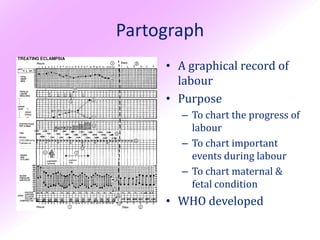
Partograph
     • A graphical record of
       labour
     • Purpose
       – To chart the progress of
         labour
       – To chart important
         events during labour
       – To chart maternal &
         fetal condition
     • WHO developed
Why do we need one?
• For early detection of abnormal progress of labour
• Recognition of CPD
• Can allow time & discussion of further management of
  labour
• Make observations & recording of fetomaternal condition
  more objective
• Prevention of fetomaternal problems & complications
Components of the partograph
              • Can be divided into 3
                parts
                – Part I : fetal condition
                  ( at top )
                – Part II : progress of
                  labour ( middle )
                – Part III : maternal
                  condition (bottom )
FETAL CONDITION
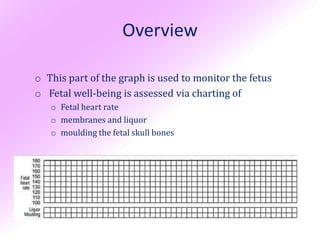
Overview

o This part of the graph is used to monitor the fetus
o Fetal well-being is assessed via charting of
   o Fetal heart rate
   o membranes and liquor
   o moulding the fetal skull bones
Fetal charting
Fetal heart                    Membranes & Liquor
Basal fetal heart rate         • intact membranes … I
• brady>110-160<tachy          • ruptured membranes
Decelerations?        yes/no   • + clear liquor …….. C
Relation to contractions?      • ruptured membranes +
      Early                     meconium liquor … M
      Variable                • ruptured membranes +
      Late
                                 bloody liquor …….. B
                               • ruptured membranes +
                                 no liquor………….. A
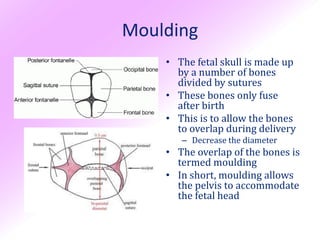
Moulding
    • The fetal skull is made up
      by a number of bones
      divided by sutures
    • These bones only fuse
      after birth
    • This is to allow the bones
      to overlap during delivery
       – Decrease the diameter
    • The overlap of the bones is
      termed moulding
    • In short, moulding allows
      the pelvis to accommodate
      the fetal head
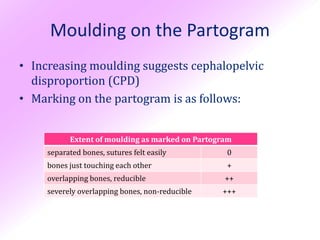
Moulding on the Partogram
• Increasing moulding suggests cephalopelvic
  disproportion (CPD)
• Marking on the partogram is as follows:


           Extent of moulding as marked on Partogram
     separated bones, sutures felt easily         0
     bones just touching each other               +
     overlapping bones, reducible                 ++
     severely overlapping bones, non-reducible   +++
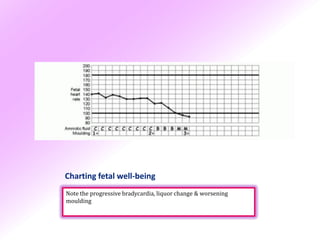
Charting fetal well-being
Note the progressive bradycardia, liquor change & worsening
moulding
LABOUR PROGRESS
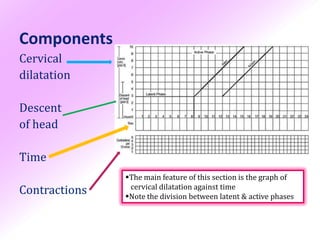
Components
Cervical
dilatation

Descent
of head

Time
               The main feature of this section is the graph of
                cervical dilatation against time
Contractions   Note the division between latent & active phases
Phases of labour
• Labour is not a continuous process
   – Begins slowly & becomes faster with time
      • Important to recognize this fact
   – Measured objectively from 0-10 cm cervical dilatation
   – This is Stage I
• Initial slow part is termed the latent phase
   – Coincides with the taking up & effacement of the Cx
   – Objectively, from 0 to 4 cm cervical dilatation
• The faster part is active labour
   – This is all about cervical dilatation
   – From 4 -10 cm dilatation
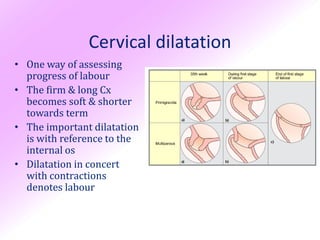
Cervical dilatation
• One way of assessing
  progress of labour
• The firm & long Cx
  becomes soft & shorter
  towards term
• The important dilatation
  is with reference to the
  internal os
• Dilatation in concert
  with contractions
  denotes labour
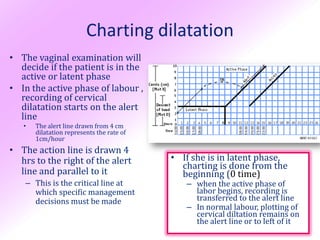
Charting dilatation
• The vaginal examination will
  decide if the patient is in the
  active or latent phase
• In the active phase of labour ,
  recording of cervical
  dilatation starts on the alert
  line
   •   The alert line drawn from 4 cm
       dilatation represents the rate of
       1cm/hour
• The action line is drawn 4
  hrs to the right of the alert            • If she is in latent phase,
                                             charting is done from the
  line and parallel to it                    beginning (0 time)
    – This is the critical line at            – when the active phase of
      which specific management                 labor begins, recording is
      decisions must be made                    transferred to the alert line
                                              – In normal labour, plotting of
                                                cervical diltation remains on
                                                the alert line or to left of it
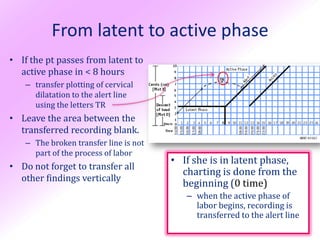
From latent to active phase
• If the pt passes from latent to
  active phase in < 8 hours
   – transfer plotting of cervical
     dilatation to the alert line
     using the letters TR
• Leave the area between the
  transferred recording blank.
   – The broken transfer line is not
     part of the process of labor
                                       • If she is in latent phase,
• Do not forget to transfer all
                                         charting is done from the
  other findings vertically
                                         beginning (0 time)
                                          – when the active phase of
                                            labor begins, recording is
                                            transferred to the alert line
• when a woman ,s partograph reaches the action line , she must
  be carefully reassessed to determine why there is lack of
  progress , and a decision must be made on further management
  ( usually by an obesterician or resident )


• when a woman in labor passes the latent phase in less than 8
  hours i.e., transfers from latent to active phase , the most
  important feature is to transfer plotting of cervical diltation to
  the alert line using the letters TR,

• Leaving the area between the transferred recording blank. The
  broken transfer line is not part of the process of labor

• do not forget to transfer all other findings vertically
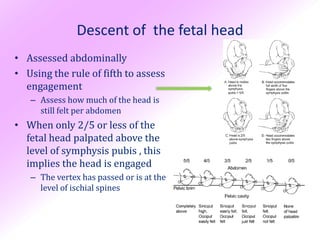
Descent of the fetal head
• Assessed abdominally
• Using the rule of fifth to assess
  engagement
   – Assess how much of the head is
     still felt per abdomen
• When only 2/5 or less of the
  fetal head palpated above the
  level of symphysis pubis , this
  implies the head is engaged
   – The vertex has passed or is at the
     level of ischial spines
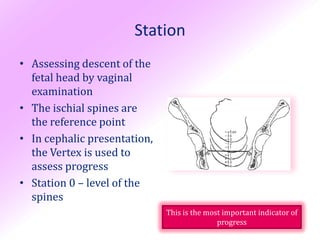
Station
• Assessing descent of the
  fetal head by vaginal
  examination
• The ischial spines are
  the reference point
• In cephalic presentation,
  the Vertex is used to
  assess progress
• Station 0 – level of the
  spines
                              This is the most important indicator of
                                             progress
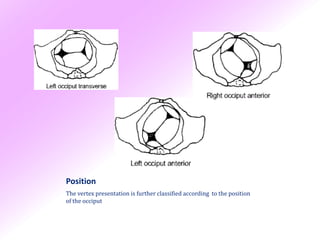
Position
The vertex presentation is further classified according to the position
of the occiput
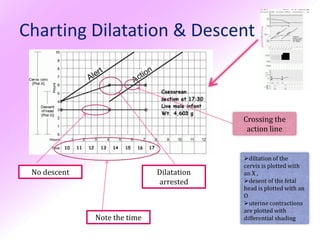
Charting Dilatation & Descent


                                           Crossing the
                                            action line


                                           diltation of the
                                           cervix is plotted with
 No descent                   Dilatation   an X ,
                              arrested     desent of the fetal
                                           head is plotted with an
                                           O
                                           uterine contractions
                                           are plotted with
              Note the time                differential shading
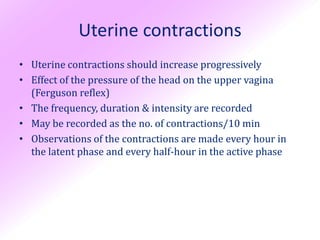
Uterine contractions
• Uterine contractions should increase progressively
• Effect of the pressure of the head on the upper vagina
  (Ferguson reflex)
• The frequency, duration & intensity are recorded
• May be recorded as the no. of contractions/10 min
• Observations of the contractions are made every hour in
  the latent phase and every half-hour in the active phase
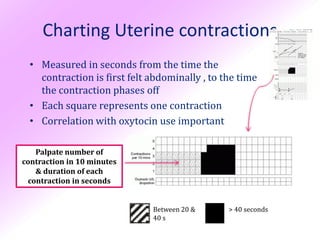
Charting Uterine contractions
  • Measured in seconds from the time the
    contraction is first felt abdominally , to the time
    the contraction phases off
  • Each square represents one contraction
  • Correlation with oxytocin use important

   Palpate number of
contraction in 10 minutes
   & duration of each
 contraction in seconds


                              Between 20 &      > 40 seconds
                              40 s
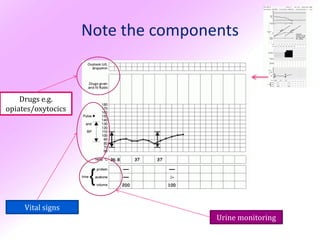
MATERNAL CONDITION
Note the components


    Drugs e.g.
opiates/oxytocics


     Vital signs
                                    Urine monitoring
SOME EXAMPLES
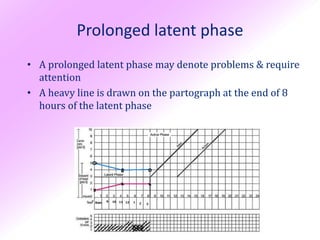
Prolonged latent phase
• A prolonged latent phase may denote problems & require
  attention
• A heavy line is drawn on the partograph at the end of 8
  hours of the latent phase
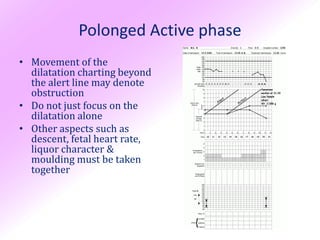
Polonged Active phase
• Movement of the
  dilatation charting beyond
  the alert line may denote
  obstruction
• Do not just focus on the
  dilatation alone
• Other aspects such as
  descent, fetal heart rate,
  liquor character &
  moulding must be taken
  together
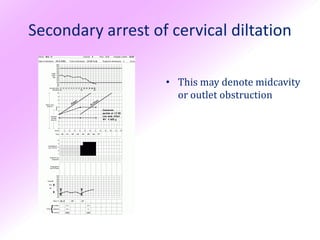
Secondary arrest of cervical diltation

                   • This may denote midcavity
                     or outlet obstruction
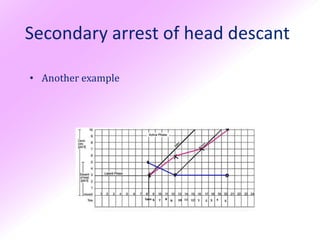
Secondary arrest of head descant

• Another example
Important points
• It is important to realize that the partograph is a tool for
  managing labor progress only
• It does not help to identify other risk factors that may have
  been present before labor started
• Charting is only done when the pt is in labour
Diagnosis of labour

Regular painful contractions resulting
 in progressive change of the cervix

             +/- show
     +/- rupture of membranes


        Does not denote labour!

Practical partography

  • 1.
    PRACTICAL PARTOGRAPHY AssocProf Dr Hanifullah Khan
  • 2.
    Partograph • A graphical record of labour • Purpose – To chart the progress of labour – To chart important events during labour – To chart maternal & fetal condition • WHO developed
  • 3.
    Why do weneed one? • For early detection of abnormal progress of labour • Recognition of CPD • Can allow time & discussion of further management of labour • Make observations & recording of fetomaternal condition more objective • Prevention of fetomaternal problems & complications
  • 4.
    Components of thepartograph • Can be divided into 3 parts – Part I : fetal condition ( at top ) – Part II : progress of labour ( middle ) – Part III : maternal condition (bottom )
  • 5.
  • 6.
    Overview o This partof the graph is used to monitor the fetus o Fetal well-being is assessed via charting of o Fetal heart rate o membranes and liquor o moulding the fetal skull bones
  • 7.
    Fetal charting Fetal heart Membranes & Liquor Basal fetal heart rate • intact membranes … I • brady>110-160<tachy • ruptured membranes Decelerations? yes/no • + clear liquor …….. C Relation to contractions? • ruptured membranes +  Early meconium liquor … M  Variable • ruptured membranes +  Late bloody liquor …….. B • ruptured membranes + no liquor………….. A
  • 8.
    Moulding • The fetal skull is made up by a number of bones divided by sutures • These bones only fuse after birth • This is to allow the bones to overlap during delivery – Decrease the diameter • The overlap of the bones is termed moulding • In short, moulding allows the pelvis to accommodate the fetal head
  • 9.
    Moulding on thePartogram • Increasing moulding suggests cephalopelvic disproportion (CPD) • Marking on the partogram is as follows: Extent of moulding as marked on Partogram separated bones, sutures felt easily 0 bones just touching each other + overlapping bones, reducible ++ severely overlapping bones, non-reducible +++
  • 10.
    Charting fetal well-being Notethe progressive bradycardia, liquor change & worsening moulding
  • 11.
  • 12.
    Components Cervical dilatation Descent of head Time The main feature of this section is the graph of cervical dilatation against time Contractions Note the division between latent & active phases
  • 13.
    Phases of labour •Labour is not a continuous process – Begins slowly & becomes faster with time • Important to recognize this fact – Measured objectively from 0-10 cm cervical dilatation – This is Stage I • Initial slow part is termed the latent phase – Coincides with the taking up & effacement of the Cx – Objectively, from 0 to 4 cm cervical dilatation • The faster part is active labour – This is all about cervical dilatation – From 4 -10 cm dilatation
  • 14.
    Cervical dilatation • Oneway of assessing progress of labour • The firm & long Cx becomes soft & shorter towards term • The important dilatation is with reference to the internal os • Dilatation in concert with contractions denotes labour
  • 15.
    Charting dilatation • Thevaginal examination will decide if the patient is in the active or latent phase • In the active phase of labour , recording of cervical dilatation starts on the alert line • The alert line drawn from 4 cm dilatation represents the rate of 1cm/hour • The action line is drawn 4 hrs to the right of the alert • If she is in latent phase, charting is done from the line and parallel to it beginning (0 time) – This is the critical line at – when the active phase of which specific management labor begins, recording is decisions must be made transferred to the alert line – In normal labour, plotting of cervical diltation remains on the alert line or to left of it
  • 16.
    From latent toactive phase • If the pt passes from latent to active phase in < 8 hours – transfer plotting of cervical dilatation to the alert line using the letters TR • Leave the area between the transferred recording blank. – The broken transfer line is not part of the process of labor • If she is in latent phase, • Do not forget to transfer all charting is done from the other findings vertically beginning (0 time) – when the active phase of labor begins, recording is transferred to the alert line
  • 17.
    • when awoman ,s partograph reaches the action line , she must be carefully reassessed to determine why there is lack of progress , and a decision must be made on further management ( usually by an obesterician or resident ) • when a woman in labor passes the latent phase in less than 8 hours i.e., transfers from latent to active phase , the most important feature is to transfer plotting of cervical diltation to the alert line using the letters TR, • Leaving the area between the transferred recording blank. The broken transfer line is not part of the process of labor • do not forget to transfer all other findings vertically
  • 18.
    Descent of thefetal head • Assessed abdominally • Using the rule of fifth to assess engagement – Assess how much of the head is still felt per abdomen • When only 2/5 or less of the fetal head palpated above the level of symphysis pubis , this implies the head is engaged – The vertex has passed or is at the level of ischial spines
  • 19.
    Station • Assessing descentof the fetal head by vaginal examination • The ischial spines are the reference point • In cephalic presentation, the Vertex is used to assess progress • Station 0 – level of the spines This is the most important indicator of progress
  • 20.
    Position The vertex presentationis further classified according to the position of the occiput
  • 21.
    Charting Dilatation &Descent Crossing the action line diltation of the cervix is plotted with No descent Dilatation an X , arrested desent of the fetal head is plotted with an O uterine contractions are plotted with Note the time differential shading
  • 22.
    Uterine contractions • Uterinecontractions should increase progressively • Effect of the pressure of the head on the upper vagina (Ferguson reflex) • The frequency, duration & intensity are recorded • May be recorded as the no. of contractions/10 min • Observations of the contractions are made every hour in the latent phase and every half-hour in the active phase
  • 23.
    Charting Uterine contractions • Measured in seconds from the time the contraction is first felt abdominally , to the time the contraction phases off • Each square represents one contraction • Correlation with oxytocin use important Palpate number of contraction in 10 minutes & duration of each contraction in seconds Between 20 & > 40 seconds 40 s
  • 24.
  • 25.
    Note the components Drugs e.g. opiates/oxytocics Vital signs Urine monitoring
  • 26.
  • 27.
    Prolonged latent phase •A prolonged latent phase may denote problems & require attention • A heavy line is drawn on the partograph at the end of 8 hours of the latent phase
  • 28.
    Polonged Active phase •Movement of the dilatation charting beyond the alert line may denote obstruction • Do not just focus on the dilatation alone • Other aspects such as descent, fetal heart rate, liquor character & moulding must be taken together
  • 29.
    Secondary arrest ofcervical diltation • This may denote midcavity or outlet obstruction
  • 30.
    Secondary arrest ofhead descant • Another example
  • 31.
    Important points • Itis important to realize that the partograph is a tool for managing labor progress only • It does not help to identify other risk factors that may have been present before labor started • Charting is only done when the pt is in labour
  • 32.
    Diagnosis of labour Regularpainful contractions resulting in progressive change of the cervix +/- show +/- rupture of membranes Does not denote labour!