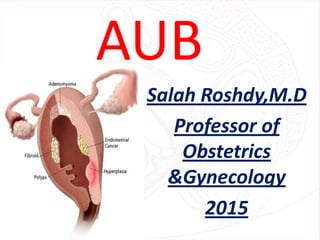
AUB
Salah Roshdy,M.D
Professor of
Obstetrics
&Gynecology
2015
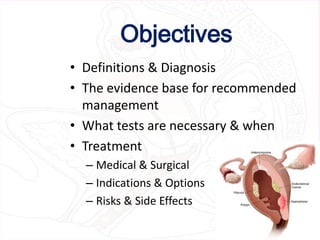
Objectives
• Definitions & Diagnosis
• The evidence base for recommended
management
• What tests are necessary & when
• Treatment
– Medical & Surgical
– Indications & Options
– Risks & Side Effects
Normal Menstrual Cycle
• Menstration is a cyclic physiological
phenomena
• starting at the age of Menarche (11-
14years) till establishment of Menopause
(45-55 yrs).
• It is regulated by hypothalmo-pituitary-
ovarian hormones secreted in pulsatile
and cyclic pattern.
• Volume of blood flow is assessed by number of pads / tampons used
whether the pads are fully/ partially soaked , presence of clots. It can
be better assessed by pictorial charts--
Pad Area Soaked 1st day 2nd
Day
3rd Day 4th Day 5th
day
6th
Day
7th
Day
X 1 // / /
X 5 /// //
X20 ///
Total Points 89(<1oo)- Nor
mal
blood Loss
Tampons
soaked
X1
// // / /
x 5
///
D X
15
//////
111
Arrest of Menstrual bleeding
1 Haemostasis by platelet plug and clot
formation – starts soon the bleeding starts
and open BV are plugged .once Blood vessels
are plugged , fibrin deposition occurs ---
Fibrinolysis also go hand in hand to balance
and keep the blood loss fluid.
Arrest of Menstrual bleeding
• 2.Prostaglandin Mediation – Archadonic acid
and Pg synthetase enzyme produce PGs ---pge2 –
vasodilator, PGf2a--- vasoconstrictor and
Thromboxane – vasoconstrictor. Estrogen
produce PGE2 and PGF2a in ratio of 1:1 in
proliferative phase ; while Progesterone produce
PGE2 and PGF2a + thromboxane in 1: 2 ratio in
premenstrual phase so balance is shifted towards
vasoconstriction which help in control of
bleeding.
Arrest of Menstrual bleeding --
3. Tissue Repair --- starts from the mouths of open
endometrial glands in the denuded areas ,
endothelium out grows and covers the raw area
under the influence of Epithelial Growth Factor (
EGF) and blood vessels regrow due to Vascular
endothelial Growth Factor (VEGF).
Thus the raw area of remaining basal
endometrium is completely epithelized under
Estrogen effect.
Why do we have to know about
AUB??
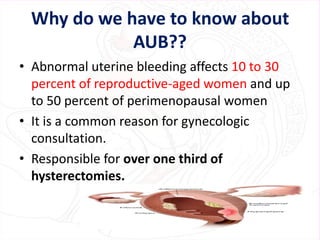
• Abnormal uterine bleeding affects 10 to 30
percent of reproductive-aged women and up
to 50 percent of perimenopausal women
• It is a common reason for gynecologic
consultation.
• Responsible for over one third of
hysterectomies.
Terms abandoned in the FIGO
nomenclature system
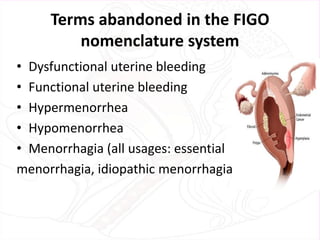
• Dysfunctional uterine bleeding
• Functional uterine bleeding
• Hypermenorrhea
• Hypomenorrhea
• Menorrhagia (all usages: essential
menorrhagia, idiopathic menorrhagia,
Terms abandoned in the FIGO
nomenclature system
primary menorrhagia, functional menorrhagia,
ovulatory menorrhagia,anovulatory
menorrhagia).
• Metrorrhagia
• Metropathica hemorrhagica.
• Oligomenorrhea
• Polymenorrhagia
• Polymenorrhea
• Uterine hemorrhage
Frasier I, Fertility and Sterility 2007; 87:466-76
The “New Normal”: Proposed Terms for Vaginal Bleeding
FIGO terminology system
• Acute AUB
Is now defined as “an episode of bleeding in a
woman of reproductive age, who is not
pregnant, that, is of sufficient quantity to
require immediate intervention to prevent
further blood loss
FIGO terminology system
• Chronic AUB
is" bleeding from the uterine corpus that is
abnormal in duration, volume, and/or frequency
and has been present for the majority of the last
6 months
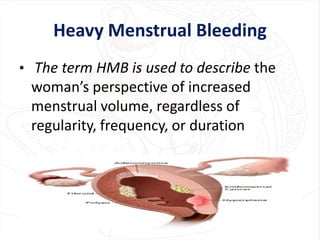
Heavy Menstrual Bleeding
• The term HMB is used to describe the
woman’s perspective of increased
menstrual volume, regardless of
regularity, frequency, or duration
National Institute
of Health and Clinical Excellence
guidelines
• “HMB should be defined as excessive
menstrual blood loss which interferes with the
woman’s physical, emotional, social and
material quality of life, and which can occur
alone or in combination with other symptoms
Intermenstrual bleeding
When a woman experiences episodes of
bleeding that occur between normally timed
menstrual periods.
• Such bleeding can be cyclic and predictable,
such as that often associated with ovulation.
FIGO System for AUB, 2011
AUB: Structural Conditions
• P: Endometrial polyp
– IMB or PCB in 30-50 year old woman
• A: Adenomyosis
– Dysmenorrhea, dyspareunia, chronic pelvic pain,
sometimes menorrhagia
• L: Leiomyoma
– Submucous myoma
– Menorrhagia; rarely IMB; never metrorrhagia
AUB: Structural Conditions
• M: Malignancy and hyperplasia
– Adenomatous hyperplasia (AH) atypical AH 
endometrial carcinoma
• Post-menopausal bleeding
• Recurrent perimenopausal metrorrhagia
• Chronic anovulator (PCOS) with metrorrhagia
– Leiomyosarcoma
• Post-menopausal bleeding
COEIN: Coagulopathy
• Clotting factor deficiency or defect
– Liver disease
– Congenital (Von Willebrands Disease)
• Platelet deficiency (thrombocytopenia) with
platelet count <20,000/mm3
– Idiopathic thrombocytopenic purpura (ITP)
– Aplastic anemia
• Platelet function defects
COEIN: Coagulopathy
Screen for underlying disorder of hemostasis if any of
• Heavy menstrual bleeding since menarche
• One of the following
– Post-partum hemorrhage
– Bleeding associated with surgery
– Bleeding associated with dental work
• Two or more of the following
– Bruising 1-2 times per month
– Epistaxis 1-2 times per month
– Frequent gum bleeding
– Family history of bleeding symptoms
Munro M, Int J Gynecol Obstet (2011)
COEIN: Ovulatory
• Anovulation
–Age: peri-menarche and perimenopuse
–PCOS
–Stress
• Hypothyroidism
• Luteal phase defects
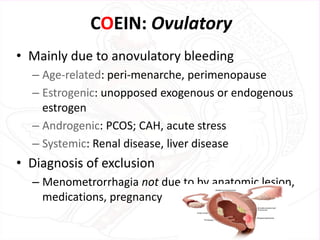
COEIN: Ovulatory
• Mainly due to anovulatory bleeding
– Age-related: peri-menarche, perimenopause
– Estrogenic: unopposed exogenous or endogenous
estrogen
– Androgenic: PCOS; CAH, acute stress
– Systemic: Renal disease, liver disease
• Diagnosis of exclusion
– Menometrorrhagia not due to by anatomic lesion,
medications, pregnancy
COEIN: Ovulatory
• Hyperthyroidism or hypothyroidism
– Bleeding can be excessive, light, or irregular
– Only severe, uncorrected thyroid disease causes
abnormal bleeding patterns
– Normal pattern when corrected to euthyroid
– 1o hypothyroidism assoc. with 2o amenorrhea
Low T4 high TRH  high TSH  normal T4
high PRL amenorrhea + galactorrhea
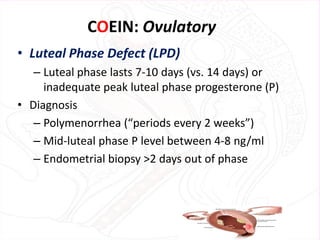
COEIN: Ovulatory
• Luteal Phase Defect (LPD)
– Luteal phase lasts 7-10 days (vs. 14 days) or
inadequate peak luteal phase progesterone (P)
• Diagnosis
– Polymenorrhea (“periods every 2 weeks”)
– Mid-luteal phase P level between 4-8 ng/ml
– Endometrial biopsy >2 days out of phase
COEIN: Endometrial
• Idiopathic
– Unexplained menorrhagia
• Endometritis
– Post-partum
– Post-abortal endometritis
– Endometritis component of PID
• In teens, PID commonly presents with abnormal
bleeding (menorrhagia, IMB), not pelvic pain
– Any teen with abnormal bleeding + pelvic pain
requires bimanual exam to evaluate for PID
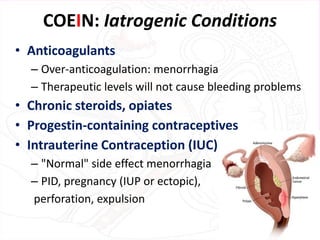
COEIN: Iatrogenic Conditions
• Anticoagulants
– Over-anticoagulation: menorrhagia
– Therapeutic levels will not cause bleeding problems
• Chronic steroids, opiates
• Progestin-containing contraceptives
• Intrauterine Contraception (IUC)
– "Normal" side effect menorrhagia
– PID, pregnancy (IUP or ectopic),
perforation, expulsion
COEIN: Not Classified
• Chronic endometritis
• AVM
• Myometrial hypertrophy
FIGO classification system for causes of abnormal
uterine bleeding in the reproductive years
Diagnostic management
• History
• Any known uterine disease, induced vaginal
bleeding.
• Risk factors for hypothyroidism and any
personal or family history of disorders of
hemostasis must be sought with specific
questions(Grade B)
• Age
• Age at menarche.
• Parity.
• Menstrual History—regularity, frequency,
duration of bleeding , Volume of blood loss.
• Post coital bleeding ?
• Dysmenorrhoea – spasmodic / congestive .
• Dyspareunia.
• O.H.---fertility / infertility/ gravidity / parity etc.
• Associated Vaginal Discharge .
• Recent Abortion / delivery / ectopic pregnancy .
• IUCD insertion , ocs, hormone therapy/ drugs.
Clinical Examination
• A complete clinical examination is
recommended, including checking for signs of
anemia, abdominal palpation, and a cervical
examination, both digital and with a speculum
, except for virgins or adolescents.
• When the history suggests nothing relevant,
the pictogram is normal, the clinical
examination is normal and no sign of anemia
is present, no diagnostic investigation is
recommended (Grade C).
laboratory Investigations
• CBC
• Blood coagulation profile
• TFT if there is any risk factors
• B HCG
Imaging examinations
• Pelvic ultrasound:
both abdominal and transvaginal, is
recommended as a first-line procedure for the
etiological diagnosis of AUB (Grade A).
• Doppler ultrasonography provides additional
information useful for characterizing
endometrial and myometrial abnormalities
(Grade B).
Hysteroscopy or SIS
• Uterine exploration: Hysteroscopy or SIS can
be suggested as a second-line procedure when
ultrasound suggests an intrauterine
abnormality or if medical treatment fails after
3–6 months (Grade B).
Endometrial biopsy
• An endometrial biopsy must be performed in the
case of any risk factor for endometrial cancer and
for all patients older than 45 years (Grade C).
• A biopsy sample should be obtained with a
polypropylene endometrial suction curette
(Pipelle de Cormier)during the diagnostic
hysteroscopy (Grade B)
• Diagnostic curettage under general anesthesia is
not recommended as a first-line treatment
(Grade A).
• Hysteroscopic directed biopsies .
Which Test?
What is the Evidence?
• Systematic Review of TVS (10 studies), Saline I Sonography (SIS, 11
studies) and Hysteroscopy (3 studies) for the identification of any
pathology
• TVS
– Sensitivity 48 – 100%
– Specificity 12 – 100%
• SIS
– Sensitivity 85 – 100%
– Specificity 50– 100%
• Hysteroscopy
– Sensitivity 90 – 97%
– Specificity 62 – 93%
• Ultrasound better for the identification of fibroids
• SIS and Hysteroscopy better for the identification of polyps
Treatment
A. General
1.Treatment of iron deficiency
anemia
B. Medical
I. Hormonal:
1.Progestagen
2.Oestrogen
3.COCP
4.Danazol
5.GnRh agonist
6.Levo-nova (Mirena)
II. Non –hormonal
1.Prostaglandin synthetase inhibitors (PSI)
2.Antifibrinolytics
3.Ethamsylate
C. Surgical
1. Endometrial ablation
2. UAE
3. Hysterectomy
Tranexamic acid
Competitive inhibitor of
plasminogen activator
-antifibrinolytic agents
Menorrhagia
-Reduced breakdown of fibrin
preformed clot in spiral endometrium
arterioles  reduce MBL
Reduce MBL by 34-59% Cost effective when compared with other
NSAIDS and no treatment
-not when compared with LNG-IUSHowever,
-not reduce dysmenorrhea
-not a contraceptive
-not regulate cycles
Dosage:
1g ( 2 tablets) 3-4x daily from onset of
bleeding up to 4 days
Mechanism of action:
The endometrium possess an active fibrinolytic
system, & the fibrinolytic activity is higher in
menorrhagia.
Effect:
Greater reduction of menstrual bleeding than other
therapies (PSI, oral luteal phase progestagen &
ethamsylate)(Cochrane library,2002).
Tranexamic acid is effective in treating menorrhagia
associated with IUCD.
Side effects: is dose related.
Nausea , vomiting, diarrhea, dizziness. Rarely:
transient color vision disturbance, intracranial
thrombosis.
But, no evidence that tranxemic acid increases
the risk in absence of past or family history of
thrombophilia. (Cochrane library,2002).
NSAIDs
Reduce prostaglandin synthesis by
inhibiting COX
Prostaglandin:
- Inflammatory response
- Pain pathways
- Uterine cramps
- Uterine bleeds
Reduces MBL 20-49% but tranexamic acid and
danazol reduces MBL greater
-better AE profile than danazol
Less cost effective than LNG and tranexamic
acid
Treatment of
dysmenorrhea
However,
- Not contraceptions
- Not to be used in bleeding
disorders
Cyclooxygenase Pathway
Arachidonic Acid
Prostaglandins
Thromboxane Prostacyclin*
cyclic endoperoxides
are inhibited, therefore
this step is blocked
X
*Causes vasodilation and inhibits platelet aggregation
Mechanism;
the endometrium is a rich source of PGE2 & PGF2œ &
its concentrations are greater in menorrhagia. PSI
decreases endometrial PG concentrations.
Effect:
PSI decreased menstrual blood by 24% &
norethisterone by 20%.
The beneficial effect of mefenamic acid on MBL
& other symptoms e.g. dysmenorrhea, headache, nausea, diarrhea & depression
persists for several months.
Dose:
Mefenamic acid 500 mg tds during menses.
Side effects:
nausea, vomiting, gastric discomfort,
diarrhea, dizziness. Rarely: haemolytic
anemia, thrombocytopenia. The degree of
reduction of MBL is not as great as it is with
tranxamic acid but PSI have a lower side
effect profile.
Ethamsylate:
Mechanism of action:
maintain capillary integrity, anti-
hyalurunidase activity & inhibitory effect
on PG
Dose:
500 mg qid, starting 5 days before
anticipated onset of the cycle &
continued for 10 days
Effect:
20% reduction in MBL.
There is no conclusive evidence of
the effectivness of ethamsylate in
reducing menorrhgea (Grade A)
Side effects:
headache, rash, nausea
Summary of Non-Hormonal Drugs
• Tranexemic acid is more effective than NSAIDs
• But both can be used together
• And either can be continued long term if benefit is
obtained
• But should be stopped if there is no response after 3
cycles
• Neither are contraceptive or cycle regulating
• NSAID is the drug of 1st choice when there is
concomitant dysmenorrhoea
• All of the trials excluded women with fibroids so their
role in menorrhagia with fibroids is uncertain
Systemic progestagens:
Norethisterone & medroxyprogesterone acetate
Ovulatory DUB: not effective if given at low dose for
short duration (5-10 days) in the luteal phase.
Effective if NEA is given at higher dose for 3 w out of
4 w (5 mg tds from D5 to 26)
Anovulatory DUB: useful
Side effects:
weight gain, nausea, bloating, edema, headache,
acne, depression, exacerbation of epilepsy &
migraine, loss of libido
Progestins: Mechanisms of Action
• Inhibit endometrial growth
–Inhibit synthesis of estrogen receptors
–Promote conversion of estradiol 
estrone
–Inhibit LH
• Organized slough to basalis layer
• Stimulate arachidonic acid formation
Progesterone
Cyclooxygenase Pathway
Arachidonic Acid
Prostaglandins
PGF2α*
Thromboxane Prostacyclin
*Net result is increased PGF2α/PGE ratio
Progestational Agents
• Cyclic medroxyprogesterone 2.5-10mg daily
for 10-14 days
• Continuous medroxyprogesterone 2.5-5mg
daily
• Progesterone in oil, 100mg every 1 week
• DepoProvera® 150mg IM every 3 months
• Levonorgestrel IUD (5 years)
LNG-IUS
Vertical stem: release daily
doses of 20 micrograms of
LNG
Effects:
-prevent endometrial
proliferation
-thicken cervical mucus
-suppress ovulation
Cost effective when compared with other
hormonal and non hormonal treatments
Reduction of MBL between 71-96%
-benefit seen after 6 months
Effect;
1.Comparable to endometrial
resection for management of AUB.
2.Superior to PSI & antifibrinolytics
3.May be an alternative to
hysterectomy in some patients
Side effects;
1.BTB in the first cycles
2.20% develop amenorrhea within 1 yr
3.Functional ovarian cysts
Special indications:
1. Intractable bleeding associated
with chronic illness
2. Ovulatory heavy bleeding
Meta-Analysis: Mirena® vs. Ablation for
AUB
• No difference between rates of treatment
failures
–21.2% LNG-IUS vs. 17.9% endometrial ablation
• Both methods resulted in similar improvements
in quality of life
• Less need for analgesia/anesthesia in LNG-IUS
group
• Ablation requires additional effective
contraceptionKaunitz, et al. OG. 2009 May;113(5):1104-16b.
The Mirena IUS for AUB
What is the Evidence?
• Systematic Review of 10 RCT’s that compare
Mirena with other hormonal methods of
treatment, endometrial ablation & hysterectomy
• Reduces mean menstrual loss by 71 – 96%
• Up to 50% of patients amenorrhoeic after 6m
depending on age
• ≈ 85% patients are satisfied (and continuation rate)
• ≈ 1% rate of troublesome hormonal side effects
When compared to endometrial ablation (EA).
The Mirena IUS for AUB
What is the Evidence?
– Mean reduction in blood loss is greater with EA
– But overall satisfaction equal
– And Mirena better in the longer term (1 small
study)
• When compared to hysterectomy
– Overall satisfaction rates are equal
– But Mirena is half the cost even when up to 40% of
patients go on to hysterectomy
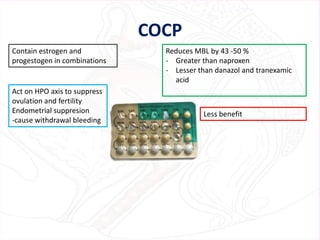
COCP
Contain estrogen and
progestogen in combinations
Act on HPO axis to suppress
ovulation and fertility
Endometrial suppresion
-cause withdrawal bleeding
Reduces MBL by 43 -50 %
- Greater than naproxen
- Lesser than danazol and tranexamic
acid
Less benefit
COCP
Mechanism of action:
endometrial suppression
Side effects;
headache, migraine, weight gain, breast
tenderness, nausea, cholestatic jaundice,
hypertension, thrombotic episodes,
Oral Hormones for AUB
What is the Evidence?
• Only one RCT of 45 patients for Combined oral contraceptive (COC)
• Mean blood loss (MBL) was reduced by 43-50%
• Better than Danazol and one NSAID but not another trialled
• Risks in older women and smokers plus side effects limit its use
• Progestin e.g. Norethisterone 5 mg TDS from Day 5 to 26 of a cycle is
effective in reducing (MBL)
– Luteal phase progestins are not effective
• Not as effective as NSAIDs and Tranexamic acid
• But MBL was reduced by 83% with long term use in 44 women CF Mirena
(94%) and this difference is not significant
• Side effects are limiting – weight gain, headaches, acne, mood changes,
mastalgia
GnRH-analogues
Synthetic peptide that act like a natural
GnRH but with longer biological half life
Action
1. Flare effect
-increase FSH and LH
2. Profoung hypogonadal effect
- after 10 days downregulation
No follicular development, estrogen
production, no ovulation, no
progeterone, no menses
Treatment
1. Hormonal sensitive cancer
-breast cancer, prostate cancer
2. Estrogen dependant lesion
- leiomyoma, endometriosis
Reduces MBL but with high adverse
effects
GnRH analog
Side effects;
hot flushes, sweats, headache,
irritability, loss of libido, vaginal
dryness, lethargy, reduced bone
density.
GnRH analogues for AUB
• Most studies have been directed at the reduction of uterine
size with these agents that induce a “reversible menopause”
• Reductions in uterine size up to 75% over 6m can occur
• And up to 90% of patients achieve amenorrhea
• This can be very useful prior to hysterectomy
• Oestrogen-deficiency symptoms i.e. hot flushes, vaginal
atrophy and bone loss are limiting
• But these can be overcome with add-back therepy using
small doses of oral oestrogen, COC, progestin or tibilone
• GnRH are currently very expensive drugs
RECOMMENDATION FOR
PHARMACEUTICAL APPROACH
Recommendations
• Considered in
- no structural or histological abnormalities
- fibroid <3 cm that not distort uterus
• Choices depends on wish to conceive
• If either can, follow order
1. LNG-IUS
2. Tranexamic acid or COCP
3. Oral Progestogen
• If treatment is needed during investigations or before
definite treatment
- tranexamic acid or NSAIDs
• If coexist with dysmenorrhea  NSAIDs
• Stop NSAIDs and tranexamic acid if no improvement
after 3 cycles
• GnRH-a
-recommended prior to surgery
-other treatments of uterine fibroids (UAE, surgery) is
contraindicated
• Not to be used as AUB treatment
-Danazol
- Oral progestogen during luteal phase
Surgical treatment
Endometrial ablation
Methods:
I.Hysteroscopic:
1. Laser
2. Electrosurgical: a. Roller ball
b. Resection
II.Non-hysteroscopic:
1. Thermachoice
2. Microwave.
Indications:
1. Failure of medical treatment
2. Family is completed
3. Uterine cavity <10 cm
4. Submucos fibroid <5 cm
5. Endometrium is normal or low
risk hyperplasia.
Complications of
hysteroscopic methods
1. Uterine perforation
2. Bleeding
3. Infection.
4. Fluid overload
5. Gas embolism
Uterine artery embolization (UAE)
Indications
- Heavy bleeding
- Large fibroids
How it works?
- Small particles introduced into artery supply to the uterus 
fibroid shrinks
Adverse outcomes
- Persistent vaginal discharge
- Post-embolisation syndrome: pain, nausea, vomiting and fever
- Need additional surgery
- Premature ovarian failure
- hematoma
Fertility
maintained!
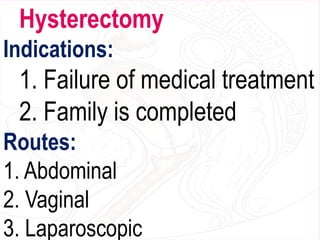
Hysterectomy
Indications:
1. Failure of medical treatment
2. Family is completed
Routes:
1. Abdominal
2. Vaginal
3. Laparoscopic
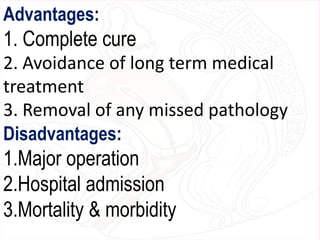
Advantages:
1. Complete cure
2. Avoidance of long term medical
treatment
3. Removal of any missed pathology
Disadvantages:
1.Major operation
2.Hospital admission
3.Mortality & morbidity
Endometrial Ablation or Hysterectomy
What is the Evidence?
• Systematic review 1999 of 5 RCTs with 706 patients
• Hysterectomy reduced MBL more (OR 0.12, CI 0.06 – 0.25)
• Greater patient satisfaction at 12m & 24m (OR 0.46, CI 0.24 –
0.88)
• Less pelvic pain on follow up (p<0.007)
• Better social functioning (p<0.007)
• Endometrial ablation had shorter hospital stay
• Fewer adverse outcomes
• More likely to require further surgery (OR 7.33, CI 4.18 – 12.86)
(1:5 patients go on to hysterectomy)
• As a result hysterectomy is as cost effective as EA
• But is associated with ↑rate of long term urinary symptoms
Uterine Artery Embolisation (UAE) or
Hysterectomy?
• 5 RCT’s 157+ patients showed that UAE better than
hysterectomy in terms of:
– Procedure time (Mean 16min less)
– Less blood loss (minimal with UAE CF av. 400 ml for hysterectomy )
– Fewer blood transfusions
– Shorter hospital stay (Mean 3.3 days less)
– Quicker return to normal duties (Mean 27 days less)
– Cheaper (UAE costs 65% those of hysterectomy)
• No difference between UAE and hysterectomy in terms of:
– Patient satisfaction
– Complication rates
• But UAE result in more readmissions (OR 6.00, CI 1.14 -31.53)
• And 13 – 30% UAE patients require further surgery
NICE Recommendations on Surgical Options
• Endometrial resection by a 2nd generation technique be
offered to all women with HMB provided that they have
completed their family
• If the uterus is <10w in size and or fibroids < 3 cm diameter
• A hysteroscopic technique is used when there are
submucous fibroids
• Practitioners and institutions be trained and competent for
EA
• Hysterectomy, uterine artery embolisation or myomectomy
be considered for fibroids >4 cm or uterus >10w size
Summary
• AUB is a common problem
• Mirena is offered as first line treatment and has
reduced need for hysterectomies significantly
• For women wanting to conceive in short term –
tranexamic acid and mefenamic acid appropriate
• For others COCP, norethisterone, Depo-provera
can be effective
• Surgical and radiological interventions available in
secondary care setting
AUB.Prof.Salah Roshdy

AUB.Prof.Salah Roshdy

  • 1.
  • 2.
    Objectives • Definitions &Diagnosis • The evidence base for recommended management • What tests are necessary & when • Treatment – Medical & Surgical – Indications & Options – Risks & Side Effects
  • 3.
    Normal Menstrual Cycle •Menstration is a cyclic physiological phenomena • starting at the age of Menarche (11- 14years) till establishment of Menopause (45-55 yrs). • It is regulated by hypothalmo-pituitary- ovarian hormones secreted in pulsatile and cyclic pattern.
  • 5.
    • Volume ofblood flow is assessed by number of pads / tampons used whether the pads are fully/ partially soaked , presence of clots. It can be better assessed by pictorial charts-- Pad Area Soaked 1st day 2nd Day 3rd Day 4th Day 5th day 6th Day 7th Day X 1 // / / X 5 /// // X20 /// Total Points 89(<1oo)- Nor mal blood Loss Tampons soaked X1 // // / / x 5 /// D X 15 ////// 111
  • 6.
    Arrest of Menstrualbleeding 1 Haemostasis by platelet plug and clot formation – starts soon the bleeding starts and open BV are plugged .once Blood vessels are plugged , fibrin deposition occurs --- Fibrinolysis also go hand in hand to balance and keep the blood loss fluid.
  • 7.
    Arrest of Menstrualbleeding • 2.Prostaglandin Mediation – Archadonic acid and Pg synthetase enzyme produce PGs ---pge2 – vasodilator, PGf2a--- vasoconstrictor and Thromboxane – vasoconstrictor. Estrogen produce PGE2 and PGF2a in ratio of 1:1 in proliferative phase ; while Progesterone produce PGE2 and PGF2a + thromboxane in 1: 2 ratio in premenstrual phase so balance is shifted towards vasoconstriction which help in control of bleeding.
  • 8.
    Arrest of Menstrualbleeding -- 3. Tissue Repair --- starts from the mouths of open endometrial glands in the denuded areas , endothelium out grows and covers the raw area under the influence of Epithelial Growth Factor ( EGF) and blood vessels regrow due to Vascular endothelial Growth Factor (VEGF). Thus the raw area of remaining basal endometrium is completely epithelized under Estrogen effect.
  • 9.
    Why do wehave to know about AUB?? • Abnormal uterine bleeding affects 10 to 30 percent of reproductive-aged women and up to 50 percent of perimenopausal women • It is a common reason for gynecologic consultation. • Responsible for over one third of hysterectomies.
  • 10.
    Terms abandoned inthe FIGO nomenclature system • Dysfunctional uterine bleeding • Functional uterine bleeding • Hypermenorrhea • Hypomenorrhea • Menorrhagia (all usages: essential menorrhagia, idiopathic menorrhagia,
  • 11.
    Terms abandoned inthe FIGO nomenclature system primary menorrhagia, functional menorrhagia, ovulatory menorrhagia,anovulatory menorrhagia). • Metrorrhagia • Metropathica hemorrhagica. • Oligomenorrhea • Polymenorrhagia • Polymenorrhea • Uterine hemorrhage
  • 12.
    Frasier I, Fertilityand Sterility 2007; 87:466-76 The “New Normal”: Proposed Terms for Vaginal Bleeding
  • 13.
    FIGO terminology system •Acute AUB Is now defined as “an episode of bleeding in a woman of reproductive age, who is not pregnant, that, is of sufficient quantity to require immediate intervention to prevent further blood loss
  • 14.
    FIGO terminology system •Chronic AUB is" bleeding from the uterine corpus that is abnormal in duration, volume, and/or frequency and has been present for the majority of the last 6 months
  • 15.
    Heavy Menstrual Bleeding •The term HMB is used to describe the woman’s perspective of increased menstrual volume, regardless of regularity, frequency, or duration
  • 16.
    National Institute of Healthand Clinical Excellence guidelines • “HMB should be defined as excessive menstrual blood loss which interferes with the woman’s physical, emotional, social and material quality of life, and which can occur alone or in combination with other symptoms
  • 17.
    Intermenstrual bleeding When awoman experiences episodes of bleeding that occur between normally timed menstrual periods. • Such bleeding can be cyclic and predictable, such as that often associated with ovulation.
  • 18.
    FIGO System forAUB, 2011
  • 19.
    AUB: Structural Conditions •P: Endometrial polyp – IMB or PCB in 30-50 year old woman • A: Adenomyosis – Dysmenorrhea, dyspareunia, chronic pelvic pain, sometimes menorrhagia • L: Leiomyoma – Submucous myoma – Menorrhagia; rarely IMB; never metrorrhagia
  • 20.
    AUB: Structural Conditions •M: Malignancy and hyperplasia – Adenomatous hyperplasia (AH) atypical AH  endometrial carcinoma • Post-menopausal bleeding • Recurrent perimenopausal metrorrhagia • Chronic anovulator (PCOS) with metrorrhagia – Leiomyosarcoma • Post-menopausal bleeding
  • 21.
    COEIN: Coagulopathy • Clottingfactor deficiency or defect – Liver disease – Congenital (Von Willebrands Disease) • Platelet deficiency (thrombocytopenia) with platelet count <20,000/mm3 – Idiopathic thrombocytopenic purpura (ITP) – Aplastic anemia • Platelet function defects
  • 22.
    COEIN: Coagulopathy Screen forunderlying disorder of hemostasis if any of • Heavy menstrual bleeding since menarche • One of the following – Post-partum hemorrhage – Bleeding associated with surgery – Bleeding associated with dental work • Two or more of the following – Bruising 1-2 times per month – Epistaxis 1-2 times per month – Frequent gum bleeding – Family history of bleeding symptoms Munro M, Int J Gynecol Obstet (2011)
  • 23.
    COEIN: Ovulatory • Anovulation –Age:peri-menarche and perimenopuse –PCOS –Stress • Hypothyroidism • Luteal phase defects
  • 24.
    COEIN: Ovulatory • Mainlydue to anovulatory bleeding – Age-related: peri-menarche, perimenopause – Estrogenic: unopposed exogenous or endogenous estrogen – Androgenic: PCOS; CAH, acute stress – Systemic: Renal disease, liver disease • Diagnosis of exclusion – Menometrorrhagia not due to by anatomic lesion, medications, pregnancy
  • 25.
    COEIN: Ovulatory • Hyperthyroidismor hypothyroidism – Bleeding can be excessive, light, or irregular – Only severe, uncorrected thyroid disease causes abnormal bleeding patterns – Normal pattern when corrected to euthyroid – 1o hypothyroidism assoc. with 2o amenorrhea Low T4 high TRH  high TSH  normal T4 high PRL amenorrhea + galactorrhea
  • 26.
    COEIN: Ovulatory • LutealPhase Defect (LPD) – Luteal phase lasts 7-10 days (vs. 14 days) or inadequate peak luteal phase progesterone (P) • Diagnosis – Polymenorrhea (“periods every 2 weeks”) – Mid-luteal phase P level between 4-8 ng/ml – Endometrial biopsy >2 days out of phase
  • 27.
    COEIN: Endometrial • Idiopathic –Unexplained menorrhagia • Endometritis – Post-partum – Post-abortal endometritis – Endometritis component of PID • In teens, PID commonly presents with abnormal bleeding (menorrhagia, IMB), not pelvic pain – Any teen with abnormal bleeding + pelvic pain requires bimanual exam to evaluate for PID
  • 28.
    COEIN: Iatrogenic Conditions •Anticoagulants – Over-anticoagulation: menorrhagia – Therapeutic levels will not cause bleeding problems • Chronic steroids, opiates • Progestin-containing contraceptives • Intrauterine Contraception (IUC) – "Normal" side effect menorrhagia – PID, pregnancy (IUP or ectopic), perforation, expulsion
  • 29.
    COEIN: Not Classified •Chronic endometritis • AVM • Myometrial hypertrophy
  • 30.
    FIGO classification systemfor causes of abnormal uterine bleeding in the reproductive years
  • 31.
    Diagnostic management • History •Any known uterine disease, induced vaginal bleeding. • Risk factors for hypothyroidism and any personal or family history of disorders of hemostasis must be sought with specific questions(Grade B)
  • 32.
    • Age • Ageat menarche. • Parity. • Menstrual History—regularity, frequency, duration of bleeding , Volume of blood loss. • Post coital bleeding ? • Dysmenorrhoea – spasmodic / congestive . • Dyspareunia. • O.H.---fertility / infertility/ gravidity / parity etc. • Associated Vaginal Discharge . • Recent Abortion / delivery / ectopic pregnancy . • IUCD insertion , ocs, hormone therapy/ drugs.
  • 33.
    Clinical Examination • Acomplete clinical examination is recommended, including checking for signs of anemia, abdominal palpation, and a cervical examination, both digital and with a speculum , except for virgins or adolescents. • When the history suggests nothing relevant, the pictogram is normal, the clinical examination is normal and no sign of anemia is present, no diagnostic investigation is recommended (Grade C).
  • 34.
    laboratory Investigations • CBC •Blood coagulation profile • TFT if there is any risk factors • B HCG
  • 35.
    Imaging examinations • Pelvicultrasound: both abdominal and transvaginal, is recommended as a first-line procedure for the etiological diagnosis of AUB (Grade A). • Doppler ultrasonography provides additional information useful for characterizing endometrial and myometrial abnormalities (Grade B).
  • 36.
    Hysteroscopy or SIS •Uterine exploration: Hysteroscopy or SIS can be suggested as a second-line procedure when ultrasound suggests an intrauterine abnormality or if medical treatment fails after 3–6 months (Grade B).
  • 37.
    Endometrial biopsy • Anendometrial biopsy must be performed in the case of any risk factor for endometrial cancer and for all patients older than 45 years (Grade C). • A biopsy sample should be obtained with a polypropylene endometrial suction curette (Pipelle de Cormier)during the diagnostic hysteroscopy (Grade B) • Diagnostic curettage under general anesthesia is not recommended as a first-line treatment (Grade A). • Hysteroscopic directed biopsies .
  • 39.
    Which Test? What isthe Evidence? • Systematic Review of TVS (10 studies), Saline I Sonography (SIS, 11 studies) and Hysteroscopy (3 studies) for the identification of any pathology • TVS – Sensitivity 48 – 100% – Specificity 12 – 100% • SIS – Sensitivity 85 – 100% – Specificity 50– 100% • Hysteroscopy – Sensitivity 90 – 97% – Specificity 62 – 93% • Ultrasound better for the identification of fibroids • SIS and Hysteroscopy better for the identification of polyps
  • 40.
  • 41.
    B. Medical I. Hormonal: 1.Progestagen 2.Oestrogen 3.COCP 4.Danazol 5.GnRhagonist 6.Levo-nova (Mirena) II. Non –hormonal 1.Prostaglandin synthetase inhibitors (PSI) 2.Antifibrinolytics 3.Ethamsylate
  • 42.
    C. Surgical 1. Endometrialablation 2. UAE 3. Hysterectomy
  • 43.
    Tranexamic acid Competitive inhibitorof plasminogen activator -antifibrinolytic agents Menorrhagia -Reduced breakdown of fibrin preformed clot in spiral endometrium arterioles  reduce MBL Reduce MBL by 34-59% Cost effective when compared with other NSAIDS and no treatment -not when compared with LNG-IUSHowever, -not reduce dysmenorrhea -not a contraceptive -not regulate cycles Dosage: 1g ( 2 tablets) 3-4x daily from onset of bleeding up to 4 days
  • 44.
    Mechanism of action: Theendometrium possess an active fibrinolytic system, & the fibrinolytic activity is higher in menorrhagia. Effect: Greater reduction of menstrual bleeding than other therapies (PSI, oral luteal phase progestagen & ethamsylate)(Cochrane library,2002). Tranexamic acid is effective in treating menorrhagia associated with IUCD.
  • 45.
    Side effects: isdose related. Nausea , vomiting, diarrhea, dizziness. Rarely: transient color vision disturbance, intracranial thrombosis. But, no evidence that tranxemic acid increases the risk in absence of past or family history of thrombophilia. (Cochrane library,2002).
  • 46.
    NSAIDs Reduce prostaglandin synthesisby inhibiting COX Prostaglandin: - Inflammatory response - Pain pathways - Uterine cramps - Uterine bleeds Reduces MBL 20-49% but tranexamic acid and danazol reduces MBL greater -better AE profile than danazol Less cost effective than LNG and tranexamic acid Treatment of dysmenorrhea However, - Not contraceptions - Not to be used in bleeding disorders
  • 47.
    Cyclooxygenase Pathway Arachidonic Acid Prostaglandins ThromboxaneProstacyclin* cyclic endoperoxides are inhibited, therefore this step is blocked X *Causes vasodilation and inhibits platelet aggregation
  • 48.
    Mechanism; the endometrium isa rich source of PGE2 & PGF2œ & its concentrations are greater in menorrhagia. PSI decreases endometrial PG concentrations. Effect: PSI decreased menstrual blood by 24% & norethisterone by 20%. The beneficial effect of mefenamic acid on MBL & other symptoms e.g. dysmenorrhea, headache, nausea, diarrhea & depression persists for several months.
  • 49.
    Dose: Mefenamic acid 500mg tds during menses. Side effects: nausea, vomiting, gastric discomfort, diarrhea, dizziness. Rarely: haemolytic anemia, thrombocytopenia. The degree of reduction of MBL is not as great as it is with tranxamic acid but PSI have a lower side effect profile.
  • 50.
    Ethamsylate: Mechanism of action: maintaincapillary integrity, anti- hyalurunidase activity & inhibitory effect on PG Dose: 500 mg qid, starting 5 days before anticipated onset of the cycle & continued for 10 days
  • 51.
    Effect: 20% reduction inMBL. There is no conclusive evidence of the effectivness of ethamsylate in reducing menorrhgea (Grade A) Side effects: headache, rash, nausea
  • 52.
    Summary of Non-HormonalDrugs • Tranexemic acid is more effective than NSAIDs • But both can be used together • And either can be continued long term if benefit is obtained • But should be stopped if there is no response after 3 cycles • Neither are contraceptive or cycle regulating • NSAID is the drug of 1st choice when there is concomitant dysmenorrhoea • All of the trials excluded women with fibroids so their role in menorrhagia with fibroids is uncertain
  • 53.
    Systemic progestagens: Norethisterone &medroxyprogesterone acetate Ovulatory DUB: not effective if given at low dose for short duration (5-10 days) in the luteal phase. Effective if NEA is given at higher dose for 3 w out of 4 w (5 mg tds from D5 to 26) Anovulatory DUB: useful Side effects: weight gain, nausea, bloating, edema, headache, acne, depression, exacerbation of epilepsy & migraine, loss of libido
  • 54.
    Progestins: Mechanisms ofAction • Inhibit endometrial growth –Inhibit synthesis of estrogen receptors –Promote conversion of estradiol  estrone –Inhibit LH • Organized slough to basalis layer • Stimulate arachidonic acid formation
  • 55.
  • 56.
    Progestational Agents • Cyclicmedroxyprogesterone 2.5-10mg daily for 10-14 days • Continuous medroxyprogesterone 2.5-5mg daily • Progesterone in oil, 100mg every 1 week • DepoProvera® 150mg IM every 3 months • Levonorgestrel IUD (5 years)
  • 57.
    LNG-IUS Vertical stem: releasedaily doses of 20 micrograms of LNG Effects: -prevent endometrial proliferation -thicken cervical mucus -suppress ovulation Cost effective when compared with other hormonal and non hormonal treatments Reduction of MBL between 71-96% -benefit seen after 6 months
  • 58.
    Effect; 1.Comparable to endometrial resectionfor management of AUB. 2.Superior to PSI & antifibrinolytics 3.May be an alternative to hysterectomy in some patients
  • 59.
    Side effects; 1.BTB inthe first cycles 2.20% develop amenorrhea within 1 yr 3.Functional ovarian cysts Special indications: 1. Intractable bleeding associated with chronic illness 2. Ovulatory heavy bleeding
  • 60.
    Meta-Analysis: Mirena® vs.Ablation for AUB • No difference between rates of treatment failures –21.2% LNG-IUS vs. 17.9% endometrial ablation • Both methods resulted in similar improvements in quality of life • Less need for analgesia/anesthesia in LNG-IUS group • Ablation requires additional effective contraceptionKaunitz, et al. OG. 2009 May;113(5):1104-16b.
  • 61.
    The Mirena IUSfor AUB What is the Evidence? • Systematic Review of 10 RCT’s that compare Mirena with other hormonal methods of treatment, endometrial ablation & hysterectomy • Reduces mean menstrual loss by 71 – 96% • Up to 50% of patients amenorrhoeic after 6m depending on age • ≈ 85% patients are satisfied (and continuation rate) • ≈ 1% rate of troublesome hormonal side effects When compared to endometrial ablation (EA).
  • 62.
    The Mirena IUSfor AUB What is the Evidence? – Mean reduction in blood loss is greater with EA – But overall satisfaction equal – And Mirena better in the longer term (1 small study) • When compared to hysterectomy – Overall satisfaction rates are equal – But Mirena is half the cost even when up to 40% of patients go on to hysterectomy
  • 63.
    COCP Contain estrogen and progestogenin combinations Act on HPO axis to suppress ovulation and fertility Endometrial suppresion -cause withdrawal bleeding Reduces MBL by 43 -50 % - Greater than naproxen - Lesser than danazol and tranexamic acid Less benefit
  • 64.
    COCP Mechanism of action: endometrialsuppression Side effects; headache, migraine, weight gain, breast tenderness, nausea, cholestatic jaundice, hypertension, thrombotic episodes,
  • 65.
    Oral Hormones forAUB What is the Evidence? • Only one RCT of 45 patients for Combined oral contraceptive (COC) • Mean blood loss (MBL) was reduced by 43-50% • Better than Danazol and one NSAID but not another trialled • Risks in older women and smokers plus side effects limit its use • Progestin e.g. Norethisterone 5 mg TDS from Day 5 to 26 of a cycle is effective in reducing (MBL) – Luteal phase progestins are not effective • Not as effective as NSAIDs and Tranexamic acid • But MBL was reduced by 83% with long term use in 44 women CF Mirena (94%) and this difference is not significant • Side effects are limiting – weight gain, headaches, acne, mood changes, mastalgia
  • 66.
    GnRH-analogues Synthetic peptide thatact like a natural GnRH but with longer biological half life Action 1. Flare effect -increase FSH and LH 2. Profoung hypogonadal effect - after 10 days downregulation No follicular development, estrogen production, no ovulation, no progeterone, no menses Treatment 1. Hormonal sensitive cancer -breast cancer, prostate cancer 2. Estrogen dependant lesion - leiomyoma, endometriosis Reduces MBL but with high adverse effects
  • 67.
    GnRH analog Side effects; hotflushes, sweats, headache, irritability, loss of libido, vaginal dryness, lethargy, reduced bone density.
  • 68.
    GnRH analogues forAUB • Most studies have been directed at the reduction of uterine size with these agents that induce a “reversible menopause” • Reductions in uterine size up to 75% over 6m can occur • And up to 90% of patients achieve amenorrhea • This can be very useful prior to hysterectomy • Oestrogen-deficiency symptoms i.e. hot flushes, vaginal atrophy and bone loss are limiting • But these can be overcome with add-back therepy using small doses of oral oestrogen, COC, progestin or tibilone • GnRH are currently very expensive drugs
  • 69.
  • 70.
    Recommendations • Considered in -no structural or histological abnormalities - fibroid <3 cm that not distort uterus • Choices depends on wish to conceive • If either can, follow order 1. LNG-IUS 2. Tranexamic acid or COCP 3. Oral Progestogen
  • 71.
    • If treatmentis needed during investigations or before definite treatment - tranexamic acid or NSAIDs • If coexist with dysmenorrhea  NSAIDs • Stop NSAIDs and tranexamic acid if no improvement after 3 cycles • GnRH-a -recommended prior to surgery -other treatments of uterine fibroids (UAE, surgery) is contraindicated
  • 72.
    • Not tobe used as AUB treatment -Danazol - Oral progestogen during luteal phase
  • 73.
    Surgical treatment Endometrial ablation Methods: I.Hysteroscopic: 1.Laser 2. Electrosurgical: a. Roller ball b. Resection II.Non-hysteroscopic: 1. Thermachoice 2. Microwave.
  • 74.
    Indications: 1. Failure ofmedical treatment 2. Family is completed 3. Uterine cavity <10 cm 4. Submucos fibroid <5 cm 5. Endometrium is normal or low risk hyperplasia.
  • 75.
    Complications of hysteroscopic methods 1.Uterine perforation 2. Bleeding 3. Infection. 4. Fluid overload 5. Gas embolism
  • 76.
    Uterine artery embolization(UAE) Indications - Heavy bleeding - Large fibroids How it works? - Small particles introduced into artery supply to the uterus  fibroid shrinks Adverse outcomes - Persistent vaginal discharge - Post-embolisation syndrome: pain, nausea, vomiting and fever - Need additional surgery - Premature ovarian failure - hematoma Fertility maintained!
  • 77.
    Hysterectomy Indications: 1. Failure ofmedical treatment 2. Family is completed Routes: 1. Abdominal 2. Vaginal 3. Laparoscopic
  • 78.
    Advantages: 1. Complete cure 2.Avoidance of long term medical treatment 3. Removal of any missed pathology Disadvantages: 1.Major operation 2.Hospital admission 3.Mortality & morbidity
  • 79.
    Endometrial Ablation orHysterectomy What is the Evidence? • Systematic review 1999 of 5 RCTs with 706 patients • Hysterectomy reduced MBL more (OR 0.12, CI 0.06 – 0.25) • Greater patient satisfaction at 12m & 24m (OR 0.46, CI 0.24 – 0.88) • Less pelvic pain on follow up (p<0.007) • Better social functioning (p<0.007) • Endometrial ablation had shorter hospital stay • Fewer adverse outcomes • More likely to require further surgery (OR 7.33, CI 4.18 – 12.86) (1:5 patients go on to hysterectomy) • As a result hysterectomy is as cost effective as EA • But is associated with ↑rate of long term urinary symptoms
  • 80.
    Uterine Artery Embolisation(UAE) or Hysterectomy? • 5 RCT’s 157+ patients showed that UAE better than hysterectomy in terms of: – Procedure time (Mean 16min less) – Less blood loss (minimal with UAE CF av. 400 ml for hysterectomy ) – Fewer blood transfusions – Shorter hospital stay (Mean 3.3 days less) – Quicker return to normal duties (Mean 27 days less) – Cheaper (UAE costs 65% those of hysterectomy) • No difference between UAE and hysterectomy in terms of: – Patient satisfaction – Complication rates • But UAE result in more readmissions (OR 6.00, CI 1.14 -31.53) • And 13 – 30% UAE patients require further surgery
  • 81.
    NICE Recommendations onSurgical Options • Endometrial resection by a 2nd generation technique be offered to all women with HMB provided that they have completed their family • If the uterus is <10w in size and or fibroids < 3 cm diameter • A hysteroscopic technique is used when there are submucous fibroids • Practitioners and institutions be trained and competent for EA • Hysterectomy, uterine artery embolisation or myomectomy be considered for fibroids >4 cm or uterus >10w size
  • 83.
    Summary • AUB isa common problem • Mirena is offered as first line treatment and has reduced need for hysterectomies significantly • For women wanting to conceive in short term – tranexamic acid and mefenamic acid appropriate • For others COCP, norethisterone, Depo-provera can be effective • Surgical and radiological interventions available in secondary care setting