CHRONIC PELVIC PAIN
Professor and Unit Chief, L.T.M.M.C & L.T.M.G.H, Sion Hospital
Joint Treasurer, FOGSI (2021-2024)
Vice President, MOGS (2021-2022)
Member Oncology Committee, SAFOG (2020-2021) (2021-2023)
Dean AGOG & Chief Content Director, HIGHGRAD & FEMAS Courses
Editor-in-Chief, FEMAS & JGOG Journal
50 publications in International and National Journals with 60 citations
National Coordinator, FOGSI Medical Disorders in Pregnancy Committee
(2019-2021)
Chair & Convener, FOGSI Cell Violence Against Doctors (2015-16)
Member, Oncology Committee AOFOG (2013-2015)
Coordinator of 11 batches of MUHS recognized Certificate Course of B.I.M.I.E at
L.T.M.G.H (2010-16)
Member, Managing Committee IAGE (2013-17), (2018-20)
Editorial Board, European Journal of Gynaec. Oncology (Italy)
Course Coordinator of 3 batches of Advanced Minimal Access Gynaec Surgery
(AMAS) at LTMGH (2018-19)
DR. NIRANJAN CHAVAN
MD, FCPS, DGO, MICOG, DICOG, FICOG, DFP
,
DIPLOMA IN ENDOSCOPY (USA)
CHRONIC PELVIC PAIN
• RCOG (2017) defines chronic pelvic pain as intermittent
or constant pain in the lower abdomen or pelvis of a
woman of at least 6 months in duration, not occurring
exclusively with menstruation or intercourse and not
associated with pregnancy.
• It is a symptom not a diagnosis, causing functional
disability or requires treatment.
• CPP is an inclusive general term that encompasses
many more specific causes like reproductive,
gastrointestinal and urinary tract etiologies to
myofascial pain and nerve entrapment syndromes.
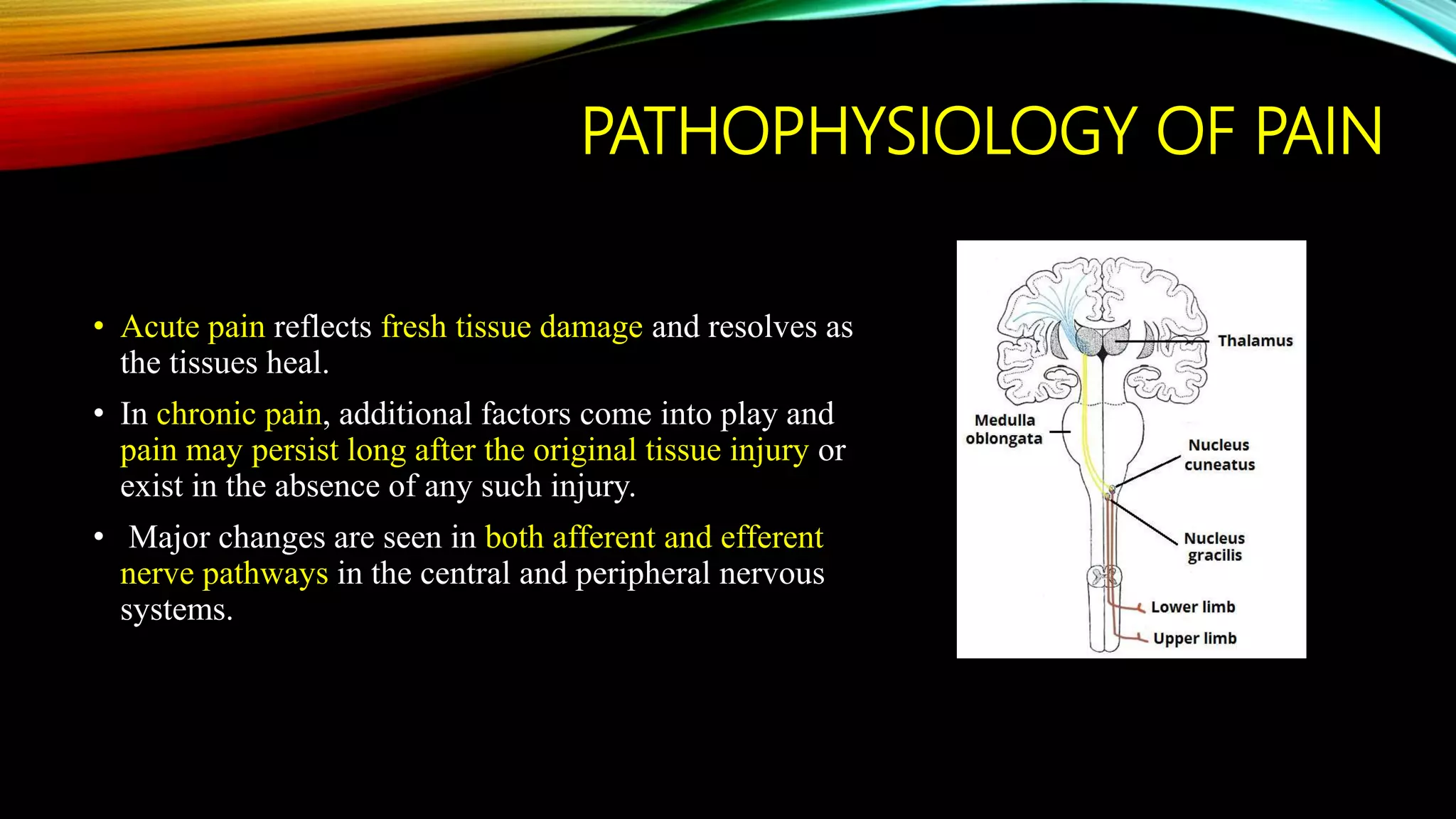
PATHOPHYSIOLOGY OF PAIN
• Acute pain reflects fresh tissue damage and resolves as
the tissues heal.
• In chronic pain, additional factors come into play and
pain may persist long after the original tissue injury or
exist in the absence of any such injury.
• Major changes are seen in both afferent and efferent
nerve pathways in the central and peripheral nervous
systems.
• Local factors, such as tumour necrosis factor alpha
(TNF-ALPHA) and chemokines, may change peripheral
nerve function and/or stimulate normally quiescent
fibres, resulting in altered sensation over a wider area
than that originally affected.
• Descending information from the central nervous
system, possibly influenced by previous experiences and
current circumstances, may modify pain perception and
visceral function.
• Alteration in visceral sensation and function,
provoked by a variety of neurological factors, has
been termed ‘visceral hyperalgesia’.
• Nerve damage following surgery, trauma,
inflammation, fibrosis or infection may play a part in
this process.
• Pain as a result of changes in the nerve itself is termed
‘neuropathic pain’ and is characteristically, but not
exclusively, burning, aching or shooting in nature.
EVALUATION
• HISTORY: Ask the patient about the
• Location
• Radiation
• Severity
• Aggravating factors
• Alleviating factors
• Effect of menstrual cycle
• Stress/Work/Exercise/Intercourse
• Context in which pain arises
• Social and occupational toll of the pain
• A visual or analogue pain scale should be used to grade
the pain.
• The evaluation should also include a comprehensive
questionnaire that addresses depression, anxiety,
emotional, physical and sexual trauma and quality of
life.
• Diagrams of woman’s abdomen, back and genital area
should be used to help the patient locate the pain.
CAUSES
REPRODUCTIVE
CAUSE
1. Endometriosis
2. Adhesions
3. Pelvic congestion
syndrome
4. Residual ovarian
syndrome
GASTRO
INTESTINAL CAUSE
1. Irritable Bowel
Syndrome
UROLOGIC
CAUSES
1. Interstitial cystitis
2. Urethral Syndrome
NEUROLOGIC AND
MUSCULOSKELETAL
1. Nerve Entrapment
Syndrome
REPRODUCTIVE TRACT CAUSE
ENDOMETRIOSIS
• Its can be demonstrated in 15 to 40% of patients
undergoing laparoscopy for CPP.
• There is no correlation between the location of disease and
pain symptoms.
• Prostaglandin E and F2 alpha production from
explants of petechial lesions present in mild, low-stage
disease was found to be significantly greater than
that from explants of powder burn of black lesions,
which are more common in patients with higher stage
endometriosis.
• Thus prostaglandin and cytokine production may
account for severe pain in some patients with mild
disease.
ADHESIONS
• Adhesions may be a cause of pain, particularly on organ
distension or stretching. Dense vascular adhesions may
cause chronic pelvic pain. However, adhesions may be
asymptomatic. Evidence to demonstrate that adhesions
cause pain or that laparoscopic division of adhesions
relieves pain is lacking.
• Adhesions may be caused by endometriosis, previous
surgery or previous infection.
• Surgery for adhesiolysis may lead to further
adhesion formation and organ injury.
• Therefore lysis is not recommended unless
there is intermittent partial bowel obstruction
or infertility.
PELVIC CONGESTION
• Pelvic congestion involves congestion or dilatation of
uterine and/or ovarian venous plexus.
• It results from compression of the left renal vein at the
origin of the superior mesenteric artery, also known as
“nutcracker syndrome”.
• It generally effects women of reproductive age group
an causes bilateral lower abdominal pain and back pain
which may increase with standing for long hours,
secondary dysmenorrhoea, dyspareunia, abnormal
uterine bleeding, chronic fatigue and irritable bowel
syndrome.
• Diagnosis is done clinically, MRI or transuterine
venography maybe used.
• It can be treated by hormonal suppression, ovarian vein
embolization or hysterectomy with bilateral salpingo-
opherectomy.
RESIDUAL OVARY SYNDROME
• Residual ovary syndrome- A small amount of ovarian
tissue inadvertently left behind following
oophorectomy which may become buried in
adhesions.
• Trapped ovary syndrome- A retained ovary becomes
buried in dense adhesions post-hysterectomy.
• Symptoms include lateralizing pelvic pain, often
cycling with ovulation or the luteal phase that is
described as sharp and stabbing or constant and dull
and non radiating.
• Symptoms generally arise 2 to 5 years after initial
operation.
• Removal of all ovarian tissue or suppression using a
GnRH analogue may relieve pain.
GASTROENTEROLOGIC ETIOLOGY
IRRITABLE BOWEL SYNDROME
• Irritable bowel syndrome (IBS) is a common disorder that
affects the large intestine.
• Signs and symptoms include cramping, abdominal pain,
bloating, gas, and diarrhea or constipation, or both.
• IBS is a chronic condition and pain in exacerbated by
events that increase GIT motility like eating, stress,
anxiety, depression and menses.
• Treatment include :
• Reassurance, education, stress reduction, bulk
forming agents and other symptomatic treatments and
maybe low dose tricyclic antidepressants.
UROLOGIC ETIOLOGY
URETHRAL SYNDROME
• It is a symptom complex including dysuria,
frequency and urgency of urination, suprapubic
discomfort, and other dysparenuria in absence of
any abnormality of the urethra or bladder.
• Treatment in absence of UTI include 2 to 3 weeks
of doxycycline or erythromycin to treat sterile
pyuria.
• All postmenopausal females should be given
oestrogen creams for at least 2 months.
INTERSTITIAL CYSTITIS/BLADDER PAIN
SYNDROME
• It occurs in females between 40 to 60 years of age.
• It is defined as suprapubic pain related to bladder filling, accompanied by other symptoms
like increased daytime and night time frequency in absence of infection or any other obvious
pathology.
• Diagnosis is done by exclusion.
• Treatment involves behavioural modification,
bladder training, stress management, dietary
modification, restriction of acidic, spicy and
fermented foods and pelvic floor muscle
physiotherapy.
NEUROLOGIC AND
MUSCULOSKELETAL CAUSES
NERVE ENTRAPMENT
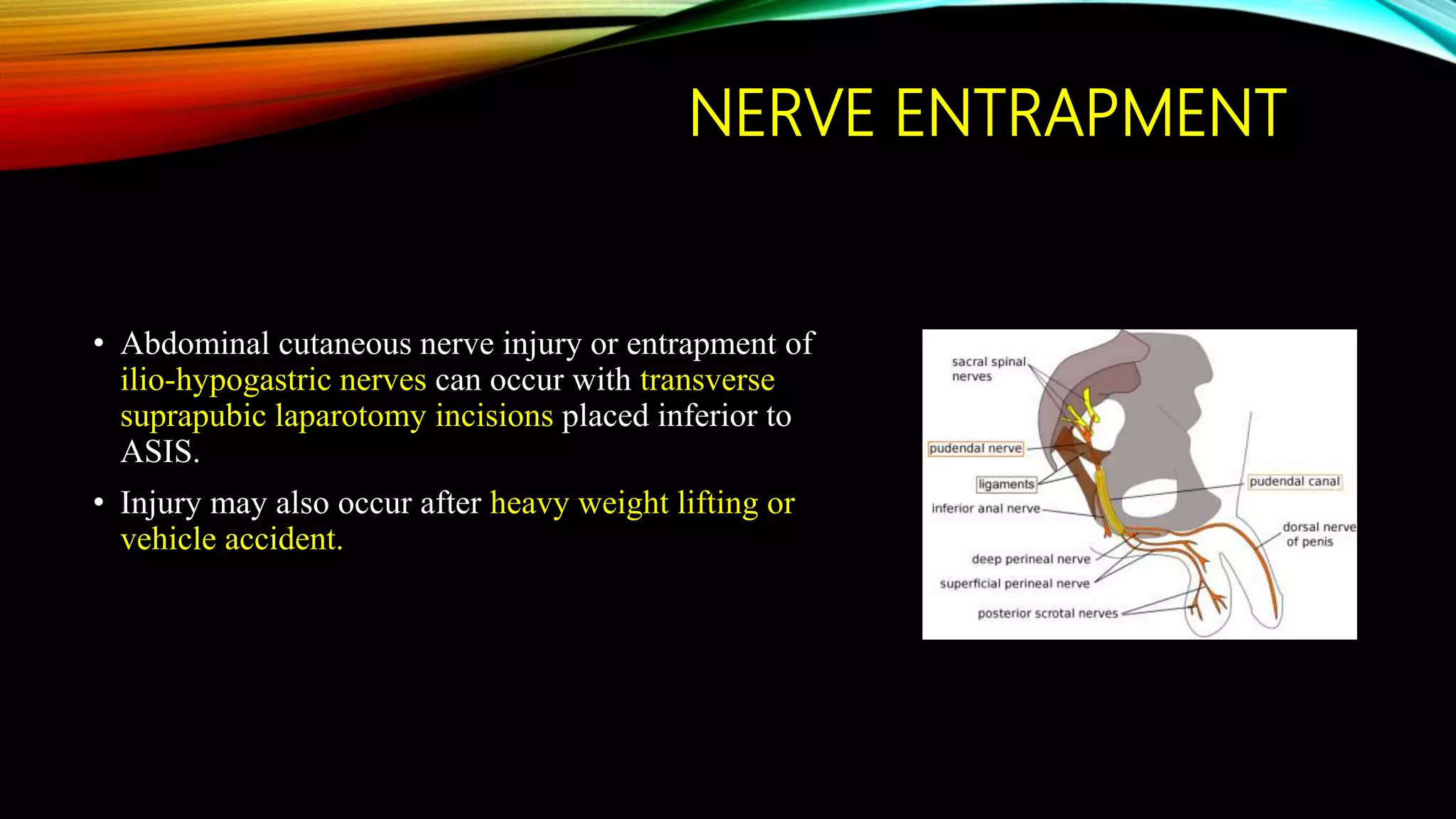
• Abdominal cutaneous nerve injury or entrapment of
ilio-hypogastric nerves can occur with transverse
suprapubic laparotomy incisions placed inferior to
ASIS.
• Injury may also occur after heavy weight lifting or
vehicle accident.
• Pudendal nerve injury may also occur from Vaginal
surgeries, childbirth, exercise, chronic constipation
of pelvic floor muscle abnormalities.
• Management includes nerve block, physiotherapy
and avoiding activities that causes pain.
PSYCHOLOGY AND CPP
• Patients with CPP are often anxious and depressed.
• Their marital, sexual, social and occupational lives are
disrupted.
• Many patients present with psychiatric co morbidities
while some women develop secondary symptoms as a
result of CPP.
• For some individuals, child sexual abuse may initiate a
cascade of events or reactions which make an individual
more vulnerable to the development of chronic pelvic pain
as an adult.
• Women who continue to be abused are particularly at risk.
INVESTIGATIONS
• 1. High Vaginal Swabs/ Pap smear:
• All sexually active women with chronic pelvic pain
should be offered screening for sexually transmitted
infections (STIs). Suitable samples to screen for
infection, particularly Chlamydia trachomatis and
gonorrhoea, should be taken if there is any suspicion of
pelvic inflammatory disease (PID).
• 2. Transvaginal Scan:
• A systematic review of the value of TVS in the
diagnosis of endometriosis found that endometriomas
may be accurately distinguished from other adnexal
masses. It is also useful in identifying structural
abnormalities such as hydrosalpinxes or fibroids,
which may be relevant even if not the cause of the
pain.
• 3. MRI:
While MRI lacks sensitivity in the detection of
endometriotic deposits, it may be useful in the assessment
of palpable nodules in the pelvis or when symptoms
suggest the presence of rectovaginal disease. It may also
reveal rare pathology.
• 4. Diagnostic Laproscopy:
Diagnostic laparoscopy is the only test capable of reliably
diagnosing peritoneal endometriosis and adhesions.
Diagnostic laparoscopy has been regarded in the past as
the ‘gold standard’ in the diagnosis of chronic pelvic pain.
One-third to one-half of diagnostic laparoscopies will be
negative and much of the pathology identified is not
necessarily the cause of pain.
• It should be performed only when the index of
suspicion of adhesive disease or endometriosis
requiring surgical intervention is high, or when the
patient has specific concerns which could be
addressed by diagnostic laparoscopy such as the
existence of endometriosis or adhesions potentially
affecting her fertility.
• 5. CA-125:
• Women reporting any of the following symptoms
persistently or frequently (more than 12 times
per month) – bloating, early satiety, pelvic pain
or urinary urgency or frequency – should have a
serum CA125 measurement taken to rule our
Carcinoma ovary.
• Particularly in women over the age of 50 years,
any new IBS symptoms should prompt such
action.
MANAGEMENT
1. MULTIDISCIPLINARY APPROACH: A
multidisciplinary team approach including
physician, psychiatric counselling and
physiotherapy is required. Regular follow up of
patient with scheduled appointments is necessary.
• PHARMACOLOGICAL INTERVENTIONS:
NSAIDs, Low dose Tricyclic Antidepressants,
Gabapentin, Pregabalin, Nerve blockers may
be used. Role of opioids in CPP is
controversial.
• PHYSIOTHERAPY
1. LAPAROSCOPY: It maybe done in evaluation
of patients with chronic non cyclic pelvic pain
or in patients having concurrent fertility issues.
Para-sacral neurectomy or Laparoscopic
uterosacral nerve Ablation (LUNA) can be
considered.
• HYSTERECTOMY- it is indicated in patients who
have completed their family and have
adenomyosis, endometriosis or pelvic congestion.
TAKE HOME MESSAGE
• Chronic pelvic pain is not just a gynaecological
issue and requires multidisciplinary approach for its
management.
• Psychological factors play an important role in its
genesis and thus behavioural therapy should be
started for all patients.
• Laparoscopy should be reserved for cases requiring
help with diagnosis, having infertility or requiring
interventions like LUNA.
REFERENCES
1. https://www.rcog.org.uk/globalassets/documents/guidelines/gtg_41.pdf
2. Clemens JQ, Kutch JJ, Mayer EA, et al. The Multidisciplinary Approach to The Study of
Chronic Pelvic Pain (MAPP) Research Network*: Design and implementation of the
Symptom Patterns Study (SPS). Neurourol Urodyn. 2020;39(6):1803-1814.
doi:10.1002/nau.24423
3. Berek, J., & Berek, D. (2020). Berek & Novak's gynecology (16th ed.). Philadelphia:
Wolters Kluwer.
4. Adamian L, Urits I, Orhurhu V, et al. A Comprehensive Review of the Diagnosis,
Treatment, and Management of Urologic Chronic Pelvic Pain Syndrome. Curr Pain
Headache Rep. 2020;24(6):27. Published 2020 May 6. doi:10.1007/s11916-020-00857-9
Chronic pelvic pain
Chronic pelvic pain

Chronic pelvic pain

  • 1.
  • 2.
    Professor and UnitChief, L.T.M.M.C & L.T.M.G.H, Sion Hospital Joint Treasurer, FOGSI (2021-2024) Vice President, MOGS (2021-2022) Member Oncology Committee, SAFOG (2020-2021) (2021-2023) Dean AGOG & Chief Content Director, HIGHGRAD & FEMAS Courses Editor-in-Chief, FEMAS & JGOG Journal 50 publications in International and National Journals with 60 citations National Coordinator, FOGSI Medical Disorders in Pregnancy Committee (2019-2021) Chair & Convener, FOGSI Cell Violence Against Doctors (2015-16) Member, Oncology Committee AOFOG (2013-2015) Coordinator of 11 batches of MUHS recognized Certificate Course of B.I.M.I.E at L.T.M.G.H (2010-16) Member, Managing Committee IAGE (2013-17), (2018-20) Editorial Board, European Journal of Gynaec. Oncology (Italy) Course Coordinator of 3 batches of Advanced Minimal Access Gynaec Surgery (AMAS) at LTMGH (2018-19) DR. NIRANJAN CHAVAN MD, FCPS, DGO, MICOG, DICOG, FICOG, DFP , DIPLOMA IN ENDOSCOPY (USA)
  • 4.
    CHRONIC PELVIC PAIN •RCOG (2017) defines chronic pelvic pain as intermittent or constant pain in the lower abdomen or pelvis of a woman of at least 6 months in duration, not occurring exclusively with menstruation or intercourse and not associated with pregnancy. • It is a symptom not a diagnosis, causing functional disability or requires treatment.
  • 5.
    • CPP isan inclusive general term that encompasses many more specific causes like reproductive, gastrointestinal and urinary tract etiologies to myofascial pain and nerve entrapment syndromes.
  • 6.
    PATHOPHYSIOLOGY OF PAIN •Acute pain reflects fresh tissue damage and resolves as the tissues heal. • In chronic pain, additional factors come into play and pain may persist long after the original tissue injury or exist in the absence of any such injury. • Major changes are seen in both afferent and efferent nerve pathways in the central and peripheral nervous systems.
  • 7.
    • Local factors,such as tumour necrosis factor alpha (TNF-ALPHA) and chemokines, may change peripheral nerve function and/or stimulate normally quiescent fibres, resulting in altered sensation over a wider area than that originally affected. • Descending information from the central nervous system, possibly influenced by previous experiences and current circumstances, may modify pain perception and visceral function.
  • 8.
    • Alteration invisceral sensation and function, provoked by a variety of neurological factors, has been termed ‘visceral hyperalgesia’. • Nerve damage following surgery, trauma, inflammation, fibrosis or infection may play a part in this process. • Pain as a result of changes in the nerve itself is termed ‘neuropathic pain’ and is characteristically, but not exclusively, burning, aching or shooting in nature.
  • 9.
    EVALUATION • HISTORY: Askthe patient about the • Location • Radiation • Severity • Aggravating factors • Alleviating factors • Effect of menstrual cycle • Stress/Work/Exercise/Intercourse • Context in which pain arises • Social and occupational toll of the pain
  • 10.
    • A visualor analogue pain scale should be used to grade the pain. • The evaluation should also include a comprehensive questionnaire that addresses depression, anxiety, emotional, physical and sexual trauma and quality of life. • Diagrams of woman’s abdomen, back and genital area should be used to help the patient locate the pain.
  • 11.
    CAUSES REPRODUCTIVE CAUSE 1. Endometriosis 2. Adhesions 3.Pelvic congestion syndrome 4. Residual ovarian syndrome GASTRO INTESTINAL CAUSE 1. Irritable Bowel Syndrome UROLOGIC CAUSES 1. Interstitial cystitis 2. Urethral Syndrome NEUROLOGIC AND MUSCULOSKELETAL 1. Nerve Entrapment Syndrome
  • 12.
  • 13.
    ENDOMETRIOSIS • Its canbe demonstrated in 15 to 40% of patients undergoing laparoscopy for CPP. • There is no correlation between the location of disease and pain symptoms.
  • 14.
    • Prostaglandin Eand F2 alpha production from explants of petechial lesions present in mild, low-stage disease was found to be significantly greater than that from explants of powder burn of black lesions, which are more common in patients with higher stage endometriosis. • Thus prostaglandin and cytokine production may account for severe pain in some patients with mild disease.
  • 15.
    ADHESIONS • Adhesions maybe a cause of pain, particularly on organ distension or stretching. Dense vascular adhesions may cause chronic pelvic pain. However, adhesions may be asymptomatic. Evidence to demonstrate that adhesions cause pain or that laparoscopic division of adhesions relieves pain is lacking. • Adhesions may be caused by endometriosis, previous surgery or previous infection.
  • 16.
    • Surgery foradhesiolysis may lead to further adhesion formation and organ injury. • Therefore lysis is not recommended unless there is intermittent partial bowel obstruction or infertility.
  • 17.
    PELVIC CONGESTION • Pelviccongestion involves congestion or dilatation of uterine and/or ovarian venous plexus. • It results from compression of the left renal vein at the origin of the superior mesenteric artery, also known as “nutcracker syndrome”.
  • 18.
    • It generallyeffects women of reproductive age group an causes bilateral lower abdominal pain and back pain which may increase with standing for long hours, secondary dysmenorrhoea, dyspareunia, abnormal uterine bleeding, chronic fatigue and irritable bowel syndrome. • Diagnosis is done clinically, MRI or transuterine venography maybe used. • It can be treated by hormonal suppression, ovarian vein embolization or hysterectomy with bilateral salpingo- opherectomy.
  • 19.
    RESIDUAL OVARY SYNDROME •Residual ovary syndrome- A small amount of ovarian tissue inadvertently left behind following oophorectomy which may become buried in adhesions. • Trapped ovary syndrome- A retained ovary becomes buried in dense adhesions post-hysterectomy.
  • 20.
    • Symptoms includelateralizing pelvic pain, often cycling with ovulation or the luteal phase that is described as sharp and stabbing or constant and dull and non radiating. • Symptoms generally arise 2 to 5 years after initial operation. • Removal of all ovarian tissue or suppression using a GnRH analogue may relieve pain.
  • 21.
  • 22.
    IRRITABLE BOWEL SYNDROME •Irritable bowel syndrome (IBS) is a common disorder that affects the large intestine. • Signs and symptoms include cramping, abdominal pain, bloating, gas, and diarrhea or constipation, or both. • IBS is a chronic condition and pain in exacerbated by events that increase GIT motility like eating, stress, anxiety, depression and menses.
  • 23.
    • Treatment include: • Reassurance, education, stress reduction, bulk forming agents and other symptomatic treatments and maybe low dose tricyclic antidepressants.
  • 24.
  • 25.
    URETHRAL SYNDROME • Itis a symptom complex including dysuria, frequency and urgency of urination, suprapubic discomfort, and other dysparenuria in absence of any abnormality of the urethra or bladder. • Treatment in absence of UTI include 2 to 3 weeks of doxycycline or erythromycin to treat sterile pyuria. • All postmenopausal females should be given oestrogen creams for at least 2 months.
  • 26.
    INTERSTITIAL CYSTITIS/BLADDER PAIN SYNDROME •It occurs in females between 40 to 60 years of age. • It is defined as suprapubic pain related to bladder filling, accompanied by other symptoms like increased daytime and night time frequency in absence of infection or any other obvious pathology. • Diagnosis is done by exclusion.
  • 27.
    • Treatment involvesbehavioural modification, bladder training, stress management, dietary modification, restriction of acidic, spicy and fermented foods and pelvic floor muscle physiotherapy.
  • 28.
  • 29.
    NERVE ENTRAPMENT • Abdominalcutaneous nerve injury or entrapment of ilio-hypogastric nerves can occur with transverse suprapubic laparotomy incisions placed inferior to ASIS. • Injury may also occur after heavy weight lifting or vehicle accident.
  • 30.
    • Pudendal nerveinjury may also occur from Vaginal surgeries, childbirth, exercise, chronic constipation of pelvic floor muscle abnormalities. • Management includes nerve block, physiotherapy and avoiding activities that causes pain.
  • 31.
    PSYCHOLOGY AND CPP •Patients with CPP are often anxious and depressed. • Their marital, sexual, social and occupational lives are disrupted. • Many patients present with psychiatric co morbidities while some women develop secondary symptoms as a result of CPP. • For some individuals, child sexual abuse may initiate a cascade of events or reactions which make an individual more vulnerable to the development of chronic pelvic pain as an adult. • Women who continue to be abused are particularly at risk.
  • 32.
    INVESTIGATIONS • 1. HighVaginal Swabs/ Pap smear: • All sexually active women with chronic pelvic pain should be offered screening for sexually transmitted infections (STIs). Suitable samples to screen for infection, particularly Chlamydia trachomatis and gonorrhoea, should be taken if there is any suspicion of pelvic inflammatory disease (PID).
  • 33.
    • 2. TransvaginalScan: • A systematic review of the value of TVS in the diagnosis of endometriosis found that endometriomas may be accurately distinguished from other adnexal masses. It is also useful in identifying structural abnormalities such as hydrosalpinxes or fibroids, which may be relevant even if not the cause of the pain.
  • 34.
    • 3. MRI: WhileMRI lacks sensitivity in the detection of endometriotic deposits, it may be useful in the assessment of palpable nodules in the pelvis or when symptoms suggest the presence of rectovaginal disease. It may also reveal rare pathology.
  • 35.
    • 4. DiagnosticLaproscopy: Diagnostic laparoscopy is the only test capable of reliably diagnosing peritoneal endometriosis and adhesions. Diagnostic laparoscopy has been regarded in the past as the ‘gold standard’ in the diagnosis of chronic pelvic pain. One-third to one-half of diagnostic laparoscopies will be negative and much of the pathology identified is not necessarily the cause of pain.
  • 36.
    • It shouldbe performed only when the index of suspicion of adhesive disease or endometriosis requiring surgical intervention is high, or when the patient has specific concerns which could be addressed by diagnostic laparoscopy such as the existence of endometriosis or adhesions potentially affecting her fertility.
  • 37.
    • 5. CA-125: •Women reporting any of the following symptoms persistently or frequently (more than 12 times per month) – bloating, early satiety, pelvic pain or urinary urgency or frequency – should have a serum CA125 measurement taken to rule our Carcinoma ovary. • Particularly in women over the age of 50 years, any new IBS symptoms should prompt such action.
  • 38.
    MANAGEMENT 1. MULTIDISCIPLINARY APPROACH:A multidisciplinary team approach including physician, psychiatric counselling and physiotherapy is required. Regular follow up of patient with scheduled appointments is necessary.
  • 39.
    • PHARMACOLOGICAL INTERVENTIONS: NSAIDs,Low dose Tricyclic Antidepressants, Gabapentin, Pregabalin, Nerve blockers may be used. Role of opioids in CPP is controversial.
  • 40.
  • 41.
    1. LAPAROSCOPY: Itmaybe done in evaluation of patients with chronic non cyclic pelvic pain or in patients having concurrent fertility issues. Para-sacral neurectomy or Laparoscopic uterosacral nerve Ablation (LUNA) can be considered.
  • 42.
    • HYSTERECTOMY- itis indicated in patients who have completed their family and have adenomyosis, endometriosis or pelvic congestion.
  • 43.
    TAKE HOME MESSAGE •Chronic pelvic pain is not just a gynaecological issue and requires multidisciplinary approach for its management. • Psychological factors play an important role in its genesis and thus behavioural therapy should be started for all patients. • Laparoscopy should be reserved for cases requiring help with diagnosis, having infertility or requiring interventions like LUNA.
  • 44.
    REFERENCES 1. https://www.rcog.org.uk/globalassets/documents/guidelines/gtg_41.pdf 2. ClemensJQ, Kutch JJ, Mayer EA, et al. The Multidisciplinary Approach to The Study of Chronic Pelvic Pain (MAPP) Research Network*: Design and implementation of the Symptom Patterns Study (SPS). Neurourol Urodyn. 2020;39(6):1803-1814. doi:10.1002/nau.24423 3. Berek, J., & Berek, D. (2020). Berek & Novak's gynecology (16th ed.). Philadelphia: Wolters Kluwer. 4. Adamian L, Urits I, Orhurhu V, et al. A Comprehensive Review of the Diagnosis, Treatment, and Management of Urologic Chronic Pelvic Pain Syndrome. Curr Pain Headache Rep. 2020;24(6):27. Published 2020 May 6. doi:10.1007/s11916-020-00857-9