The Dynamic Planet
Geologic Time and Change
Lecture 2 and 3
Department of Environmental Sciences, KIU
BS: 2nd semester, 2023
Resource Person: Dr.Karamat Ali
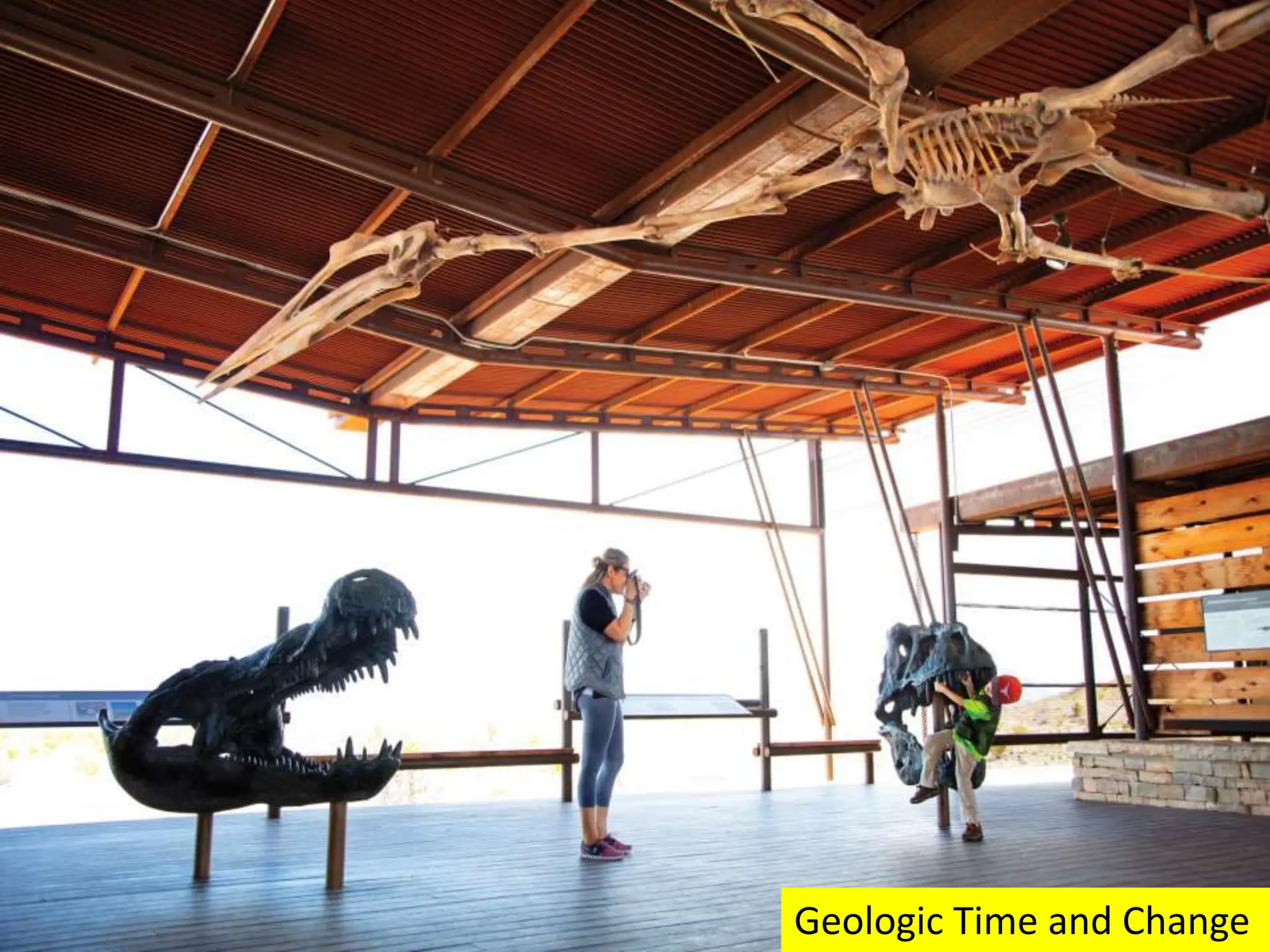
Geologic Time and Change
Lecture outline
1. Introduction
2. Geologic Time and Change
3. Priniciple of Uniformitarianism
Earth’s endogenic system
• Solid portion of Earth, broadly called the lithosphere
• Processes operating in Earth’s interior, driven by heat
from deep within the planet
• Building of mountains and the dramatic volcanic
eruptions that bring molten materials to Earth’s
surface
Earth’s exogenic system
• Processes that wear away (left) Earth’s surface
• External processes produce landscapes
• Geology……….. all aspects of Earth—its
history, composition and internal structure,
surface features, and the processes acting on
them
• Physical geography………the study of
Earth’s surface landforms—specifically, their
origin, evolution, form, and spatial
distribution
• Geomorphology is a subfield of both geology
and physical geography
• Dividing Earth history into time intervals
• Geologist have divided Earth’s history into a series
of time intervals
• Time intervals are not equal in length like the
hours in a days
• Time intervals are variable in length
• Geological time is divided using significant events
in the history of Earth
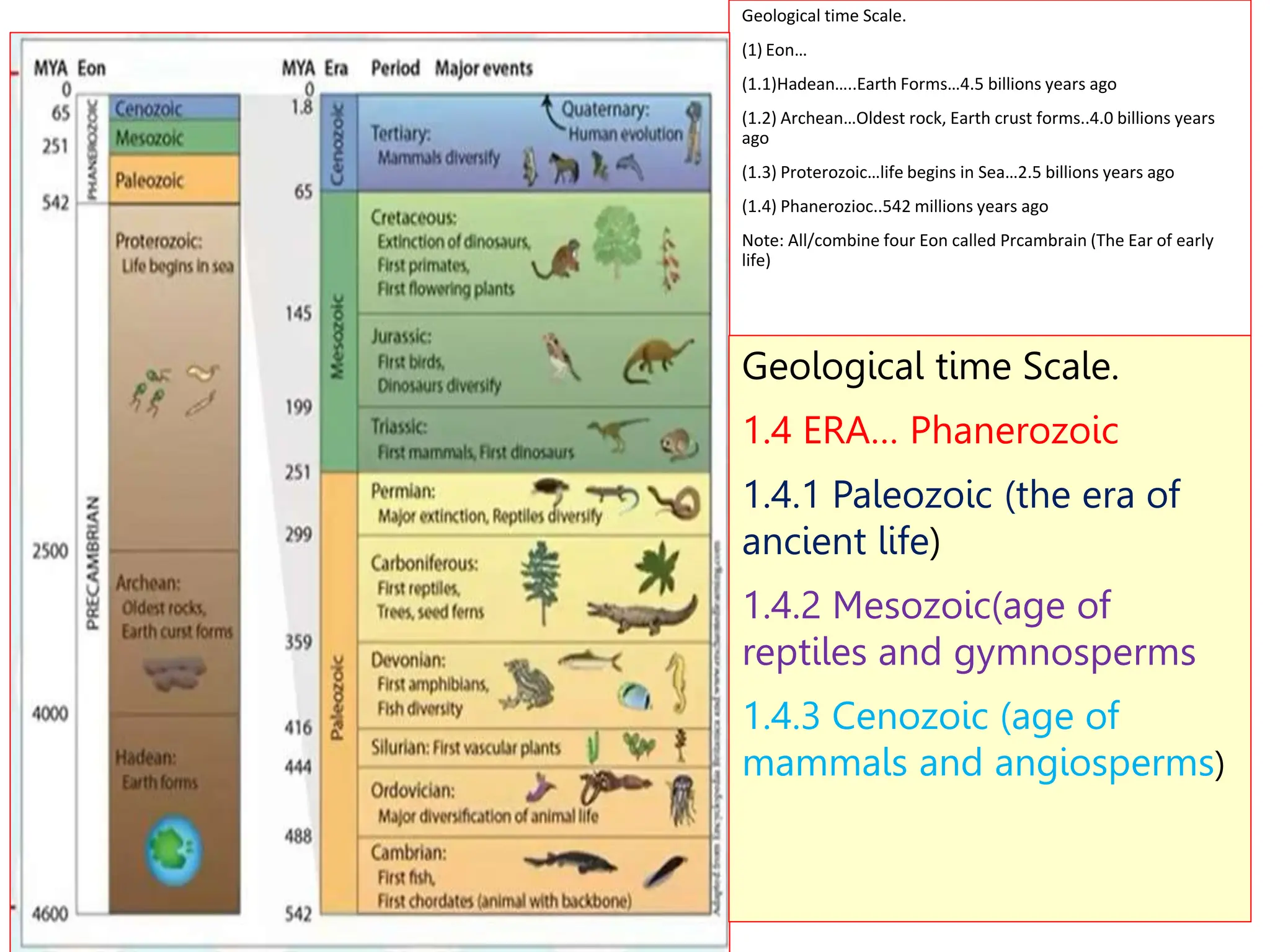
Geologic Time Scale
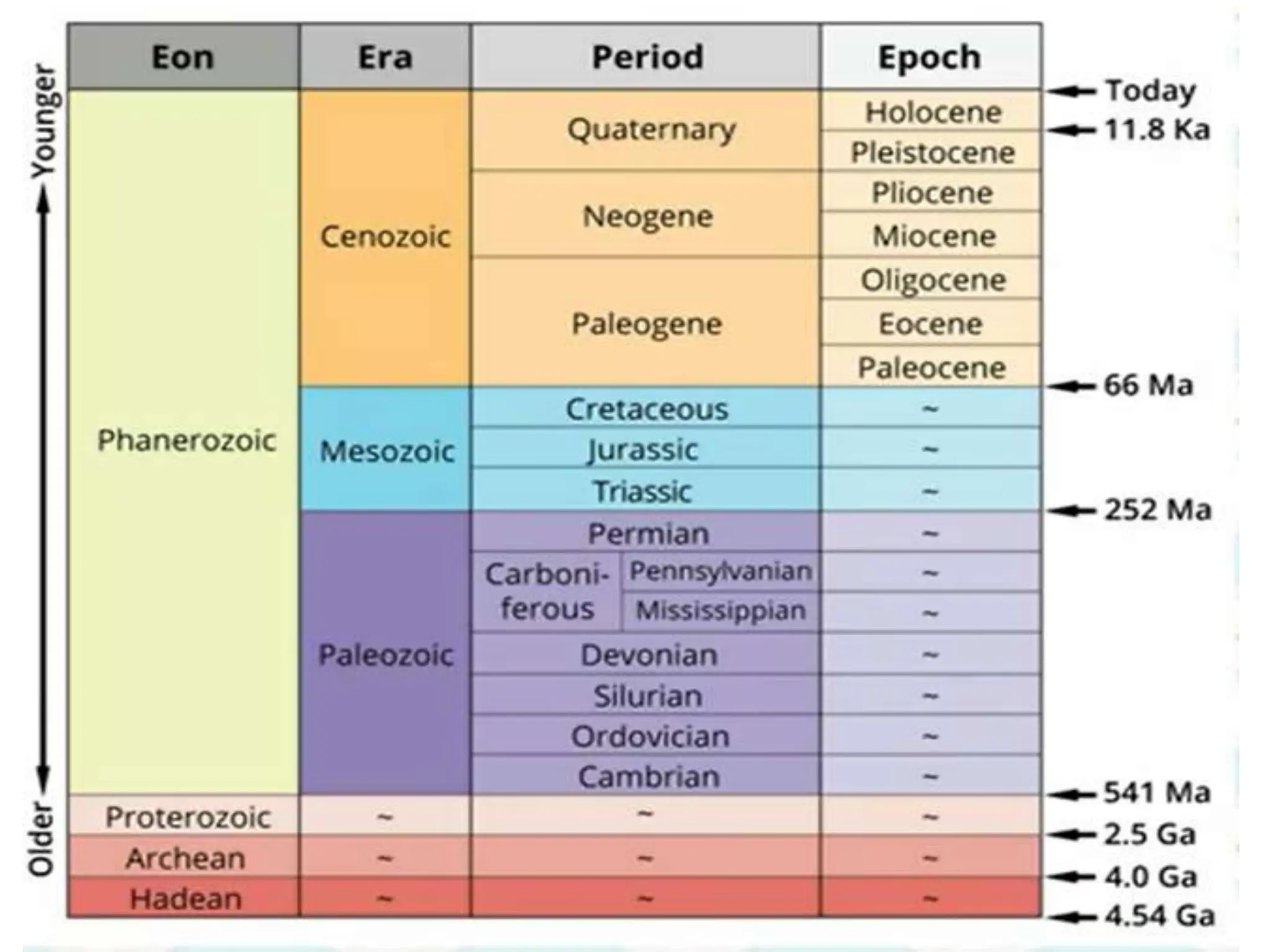
• Scale breaks the past 4.6 billion years down
into several time spans
• Eons are the largest time span, although
some refer to the Precambrian as a super-eon.
• Shorter time spans within eons are eras,
periods, and epochs.
• Major events in Earth’s history determine the
boundaries between these intervals, which
are not equal in length.
• The geologic time scale (GTS) is a system of
chronological dating that classifies geological
strata (stratigraphy) in time
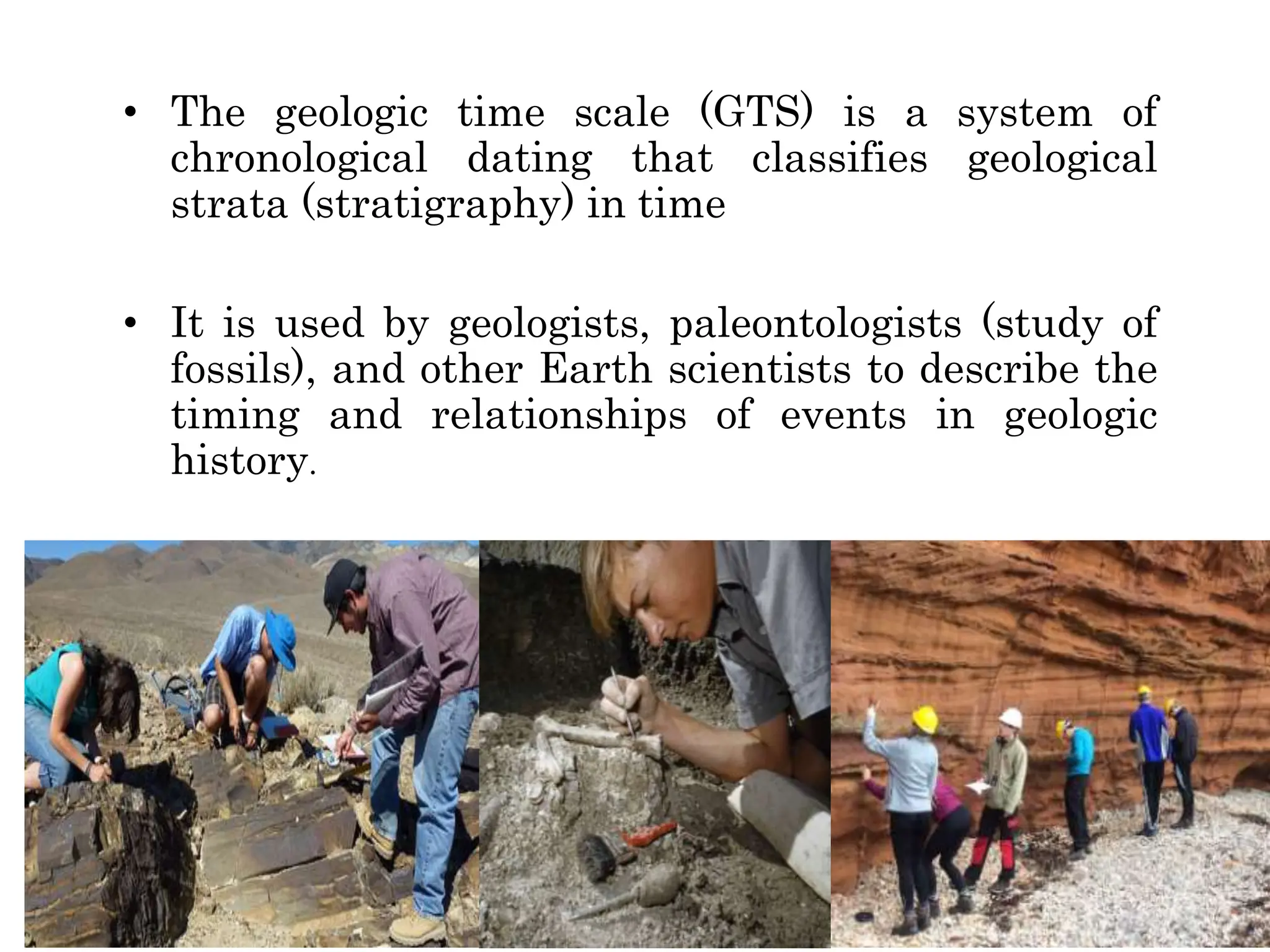
• It is used by geologists, paleontologists (study of
fossils), and other Earth scientists to describe the
timing and relationships of events in geologic
history.
1.To divide Earth’s long geologic history
(a) the geologic time scale divides Earth geological
history into intervals of time defined by major events or
change on Earth (Earth evolution , origin of organism,
extinction of organisms)
(b) The larges unit of geological time is an Eon (for
example in day largest is day same as in Eon is time unit
in the geological history )
(c ) Earth’s 4.6 billion year history is divided into eons:
The Hadean, Archean, Proterozoic and Phanerozoic
(d) The Hadean, Archean, and Proterozoic eons together
are called Precambrian time
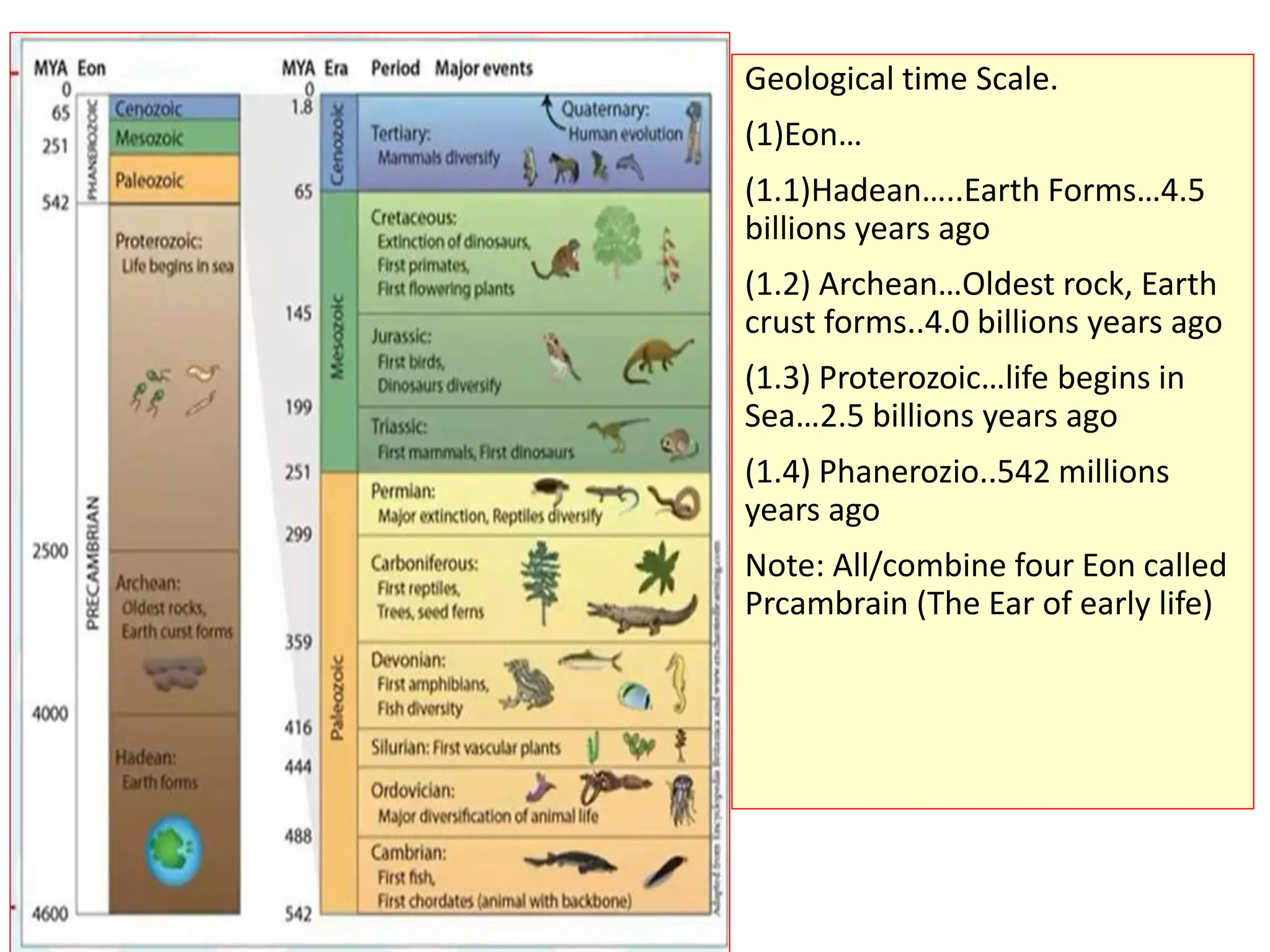
Geological time Scale.
(1)Eon…
(1.1)Hadean…..Earth Forms…4.5
billions years ago
(1.2) Archean…Oldest rock, Earth
crust forms..4.0 billions years ago
(1.3) Proterozoic…life begins in
Sea…2.5 billions years ago
(1.4) Phanerozio..542 millions
years ago
Note: All/combine four Eon called
Prcambrain (The Ear of early life)
Geological time Scale.
(1) Eon…
(1.1)Hadean…..Earth Forms…4.5 billions years ago
(1.2) Archean…Oldest rock, Earth crust forms..4.0 billions years
ago
(1.3) Proterozoic…life begins in Sea…2.5 billions years ago
(1.4) Phanerozioc..542 millions years ago
Note: All/combine four Eon called Prcambrain (The Ear of early
life)
Geological time Scale.
1.4 ERA… Phanerozoic
1.4.1 Paleozoic (the era of
ancient life)
1.4.2 Mesozoic(age of
reptiles and gymnosperms
1.4.3 Cenozoic (age of
mammals and angiosperms)
History of the Earth _ Hadean, Archean, and Proterozoic Eons
Video https://www.youtube.com/watch?v=DWC2lZHaq5c
Priniciple of Uniformitarianism
• Paleoclimatic techniques that establish chronologies of past
environments, enabling scientists to reconstruct the age and
character of past climates
• Assumption of these reconstructions is that the movements,
systems, and cycles that occur today also operated in the past
• This guiding principle of Earth science, called uniformitarianism,
presupposes that the same physical processes now active in the
environment were operating throughout Earth’s history
• The phrase “the present is the key to the past” describes the
principle
• For example, the processes by which streams carve valleys
at present are assumed to be the same as those that
carved valleys 500 million years ago.
• Evidence from the geologic record, preserved in layers of
rock that formed over millennia, supports this concept,
which was first hypothesized by geologist James Hutton in
the 18th century and later amplified by Charles Lyell in
his influential book Principles of Geology (1830
The Present is the Key to the Past
Many geologists consider James Hutton (1726–1797) to be the father of historical
geology. Hutton observed such processes as wave action, erosion by running water,
and sediment transport and concluded that given enough time these processes could
account for the geologic features in his native Scotland. He thought that “the past
history of our globe must be explained by what can be seen to be happening now.”
This assumption that present-day processes have operated throughout geologic time
was the basis for the principle of uniformitarianism.
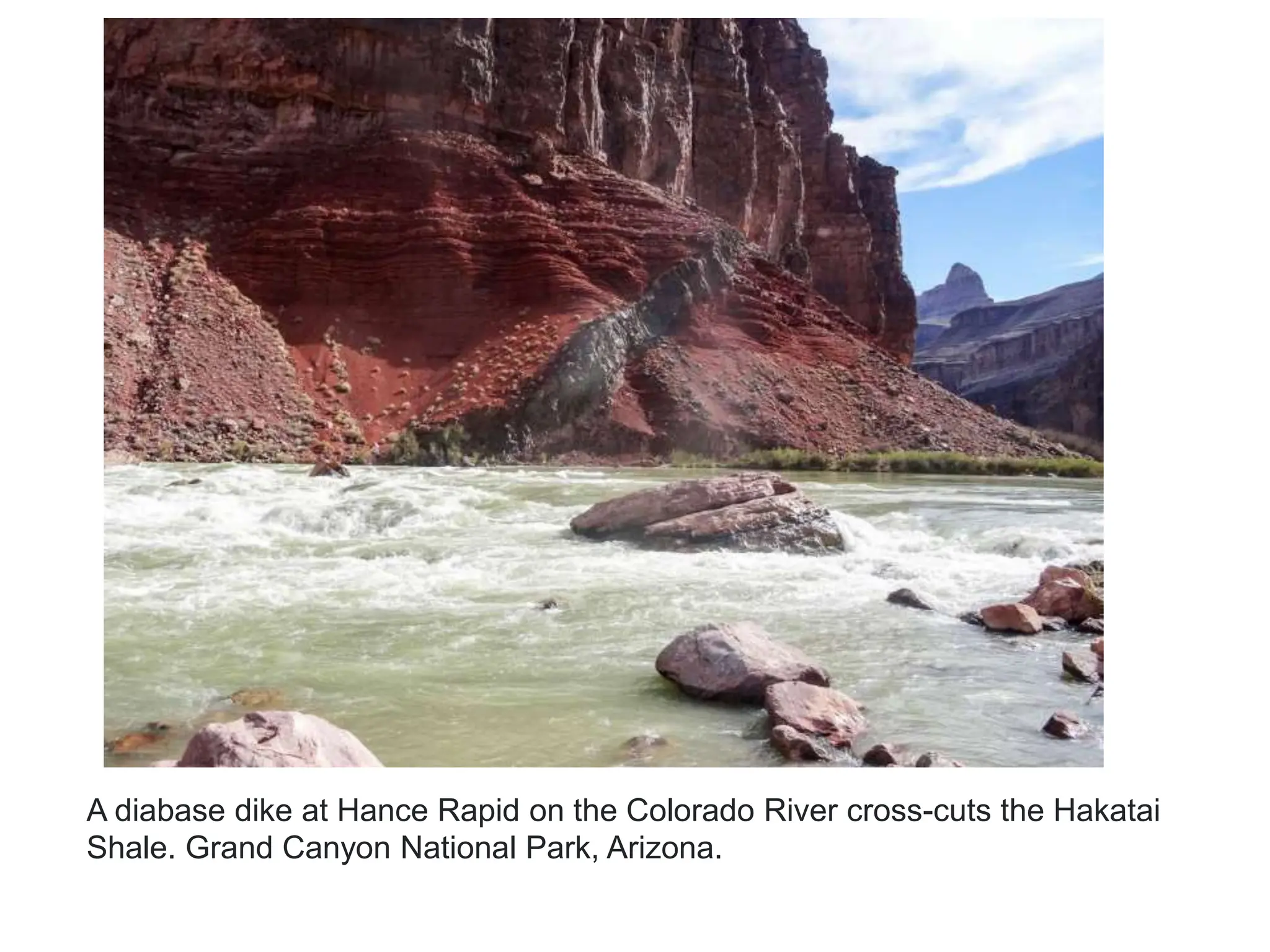
A diabase dike at Hance Rapid on the Colorado River cross-cuts the Hakatai
Shale. Grand Canyon National Park, Arizona.
• Principle of uniformitarianism applies mainly to the
gradual processes of geologic change, it also includes
sudden, catastrophic events such as massive
landslides, earthquakes, volcanic eruptions, and
asteroid impacts
• Events have geological importance and may occur as
small interruptions in the generally uniform
processes that shape the slowly evolving landscape
• Uniformitarianism means that the natural laws that
govern geologic processes have not changed
throughout geologic time even though the rate at
which these processes operate is variable
Relative Age and the Principle of Superposition
• Geologists assign ages to events or specific rocks,
structures, or landscapes using the geologic time
scale, based on either relative time (what happened
in what order) or numerical time (the actual number
of years before the present)
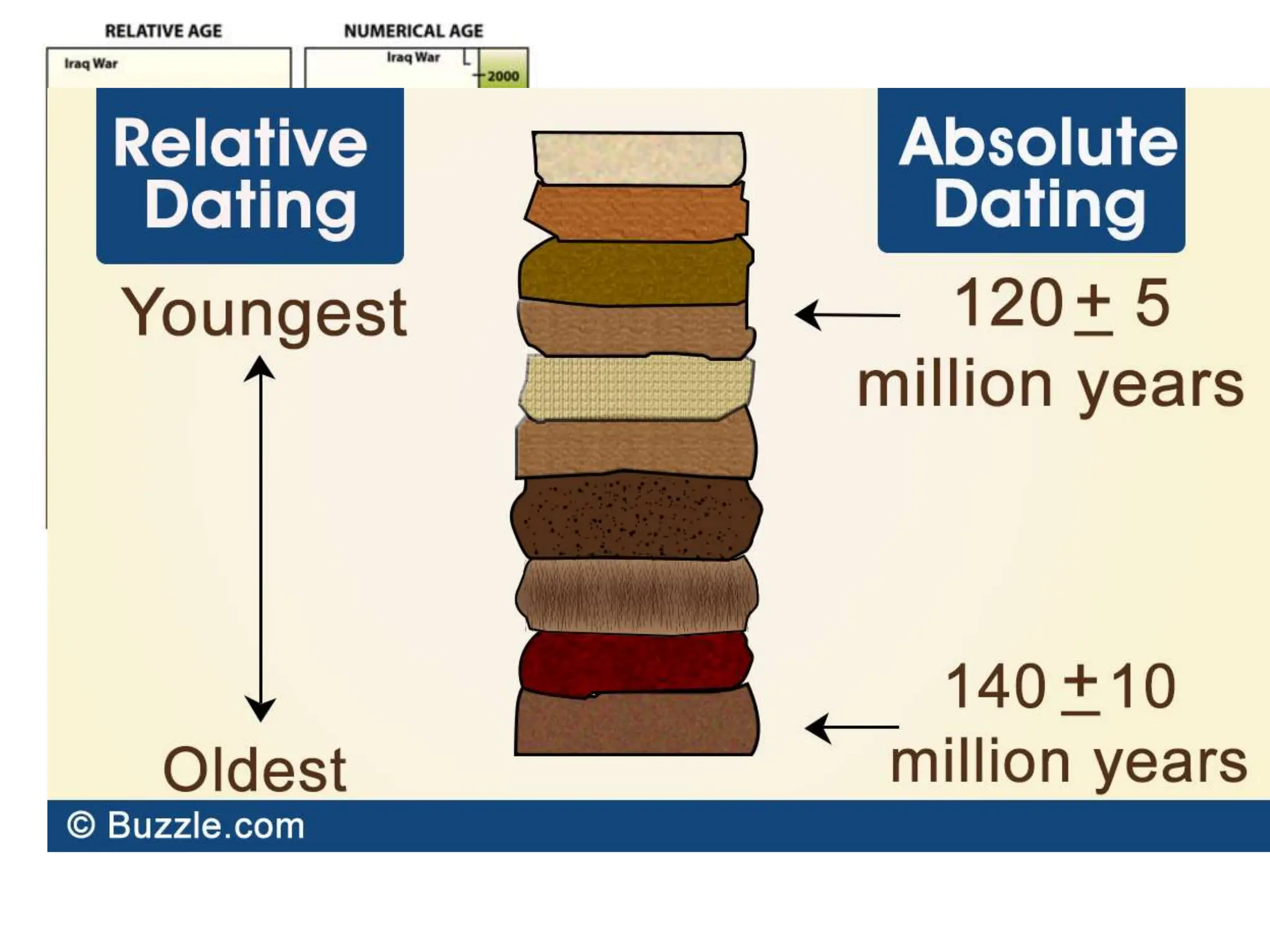
• Relative age refers to the age of one feature with
respect to another within a sequence of events. In
rocks, relative age refers to the relative positions of
rock layers, or strata, within a sequence.
• Scientific study of the order and relative position of rock sequences
is stratigraphy.
• Within rock strata, clues such as fossils indicate the environment
during rock formation
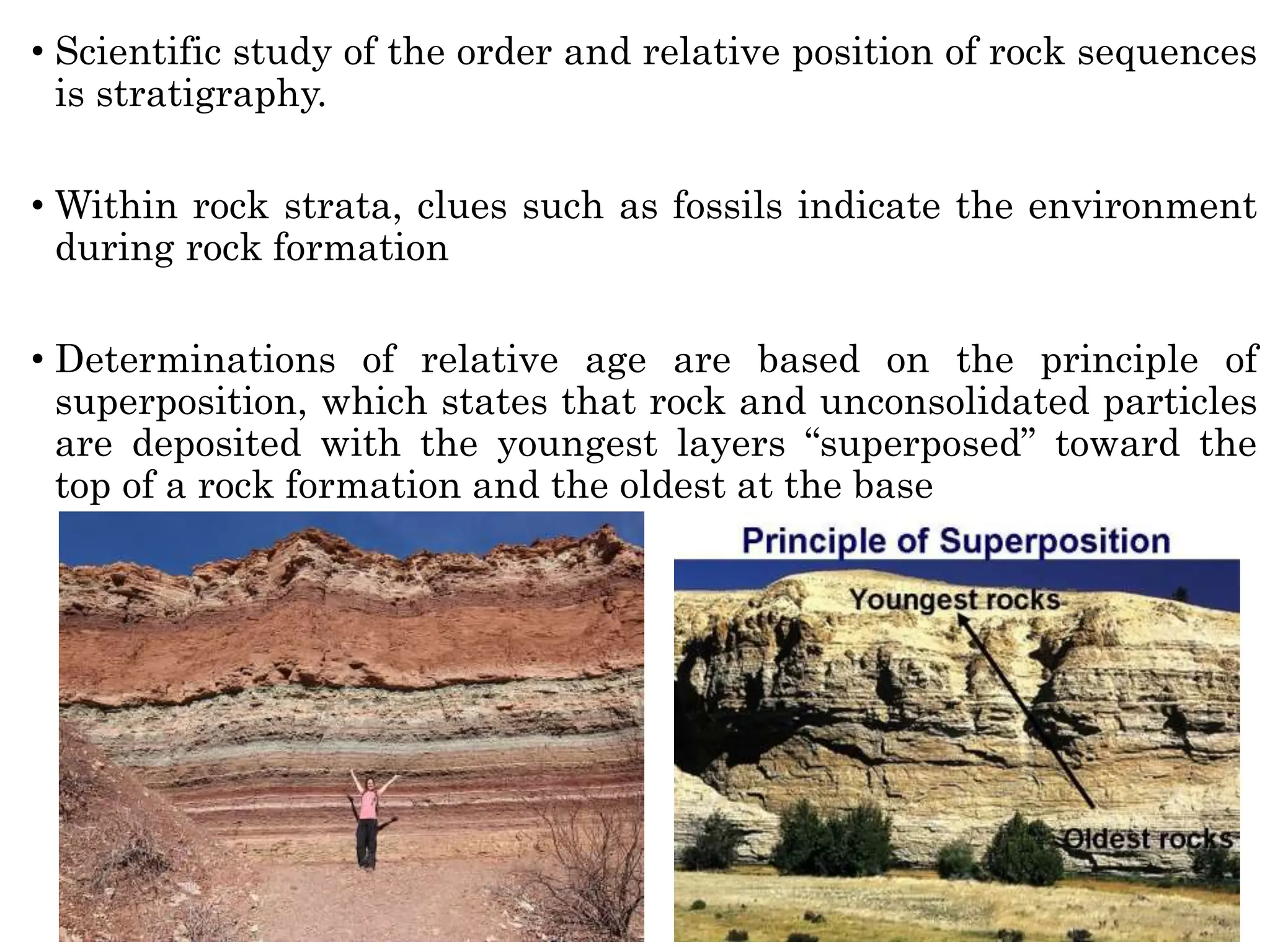
• Determinations of relative age are based on the principle of
superposition, which states that rock and unconsolidated particles
are deposited with the youngest layers “superposed” toward the
top of a rock formation and the oldest at the base
Numerical Age and Radiometric
• Dating Numerical age (sometimes called absolute age) is
today determined using isotopic dating techniques and
other scientific methods.
• The technique of radiometric dating, for example, uses the
rate of decay for different unstable isotopes to provide a
steady time clock to pinpoint the ages of Earth materials.
• Precise knowledge of radioactive decay rates allows
scientists to determine the date a rock formed by comparing
the amount of original isotope in the sample with the
amount of decayed end product in the sample
• Numerical ages permit scientists to refine the geologic scale
and improve the accuracy of relative dating sequences.
Isotopes are distinct nuclear species of the same element. Atoms with the
same number of protons but different numbers of neutrons are called isotopes
`
Assignment number 2
Draw sketch of geological time scale

earth science Dynamic planet complete presentation.pptx

  • 1.
    The Dynamic Planet GeologicTime and Change Lecture 2 and 3 Department of Environmental Sciences, KIU BS: 2nd semester, 2023 Resource Person: Dr.Karamat Ali
  • 2.
  • 3.
    Lecture outline 1. Introduction 2.Geologic Time and Change 3. Priniciple of Uniformitarianism
  • 4.
    Earth’s endogenic system •Solid portion of Earth, broadly called the lithosphere • Processes operating in Earth’s interior, driven by heat from deep within the planet • Building of mountains and the dramatic volcanic eruptions that bring molten materials to Earth’s surface Earth’s exogenic system • Processes that wear away (left) Earth’s surface • External processes produce landscapes
  • 5.
    • Geology……….. allaspects of Earth—its history, composition and internal structure, surface features, and the processes acting on them • Physical geography………the study of Earth’s surface landforms—specifically, their origin, evolution, form, and spatial distribution • Geomorphology is a subfield of both geology and physical geography
  • 7.
    • Dividing Earthhistory into time intervals • Geologist have divided Earth’s history into a series of time intervals • Time intervals are not equal in length like the hours in a days • Time intervals are variable in length • Geological time is divided using significant events in the history of Earth Geologic Time Scale
  • 8.
    • Scale breaksthe past 4.6 billion years down into several time spans • Eons are the largest time span, although some refer to the Precambrian as a super-eon. • Shorter time spans within eons are eras, periods, and epochs. • Major events in Earth’s history determine the boundaries between these intervals, which are not equal in length.
  • 9.
    • The geologictime scale (GTS) is a system of chronological dating that classifies geological strata (stratigraphy) in time • It is used by geologists, paleontologists (study of fossils), and other Earth scientists to describe the timing and relationships of events in geologic history.
  • 10.
    1.To divide Earth’slong geologic history (a) the geologic time scale divides Earth geological history into intervals of time defined by major events or change on Earth (Earth evolution , origin of organism, extinction of organisms) (b) The larges unit of geological time is an Eon (for example in day largest is day same as in Eon is time unit in the geological history ) (c ) Earth’s 4.6 billion year history is divided into eons: The Hadean, Archean, Proterozoic and Phanerozoic (d) The Hadean, Archean, and Proterozoic eons together are called Precambrian time
  • 12.
    Geological time Scale. (1)Eon… (1.1)Hadean…..EarthForms…4.5 billions years ago (1.2) Archean…Oldest rock, Earth crust forms..4.0 billions years ago (1.3) Proterozoic…life begins in Sea…2.5 billions years ago (1.4) Phanerozio..542 millions years ago Note: All/combine four Eon called Prcambrain (The Ear of early life)
  • 13.
    Geological time Scale. (1)Eon… (1.1)Hadean…..Earth Forms…4.5 billions years ago (1.2) Archean…Oldest rock, Earth crust forms..4.0 billions years ago (1.3) Proterozoic…life begins in Sea…2.5 billions years ago (1.4) Phanerozioc..542 millions years ago Note: All/combine four Eon called Prcambrain (The Ear of early life) Geological time Scale. 1.4 ERA… Phanerozoic 1.4.1 Paleozoic (the era of ancient life) 1.4.2 Mesozoic(age of reptiles and gymnosperms 1.4.3 Cenozoic (age of mammals and angiosperms)
  • 14.
    History of theEarth _ Hadean, Archean, and Proterozoic Eons Video https://www.youtube.com/watch?v=DWC2lZHaq5c
  • 15.
    Priniciple of Uniformitarianism •Paleoclimatic techniques that establish chronologies of past environments, enabling scientists to reconstruct the age and character of past climates • Assumption of these reconstructions is that the movements, systems, and cycles that occur today also operated in the past • This guiding principle of Earth science, called uniformitarianism, presupposes that the same physical processes now active in the environment were operating throughout Earth’s history • The phrase “the present is the key to the past” describes the principle
  • 16.
    • For example,the processes by which streams carve valleys at present are assumed to be the same as those that carved valleys 500 million years ago. • Evidence from the geologic record, preserved in layers of rock that formed over millennia, supports this concept, which was first hypothesized by geologist James Hutton in the 18th century and later amplified by Charles Lyell in his influential book Principles of Geology (1830
  • 17.
    The Present isthe Key to the Past Many geologists consider James Hutton (1726–1797) to be the father of historical geology. Hutton observed such processes as wave action, erosion by running water, and sediment transport and concluded that given enough time these processes could account for the geologic features in his native Scotland. He thought that “the past history of our globe must be explained by what can be seen to be happening now.” This assumption that present-day processes have operated throughout geologic time was the basis for the principle of uniformitarianism.
  • 18.
    A diabase dikeat Hance Rapid on the Colorado River cross-cuts the Hakatai Shale. Grand Canyon National Park, Arizona.
  • 20.
    • Principle ofuniformitarianism applies mainly to the gradual processes of geologic change, it also includes sudden, catastrophic events such as massive landslides, earthquakes, volcanic eruptions, and asteroid impacts • Events have geological importance and may occur as small interruptions in the generally uniform processes that shape the slowly evolving landscape • Uniformitarianism means that the natural laws that govern geologic processes have not changed throughout geologic time even though the rate at which these processes operate is variable
  • 21.
    Relative Age andthe Principle of Superposition • Geologists assign ages to events or specific rocks, structures, or landscapes using the geologic time scale, based on either relative time (what happened in what order) or numerical time (the actual number of years before the present) • Relative age refers to the age of one feature with respect to another within a sequence of events. In rocks, relative age refers to the relative positions of rock layers, or strata, within a sequence.
  • 22.
    • Scientific studyof the order and relative position of rock sequences is stratigraphy. • Within rock strata, clues such as fossils indicate the environment during rock formation • Determinations of relative age are based on the principle of superposition, which states that rock and unconsolidated particles are deposited with the youngest layers “superposed” toward the top of a rock formation and the oldest at the base
  • 23.
    Numerical Age andRadiometric • Dating Numerical age (sometimes called absolute age) is today determined using isotopic dating techniques and other scientific methods. • The technique of radiometric dating, for example, uses the rate of decay for different unstable isotopes to provide a steady time clock to pinpoint the ages of Earth materials. • Precise knowledge of radioactive decay rates allows scientists to determine the date a rock formed by comparing the amount of original isotope in the sample with the amount of decayed end product in the sample • Numerical ages permit scientists to refine the geologic scale and improve the accuracy of relative dating sequences. Isotopes are distinct nuclear species of the same element. Atoms with the same number of protons but different numbers of neutrons are called isotopes
  • 25.
  • 26.
    Assignment number 2 Drawsketch of geological time scale