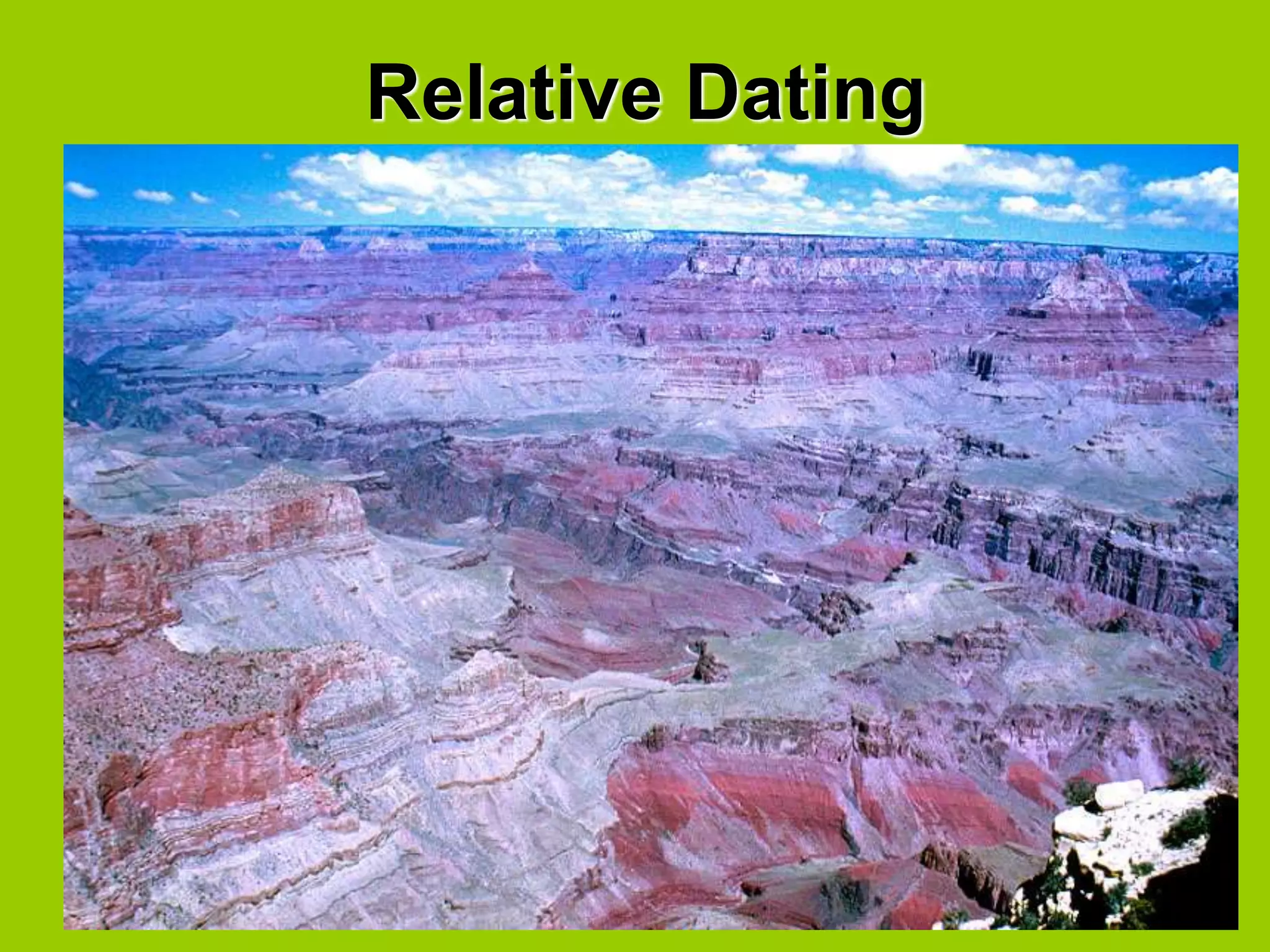
Relative Dating
Important Figures in Geologic Time
• James Hutton (1726-1797): Native of Edinburgh, Scotland. Father of
modern Geology. Published “Theory of the Earth” in 1785 in which he
outlined that geological features and ancient rocks could be explained
by present-day physical and chemical processes.
• Charles Lyell (1797-1875): Rebelled against prevailing thought, which
was rooted in Biblical interpretation and Catastrophism. His main
contribution was the development of Uniformitarianism (Actualism).
“The present is the key to the past…”
• Modern view holds that processes that operate today have shaped the
Earth through Geological Time, but rates may not have always
remained constant.
The Key to the Past
Relative Time- “this rock is older than
that”
Principles Used to Determine Relative Age
• Unconformities
• Correlation
• The Standard Geologic Time Scale
• Index Fossils
Absolute Time- “this rock is 28 million
years old”
Principles of radioactive decay
• Instruments
• The age of the Earth
I. Relative Dating
• Relative Dating is when you give the age
of a rock or fossil compared to another
rock or fossil.
– Example: Rock A is OLDER than Rock B.
– An actual age in years is not determined.
II. Rules of Relative Dating
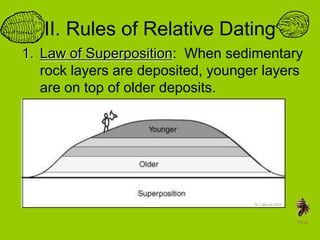
1. Law of Superposition: When sedimentary
rock layers are deposited, younger layers
are on top of older deposits.
Rules of Relative Dating
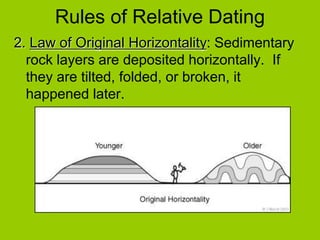
2. Law of Original Horizontality: Sedimentary
rock layers are deposited horizontally. If
they are tilted, folded, or broken, it
happened later.
Rules of Relative Dating
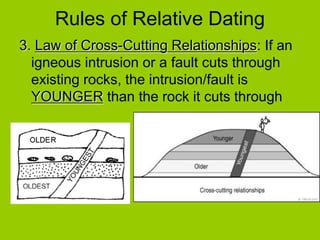
3. Law of Cross-Cutting Relationships: If an
igneous intrusion or a fault cuts through
existing rocks, the intrusion/fault is
YOUNGER than the rock it cuts through
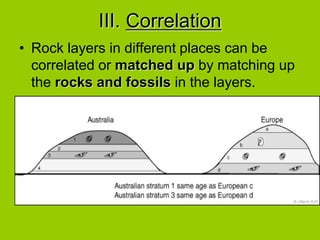
III. Correlation
• Rock layers in different places can be
correlated or matched up by matching up
the rocks and fossils in the layers.
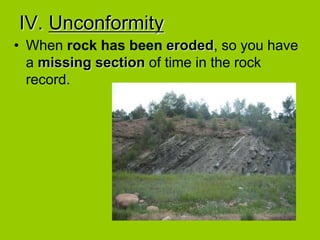
IV. Unconformity
• When rock has been eroded, so you have
a missing section of time in the rock
record.
Unconformity
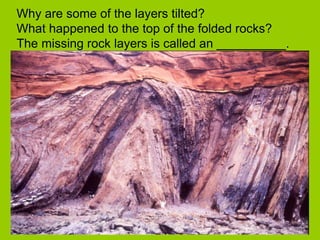
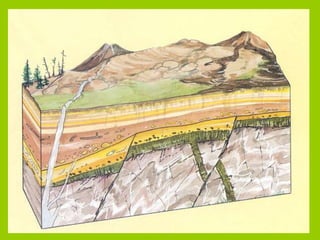
Why are some of the layers tilted?
What happened to the top of the folded rocks?
The missing rock layers is called an __________.
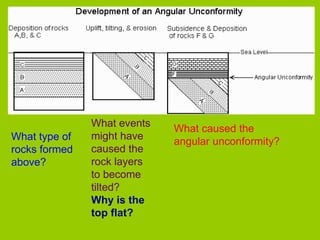
What type of
rocks formed
above?
What events
might have
caused the
rock layers
to become
tilted?
Why is the
top flat?
What caused the
angular unconformity?
Index Fossils
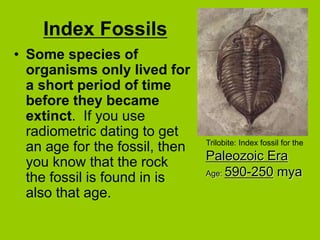
• Some species of
organisms only lived for
a short period of time
before they became
extinct. If you use
radiometric dating to get
an age for the fossil, then
you know that the rock
the fossil is found in is
also that age.
Trilobite: Index fossil for the
Paleozoic Era
Age: 590-250 mya
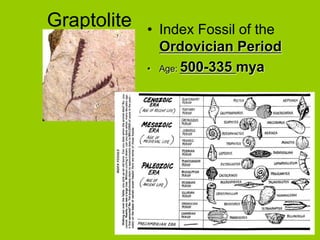
Graptolite • Index Fossil of the
Ordovician Period
• Age: 500-335 mya
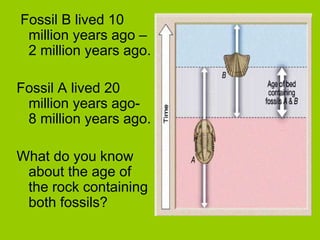
Fossil B lived 10
million years ago –
2 million years ago.
Fossil A lived 20
million years ago-
8 million years ago.
What do you know
about the age of
the rock containing
both fossils?
http://reynolds.asu.edu/glg103/relative_age_principles.htm
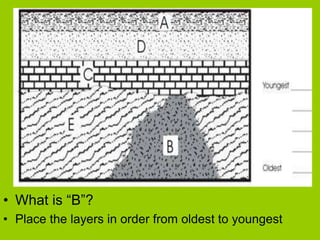
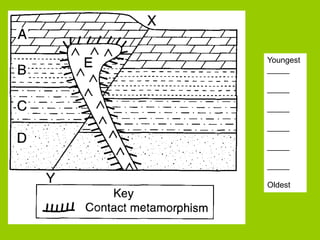
• What is “B”?
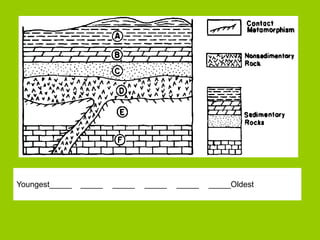
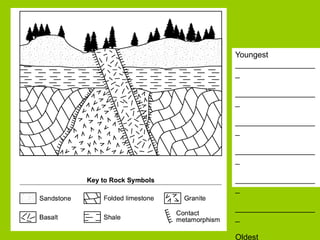
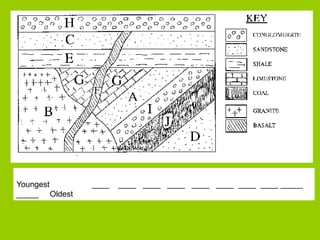
• Place the layers in order from oldest to youngest
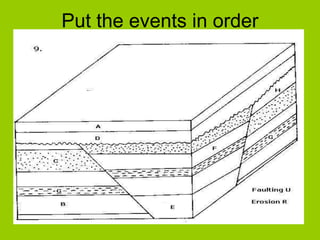
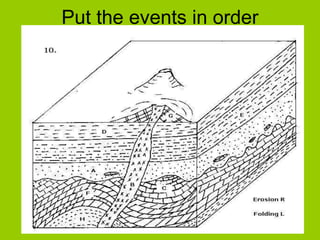
Put the events in order
Youngest
_____
_____
_____
_____
_____
_____
Oldest
Youngest_____ _____ _____ _____ _____ _____Oldest
Youngest
__________________
_
__________________
_
__________________
_
__________________
_
__________________
_
__________________
_
Oldest
Youngest ____ ____ ____ ____ ____ ____ ____ ____ _____
_____ Oldest
Make your own Strata
Sequence
Requirements:
• One of each: Igneous intrusion, faulting,
folding, erosion
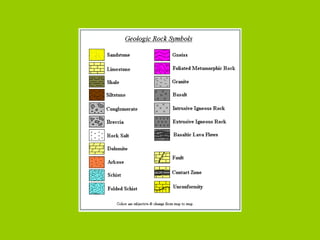
• Each rock type needs the correct symbol
• Neatness – use a ruler
• Key for rock types
• Separate Answer key
geo Relative_Dating_2016.ppt

geo Relative_Dating_2016.ppt

  • 1.
  • 2.
    Important Figures inGeologic Time • James Hutton (1726-1797): Native of Edinburgh, Scotland. Father of modern Geology. Published “Theory of the Earth” in 1785 in which he outlined that geological features and ancient rocks could be explained by present-day physical and chemical processes. • Charles Lyell (1797-1875): Rebelled against prevailing thought, which was rooted in Biblical interpretation and Catastrophism. His main contribution was the development of Uniformitarianism (Actualism). “The present is the key to the past…” • Modern view holds that processes that operate today have shaped the Earth through Geological Time, but rates may not have always remained constant.
  • 3.
    The Key tothe Past Relative Time- “this rock is older than that” Principles Used to Determine Relative Age • Unconformities • Correlation • The Standard Geologic Time Scale • Index Fossils Absolute Time- “this rock is 28 million years old” Principles of radioactive decay • Instruments • The age of the Earth
  • 4.
    I. Relative Dating •Relative Dating is when you give the age of a rock or fossil compared to another rock or fossil. – Example: Rock A is OLDER than Rock B. – An actual age in years is not determined.
  • 5.
    II. Rules ofRelative Dating 1. Law of Superposition: When sedimentary rock layers are deposited, younger layers are on top of older deposits.
  • 6.
    Rules of RelativeDating 2. Law of Original Horizontality: Sedimentary rock layers are deposited horizontally. If they are tilted, folded, or broken, it happened later.
  • 7.
    Rules of RelativeDating 3. Law of Cross-Cutting Relationships: If an igneous intrusion or a fault cuts through existing rocks, the intrusion/fault is YOUNGER than the rock it cuts through
  • 8.
    III. Correlation • Rocklayers in different places can be correlated or matched up by matching up the rocks and fossils in the layers.
  • 9.
    IV. Unconformity • Whenrock has been eroded, so you have a missing section of time in the rock record.
  • 10.
  • 11.
    Why are someof the layers tilted? What happened to the top of the folded rocks? The missing rock layers is called an __________.
  • 12.
    What type of rocksformed above? What events might have caused the rock layers to become tilted? Why is the top flat? What caused the angular unconformity?
  • 13.
    Index Fossils • Somespecies of organisms only lived for a short period of time before they became extinct. If you use radiometric dating to get an age for the fossil, then you know that the rock the fossil is found in is also that age. Trilobite: Index fossil for the Paleozoic Era Age: 590-250 mya
  • 14.
    Graptolite • IndexFossil of the Ordovician Period • Age: 500-335 mya
  • 15.
    Fossil B lived10 million years ago – 2 million years ago. Fossil A lived 20 million years ago- 8 million years ago. What do you know about the age of the rock containing both fossils?
  • 18.
  • 19.
    • What is“B”? • Place the layers in order from oldest to youngest
  • 20.
  • 21.
  • 22.
  • 23.
    Youngest_____ _____ __________ _____ _____Oldest
  • 24.
  • 25.
    Youngest ____ ________ ____ ____ ____ ____ ____ _____ _____ Oldest
  • 26.
    Make your ownStrata Sequence Requirements: • One of each: Igneous intrusion, faulting, folding, erosion • Each rock type needs the correct symbol • Neatness – use a ruler • Key for rock types • Separate Answer key