Biostratigraphy

  Geology 331
  Paleontology
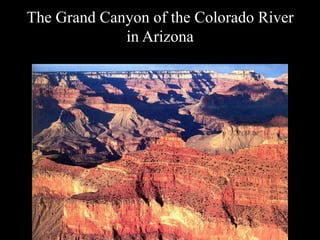
The Grand Canyon of the Colorado River
             in Arizona
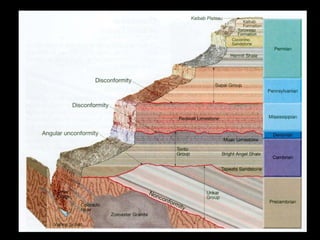
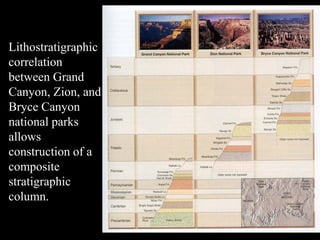
Lithostratigraphic
correlation
between Grand
Canyon, Zion, and
Bryce Canyon
national parks
allows
construction of a
composite
stratigraphic
column.
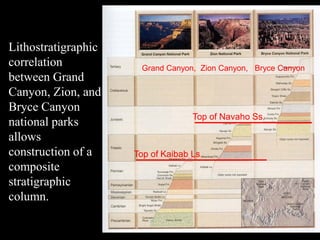
Lithostratigraphic
correlation           Grand Canyon, Zion Canyon, Bryce Canyon
between Grand
Canyon, Zion, and
Bryce Canyon
                                   Top of Navaho Ss.
national parks
allows
construction of a    Top of Kaibab Ls.
composite
stratigraphic
column.
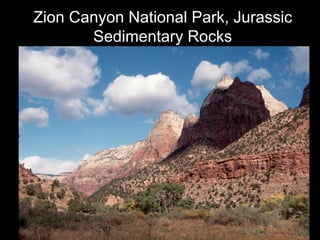
Zion Canyon National Park, Jurassic
       Sedimentary Rocks
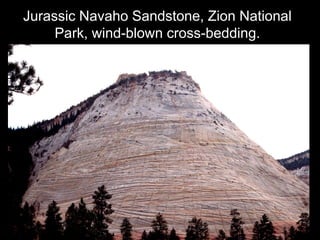
Jurassic Navaho Sandstone, Zion National
     Park, wind-blown cross-bedding.
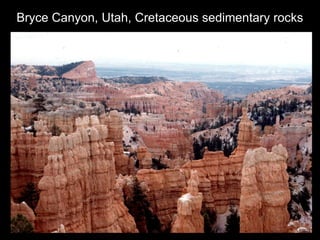
Bryce Canyon, Utah, Cretaceous sedimentary rocks
Correlation
• Determination of the equivalence of
  bodies of rock at different locations.
  There are two kinds of correlation:
• Lithostratigraphic - matching up
  continuous formations.
• Chronostratigraphic - matching up
  rocks of the same age. Usually done
  with fossils using biostratigraphy.
Correlation
• Over short distances lithostratigraphic
  correlation is the same as
  chronostratigraphic correlation.
• Over medium distances they are not
  the same.
• Over long distances only
  chronostratigraphic correlation can be
  used.
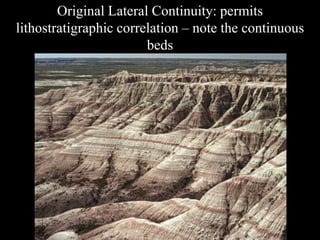
Original Lateral Continuity: permits
lithostratigraphic correlation – note the continuous
                        beds
Lithostratigraphic and
 Chronostratigraphic
    Relationships
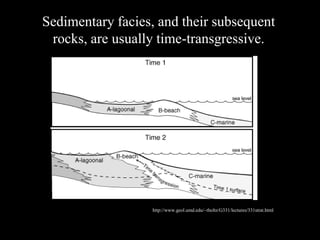
Sedimentary facies, and their subsequent
 rocks, are usually time-transgressive.


                  http://www.geol.umd.edu/~tholtz/G331/lectures/331strat.html
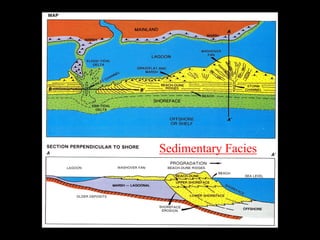
Sedimentary Facies
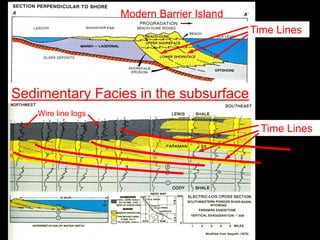
Modern Barrier Island
                                             Time Lines


Sedimentary Facies in the subsurface
    Wire line logs
                                               Time Lines
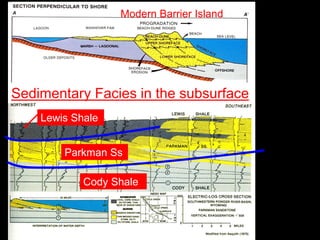
Modern Barrier Island


Sedimentary Facies in the subsurface
    Wire line logs
    Lewis Shale


           Parkman Ss

                 Cody Shale
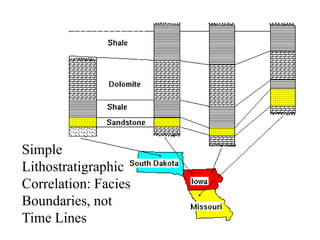
Simple
Lithostratigraphic
Correlation: Facies
Boundaries, not
Time Lines
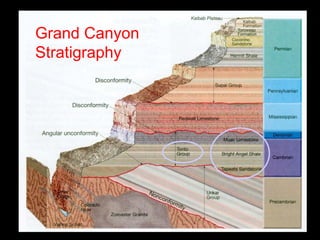
Grand Canyon
Stratigraphy
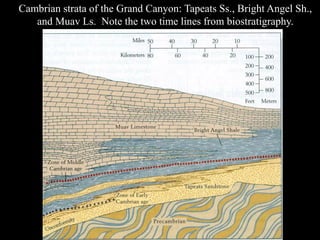
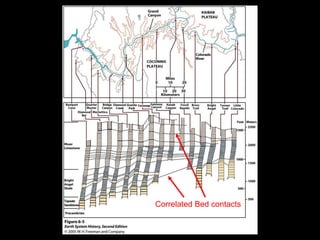
Cambrian strata of the Grand Canyon: Tapeats Ss., Bright Angel Sh.,
   and Muav Ls. Note the two time lines from biostratigraphy.
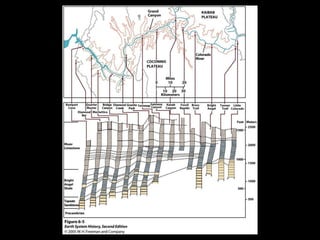
Correlated Bed contacts
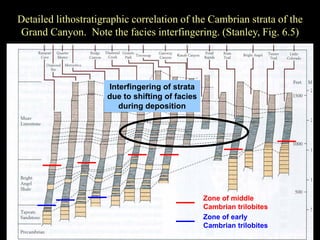
Detailed lithostratigraphic correlation of the Cambrian strata of the
Grand Canyon. Note the facies interfingering. (Stanley, Fig. 6.5)


                     Interfingering of strata
                     due to shifting of facies
                        during deposition


                                                 Zone of middle
                                                 Cambrian trilobites
                                                 Zone of early
                                                 Cambrian trilobites
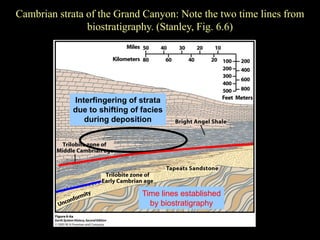
Cambrian strata of the Grand Canyon: Note the two time lines from
                biostratigraphy. (Stanley, Fig. 6.6)


            Interfingering of strata
            due to shifting of facies
               during deposition


                               Time lines established
                                 by biostratigraphy
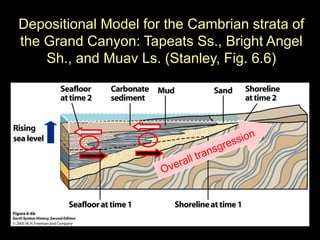
Depositional Model for the Cambrian strata of
the Grand Canyon: Tapeats Ss., Bright Angel
    Sh., and Muav Ls. (Stanley, Fig. 6.6)
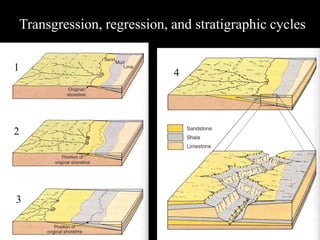
Transgression, regression, and stratigraphic cycles

1                           4


2


3
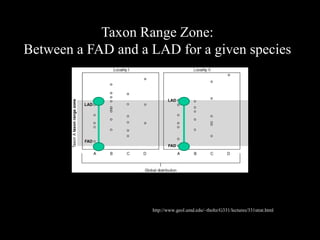
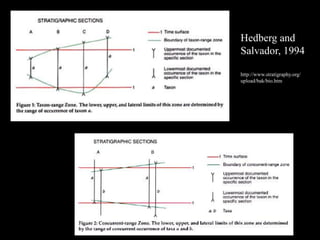
Taxon Range Zone:
Between a FAD and a LAD for a given species


                    http://www.geol.umd.edu/~tholtz/G331/lectures/331strat.html
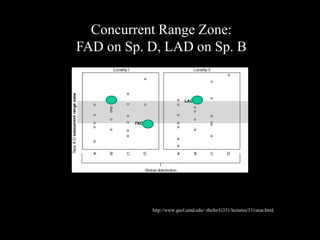
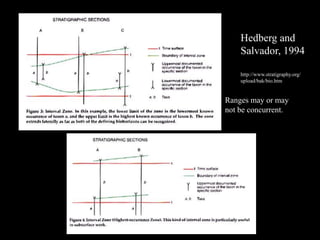
Concurrent Range Zone:
FAD on Sp. D, LAD on Sp. B


           http://www.geol.umd.edu/~tholtz/G331/lectures/331strat.html
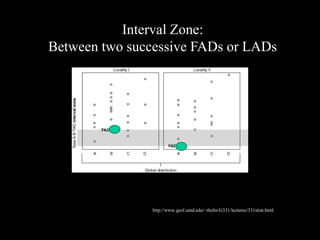
Interval Zone:
Between two successive FADs or LADs


               http://www.geol.umd.edu/~tholtz/G331/lectures/331strat.html
Hedberg and
Salvador, 1994

http://www.stratigraphy.org/
upload/bak/bio.htm
Hedberg and
    Salvador, 1994

    http://www.stratigraphy.org/
    upload/bak/bio.htm


Ranges may or may
not be concurrent.
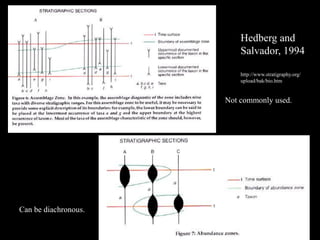
Hedberg and
                          Salvador, 1994

                          http://www.stratigraphy.org/
                          upload/bak/bio.htm


                      Not commonly used.


Can be diachronous.
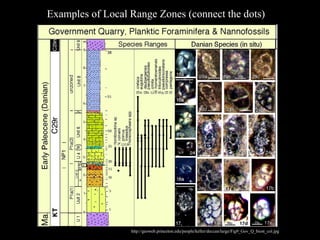
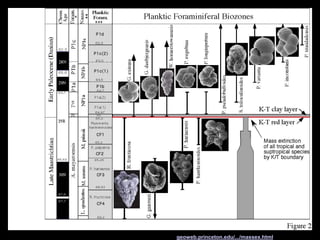
Examples of Local Range Zones (connect the dots)


                  http://geoweb.princeton.edu/people/keller/deccan/large/Fig9_Gov_Q_biost_col.jpg
geoweb.princeton.edu/.../massex.html
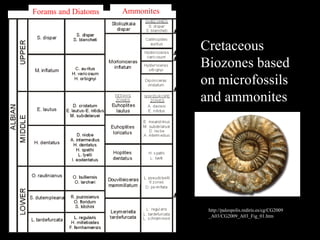
Forams and Diatoms   Ammonites


                                 Cretaceous
                                 Biozones based
                                 on microfossils
                                 and ammonites


                                  http://paleopolis.rediris.es/cg/CG2009
                                  _A03/CG2009_A03_Fig_01.htm
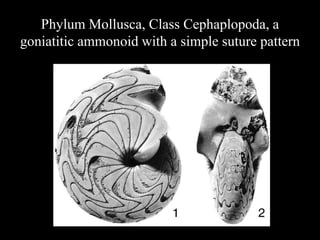
Phylum Mollusca, Class Cephaplopoda, a
goniatitic ammonoid with a simple suture pattern
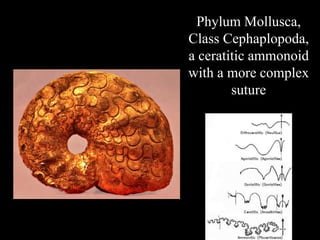
Phylum Mollusca,
Class Cephaplopoda,
a ceratitic ammonoid
with a more complex
        suture
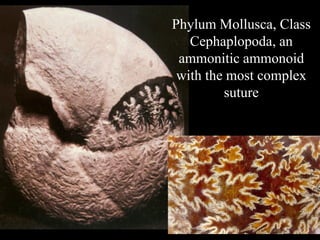
Phylum Mollusca, Class
   Cephaplopoda, an
 ammonitic ammonoid
 with the most complex
         suture
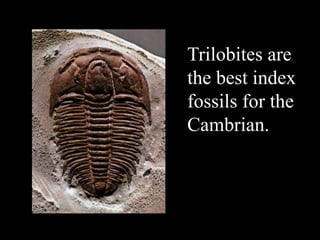
Trilobites are
the best index
fossils for the
Cambrian.
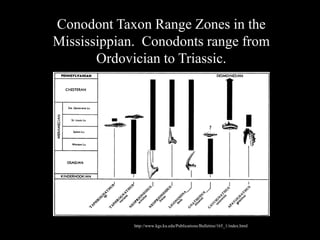
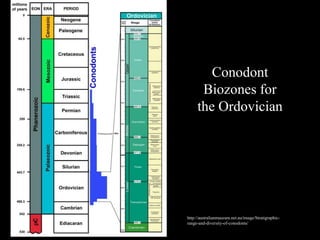
Conodont Taxon Range Zones in the
Mississippian. Conodonts range from
       Ordovician to Triassic.


             http://www.kgs.ku.edu/Publications/Bulletins/165_1/index.html
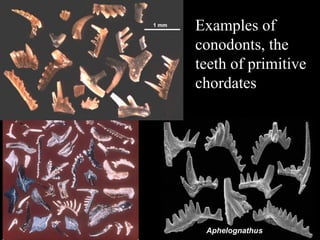
Examples of
conodonts, the
teeth of primitive
chordates
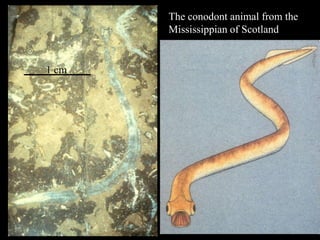
The conodont animal from the
       Mississippian of Scotland


1 cm
Conodont
      Biozones for
     the Ordovician


http://australianmuseum.net.au/image/Stratigraphic-
range-and-diversity-of-conodonts/
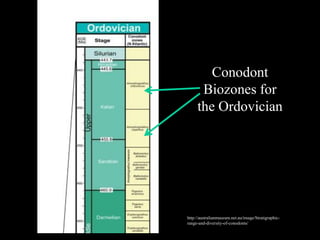
Conodont
      Biozones for
     the Ordovician


http://australianmuseum.net.au/image/Stratigraphic-
range-and-diversity-of-conodonts/
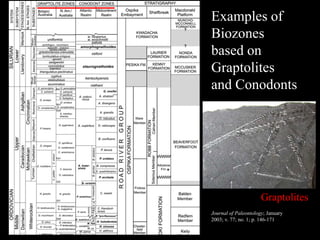
Examples of
Biozones
based on
Graptolites
and Conodonts


                      Graptolites
Journal of Paleontology; January
2003; v. 77; no. 1; p. 146-171
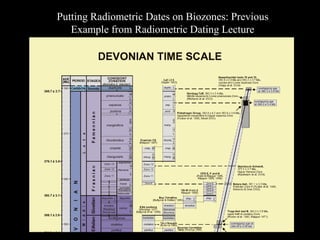
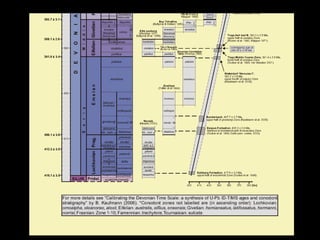
Putting Radiometric Dates on Biozones: Previous
   Example from Radiometric Dating Lecture
Biostratigraphy

Biostratigraphy