TM Heathland 5/7/13
‘Embedding Stretch & Challenge for all’
Melanie Aberson (Science AST) @TeacherTweaks
Colleen Bell (SENCO) @colesbell
‘If you want to feel secure do what you
already know how to do. But if you want to
grow......... Go to the cutting edge of your
competence, which means a temporary loss
of security. So, whenever you don’t quite
know what you are doing know that you are
growing...’ (Viscott, 2003)
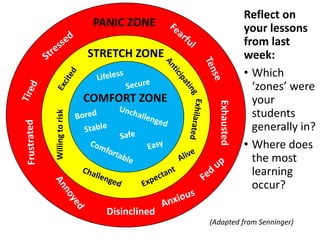
PANIC ZONE
Exhausted
Disinclined
STRETCH ZONEWillingtorisk
COMFORT ZONE
Reflect on
your lessons
from last
week:
• Which
‘zones’ were
your
students
generally in?
• Where does
the most
learning
occur?
(Adapted from Senninger)
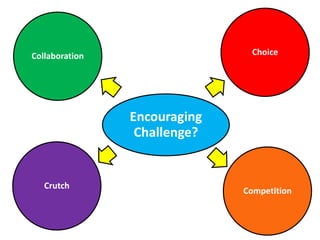
Encouraging
Challenge?
Choice
Competition
Collaboration
Crutch
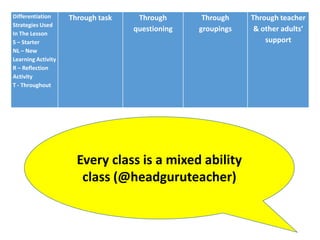
Differentiation
Strategies Used
In The Lesson
S – Starter
NL – New
Learning Activity
R – Reflection
Activity
T - Throughout
Through task Through
questioning
Through
groupings
Through teacher
& other adults’
support
Every class is a mixed ability
class (@headguruteacher)
Differentiation
Strategies Used In
The Lesson
S – Starter
NL – New Learning
Activity
R – Reflection
Activity
T - Throughout
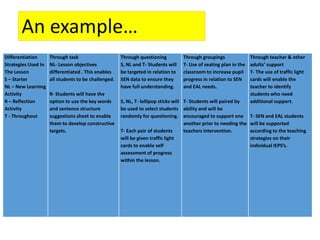
Through task
NL- Lesson objectives
differentiated . This enables
all students to be challenged.
R- Students will have the
option to use the key words
and sentence structure
suggestions sheet to enable
them to develop constructive
targets.
Through questioning
S, NL and T- Students will
be targeted in relation to
SEN data to ensure they
have full understanding.
S, NL, T- lollipop sticks will
be used to select students
randomly for questioning.
T- Each pair of students
will be given traffic light
cards to enable self
assessment of progress
within the lesson.
Through groupings
T- Use of seating plan in the
classroom to increase pupil
progress in relation to SEN
and EAL needs.
T- Students will paired by
ability and will be
encouraged to support one
another prior to needing the
teachers intervention.
Through teacher & other
adults’ support
T- The use of traffic light
cards will enable the
teacher to identify
students who need
additional support.
T- SEN and EAL students
will be supported
according to the teaching
strategies on their
individual IEPS’s.
An example…
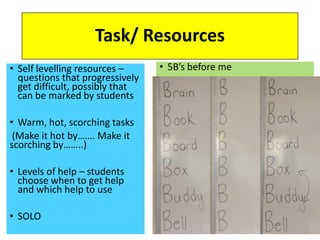
Task/ Resources
• Self levelling resources –
questions that progressively
get difficult, possibly that
can be marked by students
• Warm, hot, scorching tasks
(Make it hot by……. Make it
scorching by……..)
• Levels of help – students
choose when to get help
and which help to use
• SOLO
• 5B’s before me
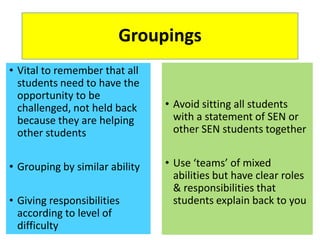
Groupings
• Vital to remember that all
students need to have the
opportunity to be
challenged, not held back
because they are helping
other students
• Grouping by similar ability
• Giving responsibilities
according to level of
difficulty
• Avoid sitting all students
with a statement of SEN or
other SEN students together
• Use ‘teams’ of mixed
abilities but have clear roles
& responsibilities that
students explain back to you
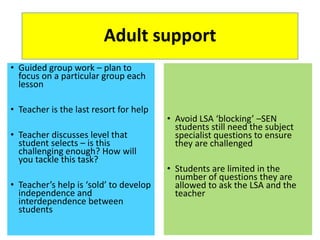
Adult support
• Guided group work – plan to
focus on a particular group each
lesson
• Teacher is the last resort for help
• Teacher discusses level that
student selects – is this
challenging enough? How will
you tackle this task?
• Teacher’s help is ‘sold’ to develop
independence and
interdependence between
students
• Avoid LSA ‘blocking’ –SEN
students still need the subject
specialist questions to ensure
they are challenged
• Students are limited in the
number of questions they are
allowed to ask the LSA and the
teacher
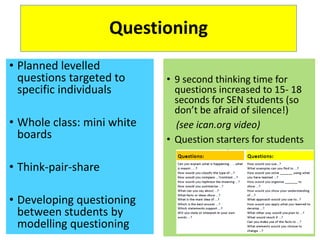
Questioning
• Planned levelled
questions targeted to
specific individuals
• Whole class: mini white
boards
• Think-pair-share
• Developing questioning
between students by
modelling questioning
• 9 second thinking time for
questions increased to 15- 18
seconds for SEN students (so
don’t be afraid of silence!)
(see ican.org video)
• Question starters for students
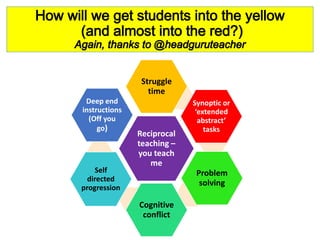
Reciprocal
teaching –
you teach
me
Struggle
time
Synoptic or
‘extended
abstract’
tasks
Problem
solving
Cognitive
conflict
Self
directed
progression
Deep end
instructions
(Off you
go)
Embedding stretch & challenge for all

Embedding stretch & challenge for all

  • 1.
    TM Heathland 5/7/13 ‘EmbeddingStretch & Challenge for all’ Melanie Aberson (Science AST) @TeacherTweaks Colleen Bell (SENCO) @colesbell ‘If you want to feel secure do what you already know how to do. But if you want to grow......... Go to the cutting edge of your competence, which means a temporary loss of security. So, whenever you don’t quite know what you are doing know that you are growing...’ (Viscott, 2003)
  • 2.
    PANIC ZONE Exhausted Disinclined STRETCH ZONEWillingtorisk COMFORTZONE Reflect on your lessons from last week: • Which ‘zones’ were your students generally in? • Where does the most learning occur? (Adapted from Senninger)
  • 3.
  • 4.
    Differentiation Strategies Used In TheLesson S – Starter NL – New Learning Activity R – Reflection Activity T - Throughout Through task Through questioning Through groupings Through teacher & other adults’ support Every class is a mixed ability class (@headguruteacher)
  • 5.
    Differentiation Strategies Used In TheLesson S – Starter NL – New Learning Activity R – Reflection Activity T - Throughout Through task NL- Lesson objectives differentiated . This enables all students to be challenged. R- Students will have the option to use the key words and sentence structure suggestions sheet to enable them to develop constructive targets. Through questioning S, NL and T- Students will be targeted in relation to SEN data to ensure they have full understanding. S, NL, T- lollipop sticks will be used to select students randomly for questioning. T- Each pair of students will be given traffic light cards to enable self assessment of progress within the lesson. Through groupings T- Use of seating plan in the classroom to increase pupil progress in relation to SEN and EAL needs. T- Students will paired by ability and will be encouraged to support one another prior to needing the teachers intervention. Through teacher & other adults’ support T- The use of traffic light cards will enable the teacher to identify students who need additional support. T- SEN and EAL students will be supported according to the teaching strategies on their individual IEPS’s. An example…
  • 6.
    Task/ Resources • Selflevelling resources – questions that progressively get difficult, possibly that can be marked by students • Warm, hot, scorching tasks (Make it hot by……. Make it scorching by……..) • Levels of help – students choose when to get help and which help to use • SOLO • 5B’s before me
  • 7.
    Groupings • Vital toremember that all students need to have the opportunity to be challenged, not held back because they are helping other students • Grouping by similar ability • Giving responsibilities according to level of difficulty • Avoid sitting all students with a statement of SEN or other SEN students together • Use ‘teams’ of mixed abilities but have clear roles & responsibilities that students explain back to you
  • 8.
    Adult support • Guidedgroup work – plan to focus on a particular group each lesson • Teacher is the last resort for help • Teacher discusses level that student selects – is this challenging enough? How will you tackle this task? • Teacher’s help is ‘sold’ to develop independence and interdependence between students • Avoid LSA ‘blocking’ –SEN students still need the subject specialist questions to ensure they are challenged • Students are limited in the number of questions they are allowed to ask the LSA and the teacher
  • 9.
    Questioning • Planned levelled questionstargeted to specific individuals • Whole class: mini white boards • Think-pair-share • Developing questioning between students by modelling questioning • 9 second thinking time for questions increased to 15- 18 seconds for SEN students (so don’t be afraid of silence!) (see ican.org video) • Question starters for students
  • 10.
    Reciprocal teaching – you teach me Struggle time Synopticor ‘extended abstract’ tasks Problem solving Cognitive conflict Self directed progression Deep end instructions (Off you go)