Achieving success in GCSE English and English
Literature
What to expect …
• The English GCSE has changed significantly since 2015:
- 100% examination – no controlled assessment
- Four exams across Language and Literature
- Closed book exams
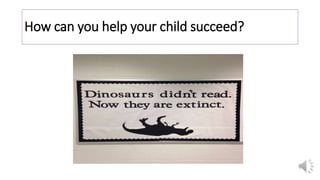
How can you help your child succeed?
Reading
Reading for pleasure is the single biggest indicator of a child’s future
success, more than their family circumstances, parents’ educational
background or their income.
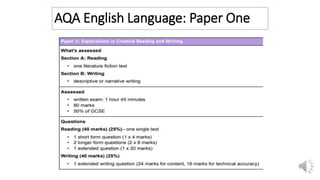
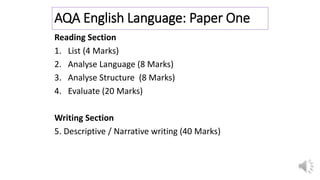
AQA English Language: Paper One
Reading Section
1. List (4 Marks)
2. Analyse Language (8 Marks)
3. Analyse Structure (8 Marks)
4. Evaluate (20 Marks)
Writing Section
5. Descriptive / Narrative writing (40 Marks)
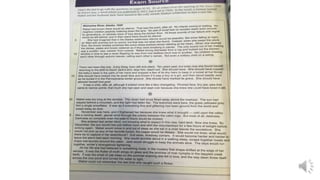
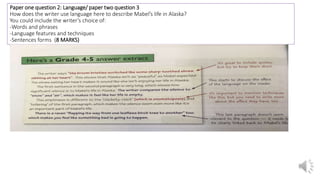
Paper one question 2: Language/ paper two question 3
How does the writer use language here to describe Mabel’s life in Alaska?
You could include the writer’s choice of:
-Words and phrases
-Language features and techniques
-Sentences forms (8 MARKS)
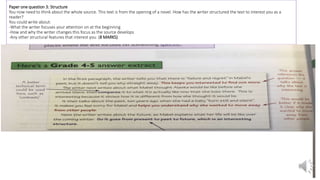
Paper one question 3: Structure
You now need to think about the whole source. This text is from the opening of a novel. How has the writer structured the text to interest you as a
reader?
You could write about:
-What the writer focuses your attention on at the beginning
-How and why the writer changes this focus as the source develops
-Any other structural features that interest you. (8 MARKS)
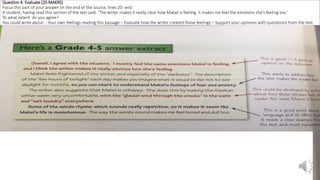
Question 4: Evaluate (20 MAKRS)
Focus this part of your answer on the end of the source, lines 20- end.
A student, having read this section of the text said: ‘The writer makes it really clear how Mabel is feeling. It makes me feel the emotions she’s feeling too.’
To what extent do you agree?
You could write about: - Your own feelings reading this passage – Evaluate how the writer created those feelings – Support your opinions with quotations from the text.
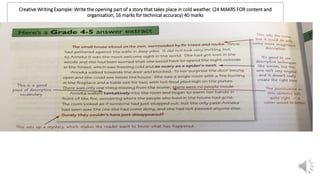
Creative Writing Example: Write the opening part of a story that takes place in cold weather. (24 MAKRS FOR content and
organisation, 16 marks for technical accuracy) 40 marks
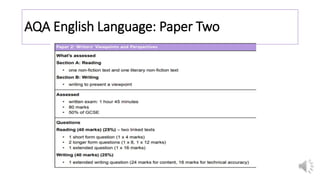
AQA English Language: Paper Two
Reading Section
1. True or false (4 Marks)
2. Summarise two texts (8 Marks)
3. Analyse language (12 Marks)
4. Compare (16 Marks)
Writing Section
5. Non-fiction writing (40 Marks)
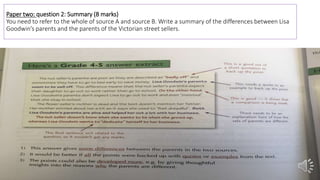
Paper two: question 2: Summary (8 marks)
You need to refer to the whole of source A and source B. Write a summary of the differences between Lisa
Goodwin’s parents and the parents of the Victorian street sellers.
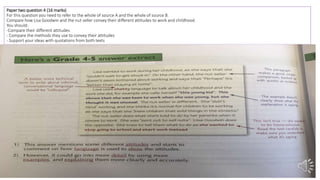
Paper two question 4 (16 marks)
For this question you need to refer to the whole of source A and the whole of source B.
Compare how Lisa Goodwin and the nut seller convey their different attitudes to work and childhood.
You should:
-Compare their different attitudes
- Compare the methods they use to convey their attitudes
- Support your ideas with quotations from both texts
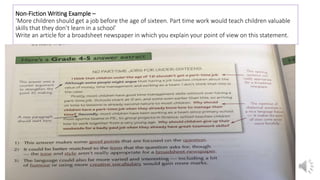
Non-Fiction Writing Example –
‘More children should get a job before the age of sixteen. Part time work would teach children valuable
skills that they don’t learn in a school’
Write an article for a broadsheet newspaper in which you explain your point of view on this statement.
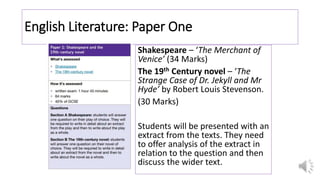
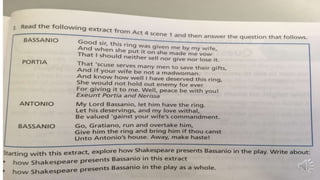
English Literature: Paper One
Shakespeare – ‘The Merchant of
Venice’ (34 Marks)
The 19th Century novel – ‘The
Strange Case of Dr. Jekyll and Mr
Hyde’ by Robert Louis Stevenson.
(30 Marks)
Students will be presented with an
extract from the texts. They need
to offer analysis of the extract in
relation to the question and then
discuss the wider text.
What to do …
Read the information at the top of the extract
Read the question
Read the extract – highlight / annotate as you read
Plan
Write a short thesis – 2-4 sentences
Aim to write between 2-4 paragraphs on the extract and the same on the
wider text
Consider the writers’ intentions –what were they trying to make reader think
or feel about the character of theme named in the question?
Offer close analysis of the language / structure. Consider the context of the
text.
AQA English Literature: Paper Two
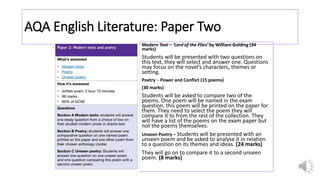
Modern Text – ‘Lord of the Flies’ by William Golding (34
marks)
Students will be presented with two questions on
this text, they will select and answer one. Questions
may focus on the novel’s characters, themes or
setting.
Poetry – Power and Conflict (15 poems)
(30 marks)
Students will be asked to compare two of the
poems. One poem will be named in the exam
question, this poem will be printed on the paper for
them. They need to select the poem they will
compare it to from the rest of the collection. They
will have a list of the poems on the exam paper but
not the poems themselves.
Unseen Poetry – Students will be presented with an
unseen poem and be asked to analyse it in relation
to a question on its themes and ideas. (24 marks)
They will go on to compare it to a second unseen
poem. (8 marks)
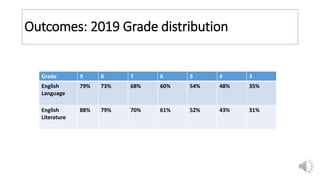
Outcomes: 2019 Grade distribution
Grade 9 8 7 6 5 4 3
English
Language
79% 73% 68% 60% 54% 48% 35%
English
Literature
88% 79% 70% 61% 52% 43% 31%
What do we expect from students?
• To attend and be punctual to all English lessons.
• To take an active role in lessons, contributing to their learning
and the learning of others.
• To complete all homework and practice examination questions
on time and to the best of their ability.
• To complete ‘responses’ to the feedback they get from their
teachers to ensure learning and progress.
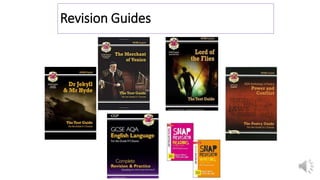
Revision Guides
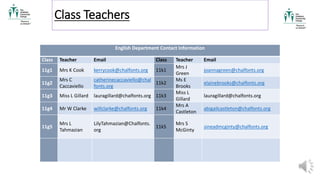
Class Teachers
English Department Contact Information
Class Teacher Email Class Teacher Email
11g1 Mrs K Cook kerrycook@chalfonts.org 11k1
Mrs J
Green
joannagreen@chalfonts.org
11g2
Mrs C
Caccaviello
catherinecaccaviello@chal
fonts.org
11k2
Ms E
Brooks
elainebrooks@chalfonts.org
11g3 Miss L Gillard lauragillard@chalfonts.org 11k3
Miss L
Gillard
lauragillard@chalfonts.org
11g4 Mr W Clarke willclarke@chalfonts.org 11k4
Mrs A
Castleton
abigailcastleton@chalfonts.org
11g5
Mrs L
Tahmazian
LilyTahmazian@Chalfonts.
org
11k5
Mrs S
McGinty
sineadmcginty@chalfonts.org
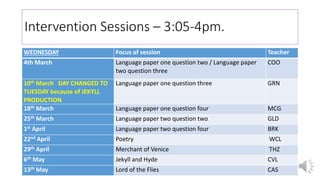
Intervention Sessions – 3:05-4pm.
WEDNESDAY Focus of session Teacher
4th March Language paper one question two / Language paper
two question three
COO
10th March DAY CHANGED TO
TUESDAY because of JEKYLL
PRODUCTION
Language paper one question three GRN
18th March Language paper one question four MCG
25th March Language paper two question two GLD
1st April Language paper two question four BRK
22nd April Poetry WCL
29th April Merchant of Venice THZ
6th May Jekyll and Hyde CVL
13th May Lord of the Flies CAS
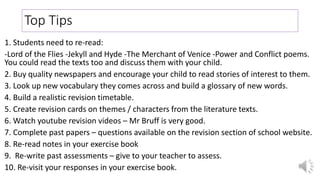
Top Tips
1. Students need to re-read:
-Lord of the Flies -Jekyll and Hyde -The Merchant of Venice -Power and Conflict poems.
You could read the texts too and discuss them with your child.
2. Buy quality newspapers and encourage your child to read stories of interest to them.
3. Look up new vocabulary they comes across and build a glossary of new words.
4. Build a realistic revision timetable.
5. Create revision cards on themes / characters from the literature texts.
6. Watch youtube revision videos – Mr Bruff is very good.
7. Complete past papers – questions available on the revision section of school website.
8. Re-read notes in your exercise book
9. Re-write past assessments – give to your teacher to assess.
10. Re-visit your responses in your exercise book.
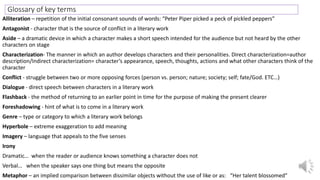
Glossary of key terms
Alliteration – repetition of the initial consonant sounds of words: “Peter Piper picked a peck of pickled peppers”
Antagonist - character that is the source of conflict in a literary work
Aside – a dramatic device in which a character makes a short speech intended for the audience but not heard by the other
characters on stage
Characterization- The manner in which an author develops characters and their personalities. Direct characterization=author
description/Indirect characterization= character’s appearance, speech, thoughts, actions and what other characters think of the
character
Conflict - struggle between two or more opposing forces (person vs. person; nature; society; self; fate/God. ETC…)
Dialogue - direct speech between characters in a literary work
Flashback - the method of returning to an earlier point in time for the purpose of making the present clearer
Foreshadowing - hint of what is to come in a literary work
Genre – type or category to which a literary work belongs
Hyperbole – extreme exaggeration to add meaning
Imagery – language that appeals to the five senses
Irony
Dramatic… when the reader or audience knows something a character does not
Verbal… when the speaker says one thing but means the opposite
Metaphor – an implied comparison between dissimilar objects without the use of like or as: “Her talent blossomed”
Onomatopoeia – use of a word whose sound imitates its meaning: “hiss”
Oxymoron – phrase that consists of two words that are contradictory: “living dead” or “jumbo shrimp”
Personification – figure of speech in which non-human things are given human characteristics
Plot- The sequence of events in a literary work
Point of view- the vantage point or perspective from which a literary work is told…
• 1st person point of view- the narrator is a character in the story (use of ‘I’)
• 2nd person point of view- the speaker addresses the listener or reader directly, using "you"
• 3rd person point of view- the narrator is outside of the story (use of ‘he’ ‘she’ ‘they’)* may be limited or omniscient
Protagonist- the main character in a literary work
Rhyme – repetition of similar or identical sounds: “look and crook”
Rhyme Scheme – pattern of rhyme among lines of poetry [denoted using letters, as in ABAB CDCD EE]
Setting- The time and place of a literary work
Simile – a direct comparison of dissimilar objects, usually using like or as: “I wandered lonely as a cloud”
Soliloquy - a dramatic device in which a character is alone and speaks his or her thoughts aloud
Speaker – voice in a poem; the person or thing that is speaking
Stanza – group of lines forming a unit in a poem
Stereotype- standardised, conventional ideas about characters, plots and settings
Suspense – technique that keeps the reader guessing what will happen next
Symbol / symbolism – one thing (object, person, place) used to represent something else
Theme – the underlying main idea of a literary work. Theme differs from the subject of a literary work in that it involves a
statement or opinion about the subject.
Tone – the author’s attitude toward the subject of a work or toward the audience

Achieving a grade 4+ in English

  • 1.
    Achieving success inGCSE English and English Literature
  • 2.
    What to expect… • The English GCSE has changed significantly since 2015: - 100% examination – no controlled assessment - Four exams across Language and Literature - Closed book exams
  • 3.
    How can youhelp your child succeed?
  • 4.
    Reading Reading for pleasureis the single biggest indicator of a child’s future success, more than their family circumstances, parents’ educational background or their income.
  • 5.
  • 6.
    AQA English Language:Paper One Reading Section 1. List (4 Marks) 2. Analyse Language (8 Marks) 3. Analyse Structure (8 Marks) 4. Evaluate (20 Marks) Writing Section 5. Descriptive / Narrative writing (40 Marks)
  • 8.
    Paper one question2: Language/ paper two question 3 How does the writer use language here to describe Mabel’s life in Alaska? You could include the writer’s choice of: -Words and phrases -Language features and techniques -Sentences forms (8 MARKS)
  • 9.
    Paper one question3: Structure You now need to think about the whole source. This text is from the opening of a novel. How has the writer structured the text to interest you as a reader? You could write about: -What the writer focuses your attention on at the beginning -How and why the writer changes this focus as the source develops -Any other structural features that interest you. (8 MARKS)
  • 10.
    Question 4: Evaluate(20 MAKRS) Focus this part of your answer on the end of the source, lines 20- end. A student, having read this section of the text said: ‘The writer makes it really clear how Mabel is feeling. It makes me feel the emotions she’s feeling too.’ To what extent do you agree? You could write about: - Your own feelings reading this passage – Evaluate how the writer created those feelings – Support your opinions with quotations from the text.
  • 11.
    Creative Writing Example:Write the opening part of a story that takes place in cold weather. (24 MAKRS FOR content and organisation, 16 marks for technical accuracy) 40 marks
  • 12.
  • 13.
    AQA English Language:Paper Two Reading Section 1. True or false (4 Marks) 2. Summarise two texts (8 Marks) 3. Analyse language (12 Marks) 4. Compare (16 Marks) Writing Section 5. Non-fiction writing (40 Marks)
  • 14.
    Paper two: question2: Summary (8 marks) You need to refer to the whole of source A and source B. Write a summary of the differences between Lisa Goodwin’s parents and the parents of the Victorian street sellers.
  • 15.
    Paper two question4 (16 marks) For this question you need to refer to the whole of source A and the whole of source B. Compare how Lisa Goodwin and the nut seller convey their different attitudes to work and childhood. You should: -Compare their different attitudes - Compare the methods they use to convey their attitudes - Support your ideas with quotations from both texts
  • 16.
    Non-Fiction Writing Example– ‘More children should get a job before the age of sixteen. Part time work would teach children valuable skills that they don’t learn in a school’ Write an article for a broadsheet newspaper in which you explain your point of view on this statement.
  • 17.
    English Literature: PaperOne Shakespeare – ‘The Merchant of Venice’ (34 Marks) The 19th Century novel – ‘The Strange Case of Dr. Jekyll and Mr Hyde’ by Robert Louis Stevenson. (30 Marks) Students will be presented with an extract from the texts. They need to offer analysis of the extract in relation to the question and then discuss the wider text.
  • 18.
    What to do… Read the information at the top of the extract Read the question Read the extract – highlight / annotate as you read Plan Write a short thesis – 2-4 sentences Aim to write between 2-4 paragraphs on the extract and the same on the wider text Consider the writers’ intentions –what were they trying to make reader think or feel about the character of theme named in the question? Offer close analysis of the language / structure. Consider the context of the text.
  • 21.
    AQA English Literature:Paper Two Modern Text – ‘Lord of the Flies’ by William Golding (34 marks) Students will be presented with two questions on this text, they will select and answer one. Questions may focus on the novel’s characters, themes or setting. Poetry – Power and Conflict (15 poems) (30 marks) Students will be asked to compare two of the poems. One poem will be named in the exam question, this poem will be printed on the paper for them. They need to select the poem they will compare it to from the rest of the collection. They will have a list of the poems on the exam paper but not the poems themselves. Unseen Poetry – Students will be presented with an unseen poem and be asked to analyse it in relation to a question on its themes and ideas. (24 marks) They will go on to compare it to a second unseen poem. (8 marks)
  • 23.
    Outcomes: 2019 Gradedistribution Grade 9 8 7 6 5 4 3 English Language 79% 73% 68% 60% 54% 48% 35% English Literature 88% 79% 70% 61% 52% 43% 31%
  • 24.
    What do weexpect from students? • To attend and be punctual to all English lessons. • To take an active role in lessons, contributing to their learning and the learning of others. • To complete all homework and practice examination questions on time and to the best of their ability. • To complete ‘responses’ to the feedback they get from their teachers to ensure learning and progress.
  • 25.
  • 26.
    Class Teachers English DepartmentContact Information Class Teacher Email Class Teacher Email 11g1 Mrs K Cook kerrycook@chalfonts.org 11k1 Mrs J Green joannagreen@chalfonts.org 11g2 Mrs C Caccaviello catherinecaccaviello@chal fonts.org 11k2 Ms E Brooks elainebrooks@chalfonts.org 11g3 Miss L Gillard lauragillard@chalfonts.org 11k3 Miss L Gillard lauragillard@chalfonts.org 11g4 Mr W Clarke willclarke@chalfonts.org 11k4 Mrs A Castleton abigailcastleton@chalfonts.org 11g5 Mrs L Tahmazian LilyTahmazian@Chalfonts. org 11k5 Mrs S McGinty sineadmcginty@chalfonts.org
  • 27.
    Intervention Sessions –3:05-4pm. WEDNESDAY Focus of session Teacher 4th March Language paper one question two / Language paper two question three COO 10th March DAY CHANGED TO TUESDAY because of JEKYLL PRODUCTION Language paper one question three GRN 18th March Language paper one question four MCG 25th March Language paper two question two GLD 1st April Language paper two question four BRK 22nd April Poetry WCL 29th April Merchant of Venice THZ 6th May Jekyll and Hyde CVL 13th May Lord of the Flies CAS
  • 28.
    Top Tips 1. Studentsneed to re-read: -Lord of the Flies -Jekyll and Hyde -The Merchant of Venice -Power and Conflict poems. You could read the texts too and discuss them with your child. 2. Buy quality newspapers and encourage your child to read stories of interest to them. 3. Look up new vocabulary they comes across and build a glossary of new words. 4. Build a realistic revision timetable. 5. Create revision cards on themes / characters from the literature texts. 6. Watch youtube revision videos – Mr Bruff is very good. 7. Complete past papers – questions available on the revision section of school website. 8. Re-read notes in your exercise book 9. Re-write past assessments – give to your teacher to assess. 10. Re-visit your responses in your exercise book.
  • 29.
    Glossary of keyterms Alliteration – repetition of the initial consonant sounds of words: “Peter Piper picked a peck of pickled peppers” Antagonist - character that is the source of conflict in a literary work Aside – a dramatic device in which a character makes a short speech intended for the audience but not heard by the other characters on stage Characterization- The manner in which an author develops characters and their personalities. Direct characterization=author description/Indirect characterization= character’s appearance, speech, thoughts, actions and what other characters think of the character Conflict - struggle between two or more opposing forces (person vs. person; nature; society; self; fate/God. ETC…) Dialogue - direct speech between characters in a literary work Flashback - the method of returning to an earlier point in time for the purpose of making the present clearer Foreshadowing - hint of what is to come in a literary work Genre – type or category to which a literary work belongs Hyperbole – extreme exaggeration to add meaning Imagery – language that appeals to the five senses Irony Dramatic… when the reader or audience knows something a character does not Verbal… when the speaker says one thing but means the opposite Metaphor – an implied comparison between dissimilar objects without the use of like or as: “Her talent blossomed”
  • 30.
    Onomatopoeia – useof a word whose sound imitates its meaning: “hiss” Oxymoron – phrase that consists of two words that are contradictory: “living dead” or “jumbo shrimp” Personification – figure of speech in which non-human things are given human characteristics Plot- The sequence of events in a literary work Point of view- the vantage point or perspective from which a literary work is told… • 1st person point of view- the narrator is a character in the story (use of ‘I’) • 2nd person point of view- the speaker addresses the listener or reader directly, using "you" • 3rd person point of view- the narrator is outside of the story (use of ‘he’ ‘she’ ‘they’)* may be limited or omniscient Protagonist- the main character in a literary work Rhyme – repetition of similar or identical sounds: “look and crook” Rhyme Scheme – pattern of rhyme among lines of poetry [denoted using letters, as in ABAB CDCD EE] Setting- The time and place of a literary work Simile – a direct comparison of dissimilar objects, usually using like or as: “I wandered lonely as a cloud” Soliloquy - a dramatic device in which a character is alone and speaks his or her thoughts aloud Speaker – voice in a poem; the person or thing that is speaking Stanza – group of lines forming a unit in a poem Stereotype- standardised, conventional ideas about characters, plots and settings Suspense – technique that keeps the reader guessing what will happen next Symbol / symbolism – one thing (object, person, place) used to represent something else Theme – the underlying main idea of a literary work. Theme differs from the subject of a literary work in that it involves a statement or opinion about the subject. Tone – the author’s attitude toward the subject of a work or toward the audience

Editor's Notes

  • #5 http://www.telegraph.co.uk/education/educationopinion/10035473/The-importance-of-instilling-a-need-to-read.html