AFL “ Tell me and I forget, teach me and I remember, involve me and I learn .” Projects>Staff>Differentiation Group> AFL Presentation
What do you think AFL is? In small groups use the whiteboard to write a definition to explain AFL
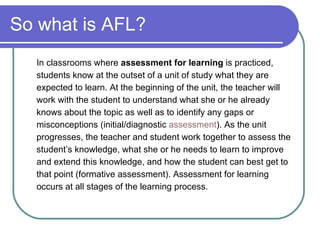
So what is AFL? In classrooms where  assessment for learning  is practiced, students know at the outset of a unit of study what they are expected to learn. At the beginning of the unit, the teacher will work with the student to understand what she or he already knows about the topic as well as to identify any gaps or misconceptions (initial/diagnostic  assessment ). As the unit progresses, the teacher and student work together to assess the student’s knowledge, what she or he needs to learn to improve and extend this knowledge, and how the student can best get to that point (formative assessment). Assessment for learning occurs at all stages of the learning process.
Or is it AFL? Assessment for learning involves using assessment in the classroom to raise pupils’ achievement. It is based on the idea that pupils will improve most if they understand the aim of their learning, where they are in relation to this aim and how they can achieve the aim (or close the gap in their knowledge).
Or maybe! Assessment for learning is the process of seeking and interpreting evidence where the learners are in their learning, where they need to go and how best to get there”
What about? Assessment for Learning (AfL) means using evidence and dialogue to identify where pupils are in their learning, where they need to go and how best to get there. In practice, this means clear evidence about how to drive up individual attainment; clear feedback for and from pupils so there is clarity on what they need to improve and how best they can do so; and a clear link between student learning and lesson planning.
Maybe? Assessment is for Learning provides a coherent framework for assessment, in which evidence of learning can be gathered and interpreted to best meet the needs of learners, their parents and teachers, as well as school managers and others with responsibility for ensuring that education is as good as it can be In distinguishing three different uses of assessment (assessment for, as and of learning), AfL seeks to ensure that evidence of learning is gathered and used in appropriate ways, and that meaningful connections can be made between the curriculum and the learning and teaching required for its effective delivery.
Assessment for learning-sometimes called formative assessment-involves teachers and learners using assessment to improve learning.It is about assessing progress and analysing  and feeding back the outcomes of that assessment positively and constructively. How about?
Or Finally Assessment for learning is the process of seeking and interpreting evidence for  use by learners and their teachers to decide where the learners are in their learning, where they need to go and how best to get there
AFL-Definition  St Ivo school is launching a teaching and learning document for all staff for sept 09. A major area for development is AFL  In groups use the definitions provided, your own knowledge and the internet to write a  definition to explain to staff what  AFL is, Please write it on a computer!
Are you using AFL in lessons? In your groups use the whiteboards to write down and discuss examples of where you are using AFL in your lessons/classroom
What makes good practice?  In your groups select one or two examples that you believe to be best practice Justify why you have selected these examples
When effective AFL is used pupil’s: Attitudes to learning change Quality of oral input improves Attainment Levels rise Quality of pupil questions improve  Have a greater involvement in  assessment processes
When planning for effective AFL teachers must  produce plans with: An emphasis on sharing quality learning intentions Assessment criteria for any feedback, marking, peer or self-assessment  Review time  Resources/strategies for pupils who need additional support (SEN/G&T) Guided group sessions with explicit formative assessment opportunities
For AFL to be effective teachers need to: know their pupils well and make judgements about next steps or interventions  share learning intentions and assessment criteria with pupils and link to any feedback, marking, peer or self-assessment  Allow time for review, by both teacher and pupils  Involve pupils in the planning for and the process of achieving learning outcomes Give pupils examples of a variety of skills, attitudes, standards and qualities to aim for  Use summative assessment to aid future planning
Case Study A class of 12 year-old students were studying english literature . The teacher planned to enhance children’s learning by incorporating AFL practices into the lesson. They wanted to share criteria for high quality (e.g. what good writing looks like), provide feedback to the students on their understanding, and provide opportunities for peer-assessment .
Case Study  The Teacher  provides the students with a checklist of criteria of quality (structure, use of language, characterisation etc) and showed how she would apply them to some examples picked from the text they were reading. She then asked the students to, individually, find examples of each of the criteria on the checklist. When they had done this she checked the answers with the whole class and then asked the students, in pairs, to correct each other’s work.
Review the Case Study Is this an example of good practice? What’s good about it? Would you do anything differently? What & Why?
Case study 2  Teacher B started the same lesson by guiding the students to draw up and agree a list of criteria based on their earlier experience of poems in performance. She then performed a new poem and asked the students to critique her performance using the criteria they had agreed. On the basis of their critique, they were then asked, in groups, to rehearse a better performance themselves and to apply the criteria to their own efforts. When they were satisfied they performed the poems to the whole class .
Case study review  What are the differences? Why is it better practice?
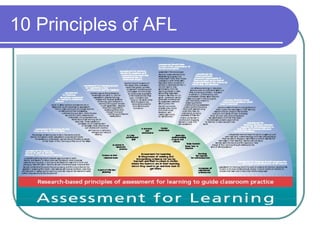
10 Principles of AFL
Key strategies for  assessment for learning using effective questioning techniques   using marking and feedback strategies   sharing learning goals   peer and self-assessment . AFL Check List and strategies  Click this Link
Afl in your classroom  Departmental  Checklist Do you have assessment criteria displayed in the classroom or available for students to study? Are the criteria in language that students can easily understand? Do you explain the meaning of key assessment words in your subject? (Describe, examine, compare, assess, explore, explain, how far and in what ways?, to what extent?) Do you have AFL built into your schemes of work?  Do you have assessed pieces of students’ work to act as models? Do you define the focus of assessment for each piece of work you ask students to do? Do you have a clear and consistent marking/assessment policy for your department? Do you induct new teachers to your department on AFL? Do staff moderate assessments and compare standards and practices within the department on a regular basis?
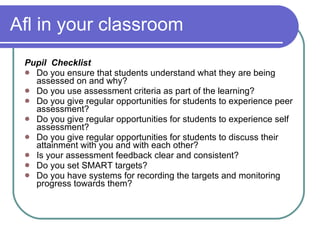
Afl in your classroom Pupil  Checklist Do you ensure that students understand what they are being assessed on and why? Do you use assessment criteria as part of the learning? Do you give regular opportunities for students to experience peer assessment? Do you give regular opportunities for students to experience self assessment? Do you give regular opportunities for students to discuss their attainment with you and with each other? Is your assessment feedback clear and consistent? Do you set SMART targets? Do you have systems for recording the targets and monitoring progress towards them?
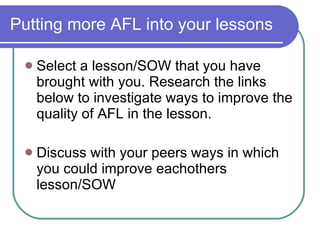
Putting more AFL into your lessons Select a lesson/SOW that you have brought with you. Research the links below to investigate ways to improve the quality of AFL in the lesson. Discuss with your peers ways in which you could improve eachothers lesson/SOW
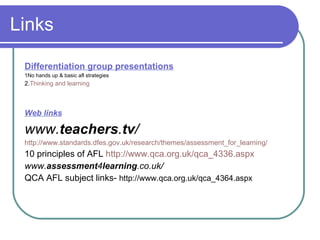
Links Differentiation group presentations 1No hands up & basic afl strategies   2. Thinking and learning Web links www. teachers . tv /   http://www.standards.dfes.gov.uk/research/themes/assessment_for_learning/ 10 principles of AFL  http://www.qca.org.uk/qca_4336.aspx www. assessment 4 learning .co.uk/   QCA AFL subject links-  http://www.qca.org.uk/qca_4364.aspx

Afl Presentation

  • 1.
    AFL “ Tellme and I forget, teach me and I remember, involve me and I learn .” Projects>Staff>Differentiation Group> AFL Presentation
  • 2.
    What do youthink AFL is? In small groups use the whiteboard to write a definition to explain AFL
  • 3.
    So what isAFL? In classrooms where assessment for learning is practiced, students know at the outset of a unit of study what they are expected to learn. At the beginning of the unit, the teacher will work with the student to understand what she or he already knows about the topic as well as to identify any gaps or misconceptions (initial/diagnostic assessment ). As the unit progresses, the teacher and student work together to assess the student’s knowledge, what she or he needs to learn to improve and extend this knowledge, and how the student can best get to that point (formative assessment). Assessment for learning occurs at all stages of the learning process.
  • 4.
    Or is itAFL? Assessment for learning involves using assessment in the classroom to raise pupils’ achievement. It is based on the idea that pupils will improve most if they understand the aim of their learning, where they are in relation to this aim and how they can achieve the aim (or close the gap in their knowledge).
  • 5.
    Or maybe! Assessmentfor learning is the process of seeking and interpreting evidence where the learners are in their learning, where they need to go and how best to get there”
  • 6.
    What about? Assessmentfor Learning (AfL) means using evidence and dialogue to identify where pupils are in their learning, where they need to go and how best to get there. In practice, this means clear evidence about how to drive up individual attainment; clear feedback for and from pupils so there is clarity on what they need to improve and how best they can do so; and a clear link between student learning and lesson planning.
  • 7.
    Maybe? Assessment isfor Learning provides a coherent framework for assessment, in which evidence of learning can be gathered and interpreted to best meet the needs of learners, their parents and teachers, as well as school managers and others with responsibility for ensuring that education is as good as it can be In distinguishing three different uses of assessment (assessment for, as and of learning), AfL seeks to ensure that evidence of learning is gathered and used in appropriate ways, and that meaningful connections can be made between the curriculum and the learning and teaching required for its effective delivery.
  • 8.
    Assessment for learning-sometimescalled formative assessment-involves teachers and learners using assessment to improve learning.It is about assessing progress and analysing and feeding back the outcomes of that assessment positively and constructively. How about?
  • 9.
    Or Finally Assessmentfor learning is the process of seeking and interpreting evidence for use by learners and their teachers to decide where the learners are in their learning, where they need to go and how best to get there
  • 10.
    AFL-Definition StIvo school is launching a teaching and learning document for all staff for sept 09. A major area for development is AFL In groups use the definitions provided, your own knowledge and the internet to write a definition to explain to staff what AFL is, Please write it on a computer!
  • 11.
    Are you usingAFL in lessons? In your groups use the whiteboards to write down and discuss examples of where you are using AFL in your lessons/classroom
  • 12.
    What makes goodpractice? In your groups select one or two examples that you believe to be best practice Justify why you have selected these examples
  • 13.
    When effective AFLis used pupil’s: Attitudes to learning change Quality of oral input improves Attainment Levels rise Quality of pupil questions improve Have a greater involvement in assessment processes
  • 14.
    When planning foreffective AFL teachers must produce plans with: An emphasis on sharing quality learning intentions Assessment criteria for any feedback, marking, peer or self-assessment Review time Resources/strategies for pupils who need additional support (SEN/G&T) Guided group sessions with explicit formative assessment opportunities
  • 15.
    For AFL tobe effective teachers need to: know their pupils well and make judgements about next steps or interventions share learning intentions and assessment criteria with pupils and link to any feedback, marking, peer or self-assessment Allow time for review, by both teacher and pupils Involve pupils in the planning for and the process of achieving learning outcomes Give pupils examples of a variety of skills, attitudes, standards and qualities to aim for Use summative assessment to aid future planning
  • 16.
    Case Study Aclass of 12 year-old students were studying english literature . The teacher planned to enhance children’s learning by incorporating AFL practices into the lesson. They wanted to share criteria for high quality (e.g. what good writing looks like), provide feedback to the students on their understanding, and provide opportunities for peer-assessment .
  • 17.
    Case Study The Teacher provides the students with a checklist of criteria of quality (structure, use of language, characterisation etc) and showed how she would apply them to some examples picked from the text they were reading. She then asked the students to, individually, find examples of each of the criteria on the checklist. When they had done this she checked the answers with the whole class and then asked the students, in pairs, to correct each other’s work.
  • 18.
    Review the CaseStudy Is this an example of good practice? What’s good about it? Would you do anything differently? What & Why?
  • 19.
    Case study 2 Teacher B started the same lesson by guiding the students to draw up and agree a list of criteria based on their earlier experience of poems in performance. She then performed a new poem and asked the students to critique her performance using the criteria they had agreed. On the basis of their critique, they were then asked, in groups, to rehearse a better performance themselves and to apply the criteria to their own efforts. When they were satisfied they performed the poems to the whole class .
  • 20.
    Case study review What are the differences? Why is it better practice?
  • 21.
  • 22.
    Key strategies for assessment for learning using effective questioning techniques using marking and feedback strategies sharing learning goals peer and self-assessment . AFL Check List and strategies Click this Link
  • 23.
    Afl in yourclassroom Departmental Checklist Do you have assessment criteria displayed in the classroom or available for students to study? Are the criteria in language that students can easily understand? Do you explain the meaning of key assessment words in your subject? (Describe, examine, compare, assess, explore, explain, how far and in what ways?, to what extent?) Do you have AFL built into your schemes of work? Do you have assessed pieces of students’ work to act as models? Do you define the focus of assessment for each piece of work you ask students to do? Do you have a clear and consistent marking/assessment policy for your department? Do you induct new teachers to your department on AFL? Do staff moderate assessments and compare standards and practices within the department on a regular basis?
  • 24.
    Afl in yourclassroom Pupil Checklist Do you ensure that students understand what they are being assessed on and why? Do you use assessment criteria as part of the learning? Do you give regular opportunities for students to experience peer assessment? Do you give regular opportunities for students to experience self assessment? Do you give regular opportunities for students to discuss their attainment with you and with each other? Is your assessment feedback clear and consistent? Do you set SMART targets? Do you have systems for recording the targets and monitoring progress towards them?
  • 25.
    Putting more AFLinto your lessons Select a lesson/SOW that you have brought with you. Research the links below to investigate ways to improve the quality of AFL in the lesson. Discuss with your peers ways in which you could improve eachothers lesson/SOW
  • 26.
    Links Differentiation grouppresentations 1No hands up & basic afl strategies 2. Thinking and learning Web links www. teachers . tv / http://www.standards.dfes.gov.uk/research/themes/assessment_for_learning/ 10 principles of AFL http://www.qca.org.uk/qca_4336.aspx www. assessment 4 learning .co.uk/ QCA AFL subject links- http://www.qca.org.uk/qca_4364.aspx