Problem Solving and
Critical Thinking
in ELT
Awad Al Sheikh, Rasha Dahman & Fida Abu Eid
Presentation outline
• Why teaching Critical Thinking and
Problem Solving is important
• Nature of Critical Thinking and Problem
Solving
• Characteristics of an effective Critical
Thinker
• Challenges to teaching Critical Thinking
In your group discuss what you
think the following proverb means
for you as a teacher 

If I hear It, I forget It .
If I see It, I remember It .
If I do It, I know It .
?What is Critical Thinking
The art of thinking about your thinking,
while you’re thinking, so as to make your
thinking more clear, precise, accurate,
relevant, consistent, and fair; the art of
constructive skepticism; the art of
identifying and removing bias…and onesidedness of thought; the art of self…directed, in-depth thinking
(Paul, 1990)
:Critical Thinking is
interpreting, analyzing or evaluating information, “. 1
arguments or experiences with a set of reflective
”attitudes, skills, and abilities
2. “reasonable reflective thinking that is focused on
deciding what to do and what to believe” OR “to guide
our thoughts, beliefs and actions”
3. “examining the thinking of others to improve our own”
Elements of Critical
Thinking
1. Observation:
From
a
series
of
observations, we can come to establish:
2. Facts: From a series of facts, or an
absence of facts, we make:
3. Inferences: Testing the validity of our
inferences, we make :
4. Assumptions: From our assumptions, we
form our…
5.Opinions: Taking our opinions, we use
the principles of logic to develop:
6.Arguments: When we want to
challenge the arguments of others,
we employ:
7.Critical analysis
Activity
Thinking about your students, which of the
elements above
are your students capable of ?
Bloom’s Taxonomy of Thinking
Skills

• Knowledge – facts or bits of information
• Comprehension – understanding what
information means
• Application – finding a practical use for
the knowledge
• Analysis – breaking down the knowledge
into component parts
• Synthesis – connecting knowledge to other
knowledge and devising something new
• Evaluation – judging knowledge
Why is Critical Thinking
?important
• Critical thinking prepares students to
educate themselves for the rest of their
lives
• Critical thinking skills are necessary for
success in many fields
• Critical thinkers are less likely to just go
along with the crowd, and…
• Passing the new Tawjihi !! 
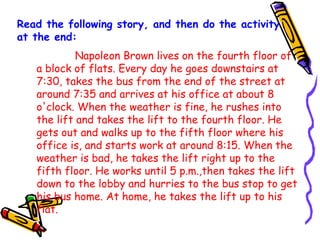
Read the following story, and then do the activity
at the end:
Napoleon Brown lives on the fourth floor of
a block of flats. Every day he goes downstairs at
7:30, takes the bus from the end of the street at
around 7:35 and arrives at his office at about 8
o'clock. When the weather is fine, he rushes into
the lift and takes the lift to the fourth floor. He
gets out and walks up to the fifth floor where his
office is, and starts work at around 8:15. When the
weather is bad, he takes the lift right up to the
fifth floor. He works until 5 p.m.,then takes the lift
down to the lobby and hurries to the bus stop to get
his bus home. At home, he takes the lift up to his
flat.
In your groups, do the following:

1. Read the story quickly (1 minute only!)
2. Write questions that start with the
following words: what, when, where, how,
why, how often, what do you think,
could… on the papers provided
3. Swap your papers with another group
4. Answer their questions, on the back of
their papers
5. Discuss the answers of the other groups
together
How to teach
?
Critical Thinking
Use analogies
Promote interaction among students
Ask open-ended questions
Allow sufficient time for reflection
Teach students to apply knowledge
to other domains
• Use real-life problems
• Allow thinking practice
•
•
•
•
•
Developing Creativity
Exposure to
creative examples

Teacher models
creative approaches
through activities

Encourage students
to play with words &
ideas

task,
problem,
challenge

Students draw on
existing
knowledge of
world

Students draw
on specific skills
in English

outcome
Meta-cognitive
reflection on
process

Students’ evaluation
Developing thinking skills through
questioning

Why do I ask questions in teaching?
What about students asking questions?
Why are students’ questions important?
What types of questions are there?
What should we avoid in questioning?
Is there a simple way to develop questioning?
How can I follow up a question?
Why is waiting in questioning a good idea?
How does questioning develop language and
thinking?
• What are some alternatives to direct questioning?
•
•
•
•
•
•
•
•
•
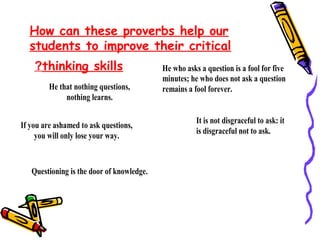
How can these proverbs help our
students to improve their critical
?thinking skills
He that nothing questions,
nothing learns.
If you are ashamed to ask questions,
you will only lose your way.

Questioning is the door of knowledge.

He who asks a question is a fool for five
minutes; he who does not ask a question
remains a fool forever.
It is not disgraceful to ask: it
is disgraceful not to ask.
…Problem Solving

… is a mental process whereby an
individual utilizes his/her previous
knowledge and experience to respond
to the requirements of an unfamiliar
situation. The response should seek
out the conflict or ambiguity of the
situation.
Activity
What are the steps to solving problems?
The Steps to Problem Solving

Defining the problem- 1
Gathering information- 2
3- Studying and analyzing the collected
information
Suggesting solutions- 4
Evaluating the suggested solutions- 5
Solving the problem- 6
Activity

You’ll be given a problem - try to apply these steps in order to
solve it.
•
•
•
•
•
•
•
•
•

Challenges and Barriers to
Teaching CT

Student fear
Impulsiveness
Overdependence on the teacher
Missing the meaning
Inflexibility
Lack of confidence
Dogmatic, assertive behavior
Inability to concentrate
Unwillingness to think

(Raths, et al., 1986)
Teachers’ roles
• change participation practices
gradually: start with brief, focused
activities, then later proceed to
longer or more complex ones
• model thoughtfulness, creativity &
socio-cultural awareness in own
behaviour; give examples of these
• encourage active participation &
relevant uses of English; recognize
thoughtful & creative contributions
Wrap-Up
• Share your revisions with the entire
group
• Questions and observations…

Thank you for coming! 

Problem solving and_critical_thinking_eltecs

  • 1.
    Problem Solving and CriticalThinking in ELT Awad Al Sheikh, Rasha Dahman & Fida Abu Eid
  • 2.
    Presentation outline • Whyteaching Critical Thinking and Problem Solving is important • Nature of Critical Thinking and Problem Solving • Characteristics of an effective Critical Thinker • Challenges to teaching Critical Thinking
  • 3.
    In your groupdiscuss what you think the following proverb means for you as a teacher  If I hear It, I forget It . If I see It, I remember It . If I do It, I know It .
  • 4.
    ?What is CriticalThinking The art of thinking about your thinking, while you’re thinking, so as to make your thinking more clear, precise, accurate, relevant, consistent, and fair; the art of constructive skepticism; the art of identifying and removing bias…and onesidedness of thought; the art of self…directed, in-depth thinking (Paul, 1990)
  • 5.
    :Critical Thinking is interpreting,analyzing or evaluating information, “. 1 arguments or experiences with a set of reflective ”attitudes, skills, and abilities 2. “reasonable reflective thinking that is focused on deciding what to do and what to believe” OR “to guide our thoughts, beliefs and actions” 3. “examining the thinking of others to improve our own”
  • 6.
    Elements of Critical Thinking 1.Observation: From a series of observations, we can come to establish: 2. Facts: From a series of facts, or an absence of facts, we make: 3. Inferences: Testing the validity of our inferences, we make : 4. Assumptions: From our assumptions, we form our…
  • 7.
    5.Opinions: Taking ouropinions, we use the principles of logic to develop: 6.Arguments: When we want to challenge the arguments of others, we employ: 7.Critical analysis Activity Thinking about your students, which of the elements above are your students capable of ?
  • 8.
    Bloom’s Taxonomy ofThinking Skills • Knowledge – facts or bits of information • Comprehension – understanding what information means • Application – finding a practical use for the knowledge • Analysis – breaking down the knowledge into component parts • Synthesis – connecting knowledge to other knowledge and devising something new • Evaluation – judging knowledge
  • 9.
    Why is CriticalThinking ?important • Critical thinking prepares students to educate themselves for the rest of their lives • Critical thinking skills are necessary for success in many fields • Critical thinkers are less likely to just go along with the crowd, and… • Passing the new Tawjihi !! 
  • 10.
    Read the followingstory, and then do the activity at the end: Napoleon Brown lives on the fourth floor of a block of flats. Every day he goes downstairs at 7:30, takes the bus from the end of the street at around 7:35 and arrives at his office at about 8 o'clock. When the weather is fine, he rushes into the lift and takes the lift to the fourth floor. He gets out and walks up to the fifth floor where his office is, and starts work at around 8:15. When the weather is bad, he takes the lift right up to the fifth floor. He works until 5 p.m.,then takes the lift down to the lobby and hurries to the bus stop to get his bus home. At home, he takes the lift up to his flat.
  • 11.
    In your groups,do the following: 1. Read the story quickly (1 minute only!) 2. Write questions that start with the following words: what, when, where, how, why, how often, what do you think, could… on the papers provided 3. Swap your papers with another group 4. Answer their questions, on the back of their papers 5. Discuss the answers of the other groups together
  • 12.
    How to teach ? CriticalThinking Use analogies Promote interaction among students Ask open-ended questions Allow sufficient time for reflection Teach students to apply knowledge to other domains • Use real-life problems • Allow thinking practice • • • • •
  • 13.
    Developing Creativity Exposure to creativeexamples Teacher models creative approaches through activities Encourage students to play with words & ideas task, problem, challenge Students draw on existing knowledge of world Students draw on specific skills in English outcome Meta-cognitive reflection on process Students’ evaluation
  • 14.
    Developing thinking skillsthrough questioning Why do I ask questions in teaching? What about students asking questions? Why are students’ questions important? What types of questions are there? What should we avoid in questioning? Is there a simple way to develop questioning? How can I follow up a question? Why is waiting in questioning a good idea? How does questioning develop language and thinking? • What are some alternatives to direct questioning? • • • • • • • • •
  • 15.
    How can theseproverbs help our students to improve their critical ?thinking skills He that nothing questions, nothing learns. If you are ashamed to ask questions, you will only lose your way. Questioning is the door of knowledge. He who asks a question is a fool for five minutes; he who does not ask a question remains a fool forever. It is not disgraceful to ask: it is disgraceful not to ask.
  • 16.
    …Problem Solving … isa mental process whereby an individual utilizes his/her previous knowledge and experience to respond to the requirements of an unfamiliar situation. The response should seek out the conflict or ambiguity of the situation. Activity What are the steps to solving problems?
  • 17.
    The Steps toProblem Solving Defining the problem- 1 Gathering information- 2 3- Studying and analyzing the collected information Suggesting solutions- 4 Evaluating the suggested solutions- 5 Solving the problem- 6 Activity You’ll be given a problem - try to apply these steps in order to solve it.
  • 18.
    • • • • • • • • • Challenges and Barriersto Teaching CT Student fear Impulsiveness Overdependence on the teacher Missing the meaning Inflexibility Lack of confidence Dogmatic, assertive behavior Inability to concentrate Unwillingness to think (Raths, et al., 1986)
  • 19.
    Teachers’ roles • changeparticipation practices gradually: start with brief, focused activities, then later proceed to longer or more complex ones • model thoughtfulness, creativity & socio-cultural awareness in own behaviour; give examples of these • encourage active participation & relevant uses of English; recognize thoughtful & creative contributions
  • 20.
    Wrap-Up • Share yourrevisions with the entire group • Questions and observations… Thank you for coming! 