Tumour Supressor Gene- Structure,Function
and Mechanism of Action of p53 and pRB
tumour suppressor proteins
ANIMAL CELL SCIENCE AND TECHNOLOGY
SUBMITTED TO-
DR G. SUNIL BABU(Assistant Professor)
MBT-403
DBT, BBAU LUCKNOW
MBT-403
SUBMITTED BY-
SHIVANI MISHRA
Roll No-181621
MSc BIOTECHNOLOGY
MBT-403, 4th semester
DBT, BBAU Lucknow
INTRODUCTION
Tumour Supressor Gene- Tumor suppressor genes are normal genes that slow down cell division, repair DNA
mistakes, or tell cells when to die (a process known as apoptosis or programmed cell death). When tumor suppressor
genes don't work properly, cells can grow out of control, which can lead to cancer.
An important difference between oncogenes and tumor suppressor genes is that oncogenes result from
the activation (turning on) of proto-oncogenes, but tumor suppressor genes cause cancer when they
are inactivated (turned off).
Tumor suppressor genes represent the opposite side of cell growth control, normally acting to inhibit cell proliferation
and tumor development. In many tumors, these genes are lost or inactivated, thereby removing negative regulators of
cell proliferation and contributing to the abnormal proliferation of tumor cells.
• Characterization of Rb as a tumor suppressor gene served as the prototype for the identification of additional tumor
suppressor genes that contribute to the development of many different human cancers.
• The second tumor suppressor gene to have been identified is p53, which is frequently inactivated in a wide variety of
human cancers, including leukemias, lymphomas, sarcomas, brain tumors, and carcinomas of many tissues, including
breast, colon, and lung.
• The proteins encoded by most tumor suppressor genes inhibit cell proliferation or survival. Inactivation of tumor
suppressor genes therefore leads to tumor development by eliminating negative regulatory proteins.
Functions of Tumour Suppressor Gene
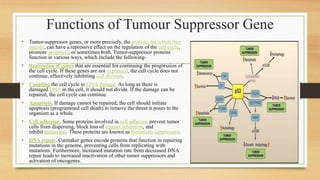
• Tumor-suppressor genes, or more precisely, the proteins for which they
encode, can have a repressive effect on the regulation of the cell cycle,
promote apoptosis, or sometimes both. Tumor-suppressor proteins
function in various ways, which include the following-
• Repression of genes that are essential for continuing the progression of
the cell cycle. If these genes are not expressed, the cell cycle does not
continue, effectively inhibiting cell division.
• Coupling the cell cycle to DNA damage. As long as there is
damaged DNA in the cell, it should not divide. If the damage can be
repaired, the cell cycle can continue.
• Apoptosis. If damage cannot be repaired, the cell should initiate
apoptosis (programmed cell death) to remove the threat it poses to the
organism as a whole.
• Cell adhesion. Some proteins involved in cell adhesion prevent tumor
cells from dispersing, block loss of contact inhibition, and
inhibit metastasis. These proteins are known as metastasis suppressors.
• DNA repair. Caretaker genes encode proteins that function in repairing
mutations in the genome, preventing cells from replicating with
mutations. Furthermore, increased mutation rate from decreased DNA
repair leads to increased inactivation of other tumor suppressors and
activation of oncogenes.
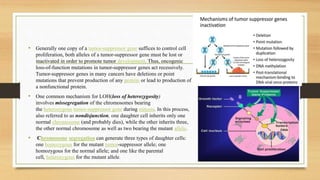
• Generally one copy of a tumor-suppressor gene suffices to control cell
proliferation, both alleles of a tumor-suppressor gene must be lost or
inactivated in order to promote tumor development. Thus, oncogenic
loss-of-function mutations in tumor-suppressor genes act recessively.
Tumor-suppressor genes in many cancers have deletions or point
mutations that prevent production of any protein or lead to production of
a nonfunctional protein.
• One common mechanism for LOH(loss of heterozygosity)
involves missegregation of the chromosomes bearing
the heterozygous tumor-suppressor gene during mitosis. In this process,
also referred to as nondisjunction, one daughter cell inherits only one
normal chromosome (and probably dies), while the other inherits three,
the other normal chromosome as well as two bearing the mutant allele.
• Chromosome segregation can generate three types of daughter cells:
one homozygous for the mutant tumor-suppressor allele; one
homozygous for the normal allele; and one like the parental
cell, heterozygous for the mutant allele.
p53-Gene
Introduction
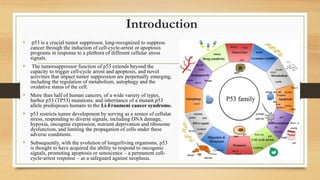
• p53 is a crucial tumor suppressor, long-recognized to suppress
cancer through the induction of cell-cycle-arrest or apoptosis
programs in response to a plethora of different cellular stress
signals.
• The tumorsuppressor function of p53 extends beyond the
capacity to trigger cell-cycle arrest and apoptosis, and novel
activities that impact tumor suppression are perpetually emerging,
including the regulation of metabolism, autophagy and the
oxidative status of the cell.
• More than half of human cancers, of a wide variety of types,
harbor p53 (TP53) mutations, and inheritance of a mutant p53
allele predisposes humans to the Li-Fraumeni cancer syndrome.
• p53 restricts tumor development by serving as a sensor of cellular
stress, responding to diverse signals, including DNA damage,
hypoxia, oncogene expression, nutrient deprivation and ribosome
dysfunction, and limiting the propagation of cells under these
adverse conditions.
• Subsequently, with the evolution of longerliving organisms, p53
is thought to have acquired the ability to respond to oncogenic
signals, promoting apoptosis or senescence – a permanent cell-
cycle-arrest response – as a safeguard against neoplasia.
Structure and Function
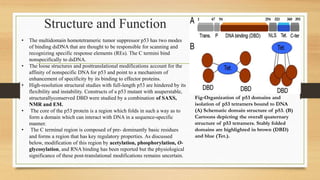
Fig-Organization of p53 domains and
isolation of p53 tetramers bound to DNA
(A) Schematic domain structure of p53. (B)
Cartoons depicting the overall quaternary
structure of p53 tetramers. Stably folded
domains are highlighted in brown (DBD)
and blue (Tet.).
• The multidomain homotetrameric tumor suppressor p53 has two modes
of binding dsDNA that are thought to be responsible for scanning and
recognizing specific response elements (REs). The C termini bind
nonspecifically to dsDNA.
• The loose structures and posttranslational modifications account for the
affinity of nonspecific DNA for p53 and point to a mechanism of
enhancement of specificity by its binding to effector proteins.
• High-resolution structural studies with full-length p53 are hindered by its
flexibility and instability. Constructs of a p53 mutant with asuperstable,
structurallyconserved DBD were studied by a combination of SAXS,
NMR and EM.
• The core of the p53 protein is a region which folds in such a way as to
form a domain which can interact with DNA in a sequence-specific
manner.
• The C terminal region is composed of pre- dominantly basic residues
and forms a region that has key regulatory properties. As discussed
below, modification of this region by acetylation, phosphorylation, O-
glycosylation, and RNA binding has been reported but the physiological
significance of these post-translational modifications remains uncertain.
• p53 restricts tumor development by serving as a sensor of cellular
stress, responding to diverse signals, including DNA damage,
hypoxia, oncogene expression, nutrient deprivation and ribosome
dysfunction, and limiting the propagation of cells under these adverse
conditions.
• p53 is thought to have acquired the ability to respond to oncogenic
signals, promoting apoptosis or senescence – a permanent cell-cycle-
arrest response – as a safeguard against neoplasia.
• Alternatively, under conditions of low-level stress, p53 elicits
protective, pro-survival responses, such as temporary cell-cycle arrest,
DNA repair and antioxidant protein production, to maintain genome
integrity and viability in cells that sustain limited, reparable damage.
• p53 has protein domains typical of transcriptional activators
Similarly to other transcription factors, p53 has a modular protein
domain structure.
• The six most common p53 amino acid residues altered in cancer –
known as ‘hotspots’ – are R175, G245, R248, R249, R273 and R282.
In addition to disrupting DNA binding, these mutations can confer
gain-of-function capabilities on p53, and have been linked to
increased invasiveness and metastasis of tumors.
• p53 induces a host of transcriptional programs involved in
different responses Once active p53 is bound to DNA, it can
stimulate the transcription of many proteincoding and non-protein-
coding genes [e.g. microRNAs or large intergenic non-coding RNAs
(lincRNAs)], which is a function of fundamental importance for all
p53-mediated responses.
• .
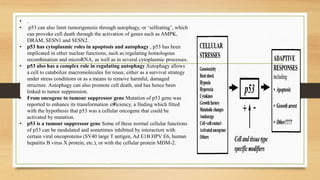
• p53 can also limit tumorigenesis through autophagy, or ‘selfeating’, which
can provoke cell death through the activation of genes such as AMPK,
DRAM, SESN1 and SESN2.
• p53 has cytoplasmic roles in apoptosis and autophagy , p53 has been
implicated in other nuclear functions, such as regulating homologous
recombination and microRNA, as well as in several cytoplasmic processes.
• p53 also has a complex role in regulating autophagy Autophagy allows
a cell to catabolize macromolecules for reuse, either as a survival strategy
under stress conditions or as a means to remove harmful, damaged
structure. Autophagy can also promote cell death, and has hence been
linked to tumor suppression.
• From oncogene to tumour suppressor gene Mutation of p53 gene was
reported to enhance its transformation e•fficiency, a finding which fitted
with the hypothesis that p53 was a cellular oncogene that could be
activated by mutation.
• p53 is a tumour suppressor gene Some of these normal cellular functions
of p53 can be modulated and sometimes inhibited by interaction with
certain viral oncoproteins (SV40 large T antigen, Ad E1B HPV E6, human
hepatitis B virus X protein, etc.), or with the cellular protein MDM-2.
Mechanism Of Action
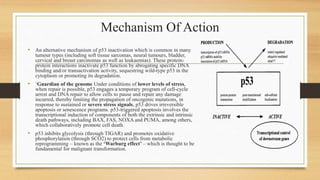
• An alternative mechanism of p53 inactivation which is common in many
tumour types (including soft tissue sarcomas, neural tumours, bladder,
cervical and breast carcinomas as well as leukaemias). These protein-
protein interactions inactivate p53 function by abrogating specific DNA
binding and/or transactivation activity, sequestring wild-type p53 in the
cytoplasm or promoting its degradation.
• ‘Guardian of the genome Under conditions of lower levels of stress,
when repair is possible, p53 engages a temporary program of cell-cycle
arrest and DNA repair to allow cells to pause and repair any damage
incurred, thereby limiting the propagation of oncogenic mutations, in
response to sustained or severe stress signals, p53 drives irreversible
apoptosis or senescence programs. p53-triggered apoptosis involves the
transcriptional induction of components of both the extrinsic and intrinsic
death pathways, including BAX, FAS, NOXA and PUMA, among others,
which collaboratively promote cell death.
• p53 inhibits glycolysis (through TIGAR) and promotes oxidative
phosphorylation (through SCO2) to protect cells from metabolic
reprogramming – known as the ‘Warburg effect’ – which is thought to be
fundamental for malignant transformation.
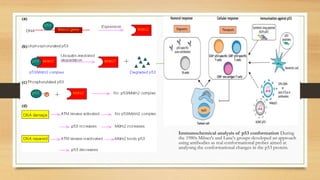
Immunochemical analysis of p53 conformation During
the 1980s Milner's and Lane's groups developed an approach
using antibodies as real conformational probes aimed at
analysing the conformational changes in the p53 protein.
Role of p53 In Cancer Treatment
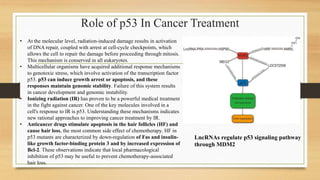
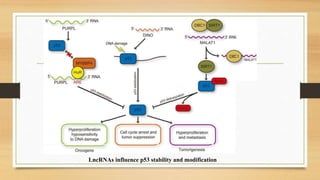
LncRNAs regulate p53 signaling pathway
through MDM2
• At the molecular level, radiation-induced damage results in activation
of DNA repair, coupled with arrest at cell-cycle checkpoints, which
allows the cell to repair the damage before proceeding through mitosis.
This mechanism is conserved in all eukaryotes.
• Multicellular organisms have acquired additional response mechanisms
to genotoxic stress, which involve activation of the transcription factor
p53. p53 can induce growth arrest or apoptosis, and these
responses maintain genomic stability. Failure of this system results
in cancer development and genomic instability.
• Ionizing radiation (IR) has proven to be a powerful medical treatment
in the fight against cancer. One of the key molecules involved in a
cell's response to IR is p53. Understanding these mechanisms indicates
new rational approaches to improving cancer treatment by IR.
• Anticancer drugs stimulate apoptosis in the hair follicles (HF) and
cause hair loss, the most common side effect of chemotherapy. HF in
p53 mutants are characterized by down-regulation of Fas and insulin-
like growth factor-binding protein 3 and by increased expression of
Bcl-2. These observations indicate that local pharmacological
inhibition of p53 may be useful to prevent chemotherapy-associated
hair loss.
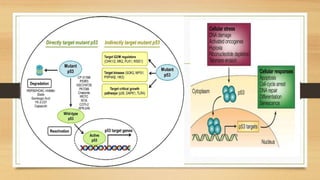
Downstream effector pathways related to mutant p53
• An additional pathway in which mutp53 plays a role is autophagy. Autophagy has been widely
recognized as a main pathway involved in both the regulation of cancer cell proliferation and in
the response to several anticancer drugs. It is an intracellular degradative process through which
damaged macromolecules and organelles are targeted to lysosomes via autophagic vesicle.
• The enhanced glucose metabolism under aerobic conditions (Warburg effect) is a common
feature of many tumors to meet the high biosynthetic demand of rapidly dividing cells.
• However increased glycolysis is observed in many types of cancer cells, but this metabolic shift
can also cause increased oxidative stress and DNA damage . A recent study reported that mutp53
promotes glycolysis and the Warburg effect in both cultured cells and mutant p53 R172H knock-
in mice as an additional novel GOF of mutp53.
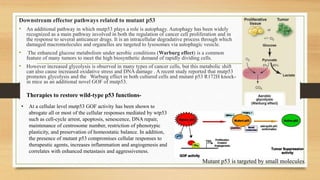
Mutant p53 is targeted by small molecules.
Therapies to restore wild-type p53 functions-
• At a cellular level mutp53 GOF activity has been shown to
abrogate all or most of the cellular responses mediated by wtp53
such as cell-cycle arrest, apoptosis, senescence, DNA repair,
maintenance of centrosome number, restriction of phenotypic
plasticity, and preservation of homeostatic balance. In addition,
the presence of mutant p53 compromises cellular responses to
therapeutic agents, increases inflammation and angiogenesis and
correlates with enhanced metastasis and aggressiveness.
LncRNAs influence p53 stability and modification
• The role of mutant p53 protein as a target for dietary-related cancer
chemopreventive compounds is a new field of research.
• Aggarwal and collegues have recently showed that cruciferous-
vegetable-derived phenethyl isothiocyanate (PEITC) can reactivate
p53 mutant under in vitro and in vivo conditions, revealing a new
mechanism of action for a dietary-related compound.
• Mechanistic studies revealed that PEITC induced apoptosis in a
p53R175H mutant-dependent manner by restoring wtp53 conformation
and transactivation functions.
• In vitro data also suggest that mutp53 can facilitate structural
chromosomal abnormalities by interacting with and inhibiting the
genome caretaker proteins of DNA repair. The fidelity of DNA double
strand break (DSB) repair plays a central role in preventing
translocations. In response to DNA double strand break signals, cells
have at their disposal two distinct repair mechanisms: homologous
recombination (HR) and nonhomologous end joining (NHEJ).
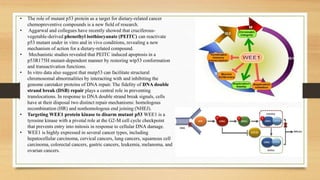
• Targeting WEE1 protein kinase to disarm mutant p53 WEE1 is a
tyrosine kinase with a pivotal role at the G2-M cell cycle checkpoint
that prevents entry into mitosis in response to cellular DNA damage.
• WEE1 is highly expressed in several cancer types, including
hepatocellular carcinoma, cervical cancers, lung cancers, squamous cell
carcinoma, colorectal cancers, gastric cancers, leukemia, melanoma, and
ovarian cancers.
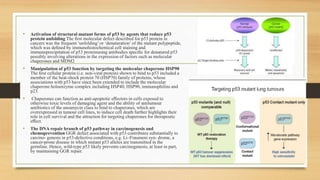
• Activation of structural mutant forms of p53 by agents that reduce p53
protein unfolding The first molecular defect described for p53 protein in
cancers was the frequent ‘unfolding’or ‘denaturation’of the mutant polypeptide,
which was defined by immunohistochemical cell staining and
immunoprecipitation of p53 proteinusing antibodies specific for denatured p53
possibly involving alterations in the expression of factors such as molecular
chaperones and MDM2
• Manipulation of p53 function by targeting the molecular chaperone HSP90
The first cellular protein (i.e. non-viral protein) shown to bind to p53 included a
member of the heat-shock protein 70 (HSP70) family of proteins, whose
associations with p53 have since been extended to include the molecular
chaperone holoenzyme complex including HSP40, HSP90, immunophilins and
p23.
• Chaperones can function as anti-apoptotic effectors in cells exposed to
otherwise toxic levels of damaging agent and the ability of antitumour
antibiotics of the ansamycin class to bind to chaperones, which are
overexpressed in tumour cell lines, to induce cell death further highlights their
role in cell survival and the attraction for targeting chaperones for therapeutic
effect.
• The DNA repair branch of p53 pathway in carcinogenesis and
chemoprevention GGR defect associated with p53 contributes substantially to
carcino- genesis in p53-defective conditions, e.g. Li–Fraumeni syn- drome, a
cancer-prone disease in which mutant p53 alleles are transmitted in the
germline. Hence, wild-type p53 likely prevents carcinogenesis, at least in part,
by maintaining GGR repair.
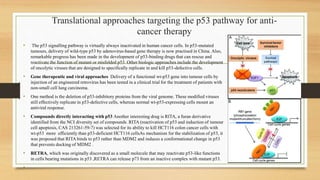
Translational approaches targeting the p53 pathway for anti-
cancer therapy
• The p53 signalling pathway is virtually always inactivated in human cancer cells. In p53-mutated
tumours, delivery of wild-type p53 by adenovirus-based gene therapy is now practised in China. Also,
remarkable progress has been made in the development of p53-binding drugs that can rescue and
reactivate the function of mutant or misfolded p53. Other biologic approaches include the development
of oncolytic viruses that are designed to specifically replicate in and kill p53-defective cells.
• Gene therapeutic and viral approaches Delivery of a functional wt-p53 gene into tumour cells by
injection of an engineered retrovirus has been tested in a clinical trial for the treatment of patients with
non-small cell lung carcinoma.
• One method is the deletion of p53-inhibitory proteins from the viral genome. These modified viruses
still effectively replicate in p53-defective cells, whereas normal wt-p53-expressing cells mount an
antiviral response.
• Compounds directly interacting with p53 Another interesting drug is RITA, a furan derivative
identified from the NCI diversity set of compounds. RITA (reactivation of p53 and induction of tumour
cell apoptosis, CAS 213261-59-7) was selected for its ability to kill HCT116 colon cancer cells with
wt-p53 more efficiently than p53-deficient HCT116 cellsAs mechanism for the stabilization of p53, it
was proposed that RITA binds to p53 rather than MDM2 and induces a conformational change in p53
that prevents docking of MDM2 .
• RETRA, which was originally discovered as a small molecule that may reactivate p53-like functions
in cells bearing mutations in p53 ,RETRA can release p73 from an inactive complex with mutant p53.
•
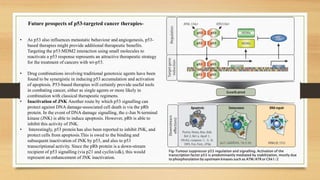
Fig-Tumour suppressor p53 regulation and signalling. Activation of the
transcription factor p53 is predominantly mediated by stabilization, mostly due
to phosphorylation by upstream kinases such as ATM/ATR or Chk1/2
Future prospects of p53-targeted cancer therapies-
• As p53 also influences metastatic behaviour and angiogenesis, p53-
based therapies might provide additional therapeutic benefits.
Targeting the p53:MDM2 interaction using small molecules to
reactivate a p53 response represents an attractive therapeutic strategy
for the treatment of cancers with wt-p53.
• Drug combinations involving traditional genotoxic agents have been
found to be synergistic in inducing p53 accumulation and activation
of apoptosis. P53-based therapies will certainly provide useful tools
in combating cancer, either as single agents or more likely in
combination with classical therapeutic regimens.
• Inactivation of JNK Another route by which p53 signalling can
protect against DNA damage-associated cell death is via the pRb
protein. In the event of DNA damage signalling, the c-Jun N-terminal
kinase (JNK) is able to induce apoptosis. However, pRb is able to
inhibit this activity of JNK.
• Interestingly, p53 protein has also been reported to inhibit JNK, and
protect cells from apoptosis.This is owed to the binding and
subsequent inactivation of JNK by p53, and also to p53
transcriptional activity. Since the pRb protein is a down-stream
recipient of p53 signalling (via p21 and cyclin/cdk), this would
represent an enhancement of JNK inactivation.
pRB-Gene
Introduction
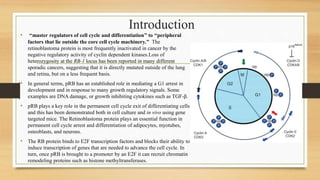
• ‘‘master regulators of cell cycle and differentiation’’ to ‘‘peripheral
factors that lie outside the core cell cycle machinery.’’ The
retinoblastoma protein is most frequently inactivated in cancer by the
negative regulatory activity of cyclin dependent kinases.Loss of
heterozygosity at the RB-1 locus has been reported in many different
sporadic cancers, suggesting that it is directly mutated outside of the lung
and retina, but on a less frequent basis.
• In general terms, pRB has an established role in mediating a G1 arrest in
development and in response to many growth regulatory signals. Some
examples are DNA damage, or growth inhibiting cytokines such as TGF-β.
• pRB plays a key role in the permanent cell cycle exit of differentiating cells
and this has been demonstrated both in cell culture and in vivo using gene
targeted mice. The Retinoblastoma protein plays an essential function in
permanent cell cycle arrest and differentiation of adipocytes, myotubes,
osteoblasts, and neurons.
• The RB protein binds to E2F transcription factors and blocks their ability to
induce transcription of genes that are needed to advance the cell cycle. In
turn, once pRB is brought to a promoter by an E2F it can recruit chromatin
remodeling proteins such as histone methyltransferases.
• Stimulation of cell cycle entry results in phosphorylation of pRB by
cyclin/Cdk complexes and causes the release of E2Fs and chromatin
regulators at the G1 to S-phase transition.
• Progression of cells into S phase is controlled by the retinoblastoma protein
(pRB) and relies on the functional inactivation of this tumour suppressor in
late G1 via protein phosphorylation.
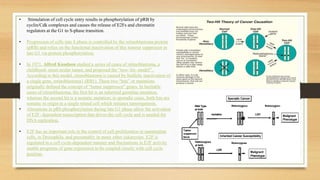
• In 1971, Alfred Knudson studied a series of cases of retinoblastoma, a
childhood- onset ocular tumor, and proposed the “two- hit- model” .
According to this model, retinoblastoma is caused by biallelic inactivation of
a single gene, retinoblastoma1 (RB1). These two “hits” or mutations
originally defined the concept of “tumor suppressor” genes. In heritable
cases of retinoblastoma, the first hit is an inherited germline mutation,
whereas the second hit is a somatic mutation; in sporadic cases, both hits are
somatic in origin in a single retinal cell which initiates tumorigenesis.
• Alterations in pRb phosphorylation during late G1 phase allow the activation
of E2F- dependent transcription that drives the cell cycle and is needed for
DNA replication.
• E2F has an important role in the control of cell proliferation in mammalian
cells, in Drosophila, and presumably in many other eukaryotes. E2F is
regulated in a cell cycle-dependent manner and fluctuations in E2F activity
enable programs of gene expression to be coupled closely with cell cycle
position.
Structure and Function
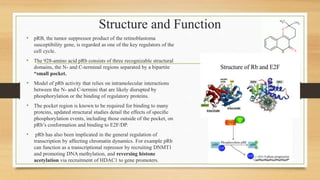
• pRB, the tumor suppressor product of the retinoblastoma
susceptibility gene, is regarded as one of the key regulators of the
cell cycle.
• The 928-amino acid pRb consists of three recognizable structural
domains, the N- and C-terminal regions separated by a bipartite
“small pocket.
• Model of pRb activity that relies on intramolecular interactions
between the N- and C-termini that are likely disrupted by
phosphorylation or the binding of regulatory proteins.
• The pocket region is known to be required for binding to many
proteins, updated structural studies detail the effects of specific
phosphorylation events, including those outside of the pocket, on
pRb’s conformation and binding to E2F/DP.
• pRb has also been implicated in the general regulation of
transcription by affecting chromatin dynamics. For example pRb
can function as a transcriptional repressor by recruiting DNMT1
and promoting DNA methylation, and reversing histone
acetylation via recruitment of HDAC1 to gene promoters.
• pRb and the maintenance of genome stability In addition to regulating
the cell cycle and establishing senescence, pRb also has important roles in
both preventing genotoxic stress and responding to it.
• In addition to regulating the expression of genes important for maintaining
genome stability, pRb plays additional roles in promoting chromosome
stability and preventing tumor growth in mice.
• Controlling cell death pRb has long been appreciated to regulate cell
death, a function that provides a failsafe mechanism against tumor
formation in the event of its inactivation.
• E2F-1 activity is known to induce apoptosis in the absence of RB via
multiple mechanisms and can promote the DNA damage response by
transcriptional activation of p14ARF, which inhibits the degradation of p53
by Mdm2.
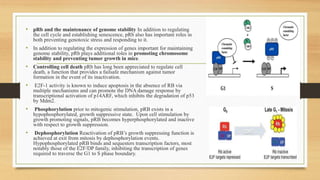
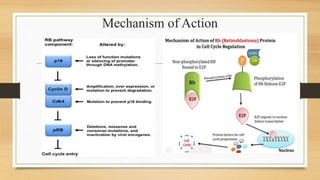
• Phosphorylation prior to mitogenic stimulation, pRB exists in a
hypophosphorylated, growth suppressive state. Upon cell stimulation by
growth promoting signals, pRB becomes hyperphosphorylated and inactive
with respect to growth suppression.
• Dephosphorylation Reactivation of pRB’s growth suppressing function is
achieved at exit from mitosis by dephosphorylation events.
Hypophosphorylated pRB binds and sequesters transcription factors, most
notably those of the E2F/DP family, inhibiting the transcription of genes
required to traverse the G1 to S phase boundary.
• Besides controlling entry of cells into S phase, pRB can operate to inhibit S phase
completion. Di€fferential arrays of phosphorylation appear to regulate these diff€erent
events, suggesting that cycle progression at these two stages of the cell cycle may
be achieved via activation of distinct downstream pRB eff€ector pathways.
• The phosphorylation state of pRB determines its ability to bind to these factors.
Evidence to this eff€ect was first provided through analysis of pRB's association
with SV40 T antigen.
• Only un- or poorly phosphorylated pRB associated with this viral oncoprotein and
this has since been similarly demonstrated for many of the cellular pRB ligands.
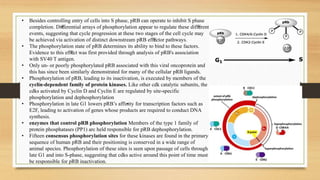
• Phosphorylation of pRB, leading to its inactivation, is executed by members of the
cyclin-dependent family of protein kinases. Like other cdk catalytic subunits, the
cdks activated by Cyclin D and Cyclin E are regulated by site-specific
phosphorylation and dephosphorylation
• Phosphorylation in late G1 lowers pRB’s affi•nity for transcription factors such as
E2F, leading to activation of genes whose products are required to conduct DNA
synthesis.
• enzymes that control pRB phosphorylation Members of the type 1 family of
protein phosphatases (PP1) arc held responsible for pRB dephosphorylation.
• Fifteen consensus phosphorylation sites for these kinases are found in the primary
sequence of human pRB and their positioning is conserved in a wide range of
animal species. Phosphorylation of these sites is seen upon passage of cells through
late G1 and into S-phase, suggesting that cdks active around this point of time must
be responsible for pRB inactivation.
Mechanism of Action
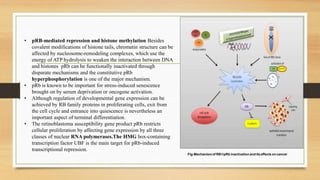
Fig-Mechanism of RB1/pRb inactivation and its effects on cancer
• pRB-mediated repression and histone methylation Besides
covalent modifications of histone tails, chromatin structure can be
affected by nucleosome-remodeling complexes, which use the
energy of ATP hydrolysis to weaken the interaction between DNA
and histones pRb can be functionally inactivated through
disparate mechanisms and the constitutive pRb
hyperphosphorylation is one of the major mechanism.
• pRb is known to be important for stress-induced senescence
brought on by serum deprivation or oncogene activation.
• Although regulation of developmental gene expression can be
achieved by RB family proteins in proliferating cells, exit from
the cell cycle and entrance into quiescence is nevertheless an
important aspect of terminal differentiation.
• The retinoblastoma susceptibility gene product pRb restricts
cellular proliferation by affecting gene expression by all three
classes of nuclear RNA polymerases.The HMG box-containing
transcription factor UBF is the main target for pRb-induced
transcriptional repression.
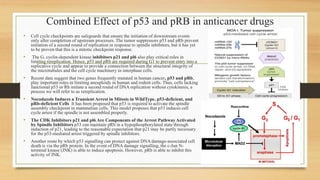
Combined Effect of p53 and pRB in anticancer drugs
• Cell cycle checkpoints are safeguards that ensure the initiation of downstream events
only after completion of upstream processes. The tumor suppressors p53 and pRb prevent
initiation of a second round of replication in response to spindle inhibitors, but it has yet
to be proven that this is a mitotic checkpoint response.
• The G, cyclin-dependent kinase inhibitors p21 and pl6 also play critical roles in
limiting rereplication. Hence, p53 and pRb are required during G1 to prevent entry into a
replicative cycle and appear to provide a connection between the structural integrity of
the microtubules and the cell cycle machinery in interphase cells.
• Recent data suggest that two genes frequently mutated in human cancer, p53 and pRb,
play important roles in limiting aneuploidy in human and rodent cells. Thus, cells lacking
functional p53 or Rb initiate a second round of DNA replication without cytokinesis, a
process we will refer to as rereplication.
• Nocodazole Induces a Transient Arrest in Mitosis in WildType, p53-deficient, and
pRb-deficient Cells It has been proposed that p53 is required to activate the spindle
assembly checkpoint in mammalian cells. This model proposes that p53 induces cell
cycle arrest if the spindle is not assembled properly.
• The CDK Inhibitors p21 and pl6 Are Components of the Arrest Pathway Activated
by Spindle Inhibitors p53 can maintain pRb in a hypophosphorylated state through
induction of p21, leading to the reasonable expectation that p21 may be partly necessary
for the p53-mediated arrest triggered by spindle inhibitors.
• Another route by which p53 signalling can protect against DNA damage-associated cell
death is via the pRb protein. In the event of DNA damage signalling, the c-Jun N-
terminal kinase (JNK) is able to induce apoptosis. However, pRb is able to inhibit this
activity of JNK.
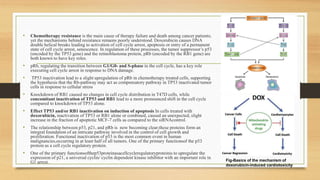
• Chemotherapy resistance is the main cause of therapy failure and death among cancer patients;
yet the mechanisms behind resistance remains poorly understood. Doxorubicin causes DNA
double helical breaks leading to activation of cell cycle arrest, apoptosis or entry of a permanent
state of cell cycle arrest, senescence. In regulation of these processes, the tumor suppressor’s p53
(encoded by the TP53 gene) and the retinoblastoma protein, pRb (encoded by the RB1 gene) are
both known to have key roles.
• pRb, regulating the transition between G1/G0- and S-phase in the cell cycle, has a key role
executing cell cycle arrest in response to DNA damage.
• TP53 inactivation lead to a slight upregulation of pRb in chemotherapy treated cells, supporting
the hypothesis that the Rb-pathway may act as compensatory pathway in TP53 inactivated tumor
cells in response to cellular stress
• Knockdown of RB1 caused no changes in cell cycle distribution in T47D cells, while
concomitant inactivation of TP53 and RB1 lead to a more pronounced shift in the cell cycle
compared to knockdown of TP53 alone.
• Effect TP53 and/or RB1 inactivation on induction of apoptosis In cells treated with
doxorubicin, inactivation of TP53 or RB1 alone or combined, caused an unexpected, slight
increase in the fraction of apoptotic MCF-7 cells as compared to the siRNAcontrol.
• The relationship between p53, p21, and pRb is now becoming clear;these proteins form an
integral foundation of an intricate pathway involved in the control of cell growth and
proliferation. Functional inactivation of p53 is the most common event in human
malignancies,occurring in at least half of all tumors. One of the primary functionsof the p53
protein as a cell cycle regulatory protein.
• One of the primary functionsofthep53proteinasacellcycleregulatoryproteinis to upregulate the
expression of p21, a universal cyclin/ cyclin dependent kinase inhibitor with an important role in
G1 arrest. Fig-Basics of the mechanism of
doxorubicin-induced cardiotoxicity
References
• https://www.ncbi.nlm.nih.gov/pmc/articles/PMC2948218/
• American Cancer Society. Cancer Facts and Figures. Atlanta, USA: American Cancer Society; 2008.
• https://www.sciencedirect.com/topics/neuroscience/tumor-suppressor-genes
• http://www.cancer.org/docroot/ETO/content/ETO_1_4x_oncogenes_and_tumor_suppressor_genes.asp (2005)
• Chau, B. N., & Wang, J. Y. Coordinated regulation of life and death by RB. Nature Reviews Cancer 3, 130–138 (2003) doi:10.1038/nrc993.
• https://jcs.biologists.org/content
• Hall PA, Meek D, Lane DP. p53: integrating the complexity. J Pathol,1996
• (Romanova et al., 2004; Suzuki et al., 2009)
• Armstrong, J. F., Kaufman, M. H., Harrison, D. J. and Clarke, A. R. (1995). High-frequency developmental abnormalities in p53-deficient mice.
Curr. Biol. 5, 931-936.
• p53 and pRb Prevent Rereplication in Response to Microtubule Inhibitors by Mediating a Reversible G! Arrest Shireen Hussain Khan and Geoffrey
M. Wahl1.
• Combined Effects of p53, p21, and pRb Expression in the Progression of Bladder Transitional Cell Carcinoma Sunanda J. Chatterjee, Ram Datar,
David Youssefzadeh, Ben George, Peter J. Goebell, John P. Stein, Lillian Young, Shan-Rong Shi, Conway Gee, Susan Groshen, Donald G. Skinner,
and Richard J. Cote
• p53 regulation of DNA excision repair pathways ,Martin L.Smith1 and Young R.Seo
• Translational approaches targeting the p53 pathway for anti-cancer therapy Frank Essmann and Klaus Schulze-Osthoff ,Interfaculty Institute
for Biochemistry and Comprehensive Cancer Center, University of Tübingen, Tübingen, Germany
• RB1 in Cancer: Different Mechanisms of RB1 Inactivation and Alterations of pRb Pathway in Tumorigenesis RICCARDO DI
FIORE,1 ANTONELLA D’ANNEO,1 GIOVANNI TESORIERE,2 AND RENZA VENTO1
• ROLE OF pRB DEPHOSPHORYLATION IN CELL CYCLE REGULATION Sama Tamrakar 1, Ethel Rubin 1 and John W.
Ludlow .
• Control of pRB phosphorylation Sibylle Mittnacht.
• Reactivation of mutant p53 by a dietary-related compound phenethyl isothiocyanate inhibits tumor growth M Aggarwal, R
Saxena, E Sinclair, Y Fu… - Cell Death & …, 2016
• New therapeutic strategies to treat human cancers expressing mutant p53 proteins Giovanni Blandino & Silvia Di
Agostino Journal of Experimental & Clinical Cancer Research
• Bressy, C., Hastie, E., and Grdzelishvili, V. (2017, April 6). Combining Oncolytic Virotherapy with p53 Tumor Suppressor
Gene Therapy.
• https://www.asbestos.com/treatment/tumor-based-p53-therapy
• Strategies for manipulating the p53 pathway in the treatment of human cancer Ted R. HUPP*1, David P. LANE† and Kathryn
L. BALL†
• Effects of concomitant inactivation of p53 and pRb on response to doxorubicin treatment in breast cancer cell lines Johanna
Huun1, Per Eystein Lønning1,2 and Stian Knappskog1
• p53 Is Essential for Chemotherapy-induced Hair Loss1
• Vladimir A. Botchkarev,2 Elena A. Komarova, Frank Siebenhaar, Natalia V. Botchkareva, Pavel G. Komarov, Marcus Maurer,
Barbara A. Gilchrest, and Andrei V. Gudkov2
• Protective mechanisms of p53-p21-pRb proteins against DNA damage-induced cell death Elizabeth Garner and Kenneth Raj
THANK YOU

Tumour supressor genes

  • 1.
    Tumour Supressor Gene-Structure,Function and Mechanism of Action of p53 and pRB tumour suppressor proteins ANIMAL CELL SCIENCE AND TECHNOLOGY SUBMITTED TO- DR G. SUNIL BABU(Assistant Professor) MBT-403 DBT, BBAU LUCKNOW MBT-403 SUBMITTED BY- SHIVANI MISHRA Roll No-181621 MSc BIOTECHNOLOGY MBT-403, 4th semester DBT, BBAU Lucknow
  • 2.
    INTRODUCTION Tumour Supressor Gene-Tumor suppressor genes are normal genes that slow down cell division, repair DNA mistakes, or tell cells when to die (a process known as apoptosis or programmed cell death). When tumor suppressor genes don't work properly, cells can grow out of control, which can lead to cancer. An important difference between oncogenes and tumor suppressor genes is that oncogenes result from the activation (turning on) of proto-oncogenes, but tumor suppressor genes cause cancer when they are inactivated (turned off). Tumor suppressor genes represent the opposite side of cell growth control, normally acting to inhibit cell proliferation and tumor development. In many tumors, these genes are lost or inactivated, thereby removing negative regulators of cell proliferation and contributing to the abnormal proliferation of tumor cells. • Characterization of Rb as a tumor suppressor gene served as the prototype for the identification of additional tumor suppressor genes that contribute to the development of many different human cancers. • The second tumor suppressor gene to have been identified is p53, which is frequently inactivated in a wide variety of human cancers, including leukemias, lymphomas, sarcomas, brain tumors, and carcinomas of many tissues, including breast, colon, and lung. • The proteins encoded by most tumor suppressor genes inhibit cell proliferation or survival. Inactivation of tumor suppressor genes therefore leads to tumor development by eliminating negative regulatory proteins.
  • 3.
    Functions of TumourSuppressor Gene • Tumor-suppressor genes, or more precisely, the proteins for which they encode, can have a repressive effect on the regulation of the cell cycle, promote apoptosis, or sometimes both. Tumor-suppressor proteins function in various ways, which include the following- • Repression of genes that are essential for continuing the progression of the cell cycle. If these genes are not expressed, the cell cycle does not continue, effectively inhibiting cell division. • Coupling the cell cycle to DNA damage. As long as there is damaged DNA in the cell, it should not divide. If the damage can be repaired, the cell cycle can continue. • Apoptosis. If damage cannot be repaired, the cell should initiate apoptosis (programmed cell death) to remove the threat it poses to the organism as a whole. • Cell adhesion. Some proteins involved in cell adhesion prevent tumor cells from dispersing, block loss of contact inhibition, and inhibit metastasis. These proteins are known as metastasis suppressors. • DNA repair. Caretaker genes encode proteins that function in repairing mutations in the genome, preventing cells from replicating with mutations. Furthermore, increased mutation rate from decreased DNA repair leads to increased inactivation of other tumor suppressors and activation of oncogenes.
  • 4.
    • Generally onecopy of a tumor-suppressor gene suffices to control cell proliferation, both alleles of a tumor-suppressor gene must be lost or inactivated in order to promote tumor development. Thus, oncogenic loss-of-function mutations in tumor-suppressor genes act recessively. Tumor-suppressor genes in many cancers have deletions or point mutations that prevent production of any protein or lead to production of a nonfunctional protein. • One common mechanism for LOH(loss of heterozygosity) involves missegregation of the chromosomes bearing the heterozygous tumor-suppressor gene during mitosis. In this process, also referred to as nondisjunction, one daughter cell inherits only one normal chromosome (and probably dies), while the other inherits three, the other normal chromosome as well as two bearing the mutant allele. • Chromosome segregation can generate three types of daughter cells: one homozygous for the mutant tumor-suppressor allele; one homozygous for the normal allele; and one like the parental cell, heterozygous for the mutant allele.
  • 5.
  • 6.
    Introduction • p53 isa crucial tumor suppressor, long-recognized to suppress cancer through the induction of cell-cycle-arrest or apoptosis programs in response to a plethora of different cellular stress signals. • The tumorsuppressor function of p53 extends beyond the capacity to trigger cell-cycle arrest and apoptosis, and novel activities that impact tumor suppression are perpetually emerging, including the regulation of metabolism, autophagy and the oxidative status of the cell. • More than half of human cancers, of a wide variety of types, harbor p53 (TP53) mutations, and inheritance of a mutant p53 allele predisposes humans to the Li-Fraumeni cancer syndrome. • p53 restricts tumor development by serving as a sensor of cellular stress, responding to diverse signals, including DNA damage, hypoxia, oncogene expression, nutrient deprivation and ribosome dysfunction, and limiting the propagation of cells under these adverse conditions. • Subsequently, with the evolution of longerliving organisms, p53 is thought to have acquired the ability to respond to oncogenic signals, promoting apoptosis or senescence – a permanent cell- cycle-arrest response – as a safeguard against neoplasia.
  • 7.
    Structure and Function Fig-Organizationof p53 domains and isolation of p53 tetramers bound to DNA (A) Schematic domain structure of p53. (B) Cartoons depicting the overall quaternary structure of p53 tetramers. Stably folded domains are highlighted in brown (DBD) and blue (Tet.). • The multidomain homotetrameric tumor suppressor p53 has two modes of binding dsDNA that are thought to be responsible for scanning and recognizing specific response elements (REs). The C termini bind nonspecifically to dsDNA. • The loose structures and posttranslational modifications account for the affinity of nonspecific DNA for p53 and point to a mechanism of enhancement of specificity by its binding to effector proteins. • High-resolution structural studies with full-length p53 are hindered by its flexibility and instability. Constructs of a p53 mutant with asuperstable, structurallyconserved DBD were studied by a combination of SAXS, NMR and EM. • The core of the p53 protein is a region which folds in such a way as to form a domain which can interact with DNA in a sequence-specific manner. • The C terminal region is composed of pre- dominantly basic residues and forms a region that has key regulatory properties. As discussed below, modification of this region by acetylation, phosphorylation, O- glycosylation, and RNA binding has been reported but the physiological significance of these post-translational modifications remains uncertain.
  • 8.
    • p53 restrictstumor development by serving as a sensor of cellular stress, responding to diverse signals, including DNA damage, hypoxia, oncogene expression, nutrient deprivation and ribosome dysfunction, and limiting the propagation of cells under these adverse conditions. • p53 is thought to have acquired the ability to respond to oncogenic signals, promoting apoptosis or senescence – a permanent cell-cycle- arrest response – as a safeguard against neoplasia. • Alternatively, under conditions of low-level stress, p53 elicits protective, pro-survival responses, such as temporary cell-cycle arrest, DNA repair and antioxidant protein production, to maintain genome integrity and viability in cells that sustain limited, reparable damage. • p53 has protein domains typical of transcriptional activators Similarly to other transcription factors, p53 has a modular protein domain structure. • The six most common p53 amino acid residues altered in cancer – known as ‘hotspots’ – are R175, G245, R248, R249, R273 and R282. In addition to disrupting DNA binding, these mutations can confer gain-of-function capabilities on p53, and have been linked to increased invasiveness and metastasis of tumors. • p53 induces a host of transcriptional programs involved in different responses Once active p53 is bound to DNA, it can stimulate the transcription of many proteincoding and non-protein- coding genes [e.g. microRNAs or large intergenic non-coding RNAs (lincRNAs)], which is a function of fundamental importance for all p53-mediated responses.
  • 9.
    • . • p53can also limit tumorigenesis through autophagy, or ‘selfeating’, which can provoke cell death through the activation of genes such as AMPK, DRAM, SESN1 and SESN2. • p53 has cytoplasmic roles in apoptosis and autophagy , p53 has been implicated in other nuclear functions, such as regulating homologous recombination and microRNA, as well as in several cytoplasmic processes. • p53 also has a complex role in regulating autophagy Autophagy allows a cell to catabolize macromolecules for reuse, either as a survival strategy under stress conditions or as a means to remove harmful, damaged structure. Autophagy can also promote cell death, and has hence been linked to tumor suppression. • From oncogene to tumour suppressor gene Mutation of p53 gene was reported to enhance its transformation e•fficiency, a finding which fitted with the hypothesis that p53 was a cellular oncogene that could be activated by mutation. • p53 is a tumour suppressor gene Some of these normal cellular functions of p53 can be modulated and sometimes inhibited by interaction with certain viral oncoproteins (SV40 large T antigen, Ad E1B HPV E6, human hepatitis B virus X protein, etc.), or with the cellular protein MDM-2.
  • 10.
    Mechanism Of Action •An alternative mechanism of p53 inactivation which is common in many tumour types (including soft tissue sarcomas, neural tumours, bladder, cervical and breast carcinomas as well as leukaemias). These protein- protein interactions inactivate p53 function by abrogating specific DNA binding and/or transactivation activity, sequestring wild-type p53 in the cytoplasm or promoting its degradation. • ‘Guardian of the genome Under conditions of lower levels of stress, when repair is possible, p53 engages a temporary program of cell-cycle arrest and DNA repair to allow cells to pause and repair any damage incurred, thereby limiting the propagation of oncogenic mutations, in response to sustained or severe stress signals, p53 drives irreversible apoptosis or senescence programs. p53-triggered apoptosis involves the transcriptional induction of components of both the extrinsic and intrinsic death pathways, including BAX, FAS, NOXA and PUMA, among others, which collaboratively promote cell death. • p53 inhibits glycolysis (through TIGAR) and promotes oxidative phosphorylation (through SCO2) to protect cells from metabolic reprogramming – known as the ‘Warburg effect’ – which is thought to be fundamental for malignant transformation.
  • 11.
    Immunochemical analysis ofp53 conformation During the 1980s Milner's and Lane's groups developed an approach using antibodies as real conformational probes aimed at analysing the conformational changes in the p53 protein.
  • 12.
    Role of p53In Cancer Treatment LncRNAs regulate p53 signaling pathway through MDM2 • At the molecular level, radiation-induced damage results in activation of DNA repair, coupled with arrest at cell-cycle checkpoints, which allows the cell to repair the damage before proceeding through mitosis. This mechanism is conserved in all eukaryotes. • Multicellular organisms have acquired additional response mechanisms to genotoxic stress, which involve activation of the transcription factor p53. p53 can induce growth arrest or apoptosis, and these responses maintain genomic stability. Failure of this system results in cancer development and genomic instability. • Ionizing radiation (IR) has proven to be a powerful medical treatment in the fight against cancer. One of the key molecules involved in a cell's response to IR is p53. Understanding these mechanisms indicates new rational approaches to improving cancer treatment by IR. • Anticancer drugs stimulate apoptosis in the hair follicles (HF) and cause hair loss, the most common side effect of chemotherapy. HF in p53 mutants are characterized by down-regulation of Fas and insulin- like growth factor-binding protein 3 and by increased expression of Bcl-2. These observations indicate that local pharmacological inhibition of p53 may be useful to prevent chemotherapy-associated hair loss.
  • 13.
    Downstream effector pathwaysrelated to mutant p53 • An additional pathway in which mutp53 plays a role is autophagy. Autophagy has been widely recognized as a main pathway involved in both the regulation of cancer cell proliferation and in the response to several anticancer drugs. It is an intracellular degradative process through which damaged macromolecules and organelles are targeted to lysosomes via autophagic vesicle. • The enhanced glucose metabolism under aerobic conditions (Warburg effect) is a common feature of many tumors to meet the high biosynthetic demand of rapidly dividing cells. • However increased glycolysis is observed in many types of cancer cells, but this metabolic shift can also cause increased oxidative stress and DNA damage . A recent study reported that mutp53 promotes glycolysis and the Warburg effect in both cultured cells and mutant p53 R172H knock- in mice as an additional novel GOF of mutp53. Mutant p53 is targeted by small molecules. Therapies to restore wild-type p53 functions- • At a cellular level mutp53 GOF activity has been shown to abrogate all or most of the cellular responses mediated by wtp53 such as cell-cycle arrest, apoptosis, senescence, DNA repair, maintenance of centrosome number, restriction of phenotypic plasticity, and preservation of homeostatic balance. In addition, the presence of mutant p53 compromises cellular responses to therapeutic agents, increases inflammation and angiogenesis and correlates with enhanced metastasis and aggressiveness.
  • 14.
    LncRNAs influence p53stability and modification
  • 15.
    • The roleof mutant p53 protein as a target for dietary-related cancer chemopreventive compounds is a new field of research. • Aggarwal and collegues have recently showed that cruciferous- vegetable-derived phenethyl isothiocyanate (PEITC) can reactivate p53 mutant under in vitro and in vivo conditions, revealing a new mechanism of action for a dietary-related compound. • Mechanistic studies revealed that PEITC induced apoptosis in a p53R175H mutant-dependent manner by restoring wtp53 conformation and transactivation functions. • In vitro data also suggest that mutp53 can facilitate structural chromosomal abnormalities by interacting with and inhibiting the genome caretaker proteins of DNA repair. The fidelity of DNA double strand break (DSB) repair plays a central role in preventing translocations. In response to DNA double strand break signals, cells have at their disposal two distinct repair mechanisms: homologous recombination (HR) and nonhomologous end joining (NHEJ). • Targeting WEE1 protein kinase to disarm mutant p53 WEE1 is a tyrosine kinase with a pivotal role at the G2-M cell cycle checkpoint that prevents entry into mitosis in response to cellular DNA damage. • WEE1 is highly expressed in several cancer types, including hepatocellular carcinoma, cervical cancers, lung cancers, squamous cell carcinoma, colorectal cancers, gastric cancers, leukemia, melanoma, and ovarian cancers.
  • 16.
    • Activation ofstructural mutant forms of p53 by agents that reduce p53 protein unfolding The first molecular defect described for p53 protein in cancers was the frequent ‘unfolding’or ‘denaturation’of the mutant polypeptide, which was defined by immunohistochemical cell staining and immunoprecipitation of p53 proteinusing antibodies specific for denatured p53 possibly involving alterations in the expression of factors such as molecular chaperones and MDM2 • Manipulation of p53 function by targeting the molecular chaperone HSP90 The first cellular protein (i.e. non-viral protein) shown to bind to p53 included a member of the heat-shock protein 70 (HSP70) family of proteins, whose associations with p53 have since been extended to include the molecular chaperone holoenzyme complex including HSP40, HSP90, immunophilins and p23. • Chaperones can function as anti-apoptotic effectors in cells exposed to otherwise toxic levels of damaging agent and the ability of antitumour antibiotics of the ansamycin class to bind to chaperones, which are overexpressed in tumour cell lines, to induce cell death further highlights their role in cell survival and the attraction for targeting chaperones for therapeutic effect. • The DNA repair branch of p53 pathway in carcinogenesis and chemoprevention GGR defect associated with p53 contributes substantially to carcino- genesis in p53-defective conditions, e.g. Li–Fraumeni syn- drome, a cancer-prone disease in which mutant p53 alleles are transmitted in the germline. Hence, wild-type p53 likely prevents carcinogenesis, at least in part, by maintaining GGR repair.
  • 17.
    Translational approaches targetingthe p53 pathway for anti- cancer therapy • The p53 signalling pathway is virtually always inactivated in human cancer cells. In p53-mutated tumours, delivery of wild-type p53 by adenovirus-based gene therapy is now practised in China. Also, remarkable progress has been made in the development of p53-binding drugs that can rescue and reactivate the function of mutant or misfolded p53. Other biologic approaches include the development of oncolytic viruses that are designed to specifically replicate in and kill p53-defective cells. • Gene therapeutic and viral approaches Delivery of a functional wt-p53 gene into tumour cells by injection of an engineered retrovirus has been tested in a clinical trial for the treatment of patients with non-small cell lung carcinoma. • One method is the deletion of p53-inhibitory proteins from the viral genome. These modified viruses still effectively replicate in p53-defective cells, whereas normal wt-p53-expressing cells mount an antiviral response. • Compounds directly interacting with p53 Another interesting drug is RITA, a furan derivative identified from the NCI diversity set of compounds. RITA (reactivation of p53 and induction of tumour cell apoptosis, CAS 213261-59-7) was selected for its ability to kill HCT116 colon cancer cells with wt-p53 more efficiently than p53-deficient HCT116 cellsAs mechanism for the stabilization of p53, it was proposed that RITA binds to p53 rather than MDM2 and induces a conformational change in p53 that prevents docking of MDM2 . • RETRA, which was originally discovered as a small molecule that may reactivate p53-like functions in cells bearing mutations in p53 ,RETRA can release p73 from an inactive complex with mutant p53. •
  • 19.
    Fig-Tumour suppressor p53regulation and signalling. Activation of the transcription factor p53 is predominantly mediated by stabilization, mostly due to phosphorylation by upstream kinases such as ATM/ATR or Chk1/2 Future prospects of p53-targeted cancer therapies- • As p53 also influences metastatic behaviour and angiogenesis, p53- based therapies might provide additional therapeutic benefits. Targeting the p53:MDM2 interaction using small molecules to reactivate a p53 response represents an attractive therapeutic strategy for the treatment of cancers with wt-p53. • Drug combinations involving traditional genotoxic agents have been found to be synergistic in inducing p53 accumulation and activation of apoptosis. P53-based therapies will certainly provide useful tools in combating cancer, either as single agents or more likely in combination with classical therapeutic regimens. • Inactivation of JNK Another route by which p53 signalling can protect against DNA damage-associated cell death is via the pRb protein. In the event of DNA damage signalling, the c-Jun N-terminal kinase (JNK) is able to induce apoptosis. However, pRb is able to inhibit this activity of JNK. • Interestingly, p53 protein has also been reported to inhibit JNK, and protect cells from apoptosis.This is owed to the binding and subsequent inactivation of JNK by p53, and also to p53 transcriptional activity. Since the pRb protein is a down-stream recipient of p53 signalling (via p21 and cyclin/cdk), this would represent an enhancement of JNK inactivation.
  • 20.
  • 21.
    Introduction • ‘‘master regulatorsof cell cycle and differentiation’’ to ‘‘peripheral factors that lie outside the core cell cycle machinery.’’ The retinoblastoma protein is most frequently inactivated in cancer by the negative regulatory activity of cyclin dependent kinases.Loss of heterozygosity at the RB-1 locus has been reported in many different sporadic cancers, suggesting that it is directly mutated outside of the lung and retina, but on a less frequent basis. • In general terms, pRB has an established role in mediating a G1 arrest in development and in response to many growth regulatory signals. Some examples are DNA damage, or growth inhibiting cytokines such as TGF-β. • pRB plays a key role in the permanent cell cycle exit of differentiating cells and this has been demonstrated both in cell culture and in vivo using gene targeted mice. The Retinoblastoma protein plays an essential function in permanent cell cycle arrest and differentiation of adipocytes, myotubes, osteoblasts, and neurons. • The RB protein binds to E2F transcription factors and blocks their ability to induce transcription of genes that are needed to advance the cell cycle. In turn, once pRB is brought to a promoter by an E2F it can recruit chromatin remodeling proteins such as histone methyltransferases.
  • 22.
    • Stimulation ofcell cycle entry results in phosphorylation of pRB by cyclin/Cdk complexes and causes the release of E2Fs and chromatin regulators at the G1 to S-phase transition. • Progression of cells into S phase is controlled by the retinoblastoma protein (pRB) and relies on the functional inactivation of this tumour suppressor in late G1 via protein phosphorylation. • In 1971, Alfred Knudson studied a series of cases of retinoblastoma, a childhood- onset ocular tumor, and proposed the “two- hit- model” . According to this model, retinoblastoma is caused by biallelic inactivation of a single gene, retinoblastoma1 (RB1). These two “hits” or mutations originally defined the concept of “tumor suppressor” genes. In heritable cases of retinoblastoma, the first hit is an inherited germline mutation, whereas the second hit is a somatic mutation; in sporadic cases, both hits are somatic in origin in a single retinal cell which initiates tumorigenesis. • Alterations in pRb phosphorylation during late G1 phase allow the activation of E2F- dependent transcription that drives the cell cycle and is needed for DNA replication. • E2F has an important role in the control of cell proliferation in mammalian cells, in Drosophila, and presumably in many other eukaryotes. E2F is regulated in a cell cycle-dependent manner and fluctuations in E2F activity enable programs of gene expression to be coupled closely with cell cycle position.
  • 23.
    Structure and Function •pRB, the tumor suppressor product of the retinoblastoma susceptibility gene, is regarded as one of the key regulators of the cell cycle. • The 928-amino acid pRb consists of three recognizable structural domains, the N- and C-terminal regions separated by a bipartite “small pocket. • Model of pRb activity that relies on intramolecular interactions between the N- and C-termini that are likely disrupted by phosphorylation or the binding of regulatory proteins. • The pocket region is known to be required for binding to many proteins, updated structural studies detail the effects of specific phosphorylation events, including those outside of the pocket, on pRb’s conformation and binding to E2F/DP. • pRb has also been implicated in the general regulation of transcription by affecting chromatin dynamics. For example pRb can function as a transcriptional repressor by recruiting DNMT1 and promoting DNA methylation, and reversing histone acetylation via recruitment of HDAC1 to gene promoters.
  • 24.
    • pRb andthe maintenance of genome stability In addition to regulating the cell cycle and establishing senescence, pRb also has important roles in both preventing genotoxic stress and responding to it. • In addition to regulating the expression of genes important for maintaining genome stability, pRb plays additional roles in promoting chromosome stability and preventing tumor growth in mice. • Controlling cell death pRb has long been appreciated to regulate cell death, a function that provides a failsafe mechanism against tumor formation in the event of its inactivation. • E2F-1 activity is known to induce apoptosis in the absence of RB via multiple mechanisms and can promote the DNA damage response by transcriptional activation of p14ARF, which inhibits the degradation of p53 by Mdm2. • Phosphorylation prior to mitogenic stimulation, pRB exists in a hypophosphorylated, growth suppressive state. Upon cell stimulation by growth promoting signals, pRB becomes hyperphosphorylated and inactive with respect to growth suppression. • Dephosphorylation Reactivation of pRB’s growth suppressing function is achieved at exit from mitosis by dephosphorylation events. Hypophosphorylated pRB binds and sequesters transcription factors, most notably those of the E2F/DP family, inhibiting the transcription of genes required to traverse the G1 to S phase boundary.
  • 25.
    • Besides controllingentry of cells into S phase, pRB can operate to inhibit S phase completion. Di€fferential arrays of phosphorylation appear to regulate these diff€erent events, suggesting that cycle progression at these two stages of the cell cycle may be achieved via activation of distinct downstream pRB eff€ector pathways. • The phosphorylation state of pRB determines its ability to bind to these factors. Evidence to this eff€ect was first provided through analysis of pRB's association with SV40 T antigen. • Only un- or poorly phosphorylated pRB associated with this viral oncoprotein and this has since been similarly demonstrated for many of the cellular pRB ligands. • Phosphorylation of pRB, leading to its inactivation, is executed by members of the cyclin-dependent family of protein kinases. Like other cdk catalytic subunits, the cdks activated by Cyclin D and Cyclin E are regulated by site-specific phosphorylation and dephosphorylation • Phosphorylation in late G1 lowers pRB’s affi•nity for transcription factors such as E2F, leading to activation of genes whose products are required to conduct DNA synthesis. • enzymes that control pRB phosphorylation Members of the type 1 family of protein phosphatases (PP1) arc held responsible for pRB dephosphorylation. • Fifteen consensus phosphorylation sites for these kinases are found in the primary sequence of human pRB and their positioning is conserved in a wide range of animal species. Phosphorylation of these sites is seen upon passage of cells through late G1 and into S-phase, suggesting that cdks active around this point of time must be responsible for pRB inactivation.
  • 26.
  • 27.
    Fig-Mechanism of RB1/pRbinactivation and its effects on cancer • pRB-mediated repression and histone methylation Besides covalent modifications of histone tails, chromatin structure can be affected by nucleosome-remodeling complexes, which use the energy of ATP hydrolysis to weaken the interaction between DNA and histones pRb can be functionally inactivated through disparate mechanisms and the constitutive pRb hyperphosphorylation is one of the major mechanism. • pRb is known to be important for stress-induced senescence brought on by serum deprivation or oncogene activation. • Although regulation of developmental gene expression can be achieved by RB family proteins in proliferating cells, exit from the cell cycle and entrance into quiescence is nevertheless an important aspect of terminal differentiation. • The retinoblastoma susceptibility gene product pRb restricts cellular proliferation by affecting gene expression by all three classes of nuclear RNA polymerases.The HMG box-containing transcription factor UBF is the main target for pRb-induced transcriptional repression.
  • 28.
    Combined Effect ofp53 and pRB in anticancer drugs • Cell cycle checkpoints are safeguards that ensure the initiation of downstream events only after completion of upstream processes. The tumor suppressors p53 and pRb prevent initiation of a second round of replication in response to spindle inhibitors, but it has yet to be proven that this is a mitotic checkpoint response. • The G, cyclin-dependent kinase inhibitors p21 and pl6 also play critical roles in limiting rereplication. Hence, p53 and pRb are required during G1 to prevent entry into a replicative cycle and appear to provide a connection between the structural integrity of the microtubules and the cell cycle machinery in interphase cells. • Recent data suggest that two genes frequently mutated in human cancer, p53 and pRb, play important roles in limiting aneuploidy in human and rodent cells. Thus, cells lacking functional p53 or Rb initiate a second round of DNA replication without cytokinesis, a process we will refer to as rereplication. • Nocodazole Induces a Transient Arrest in Mitosis in WildType, p53-deficient, and pRb-deficient Cells It has been proposed that p53 is required to activate the spindle assembly checkpoint in mammalian cells. This model proposes that p53 induces cell cycle arrest if the spindle is not assembled properly. • The CDK Inhibitors p21 and pl6 Are Components of the Arrest Pathway Activated by Spindle Inhibitors p53 can maintain pRb in a hypophosphorylated state through induction of p21, leading to the reasonable expectation that p21 may be partly necessary for the p53-mediated arrest triggered by spindle inhibitors. • Another route by which p53 signalling can protect against DNA damage-associated cell death is via the pRb protein. In the event of DNA damage signalling, the c-Jun N- terminal kinase (JNK) is able to induce apoptosis. However, pRb is able to inhibit this activity of JNK.
  • 29.
    • Chemotherapy resistanceis the main cause of therapy failure and death among cancer patients; yet the mechanisms behind resistance remains poorly understood. Doxorubicin causes DNA double helical breaks leading to activation of cell cycle arrest, apoptosis or entry of a permanent state of cell cycle arrest, senescence. In regulation of these processes, the tumor suppressor’s p53 (encoded by the TP53 gene) and the retinoblastoma protein, pRb (encoded by the RB1 gene) are both known to have key roles. • pRb, regulating the transition between G1/G0- and S-phase in the cell cycle, has a key role executing cell cycle arrest in response to DNA damage. • TP53 inactivation lead to a slight upregulation of pRb in chemotherapy treated cells, supporting the hypothesis that the Rb-pathway may act as compensatory pathway in TP53 inactivated tumor cells in response to cellular stress • Knockdown of RB1 caused no changes in cell cycle distribution in T47D cells, while concomitant inactivation of TP53 and RB1 lead to a more pronounced shift in the cell cycle compared to knockdown of TP53 alone. • Effect TP53 and/or RB1 inactivation on induction of apoptosis In cells treated with doxorubicin, inactivation of TP53 or RB1 alone or combined, caused an unexpected, slight increase in the fraction of apoptotic MCF-7 cells as compared to the siRNAcontrol. • The relationship between p53, p21, and pRb is now becoming clear;these proteins form an integral foundation of an intricate pathway involved in the control of cell growth and proliferation. Functional inactivation of p53 is the most common event in human malignancies,occurring in at least half of all tumors. One of the primary functionsof the p53 protein as a cell cycle regulatory protein. • One of the primary functionsofthep53proteinasacellcycleregulatoryproteinis to upregulate the expression of p21, a universal cyclin/ cyclin dependent kinase inhibitor with an important role in G1 arrest. Fig-Basics of the mechanism of doxorubicin-induced cardiotoxicity
  • 30.
    References • https://www.ncbi.nlm.nih.gov/pmc/articles/PMC2948218/ • AmericanCancer Society. Cancer Facts and Figures. Atlanta, USA: American Cancer Society; 2008. • https://www.sciencedirect.com/topics/neuroscience/tumor-suppressor-genes • http://www.cancer.org/docroot/ETO/content/ETO_1_4x_oncogenes_and_tumor_suppressor_genes.asp (2005) • Chau, B. N., & Wang, J. Y. Coordinated regulation of life and death by RB. Nature Reviews Cancer 3, 130–138 (2003) doi:10.1038/nrc993. • https://jcs.biologists.org/content • Hall PA, Meek D, Lane DP. p53: integrating the complexity. J Pathol,1996 • (Romanova et al., 2004; Suzuki et al., 2009) • Armstrong, J. F., Kaufman, M. H., Harrison, D. J. and Clarke, A. R. (1995). High-frequency developmental abnormalities in p53-deficient mice. Curr. Biol. 5, 931-936. • p53 and pRb Prevent Rereplication in Response to Microtubule Inhibitors by Mediating a Reversible G! Arrest Shireen Hussain Khan and Geoffrey M. Wahl1. • Combined Effects of p53, p21, and pRb Expression in the Progression of Bladder Transitional Cell Carcinoma Sunanda J. Chatterjee, Ram Datar, David Youssefzadeh, Ben George, Peter J. Goebell, John P. Stein, Lillian Young, Shan-Rong Shi, Conway Gee, Susan Groshen, Donald G. Skinner, and Richard J. Cote • p53 regulation of DNA excision repair pathways ,Martin L.Smith1 and Young R.Seo • Translational approaches targeting the p53 pathway for anti-cancer therapy Frank Essmann and Klaus Schulze-Osthoff ,Interfaculty Institute for Biochemistry and Comprehensive Cancer Center, University of Tübingen, Tübingen, Germany
  • 31.
    • RB1 inCancer: Different Mechanisms of RB1 Inactivation and Alterations of pRb Pathway in Tumorigenesis RICCARDO DI FIORE,1 ANTONELLA D’ANNEO,1 GIOVANNI TESORIERE,2 AND RENZA VENTO1 • ROLE OF pRB DEPHOSPHORYLATION IN CELL CYCLE REGULATION Sama Tamrakar 1, Ethel Rubin 1 and John W. Ludlow . • Control of pRB phosphorylation Sibylle Mittnacht. • Reactivation of mutant p53 by a dietary-related compound phenethyl isothiocyanate inhibits tumor growth M Aggarwal, R Saxena, E Sinclair, Y Fu… - Cell Death & …, 2016 • New therapeutic strategies to treat human cancers expressing mutant p53 proteins Giovanni Blandino & Silvia Di Agostino Journal of Experimental & Clinical Cancer Research • Bressy, C., Hastie, E., and Grdzelishvili, V. (2017, April 6). Combining Oncolytic Virotherapy with p53 Tumor Suppressor Gene Therapy. • https://www.asbestos.com/treatment/tumor-based-p53-therapy • Strategies for manipulating the p53 pathway in the treatment of human cancer Ted R. HUPP*1, David P. LANE† and Kathryn L. BALL† • Effects of concomitant inactivation of p53 and pRb on response to doxorubicin treatment in breast cancer cell lines Johanna Huun1, Per Eystein Lønning1,2 and Stian Knappskog1 • p53 Is Essential for Chemotherapy-induced Hair Loss1 • Vladimir A. Botchkarev,2 Elena A. Komarova, Frank Siebenhaar, Natalia V. Botchkareva, Pavel G. Komarov, Marcus Maurer, Barbara A. Gilchrest, and Andrei V. Gudkov2 • Protective mechanisms of p53-p21-pRb proteins against DNA damage-induced cell death Elizabeth Garner and Kenneth Raj
  • 32.