V. Babaiyan, O. Bushehrian
Dept. of Computer Eng. and IT, Shiraz University of Technology Shiraz, Iran
[v.babaiyan, bushehrian]@sutech.ac.ir
A Novel Service
Providing Protocol
With QoS Support Over
MANET’s
1
Out line
Introduction
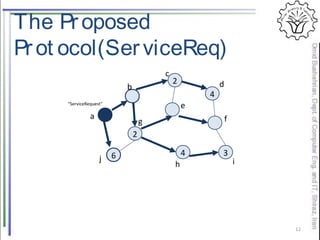
Problem statement
The proposed service selection method
State estimation using HMM
Evaluation and experimental results
Conclusion
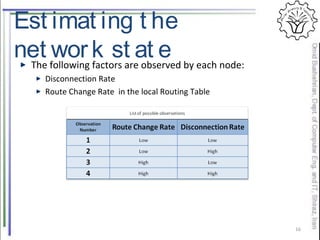
2
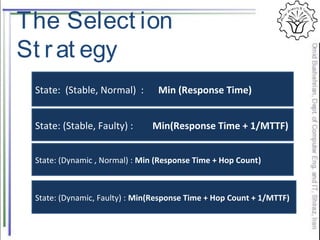
I nt roduct ion
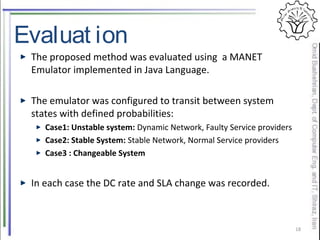
Mobile ad-hoc networks (MANET’s) consist of mobile
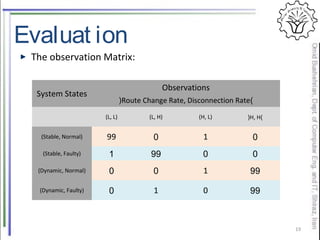
nodes interconnected by multi-hop wireless paths.
Application Level: A set of Service providers and
Service Consumers deployed over MANET
Example: A planner Service, A Logger Service
3
Problem St at ement
Service Assignment Problem:
Once a node demands a service: How to select from
available services?
Criteria: Reliability and response time
Objective: Select the fastest service provider
which provides a reliable service( in terms of DC
rate)
4
The proposed
Solut ion
Assumptions:
Service providers with different QoS(RT)
An on-demand based service discovery method
The proposed solution:
Collect the list of service providers.
Score the providers according to their reliability and
response time.
Select the best service provider.
5
Paper I dea
Causes of unreliable service providing:
Network dynamicity:
Neighbor nodes frequently move away each other
Service Dynamicity:
A service provided by a node fails or goes out of service
frequently
Service providers are scored regarding the
above factors
6
7
Paper I dea
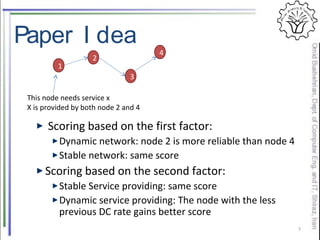
1
2
3
4
This node needs service x
X is provided by both node 2 and 4
Scoring based on the first factor:
Dynamic network: node 2 is more reliable than node 4
Stable network: same score
Scoring based on the second factor:
Stable Service providing: same score
Dynamic service providing: The node with the less
previous DC rate gains better score
The Service select ion
met hod
8
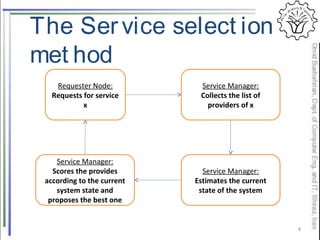
Requester Node:
Requests for service
x
Service Manager:
Collects the list of
providers of x
Service Manager:
Estimates the current
state of the system
Service Manager:
Scores the provides
according to the current
system state and
proposes the best one
9
EnvironmentEnvironment
Requester
Program
Node
Service
Manager
Provider
Program
Node
Service
Manager
Node
Service
Manager
…. ….
The Proposed
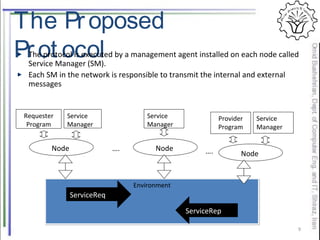
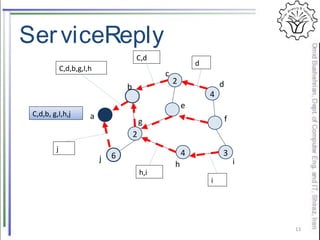
Prot ocolThe protocol is executed by a management agent installed on each node called
Service Manager (SM).
Each SM in the network is responsible to transmit the internal and external
messages
ServiceReq
ServiceRep
11
The Proposed
Prot ocol
6
2
2
4
4 3
a
b
c
d
f
ih
g
e
j
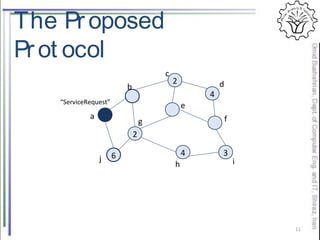
“ServiceRequest”
12
6
2
2
4
4 3
a
b
c
d
f
ih
g
e
j
“ServiceRequest”
The Proposed
Prot ocol(ServiceReq)
ServiceReply
13
6
2
2
4
4 3
a
b
c
d
f
ih
g
e
j
C,d
C,d,b,g,I,h
C,d,b, g,I,h,j
h,i
j
d
i
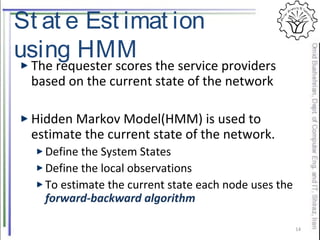
The requester scores the service providers
based on the current state of the network
Hidden Markov Model(HMM) is used to
estimate the current state of the network.
Define the System States
Define the local observations
To estimate the current state each node uses the
forward-backward algorithm
14
St at e Est imat ion
using HMM
St at e Est imat ion
using HMM
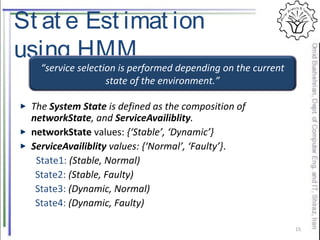
The System State is defined as the composition of
networkState, and ServiceAvailiblity.
networkState values: {‘Stable’, ‘Dynamic’}
ServiceAvailiblity values: {‘Normal’, ‘Faulty’}.
State1: (Stable, Normal)
State2: (Stable, Faulty)
State3: (Dynamic, Normal)
State4: (Dynamic, Faulty)
15
“service selection is performed depending on the current
state of the environment.”
Est imat ing t he
net work st at eThe following factors are observed by each node:
Disconnection Rate
Route Change Rate in the local Routing Table
16
The Select ion
St rat egy
17
State: (Stable, Normal) : Min (Response Time)
State: (Stable, Faulty) : Min(Response Time + 1/MTTF)
State: (Dynamic , Normal) : Min (Response Time + Hop Count)
State: (Dynamic, Faulty) : Min(Response Time + Hop Count + 1/MTTF)
Evaluat ion
The proposed method was evaluated using a MANET
Emulator implemented in Java Language.
The emulator was configured to transit between system
states with defined probabilities:
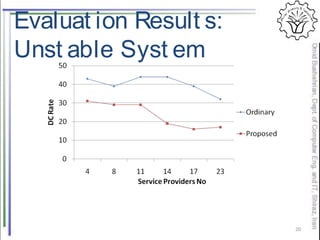
Case1: Unstable system: Dynamic Network, Faulty Service providers
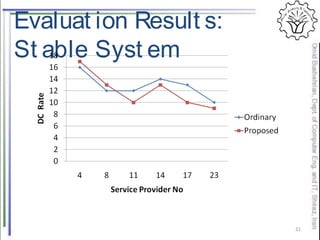
Case2: Stable System: Stable Network, Normal Service providers
Case3 : Changeable System
In each case the DC rate and SLA change was recorded.
18
Evaluat ion
The observation Matrix:
19
System States
Observations
)Route Change Rate, Disconnection Rate(
(L, L) (L, H) (H, L) )H, H(
(Stable, Normal) 99 0 1 0
(Stable, Faulty) 1 99 0 0
(Dynamic, Normal) 0 0 1 99
(Dynamic, Faulty) 0 1 0 99
20
Evaluat ion Result s:
Unst able Syst em
21
Evaluat ion Result s:
St able Syst em
Conclusion
We have proposed a novel service providing protocol which
applies the HMM to estimate the network state based on the
local observations.
We also have proposed the actions to be taken at each network
state by the clients.
Our protocol selects service providers at each network state
such that the minimal amount of hand-off is resulted, so a
reliable service is provided to the clients.
22
23
THANKYOU FORYOUR
ATTENTION…

P1141213149

  • 1.
    V. Babaiyan, O.Bushehrian Dept. of Computer Eng. and IT, Shiraz University of Technology Shiraz, Iran [v.babaiyan, bushehrian]@sutech.ac.ir A Novel Service Providing Protocol With QoS Support Over MANET’s 1
  • 2.
    Out line Introduction Problem statement Theproposed service selection method State estimation using HMM Evaluation and experimental results Conclusion 2
  • 3.
    I nt roduction Mobile ad-hoc networks (MANET’s) consist of mobile nodes interconnected by multi-hop wireless paths. Application Level: A set of Service providers and Service Consumers deployed over MANET Example: A planner Service, A Logger Service 3
  • 4.
    Problem St atement Service Assignment Problem: Once a node demands a service: How to select from available services? Criteria: Reliability and response time Objective: Select the fastest service provider which provides a reliable service( in terms of DC rate) 4
  • 5.
    The proposed Solut ion Assumptions: Serviceproviders with different QoS(RT) An on-demand based service discovery method The proposed solution: Collect the list of service providers. Score the providers according to their reliability and response time. Select the best service provider. 5
  • 6.
    Paper I dea Causesof unreliable service providing: Network dynamicity: Neighbor nodes frequently move away each other Service Dynamicity: A service provided by a node fails or goes out of service frequently Service providers are scored regarding the above factors 6
  • 7.
    7 Paper I dea 1 2 3 4 Thisnode needs service x X is provided by both node 2 and 4 Scoring based on the first factor: Dynamic network: node 2 is more reliable than node 4 Stable network: same score Scoring based on the second factor: Stable Service providing: same score Dynamic service providing: The node with the less previous DC rate gains better score
  • 8.
    The Service selection met hod 8 Requester Node: Requests for service x Service Manager: Collects the list of providers of x Service Manager: Estimates the current state of the system Service Manager: Scores the provides according to the current system state and proposes the best one
  • 9.
    9 EnvironmentEnvironment Requester Program Node Service Manager Provider Program Node Service Manager Node Service Manager …. …. The Proposed ProtocolThe protocol is executed by a management agent installed on each node called Service Manager (SM). Each SM in the network is responsible to transmit the internal and external messages ServiceReq ServiceRep
  • 10.
    11 The Proposed Prot ocol 6 2 2 4 43 a b c d f ih g e j “ServiceRequest”
  • 11.
  • 12.
  • 13.
    The requester scoresthe service providers based on the current state of the network Hidden Markov Model(HMM) is used to estimate the current state of the network. Define the System States Define the local observations To estimate the current state each node uses the forward-backward algorithm 14 St at e Est imat ion using HMM
  • 14.
    St at eEst imat ion using HMM The System State is defined as the composition of networkState, and ServiceAvailiblity. networkState values: {‘Stable’, ‘Dynamic’} ServiceAvailiblity values: {‘Normal’, ‘Faulty’}. State1: (Stable, Normal) State2: (Stable, Faulty) State3: (Dynamic, Normal) State4: (Dynamic, Faulty) 15 “service selection is performed depending on the current state of the environment.”
  • 15.
    Est imat ingt he net work st at eThe following factors are observed by each node: Disconnection Rate Route Change Rate in the local Routing Table 16
  • 16.
    The Select ion Strat egy 17 State: (Stable, Normal) : Min (Response Time) State: (Stable, Faulty) : Min(Response Time + 1/MTTF) State: (Dynamic , Normal) : Min (Response Time + Hop Count) State: (Dynamic, Faulty) : Min(Response Time + Hop Count + 1/MTTF)
  • 17.
    Evaluat ion The proposedmethod was evaluated using a MANET Emulator implemented in Java Language. The emulator was configured to transit between system states with defined probabilities: Case1: Unstable system: Dynamic Network, Faulty Service providers Case2: Stable System: Stable Network, Normal Service providers Case3 : Changeable System In each case the DC rate and SLA change was recorded. 18
  • 18.
    Evaluat ion The observationMatrix: 19 System States Observations )Route Change Rate, Disconnection Rate( (L, L) (L, H) (H, L) )H, H( (Stable, Normal) 99 0 1 0 (Stable, Faulty) 1 99 0 0 (Dynamic, Normal) 0 0 1 99 (Dynamic, Faulty) 0 1 0 99
  • 19.
    20 Evaluat ion Results: Unst able Syst em
  • 20.
    21 Evaluat ion Results: St able Syst em
  • 21.
    Conclusion We have proposeda novel service providing protocol which applies the HMM to estimate the network state based on the local observations. We also have proposed the actions to be taken at each network state by the clients. Our protocol selects service providers at each network state such that the minimal amount of hand-off is resulted, so a reliable service is provided to the clients. 22
  • 22.

Editor's Notes

  • #4 Due to the lack of stable infrastructure in MANETs, Running the application over MANET has several QoS issues and challenges At the application level usually there are a set of service provides and consumers. For example assume a set of military automotives which are moving in a battle field. Each machine needs frequently to connect to a planner service provided by another machine to fine his way or a logger service whcich is used by the nodes with low storage capacity to log their observation for later use
  • #5 The problem is the service assignment problem. Once a node requires a service, and there are more than one service providers with different QoS characteristic how to select one? Usually in the critical and realtime applications the RT is very important, so we always need the fastest service provider but with this constraint that the service reliability is at an acceptable level, so we need a reliable service and Fast Service
  • #6 The problem is an optimization problem and different strategies can be applied, we have applied a greedy strategy: Assumptions: Scoring based on the RT is easy, each provider can announce its estimated RT to the requester, However the provider can not announce how reliable is
  • #7 The problem is: scoring a provider from the reliability viewpoint based on the above factors is very dependent on the network status
  • #10 To elect a service provider, any node in the network, called the requester, can initiate an election by sending a “ServiceRequest” message to its immediate neighbours. The “ServiceReply” messages contain a “capability” field that keeps information about the service provider properties. In this way, the requester will eventually get to know which node is best to be selected as the service provider. When a node receives this request for the first time, it designates the sender as its parent, and subsequently sends out a “ServiceRequest” message to all its immediate neighbours and waits for their “ServiceReply” messages for a period of time.
  • #13 Assume that node ‘a’ is a requester of the storage service. So it sends a “ServiceRequest” message to its immediate neighbours (‘b’ and ‘j’) as shown in Figure below.
  • #15 In a HMM, the state is unknown, but each node is able to compute the most probable system state based on its local observations.
  • #18 After using forward algorithm of HMM and estimating the current state of the system, a client decides which service provider to choose. List of possible actions that a client may take, upon a service request are as follows: