
Lab Experiment – I
(per VTU M-Tech Syllabus)
On
Mobile Ad-Hoc Network
using
www.tetcos.com
Objective:
• Develop MAC Protocol using NetSim for MANETs
to send the packet without any contention
through wireless link using the following MAC
protocols;(CSMA/CA (802.11)). Analyze its
performance with
• Increasing node density
• Mobility
Introduction:
• Mobile Ad-Hoc Network (MANET) is a self-configuring network of
mobile nodes connected by wireless links to form an arbitrary
topology without the use of existing infrastructure. The nodes are
free to move randomly. Thus the network's wireless topology may
be unpredictable and may change rapidly.
• Mobility and node density are the two major factors which
influences the performance of any routing protocol of mobile ad hoc
network. The mobility of the nodes affects the number of connected
paths, which in turn affect the performance of the routing
algorithm.
• The node density also has an impact on the routing performance.
With very sparsely populated network the number of possible
connection between any two nodes is very less and hence the
performance is poor. It is expected that if the node density is
increased the throughput of the network shall increase, but beyond
a certain level if density is increased the performance degrades.
Performance metrics:
• Throughput: It is the rate of successfully transmitted data
packets in unit time in the network during the simulation.
• Average Delay: It is defined as the average time taken by the
data packets to propagate from source to destination across a
MANET. This includes all possible delays caused by routing
discovery latency, queuing at the interface queue, and
retransmission delays at the MAC, propagation and transfer
times.
• Packet Delivery Ration (PDR): This is the ratio of the number
of data packets successfully delivered to the destinations to
those transmitted by sources.
Packet Delivery Ratio = Total_Pkts_Rcvd/ Total_Pkts_Transmtd
Performingthe experimentusing NetSim
Results (IncreasingNodeDensity)
0.8
0.9
1
1.1
1.2
1.3
1.4
1.5
1.6
4 6 8
Throughput(Mbps)
Number of Nodes
Throughput
Average Delay
0
5
10
15
20
25
30
4 6 8
AverageDelay(Seconds)
Number of Nodes
Results (IncreasingNodeDensity)
Packet Delivery Ratio
0
0.2
0.4
0.6
0.8
1
1.2
4 6 8
PacketDeliveryRatio
Number of Nodes
Results (IncreasingNodeDensity)
Inference (IncreasingNodeDensity)
• As the number of nodes increases (4  6  8) the throughput
of the network increases because the channel is able to
handle additional network traffic. However, if the number of
nodes is increased further (6  8), the throughput decreases
as the network traffic is too high, and this leads to collisions.
• As the number of nodes increases, the delay also increases as
it takes more time for a packet to reach its destination. The
packet delivery ratio decreases with the increase in nodes, as
collisions are higher leading to lower number of packets
successfully reaching the destination.
Throughput
Results (IncreasingMobility)
0
0.1
0.2
0.3
0.4
0.5
0.6
0.7
0.8
60 70 80
Throughput(Mbps)
Mobility Velocity (m/s)
Inference (IncreasingMobility)
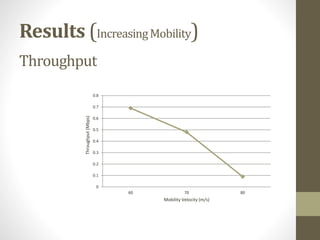
• As the mobility of nodes increases, the throughput decreases.
This is because as the velocity increases, more packets get lost
in lieu of ad hoc movement of the nodes. The packet delivery
ratio decreases as the sum of total packets received decreases
with increased mobility.
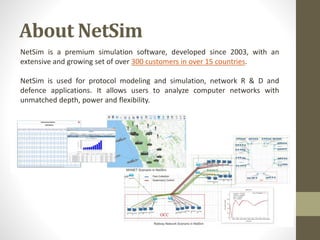
NetSim is a premium simulation software, developed since 2003, with an
extensive and growing set of over 300 customers in over 15 countries.
NetSim is used for protocol modeling and simulation, network R & D and
defence applications. It allows users to analyze computer networks with
unmatched depth, power and flexibility.
About NetSim
MANET Experiment - I (Using Network Simulator NetSim -www.tetcos.com)

MANET Experiment - I (Using Network Simulator NetSim -www.tetcos.com)

  • 1.
    Lab Experiment –I (per VTU M-Tech Syllabus) On Mobile Ad-Hoc Network using www.tetcos.com
  • 2.
    Objective: • Develop MACProtocol using NetSim for MANETs to send the packet without any contention through wireless link using the following MAC protocols;(CSMA/CA (802.11)). Analyze its performance with • Increasing node density • Mobility
  • 3.
    Introduction: • Mobile Ad-HocNetwork (MANET) is a self-configuring network of mobile nodes connected by wireless links to form an arbitrary topology without the use of existing infrastructure. The nodes are free to move randomly. Thus the network's wireless topology may be unpredictable and may change rapidly. • Mobility and node density are the two major factors which influences the performance of any routing protocol of mobile ad hoc network. The mobility of the nodes affects the number of connected paths, which in turn affect the performance of the routing algorithm. • The node density also has an impact on the routing performance. With very sparsely populated network the number of possible connection between any two nodes is very less and hence the performance is poor. It is expected that if the node density is increased the throughput of the network shall increase, but beyond a certain level if density is increased the performance degrades.
  • 4.
    Performance metrics: • Throughput:It is the rate of successfully transmitted data packets in unit time in the network during the simulation. • Average Delay: It is defined as the average time taken by the data packets to propagate from source to destination across a MANET. This includes all possible delays caused by routing discovery latency, queuing at the interface queue, and retransmission delays at the MAC, propagation and transfer times. • Packet Delivery Ration (PDR): This is the ratio of the number of data packets successfully delivered to the destinations to those transmitted by sources. Packet Delivery Ratio = Total_Pkts_Rcvd/ Total_Pkts_Transmtd
  • 5.
  • 6.
    Results (IncreasingNodeDensity) 0.8 0.9 1 1.1 1.2 1.3 1.4 1.5 1.6 4 68 Throughput(Mbps) Number of Nodes Throughput
  • 7.
    Average Delay 0 5 10 15 20 25 30 4 68 AverageDelay(Seconds) Number of Nodes Results (IncreasingNodeDensity)
  • 8.
    Packet Delivery Ratio 0 0.2 0.4 0.6 0.8 1 1.2 46 8 PacketDeliveryRatio Number of Nodes Results (IncreasingNodeDensity)
  • 9.
    Inference (IncreasingNodeDensity) • Asthe number of nodes increases (4  6  8) the throughput of the network increases because the channel is able to handle additional network traffic. However, if the number of nodes is increased further (6  8), the throughput decreases as the network traffic is too high, and this leads to collisions. • As the number of nodes increases, the delay also increases as it takes more time for a packet to reach its destination. The packet delivery ratio decreases with the increase in nodes, as collisions are higher leading to lower number of packets successfully reaching the destination.
  • 10.
  • 11.
    Inference (IncreasingMobility) • Asthe mobility of nodes increases, the throughput decreases. This is because as the velocity increases, more packets get lost in lieu of ad hoc movement of the nodes. The packet delivery ratio decreases as the sum of total packets received decreases with increased mobility.
  • 12.
    NetSim is apremium simulation software, developed since 2003, with an extensive and growing set of over 300 customers in over 15 countries. NetSim is used for protocol modeling and simulation, network R & D and defence applications. It allows users to analyze computer networks with unmatched depth, power and flexibility. About NetSim