Unit Commitment Using a Hybrid Differential
Evolution with Triangular Distribution Factor for
Adaptive Crossover
N. Malla Reddy* K. Ramesh Reddy** and N. V. Ramana***
1www.icgst.com
http://www.icgst.com/paper.aspx?pid=P1121340294
In the present day power scenario Unit Commitment (UC) is one of the complex challenging tasks for
power system operators. UC is a nonlinear, non-convex, large scale, mixed integer problem. To mitigate
this complex problem in this paper a hybrid Differential Evolution with local search technique and an
adaptive Crossover using triangular distribution factor (DE-TCR) is presented. The salient features of the
proposed DE-TCR are: An intelligent chromosome representation is used which is independent of
number of units present in UC problem thereby reducing the length of chromosome. It is able to
interlink the cross over probability in conjunction with the non-separable and decision variable
dependency of UC problems. Local search using Sequential Quadratic Programming, which has proved
in improving the performance of the classical DE algorithm. Initially, the proposed DE-TCR is used to
determine an optimal generation schedule for each hourly demand. Later, SQP is utilized to find the
optimal dispatch strategy to minimize the fuel cost. The effectiveness of the proposed algorithm is
tested on standard 4 units, 8 hour and 10 units, 24 hour UC systems. Results demonstrate that the
proposed algorithm can perform better and produce global optimal solutions compared to that of other
reported methods.
2www.icgst.com
http://www.icgst.com/paper.aspx?pid=P1121340294
Unit Commitment Using a Hybrid Differential Evolution with Triangular Distribution
Factor for Adaptive Crossover
Abstract
3www.icgst.com
N. Venkata Ramana has received M. Tech from, S.V.University, India in 1991 and Ph.D.
in Electrical Engineering from Jawaharlal Nehru Technological University (J.N.T.U),
India in Jan’ 2005. His main research interest includes Power System Modeling and
Control.He is currently Professor at J.N.T.U. College of Engineering, Jagityal,
Karimnagar District, A.P., India
J.N.T.U.
http://www.jntuh.ac.in/new/
4www.icgst.com
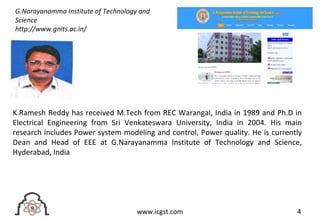
K.Ramesh Reddy has received M.Tech from REC Warangal, India in 1989 and Ph.D in
Electrical Engineering from Sri Venkateswara University, India in 2004. His main
research includes Power system modeling and control, Power quality. He is currently
Dean and Head of EEE at G.Narayanamma Institute of Technology and Science,
Hyderabad, India
G.Narayanamma Institute of Technology and
Science
http://www.gnits.ac.in/
5www.icgst.com
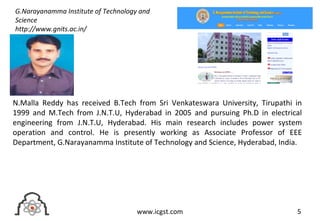
N.Malla Reddy has received B.Tech from Sri Venkateswara University, Tirupathi in
1999 and M.Tech from J.N.T.U, Hyderabad in 2005 and pursuing Ph.D in electrical
engineering from J.N.T.U, Hyderabad. His main research includes power system
operation and control. He is presently working as Associate Professor of EEE
Department, G.Narayanamma Institute of Technology and Science, Hyderabad, India.
G.Narayanamma Institute of Technology and
Science
http://www.gnits.ac.in/
6
6

P1121340294

  • 1.
    Unit Commitment Usinga Hybrid Differential Evolution with Triangular Distribution Factor for Adaptive Crossover N. Malla Reddy* K. Ramesh Reddy** and N. V. Ramana*** 1www.icgst.com http://www.icgst.com/paper.aspx?pid=P1121340294
  • 2.
    In the presentday power scenario Unit Commitment (UC) is one of the complex challenging tasks for power system operators. UC is a nonlinear, non-convex, large scale, mixed integer problem. To mitigate this complex problem in this paper a hybrid Differential Evolution with local search technique and an adaptive Crossover using triangular distribution factor (DE-TCR) is presented. The salient features of the proposed DE-TCR are: An intelligent chromosome representation is used which is independent of number of units present in UC problem thereby reducing the length of chromosome. It is able to interlink the cross over probability in conjunction with the non-separable and decision variable dependency of UC problems. Local search using Sequential Quadratic Programming, which has proved in improving the performance of the classical DE algorithm. Initially, the proposed DE-TCR is used to determine an optimal generation schedule for each hourly demand. Later, SQP is utilized to find the optimal dispatch strategy to minimize the fuel cost. The effectiveness of the proposed algorithm is tested on standard 4 units, 8 hour and 10 units, 24 hour UC systems. Results demonstrate that the proposed algorithm can perform better and produce global optimal solutions compared to that of other reported methods. 2www.icgst.com http://www.icgst.com/paper.aspx?pid=P1121340294 Unit Commitment Using a Hybrid Differential Evolution with Triangular Distribution Factor for Adaptive Crossover Abstract
  • 3.
    3www.icgst.com N. Venkata Ramanahas received M. Tech from, S.V.University, India in 1991 and Ph.D. in Electrical Engineering from Jawaharlal Nehru Technological University (J.N.T.U), India in Jan’ 2005. His main research interest includes Power System Modeling and Control.He is currently Professor at J.N.T.U. College of Engineering, Jagityal, Karimnagar District, A.P., India J.N.T.U. http://www.jntuh.ac.in/new/
  • 4.
    4www.icgst.com K.Ramesh Reddy hasreceived M.Tech from REC Warangal, India in 1989 and Ph.D in Electrical Engineering from Sri Venkateswara University, India in 2004. His main research includes Power system modeling and control, Power quality. He is currently Dean and Head of EEE at G.Narayanamma Institute of Technology and Science, Hyderabad, India G.Narayanamma Institute of Technology and Science http://www.gnits.ac.in/
  • 5.
    5www.icgst.com N.Malla Reddy hasreceived B.Tech from Sri Venkateswara University, Tirupathi in 1999 and M.Tech from J.N.T.U, Hyderabad in 2005 and pursuing Ph.D in electrical engineering from J.N.T.U, Hyderabad. His main research includes power system operation and control. He is presently working as Associate Professor of EEE Department, G.Narayanamma Institute of Technology and Science, Hyderabad, India. G.Narayanamma Institute of Technology and Science http://www.gnits.ac.in/
  • 6.
  • 7.