A Two Branch SIMULINK Model of the Lithium Polymer
Battery
University of Massachusetts Lowell, One University Ave., Lowell, MA 01854
1www.icgst.com
http://www.icgst.com/paper.aspx?pid=P1111410321
The paper discusses the Simulink model of lithium polymer battery. Model
parameters are temperature and state of charge dependent. This model is two
branch (parallel R-C) model. 2-D Look-up table method is used to represent the
relation between model branch parameters and state of charge. Matlab user
defined function is used to calculate the open circuit voltage and internal dc
resistance. One whole block is dedicated to state of charge calculation. This block
is able to autonomously detect the transition from charge to discharge and vice
versa. Also if charging or discharging current stops flowing, it resets the current
integrator initial condition to the last state of charge calculated. Comparison
between experimental and model results showed about 3% maximum error in
dynamic (interval test) response and 5% error in static response of battery
discharging (until 10% state of charge is left in the battery).
2www.icgst.com
http://www.icgst.com/paper.aspx?pid=P1111410321
A Two Branch SIMULINK Model of the Lithium Polymer Battery
Abstract
3www.icgst.com
Dr. Salameh got his Diploma (with honors) from Russia in 1974 and his M.Sc. and Ph.D from University of Michigan (Ann Arbor) in 1980 and 1982
respectively. Dr. Ziyad Salameh is a professor of Electrical and Computer Engineering (ECE) Department at the University of Massachusetts Lowell since 1985;
he chaired the ECE Department for three years 2001-2004. Dr. Salameh has technical expertise in a wide area of renewable energy subjects, especially in the
area of residential hybrid wind/photovoltaic systems, storage batteries, fuel cells, super capacitors ,electric vehicle technologies and vehicle to grid (V2G)
tecnology. Dr. Salameh has been a co-investigator and principal investigator of many DOE, state, and utility projects. Professor Salameh has published more
than 120 papers in renewable energy systems and electric vehicle technologies. Dr Salameh is an associate editor of the International Journal of Power and
Energy systems, and the International Journal of renewable Energy Dr. Salameh is member of IEEE Renewable Technologies Subcommittee , IEEE Emerging
Technologies coordinating Committee ETCC, and IEEE Distributed Generation and Energy Storage Subcommittee Dr. Salameh is the director of the center for
Electric Car and Energy Conversion (EC&EC) with four research laboratories: Renewable Energy Lab, Battery Evaluation Lab, Power Electronics Lab, and
Electric Vehicle Lab. The renewable energy lab hosts four wind turbines 2400w, 1500w, 500w, and 300w. Moreover it has two PV systems 2500 w and 10.5
kw and 1.2 kw PEM fuel cell, also it has a super Capacitor evaluation station. Dr. Salameh has been driving an electric car since 1994, the EC&EC center has
10 electric cars for research and education. Dr. Salameh supervised 7 Ph.D Dissertations and 34 master thesises Dr. Salameh is the author of a book
“Renewable Energy systems Analysis and Design” to be published by Elsevier,ISBN:0123749913, EAN: 9780123749918 Invited to conferences: Invited
Speaker to the 13th IEEE Saudi Technical Exchange Meeting, held in Dhahran, April 29-30, 2008 invited speaker, and gave a tutorial session at the 5th IEEE
GCC in Kuwait, March 17-10, 2009 Invited speaker at IDTechEx, [Global Research and Analysis on Electric Vehicle Future] conference, Cambridge, MA, Nov
18th, 2010 . Panelist at the IEEE PES GM2010, Minneapolis July26-29th on two topics: Building Integrated Wind Energy Conversion Systems Small Scale
Distributed Generation Systems Panelist at the Electric Vehicle Summit and Workshop, Lowell, MA, Oct. 6, 2010.
University of Massachusetts Lowell
http://www.uml.edu/
4www.icgst.com
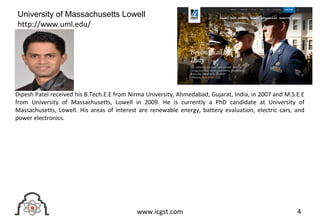
Dipesh Patel received his B.Tech.E.E from Nirma University, Ahmedabad, Gujarat, India, in 2007 and M.S.E.E
from University of Massachusetts, Lowell in 2009. He is currently a PhD candidate at University of
Massachusetts, Lowell. His areas of interest are renewable energy, battery evaluation, electric cars, and
power electronics.
University of Massachusetts Lowell
http://www.uml.edu/
5
5

P1111410321

  • 1.
    A Two BranchSIMULINK Model of the Lithium Polymer Battery University of Massachusetts Lowell, One University Ave., Lowell, MA 01854 1www.icgst.com http://www.icgst.com/paper.aspx?pid=P1111410321
  • 2.
    The paper discussesthe Simulink model of lithium polymer battery. Model parameters are temperature and state of charge dependent. This model is two branch (parallel R-C) model. 2-D Look-up table method is used to represent the relation between model branch parameters and state of charge. Matlab user defined function is used to calculate the open circuit voltage and internal dc resistance. One whole block is dedicated to state of charge calculation. This block is able to autonomously detect the transition from charge to discharge and vice versa. Also if charging or discharging current stops flowing, it resets the current integrator initial condition to the last state of charge calculated. Comparison between experimental and model results showed about 3% maximum error in dynamic (interval test) response and 5% error in static response of battery discharging (until 10% state of charge is left in the battery). 2www.icgst.com http://www.icgst.com/paper.aspx?pid=P1111410321 A Two Branch SIMULINK Model of the Lithium Polymer Battery Abstract
  • 3.
    3www.icgst.com Dr. Salameh gothis Diploma (with honors) from Russia in 1974 and his M.Sc. and Ph.D from University of Michigan (Ann Arbor) in 1980 and 1982 respectively. Dr. Ziyad Salameh is a professor of Electrical and Computer Engineering (ECE) Department at the University of Massachusetts Lowell since 1985; he chaired the ECE Department for three years 2001-2004. Dr. Salameh has technical expertise in a wide area of renewable energy subjects, especially in the area of residential hybrid wind/photovoltaic systems, storage batteries, fuel cells, super capacitors ,electric vehicle technologies and vehicle to grid (V2G) tecnology. Dr. Salameh has been a co-investigator and principal investigator of many DOE, state, and utility projects. Professor Salameh has published more than 120 papers in renewable energy systems and electric vehicle technologies. Dr Salameh is an associate editor of the International Journal of Power and Energy systems, and the International Journal of renewable Energy Dr. Salameh is member of IEEE Renewable Technologies Subcommittee , IEEE Emerging Technologies coordinating Committee ETCC, and IEEE Distributed Generation and Energy Storage Subcommittee Dr. Salameh is the director of the center for Electric Car and Energy Conversion (EC&EC) with four research laboratories: Renewable Energy Lab, Battery Evaluation Lab, Power Electronics Lab, and Electric Vehicle Lab. The renewable energy lab hosts four wind turbines 2400w, 1500w, 500w, and 300w. Moreover it has two PV systems 2500 w and 10.5 kw and 1.2 kw PEM fuel cell, also it has a super Capacitor evaluation station. Dr. Salameh has been driving an electric car since 1994, the EC&EC center has 10 electric cars for research and education. Dr. Salameh supervised 7 Ph.D Dissertations and 34 master thesises Dr. Salameh is the author of a book “Renewable Energy systems Analysis and Design” to be published by Elsevier,ISBN:0123749913, EAN: 9780123749918 Invited to conferences: Invited Speaker to the 13th IEEE Saudi Technical Exchange Meeting, held in Dhahran, April 29-30, 2008 invited speaker, and gave a tutorial session at the 5th IEEE GCC in Kuwait, March 17-10, 2009 Invited speaker at IDTechEx, [Global Research and Analysis on Electric Vehicle Future] conference, Cambridge, MA, Nov 18th, 2010 . Panelist at the IEEE PES GM2010, Minneapolis July26-29th on two topics: Building Integrated Wind Energy Conversion Systems Small Scale Distributed Generation Systems Panelist at the Electric Vehicle Summit and Workshop, Lowell, MA, Oct. 6, 2010. University of Massachusetts Lowell http://www.uml.edu/
  • 4.
    4www.icgst.com Dipesh Patel receivedhis B.Tech.E.E from Nirma University, Ahmedabad, Gujarat, India, in 2007 and M.S.E.E from University of Massachusetts, Lowell in 2009. He is currently a PhD candidate at University of Massachusetts, Lowell. His areas of interest are renewable energy, battery evaluation, electric cars, and power electronics. University of Massachusetts Lowell http://www.uml.edu/
  • 5.
  • 6.