Combinatory Logic and language
engineering
Ismail Biskri, Adam Joly and Boucif Amar Bensaber
LAMIA, Université du Québec à Trois-Rivières
Introduction
 Language engineering:
 Everything related to the NLP and the knowledge extraction
 Main goal: help humans to access to knowledge contained in texts
 Definition:
 The study and the description of the concepts, the approaches, the methods and the
techniques that allow data extraction and knowledge modeling and acquisition from
texts
 Knowledge acquisition from text needs to be assisted by analysis tools for
corpus, such as:
 Semantic or syntactic analyzers
 Marker tracking tools supported by contextual exploration
 Statistical analyzers
 Etc.
 Numerous application fields since the development of the Web and
office tools
2 Biskri, Joly & Amar Bensaber, ICGST 2011
Introduction (2/3)
 Many generations of tools:
 At the beginning (about 40 years ago):
 Applications focusing on 1 functionality
 Since the 90’s:
 More complex approaches are required by the industry for text analysis
 There is an interest for functions and operations assembling in complex processing
chains (Hallab & al. 2000; Moscarola & al., 2002)
 Most of the tools proposed then offer various functionalities
 Despite some success with scientists and industries, they have many
important limits:
 The technologies offer a closed and limited set of functionalities
 They are designed as autonomous entities that can hardly or simply not be
integrated into more complex processing chains
 They can be unusable by researchers with particular analysis needs (lack of
adaptability)
3 Biskri, Joly & Amar Bensaber, ICGST 2011
Introduction (3/3)
 Recently, a new generation of software platforms for language engineering
has started to emerge
 Statistical analysis:
 Aladin (Seffah & al., 1995)
 T2K and Knime (Warr, 2007)
 Linguistic Analysis:
 Context (Crispino & al., 1999)
 Gate (Cunningham & al, 2002)
 From these new platforms emerge new interests on processing chains
about:
 Their coherence
 Their flexibility
 Their adaptability
 Etc.
4 Biskri, Joly & Amar Bensaber, ICGST 2011
General Framework
 Processing chain:
 Integrated sequence of computational modules dedicated to specific processing,
assembled in a pertinent order according to a processing goal determined by the
language engineer
 A module accomplishes an operation which applies to one or many object
entities from a given type and returns other object entities from another
type
 A processing chain allow the composition of modules
 We need a formal system that can answer 2 fundamental questions:
 Given a set of modules, what are the allowable arrangements which lead to
coherent processing chains?
 Given a coherent processing chain, how can we automate (as much as possible)
its assessment (in the sense of its calculability)?
 Such a system will be at the center of our theoretical model
5 Biskri, Joly & Amar Bensaber, ICGST 2011
General Framework
 Theoretical general framework chosen: Applicative
Grammars (Desclés, 1990; Shaumyan, 1998)
 Instead of designing a rewritten grammar for syntactical
validation of the processing chain, we use a typed logic.
 Types are given to inputs/outputs (integer, char, …)
 Types constraint the possibilities of modules composition
 Main advantages of this formalism:
 Assures a firm compositionality of the different modules in the different processing chains,
by validating the types attributed to the modules
 Allows to compose an infinity of modules
6 Biskri, Joly & Amar Bensaber, ICGST 2011
Combinatory Logic
Combinator Role -Reduction ruleβ
B Composition B x y z x (y z)→
C Permutation C x z y x y z→
Φ Distribution Φ x y z u x (y u) (z u)→
W Duplication W x y x y y→
 From the works of Schöfinkel (1924) and Curry and Feys (1958)
 Eliminate the need for variables in mathematics
 Combinators:
 Abstract operators that apply to other operators in order to build more
complex operators;
 Act as functions over arguments, in an operator-operands structure
 Each specific action is represented by a unique rule that defines the
equivalence between a logical expression with a combinator versus one
without a combinator ( -reduction rule)β
7 Biskri, Joly & Amar Bensaber, ICGST 2011
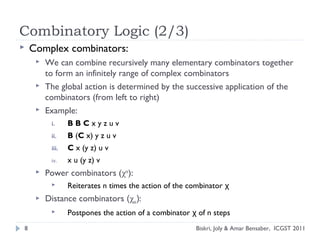
 Complex combinators:
 We can combine recursively many elementary combinators together
to form an infinitely range of complex combinators
 The global action is determined by the successive application of the
combinators (from left to right)
 Example:
i. B B C x y z u v
ii. B (C x) y z u v
iii. C x (y z) u v
iv. x u (y z) v
 Power combinators (χn
):
 Reiterates n times the action of the combinator χ
 Distance combinators (χn):
 Postpones the action of a combinator of n stepsχ
Combinatory Logic (2/3)
8 Biskri, Joly & Amar Bensaber, ICGST 2011
Combinatory Logic (3/3)
 Combinatory logic fills 2 major goals:
 It gives an interoperable and formal representation of the solution;
 Combinatory logic expressions formally represent the composition of the
modules of the processing chain and gives the direct execution order
 Combinators provides operators to support the different types of
interactions between modules:
 B: expresses the composition of 2 interconnected modules
 C: assures that all combinators and modules of the expression appear together
to the left and all inputs to the right (ordering)
 Φ: distributes the same input to 2 or more different modules
9 Biskri, Joly & Amar Bensaber, ICGST 2011
Processing Chains
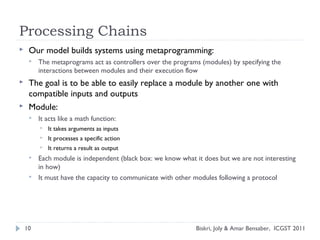
 Our model builds systems using metaprogramming:
 The metaprograms act as controllers over the programs (modules) by specifying the
interactions between modules and their execution flow
 The goal is to be able to easily replace a module by another one with
compatible inputs and outputs
 Module:
 It acts like a math function:
 It takes arguments as inputs
 It processes a specific action
 It returns a result as output
 Each module is independent (black box: we know what it does but we are not interesting
in how)
 It must have the capacity to communicate with other modules following a protocol
10 Biskri, Joly & Amar Bensaber, ICGST 2011
Processing Chains (2/2)
 A controller supervises the flow of communication:
 It verifies the validity of connections between modules (if the processing chain is
syntactically correct):
 It determines the execution order of modules (following the combinatory
expression)
 It triggers the execution of a module (one at a time only)
Processing chain 2
Processing chain 1
M1M1
M2M2
O1
O2
I1
I2 I4
I3
M3/C2M3/C2 O3 M4M4 O4I5
Controller 1
M1M1 O1 M2/C3M2/C3 O2I3
I2
I1
…
 By abstraction, a processing
chain (the controller and
modules) can be considered
as a (super or meta) module
by itself)
 Thus it can be used as a
module in another processing
chain
11 Biskri, Joly & Amar Bensaber, ICGST 2011
Basic Processing Chains (1 module)
M1M1 O1I1
M1M1 O1
I2
I1
In
…
12 Biskri, Joly & Amar Bensaber, ICGST 2011
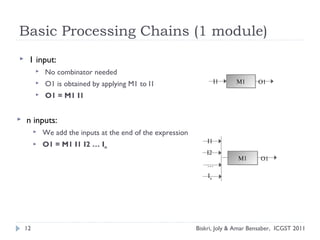
 1 input:
 No combinator needed
 O1 is obtained by applying M1 to I1
 O1 = M1 I1
 n inputs:
 We add the inputs at the end of the expression
 O1 = M1 I1 I2 … In
Serial processing chains
 Relation of composition between modules (B)
 2 connected modules:
 O1 = M1 I1
 O2 = M2 I2
 I2 = O1
 O2 = M2 (M1 I1)
 O2 = B M2 M1 I1
 3 connected modules:
 O3 = M3 I3
 I3 = O2
 O3 = M3 (B M2 M1 I1)
 O3 = B3
M3 B M2 M1 I1
 O3 = C B3
B M3 M2 M1 I1
 4 connected modules: O4 = C B4
(C B3
B) M4 M3 M2 M1 I1
 (…)
 The power of B is induced by the number of modules in the chain
M1M1 O1I1 M2M2 O2I2
M1M1 O1I1 M2M2 O2I2 M3M3 O3I3
13 Biskri, Joly & Amar Bensaber, ICGST 2011
Parallel processing chains
 Contains modules that have many inputs
 Module connected on the 1st input of a 2nd module:
 O2 = M2 I2 I3
 O1 = M1 I1
 I2 = O1
 O2 = M2 (M1 I1) I3
 O2 = B M2 M1 I1 I3
 2 modules connected to a 3rd module:
 O3 = M3 I3 I4
 I3 = M1 I1
 I4 = M2 I2
 O3 = M3 (M1 I1) (M2 I2)
 O3 = B M3 M1 I1 (M2 I2)
 O3 = C2 B M3 M1 (M2 I2) I1
 O3 = B3 C2 B M3 M1 M2 I2 I1
 3 modules connected to a 4th module: B7 C6 C6 B3 C2 B M4 M1 M2 M3 I3 I2 I1
 (…)
 The distance of combinators B and C can be induced by the number of modules
M1M1 O1I1
M2M2 O2
I2
I3
M1M1
M2M2
O1
O2
I1
I2 I4
I3
M3M3 O3
14 Biskri, Joly & Amar Bensaber, ICGST 2011
A Complex Processing Chain
M3M3
M6M6
O3
O6I4 M4M4 O4
M5M5 O5
I9
I8
M7M7 O7M2M2 O2I2
M1M1 O1I1 I3
I7
I6
I5
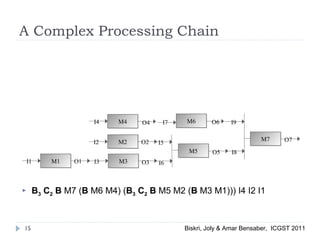
 B3 C2 B M7 (B M6 M4) (B3 C2 B M5 M2 (B M3 M1))) I4 I2 I1
15 Biskri, Joly & Amar Bensaber, ICGST 2011
SATIM
 Following these formalisms and principles, we have implemented a prototype
(work in progress) named SATIM.
 SATIM: « Système d’Analyse et de Traitement de l’Information Multidimensionnelle »
(Multidimensional Data Analysis and processing System)
 The architecture of this modular platform postulates 3 levels of interaction with a
language engineer:
1. Workshop:
 Contains various modules, procedures and functions and their assigned applicative categories
 Possibility to add or delete modules to a « database » of modules
1. Laboratory:
 Allows an engineer to build his processing chain and adjust it using tests and according to his
objective
1. Application:
 It is the output of the previous level: the processing chain is then an autonomous software that
contains a coherent and well organized subset of modules
16 Biskri, Joly & Amar Bensaber, ICGST 2011
Conclusion
 We are at a prototypal stage/test phase
 Eventually, it will become the full-size project within which we aspire
to design tools for language engineering and other tools for NLP in
general
 The strong foundations (formalism and principles) at the heart of SATIM
are aimed to address the need for coherence, flexibility, adaptability and
easy communication between programs (processing chains):
 Modules are independents: we can easily replace a module by another one
with compatible inputs and output to change some parts of a given program
 We believe that the approach could help research teams to collaborate
together by sharing components
17 Biskri, Joly & Amar Bensaber, ICGST 2011

P1121133746

  • 1.
    Combinatory Logic andlanguage engineering Ismail Biskri, Adam Joly and Boucif Amar Bensaber LAMIA, Université du Québec à Trois-Rivières
  • 2.
    Introduction  Language engineering: Everything related to the NLP and the knowledge extraction  Main goal: help humans to access to knowledge contained in texts  Definition:  The study and the description of the concepts, the approaches, the methods and the techniques that allow data extraction and knowledge modeling and acquisition from texts  Knowledge acquisition from text needs to be assisted by analysis tools for corpus, such as:  Semantic or syntactic analyzers  Marker tracking tools supported by contextual exploration  Statistical analyzers  Etc.  Numerous application fields since the development of the Web and office tools 2 Biskri, Joly & Amar Bensaber, ICGST 2011
  • 3.
    Introduction (2/3)  Manygenerations of tools:  At the beginning (about 40 years ago):  Applications focusing on 1 functionality  Since the 90’s:  More complex approaches are required by the industry for text analysis  There is an interest for functions and operations assembling in complex processing chains (Hallab & al. 2000; Moscarola & al., 2002)  Most of the tools proposed then offer various functionalities  Despite some success with scientists and industries, they have many important limits:  The technologies offer a closed and limited set of functionalities  They are designed as autonomous entities that can hardly or simply not be integrated into more complex processing chains  They can be unusable by researchers with particular analysis needs (lack of adaptability) 3 Biskri, Joly & Amar Bensaber, ICGST 2011
  • 4.
    Introduction (3/3)  Recently,a new generation of software platforms for language engineering has started to emerge  Statistical analysis:  Aladin (Seffah & al., 1995)  T2K and Knime (Warr, 2007)  Linguistic Analysis:  Context (Crispino & al., 1999)  Gate (Cunningham & al, 2002)  From these new platforms emerge new interests on processing chains about:  Their coherence  Their flexibility  Their adaptability  Etc. 4 Biskri, Joly & Amar Bensaber, ICGST 2011
  • 5.
    General Framework  Processingchain:  Integrated sequence of computational modules dedicated to specific processing, assembled in a pertinent order according to a processing goal determined by the language engineer  A module accomplishes an operation which applies to one or many object entities from a given type and returns other object entities from another type  A processing chain allow the composition of modules  We need a formal system that can answer 2 fundamental questions:  Given a set of modules, what are the allowable arrangements which lead to coherent processing chains?  Given a coherent processing chain, how can we automate (as much as possible) its assessment (in the sense of its calculability)?  Such a system will be at the center of our theoretical model 5 Biskri, Joly & Amar Bensaber, ICGST 2011
  • 6.
    General Framework  Theoreticalgeneral framework chosen: Applicative Grammars (Desclés, 1990; Shaumyan, 1998)  Instead of designing a rewritten grammar for syntactical validation of the processing chain, we use a typed logic.  Types are given to inputs/outputs (integer, char, …)  Types constraint the possibilities of modules composition  Main advantages of this formalism:  Assures a firm compositionality of the different modules in the different processing chains, by validating the types attributed to the modules  Allows to compose an infinity of modules 6 Biskri, Joly & Amar Bensaber, ICGST 2011
  • 7.
    Combinatory Logic Combinator Role-Reduction ruleβ B Composition B x y z x (y z)→ C Permutation C x z y x y z→ Φ Distribution Φ x y z u x (y u) (z u)→ W Duplication W x y x y y→  From the works of Schöfinkel (1924) and Curry and Feys (1958)  Eliminate the need for variables in mathematics  Combinators:  Abstract operators that apply to other operators in order to build more complex operators;  Act as functions over arguments, in an operator-operands structure  Each specific action is represented by a unique rule that defines the equivalence between a logical expression with a combinator versus one without a combinator ( -reduction rule)β 7 Biskri, Joly & Amar Bensaber, ICGST 2011
  • 8.
     Complex combinators: We can combine recursively many elementary combinators together to form an infinitely range of complex combinators  The global action is determined by the successive application of the combinators (from left to right)  Example: i. B B C x y z u v ii. B (C x) y z u v iii. C x (y z) u v iv. x u (y z) v  Power combinators (χn ):  Reiterates n times the action of the combinator χ  Distance combinators (χn):  Postpones the action of a combinator of n stepsχ Combinatory Logic (2/3) 8 Biskri, Joly & Amar Bensaber, ICGST 2011
  • 9.
    Combinatory Logic (3/3) Combinatory logic fills 2 major goals:  It gives an interoperable and formal representation of the solution;  Combinatory logic expressions formally represent the composition of the modules of the processing chain and gives the direct execution order  Combinators provides operators to support the different types of interactions between modules:  B: expresses the composition of 2 interconnected modules  C: assures that all combinators and modules of the expression appear together to the left and all inputs to the right (ordering)  Φ: distributes the same input to 2 or more different modules 9 Biskri, Joly & Amar Bensaber, ICGST 2011
  • 10.
    Processing Chains  Ourmodel builds systems using metaprogramming:  The metaprograms act as controllers over the programs (modules) by specifying the interactions between modules and their execution flow  The goal is to be able to easily replace a module by another one with compatible inputs and outputs  Module:  It acts like a math function:  It takes arguments as inputs  It processes a specific action  It returns a result as output  Each module is independent (black box: we know what it does but we are not interesting in how)  It must have the capacity to communicate with other modules following a protocol 10 Biskri, Joly & Amar Bensaber, ICGST 2011
  • 11.
    Processing Chains (2/2) A controller supervises the flow of communication:  It verifies the validity of connections between modules (if the processing chain is syntactically correct):  It determines the execution order of modules (following the combinatory expression)  It triggers the execution of a module (one at a time only) Processing chain 2 Processing chain 1 M1M1 M2M2 O1 O2 I1 I2 I4 I3 M3/C2M3/C2 O3 M4M4 O4I5 Controller 1 M1M1 O1 M2/C3M2/C3 O2I3 I2 I1 …  By abstraction, a processing chain (the controller and modules) can be considered as a (super or meta) module by itself)  Thus it can be used as a module in another processing chain 11 Biskri, Joly & Amar Bensaber, ICGST 2011
  • 12.
    Basic Processing Chains(1 module) M1M1 O1I1 M1M1 O1 I2 I1 In … 12 Biskri, Joly & Amar Bensaber, ICGST 2011  1 input:  No combinator needed  O1 is obtained by applying M1 to I1  O1 = M1 I1  n inputs:  We add the inputs at the end of the expression  O1 = M1 I1 I2 … In
  • 13.
    Serial processing chains Relation of composition between modules (B)  2 connected modules:  O1 = M1 I1  O2 = M2 I2  I2 = O1  O2 = M2 (M1 I1)  O2 = B M2 M1 I1  3 connected modules:  O3 = M3 I3  I3 = O2  O3 = M3 (B M2 M1 I1)  O3 = B3 M3 B M2 M1 I1  O3 = C B3 B M3 M2 M1 I1  4 connected modules: O4 = C B4 (C B3 B) M4 M3 M2 M1 I1  (…)  The power of B is induced by the number of modules in the chain M1M1 O1I1 M2M2 O2I2 M1M1 O1I1 M2M2 O2I2 M3M3 O3I3 13 Biskri, Joly & Amar Bensaber, ICGST 2011
  • 14.
    Parallel processing chains Contains modules that have many inputs  Module connected on the 1st input of a 2nd module:  O2 = M2 I2 I3  O1 = M1 I1  I2 = O1  O2 = M2 (M1 I1) I3  O2 = B M2 M1 I1 I3  2 modules connected to a 3rd module:  O3 = M3 I3 I4  I3 = M1 I1  I4 = M2 I2  O3 = M3 (M1 I1) (M2 I2)  O3 = B M3 M1 I1 (M2 I2)  O3 = C2 B M3 M1 (M2 I2) I1  O3 = B3 C2 B M3 M1 M2 I2 I1  3 modules connected to a 4th module: B7 C6 C6 B3 C2 B M4 M1 M2 M3 I3 I2 I1  (…)  The distance of combinators B and C can be induced by the number of modules M1M1 O1I1 M2M2 O2 I2 I3 M1M1 M2M2 O1 O2 I1 I2 I4 I3 M3M3 O3 14 Biskri, Joly & Amar Bensaber, ICGST 2011
  • 15.
    A Complex ProcessingChain M3M3 M6M6 O3 O6I4 M4M4 O4 M5M5 O5 I9 I8 M7M7 O7M2M2 O2I2 M1M1 O1I1 I3 I7 I6 I5  B3 C2 B M7 (B M6 M4) (B3 C2 B M5 M2 (B M3 M1))) I4 I2 I1 15 Biskri, Joly & Amar Bensaber, ICGST 2011
  • 16.
    SATIM  Following theseformalisms and principles, we have implemented a prototype (work in progress) named SATIM.  SATIM: « Système d’Analyse et de Traitement de l’Information Multidimensionnelle » (Multidimensional Data Analysis and processing System)  The architecture of this modular platform postulates 3 levels of interaction with a language engineer: 1. Workshop:  Contains various modules, procedures and functions and their assigned applicative categories  Possibility to add or delete modules to a « database » of modules 1. Laboratory:  Allows an engineer to build his processing chain and adjust it using tests and according to his objective 1. Application:  It is the output of the previous level: the processing chain is then an autonomous software that contains a coherent and well organized subset of modules 16 Biskri, Joly & Amar Bensaber, ICGST 2011
  • 17.
    Conclusion  We areat a prototypal stage/test phase  Eventually, it will become the full-size project within which we aspire to design tools for language engineering and other tools for NLP in general  The strong foundations (formalism and principles) at the heart of SATIM are aimed to address the need for coherence, flexibility, adaptability and easy communication between programs (processing chains):  Modules are independents: we can easily replace a module by another one with compatible inputs and output to change some parts of a given program  We believe that the approach could help research teams to collaborate together by sharing components 17 Biskri, Joly & Amar Bensaber, ICGST 2011

Editor's Notes

  • #8 The composition combinator B combines together two operators x and y in order to form the complex operator B x y that acts on an operand z according to the β-reduction rule. The permutation combinator C uses an operator x in order to build the complex operator C x such as if x acts on the operands y and z, C x will act on those operands in the reverse order, that is to say z and y. Given the three operators x, y and z and the operand u, the distribution combinator Φ distributes the operand with the two precedent operators. Finally, given the binary operators x, and the operand y, the combinator W duplicates y so that the operator x will have its two arguments.