Scene 1: Text Scene 1: Art Scene 1: Poem Scene 2: Text Scene 2: Art Scene 2: Poem Scene 3: Text Scene 3: Art Scene 3: Poem
“‘ You young dog,’ said the man (Magwitch), licking hislips, ‘what fat cheeks you  ha’ got.’ I believe they were fat, though I was at the time undersized, for my years, and not strong. ‘ Darn me if I couldn’t eat ‘em,’ said the man, with a threatening shake of his head, ‘and if I han’t half a mind to’t!’ I earnestly expressed my hope that he wouldn’t, and held tighter to the tombstone on which he had put me; partly to keep myself upon it; partly to keep myself from crying. ‘ Now lookee here!’ said the man.  ‘Where’s your mother?’ ‘ There, sir!’ I said. He started, made a short run,  and stopped and looked over his shoulder. ‘ There, sir!’ I timidly explained.  ‘Also Georgiana.  That’s my mother.’ ‘ Oh!’  said he, coming back.  ‘And is that your father along your mother’” (Dickens, 3)?
 
“ I leant upon the coppice gate When Frost was spectre-grey, And Winter’s dregs made desolate The weakening eye of day.”
“ It was not the first few moments that I saw all these, though I saw more of them in the first moments than might be supposed.  But, I saw that everything within my view which ought to be white, had been white long ago, and had lost its lustre, and was faded and yellow.  I saw that the bride within the bridal dress had withered like the dress, and like the flowers, and had no brightness but the brightness of her sunken eyes.  I saw that the dress had been put upon the rounded figure of a young woman, and that the figure upon which it now hung loose and shrunk to skin and bone.  Once, I had been taken to see some ghastly waxwork at the fair, representing I know what impossible personage lying in state.  Once, I had been taken to one of our old marsh churches to see a skeleton in the ashes of a rich dress that had been dug out of a vault under the church pavement.  Now, waxwork and skeleton seemed to have dark eyes that moved and looked at me.  I should have cried out, if I could ” (Dickens, 59).
 
“ Dead love, by treason slain, lies stark, White as dead stark-stricken dove: None that pass him pause to mark Dead Love.”
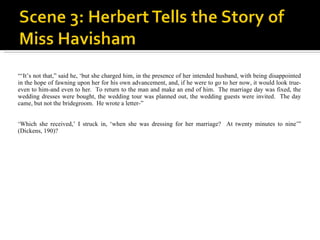
“‘ It’s not that,” said he, ‘but she charged him, in the presence of her intended husband, with being disappointed in the hope of fawning upon her for his own advancement, and, if he were to go to her now, it would look true-even to him-and even to her.  To return to the man and make an end of him.  The marriage day was fixed, the wedding dresses were bought, the wedding tour was planned out, the wedding guests were invited.  The day came, but not the bridegroom.  He wrote a letter-” ‘ Which she received,’ I struck in, ‘when she was dressing for her marriage?  At twenty minutes to nine’” (Dickens, 190)?
 
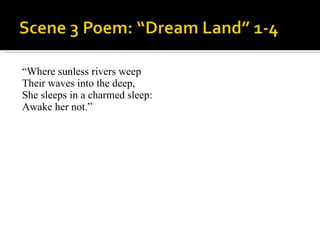
“ Where sunless rivers weep Their waves into the deep, She sleeps in a charmed sleep: Awake her not.”

Great expectations

  • 1.
    Scene 1: TextScene 1: Art Scene 1: Poem Scene 2: Text Scene 2: Art Scene 2: Poem Scene 3: Text Scene 3: Art Scene 3: Poem
  • 2.
    “‘ You youngdog,’ said the man (Magwitch), licking hislips, ‘what fat cheeks you ha’ got.’ I believe they were fat, though I was at the time undersized, for my years, and not strong. ‘ Darn me if I couldn’t eat ‘em,’ said the man, with a threatening shake of his head, ‘and if I han’t half a mind to’t!’ I earnestly expressed my hope that he wouldn’t, and held tighter to the tombstone on which he had put me; partly to keep myself upon it; partly to keep myself from crying. ‘ Now lookee here!’ said the man. ‘Where’s your mother?’ ‘ There, sir!’ I said. He started, made a short run, and stopped and looked over his shoulder. ‘ There, sir!’ I timidly explained. ‘Also Georgiana. That’s my mother.’ ‘ Oh!’ said he, coming back. ‘And is that your father along your mother’” (Dickens, 3)?
  • 3.
  • 4.
    “ I leantupon the coppice gate When Frost was spectre-grey, And Winter’s dregs made desolate The weakening eye of day.”
  • 5.
    “ It wasnot the first few moments that I saw all these, though I saw more of them in the first moments than might be supposed. But, I saw that everything within my view which ought to be white, had been white long ago, and had lost its lustre, and was faded and yellow. I saw that the bride within the bridal dress had withered like the dress, and like the flowers, and had no brightness but the brightness of her sunken eyes. I saw that the dress had been put upon the rounded figure of a young woman, and that the figure upon which it now hung loose and shrunk to skin and bone. Once, I had been taken to see some ghastly waxwork at the fair, representing I know what impossible personage lying in state. Once, I had been taken to one of our old marsh churches to see a skeleton in the ashes of a rich dress that had been dug out of a vault under the church pavement. Now, waxwork and skeleton seemed to have dark eyes that moved and looked at me. I should have cried out, if I could ” (Dickens, 59).
  • 6.
  • 7.
    “ Dead love,by treason slain, lies stark, White as dead stark-stricken dove: None that pass him pause to mark Dead Love.”
  • 8.
    “‘ It’s notthat,” said he, ‘but she charged him, in the presence of her intended husband, with being disappointed in the hope of fawning upon her for his own advancement, and, if he were to go to her now, it would look true-even to him-and even to her. To return to the man and make an end of him. The marriage day was fixed, the wedding dresses were bought, the wedding tour was planned out, the wedding guests were invited. The day came, but not the bridegroom. He wrote a letter-” ‘ Which she received,’ I struck in, ‘when she was dressing for her marriage? At twenty minutes to nine’” (Dickens, 190)?
  • 9.
  • 10.
    “ Where sunlessrivers weep Their waves into the deep, She sleeps in a charmed sleep: Awake her not.”

Editor's Notes

  • #3 Here, Pip has just met Magwitch (who is starving, hence the cannibalistic threat) in the churchyard. When Magwitch asks where Pip’s parents are, he points him to two adjacent tombstones, where his mother and father lie. The scene itself is very grim and malicious, due to the fact that Pip is surrounded by buried corpses and is being given death threats by an escaped convict. This scene is of great significance because Magwitch will straighten out his life after this, and soon help Pip go to London to become a gentleman.
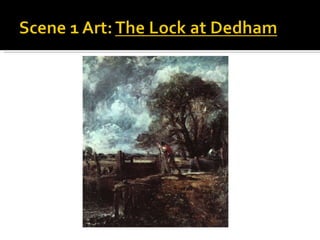
  • #4 This picture easily captures the setting in which this scene takes place. The use of both dark and earthy colors such as grey, brown, and dark green seem to have the grim essence that this scene possesses. While not a graveyard, the place is rather dark and dreary and the man in the center of the picture could be seen as Magwitch.
  • #5 This poem in particular contained several elements that are similar to this scene. Cold and dark words like “frost,” “spectre-grey,” “desolate,” and “weakening” all help paint the picture of a dark and cold place. The poem itself is, in this case, meant to refer to the churchyard setting in which the scene takes place.
  • #6 In this section of the scene, Pip first sees Miss Havisham, the old woman who cares for Estella, and lives locked up in her room. She stays in a wedding dress and keeps all of the clocks at twenty of nine in her room because she had been left at the alter of her wedding, alone, by her groom, causing her to go slightly insane. Pip, who had first met Estella earlier in the scene, he develops feelings for her, though she cares little about him.
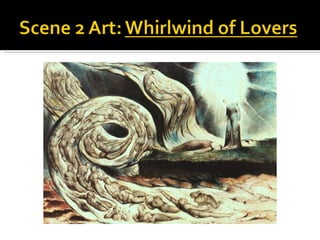
  • #7 This art depicts a scene of Dante’s Inferno , and this dark depiction of love is very fitting for this scene. Love is very present during this scene, but in a twisted way. After Pip meets Estella and Miss Havisham, he falls madly in love with Estella, who shows no love for him and constantly insults him. As for Miss Havisham, she has been so tormented by a past lover that she has become a hermit, almost never leaving her room.
  • #8 The love present in this scene could very easily be described as “dead.” Pip is infatuated by Estella, but she has no feelings for him whatsoever. Miss Havisham, at one time, had a love of her own but was left broken hearted, and now uses Estella to break the hearts of others for her amusement.
  • #9 Here, it is finally revealed to Pip as to why Miss Havisham is so insane. He now understands why she was locked in her room, why the clocks were all stuck at twenty of nine, and why she is so obsessed with breaking men’s hearts. It is because she was betrayed by her groom at her wedding (which you already know), and just used Miss Havisham to get her section of profits from the brewery she was left (which you did not already know).
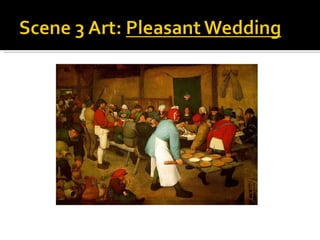
  • #10 Most of what caused Miss Havisham to go insane had occurred at her wedding, when she was stood up by her groom at the alter (at twenty of nine, might I add). While her wedding experience was far from pleasant, the scene of a wedding itself still accurately represents one of the most important moments in Miss Havisham’s life.
  • #11 In the beginning, Miss Havisham was spoiled and lived in world ignorant of many harsh truths. This lifestyle was similar to a nice dream, or a “charmed sleep.” The key factor that had “awoken her” from that sleep was when her wedding had been a disaster. Had this never happened, she would have been fine; but when it did, she declined into insanity.