UNIT II : DMA, Pointers and Functions,
Pointers and Structures
By
Mr.S.Selvaraj
Asst. Professor (SRG) / CSE
Kongu Engineering College
Perundurai, Erode, Tamilnadu, India
Thanks to and Resource from : Sumitabha Das, “Computer Fundamentals and C Programming”, 1st Edition, McGraw Hill, 2018.
20CST21 – Programming and Linear Data Structures
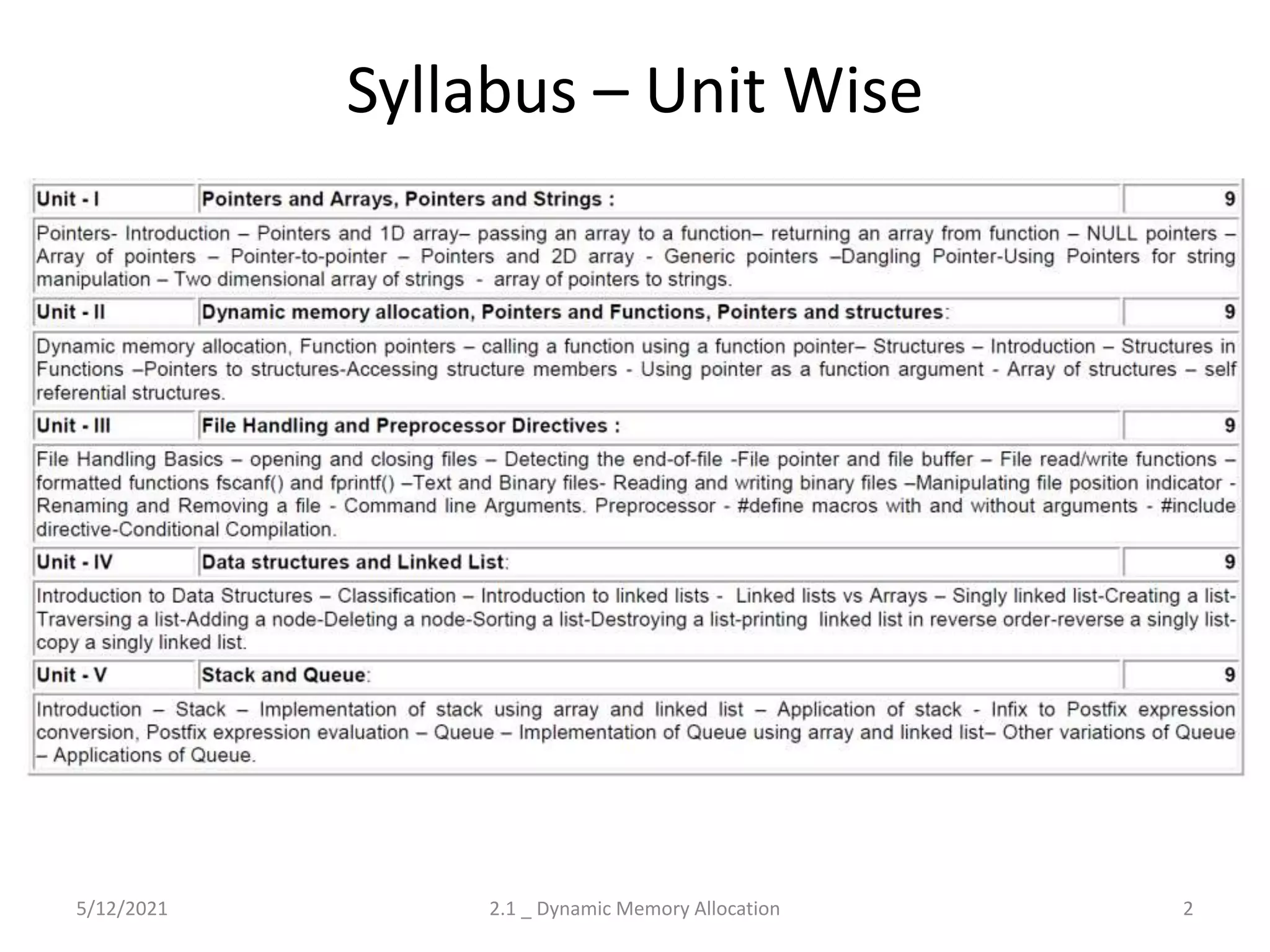
Syllabus – Unit Wise
5/12/2021 2.1 _ Dynamic Memory Allocation 2
List of Exercises
5/12/2021 2.1 _ Dynamic Memory Allocation 3
Text Book and Reference Book
5/12/2021 2.1 _ Dynamic Memory Allocation 4
Unit I : Contents
1. Dynamic Memory Allocation
2. Function pointers
3. Calling a function using a function pointer
4. Structures – Introduction
5. Structures in Functions
6. Pointers to structures
7. Accessing structure members
8. Using pointer as a function argument
9. Array of structures
10. Self referential structures.
5/12/2021 5
2.1 _ Dynamic Memory Allocation
Dynamic Memory Allocation
• While programming, if we know the amount
of memory required prior, then we can
allocate memory in advance during compile
time itself.
• For example, to store a name of any
employee whose name may go up to a
maximum of 50 characters, we can define it
using array as follows:
5/12/2021 2.1 _ Dynamic Memory Allocation 6
Dynamic Memory Allocation
• But there might be a situation when we have to
allocate memory based on the user requirement i.e.,
amount of memory needed may change over time.
• For example, Let us consider a situation where we have
no idea about the length of the text like detailed
description about a topic.
• Here we need to define a pointer to character without
defining how much memory is required and later,
based on the requirement, we can allocate memory
during execution time.
• The process of allocating memory during program
execution is called dynamic memory allocation.
5/12/2021 2.1 _ Dynamic Memory Allocation 7
Difference between static memory allocation
and dynamic memory allocation
5/12/2021 2.1 _ Dynamic Memory Allocation 8
Dynamic memory allocation functions
• The C language offers the following dynamic
memory allocation functions in stdlib.h
header file.
5/12/2021 2.1 _ Dynamic Memory Allocation 9
malloc() function
• “malloc” or “memory allocation”
• malloc () function is used to allocate space in memory
during the execution of the program.
• malloc() allocates memory block of given size (in
bytes) and returns a pointer to the beginning of the
block.
• It returns a pointer of type void which can be cast into
a pointer of any form.
• The malloc() function allocates single block of
requested memory.
• It does not initialize memory at execution time, so the
allocated memory is filled with some garbage value.
• It returns NULL if sufficient memory is not allocated.
5/12/2021 2.1 _ Dynamic Memory Allocation 10
malloc() function
• The syntax of malloc() function is given below:
5/12/2021 2.1 _ Dynamic Memory Allocation 11
malloc() function
5/12/2021 2.1 _ Dynamic Memory Allocation 12
Example –malloc()
5/12/2021 2.1 _ Dynamic Memory Allocation 13
• “calloc” or “contiguous allocation” method in C is used to
dynamically allocate the specified number of blocks of
memory of the specified type.
• It initializes each block with a default value ‘0’.
• Allocates the space for elements of an array.
• Initializes the elements to zero and returns a pointer to the
memory.
• Returns NULL if memory is not sufficient.
calloc()
• Syntax
ptr = (cast_type *) calloc (number,byte-size);
• Example
ptr = (int *) calloc(5, sizeof(int));
calloc()
calloc()
5/12/2021 2.1 _ Dynamic Memory Allocation 16
#include <stdio.h> #include <stdlib.h>
int main(){
int* ptr; int n, i;
n = 5;
ptr = (int*)calloc(n , sizeof(int));
if (ptr == NULL) {
printf("Memory not allocated.n");
exit(0);
}
else {
for (i = 0; i < n; ++i)
ptr[i] = i + 1;
printf("The elements of the array are: ");
for (i = 0; i < n; ++i)
printf("%d, ", ptr[i]);
}
return 0;}
Example - calloc()
• malloc() function allocates memory and
leaves the memory uninitialized
• calloc() function allocates memory and
initializes all bits to zero
malloc() vs calloc()
• “realloc” or “re-allocation” method in C is used to
dynamically change the memory allocation of a previously
allocated memory.
• In other words, if the memory previously allocated with the
help of malloc or calloc is insufficient, realloc can be used
to dynamically re-allocate memory.
• re-allocation of memory maintains the already present
value and new blocks will be initialized with default
garbage value.
realloc()
• Syntax
ptr=realloc(ptr, new-size)
• Example
int *ptr;
ptr = (int*)malloc(50 * sizeof(int));
ptr = (int *) realloc(ptr, 60*sizeof(int));
realloc()
realloc()
#include <stdio.h>
int main () {
char *ptr;
ptr = (char *) malloc(10);
strcpy(ptr, "Programming");
printf(" %s, Address = %un", ptr, ptr);
ptr = (char *) realloc(ptr, 20); //ptr is reallocated with new size
strcat(ptr, " In 'C'");
printf(" %s, Address = %un", ptr, ptr);
free(ptr);
return 0;
}
Example
• “free” method in C is used to dynamically de-
allocate the memory.
• Frees or empties the previously allocated memory
space.
• It helps to reduce wastage of memory by freeing it.
• Syntax
free(ptr);
free()
free()
5/12/2021 2.1 _ Dynamic Memory Allocation 24
#include <stdio.h> #include <stdlib.h>
int main(){
int* ptr; int n, i;
n = 5;
ptr = (int*)calloc(n , sizeof(int));
if (ptr == NULL) {
printf("Memory not allocated.n");
exit(0);
}
else {
for (i = 0; i < n; ++i)
ptr[i] = i + 1;
printf("The elements of the array are: ");
for (i = 0; i < n; ++i)
printf("%d, ", ptr[i]);
}
free(ptr);
return 0;}
Example - free()
Thank you
5/12/2021 2.1 _ Dynamic Memory Allocation 26
UNIT II : DMA, Pointers and Functions,
Pointers and Structures
By
Mr.S.Selvaraj
Asst. Professor (SRG) / CSE
Kongu Engineering College
Perundurai, Erode, Tamilnadu, India
Thanks to and Resource from : Sumitabha Das, “Computer Fundamentals and C Programming”, 1st Edition, McGraw Hill, 2018.
20CST21 – Programming and Linear Data Structures
Unit I : Contents
1. Dynamic Memory Allocation
2. Function pointers
3. Calling a function using a function pointer
4. Structures – Introduction
5. Structures in Functions
6. Pointers to structures
7. Accessing structure members
8. Using pointer as a function argument
9. Array of structures
10. Self referential structures.
5/12/2021 28
2.2 _ Function Pointer
Interesting facts about Function Pointers
• Unlike normal pointers, a function pointer points to code,
not data. Typically a function pointer stores the start of
executable code.
• Unlike normal pointers, we do not allocate de-allocate
memory using function pointers.
• A function’s name can also be used to get functions’
address.
• Like normal pointers, we can have an array of function
pointers.
• Function pointer can be used in place of switch case.
• Like normal data pointers, a function pointer can be passed
as an argument and can also be returned from a function.
5/12/2021 2.2 _ Function Pointer 29
Function Pointer
• Function pointer is a pointer variable that points to a function or
stores the address of a function.
• Generally in programming languages, the functions are called using
their name.
• Instead of calling a function using function name, function pointer
calls the function by passing the address of the function.
• Every function code along with its variables is stored in a memory.
Hence, every function has an address.
• Function pointer is also called as subroutine pointer or procedure
pointer.
• Like other pointer variables, function pointer variables can also be
declared, assigned values and used to access the function they
point to.
• The steps for invoking function pointers are
– Declaration of a function pointer
– Initializing a function pointer
– Calling a function using function pointer
5/12/2021 2.2 _ Function Pointer 30
Declaration of a function pointer
• Function pointer has to be declared like the prototype
of the function except that the name of the function
is enclosed between parenthesis () and an asterisk * is
inserted before the name.
• Rules for declaring function pointer is given as follows:
– Return type of the function must match with the datatype
of the function pointer variable.
– Function pointer variable name must be specified within
parenthesis () and it needs to be preceded by asterisk
symbol *.
– The number of arguments and datatype of the argument
in the function pointer variable declaration must be
exactly same as the number and datatype of the
argument in the function.
5/12/2021 2.2 _ Function Pointer 31
Declaration of a function pointer
• The syntax for declaring a function pointer can be
given as:
• Example:
• The above function pointer
– returns a float value and
– accepts two arguments one of integer and other of float
type.
5/12/2021 2.2 _ Function Pointer 32
Declaration of a function pointer
• Suppose, if the function pointer variable is not
declared within parenthesis, then because of
precedence, the declaration of function returns
pointer to a pointer variable.
• In the following declaration, test is not a function
pointer.
• test is a function which returns floating point
address.
5/12/2021 2.2 _ Function Pointer 33
int add(int,int);
Guess the Differences ???
int *add(int,int);
int (*add)(int,int);
5/12/2021 34
2.2 _ Function Pointer
Initializing a function pointer
• After declaration, the function pointer must be
initialized by assigning the address of a function which
has the same signature.
• The syntax for initializing a function pointer is
• Similar to an array, the function name holds the
starting address of the function.
• Hence, the address operator (&) in front of
function_name is optional.
• So the function pointer can also be initialized by
assigning function name without address operator.
5/12/2021 2.2 _ Function Pointer 35
Initializing a function pointer with NULL
• The function pointer can also be declared and
initialize to NULL as given below:
• Example :
5/12/2021 2.2 _ Function Pointer 36
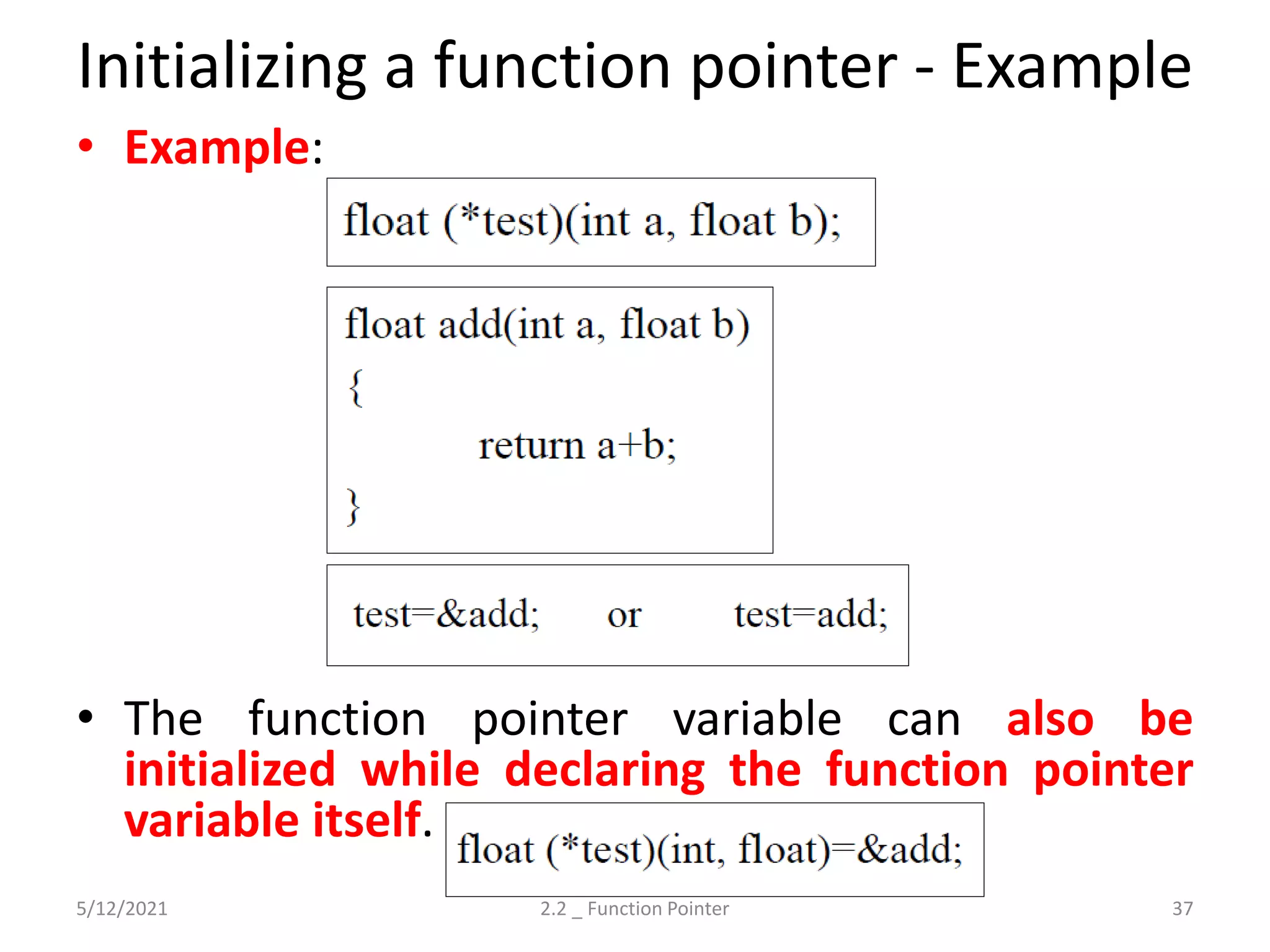
Initializing a function pointer - Example
• Example:
• The function pointer variable can also be
initialized while declaring the function pointer
variable itself.
5/12/2021 2.2 _ Function Pointer 37
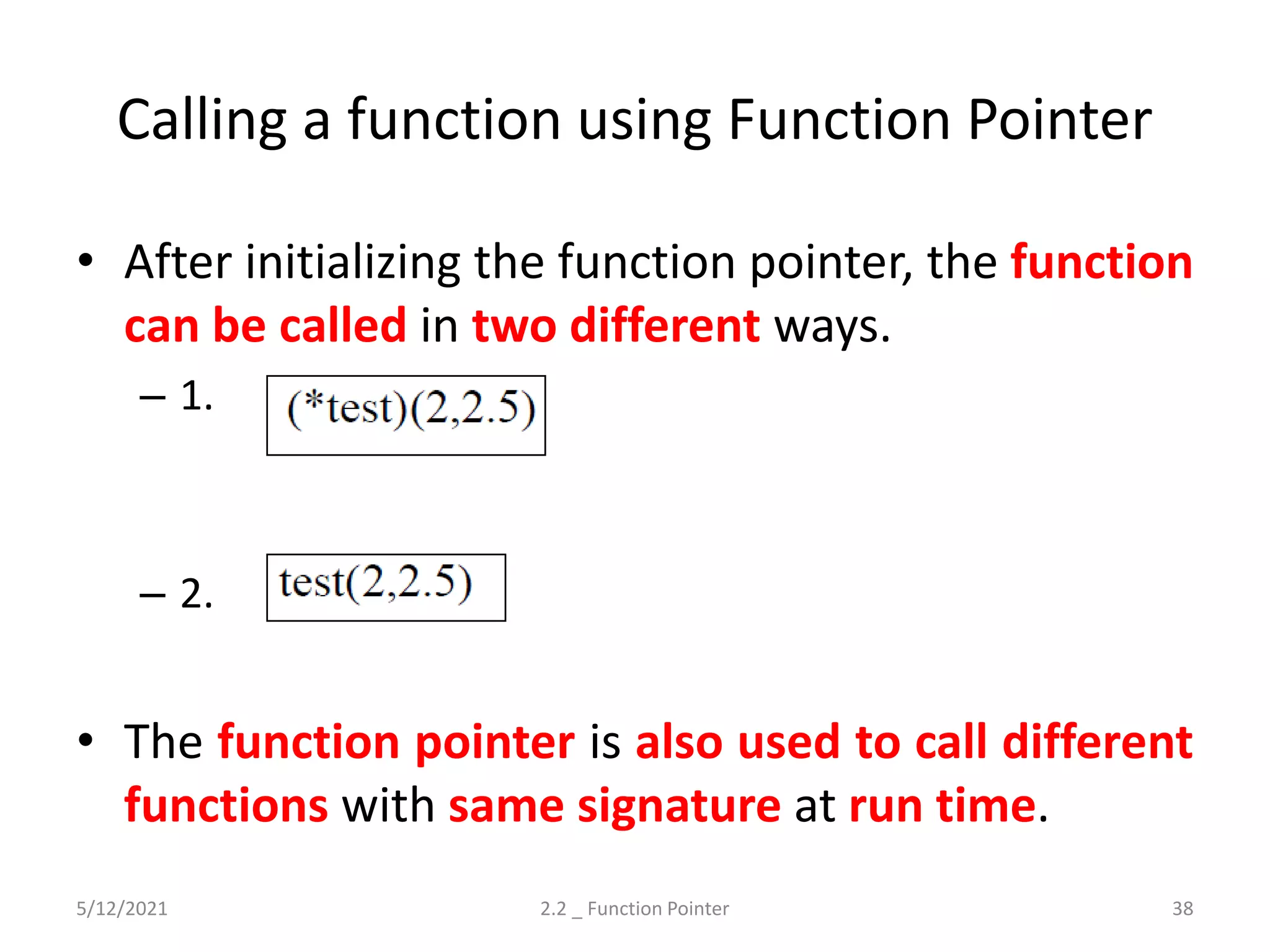
Calling a function using Function Pointer
• After initializing the function pointer, the function
can be called in two different ways.
– 1.
– 2.
• The function pointer is also used to call different
functions with same signature at run time.
5/12/2021 2.2 _ Function Pointer 38
Example 1 - Find the sum of two numbers
using function pointer
5/12/2021 2.2 _ Function Pointer 39
5/12/2021 2.2 _ Function Pointer 40
5/12/2021 2.2 _ Function Pointer 41
Example 2 - Perform arithmetic operation
using function pointer
5/12/2021 2.2 _ Function Pointer 42
5/12/2021 2.2 _ Function Pointer 43
5/12/2021 2.2 _ Function Pointer 44
Example 3 - Find the maximum of two numbers
using function pointer
5/12/2021 2.2 _ Function Pointer 45
5/12/2021 2.2 _ Function Pointer 46
Passing a Function
to
another Function
5/12/2021 47
2.2 _ Function Pointer
#include <stdio.h>
int add(int a, int b)
{
return a+b;
}
int sub(int a, int b)
{
return a-b;
}
int arith(int f(int,int))
{
int x=5, y=4,s;
s=(*f)(x,y);
return s;
}
int main()
{
printf("n Add: %d",arith(add));
printf("n Sub: %d",arith(sub));
return 0;
}
5/12/2021 48
2.2 _ Function Pointer
#include <stdio.h>
int even(int a)
{
if(a%2==0)
return a;
else
return 0;
}
int odd(int a)
{
if(a%2!=0)
return a;
else
return 0;
}
int sum(int f(int), int m, int n)
{
int s = 0;
for(int i=m; i<=n;++i)
s+=f(i); or s+=(*f)(i);
return s;
}
int main()
{
printf("n Sum of Even numbers: %d",sum(even,5,10));
printf("n Sum of Odd numbers: %d",sum(odd,5,10));
return 0;
}
5/12/2021 49
2.2 _ Function Pointer
Return a Function Pointer
5/12/2021 50
2.2 _ Function Pointer
#include <stdio.h>
int add(int x,int y)
{
return x + y;
}
int sub(int x,int y)
{
return x - y;
}
int (*getOperator(const char
oper))(int, int)
{
if(oper == '+') return &add;
if(oper == '-') return &sub;
}
int main()
{
int x = 20,y = 10,z = 0;
int (*func)(int, int);
func = getOperator('+');
z = func(x,y);
printf("Add : %dn",z);
func = getOperator('-');
z = func(x,y);
printf("Sub : %dn",z);
return 0;
}
5/12/2021 51
2.2 _ Function Pointer
#include <stdio.h>
#include <stdlib.h>
typedef int(*pfOperator)(int, int);
int add(int x,int y)
{
return x + y;
}
int sub(int x,int y)
{
return x - y;
}
pfOperator getOperator(const
char oper)
{
if(oper == '+') return &add;
if(oper == '-') return &sub;
}
int main()
{
int x = 20,y = 10,z = 0;
pfOperator func = NULL;
func = getOperator('+');
z = func(x,y);
printf("Add : %dn",z);
func = getOperator('-');
z = func(x,y);
printf("Sub : %dn",z);
return 0;
}
5/12/2021 52
2.2 _ Function Pointer
Arrays of Function Pointers
5/12/2021 53
2.2 _ Function Pointer
Arrays of Function Pointer
• Generally, array is a collection of similar data items
that can be stored under a common name.
• Similarly, an array of function pointers is a collection
of function pointers.
• In array of function pointer, addresses of different
functions with same signature are stored under a
single name.
• A function pointer chooses the appropriate function at
runtime which are called using their index value.
• In general, arrays of function pointers are useful where
there is the potential for a range of inputs to a
program, that subsequently alters program flow.
• There are ways of how to define and use an array of
function pointers in C.
5/12/2021 2.2 _ Function Pointer 54
Arrays of Function Pointer - Declaration
• Array of function pointer can be declared in
the following two ways:
5/12/2021 2.2 _ Function Pointer 55
Arrays of Function Pointer - Initialization
• After declaration, the array of function pointer
can be assigned/initialized with function
address using one of two forms.
5/12/2021 2.2 _ Function Pointer 56
Arrays of Function Pointer – Initialization NULL
• During the declaration of array of function
pointer, each element in the array of function
pointer can be initialized as NULL by the
following statements:
5/12/2021 2.2 _ Function Pointer 57
Arrays of Function Pointer – Calling a function
• After assigning the address of a function to an
array of function pointer, the function can be
called as
5/12/2021 2.2 _ Function Pointer 58
#include <stdio.h>
int(*fpointer[2])(int, int);
int add(int a, int b){return(a + b);}
int sub(int a, int b) {return(a - b);}
int main(){
fpointer[0] = &add;
printf("%d n", (*fpointer[0])(4, 5));
fpointer[1] = sub;
printf(“%d n”, fpointer[1](6, 2));
return 0;}
5/12/2021 59
2.2 _ Function Pointer
Thank you
5/12/2021 2.2 _ Function Pointer 60
UNIT II : DMA, Pointers and Functions,
Pointers and Structures
By
Mr.S.Selvaraj
Asst. Professor (SRG) / CSE
Kongu Engineering College
Perundurai, Erode, Tamilnadu, India
Thanks to and Resource from : Sumitabha Das, “Computer Fundamentals and C Programming”, 1st Edition, McGraw Hill, 2018.
20CST21 – Programming and Linear Data Structures
Unit I : Contents
1. Dynamic Memory Allocation
2. Function pointers
3. Calling a function using a function pointer
4. Structures – Introduction
5. Structures in Functions
6. Pointers to structures
7. Accessing structure members
8. Using pointer as a function argument
9. Array of structures
10. Self referential structures.
5/12/2021 62
2.3 _ Pointers and Structures
Structure Introduction
• An array is a collection of similar or
homogeneous data types which could be
stored under a single name.
• But, structure is defined as a collection of
dissimilar or heterogeneous data types that
can be stored under a common name.
• A structure is a user defined data type.
(Others are like Union, Typedef, Enum)
5/12/2021 2.3 _ Pointers and Structures 63
Definition of a structure
• The rules for defining a structure are given below:
– Structure is defined with a struct keyword.
– Each member of the structure definition is similar to a
normal variable definition such as
• int i, float f or any other valid variable definition.
– At the end of the structure definition, the final
semicolon must be placed.
– One or more structural variable can be created but it’s
optional.
– The structure is defined either outside the main
function or inside the main function. Mostly, the
structure is defined outside the main function.
5/12/2021 2.3 _ Pointers and Structures 64
Definition of a structure
5/12/2021 2.3 _ Pointers and Structures 65
Declaration of structure variable
• Memory is allocated only when structure variable is
declared and not during the definition.
• The structure variable can be created using the following
syntax
• The structure variable can also be declared while defining
the structure as given below.
5/12/2021 2.3 _ Pointers and Structures 66
Declaration of structure variable - Example
5/12/2021 2.3 _ Pointers and Structures 67
Initialization of structure variable
• A structure variable can be initialized during
its declaration as follows:
5/12/2021 2.3 _ Pointers and Structures 68
Accessing of structure member
• There are two ways for accessing the
members of a structure. They are,
– Dot operator(.)
– Structure pointer(->)
5/12/2021 2.3 _ Pointers and Structures 69
Dot operator (.)
• The dot operator (.) is used to access the
members of a structure and the syntax is
given below:
• For example, to access the rollno of variable
s1 of student structure, we can use s1.rollno
5/12/2021 2.3 _ Pointers and Structures 70
Example 1
5/12/2021 2.3 _ Pointers and Structures 71
5/12/2021 2.3 _ Pointers and Structures 72
5/12/2021 2.3 _ Pointers and Structures 73
Structure Pointer (->)
• Structure pointer is another method for
accessing the structure member.
• The arrow operator -> is used to access the
member of the structure variable through
pointers.
5/12/2021 2.3 _ Pointers and Structures 74
Example 2
5/12/2021 2.3 _ Pointers and Structures 75
5/12/2021 2.3 _ Pointers and Structures 76
Typedef and its use in structure
declaration
• Typedef is a keyword that is used to give a
new symbolic name (alias or alternate name)
for the existing datatype.
• It is often used to simplify the syntax for
declaring complex data types.
• We can either use existing data type or
new_name for creating variables .
5/12/2021 2.3 _ Pointers and Structures 77
5/12/2021 2.3 _ Pointers and Structures 78
• Structure variable of type student can be created using the newly assigned name temp as
structure name as alias name
• We can also use structure name as alias name
such as,
• Here, we can use the name student for creating
structure variable without using the keyword
struct such as,
5/12/2021 2.3 _ Pointers and Structures 79
Example 3
5/12/2021 2.3 _ Pointers and Structures 80
5/12/2021 2.3 _ Pointers and Structures 81
Example 4 - The another way of defining the structure variable
5/12/2021 2.3 _ Pointers and Structures 82
5/12/2021 2.3 _ Pointers and Structures 83
Nesting of Structure
• Nesting of structure means that defining a
structure as one of the member of another
structure.
• The use of such nested structures facilitates
representation and processing of complex
data.
5/12/2021 2.3 _ Pointers and Structures 84
Nested Structure - Syntax
5/12/2021 2.3 _ Pointers and Structures 85
• First member (in_member1) of the inner structure can be accessed as
Example 5
5/12/2021 2.3 _ Pointers and Structures 86
5/12/2021 2.3 _ Pointers and Structures 87
What is the size of this structure?
5/12/2021 2.3 _ Pointers and Structures 88
Memory Layout of Members of music_cd
• Note that sizeof computes the total memory
occupied by a structure.
• This is not necessarily the sum of the sizes of the
members.
• Thus, on this machine having a 4-byte word.
– title occupies 28 bytes (7 words) even though it uses
27 of them.
– qty and price individually occupy an entire word (4
bytes each), but qty uses two of these bytes.
– disk1 thus needs 33 bytes (27 + 2 + 4) but it actually
occupies 36 bytes.
5/12/2021 2.3 _ Pointers and Structures 89
Memory Layout of Members of music_cd
• Alignment issues related to structures lead to
the creation of slack bytes or holes in the
allocated memory segment.
5/12/2021 2.3 _ Pointers and Structures 90
Size ???
5/12/2021 2.3 _ Pointers and Structures 91
Thank you
5/12/2021 2.3 _ Pointers and Structures 92
UNIT II : DMA, Pointers and Functions,
Pointers and Structures
By
Mr.S.Selvaraj
Asst. Professor (SRG) / CSE
Kongu Engineering College
Perundurai, Erode, Tamilnadu, India
Thanks to and Resource from : Sumitabha Das, “Computer Fundamentals and C Programming”, 1st Edition, McGraw Hill, 2018.
20CST21 – Programming and Linear Data Structures
Unit I : Contents
1. Dynamic Memory Allocation
2. Function pointers
3. Calling a function using a function pointer
4. Structures – Introduction
5. Structures in Functions
6. Pointers to structures
7. Accessing structure members
8. Using pointer as a function argument
9. Array of structures
10. Self referential structures.
5/12/2021 94
2.4 _ Structure in Functions
Structures in Functions - Contents
1. Passing structure variables as arguments to a
function.
1. We can pass individual members of a structure or
2. we can pass entire structure as a whole to a function.
3. Also more than one structure variable can be passes to
a function.
2. Return structure from a function
3. Declaration of Structure Variable as Global Variable
4. Passing array of structures to function
1. Formal Parameter as an array
2. Formal Parameter as a pointer
5/12/2021 2.4 _ Structure in Functions 95
1. Passing structure variables as arguments
• Like a normal variable, the structure variable
may be passed using
– pass-by-value or
– pass-by-address
5/12/2021 2.4 _ Structure in Functions 96
Using pass-by-value
• The structure can be passed to function as an
argument.
• Here, the entire structure with all its members are
passed as an argument to the function.
• It is passed to a function by pass-by-value method.
• Any changes made to the structure variable within
the function will not be reflected in the calling
function.
• If the changes need to be reflected, the updated
structure has to be returned to the calling function.
5/12/2021 2.4 _ Structure in Functions 97
Example – Pass-by-value
5/12/2021 2.4 _ Structure in Functions 98
5/12/2021 2.4 _ Structure in Functions 99
Using Pass-by-address
• We can also use pass-by-address method for
passing the structure to function.
• Here, address of structure is passed to function.
• In this case, whatever the changes made in
formal argument in called function is reflected in
actual argument in calling function.
• In the function, structure should be received by
structure pointer.
• During pass by reference, the memory addresses
of structure variables are passed to the function.
5/12/2021 2.4 _ Structure in Functions 100
Example – Pass-by-address
5/12/2021 2.4 _ Structure in Functions 101
5/12/2021 2.4 _ Structure in Functions 102
5/12/2021 2.4 _ Structure in Functions 103
2. Return structure from a function
• Declare a function with data type as
– struct <structure name> <function name()>;
• To return a structure from a function use the
return keyword as
– return <structure_variable_name>;
5/12/2021 2.4 _ Structure in Functions 104
Example – Return structure from function
5/12/2021 2.4 _ Structure in Functions 105
5/12/2021 2.4 _ Structure in Functions 106
5/12/2021 2.4 _ Structure in Functions 107
3. Declaration of Structure Variable as Global Variable
• Structure variables also can be declared as
global variables which is similar to declaring
other variables.
• If the variable is declared as global, it can be
accessed by all the functions in the program
without passing it as an argument to
function.
5/12/2021 2.4 _ Structure in Functions 108
Example
5/12/2021 2.4 _ Structure in Functions 109
5/12/2021 2.4 _ Structure in Functions 110
4. Passing array of structures to function
• We can also pass entire array of structures to a
function as an argument.
• To pass an entire array to a function, only the
name of the array is passed as an argument.
• When address is passed as an argument, the
function definition should have an array or a
pointer as a parameter to receive the passed
address.
• When an array is passed to a function, the
changes made by the function affect the original
array.
5/12/2021 2.4 _ Structure in Functions 111
Passing array of structures to function
• We can receive an array of structure in a
function using one of the following two
methods :
5/12/2021 2.4 _ Structure in Functions 112
Example – formal parameter as an array
5/12/2021 2.4 _ Structure in Functions 113
5/12/2021 2.4 _ Structure in Functions 114
5/12/2021 2.4 _ Structure in Functions 115
5/12/2021 2.4 _ Structure in Functions 116
Example – formal parameter as a pointer
5/12/2021 2.4 _ Structure in Functions 117
5/12/2021 2.4 _ Structure in Functions 118
5/12/2021 2.4 _ Structure in Functions 119
5/12/2021 2.4 _ Structure in Functions 120
Thank you
5/12/2021 2.4 _ Structure in Functions 121
UNIT II : DMA, Pointers and Functions,
Pointers and Structures
By
Mr.S.Selvaraj
Asst. Professor (SRG) / CSE
Kongu Engineering College
Perundurai, Erode, Tamilnadu, India
Thanks to and Resource from : Sumitabha Das, “Computer Fundamentals and C Programming”, 1st Edition, McGraw Hill, 2018.
20CST21 – Programming and Linear Data Structures
Unit I : Contents
1. Dynamic Memory Allocation
2. Function pointers
3. Calling a function using a function pointer
4. Structures – Introduction
5. Structures in Functions
6. Pointers to structures
7. Accessing structure members
8. Using pointer as a function argument
9. Array of structures
10. Self referential structures.
5/12/2021 123
2.6 _ Pointers to Structures
Pointers to structures
• A pointer to a structure must be defined
before it is pointed to a structure variable.
struct rectangle
{
short length;
short width;
} rect1 = {10, 20};
struct rectangle *p; //Creates pointer p
p = &rect1; //p points to rect1
5/12/2021 2.6 _ Pointers to Structures 124
Accessing structure members
• The structure members can be accessed in three ways.
• Two of them use a pointer with standard and special
notation.
– rect1.length //The standard access mechanism that doesn’t use a
pointer.
– p->length //Uses a special operator, ->, that works only with
structures. It uses a pointer.
– (*p).length //Pointer dereferenced with * and then connected to the
member. It uses a pointer.
• Example:
5/12/2021 2.6 _ Pointers to Structures 125
Example Program
#include <stdio.h>
#include <string.h>
int main(void)
{
struct employee
{
short id;
char name[30];
int pay;
} emp = {1024, “Steve Wozniak”, 10000}, *p;
p = &emp;
printf(“Emp-id: %hd, Name: %s, Pay: %dn”, emp.id, (*p).name, p->pay);
(*p).id = 4201; /* Updates id */
strcpy(p->name, “Steve Jobs”); /* Updates name */
p->pay = 20000; /* Updates pay */
printf(“Emp-id: %hd, Name: %s, Pay: %dn”, p->id, p->name, p->pay);
return 0;
}
5/12/2021 2.6 _ Pointers to Structures 126
Using a Pointer as a Function Argument
• A structure variable can be passed as function arguments.
• This will behave as pass-by-value.
• This mechanism is safe and it protects the original structure
from modification by the function.
• However, large structures can consume a lot of memory, so we
may need to pass a pointer to a structure instead of the entire
structure.
• Updating a member’s value using a pointer represents a
memory-efficient technique because the function copies not
the structure (36 bytes) but its pointer (4 bytes).
5/12/2021 2.6 _ Pointers to Structures 127
Example Program
/* update_pay.c: Uses a pointer to a structure as a function argument to update the
structure. */
#include <stdio.h>
struct employee
{
short id;
char name[30];
int pay;
} emp = {1024, “Steve Wozniak”, 10000};
void update_pay(struct employee *f_emp, int f_pay);
int main(void)
{
printf(“Old pay = %dn”, emp.pay);
update_pay(&emp, 20000);
printf(“New pay = %dn”, emp.pay);
return 0;
}
5/12/2021 2.6 _ Pointers to Structures 128
Example Program
void update_pay(struct employee *f_emp, int f_pay)
{
f_emp->pay = f_pay; /* Updates member pay of emp */
}
OUTPUT:
Old pay = 10000
New pay = 20000
5/12/2021 2.6 _ Pointers to Structures 129
Thank you
5/12/2021 2.6 _ Pointers to Structures 130
UNIT II : DMA, Pointers and Functions,
Pointers and Structures
By
Mr.S.Selvaraj
Asst. Professor (SRG) / CSE
Kongu Engineering College
Perundurai, Erode, Tamilnadu, India
Thanks to and Resource from : Sumitabha Das, “Computer Fundamentals and C Programming”, 1st Edition, McGraw Hill, 2018.
20CST21 – Programming and Linear Data Structures
Unit I : Contents
1. Dynamic Memory Allocation
2. Function pointers
3. Calling a function using a function pointer
4. Structures – Introduction
5. Structures in Functions
6. Pointers to structures
7. Accessing structure members
8. Using pointer as a function argument
9. Array of structures
10. Self referential structures
5/12/2021 132
2.6 _ Array of Structure and Self Referential
Structures
Arrays Of Structures
• An array of structures is a collection of
structures and therefore, each element of an
array is of same structure type.
• If the user needs to store more than one
record of same structure type, we have to
create an array of structure.
5/12/2021
2.6 _ Array of Structure and Self Referential
Structures
133
Arrays Of Structures
• Suppose, to handle two students data we can use the
two structure variables, stud1 and stud2.
• This technique won’t work with 500 students.
• C supports an array of structures, whose definition
may or may not be combined with the declaration of
the structure.
• The following statement defines an array of type struct
student that can hold 50 sets (or records) of student
data.
5/12/2021
2.6 _ Array of Structure and Self Referential
Structures
134
Syntax for declaring structure array and
accessing member
5/12/2021
2.6 _ Array of Structure and Self Referential
Structures
135
Arrays Of Structures
• Alternatively, you can separate the declaration and
definition.
• You can also use typedef to replace struct student with
STUDENT.
5/12/2021
2.6 _ Array of Structure and Self Referential
Structures
136
Array of Structures
• This array can be partially or fully initialized by
enclosing the initializers for each array element in a set
of curly braces.
• Each set is separated from its adjacent one by a
comma, while the entire set of initializers are enclosed
by outermost braces:
5/12/2021
2.6 _ Array of Structure and Self Referential
Structures
137
Array of Structures
• Each member of each element of this array is accessed
by using a dot to connect the member to its array
element.
• You can use scanf to input values to each member
using pointers to these variables (like &stud[i].marks).
• A simple for loop using the array index as the key
variable prints the entire list.
5/12/2021
2.6 _ Array of Structure and Self Referential
Structures
138
Example
5/12/2021
2.6 _ Array of Structure and Self Referential
Structures
139
5/12/2021
2.6 _ Array of Structure and Self Referential
Structures
140
Self Referential Structures
• Self Referential structures are structures that
have one or more pointers which point to the
same type of structure, as their member.
• In other words, structures pointing to the
same type of structures are self-referential in
nature.
5/12/2021
2.6 _ Array of Structure and Self Referential
Structures
141
Self Referential Structures
5/12/2021
2.6 _ Array of Structure and Self Referential
Structures
142
Example
• In the above example ‘link’ is a pointer to a structure of
type ‘node’.
• Hence, the structure ‘node’ is a self-referential structure
with ‘link’ as the referencing pointer.
• An important point to consider is that the pointer should
be initialized properly before accessing, as by default it
contains garbage value.
5/12/2021
2.6 _ Array of Structure and Self Referential
Structures
143
Types of Self Referential Structures
• Self Referential Structure with Single Link
• Self Referential Structure with Multiple Links
5/12/2021
2.6 _ Array of Structure and Self Referential
Structures
144
Self Referential Structure with Single Link
• These structures can have only one self-
pointer as their member.
• The following example will show us how to
connect the objects of a self-referential
structure with the single link and access the
corresponding data members.
• The connection formed is shown in the
following figure.
5/12/2021
2.6 _ Array of Structure and Self Referential
Structures
145
Example
5/12/2021
2.6 _ Array of Structure and Self Referential
Structures
146
5/12/2021
2.6 _ Array of Structure and Self Referential
Structures
147
10 20 X
30 40 X
Self Referential Structure with Multiple Link
• Self referential structures with multiple links can
have more than one self-pointers.
• Many complicated data structures can be easily
constructed using these structures.
• Such structures can easily connect to more than
one nodes at a time.
• The following example shows one such structure
with more than one links.
• The connections made in the above example can
be understood using the following figure.
5/12/2021
2.6 _ Array of Structure and Self Referential
Structures
148
Example
5/12/2021
2.6 _ Array of Structure and Self Referential
Structures
149
X 10 X
X 20 X
X 30 X
5/12/2021
2.6 _ Array of Structure and Self Referential
Structures
150
Applications of Self Referential Structures
• Self referential structures are very useful in
creation of other complex data structures like:
– Linked Lists
– Stacks
– Queues
– Trees
– Graphs etc
5/12/2021
2.6 _ Array of Structure and Self Referential
Structures
151
Thank you
5/12/2021
2.6 _ Array of Structure and Self Referential
Structures
152

Dynamic Memory Allocation, Pointers and Functions, Pointers and Structures

  • 1.
    UNIT II :DMA, Pointers and Functions, Pointers and Structures By Mr.S.Selvaraj Asst. Professor (SRG) / CSE Kongu Engineering College Perundurai, Erode, Tamilnadu, India Thanks to and Resource from : Sumitabha Das, “Computer Fundamentals and C Programming”, 1st Edition, McGraw Hill, 2018. 20CST21 – Programming and Linear Data Structures
  • 2.
    Syllabus – UnitWise 5/12/2021 2.1 _ Dynamic Memory Allocation 2
  • 3.
    List of Exercises 5/12/20212.1 _ Dynamic Memory Allocation 3
  • 4.
    Text Book andReference Book 5/12/2021 2.1 _ Dynamic Memory Allocation 4
  • 5.
    Unit I :Contents 1. Dynamic Memory Allocation 2. Function pointers 3. Calling a function using a function pointer 4. Structures – Introduction 5. Structures in Functions 6. Pointers to structures 7. Accessing structure members 8. Using pointer as a function argument 9. Array of structures 10. Self referential structures. 5/12/2021 5 2.1 _ Dynamic Memory Allocation
  • 6.
    Dynamic Memory Allocation •While programming, if we know the amount of memory required prior, then we can allocate memory in advance during compile time itself. • For example, to store a name of any employee whose name may go up to a maximum of 50 characters, we can define it using array as follows: 5/12/2021 2.1 _ Dynamic Memory Allocation 6
  • 7.
    Dynamic Memory Allocation •But there might be a situation when we have to allocate memory based on the user requirement i.e., amount of memory needed may change over time. • For example, Let us consider a situation where we have no idea about the length of the text like detailed description about a topic. • Here we need to define a pointer to character without defining how much memory is required and later, based on the requirement, we can allocate memory during execution time. • The process of allocating memory during program execution is called dynamic memory allocation. 5/12/2021 2.1 _ Dynamic Memory Allocation 7
  • 8.
    Difference between staticmemory allocation and dynamic memory allocation 5/12/2021 2.1 _ Dynamic Memory Allocation 8
  • 9.
    Dynamic memory allocationfunctions • The C language offers the following dynamic memory allocation functions in stdlib.h header file. 5/12/2021 2.1 _ Dynamic Memory Allocation 9
  • 10.
    malloc() function • “malloc”or “memory allocation” • malloc () function is used to allocate space in memory during the execution of the program. • malloc() allocates memory block of given size (in bytes) and returns a pointer to the beginning of the block. • It returns a pointer of type void which can be cast into a pointer of any form. • The malloc() function allocates single block of requested memory. • It does not initialize memory at execution time, so the allocated memory is filled with some garbage value. • It returns NULL if sufficient memory is not allocated. 5/12/2021 2.1 _ Dynamic Memory Allocation 10
  • 11.
    malloc() function • Thesyntax of malloc() function is given below: 5/12/2021 2.1 _ Dynamic Memory Allocation 11
  • 12.
    malloc() function 5/12/2021 2.1_ Dynamic Memory Allocation 12
  • 13.
    Example –malloc() 5/12/2021 2.1_ Dynamic Memory Allocation 13
  • 14.
    • “calloc” or“contiguous allocation” method in C is used to dynamically allocate the specified number of blocks of memory of the specified type. • It initializes each block with a default value ‘0’. • Allocates the space for elements of an array. • Initializes the elements to zero and returns a pointer to the memory. • Returns NULL if memory is not sufficient. calloc()
  • 15.
    • Syntax ptr =(cast_type *) calloc (number,byte-size); • Example ptr = (int *) calloc(5, sizeof(int)); calloc()
  • 16.
    calloc() 5/12/2021 2.1 _Dynamic Memory Allocation 16
  • 17.
    #include <stdio.h> #include<stdlib.h> int main(){ int* ptr; int n, i; n = 5; ptr = (int*)calloc(n , sizeof(int)); if (ptr == NULL) { printf("Memory not allocated.n"); exit(0); } else { for (i = 0; i < n; ++i) ptr[i] = i + 1; printf("The elements of the array are: "); for (i = 0; i < n; ++i) printf("%d, ", ptr[i]); } return 0;} Example - calloc()
  • 18.
    • malloc() functionallocates memory and leaves the memory uninitialized • calloc() function allocates memory and initializes all bits to zero malloc() vs calloc()
  • 19.
    • “realloc” or“re-allocation” method in C is used to dynamically change the memory allocation of a previously allocated memory. • In other words, if the memory previously allocated with the help of malloc or calloc is insufficient, realloc can be used to dynamically re-allocate memory. • re-allocation of memory maintains the already present value and new blocks will be initialized with default garbage value. realloc()
  • 20.
    • Syntax ptr=realloc(ptr, new-size) •Example int *ptr; ptr = (int*)malloc(50 * sizeof(int)); ptr = (int *) realloc(ptr, 60*sizeof(int)); realloc()
  • 21.
  • 22.
    #include <stdio.h> int main() { char *ptr; ptr = (char *) malloc(10); strcpy(ptr, "Programming"); printf(" %s, Address = %un", ptr, ptr); ptr = (char *) realloc(ptr, 20); //ptr is reallocated with new size strcat(ptr, " In 'C'"); printf(" %s, Address = %un", ptr, ptr); free(ptr); return 0; } Example
  • 23.
    • “free” methodin C is used to dynamically de- allocate the memory. • Frees or empties the previously allocated memory space. • It helps to reduce wastage of memory by freeing it. • Syntax free(ptr); free()
  • 24.
    free() 5/12/2021 2.1 _Dynamic Memory Allocation 24
  • 25.
    #include <stdio.h> #include<stdlib.h> int main(){ int* ptr; int n, i; n = 5; ptr = (int*)calloc(n , sizeof(int)); if (ptr == NULL) { printf("Memory not allocated.n"); exit(0); } else { for (i = 0; i < n; ++i) ptr[i] = i + 1; printf("The elements of the array are: "); for (i = 0; i < n; ++i) printf("%d, ", ptr[i]); } free(ptr); return 0;} Example - free()
  • 26.
    Thank you 5/12/2021 2.1_ Dynamic Memory Allocation 26
  • 27.
    UNIT II :DMA, Pointers and Functions, Pointers and Structures By Mr.S.Selvaraj Asst. Professor (SRG) / CSE Kongu Engineering College Perundurai, Erode, Tamilnadu, India Thanks to and Resource from : Sumitabha Das, “Computer Fundamentals and C Programming”, 1st Edition, McGraw Hill, 2018. 20CST21 – Programming and Linear Data Structures
  • 28.
    Unit I :Contents 1. Dynamic Memory Allocation 2. Function pointers 3. Calling a function using a function pointer 4. Structures – Introduction 5. Structures in Functions 6. Pointers to structures 7. Accessing structure members 8. Using pointer as a function argument 9. Array of structures 10. Self referential structures. 5/12/2021 28 2.2 _ Function Pointer
  • 29.
    Interesting facts aboutFunction Pointers • Unlike normal pointers, a function pointer points to code, not data. Typically a function pointer stores the start of executable code. • Unlike normal pointers, we do not allocate de-allocate memory using function pointers. • A function’s name can also be used to get functions’ address. • Like normal pointers, we can have an array of function pointers. • Function pointer can be used in place of switch case. • Like normal data pointers, a function pointer can be passed as an argument and can also be returned from a function. 5/12/2021 2.2 _ Function Pointer 29
  • 30.
    Function Pointer • Functionpointer is a pointer variable that points to a function or stores the address of a function. • Generally in programming languages, the functions are called using their name. • Instead of calling a function using function name, function pointer calls the function by passing the address of the function. • Every function code along with its variables is stored in a memory. Hence, every function has an address. • Function pointer is also called as subroutine pointer or procedure pointer. • Like other pointer variables, function pointer variables can also be declared, assigned values and used to access the function they point to. • The steps for invoking function pointers are – Declaration of a function pointer – Initializing a function pointer – Calling a function using function pointer 5/12/2021 2.2 _ Function Pointer 30
  • 31.
    Declaration of afunction pointer • Function pointer has to be declared like the prototype of the function except that the name of the function is enclosed between parenthesis () and an asterisk * is inserted before the name. • Rules for declaring function pointer is given as follows: – Return type of the function must match with the datatype of the function pointer variable. – Function pointer variable name must be specified within parenthesis () and it needs to be preceded by asterisk symbol *. – The number of arguments and datatype of the argument in the function pointer variable declaration must be exactly same as the number and datatype of the argument in the function. 5/12/2021 2.2 _ Function Pointer 31
  • 32.
    Declaration of afunction pointer • The syntax for declaring a function pointer can be given as: • Example: • The above function pointer – returns a float value and – accepts two arguments one of integer and other of float type. 5/12/2021 2.2 _ Function Pointer 32
  • 33.
    Declaration of afunction pointer • Suppose, if the function pointer variable is not declared within parenthesis, then because of precedence, the declaration of function returns pointer to a pointer variable. • In the following declaration, test is not a function pointer. • test is a function which returns floating point address. 5/12/2021 2.2 _ Function Pointer 33
  • 34.
    int add(int,int); Guess theDifferences ??? int *add(int,int); int (*add)(int,int); 5/12/2021 34 2.2 _ Function Pointer
  • 35.
    Initializing a functionpointer • After declaration, the function pointer must be initialized by assigning the address of a function which has the same signature. • The syntax for initializing a function pointer is • Similar to an array, the function name holds the starting address of the function. • Hence, the address operator (&) in front of function_name is optional. • So the function pointer can also be initialized by assigning function name without address operator. 5/12/2021 2.2 _ Function Pointer 35
  • 36.
    Initializing a functionpointer with NULL • The function pointer can also be declared and initialize to NULL as given below: • Example : 5/12/2021 2.2 _ Function Pointer 36
  • 37.
    Initializing a functionpointer - Example • Example: • The function pointer variable can also be initialized while declaring the function pointer variable itself. 5/12/2021 2.2 _ Function Pointer 37
  • 38.
    Calling a functionusing Function Pointer • After initializing the function pointer, the function can be called in two different ways. – 1. – 2. • The function pointer is also used to call different functions with same signature at run time. 5/12/2021 2.2 _ Function Pointer 38
  • 39.
    Example 1 -Find the sum of two numbers using function pointer 5/12/2021 2.2 _ Function Pointer 39
  • 40.
    5/12/2021 2.2 _Function Pointer 40
  • 41.
    5/12/2021 2.2 _Function Pointer 41
  • 42.
    Example 2 -Perform arithmetic operation using function pointer 5/12/2021 2.2 _ Function Pointer 42
  • 43.
    5/12/2021 2.2 _Function Pointer 43
  • 44.
    5/12/2021 2.2 _Function Pointer 44
  • 45.
    Example 3 -Find the maximum of two numbers using function pointer 5/12/2021 2.2 _ Function Pointer 45
  • 46.
    5/12/2021 2.2 _Function Pointer 46
  • 47.
    Passing a Function to anotherFunction 5/12/2021 47 2.2 _ Function Pointer
  • 48.
    #include <stdio.h> int add(inta, int b) { return a+b; } int sub(int a, int b) { return a-b; } int arith(int f(int,int)) { int x=5, y=4,s; s=(*f)(x,y); return s; } int main() { printf("n Add: %d",arith(add)); printf("n Sub: %d",arith(sub)); return 0; } 5/12/2021 48 2.2 _ Function Pointer
  • 49.
    #include <stdio.h> int even(inta) { if(a%2==0) return a; else return 0; } int odd(int a) { if(a%2!=0) return a; else return 0; } int sum(int f(int), int m, int n) { int s = 0; for(int i=m; i<=n;++i) s+=f(i); or s+=(*f)(i); return s; } int main() { printf("n Sum of Even numbers: %d",sum(even,5,10)); printf("n Sum of Odd numbers: %d",sum(odd,5,10)); return 0; } 5/12/2021 49 2.2 _ Function Pointer
  • 50.
    Return a FunctionPointer 5/12/2021 50 2.2 _ Function Pointer
  • 51.
    #include <stdio.h> int add(intx,int y) { return x + y; } int sub(int x,int y) { return x - y; } int (*getOperator(const char oper))(int, int) { if(oper == '+') return &add; if(oper == '-') return &sub; } int main() { int x = 20,y = 10,z = 0; int (*func)(int, int); func = getOperator('+'); z = func(x,y); printf("Add : %dn",z); func = getOperator('-'); z = func(x,y); printf("Sub : %dn",z); return 0; } 5/12/2021 51 2.2 _ Function Pointer
  • 52.
    #include <stdio.h> #include <stdlib.h> typedefint(*pfOperator)(int, int); int add(int x,int y) { return x + y; } int sub(int x,int y) { return x - y; } pfOperator getOperator(const char oper) { if(oper == '+') return &add; if(oper == '-') return &sub; } int main() { int x = 20,y = 10,z = 0; pfOperator func = NULL; func = getOperator('+'); z = func(x,y); printf("Add : %dn",z); func = getOperator('-'); z = func(x,y); printf("Sub : %dn",z); return 0; } 5/12/2021 52 2.2 _ Function Pointer
  • 53.
    Arrays of FunctionPointers 5/12/2021 53 2.2 _ Function Pointer
  • 54.
    Arrays of FunctionPointer • Generally, array is a collection of similar data items that can be stored under a common name. • Similarly, an array of function pointers is a collection of function pointers. • In array of function pointer, addresses of different functions with same signature are stored under a single name. • A function pointer chooses the appropriate function at runtime which are called using their index value. • In general, arrays of function pointers are useful where there is the potential for a range of inputs to a program, that subsequently alters program flow. • There are ways of how to define and use an array of function pointers in C. 5/12/2021 2.2 _ Function Pointer 54
  • 55.
    Arrays of FunctionPointer - Declaration • Array of function pointer can be declared in the following two ways: 5/12/2021 2.2 _ Function Pointer 55
  • 56.
    Arrays of FunctionPointer - Initialization • After declaration, the array of function pointer can be assigned/initialized with function address using one of two forms. 5/12/2021 2.2 _ Function Pointer 56
  • 57.
    Arrays of FunctionPointer – Initialization NULL • During the declaration of array of function pointer, each element in the array of function pointer can be initialized as NULL by the following statements: 5/12/2021 2.2 _ Function Pointer 57
  • 58.
    Arrays of FunctionPointer – Calling a function • After assigning the address of a function to an array of function pointer, the function can be called as 5/12/2021 2.2 _ Function Pointer 58
  • 59.
    #include <stdio.h> int(*fpointer[2])(int, int); intadd(int a, int b){return(a + b);} int sub(int a, int b) {return(a - b);} int main(){ fpointer[0] = &add; printf("%d n", (*fpointer[0])(4, 5)); fpointer[1] = sub; printf(“%d n”, fpointer[1](6, 2)); return 0;} 5/12/2021 59 2.2 _ Function Pointer
  • 60.
    Thank you 5/12/2021 2.2_ Function Pointer 60
  • 61.
    UNIT II :DMA, Pointers and Functions, Pointers and Structures By Mr.S.Selvaraj Asst. Professor (SRG) / CSE Kongu Engineering College Perundurai, Erode, Tamilnadu, India Thanks to and Resource from : Sumitabha Das, “Computer Fundamentals and C Programming”, 1st Edition, McGraw Hill, 2018. 20CST21 – Programming and Linear Data Structures
  • 62.
    Unit I :Contents 1. Dynamic Memory Allocation 2. Function pointers 3. Calling a function using a function pointer 4. Structures – Introduction 5. Structures in Functions 6. Pointers to structures 7. Accessing structure members 8. Using pointer as a function argument 9. Array of structures 10. Self referential structures. 5/12/2021 62 2.3 _ Pointers and Structures
  • 63.
    Structure Introduction • Anarray is a collection of similar or homogeneous data types which could be stored under a single name. • But, structure is defined as a collection of dissimilar or heterogeneous data types that can be stored under a common name. • A structure is a user defined data type. (Others are like Union, Typedef, Enum) 5/12/2021 2.3 _ Pointers and Structures 63
  • 64.
    Definition of astructure • The rules for defining a structure are given below: – Structure is defined with a struct keyword. – Each member of the structure definition is similar to a normal variable definition such as • int i, float f or any other valid variable definition. – At the end of the structure definition, the final semicolon must be placed. – One or more structural variable can be created but it’s optional. – The structure is defined either outside the main function or inside the main function. Mostly, the structure is defined outside the main function. 5/12/2021 2.3 _ Pointers and Structures 64
  • 65.
    Definition of astructure 5/12/2021 2.3 _ Pointers and Structures 65
  • 66.
    Declaration of structurevariable • Memory is allocated only when structure variable is declared and not during the definition. • The structure variable can be created using the following syntax • The structure variable can also be declared while defining the structure as given below. 5/12/2021 2.3 _ Pointers and Structures 66
  • 67.
    Declaration of structurevariable - Example 5/12/2021 2.3 _ Pointers and Structures 67
  • 68.
    Initialization of structurevariable • A structure variable can be initialized during its declaration as follows: 5/12/2021 2.3 _ Pointers and Structures 68
  • 69.
    Accessing of structuremember • There are two ways for accessing the members of a structure. They are, – Dot operator(.) – Structure pointer(->) 5/12/2021 2.3 _ Pointers and Structures 69
  • 70.
    Dot operator (.) •The dot operator (.) is used to access the members of a structure and the syntax is given below: • For example, to access the rollno of variable s1 of student structure, we can use s1.rollno 5/12/2021 2.3 _ Pointers and Structures 70
  • 71.
    Example 1 5/12/2021 2.3_ Pointers and Structures 71
  • 72.
    5/12/2021 2.3 _Pointers and Structures 72
  • 73.
    5/12/2021 2.3 _Pointers and Structures 73
  • 74.
    Structure Pointer (->) •Structure pointer is another method for accessing the structure member. • The arrow operator -> is used to access the member of the structure variable through pointers. 5/12/2021 2.3 _ Pointers and Structures 74
  • 75.
    Example 2 5/12/2021 2.3_ Pointers and Structures 75
  • 76.
    5/12/2021 2.3 _Pointers and Structures 76
  • 77.
    Typedef and itsuse in structure declaration • Typedef is a keyword that is used to give a new symbolic name (alias or alternate name) for the existing datatype. • It is often used to simplify the syntax for declaring complex data types. • We can either use existing data type or new_name for creating variables . 5/12/2021 2.3 _ Pointers and Structures 77
  • 78.
    5/12/2021 2.3 _Pointers and Structures 78 • Structure variable of type student can be created using the newly assigned name temp as
  • 79.
    structure name asalias name • We can also use structure name as alias name such as, • Here, we can use the name student for creating structure variable without using the keyword struct such as, 5/12/2021 2.3 _ Pointers and Structures 79
  • 80.
    Example 3 5/12/2021 2.3_ Pointers and Structures 80
  • 81.
    5/12/2021 2.3 _Pointers and Structures 81
  • 82.
    Example 4 -The another way of defining the structure variable 5/12/2021 2.3 _ Pointers and Structures 82
  • 83.
    5/12/2021 2.3 _Pointers and Structures 83
  • 84.
    Nesting of Structure •Nesting of structure means that defining a structure as one of the member of another structure. • The use of such nested structures facilitates representation and processing of complex data. 5/12/2021 2.3 _ Pointers and Structures 84
  • 85.
    Nested Structure -Syntax 5/12/2021 2.3 _ Pointers and Structures 85 • First member (in_member1) of the inner structure can be accessed as
  • 86.
    Example 5 5/12/2021 2.3_ Pointers and Structures 86
  • 87.
    5/12/2021 2.3 _Pointers and Structures 87
  • 88.
    What is thesize of this structure? 5/12/2021 2.3 _ Pointers and Structures 88
  • 89.
    Memory Layout ofMembers of music_cd • Note that sizeof computes the total memory occupied by a structure. • This is not necessarily the sum of the sizes of the members. • Thus, on this machine having a 4-byte word. – title occupies 28 bytes (7 words) even though it uses 27 of them. – qty and price individually occupy an entire word (4 bytes each), but qty uses two of these bytes. – disk1 thus needs 33 bytes (27 + 2 + 4) but it actually occupies 36 bytes. 5/12/2021 2.3 _ Pointers and Structures 89
  • 90.
    Memory Layout ofMembers of music_cd • Alignment issues related to structures lead to the creation of slack bytes or holes in the allocated memory segment. 5/12/2021 2.3 _ Pointers and Structures 90
  • 91.
    Size ??? 5/12/2021 2.3_ Pointers and Structures 91
  • 92.
    Thank you 5/12/2021 2.3_ Pointers and Structures 92
  • 93.
    UNIT II :DMA, Pointers and Functions, Pointers and Structures By Mr.S.Selvaraj Asst. Professor (SRG) / CSE Kongu Engineering College Perundurai, Erode, Tamilnadu, India Thanks to and Resource from : Sumitabha Das, “Computer Fundamentals and C Programming”, 1st Edition, McGraw Hill, 2018. 20CST21 – Programming and Linear Data Structures
  • 94.
    Unit I :Contents 1. Dynamic Memory Allocation 2. Function pointers 3. Calling a function using a function pointer 4. Structures – Introduction 5. Structures in Functions 6. Pointers to structures 7. Accessing structure members 8. Using pointer as a function argument 9. Array of structures 10. Self referential structures. 5/12/2021 94 2.4 _ Structure in Functions
  • 95.
    Structures in Functions- Contents 1. Passing structure variables as arguments to a function. 1. We can pass individual members of a structure or 2. we can pass entire structure as a whole to a function. 3. Also more than one structure variable can be passes to a function. 2. Return structure from a function 3. Declaration of Structure Variable as Global Variable 4. Passing array of structures to function 1. Formal Parameter as an array 2. Formal Parameter as a pointer 5/12/2021 2.4 _ Structure in Functions 95
  • 96.
    1. Passing structurevariables as arguments • Like a normal variable, the structure variable may be passed using – pass-by-value or – pass-by-address 5/12/2021 2.4 _ Structure in Functions 96
  • 97.
    Using pass-by-value • Thestructure can be passed to function as an argument. • Here, the entire structure with all its members are passed as an argument to the function. • It is passed to a function by pass-by-value method. • Any changes made to the structure variable within the function will not be reflected in the calling function. • If the changes need to be reflected, the updated structure has to be returned to the calling function. 5/12/2021 2.4 _ Structure in Functions 97
  • 98.
    Example – Pass-by-value 5/12/20212.4 _ Structure in Functions 98
  • 99.
    5/12/2021 2.4 _Structure in Functions 99
  • 100.
    Using Pass-by-address • Wecan also use pass-by-address method for passing the structure to function. • Here, address of structure is passed to function. • In this case, whatever the changes made in formal argument in called function is reflected in actual argument in calling function. • In the function, structure should be received by structure pointer. • During pass by reference, the memory addresses of structure variables are passed to the function. 5/12/2021 2.4 _ Structure in Functions 100
  • 101.
    Example – Pass-by-address 5/12/20212.4 _ Structure in Functions 101
  • 102.
    5/12/2021 2.4 _Structure in Functions 102
  • 103.
    5/12/2021 2.4 _Structure in Functions 103
  • 104.
    2. Return structurefrom a function • Declare a function with data type as – struct <structure name> <function name()>; • To return a structure from a function use the return keyword as – return <structure_variable_name>; 5/12/2021 2.4 _ Structure in Functions 104
  • 105.
    Example – Returnstructure from function 5/12/2021 2.4 _ Structure in Functions 105
  • 106.
    5/12/2021 2.4 _Structure in Functions 106
  • 107.
    5/12/2021 2.4 _Structure in Functions 107
  • 108.
    3. Declaration ofStructure Variable as Global Variable • Structure variables also can be declared as global variables which is similar to declaring other variables. • If the variable is declared as global, it can be accessed by all the functions in the program without passing it as an argument to function. 5/12/2021 2.4 _ Structure in Functions 108
  • 109.
    Example 5/12/2021 2.4 _Structure in Functions 109
  • 110.
    5/12/2021 2.4 _Structure in Functions 110
  • 111.
    4. Passing arrayof structures to function • We can also pass entire array of structures to a function as an argument. • To pass an entire array to a function, only the name of the array is passed as an argument. • When address is passed as an argument, the function definition should have an array or a pointer as a parameter to receive the passed address. • When an array is passed to a function, the changes made by the function affect the original array. 5/12/2021 2.4 _ Structure in Functions 111
  • 112.
    Passing array ofstructures to function • We can receive an array of structure in a function using one of the following two methods : 5/12/2021 2.4 _ Structure in Functions 112
  • 113.
    Example – formalparameter as an array 5/12/2021 2.4 _ Structure in Functions 113
  • 114.
    5/12/2021 2.4 _Structure in Functions 114
  • 115.
    5/12/2021 2.4 _Structure in Functions 115
  • 116.
    5/12/2021 2.4 _Structure in Functions 116
  • 117.
    Example – formalparameter as a pointer 5/12/2021 2.4 _ Structure in Functions 117
  • 118.
    5/12/2021 2.4 _Structure in Functions 118
  • 119.
    5/12/2021 2.4 _Structure in Functions 119
  • 120.
    5/12/2021 2.4 _Structure in Functions 120
  • 121.
    Thank you 5/12/2021 2.4_ Structure in Functions 121
  • 122.
    UNIT II :DMA, Pointers and Functions, Pointers and Structures By Mr.S.Selvaraj Asst. Professor (SRG) / CSE Kongu Engineering College Perundurai, Erode, Tamilnadu, India Thanks to and Resource from : Sumitabha Das, “Computer Fundamentals and C Programming”, 1st Edition, McGraw Hill, 2018. 20CST21 – Programming and Linear Data Structures
  • 123.
    Unit I :Contents 1. Dynamic Memory Allocation 2. Function pointers 3. Calling a function using a function pointer 4. Structures – Introduction 5. Structures in Functions 6. Pointers to structures 7. Accessing structure members 8. Using pointer as a function argument 9. Array of structures 10. Self referential structures. 5/12/2021 123 2.6 _ Pointers to Structures
  • 124.
    Pointers to structures •A pointer to a structure must be defined before it is pointed to a structure variable. struct rectangle { short length; short width; } rect1 = {10, 20}; struct rectangle *p; //Creates pointer p p = &rect1; //p points to rect1 5/12/2021 2.6 _ Pointers to Structures 124
  • 125.
    Accessing structure members •The structure members can be accessed in three ways. • Two of them use a pointer with standard and special notation. – rect1.length //The standard access mechanism that doesn’t use a pointer. – p->length //Uses a special operator, ->, that works only with structures. It uses a pointer. – (*p).length //Pointer dereferenced with * and then connected to the member. It uses a pointer. • Example: 5/12/2021 2.6 _ Pointers to Structures 125
  • 126.
    Example Program #include <stdio.h> #include<string.h> int main(void) { struct employee { short id; char name[30]; int pay; } emp = {1024, “Steve Wozniak”, 10000}, *p; p = &emp; printf(“Emp-id: %hd, Name: %s, Pay: %dn”, emp.id, (*p).name, p->pay); (*p).id = 4201; /* Updates id */ strcpy(p->name, “Steve Jobs”); /* Updates name */ p->pay = 20000; /* Updates pay */ printf(“Emp-id: %hd, Name: %s, Pay: %dn”, p->id, p->name, p->pay); return 0; } 5/12/2021 2.6 _ Pointers to Structures 126
  • 127.
    Using a Pointeras a Function Argument • A structure variable can be passed as function arguments. • This will behave as pass-by-value. • This mechanism is safe and it protects the original structure from modification by the function. • However, large structures can consume a lot of memory, so we may need to pass a pointer to a structure instead of the entire structure. • Updating a member’s value using a pointer represents a memory-efficient technique because the function copies not the structure (36 bytes) but its pointer (4 bytes). 5/12/2021 2.6 _ Pointers to Structures 127
  • 128.
    Example Program /* update_pay.c:Uses a pointer to a structure as a function argument to update the structure. */ #include <stdio.h> struct employee { short id; char name[30]; int pay; } emp = {1024, “Steve Wozniak”, 10000}; void update_pay(struct employee *f_emp, int f_pay); int main(void) { printf(“Old pay = %dn”, emp.pay); update_pay(&emp, 20000); printf(“New pay = %dn”, emp.pay); return 0; } 5/12/2021 2.6 _ Pointers to Structures 128
  • 129.
    Example Program void update_pay(structemployee *f_emp, int f_pay) { f_emp->pay = f_pay; /* Updates member pay of emp */ } OUTPUT: Old pay = 10000 New pay = 20000 5/12/2021 2.6 _ Pointers to Structures 129
  • 130.
    Thank you 5/12/2021 2.6_ Pointers to Structures 130
  • 131.
    UNIT II :DMA, Pointers and Functions, Pointers and Structures By Mr.S.Selvaraj Asst. Professor (SRG) / CSE Kongu Engineering College Perundurai, Erode, Tamilnadu, India Thanks to and Resource from : Sumitabha Das, “Computer Fundamentals and C Programming”, 1st Edition, McGraw Hill, 2018. 20CST21 – Programming and Linear Data Structures
  • 132.
    Unit I :Contents 1. Dynamic Memory Allocation 2. Function pointers 3. Calling a function using a function pointer 4. Structures – Introduction 5. Structures in Functions 6. Pointers to structures 7. Accessing structure members 8. Using pointer as a function argument 9. Array of structures 10. Self referential structures 5/12/2021 132 2.6 _ Array of Structure and Self Referential Structures
  • 133.
    Arrays Of Structures •An array of structures is a collection of structures and therefore, each element of an array is of same structure type. • If the user needs to store more than one record of same structure type, we have to create an array of structure. 5/12/2021 2.6 _ Array of Structure and Self Referential Structures 133
  • 134.
    Arrays Of Structures •Suppose, to handle two students data we can use the two structure variables, stud1 and stud2. • This technique won’t work with 500 students. • C supports an array of structures, whose definition may or may not be combined with the declaration of the structure. • The following statement defines an array of type struct student that can hold 50 sets (or records) of student data. 5/12/2021 2.6 _ Array of Structure and Self Referential Structures 134
  • 135.
    Syntax for declaringstructure array and accessing member 5/12/2021 2.6 _ Array of Structure and Self Referential Structures 135
  • 136.
    Arrays Of Structures •Alternatively, you can separate the declaration and definition. • You can also use typedef to replace struct student with STUDENT. 5/12/2021 2.6 _ Array of Structure and Self Referential Structures 136
  • 137.
    Array of Structures •This array can be partially or fully initialized by enclosing the initializers for each array element in a set of curly braces. • Each set is separated from its adjacent one by a comma, while the entire set of initializers are enclosed by outermost braces: 5/12/2021 2.6 _ Array of Structure and Self Referential Structures 137
  • 138.
    Array of Structures •Each member of each element of this array is accessed by using a dot to connect the member to its array element. • You can use scanf to input values to each member using pointers to these variables (like &stud[i].marks). • A simple for loop using the array index as the key variable prints the entire list. 5/12/2021 2.6 _ Array of Structure and Self Referential Structures 138
  • 139.
    Example 5/12/2021 2.6 _ Arrayof Structure and Self Referential Structures 139
  • 140.
    5/12/2021 2.6 _ Arrayof Structure and Self Referential Structures 140
  • 141.
    Self Referential Structures •Self Referential structures are structures that have one or more pointers which point to the same type of structure, as their member. • In other words, structures pointing to the same type of structures are self-referential in nature. 5/12/2021 2.6 _ Array of Structure and Self Referential Structures 141
  • 142.
    Self Referential Structures 5/12/2021 2.6_ Array of Structure and Self Referential Structures 142
  • 143.
    Example • In theabove example ‘link’ is a pointer to a structure of type ‘node’. • Hence, the structure ‘node’ is a self-referential structure with ‘link’ as the referencing pointer. • An important point to consider is that the pointer should be initialized properly before accessing, as by default it contains garbage value. 5/12/2021 2.6 _ Array of Structure and Self Referential Structures 143
  • 144.
    Types of SelfReferential Structures • Self Referential Structure with Single Link • Self Referential Structure with Multiple Links 5/12/2021 2.6 _ Array of Structure and Self Referential Structures 144
  • 145.
    Self Referential Structurewith Single Link • These structures can have only one self- pointer as their member. • The following example will show us how to connect the objects of a self-referential structure with the single link and access the corresponding data members. • The connection formed is shown in the following figure. 5/12/2021 2.6 _ Array of Structure and Self Referential Structures 145
  • 146.
    Example 5/12/2021 2.6 _ Arrayof Structure and Self Referential Structures 146
  • 147.
    5/12/2021 2.6 _ Arrayof Structure and Self Referential Structures 147 10 20 X 30 40 X
  • 148.
    Self Referential Structurewith Multiple Link • Self referential structures with multiple links can have more than one self-pointers. • Many complicated data structures can be easily constructed using these structures. • Such structures can easily connect to more than one nodes at a time. • The following example shows one such structure with more than one links. • The connections made in the above example can be understood using the following figure. 5/12/2021 2.6 _ Array of Structure and Self Referential Structures 148
  • 149.
    Example 5/12/2021 2.6 _ Arrayof Structure and Self Referential Structures 149 X 10 X X 20 X X 30 X
  • 150.
    5/12/2021 2.6 _ Arrayof Structure and Self Referential Structures 150
  • 151.
    Applications of SelfReferential Structures • Self referential structures are very useful in creation of other complex data structures like: – Linked Lists – Stacks – Queues – Trees – Graphs etc 5/12/2021 2.6 _ Array of Structure and Self Referential Structures 151
  • 152.
    Thank you 5/12/2021 2.6 _Array of Structure and Self Referential Structures 152