Dr.Y.NARASIMHA MURTHY Ph.D
yayavaram@yahoo.com
1
Hardware Description Languages(HDLs)
Overview of VHDL and Verilog
Hardware Description Language (HDL) is a computer aided design (CAD) tool used for the
modern design and synthesis of digital systems.
Due to the unprecedented growth of gate density on the chip it is impossible to design the digital
systems manually without the help of sophisticated CAD tools. (Computer Aided Tools) .
HDL (Hardware Description Language) is an integral part of such tools. HDL is a very efficient
tool for implementing and synthesizing the designs on chips.
The HDLs describe the behavior of a digital circuit in a computer-language code that is similar
to a software languages like C.
There are many HDLs in the market. But the two popular HDLs are VHDL and Verilog.
Verilog stands for Verification Logic (Some people also calls this as True Logic) was introduced
in 1980s and has gone through several changes and standardizations by the Institute of Electrical
and Electronic Engineers (IEEE).
In December 1995 Verilog HDL became IEEE Standard 1364-1995, in 2001 IEEE Std. 1364-
2001 was introduced, and in 2005 IEEE 1800-2005 was introduced.
VHDL, which stands for Very-High-Speed Integrated Circuit (VHSIC) Hardware Description
Language, was developed in the early 1980s. In 1987, the IEEE Standard 1076-1987 version of
VHDL was introduced, and several upgrades followed.
In 1993, VHDL was updated and more futures were added which resulted in IEEE Standard
1076-1993. Finally, in 2008, the VHDL IEEE 1076-2008 was introduced.
Code structure
HDL modules follow the general structure of software languages such as C. The module has a
source code that is written in high-level language style.
VHDL has a somewhat different structure than Verilog HDL.
Code Structure of the VHDL Module
The VHDL module has two major constructs : entity and architecture.
Entity declares the input and output signals of the system to be described and is given a name or
identifier by the user.
Dr.Y.NARASIMHA MURTHY Ph.D
yayavaram@yahoo.com
2
VHDL is case insensitive. For example, the two entity names Half_ADDER and half adder are
treated as the same name. The name should start with an alphabetical letter and can include the
special character underscore (_).
Declarations include the name and type of the inputs and outputs of the system. The inputs and
outputs here are called input ports and output ports. The name of the port is user selected, and it
has the same requirements as the entity’s name.
Ex:
entity Half_adder is
port (a: in bit; b : in bit; S : out bit;
C: out bit);
end half_adder;
The word entity is a predefined word. The name of the entity is Half_adder. This name is user
selected and does not convey any information about the system; it is just an identifier.
The entity in the above code has two input ports and two output ports. The term is is a
predefined word and must be written after the name of the entity.
The word port is predefined.
The names of the input ports are a and b, and they must be followed by a colon (:). The
predefined word in instantiates the mode of the port as an input.
The type of these input signals is bit and determines the allowed values that signals a and b can
take. Type bit allows the signal to take only either logic 0 or logic 1. There are several other
types, such as std_logic, real, and integer.
The last line of the entity’s code uses the predefined word end, and it ends the entity. The name
of the entity can follow the word end, as in end Half_adder, or the name of the entity can be
omitted and only end is entered.
The semicolon (;) is an important character in HDL. It is used as a separator similar to the
carriage return character used in C language.
The second construct of the VHDL module, the architecture, describes the relationship between
the inputs and outputs of the system. Architecture has to be bound to an entity. This relationship
can be described using several sources; one of these sources is the Boolean function of the
outputs.
Dr.Y.NARASIMHA MURTHY Ph.D
yayavaram@yahoo.com
3
Ex:
entity Half_adder is
port(a: in bit; b : in bit; S : out bit; C: out bit);
end half_adder;
architecture dtfl_half of Half_adder is
begin
S <= a xor b; -- statement 1
C <= a and b; -- statement 2
--Blank lines are allowed
end dtfl_half;
Structure of the Verilog Module
Verilog module has two sections. Declaration and the other is body. In the declaration section ,
the name, inputs, and outputs of the module are entered. The body denotes the relationship
between the inputs and the outputs.
Ex:
module Half_adder(a,b,S,C);
input a,b;
output S, C;
// Body section starts
assign S = a ^ b ; // statement 1, XOR operation
assign C= a & b ; // statement 2, Logical AND operation
endmodule
In contrast to VHDL, Verilog is case sensitive. Half_adder, half_adder, and half_addEr are all
different names.
The name of the module should start with an alphabetical letter and can include the special
character underscore (_).
The names of the inputs and outputs (they are called input and output ports) follow the same
guidelines as the module’s name. They are written inside parentheses separated by a comma. The
parenthesis is followed by a semicolon.
The semicolon (;) is a line separator.
Dr.Y.NARASIMHA MURTHY Ph.D
yayavaram@yahoo.com
4
Following the module statement, the input and output port modes are declared. For example, the
statement input a; declares signal a as an input port.
In contrast to VHDL, the type of the input and output port signals need not be declared. The
order of writing the inputs and outputs and their declaration is irrelevant.
Ex:
module half_adder (a,b, S, C);
output S;
output C;
input a;
input b;
Statements 1 and 2 in above code are signal assignment statements.
The double slash (//) is a comment command where a comment can be entered.
If the comment takes more than one line, a double slash or pair (/*……..*/) can be used. The
module is concluded by the predefined word endmodule.
Leaving blank lines is allowed in the module; also, spaces between two words or at the
beginning of the line are allowed.
Abstraction levels (Types or Models of Description)
Several models of code writing can be used to describe the system. Selection of the styles
depends on the available information on the system.
Commonly used models are data flow, behavioral, structural, switch level, mixed type, and
mixed language.
Data Flow Model
Data flow describes how the system’s signals flow from the inputs to the outputs. Usually, the
description is done by writing the Boolean function of the outputs. The data-flow statements are
concurrent; their execution is controlled by events.
Behavioral Description
A behavioral description models the system as to how the outputs behave with the inputs;
usually, a flowchart is used to show this behavior.
The HDL behavioral description is the one where the architecture (VHDL) or the module
(Verilog) contains the predefined word process (VHDL) or always or initial (Verilog).
Dr.Y.NARASIMHA MURTHY Ph.D
yayavaram@yahoo.com
5
Behavioral description is usually used when the Boolean function or the digital logic of the
system is hard to obtain.
Ex.VHDL :
entity Half_adder is
port(a: in bit; b : in bit; S : out bit;C: out bit);
end half_adder;
architecture beh_half of Half_adder is
begin
process (a, b)
begin
if (a /= b) then
S <= ‘1’;
else
S <= ‘0’; --Blank lines are allowed
end if;
end process;
end beh_half;
Verilog Description
module Half_adder(a,b,S,C);
input a,b;
output S, C;
reg S,C;
// Blank lines are allowed
always @ (a,b)
begin
if (a != b)
S = 1’b1;
else
S = 1’b0;
end
endmodule
Dr.Y.NARASIMHA MURTHY Ph.D
yayavaram@yahoo.com
6
Structural Description (Gate Level Modelling)
Structural description models the system as components or gates. This description is identified
by the presence of the keyword component in the architecture (VHDL) or gates construct such as
and, or, and not in the module (Verilog).
Verilog Description
module Half_adder1(a,b,S,C);
input a, b;
output S,C;
and a1(C,a,b); //This statement is AND gate
xor x1(S,a,b); //This statement is EXCLUSIVE-OR gate
endmodule
Operators
HDLs use an extensive list of operators Operators perform a wide variety of functions. These
functions can be classified as:
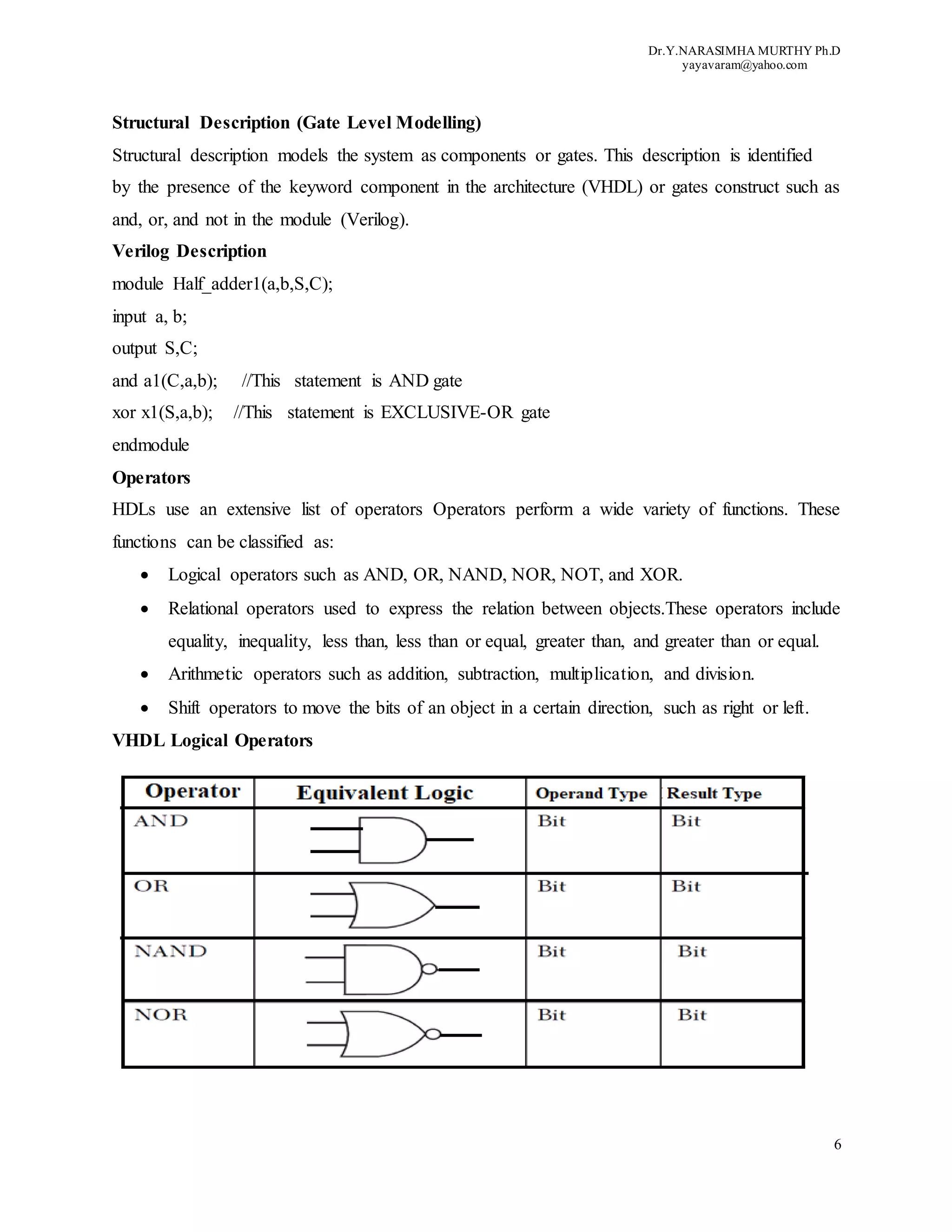
 Logical operators such as AND, OR, NAND, NOR, NOT, and XOR.
 Relational operators used to express the relation between objects.These operators include
equality, inequality, less than, less than or equal, greater than, and greater than or equal.
 Arithmetic operators such as addition, subtraction, multiplication, and division.
 Shift operators to move the bits of an object in a certain direction, such as right or left.
VHDL Logical Operators
Dr.Y.NARASIMHA MURTHY Ph.D
yayavaram@yahoo.com
7
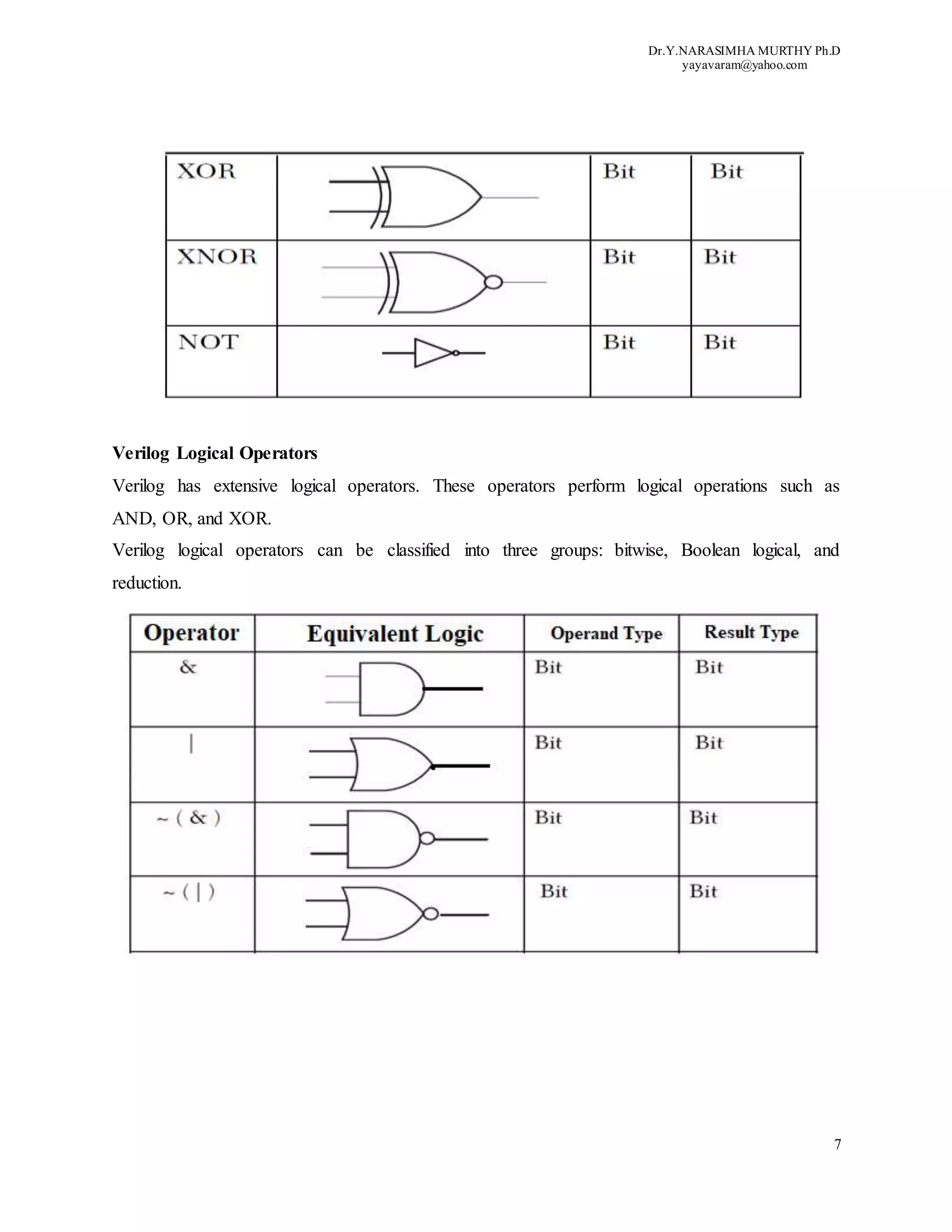
Verilog Logical Operators
Verilog has extensive logical operators. These operators perform logical operations such as
AND, OR, and XOR.
Verilog logical operators can be classified into three groups: bitwise, Boolean logical, and
reduction.
Dr.Y.NARASIMHA MURTHY Ph.D
yayavaram@yahoo.com
8
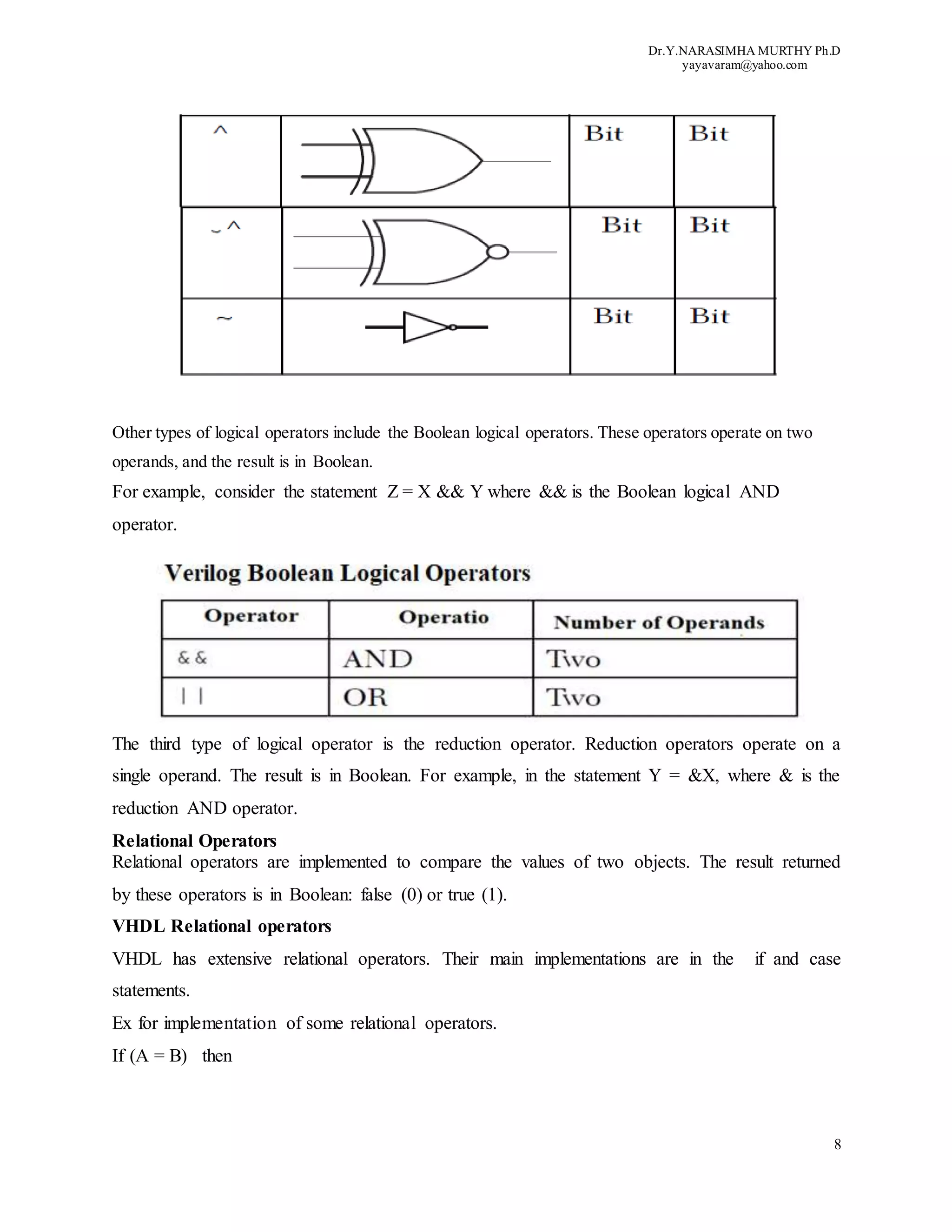
Other types of logical operators include the Boolean logical operators. These operators operate on two
operands, and the result is in Boolean.
For example, consider the statement Z = X && Y where && is the Boolean logical AND
operator.
The third type of logical operator is the reduction operator. Reduction operators operate on a
single operand. The result is in Boolean. For example, in the statement Y = &X, where & is the
reduction AND operator.
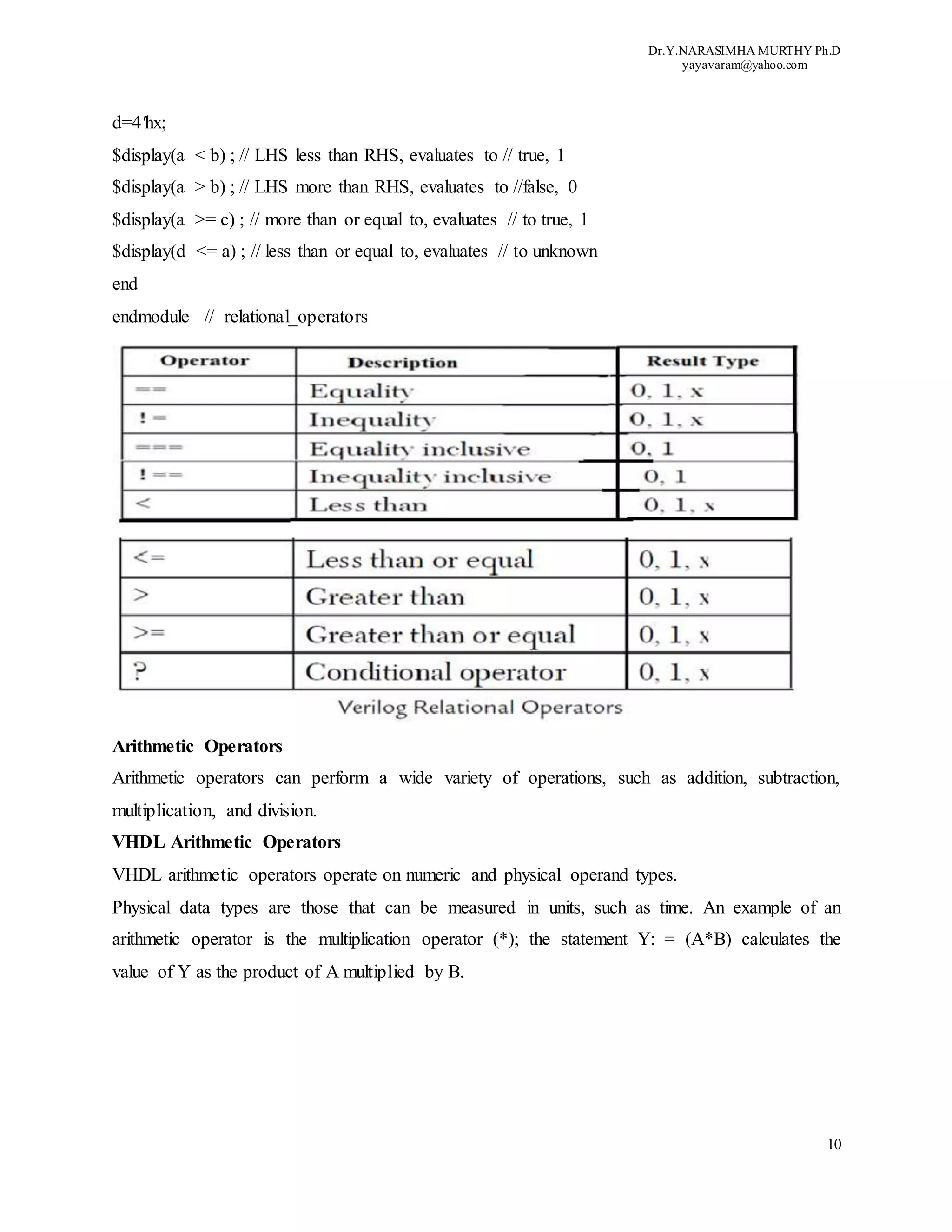
Relational Operators
Relational operators are implemented to compare the values of two objects. The result returned
by these operators is in Boolean: false (0) or true (1).
VHDL Relational operators
VHDL has extensive relational operators. Their main implementations are in the if and case
statements.
Ex for implementation of some relational operators.
If (A = B) then
Dr.Y.NARASIMHA MURTHY Ph.D
yayavaram@yahoo.com
9
A is compared to B. If A is equal to B, the value of the expression (A = B) is true (1); otherwise,
it is false (0).
If (A < B) then
If A is less than B, the value of the expression (A < B) is true (1); otherwise, it is false (0).
Verilog Relational Operators
Verilog has a set of relational operators similar to VHDL. Similar to VHDL, the relational
operators return Boolean values: false (0) or true (1).
The relational operators are, less-than (<), more-than (>), less-than-or-equal-to (<=) and more-
than-or-equal-to (>=).In this case if any operand is unknown the whole expression evaluates to
unknown.
For the conditional operator “?” the format is:
Conditional- expression? true- expression: false-expression ;
The conditional expression is evaluated; if true, true-expression is executed If false, false-
expression is executed. If the result of the conditional expression is “x,” both false and true are
executed, and their results are compared bit by bit; if two corresponding bits are the same, the
common value of these bits is returned. If they are not equal, an “x” is returned.
Ex: Relational Operators
module relational_ operators;
reg [3:0] a, b ,c, d;
initial begin
a=2;
b=5;
c=2;
Dr.Y.NARASIMHA MURTHY Ph.D
yayavaram@yahoo.com
10
d=4'hx;
$display(a < b) ; // LHS less than RHS, evaluates to // true, 1
$display(a > b) ; // LHS more than RHS, evaluates to //false, 0
$display(a >= c) ; // more than or equal to, evaluates // to true, 1
$display(d <= a) ; // less than or equal to, evaluates // to unknown
end
endmodule // relational_operators
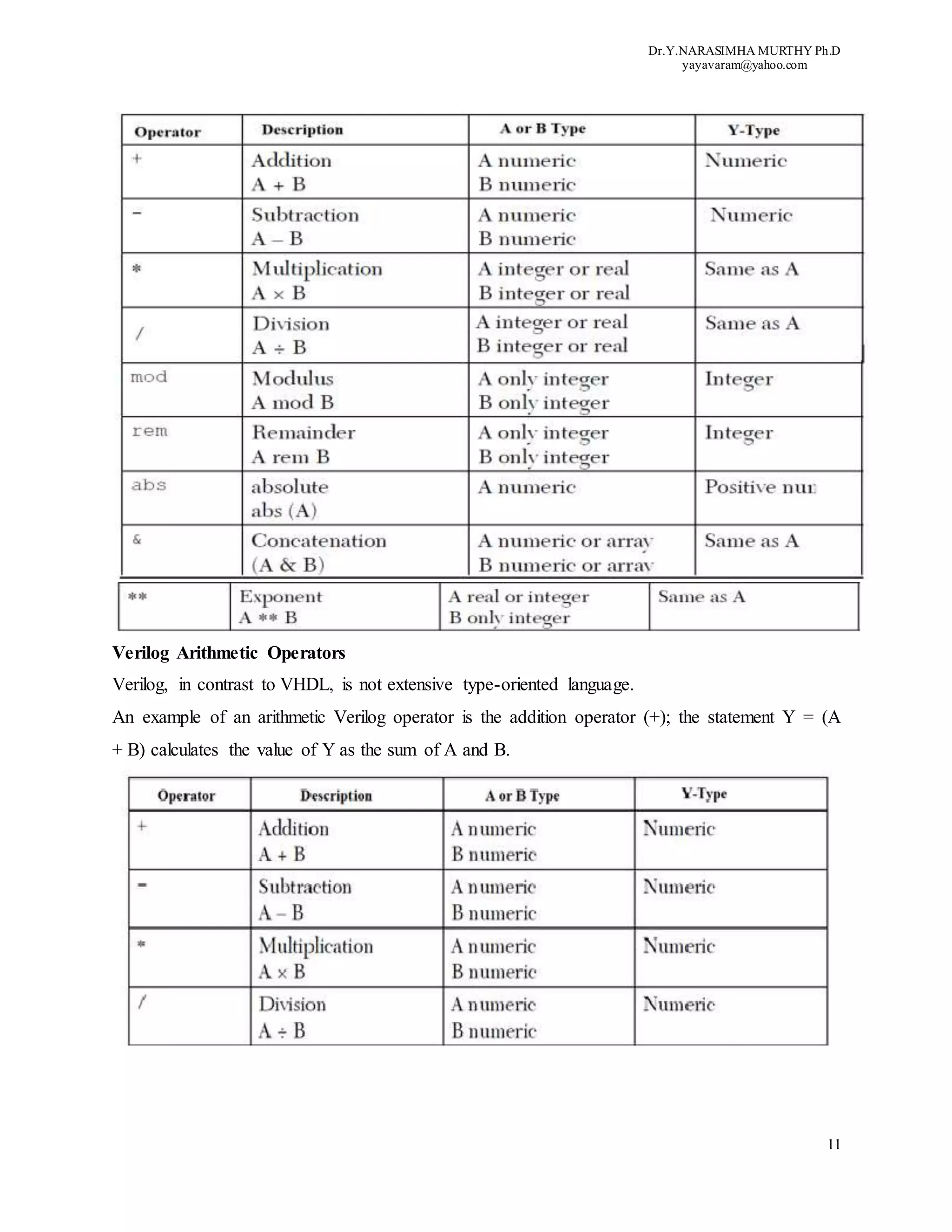
Arithmetic Operators
Arithmetic operators can perform a wide variety of operations, such as addition, subtraction,
multiplication, and division.
VHDL Arithmetic Operators
VHDL arithmetic operators operate on numeric and physical operand types.
Physical data types are those that can be measured in units, such as time. An example of an
arithmetic operator is the multiplication operator (*); the statement Y: = (A*B) calculates the
value of Y as the product of A multiplied by B.
Dr.Y.NARASIMHA MURTHY Ph.D
yayavaram@yahoo.com
11
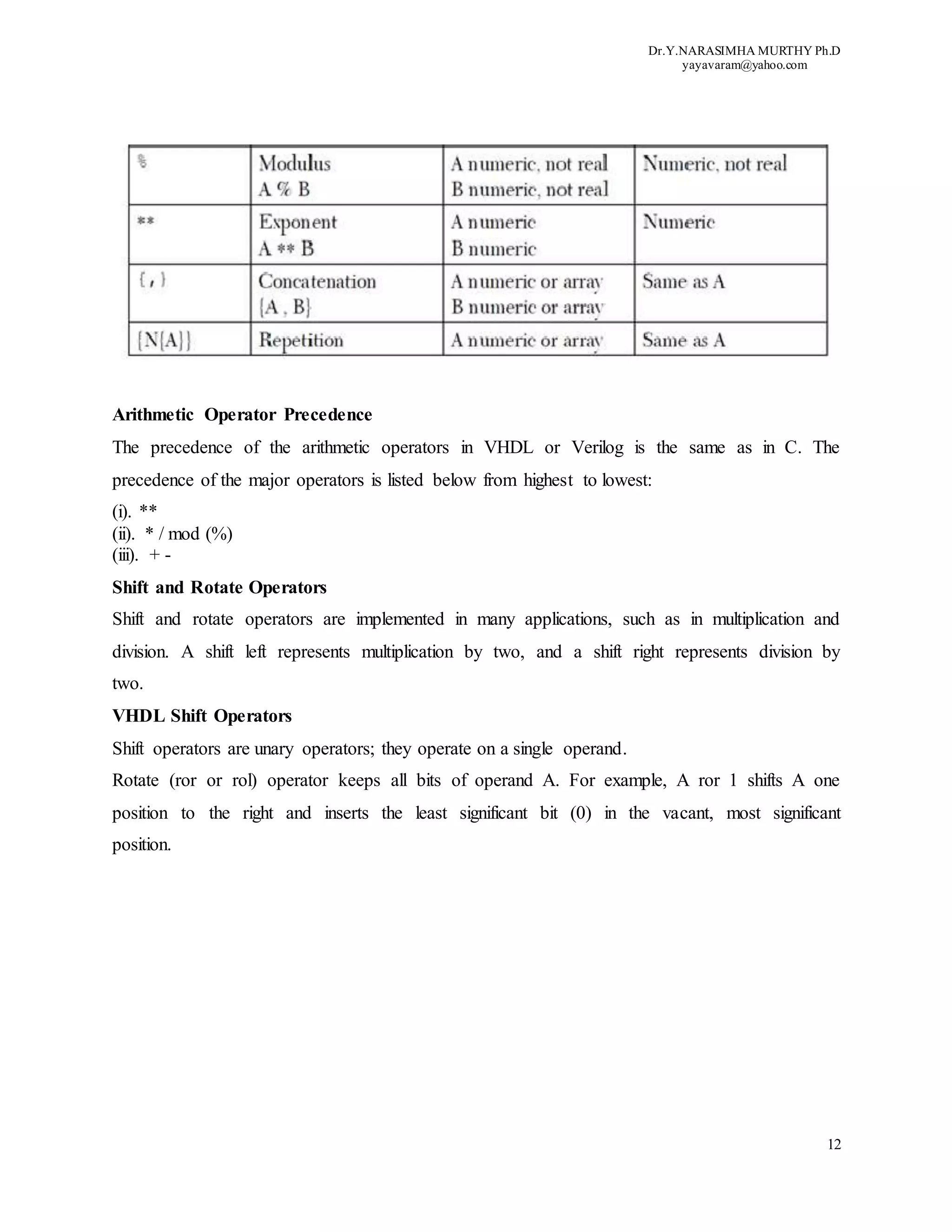
Verilog Arithmetic Operators
Verilog, in contrast to VHDL, is not extensive type-oriented language.
An example of an arithmetic Verilog operator is the addition operator (+); the statement Y = (A
+ B) calculates the value of Y as the sum of A and B.
Dr.Y.NARASIMHA MURTHY Ph.D
yayavaram@yahoo.com
12
Arithmetic Operator Precedence
The precedence of the arithmetic operators in VHDL or Verilog is the same as in C. The
precedence of the major operators is listed below from highest to lowest:
(i). **
(ii). * / mod (%)
(iii). + -
Shift and Rotate Operators
Shift and rotate operators are implemented in many applications, such as in multiplication and
division. A shift left represents multiplication by two, and a shift right represents division by
two.
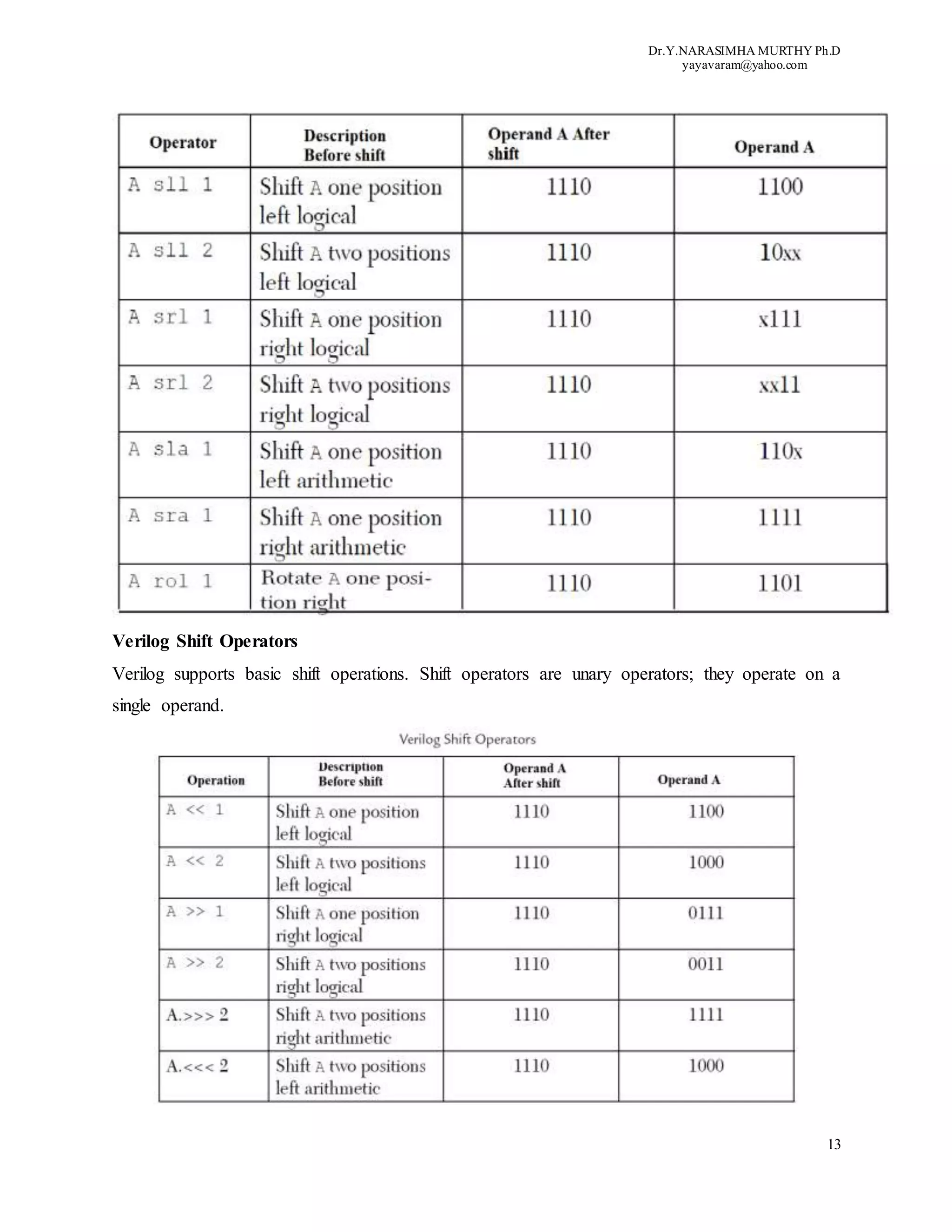
VHDL Shift Operators
Shift operators are unary operators; they operate on a single operand.
Rotate (ror or rol) operator keeps all bits of operand A. For example, A ror 1 shifts A one
position to the right and inserts the least significant bit (0) in the vacant, most significant
position.
Dr.Y.NARASIMHA MURTHY Ph.D
yayavaram@yahoo.com
13
Verilog Shift Operators
Verilog supports basic shift operations. Shift operators are unary operators; they operate on a
single operand.
Dr.Y.NARASIMHA MURTHY Ph.D
yayavaram@yahoo.com
14
The Verilog shift operators are shift-left (<<) and shift-right (>>). The shift operator takes a
vector and a number indicating the shift. The empty bits caused by shifting are filled with zeros
Ex:
module shift_operators;
reg [7:0] a;
initial begin
a = 8'b10101010;
$displayb(a << 1); // shift left by 1, evaluates to // 8'b01010100
$displayb(a >> 2); // shift right by 2, evaluates to // 8'b01010101
end
endmodule // bitwise_operators
The shift operators are useful in modeling shift registers, long multiplication algorithms, etc.
Data Types
HDL is a hardware description Language used to describe the hardware of a system.So, the data
or operands used in the language must have several types to match the need for describing the
hardware. For example, if we are describing a signal, we need to specify its type (i.e., the values
that the signal can take), such as type bit, which means that the signal can assume only 0 or 1, or
type std_logic, in which the signal can assume a value out of nine possible values that include 0,
1, and high impedance.
VHDL Data Types
VHDL is a type-oriented language; many operations will not be executed if the right type for the
operands has not been chosen. The type of any element or object in VHDL determines the
allowed values that element can assume. Objects in VHDL can be signal, variable or constant.
VHDL data types can be classified into five groups depending on the nature of the values the
object can assume: scalar, composite, access, file, and other.
Scalar Types
The values that a scalar can assume are numeric. Numeric values can be integer, real, physical
(such as time), Boolean (0 or 1), or characters when stored as American Standard Code for
Information Interchange (ASCII) or compatible code.
Dr.Y.NARASIMHA MURTHY Ph.D
yayavaram@yahoo.com
15
Bit Type
The only values allowed here are 0 or 1. It is used to describe a signal that takes only 1 (high) or
0 (low). The signal cannot take other values such as high impedance (open).
An example of implementing this type is when the type of a port signal is
port (I1, I2 : in bit; O1, O2 : out bit);
Signals I1, I2, O1, and O2 can assume only 0 or 1. If any of these signals must assume other levels
or values, such as high impedance, bit type cannot be used.
Boolean Type
This type can assume two values: false (0) or true (1). Both true and false are predefined words.
One of the most frequent applications of the Boolean type is in the if statement.
Consider the statements:
If (y = B) then
S : = ‘1’;
else
S : = ‘0’;
end if;
The output of the first line, If (y =B), is Boolean: it is either true or false. If true, then S = 1; if
false, S = 0. Boolean can also be specified as the port type:
port (I1, I2 : in bit; O1 : out bit; O2 : Boolean);
Integer Type
This type covers all integer values; the values can be negative or positive. The default range is
from –2,147,483,648 to +2,147,483,647. The user can specify a shorter range by using the
predefined word range. The predefined word natural can be used instead of integer if the values
of the object are always positive, including 0.
An example of the integer type is in the implementation of the exponent operator. The exponent
has to be of type integer, such as X**2 or X**y, where y is declared as integer. The port can also
be declared as type integer:
port (I1 : in natural; I2 : in bit; O1 : out integer; O2 : Boolean);
Another predefined type positive restricts the values an object can take to be positive and higher
than 0.
Real Type
This type accepts fractions, such as .4502, 12.5, and –5.2E–10 where E–10 = 10–10.
Dr.Y.NARASIMHA MURTHY Ph.D
yayavaram@yahoo.com
16
An example of using real type is:
port (I1 : in natural; I2 : in real; O1 : out integer; O2 :Boolean);
Character Type
This type includes characters that can be used to print a message using,
for example, the predefined command report, such as:
report (“Variable x is greater than Y”);
Physical Type
This type has values that can be measured in units, such as time (e.g.,second, millisecond,
microsecond) and voltage (e.g., volt, millivolt, microvolts).
An example of type time is:
constant Delay_inv : time := 1 ns;
User-Defined Types
The user can define a type by using the predefined word type as shown below:
type op is (add, mul, divide, none);
variable opcode : op := mul;
Type op is user defined. The variable opcode is of type op and can therefore be instantiated to:
add, mul, divide, or none.
Other Types
There are several other data types provided by external libraries. For example, the IEEE library
contains a package by the name of std_logic_1164. This package contains an extremely
important type: std_logic.
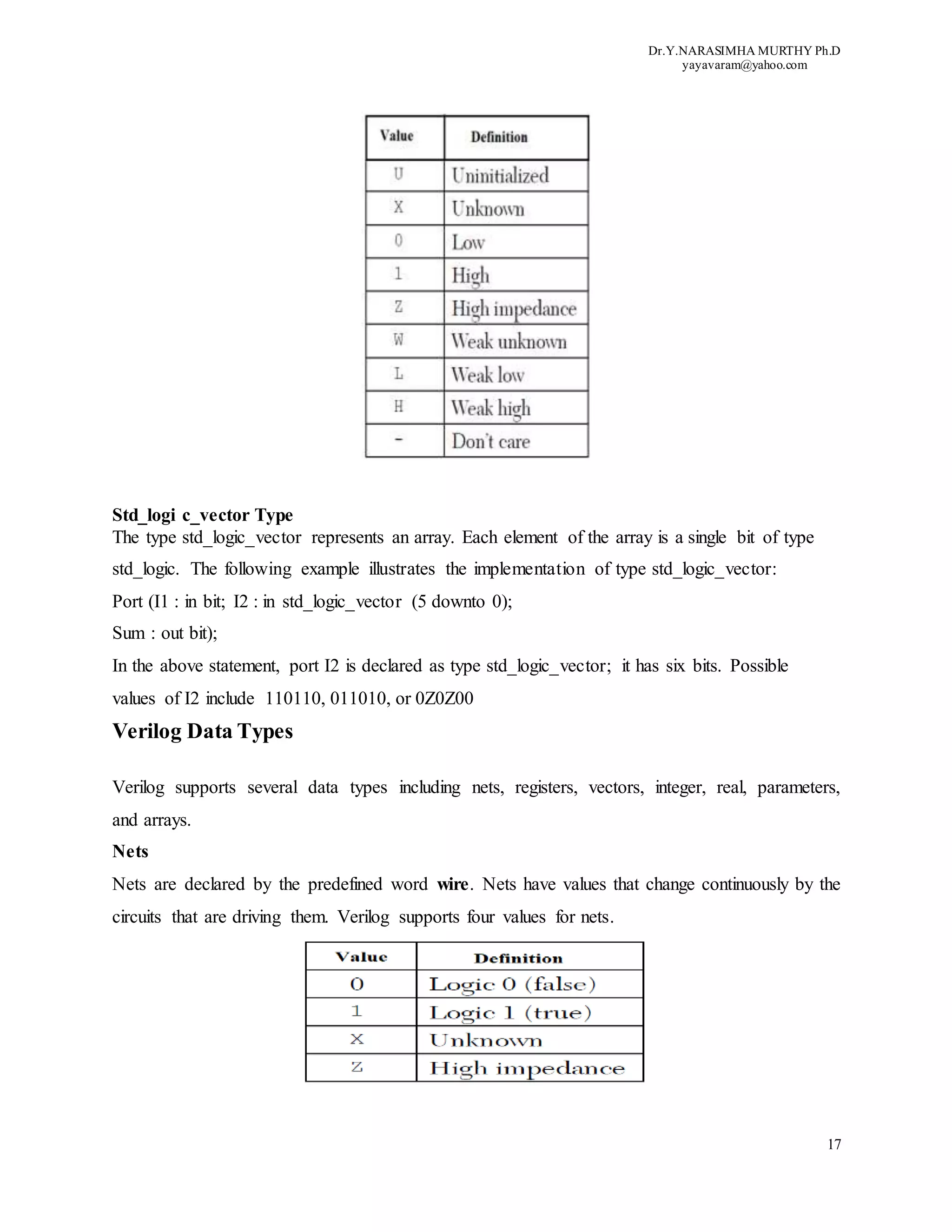
Type bit has only two values: level 0 and level 1. If more values are needed to represent the
signal, such as high impedance, bit type cannot be used. Instead, type std_logic, which can
assume nine values including high impedance, can be used
Std_Logic Type
Std_Logic has nine values, including 1 and 0. Package std_logic_1164 should be attached to the
VHDL module.
Dr.Y.NARASIMHA MURTHY Ph.D
yayavaram@yahoo.com
17
Std_logi c_vector Type
The type std_logic_vector represents an array. Each element of the array is a single bit of type
std_logic. The following example illustrates the implementation of type std_logic_vector:
Port (I1 : in bit; I2 : in std_logic_vector (5 downto 0);
Sum : out bit);
In the above statement, port I2 is declared as type std_logic_vector; it has six bits. Possible
values of I2 include 110110, 011010, or 0Z0Z00
Verilog Data Types
Verilog supports several data types including nets, registers, vectors, integer, real, parameters,
and arrays.
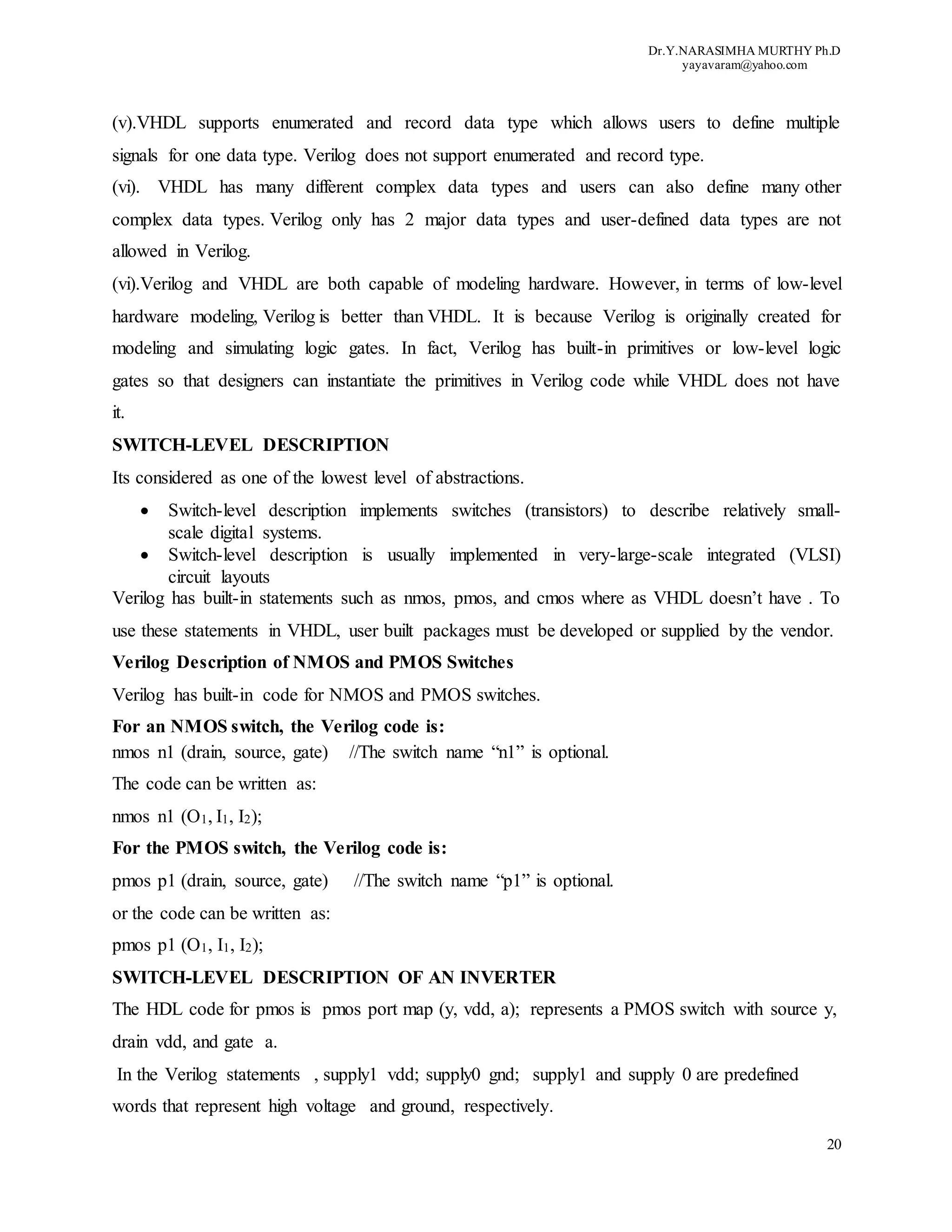
Nets
Nets are declared by the predefined word wire. Nets have values that change continuously by the
circuits that are driving them. Verilog supports four values for nets.
Dr.Y.NARASIMHA MURTHY Ph.D
yayavaram@yahoo.com
18
Examples of net types are wire sum;
wire S1 = 1’b0;
The first statement declares a net by the name sum. The second statement declares a net by the
name of S1; its initial value is 1’b0, which represents 1 bit with value 0.
Register
Register, in contrast to nets, stores values until they are updated. Register, as its name suggests,
represents data-storage elements. Register is declared by the predefined word reg.
Verilog supports four values for register
An example of register is:
reg Sum_total;
The above statement declares a register by the name Sum_total.
Vectors
Vectors are multiple bits. A register or a net can be declared as a vector.
Vectors are declared by brackets [ ]. Examples of vectors are:
wire [3:0] a = 4’b1010;
reg [7:0] total = 8’d12;
The first statement declares a net a. It has four bits, and its initial value is 1010 (b stands for bit).
The second statement declares a register total. Its size is eight bits, and its value is decimal 12 (d
stands for decimal).
Integers
Integers are declared by the predefined word integer. An example of integer declaration is:
integer no_bits;
The above statement declares no_bits as an integer.
Real
Real (floating-point) numbers are declared with the predefined word real. Examples of real
values are 2.4, 56.3, and 5e12. The value 5e12 is equal to 5 × 10¹². The following statement
declares the register weight as real:
Dr.Y.NARASIMHA MURTHY Ph.D
yayavaram@yahoo.com
19
real weight;
Parameter
Parameter represents a global constant. It is declared by the predefined word parameter.
Ex:
module compr_genr (X, Y, xgty, xlty, xeqy);
parameter N = 3;
input [N:0] X, Y;
output xgty, xlty, xeqy;
wire [N:0] sum, Yb;
To change the size of the inputs x and y, the size of the nets sum, and
the size of net Yb to eight bits, the value of N is changed to seven as:
parameter N = 7
Arrays
Verilog, in contrast to VHDL, does not have a predefined word for array.
Registers and integers can be written as arrays.
Let us consider example
parameter N = 4;
parameter M = 3;
reg signed [M:0] carry [0:N];
The above statements declare an array by the name carry. The array carry has five elements, and
each element is four bits. The four bits are in two’s complement form. For example, if the value
of a certain element is 1001, then it is equivalent to decimal –7. Arrays can be multidimensional.
Differences between VHDL and Verilog.
The VHDL language describes a digital system as a set of entities while the Verilog language
describes a digital system as a set of modules
(ii) VHDL is a case insensitive while Verilog is case sensitive
(iii).VHDL is like Ada or Pascal programming language while Verilog is like C programming
language.
(iv).Verilog has compiler directives such as `timescale , `define , `ifdef, ifndef `else `elseif
`endif (conditional compiling), `include , etc. VHDL does not have compiler directives.
Dr.Y.NARASIMHA MURTHY Ph.D
yayavaram@yahoo.com
20
(v).VHDL supports enumerated and record data type which allows users to define multiple
signals for one data type. Verilog does not support enumerated and record type.
(vi). VHDL has many different complex data types and users can also define many other
complex data types. Verilog only has 2 major data types and user-defined data types are not
allowed in Verilog.
(vi).Verilog and VHDL are both capable of modeling hardware. However, in terms of low-level
hardware modeling, Verilog is better than VHDL. It is because Verilog is originally created for
modeling and simulating logic gates. In fact, Verilog has built-in primitives or low-level logic
gates so that designers can instantiate the primitives in Verilog code while VHDL does not have
it.
SWITCH-LEVEL DESCRIPTION
Its considered as one of the lowest level of abstractions.
 Switch-level description implements switches (transistors) to describe relatively small-
scale digital systems.
 Switch-level description is usually implemented in very-large-scale integrated (VLSI)
circuit layouts
Verilog has built-in statements such as nmos, pmos, and cmos where as VHDL doesn’t have . To
use these statements in VHDL, user built packages must be developed or supplied by the vendor.
Verilog Description of NMOS and PMOS Switches
Verilog has built-in code for NMOS and PMOS switches.
For an NMOS switch, the Verilog code is:
nmos n1 (drain, source, gate) //The switch name “n1” is optional.
The code can be written as:
nmos n1 (O1, I1, I2);
For the PMOS switch, the Verilog code is:
pmos p1 (drain, source, gate) //The switch name “p1” is optional.
or the code can be written as:
pmos p1 (O1, I1, I2);
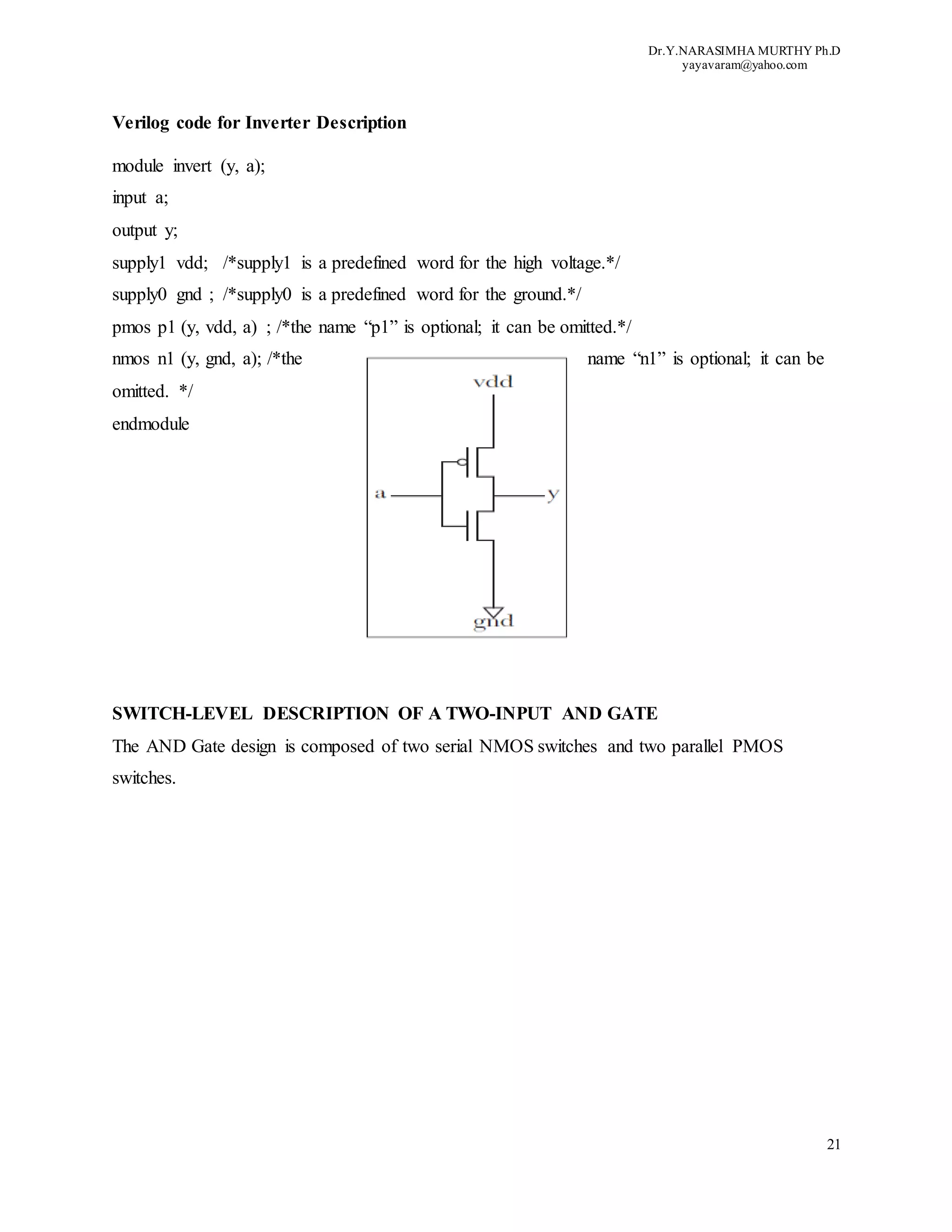
SWITCH-LEVEL DESCRIPTION OF AN INVERTER
The HDL code for pmos is pmos port map (y, vdd, a); represents a PMOS switch with source y,
drain vdd, and gate a.
In the Verilog statements , supply1 vdd; supply0 gnd; supply1 and supply 0 are predefined
words that represent high voltage and ground, respectively.
Dr.Y.NARASIMHA MURTHY Ph.D
yayavaram@yahoo.com
21
Verilog code for Inverter Description
module invert (y, a);
input a;
output y;
supply1 vdd; /*supply1 is a predefined word for the high voltage.*/
supply0 gnd ; /*supply0 is a predefined word for the ground.*/
pmos p1 (y, vdd, a) ; /*the name “p1” is optional; it can be omitted.*/
nmos n1 (y, gnd, a); /*the name “n1” is optional; it can be
omitted. */
endmodule
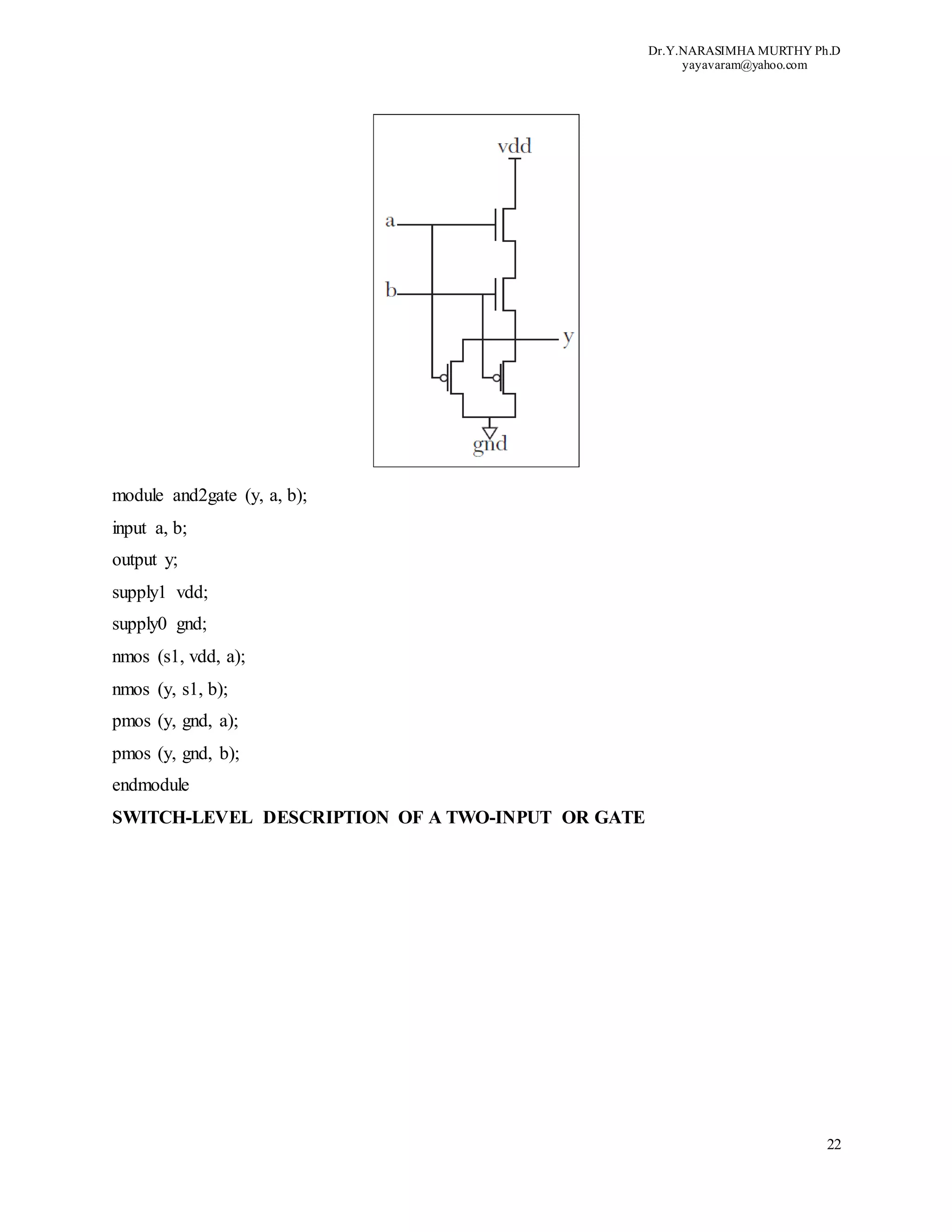
SWITCH-LEVEL DESCRIPTION OF A TWO-INPUT AND GATE
The AND Gate design is composed of two serial NMOS switches and two parallel PMOS
switches.
Dr.Y.NARASIMHA MURTHY Ph.D
yayavaram@yahoo.com
22
module and2gate (y, a, b);
input a, b;
output y;
supply1 vdd;
supply0 gnd;
nmos (s1, vdd, a);
nmos (y, s1, b);
pmos (y, gnd, a);
pmos (y, gnd, b);
endmodule
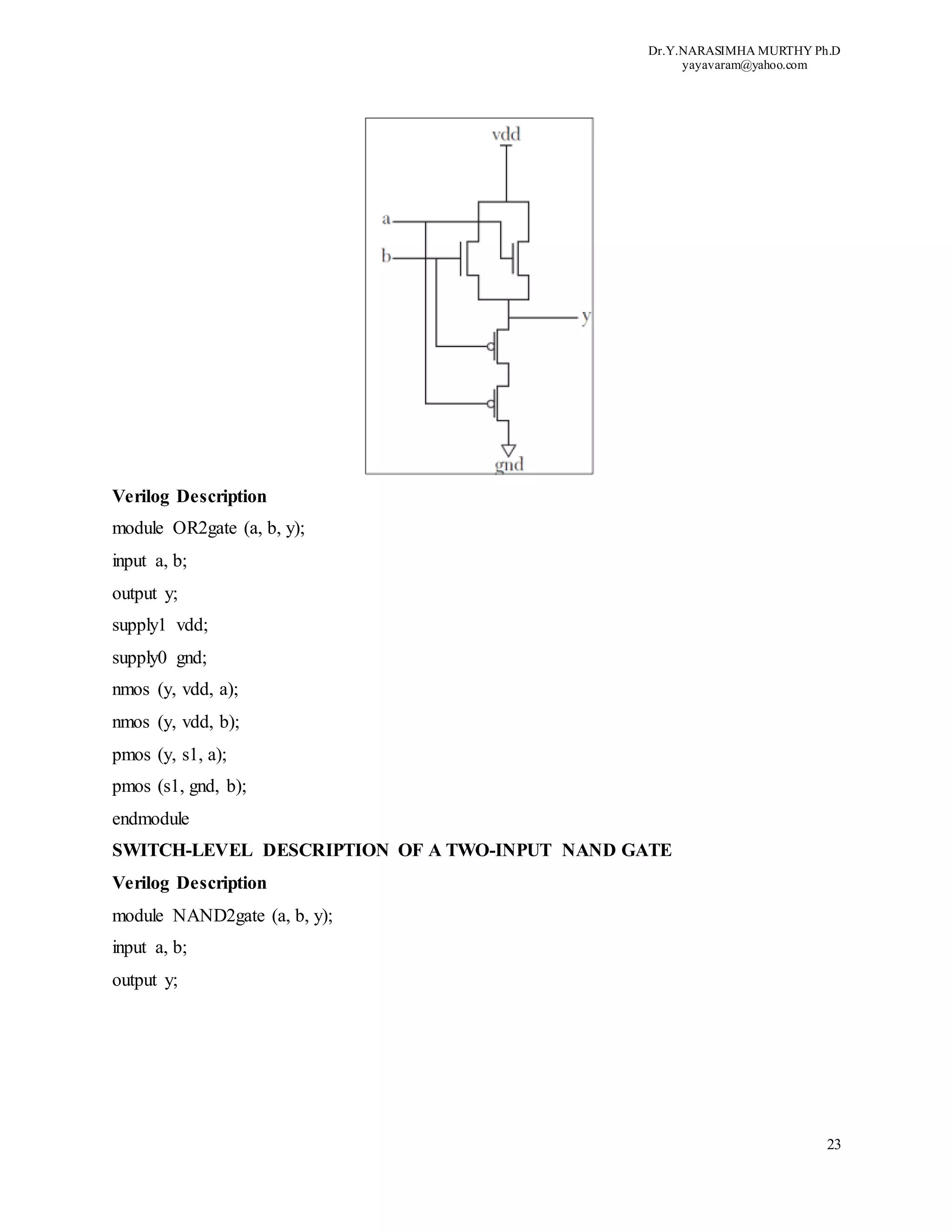
SWITCH-LEVEL DESCRIPTION OF A TWO-INPUT OR GATE
Dr.Y.NARASIMHA MURTHY Ph.D
yayavaram@yahoo.com
23
Verilog Description
module OR2gate (a, b, y);
input a, b;
output y;
supply1 vdd;
supply0 gnd;
nmos (y, vdd, a);
nmos (y, vdd, b);
pmos (y, s1, a);
pmos (s1, gnd, b);
endmodule
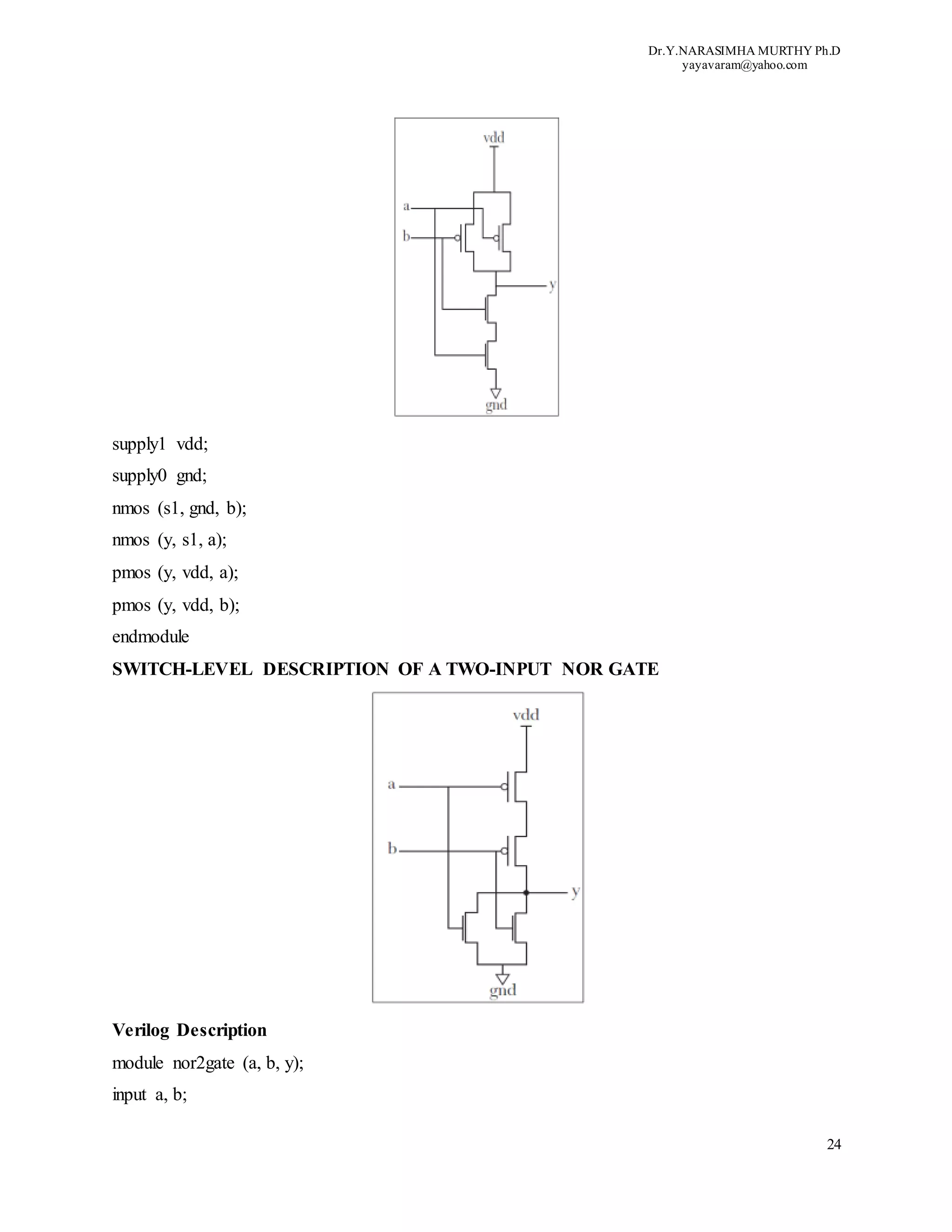
SWITCH-LEVEL DESCRIPTION OF A TWO-INPUT NAND GATE
Verilog Description
module NAND2gate (a, b, y);
input a, b;
output y;
Dr.Y.NARASIMHA MURTHY Ph.D
yayavaram@yahoo.com
24
supply1 vdd;
supply0 gnd;
nmos (s1, gnd, b);
nmos (y, s1, a);
pmos (y, vdd, a);
pmos (y, vdd, b);
endmodule
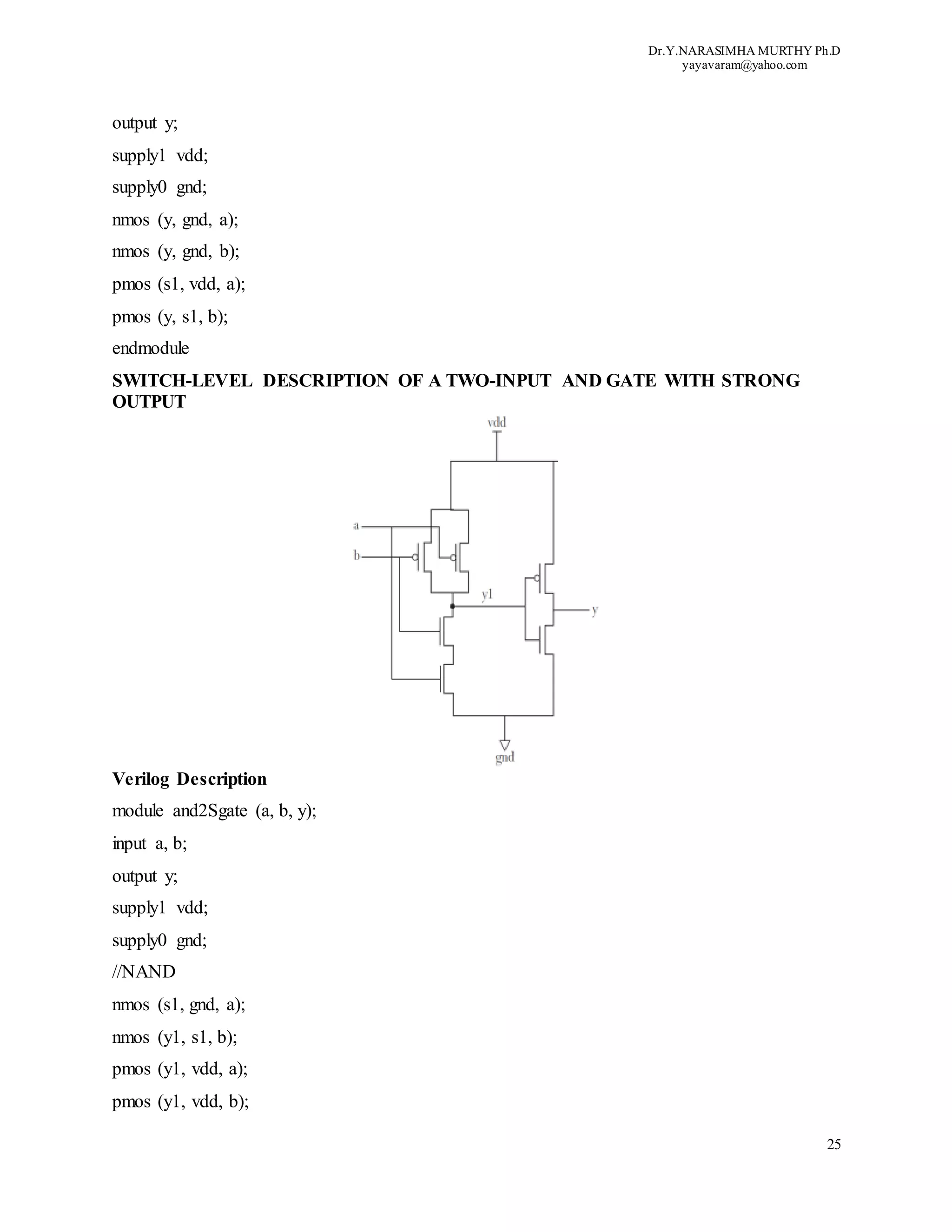
SWITCH-LEVEL DESCRIPTION OF A TWO-INPUT NOR GATE
Verilog Description
module nor2gate (a, b, y);
input a, b;
Dr.Y.NARASIMHA MURTHY Ph.D
yayavaram@yahoo.com
25
output y;
supply1 vdd;
supply0 gnd;
nmos (y, gnd, a);
nmos (y, gnd, b);
pmos (s1, vdd, a);
pmos (y, s1, b);
endmodule
SWITCH-LEVEL DESCRIPTION OF A TWO-INPUT AND GATE WITH STRONG
OUTPUT
Verilog Description
module and2Sgate (a, b, y);
input a, b;
output y;
supply1 vdd;
supply0 gnd;
//NAND
nmos (s1, gnd, a);
nmos (y1, s1, b);
pmos (y1, vdd, a);
pmos (y1, vdd, b);
Dr.Y.NARASIMHA MURTHY Ph.D
yayavaram@yahoo.com
26
//inverter
nmos (y, gnd, y1);
pmos (y, vdd, y1);
endmodule
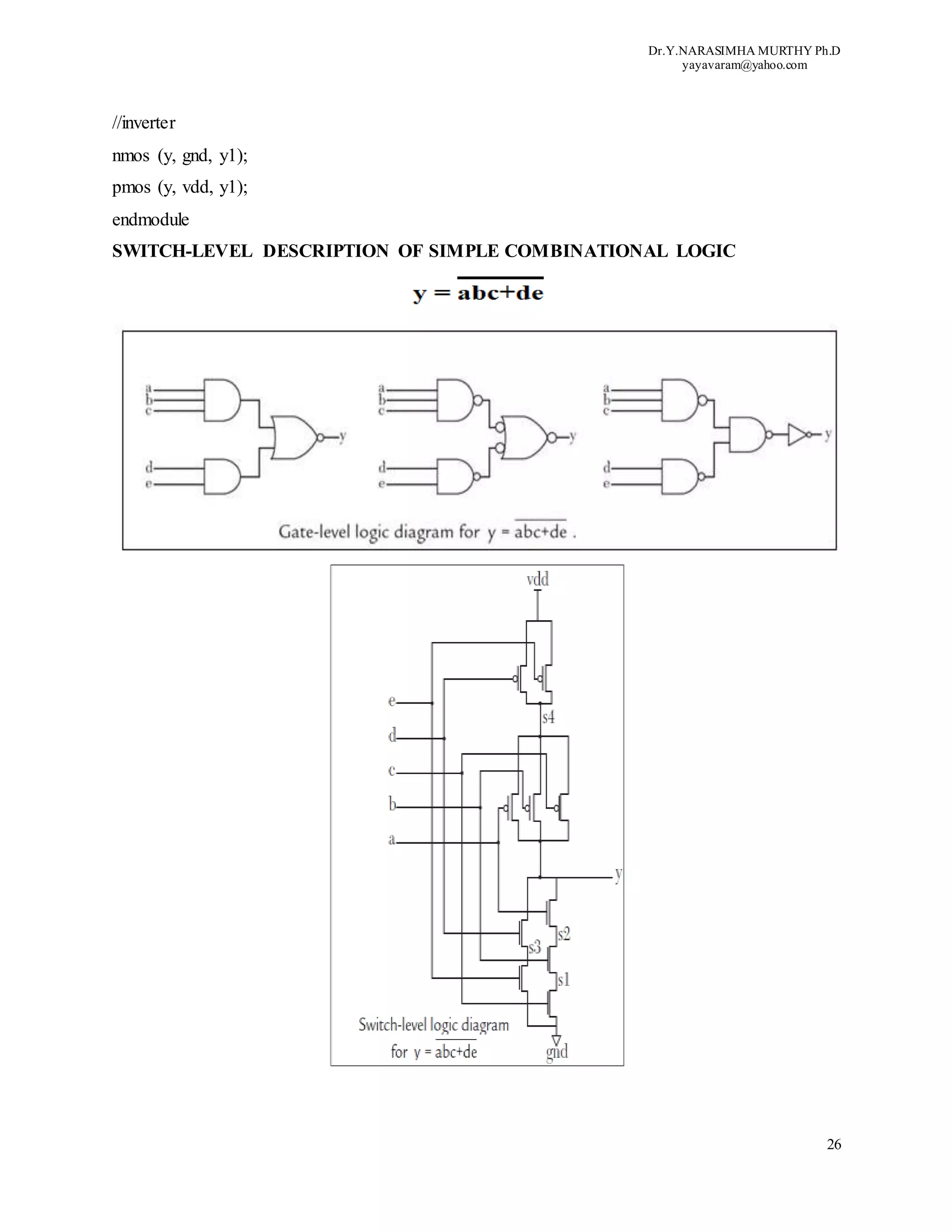
SWITCH-LEVEL DESCRIPTION OF SIMPLE COMBINATIONAL LOGIC
Dr.Y.NARASIMHA MURTHY Ph.D
yayavaram@yahoo.com
27
Verilog Description
module simple_logic (a, b, c, d, e, y);
input a, b, c, d, e;
output y;
supply1 vdd;
supply0 gnd;
nmos (s1, gnd, c);
nmos (s2, s1, b);
nmos (y, s2, a);
nmos (s3, gnd, e);
nmos (y, s3, d);
pmos (y, s4, a);
pmos (y, s4, b);
pmos (y, s4, c);
pmos (s4, vdd, d);
pmos (s4, vdd, e);
endmodule.
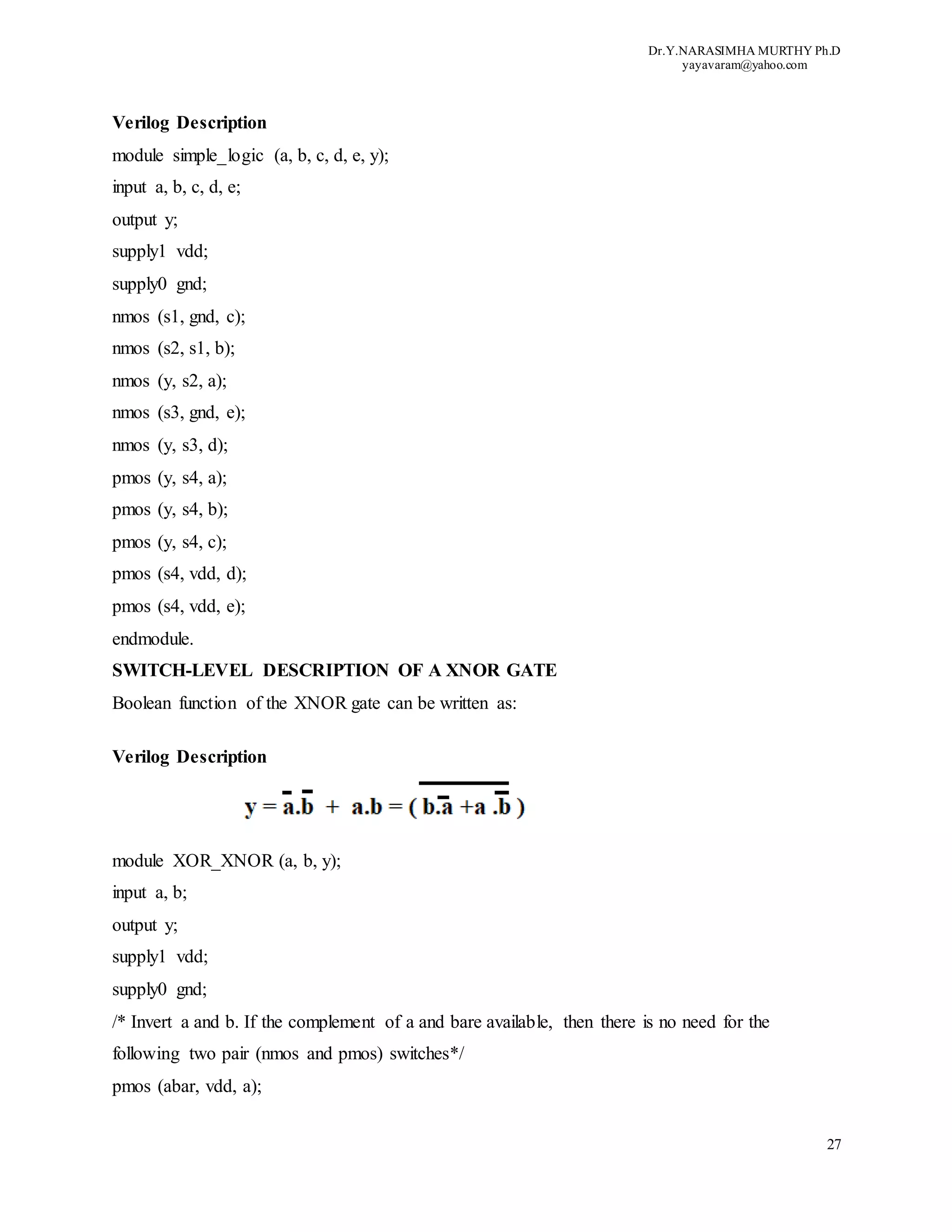
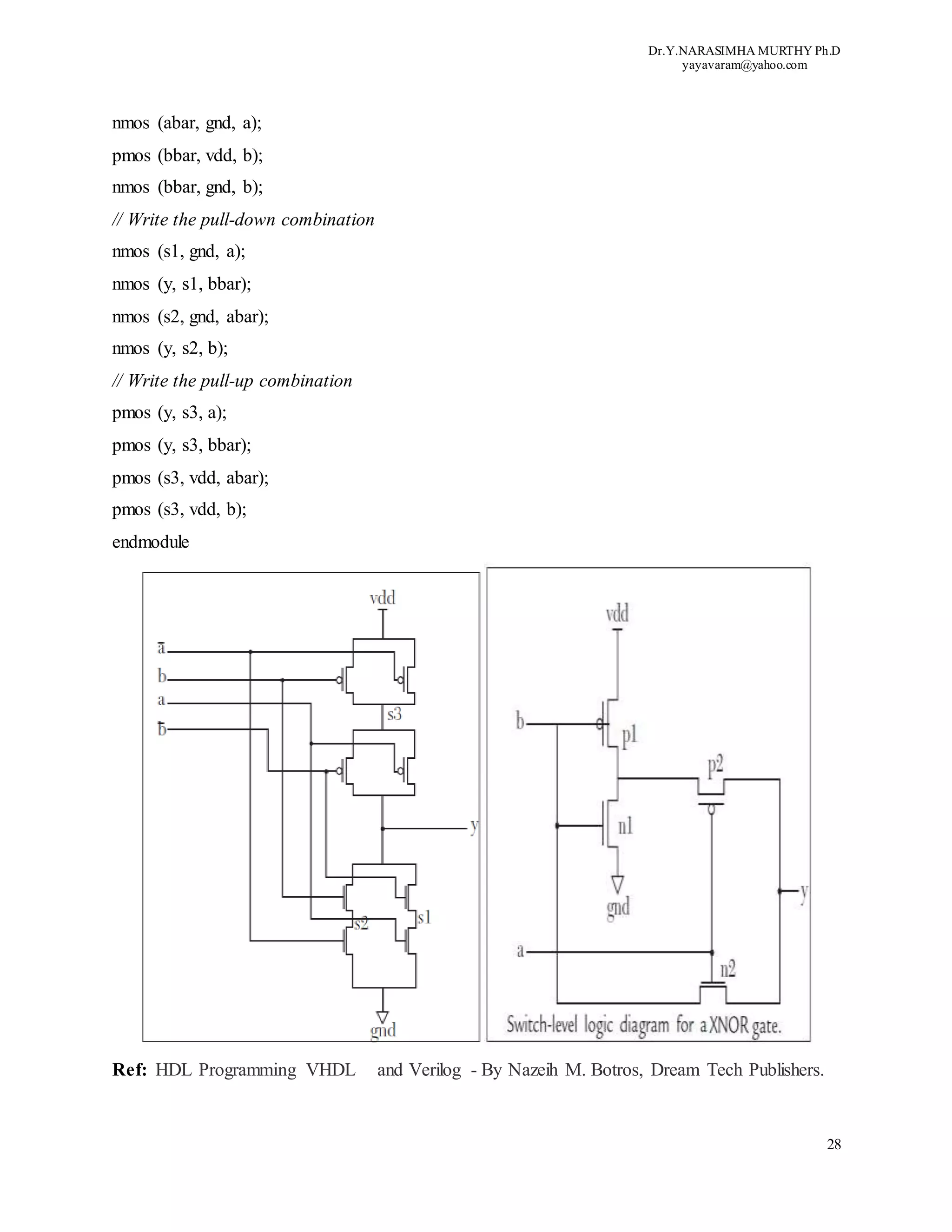
SWITCH-LEVEL DESCRIPTION OF A XNOR GATE
Boolean function of the XNOR gate can be written as:
Verilog Description
module XOR_XNOR (a, b, y);
input a, b;
output y;
supply1 vdd;
supply0 gnd;
/* Invert a and b. If the complement of a and bare available, then there is no need for the
following two pair (nmos and pmos) switches*/
pmos (abar, vdd, a);
Dr.Y.NARASIMHA MURTHY Ph.D
yayavaram@yahoo.com
28
nmos (abar, gnd, a);
pmos (bbar, vdd, b);
nmos (bbar, gnd, b);
// Write the pull-down combination
nmos (s1, gnd, a);
nmos (y, s1, bbar);
nmos (s2, gnd, abar);
nmos (y, s2, b);
// Write the pull-up combination
pmos (y, s3, a);
pmos (y, s3, bbar);
pmos (s3, vdd, abar);
pmos (s3, vdd, b);
endmodule
Ref: HDL Programming VHDL and Verilog - By Nazeih M. Botros, Dream Tech Publishers.

OVERVIEW OF HARDWARE DESCRIPTION LANGUAGES (HDLs)

  • 1.
    Dr.Y.NARASIMHA MURTHY Ph.D yayavaram@yahoo.com 1 HardwareDescription Languages(HDLs) Overview of VHDL and Verilog Hardware Description Language (HDL) is a computer aided design (CAD) tool used for the modern design and synthesis of digital systems. Due to the unprecedented growth of gate density on the chip it is impossible to design the digital systems manually without the help of sophisticated CAD tools. (Computer Aided Tools) . HDL (Hardware Description Language) is an integral part of such tools. HDL is a very efficient tool for implementing and synthesizing the designs on chips. The HDLs describe the behavior of a digital circuit in a computer-language code that is similar to a software languages like C. There are many HDLs in the market. But the two popular HDLs are VHDL and Verilog. Verilog stands for Verification Logic (Some people also calls this as True Logic) was introduced in 1980s and has gone through several changes and standardizations by the Institute of Electrical and Electronic Engineers (IEEE). In December 1995 Verilog HDL became IEEE Standard 1364-1995, in 2001 IEEE Std. 1364- 2001 was introduced, and in 2005 IEEE 1800-2005 was introduced. VHDL, which stands for Very-High-Speed Integrated Circuit (VHSIC) Hardware Description Language, was developed in the early 1980s. In 1987, the IEEE Standard 1076-1987 version of VHDL was introduced, and several upgrades followed. In 1993, VHDL was updated and more futures were added which resulted in IEEE Standard 1076-1993. Finally, in 2008, the VHDL IEEE 1076-2008 was introduced. Code structure HDL modules follow the general structure of software languages such as C. The module has a source code that is written in high-level language style. VHDL has a somewhat different structure than Verilog HDL. Code Structure of the VHDL Module The VHDL module has two major constructs : entity and architecture. Entity declares the input and output signals of the system to be described and is given a name or identifier by the user.
  • 2.
    Dr.Y.NARASIMHA MURTHY Ph.D yayavaram@yahoo.com 2 VHDLis case insensitive. For example, the two entity names Half_ADDER and half adder are treated as the same name. The name should start with an alphabetical letter and can include the special character underscore (_). Declarations include the name and type of the inputs and outputs of the system. The inputs and outputs here are called input ports and output ports. The name of the port is user selected, and it has the same requirements as the entity’s name. Ex: entity Half_adder is port (a: in bit; b : in bit; S : out bit; C: out bit); end half_adder; The word entity is a predefined word. The name of the entity is Half_adder. This name is user selected and does not convey any information about the system; it is just an identifier. The entity in the above code has two input ports and two output ports. The term is is a predefined word and must be written after the name of the entity. The word port is predefined. The names of the input ports are a and b, and they must be followed by a colon (:). The predefined word in instantiates the mode of the port as an input. The type of these input signals is bit and determines the allowed values that signals a and b can take. Type bit allows the signal to take only either logic 0 or logic 1. There are several other types, such as std_logic, real, and integer. The last line of the entity’s code uses the predefined word end, and it ends the entity. The name of the entity can follow the word end, as in end Half_adder, or the name of the entity can be omitted and only end is entered. The semicolon (;) is an important character in HDL. It is used as a separator similar to the carriage return character used in C language. The second construct of the VHDL module, the architecture, describes the relationship between the inputs and outputs of the system. Architecture has to be bound to an entity. This relationship can be described using several sources; one of these sources is the Boolean function of the outputs.
  • 3.
    Dr.Y.NARASIMHA MURTHY Ph.D yayavaram@yahoo.com 3 Ex: entityHalf_adder is port(a: in bit; b : in bit; S : out bit; C: out bit); end half_adder; architecture dtfl_half of Half_adder is begin S <= a xor b; -- statement 1 C <= a and b; -- statement 2 --Blank lines are allowed end dtfl_half; Structure of the Verilog Module Verilog module has two sections. Declaration and the other is body. In the declaration section , the name, inputs, and outputs of the module are entered. The body denotes the relationship between the inputs and the outputs. Ex: module Half_adder(a,b,S,C); input a,b; output S, C; // Body section starts assign S = a ^ b ; // statement 1, XOR operation assign C= a & b ; // statement 2, Logical AND operation endmodule In contrast to VHDL, Verilog is case sensitive. Half_adder, half_adder, and half_addEr are all different names. The name of the module should start with an alphabetical letter and can include the special character underscore (_). The names of the inputs and outputs (they are called input and output ports) follow the same guidelines as the module’s name. They are written inside parentheses separated by a comma. The parenthesis is followed by a semicolon. The semicolon (;) is a line separator.
  • 4.
    Dr.Y.NARASIMHA MURTHY Ph.D yayavaram@yahoo.com 4 Followingthe module statement, the input and output port modes are declared. For example, the statement input a; declares signal a as an input port. In contrast to VHDL, the type of the input and output port signals need not be declared. The order of writing the inputs and outputs and their declaration is irrelevant. Ex: module half_adder (a,b, S, C); output S; output C; input a; input b; Statements 1 and 2 in above code are signal assignment statements. The double slash (//) is a comment command where a comment can be entered. If the comment takes more than one line, a double slash or pair (/*……..*/) can be used. The module is concluded by the predefined word endmodule. Leaving blank lines is allowed in the module; also, spaces between two words or at the beginning of the line are allowed. Abstraction levels (Types or Models of Description) Several models of code writing can be used to describe the system. Selection of the styles depends on the available information on the system. Commonly used models are data flow, behavioral, structural, switch level, mixed type, and mixed language. Data Flow Model Data flow describes how the system’s signals flow from the inputs to the outputs. Usually, the description is done by writing the Boolean function of the outputs. The data-flow statements are concurrent; their execution is controlled by events. Behavioral Description A behavioral description models the system as to how the outputs behave with the inputs; usually, a flowchart is used to show this behavior. The HDL behavioral description is the one where the architecture (VHDL) or the module (Verilog) contains the predefined word process (VHDL) or always or initial (Verilog).
  • 5.
    Dr.Y.NARASIMHA MURTHY Ph.D yayavaram@yahoo.com 5 Behavioraldescription is usually used when the Boolean function or the digital logic of the system is hard to obtain. Ex.VHDL : entity Half_adder is port(a: in bit; b : in bit; S : out bit;C: out bit); end half_adder; architecture beh_half of Half_adder is begin process (a, b) begin if (a /= b) then S <= ‘1’; else S <= ‘0’; --Blank lines are allowed end if; end process; end beh_half; Verilog Description module Half_adder(a,b,S,C); input a,b; output S, C; reg S,C; // Blank lines are allowed always @ (a,b) begin if (a != b) S = 1’b1; else S = 1’b0; end endmodule
  • 6.
    Dr.Y.NARASIMHA MURTHY Ph.D yayavaram@yahoo.com 6 StructuralDescription (Gate Level Modelling) Structural description models the system as components or gates. This description is identified by the presence of the keyword component in the architecture (VHDL) or gates construct such as and, or, and not in the module (Verilog). Verilog Description module Half_adder1(a,b,S,C); input a, b; output S,C; and a1(C,a,b); //This statement is AND gate xor x1(S,a,b); //This statement is EXCLUSIVE-OR gate endmodule Operators HDLs use an extensive list of operators Operators perform a wide variety of functions. These functions can be classified as:  Logical operators such as AND, OR, NAND, NOR, NOT, and XOR.  Relational operators used to express the relation between objects.These operators include equality, inequality, less than, less than or equal, greater than, and greater than or equal.  Arithmetic operators such as addition, subtraction, multiplication, and division.  Shift operators to move the bits of an object in a certain direction, such as right or left. VHDL Logical Operators
  • 7.
    Dr.Y.NARASIMHA MURTHY Ph.D yayavaram@yahoo.com 7 VerilogLogical Operators Verilog has extensive logical operators. These operators perform logical operations such as AND, OR, and XOR. Verilog logical operators can be classified into three groups: bitwise, Boolean logical, and reduction.
  • 8.
    Dr.Y.NARASIMHA MURTHY Ph.D yayavaram@yahoo.com 8 Othertypes of logical operators include the Boolean logical operators. These operators operate on two operands, and the result is in Boolean. For example, consider the statement Z = X && Y where && is the Boolean logical AND operator. The third type of logical operator is the reduction operator. Reduction operators operate on a single operand. The result is in Boolean. For example, in the statement Y = &X, where & is the reduction AND operator. Relational Operators Relational operators are implemented to compare the values of two objects. The result returned by these operators is in Boolean: false (0) or true (1). VHDL Relational operators VHDL has extensive relational operators. Their main implementations are in the if and case statements. Ex for implementation of some relational operators. If (A = B) then
  • 9.
    Dr.Y.NARASIMHA MURTHY Ph.D yayavaram@yahoo.com 9 Ais compared to B. If A is equal to B, the value of the expression (A = B) is true (1); otherwise, it is false (0). If (A < B) then If A is less than B, the value of the expression (A < B) is true (1); otherwise, it is false (0). Verilog Relational Operators Verilog has a set of relational operators similar to VHDL. Similar to VHDL, the relational operators return Boolean values: false (0) or true (1). The relational operators are, less-than (<), more-than (>), less-than-or-equal-to (<=) and more- than-or-equal-to (>=).In this case if any operand is unknown the whole expression evaluates to unknown. For the conditional operator “?” the format is: Conditional- expression? true- expression: false-expression ; The conditional expression is evaluated; if true, true-expression is executed If false, false- expression is executed. If the result of the conditional expression is “x,” both false and true are executed, and their results are compared bit by bit; if two corresponding bits are the same, the common value of these bits is returned. If they are not equal, an “x” is returned. Ex: Relational Operators module relational_ operators; reg [3:0] a, b ,c, d; initial begin a=2; b=5; c=2;
  • 10.
    Dr.Y.NARASIMHA MURTHY Ph.D yayavaram@yahoo.com 10 d=4'hx; $display(a< b) ; // LHS less than RHS, evaluates to // true, 1 $display(a > b) ; // LHS more than RHS, evaluates to //false, 0 $display(a >= c) ; // more than or equal to, evaluates // to true, 1 $display(d <= a) ; // less than or equal to, evaluates // to unknown end endmodule // relational_operators Arithmetic Operators Arithmetic operators can perform a wide variety of operations, such as addition, subtraction, multiplication, and division. VHDL Arithmetic Operators VHDL arithmetic operators operate on numeric and physical operand types. Physical data types are those that can be measured in units, such as time. An example of an arithmetic operator is the multiplication operator (*); the statement Y: = (A*B) calculates the value of Y as the product of A multiplied by B.
  • 11.
    Dr.Y.NARASIMHA MURTHY Ph.D yayavaram@yahoo.com 11 VerilogArithmetic Operators Verilog, in contrast to VHDL, is not extensive type-oriented language. An example of an arithmetic Verilog operator is the addition operator (+); the statement Y = (A + B) calculates the value of Y as the sum of A and B.
  • 12.
    Dr.Y.NARASIMHA MURTHY Ph.D yayavaram@yahoo.com 12 ArithmeticOperator Precedence The precedence of the arithmetic operators in VHDL or Verilog is the same as in C. The precedence of the major operators is listed below from highest to lowest: (i). ** (ii). * / mod (%) (iii). + - Shift and Rotate Operators Shift and rotate operators are implemented in many applications, such as in multiplication and division. A shift left represents multiplication by two, and a shift right represents division by two. VHDL Shift Operators Shift operators are unary operators; they operate on a single operand. Rotate (ror or rol) operator keeps all bits of operand A. For example, A ror 1 shifts A one position to the right and inserts the least significant bit (0) in the vacant, most significant position.
  • 13.
    Dr.Y.NARASIMHA MURTHY Ph.D yayavaram@yahoo.com 13 VerilogShift Operators Verilog supports basic shift operations. Shift operators are unary operators; they operate on a single operand.
  • 14.
    Dr.Y.NARASIMHA MURTHY Ph.D yayavaram@yahoo.com 14 TheVerilog shift operators are shift-left (<<) and shift-right (>>). The shift operator takes a vector and a number indicating the shift. The empty bits caused by shifting are filled with zeros Ex: module shift_operators; reg [7:0] a; initial begin a = 8'b10101010; $displayb(a << 1); // shift left by 1, evaluates to // 8'b01010100 $displayb(a >> 2); // shift right by 2, evaluates to // 8'b01010101 end endmodule // bitwise_operators The shift operators are useful in modeling shift registers, long multiplication algorithms, etc. Data Types HDL is a hardware description Language used to describe the hardware of a system.So, the data or operands used in the language must have several types to match the need for describing the hardware. For example, if we are describing a signal, we need to specify its type (i.e., the values that the signal can take), such as type bit, which means that the signal can assume only 0 or 1, or type std_logic, in which the signal can assume a value out of nine possible values that include 0, 1, and high impedance. VHDL Data Types VHDL is a type-oriented language; many operations will not be executed if the right type for the operands has not been chosen. The type of any element or object in VHDL determines the allowed values that element can assume. Objects in VHDL can be signal, variable or constant. VHDL data types can be classified into five groups depending on the nature of the values the object can assume: scalar, composite, access, file, and other. Scalar Types The values that a scalar can assume are numeric. Numeric values can be integer, real, physical (such as time), Boolean (0 or 1), or characters when stored as American Standard Code for Information Interchange (ASCII) or compatible code.
  • 15.
    Dr.Y.NARASIMHA MURTHY Ph.D yayavaram@yahoo.com 15 BitType The only values allowed here are 0 or 1. It is used to describe a signal that takes only 1 (high) or 0 (low). The signal cannot take other values such as high impedance (open). An example of implementing this type is when the type of a port signal is port (I1, I2 : in bit; O1, O2 : out bit); Signals I1, I2, O1, and O2 can assume only 0 or 1. If any of these signals must assume other levels or values, such as high impedance, bit type cannot be used. Boolean Type This type can assume two values: false (0) or true (1). Both true and false are predefined words. One of the most frequent applications of the Boolean type is in the if statement. Consider the statements: If (y = B) then S : = ‘1’; else S : = ‘0’; end if; The output of the first line, If (y =B), is Boolean: it is either true or false. If true, then S = 1; if false, S = 0. Boolean can also be specified as the port type: port (I1, I2 : in bit; O1 : out bit; O2 : Boolean); Integer Type This type covers all integer values; the values can be negative or positive. The default range is from –2,147,483,648 to +2,147,483,647. The user can specify a shorter range by using the predefined word range. The predefined word natural can be used instead of integer if the values of the object are always positive, including 0. An example of the integer type is in the implementation of the exponent operator. The exponent has to be of type integer, such as X**2 or X**y, where y is declared as integer. The port can also be declared as type integer: port (I1 : in natural; I2 : in bit; O1 : out integer; O2 : Boolean); Another predefined type positive restricts the values an object can take to be positive and higher than 0. Real Type This type accepts fractions, such as .4502, 12.5, and –5.2E–10 where E–10 = 10–10.
  • 16.
    Dr.Y.NARASIMHA MURTHY Ph.D yayavaram@yahoo.com 16 Anexample of using real type is: port (I1 : in natural; I2 : in real; O1 : out integer; O2 :Boolean); Character Type This type includes characters that can be used to print a message using, for example, the predefined command report, such as: report (“Variable x is greater than Y”); Physical Type This type has values that can be measured in units, such as time (e.g.,second, millisecond, microsecond) and voltage (e.g., volt, millivolt, microvolts). An example of type time is: constant Delay_inv : time := 1 ns; User-Defined Types The user can define a type by using the predefined word type as shown below: type op is (add, mul, divide, none); variable opcode : op := mul; Type op is user defined. The variable opcode is of type op and can therefore be instantiated to: add, mul, divide, or none. Other Types There are several other data types provided by external libraries. For example, the IEEE library contains a package by the name of std_logic_1164. This package contains an extremely important type: std_logic. Type bit has only two values: level 0 and level 1. If more values are needed to represent the signal, such as high impedance, bit type cannot be used. Instead, type std_logic, which can assume nine values including high impedance, can be used Std_Logic Type Std_Logic has nine values, including 1 and 0. Package std_logic_1164 should be attached to the VHDL module.
  • 17.
    Dr.Y.NARASIMHA MURTHY Ph.D yayavaram@yahoo.com 17 Std_logic_vector Type The type std_logic_vector represents an array. Each element of the array is a single bit of type std_logic. The following example illustrates the implementation of type std_logic_vector: Port (I1 : in bit; I2 : in std_logic_vector (5 downto 0); Sum : out bit); In the above statement, port I2 is declared as type std_logic_vector; it has six bits. Possible values of I2 include 110110, 011010, or 0Z0Z00 Verilog Data Types Verilog supports several data types including nets, registers, vectors, integer, real, parameters, and arrays. Nets Nets are declared by the predefined word wire. Nets have values that change continuously by the circuits that are driving them. Verilog supports four values for nets.
  • 18.
    Dr.Y.NARASIMHA MURTHY Ph.D yayavaram@yahoo.com 18 Examplesof net types are wire sum; wire S1 = 1’b0; The first statement declares a net by the name sum. The second statement declares a net by the name of S1; its initial value is 1’b0, which represents 1 bit with value 0. Register Register, in contrast to nets, stores values until they are updated. Register, as its name suggests, represents data-storage elements. Register is declared by the predefined word reg. Verilog supports four values for register An example of register is: reg Sum_total; The above statement declares a register by the name Sum_total. Vectors Vectors are multiple bits. A register or a net can be declared as a vector. Vectors are declared by brackets [ ]. Examples of vectors are: wire [3:0] a = 4’b1010; reg [7:0] total = 8’d12; The first statement declares a net a. It has four bits, and its initial value is 1010 (b stands for bit). The second statement declares a register total. Its size is eight bits, and its value is decimal 12 (d stands for decimal). Integers Integers are declared by the predefined word integer. An example of integer declaration is: integer no_bits; The above statement declares no_bits as an integer. Real Real (floating-point) numbers are declared with the predefined word real. Examples of real values are 2.4, 56.3, and 5e12. The value 5e12 is equal to 5 × 10¹². The following statement declares the register weight as real:
  • 19.
    Dr.Y.NARASIMHA MURTHY Ph.D yayavaram@yahoo.com 19 realweight; Parameter Parameter represents a global constant. It is declared by the predefined word parameter. Ex: module compr_genr (X, Y, xgty, xlty, xeqy); parameter N = 3; input [N:0] X, Y; output xgty, xlty, xeqy; wire [N:0] sum, Yb; To change the size of the inputs x and y, the size of the nets sum, and the size of net Yb to eight bits, the value of N is changed to seven as: parameter N = 7 Arrays Verilog, in contrast to VHDL, does not have a predefined word for array. Registers and integers can be written as arrays. Let us consider example parameter N = 4; parameter M = 3; reg signed [M:0] carry [0:N]; The above statements declare an array by the name carry. The array carry has five elements, and each element is four bits. The four bits are in two’s complement form. For example, if the value of a certain element is 1001, then it is equivalent to decimal –7. Arrays can be multidimensional. Differences between VHDL and Verilog. The VHDL language describes a digital system as a set of entities while the Verilog language describes a digital system as a set of modules (ii) VHDL is a case insensitive while Verilog is case sensitive (iii).VHDL is like Ada or Pascal programming language while Verilog is like C programming language. (iv).Verilog has compiler directives such as `timescale , `define , `ifdef, ifndef `else `elseif `endif (conditional compiling), `include , etc. VHDL does not have compiler directives.
  • 20.
    Dr.Y.NARASIMHA MURTHY Ph.D yayavaram@yahoo.com 20 (v).VHDLsupports enumerated and record data type which allows users to define multiple signals for one data type. Verilog does not support enumerated and record type. (vi). VHDL has many different complex data types and users can also define many other complex data types. Verilog only has 2 major data types and user-defined data types are not allowed in Verilog. (vi).Verilog and VHDL are both capable of modeling hardware. However, in terms of low-level hardware modeling, Verilog is better than VHDL. It is because Verilog is originally created for modeling and simulating logic gates. In fact, Verilog has built-in primitives or low-level logic gates so that designers can instantiate the primitives in Verilog code while VHDL does not have it. SWITCH-LEVEL DESCRIPTION Its considered as one of the lowest level of abstractions.  Switch-level description implements switches (transistors) to describe relatively small- scale digital systems.  Switch-level description is usually implemented in very-large-scale integrated (VLSI) circuit layouts Verilog has built-in statements such as nmos, pmos, and cmos where as VHDL doesn’t have . To use these statements in VHDL, user built packages must be developed or supplied by the vendor. Verilog Description of NMOS and PMOS Switches Verilog has built-in code for NMOS and PMOS switches. For an NMOS switch, the Verilog code is: nmos n1 (drain, source, gate) //The switch name “n1” is optional. The code can be written as: nmos n1 (O1, I1, I2); For the PMOS switch, the Verilog code is: pmos p1 (drain, source, gate) //The switch name “p1” is optional. or the code can be written as: pmos p1 (O1, I1, I2); SWITCH-LEVEL DESCRIPTION OF AN INVERTER The HDL code for pmos is pmos port map (y, vdd, a); represents a PMOS switch with source y, drain vdd, and gate a. In the Verilog statements , supply1 vdd; supply0 gnd; supply1 and supply 0 are predefined words that represent high voltage and ground, respectively.
  • 21.
    Dr.Y.NARASIMHA MURTHY Ph.D yayavaram@yahoo.com 21 Verilogcode for Inverter Description module invert (y, a); input a; output y; supply1 vdd; /*supply1 is a predefined word for the high voltage.*/ supply0 gnd ; /*supply0 is a predefined word for the ground.*/ pmos p1 (y, vdd, a) ; /*the name “p1” is optional; it can be omitted.*/ nmos n1 (y, gnd, a); /*the name “n1” is optional; it can be omitted. */ endmodule SWITCH-LEVEL DESCRIPTION OF A TWO-INPUT AND GATE The AND Gate design is composed of two serial NMOS switches and two parallel PMOS switches.
  • 22.
    Dr.Y.NARASIMHA MURTHY Ph.D yayavaram@yahoo.com 22 moduleand2gate (y, a, b); input a, b; output y; supply1 vdd; supply0 gnd; nmos (s1, vdd, a); nmos (y, s1, b); pmos (y, gnd, a); pmos (y, gnd, b); endmodule SWITCH-LEVEL DESCRIPTION OF A TWO-INPUT OR GATE
  • 23.
    Dr.Y.NARASIMHA MURTHY Ph.D yayavaram@yahoo.com 23 VerilogDescription module OR2gate (a, b, y); input a, b; output y; supply1 vdd; supply0 gnd; nmos (y, vdd, a); nmos (y, vdd, b); pmos (y, s1, a); pmos (s1, gnd, b); endmodule SWITCH-LEVEL DESCRIPTION OF A TWO-INPUT NAND GATE Verilog Description module NAND2gate (a, b, y); input a, b; output y;
  • 24.
    Dr.Y.NARASIMHA MURTHY Ph.D yayavaram@yahoo.com 24 supply1vdd; supply0 gnd; nmos (s1, gnd, b); nmos (y, s1, a); pmos (y, vdd, a); pmos (y, vdd, b); endmodule SWITCH-LEVEL DESCRIPTION OF A TWO-INPUT NOR GATE Verilog Description module nor2gate (a, b, y); input a, b;
  • 25.
    Dr.Y.NARASIMHA MURTHY Ph.D yayavaram@yahoo.com 25 outputy; supply1 vdd; supply0 gnd; nmos (y, gnd, a); nmos (y, gnd, b); pmos (s1, vdd, a); pmos (y, s1, b); endmodule SWITCH-LEVEL DESCRIPTION OF A TWO-INPUT AND GATE WITH STRONG OUTPUT Verilog Description module and2Sgate (a, b, y); input a, b; output y; supply1 vdd; supply0 gnd; //NAND nmos (s1, gnd, a); nmos (y1, s1, b); pmos (y1, vdd, a); pmos (y1, vdd, b);
  • 26.
    Dr.Y.NARASIMHA MURTHY Ph.D yayavaram@yahoo.com 26 //inverter nmos(y, gnd, y1); pmos (y, vdd, y1); endmodule SWITCH-LEVEL DESCRIPTION OF SIMPLE COMBINATIONAL LOGIC
  • 27.
    Dr.Y.NARASIMHA MURTHY Ph.D yayavaram@yahoo.com 27 VerilogDescription module simple_logic (a, b, c, d, e, y); input a, b, c, d, e; output y; supply1 vdd; supply0 gnd; nmos (s1, gnd, c); nmos (s2, s1, b); nmos (y, s2, a); nmos (s3, gnd, e); nmos (y, s3, d); pmos (y, s4, a); pmos (y, s4, b); pmos (y, s4, c); pmos (s4, vdd, d); pmos (s4, vdd, e); endmodule. SWITCH-LEVEL DESCRIPTION OF A XNOR GATE Boolean function of the XNOR gate can be written as: Verilog Description module XOR_XNOR (a, b, y); input a, b; output y; supply1 vdd; supply0 gnd; /* Invert a and b. If the complement of a and bare available, then there is no need for the following two pair (nmos and pmos) switches*/ pmos (abar, vdd, a);
  • 28.
    Dr.Y.NARASIMHA MURTHY Ph.D yayavaram@yahoo.com 28 nmos(abar, gnd, a); pmos (bbar, vdd, b); nmos (bbar, gnd, b); // Write the pull-down combination nmos (s1, gnd, a); nmos (y, s1, bbar); nmos (s2, gnd, abar); nmos (y, s2, b); // Write the pull-up combination pmos (y, s3, a); pmos (y, s3, bbar); pmos (s3, vdd, abar); pmos (s3, vdd, b); endmodule Ref: HDL Programming VHDL and Verilog - By Nazeih M. Botros, Dream Tech Publishers.