

Saggar Farid Rollno:21
Umar Abid Rollno:35
Hassan Rasheed Rollno:5
 In electronics, a hardware description
language or HDL is a specialized computer
language used to program the structure,
design and operation of electronic circuits,
and most commonly,digital logic circuits.
 Simulation allows an HDL description of a design (called a
model) to pass design verification, an important milestone
that validates the design's intended function
(specification) against the code implementation in the HDL
description
 . The engineer can experiment with design choices by
writing multiple variations of a base design, then
comparing their behavior in simulation. Thus, simulation is
critical for successful HDL design
Example:
 Work Bench Software
 Histrocially,design verification was a laborious,
repetitive loop of writing and running
simulation test cases against the design under
test which takes much time to verify.
 The EDA industry developed the Property
Specification Language. A property or properties
can be proven true or false using formal
mathematical methods.
 VHDL
 Verilog HDL
VHDL (V Hardware Description Language) is a
hardware description language used in electronic
design automation to describe digital and mixed-
signal systems such as field-programmable gate
arrays and integrated circuits
Advantage:
 VHDL is a dataflow language, unlike procedural
computing languages such as BASIC, C, and
assembly code, which all run sequentially, one
instruction at a time.
 Hardware description languages such as
Verilog differ from software programming
languages because they include ways of
describing the propagation of time and signal
dependencies (sensitivity).
 Now a day there is no use of verilog HDL.
The module is the basic building bloak f0r
modeling hardware with the VerilogHDL. The
logic of a module can be described in any
one (or a combination) of the following
modeling styles
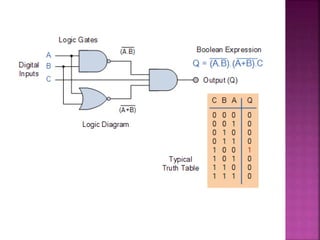
 Gate-level modeling
 Dataflow modeling
 Behavioral modelings
 A logic network can be modeled using
continuous assignments or switches and logic
gates. Gates and continuous assignments
serve different modeling purposes and it is
important to appreciate the differences
between them in order to achieve the right
balance between accuracy and efficiency in
Verilog-XL
 Dataflow modeling provides a powerful way
to implement a design. Verilog allows a
design processes data rather than
instantiation of individual gates. Dataflow
modeling has become a popular design
approach as logic synthesis tools have
become sophisticated. This approach allows
the designer to concentrate on optimizing
the circuit in terms of data flow.
 Verilog behavioral models contain procedural
statements that control the simulation and
manipulate variables of the data types
previously described. These statements are
contained within procedures. Each procedure
has an activity flow associated with it.
HDL (hardware description language) presentation

HDL (hardware description language) presentation

  • 1.
    Saggar Farid Rollno:21 UmarAbid Rollno:35 Hassan Rasheed Rollno:5
  • 2.
     In electronics,a hardware description language or HDL is a specialized computer language used to program the structure, design and operation of electronic circuits, and most commonly,digital logic circuits.
  • 3.
     Simulation allowsan HDL description of a design (called a model) to pass design verification, an important milestone that validates the design's intended function (specification) against the code implementation in the HDL description  . The engineer can experiment with design choices by writing multiple variations of a base design, then comparing their behavior in simulation. Thus, simulation is critical for successful HDL design Example:  Work Bench Software
  • 4.
     Histrocially,design verificationwas a laborious, repetitive loop of writing and running simulation test cases against the design under test which takes much time to verify.  The EDA industry developed the Property Specification Language. A property or properties can be proven true or false using formal mathematical methods.
  • 5.
  • 6.
    VHDL (V HardwareDescription Language) is a hardware description language used in electronic design automation to describe digital and mixed- signal systems such as field-programmable gate arrays and integrated circuits Advantage:  VHDL is a dataflow language, unlike procedural computing languages such as BASIC, C, and assembly code, which all run sequentially, one instruction at a time.
  • 7.
     Hardware descriptionlanguages such as Verilog differ from software programming languages because they include ways of describing the propagation of time and signal dependencies (sensitivity).  Now a day there is no use of verilog HDL.
  • 8.
    The module isthe basic building bloak f0r modeling hardware with the VerilogHDL. The logic of a module can be described in any one (or a combination) of the following modeling styles  Gate-level modeling  Dataflow modeling  Behavioral modelings
  • 9.
     A logicnetwork can be modeled using continuous assignments or switches and logic gates. Gates and continuous assignments serve different modeling purposes and it is important to appreciate the differences between them in order to achieve the right balance between accuracy and efficiency in Verilog-XL
  • 10.
     Dataflow modelingprovides a powerful way to implement a design. Verilog allows a design processes data rather than instantiation of individual gates. Dataflow modeling has become a popular design approach as logic synthesis tools have become sophisticated. This approach allows the designer to concentrate on optimizing the circuit in terms of data flow.
  • 11.
     Verilog behavioralmodels contain procedural statements that control the simulation and manipulate variables of the data types previously described. These statements are contained within procedures. Each procedure has an activity flow associated with it.