Cloud Computing: The
NewFrontier
Cloud computing has revolutionized the way we store, access, and
process data, transforming the digital landscape. This powerful
technology offers unparalleled flexibility, scalability, and cost-efficiency,
making it the backbone of modern digital infrastructure.
2.
Defining Cloud
Computing
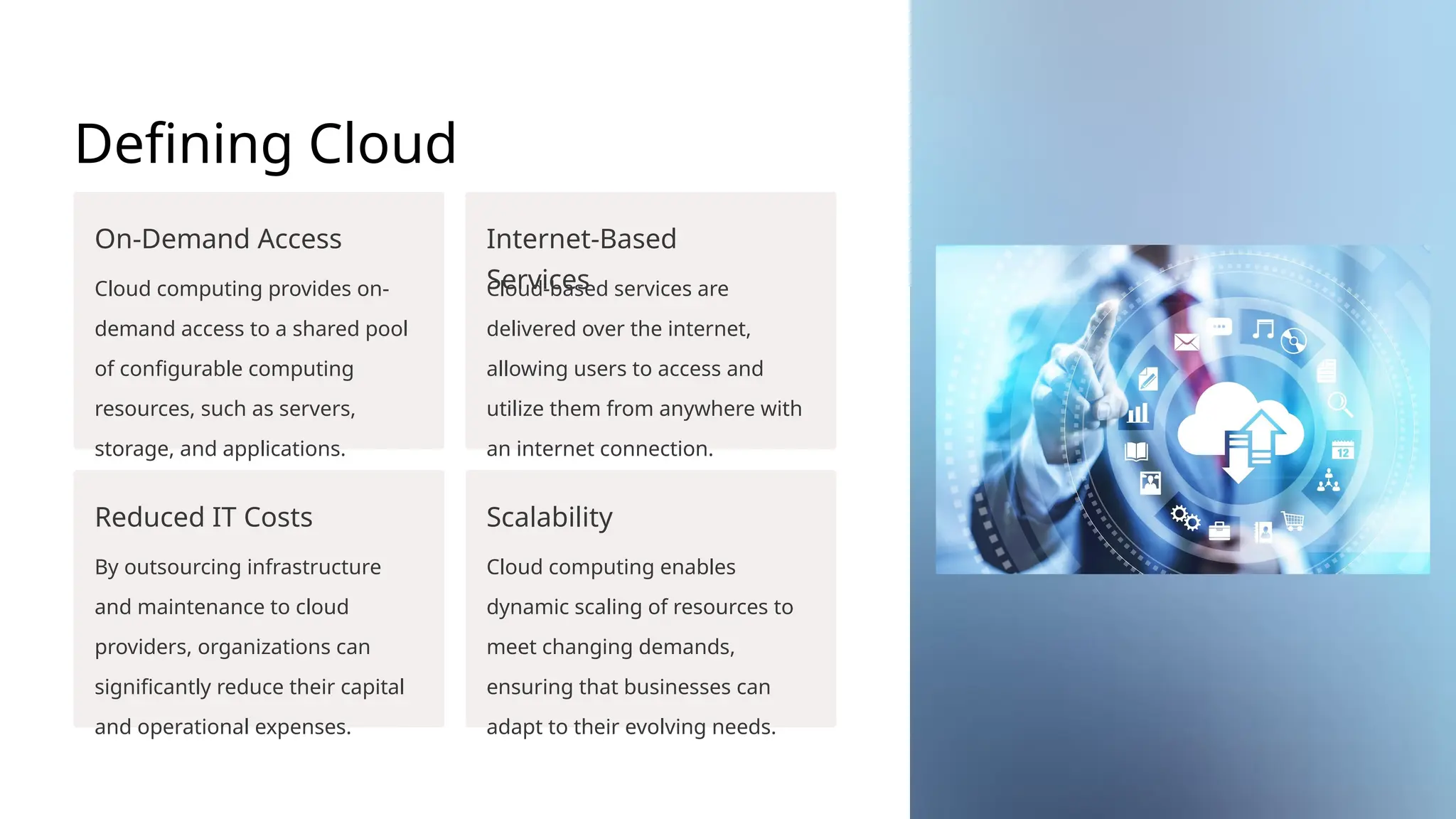
On-Demand Access
Cloudcomputing provides on-
demand access to a shared pool
of configurable computing
resources, such as servers,
storage, and applications.
Internet-Based
Services
Cloud-based services are
delivered over the internet,
allowing users to access and
utilize them from anywhere with
an internet connection.
Reduced IT Costs
By outsourcing infrastructure
and maintenance to cloud
providers, organizations can
significantly reduce their capital
and operational expenses.
Scalability
Cloud computing enables
dynamic scaling of resources to
meet changing demands,
ensuring that businesses can
adapt to their evolving needs.
3.
Characteristics of Cloud
Computing
1On-Demand Self-
Service
Users can provision computing
capabilities, such as server time
and network storage, without
requiring human interaction
with the service provider.
2 Broad Network
Access
Cloud resources are available
over the network and can be
accessed through various
devices, including phones,
tablets, and laptops.
3 Resource Pooling
The provider's computing
resources are pooled to serve
multiple consumers, with
dynamic assignment and
reassignment based on
demand.
4 Rapid Elasticity
Capabilities can be rapidly and
elastically provisioned, allowing
for automatic scale-up or scale-
down to meet changing
requirements.
4.
Cloud Deployment Models:Public, Private,
Hybrid, and Community
Public Cloud
Services are provided over the
internet and available to the general
public. Public clouds are owned and
operated by third-party cloud
providers.
Private Cloud
Cloud infrastructure is operated
solely for a single organization,
providing greater control and
customization. It can be managed
internally or by a third party.
Hybrid Cloud
A composition of two or more cloud
deployment models, allowing data
and applications to be shared
between them. This offers the
benefits of both public and private
clouds.
5.
Cloud Service Models:IaaS,
PaaS, and SaaS
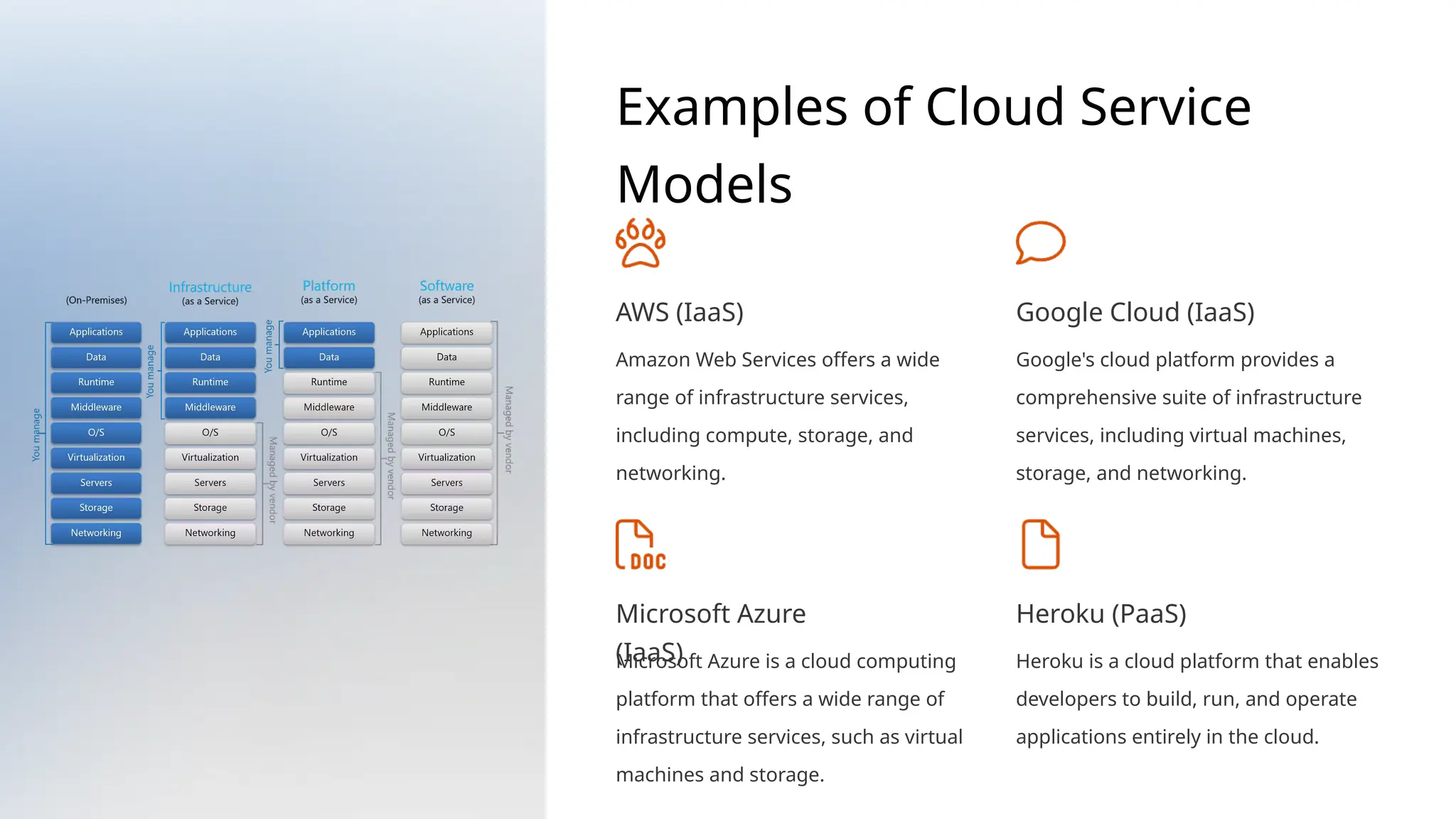
1 IaaS (Infrastructure as a
Service)
Provides access to virtualized computing resources, such as servers,
storage, and networking, allowing users to build and manage their own
IT infrastructure.
2 PaaS (Platform as a
Service)
Offers a platform for developing, testing, deploying, and managing
applications, including the underlying infrastructure and middleware,
without the need to manage the lower-level components.
3 SaaS (Software as a
Service)
Provides access to software applications over the internet, eliminating
the need for users to install and maintain the software on their own
devices.
6.
Examples of CloudService
Models
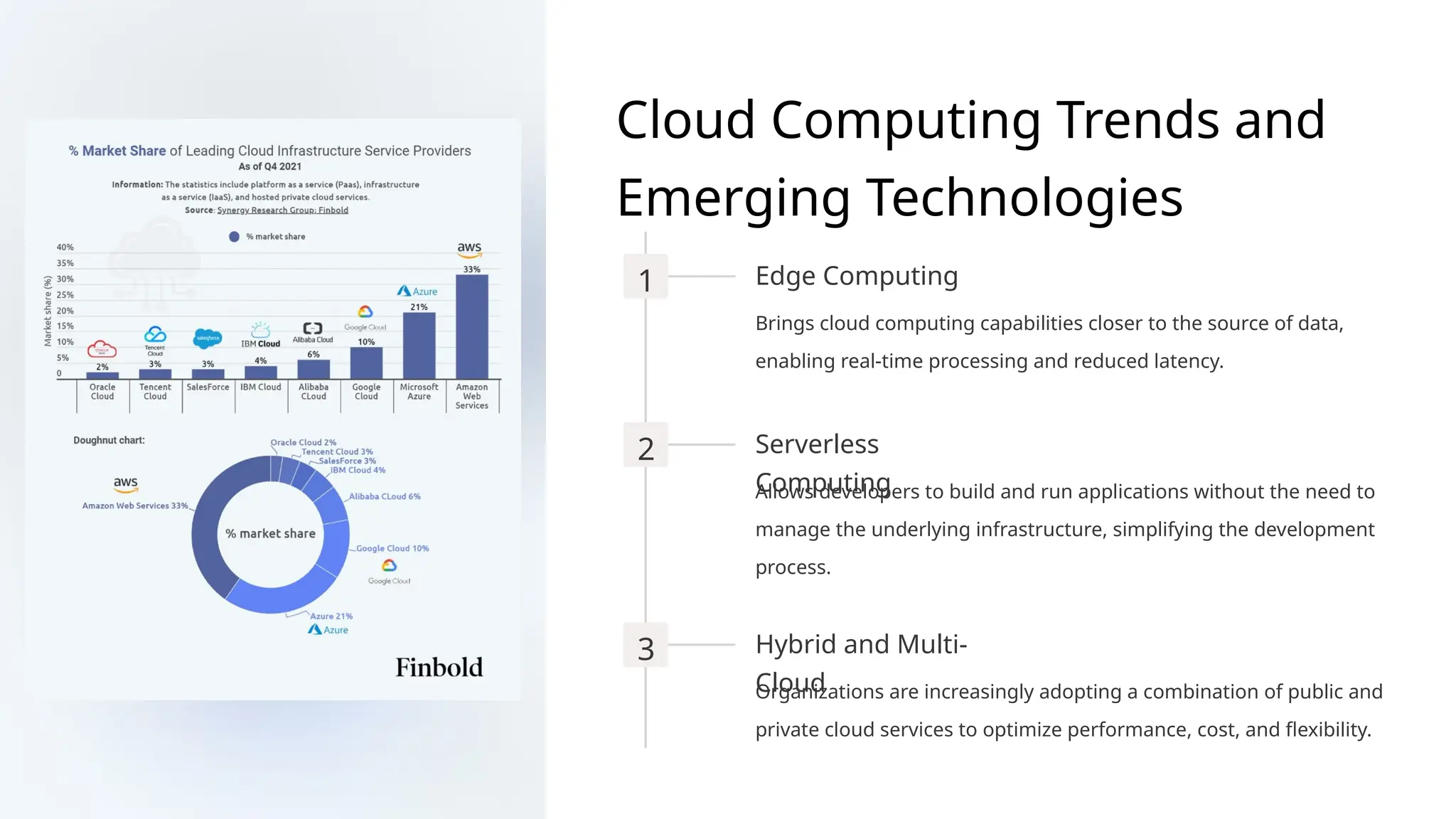
AWS (IaaS)
Amazon Web Services offers a wide
range of infrastructure services,
including compute, storage, and
networking.
Google Cloud (IaaS)
Google's cloud platform provides a
comprehensive suite of infrastructure
services, including virtual machines,
storage, and networking.
Microsoft Azure
(IaaS)
Microsoft Azure is a cloud computing
platform that offers a wide range of
infrastructure services, such as virtual
machines and storage.
Heroku (PaaS)
Heroku is a cloud platform that enables
developers to build, run, and operate
applications entirely in the cloud.
7.
Benefits of Cloud
Computing
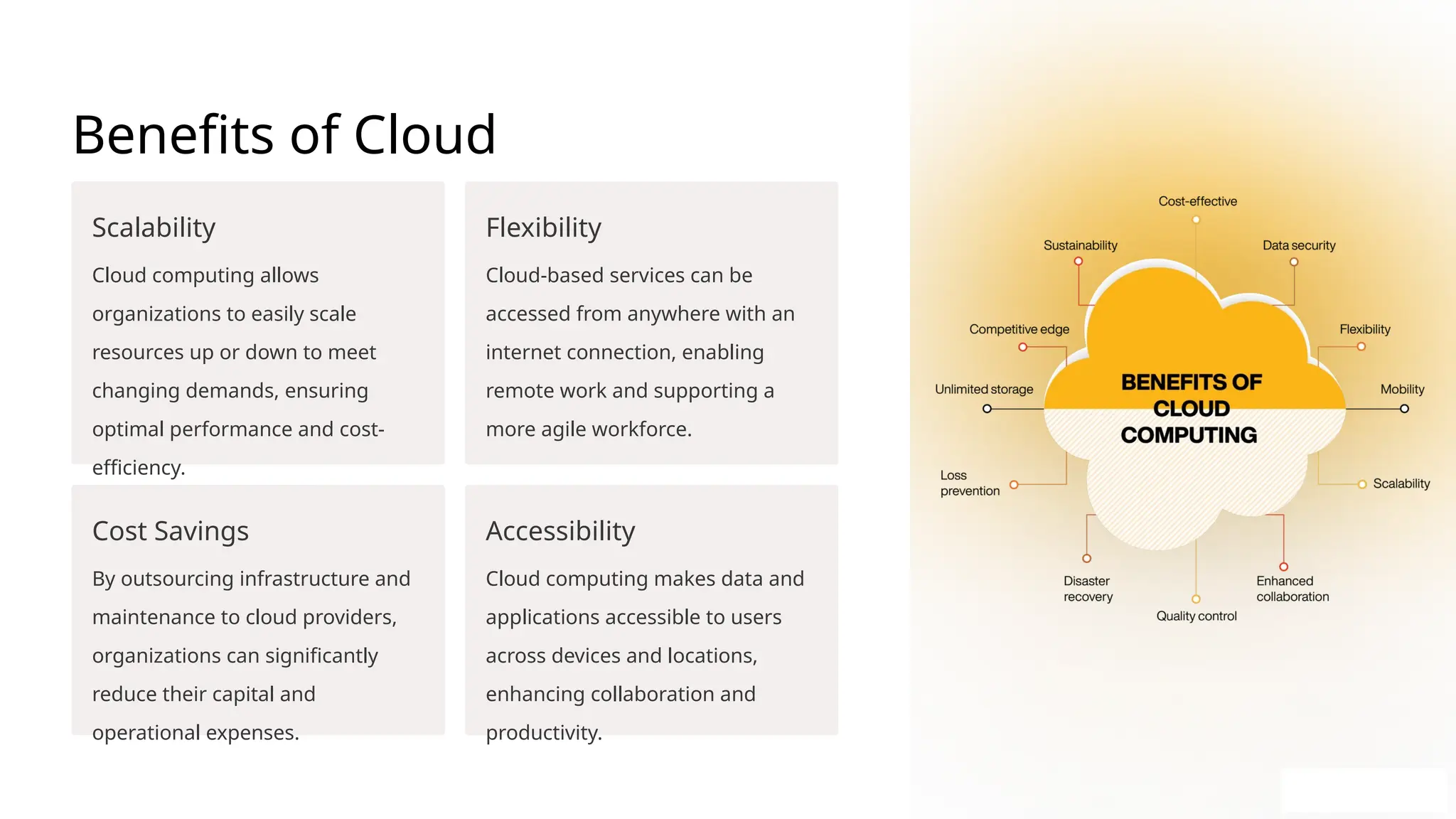
Scalability
Cloudcomputing allows
organizations to easily scale
resources up or down to meet
changing demands, ensuring
optimal performance and cost-
efficiency.
Flexibility
Cloud-based services can be
accessed from anywhere with an
internet connection, enabling
remote work and supporting a
more agile workforce.
Cost Savings
By outsourcing infrastructure and
maintenance to cloud providers,
organizations can significantly
reduce their capital and
operational expenses.
Accessibility
Cloud computing makes data and
applications accessible to users
across devices and locations,
enhancing collaboration and
productivity.
8.
Challenges of Cloud
Computing
Security
Ensuringthe security and privacy of
data stored and processed in the
cloud is a critical concern, requiring
robust security measures and
compliance with regulations.
Compliance
Organizations must ensure that their
cloud service providers adhere to
industry-specific regulations and
standards, such as HIPAA, PCI-DSS,
and GDPR.
Vendor Lock-in
Reliance on a single cloud provider
can lead to vendor lock-in, making it
difficult to migrate to a different
platform or service in the future.
9.
Cloud Computing Trendsand
Emerging Technologies
1 Edge Computing
Brings cloud computing capabilities closer to the source of data,
enabling real-time processing and reduced latency.
2 Serverless
Computing
Allows developers to build and run applications without the need to
manage the underlying infrastructure, simplifying the development
process.
3 Hybrid and Multi-
Cloud
Organizations are increasingly adopting a combination of public and
private cloud services to optimize performance, cost, and flexibility.
10.
The Future ofCloud
Computing
As cloud computing continues to evolve, it will become increasingly
integrated into our daily lives and the operations of businesses and
organizations worldwide. With advancements in edge computing,
serverless architectures, and hybrid cloud strategies, the cloud's role in
shaping the digital landscape will only grow stronger in the years to
come.