Cloud Computing Tutorial
                       Jens Nimis

       Tutorial, IPE-Klausurtagung
       30. Juli 2009, Freudenstadt
Sources
    •   [JB] Dr. James Broberg, U. Melbourne, CC-Tutorial at CCGrid 2009
        http://www.slideshare.net/jamesbroberg/introduction-to-cloud-computing-ccgrid-2009


    •   [MM] Michael Maximilien, IBM

    •   [MK] Dr. Marcel Kunze und Christian Baun (comics), SCC Karlsruhe

    •   Stefan Tai, Alex Lenk, Markus Klems, Sebastian Schmidt & many more...


2
Agenda
    • Part 1: What is Cloud Computing?

    • Part 2: The Cloud Ecosystem

    • Part 3: Current research questions and interesting directions


3
Agenda – Part 1
    • Part 1: What is Cloud Computing?
        • Definitions
        • Cloud vs. Grid
        • Challenges and Oportunities


    • Part 2: The Cloud Ecosystem

    • Part 3: Current research questions and interesting directions


4
Some remarks on Cloud Definitions
    • Anonymous:
      „[…] unfortunately the marketing guys got hold of the term before
      the technicians had known what Cloud Computing is […]“

    • A lot of semi-serious definitions:
        • Cloud = Grid made right / Grid made easy

        • Grid: from Science for Science
          Cloud: from Business for Business


    • Let‘s get serious (first…)


5
Some serious definitions
    •   UCBerkeley RADLabs: “Cloud computing has the following
        characteristics: (1) The illusion of infinite computing resources… (2) The
        elimination of an up-front commitment by Cloud users… (3). The ability to
        pay for use…as needed…”
         business perspective

    •   McKinsey: “Clouds are hardware-based services offering compute,
        network and storage capacity where: Hardware management is highly
        abstracted from the buyer, Buyers incur infrastructure costs as variable
        OPEX, and Infrastructure capacity is highly elastic”
         only one kind of Cloud

    •   Wikipedia: “.. a style of computing in which dynamically scalable and
        often virtualized resources are provided as a service over the Internet”
         technical perspective

    [JB]
6
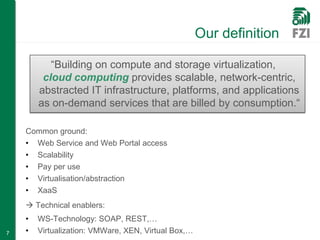
Our definition

           “Building on compute and storage virtualization,
         cloud computing provides scalable, network-centric,
        abstracted IT infrastructure, platforms, and applications
        as on-demand services that are billed by consumption.“

    Common ground:
    • Web Service and Web Portal access
    • Scalability
    • Pay per use
    • Virtualisation/abstraction
    • XaaS
     Technical enablers:
    •   WS-Technology: SOAP, REST,…
7   •   Virtualization: VMWare, XEN, Virtual Box,…
Grid vs. Cloud


                                                                                            [MK]

    •   Cloud has replaced Grid in public visibility, but for the last time: Cloud <> Grid V2 !!!

    •   Foster‘s Grid Definition “What is the Grid? A Three Point Checklist”
         •   Computing resources are not administered centrally
         •   Open standards are used
         •   Nontrivial quality of service is achieved

8
     Big differences in definitions, but unfortunately promises and the metapher are similar…
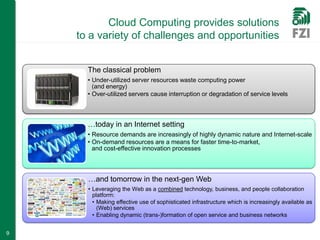
Cloud Computing provides solutions
    to a variety of challenges and opportunities


      The classical problem
      • Under-utilized server resources waste computing power
        (and energy)
      • Over-utilized servers cause interruption or degradation of service levels


      …today in an Internet setting
      • Resource demands are increasingly of highly dynamic nature and Internet-scale
      • On-demand resources are a means for faster time-to-market,
        and cost-effective innovation processes


      …and tomorrow in the next-gen Web
      • Leveraging the Web as a combined technology, business, and people collaboration
        platform:
        • Making effective use of sophisticated infrastructure which is increasingly available as
          (Web) services
        • Enabling dynamic (trans-)formation of open service and business networks


9
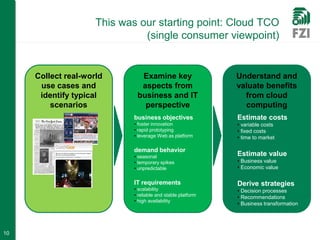
This was our starting point: Cloud TCO
                               (single consumer viewpoint)


     Collect real-world        Examine key                    Understand and
      use cases and            aspects from                   valuate benefits
      identify typical        business and IT                   from cloud
         scenarios              perspective                     computing
                             business objectives              Estimate costs
                             • foster innovation              • variable costs
                             • rapid prototyping              • fixed costs
                             • leverage Web as platform       • time to market

                             demand behavior
                             • seasonal                       Estimate value
                             • temporary spikes               • Business value
                             • unpredictable                  • Economic value

                             IT requirements                  Derive strategies
                             • scalability                    • Decision processes
                             • reliable and stable platform   • Recommendations
                             • high availability
                                                              • Business transformation


10
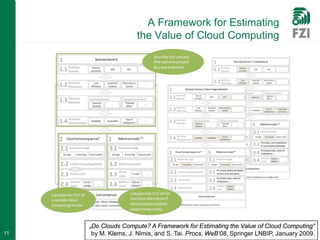
A Framework for Estimating
                     the Value of Cloud Computing


     „Do Clouds Compute? A Framework for Estimating the Value of Cloud Computing“
11    by M. Klems, J. Nimis, and S. Tai. Procs. WeB‘08, Springer LNBIP, January 2009.
Agenda – Part 2
     • Part 1: What is Cloud Computing?

     • Part 2: The Cloud Ecosystem
         • Cloud Architecture
         • Cloud Players
         • Change ahead!


     • Part 3: Current research questions and interesting directions


12
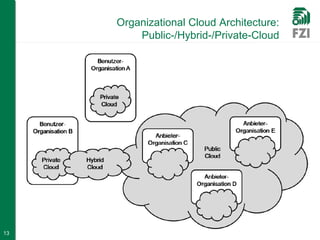
Organizational Cloud Architecture:
         Public-/Hybrid-/Private-Cloud


13
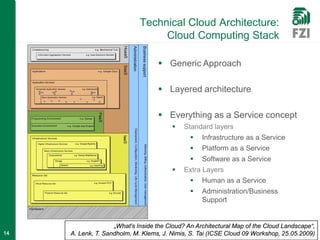
Technical Cloud Architecture:
                                  Cloud Computing Stack

                                    Generic Approach

                                    Layered architecture

                                    Everything as a Service concept
                                           Standard layers
                                                  Infrastructure as a Service
                                                  Platform as a Service
                                                  Software as a Service
                                           Extra Layers
                                                  Human as a Service
                                                  Administration/Business
                                                   Support


                    „What's Inside the Cloud? An Architectural Map of the Cloud Landscape“,
14   A. Lenk, T. Sandholm, M. Klems, J. Nimis, S. Tai (ICSE Cloud 09 Workshop, 25.05.2009)
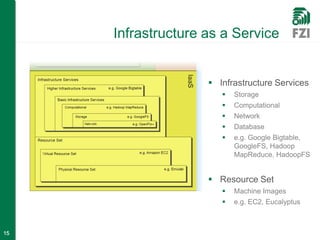
Infrastructure as a Service


                     Infrastructure Services
                          Storage
                          Computational
                          Network
                          Database
                          e.g. Google Bigtable,
                           GoogleFS, Hadoop
                           MapReduce, HadoopFS


                     Resource Set
                          Machine Images
                          e.g. EC2, Eucalyptus


15
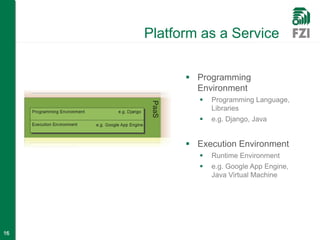
Platform as a Service

            Programming
             Environment
                 Programming Language,
                  Libraries
                 e.g. Django, Java


            Execution Environment
                 Runtime Environment
                 e.g. Google App Engine,
                  Java Virtual Machine


16
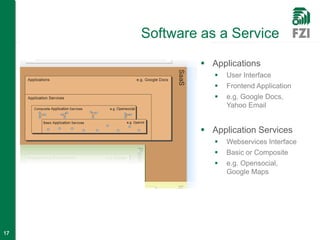
Software as a Service
               Applications
                    User Interface
                    Frontend Application
                    e.g. Google Docs,
                     Yahoo Email


               Application Services
                    Webservices Interface
                    Basic or Composite
                    e.g. Opensocial,
                     Google Maps


17
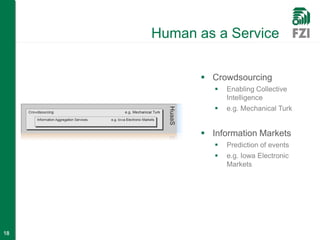
Human as a Service

            Crowdsourcing
                 Enabling Collective
                  Intelligence
                 e.g. Mechanical Turk


            Information Markets
                 Prediction of events
                 e.g. Iowa Electronic
                  Markets


18
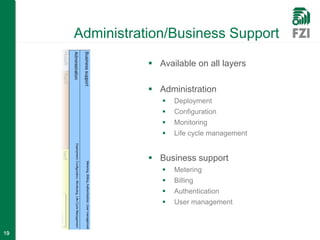
Administration/Business Support
                 Available on all layers

                 Administration
                      Deployment
                      Configuration
                      Monitoring
                      Life cycle management


                 Business support
                      Metering
                      Billing
                      Authentication
                      User management


19
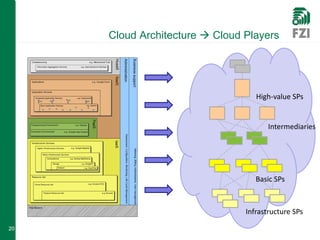
Cloud Architecture  Cloud Players


                                   High-value SPs


                                       Intermediaries


                                   Basic SPs


                                Infrastructure SPs

20
Players
     Cloud infrastructure service providers – raw cloud resources
        IaaS (infrastructure-as-a-service)
     Cloud platform providers – resources + frameworks; PaaS (platform-
        as-a-service)
     Cloud intermediares – help broker some aspect of raw resources and
        frameworks, e.g.,
        server managers, application assemblers, application hosting
     Cloud application providers (SaaS)
     Cloud consumers – users of the above


     [MM]
21
Players: Providers
     Programmatic access via Web Services and/or Web APIs
     “Pure” virtualized resources
         CPU, memory, storage, and bandwidth
         Data store


             versus


     Virtualized resources plus application framework
     (e.g., RoR, Python, .NET)
         Imposes an application and data architecture
         Constrains how application is built


22
     [MM]
Players: Cloud Intermediaires
     Resells (aspects of) raw cloud resources, with added value
       propositions
         Packaging resources as bundles
         Facilitating cloud resource management,
            e.g., setup, updates, backup, load balancing, etc.
         Providing tools and dashboards
     Enabler of the cloud ecosystem


     [MM]
23
Players: Application Providers
     Software as a Service (SaaS):
         Applications provided and consumed over the Web
     Infrastructure usage (mostly) hidden


24
     [MM]                                                  24
Cloud computing by example:
                                                  Amazon AWS

     Amazon AWS Cloud Offerings:
     • Amazon Elastic Compute Cloud (Amazon EC2)
     • Amazon Simple Storage Service (Amazon S3
     • Amazon Simple Queuing Service (Amazon SQS)
     • Amazon SimpleDB

     •   Amazon Elastic MapReduce
     •   Amazon CloudFront
     •   Amazon DevPay
     •   AWS Import/Export


25
Cloud computing by example:
                                                 Amazon EC2

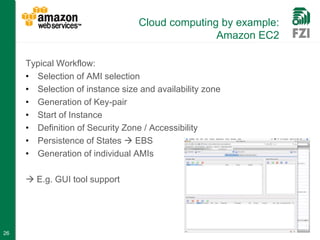
     Typical Workflow:
     • Selection of AMI selection
     • Selection of instance size and availability zone
     • Generation of Key-pair
     • Start of Instance
     • Definition of Security Zone / Accessibility
     • Persistence of States  EBS
     • Generation of individual AMIs

      E.g. GUI tool support


26
Cloud computing by example:
                                                        Amazon S3

     Typical Workflow:
     •   Anlegen von Buckets
         s3cmd mb s3://Bucket
     •   Hochladen von Objekten in einen Bucket
         s3cmd put LokaleDatei s3://Bucket/EntfernteDatei
     •   Auslesen von Meta-Daten z.B. Bucketinhalten
         s3cmd ls s3://Bucket
     •   Herunterladen von Objekten aus einem Bucket
         s3cmd get s3://Bucket/EntfernteDatei LokaleDatei
     •   Löschen von Dateien
         s3cmd del s3://Bucket/EntfernteDatei
     •   Löschen von (leeren) Buckets
         s3cmd rb s3://Bucket


      E.g. command line tool support


27
Cloud computing by example:
                                                     Amazon SQS

     Typical Workflow:
     • CreateQueue: Anlegen einer Queue im AWSBenutzerkontext
     •   ListQueues: Aufzählung der existierenden Queues
     •   DeleteQueue: Löschen einer Queue
     •   SendMessage: Einstellen einer Nachricht in eine Queue
     •   ReceiveMessage: Auslesen einer (oder mehrerer) Nachrichten aus einer Queue


     •   ChangeMessageVisibility: Einstellen weitere Sichtbarkeit gelesener Nachrichten
     •   DeleteMessage: Löschen einer gelesenen Nachricht
     •   SetQueueAttributes: z.B. Zeit zw. zwei Leseoperationen auf dieselbe Nachricht
     •   GetQueueAttributes: z.B. Anzahl der aktuell in der Queue befindlichen Nachrichten
     •   AddPermission: Freigabe von Queues zum geteilten Zugriff verschiedener Benutzer
     •   RemovePermission: Widerrufen der Freigabe für andere Benutzerkontexte


28
Cloud computing by example:
                                                Amazon SimpleDB

     Typical Workflow:
     • CreateDomain, ListDomains, DeleteDomain: Domäne ≈ Relation
     •   DomainMetadata: Auslesen z.B. von aktuellem Speicherplatzbedarf
     •   PutAttributes: Hinzufügen oder Aktualisieren eines Datensatzes basierend auf
         einem Datensatzidentifikator und Attribut/Wert-Paaren
     •   BatchPutAttributes: Gleichzeitiges Anstoßen mehrer Einfügeoperationen zur
         Performance-Erhöhung
     •   GetAttributes: Lesen eines identifizierten (Teil-)Datensatzes
     •   DeleteAttributes: Löschen von Datensätzen, Attributen oder Werten
     •   Select: Anfrage in SQL-ähnlicher Syntax (ohne Joins!)


29
Change Ahead!
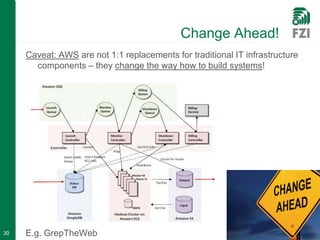
     Caveat: AWS are not 1:1 replacements for traditional IT infrastructure
       components – they change the way how to build systems!


30   E.g. GrepTheWeb
Agenda – Part 3
     • Part 1: What is Cloud Computing?

     • Part 2: The Cloud Ecosystem

     • Part 3: Current research questions and interesting directions
         • In general
         • At IPE
         • „Near“ IPE


31
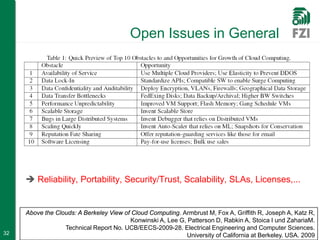
Open Issues in General


      Reliability, Portability, Security/Trust, Scalability, SLAs, Licenses,...


     Above the Clouds: A Berkeley View of Cloud Computing. Armbrust M, Fox A, Griffith R, Joseph A, Katz R,
                                         Konwinski A, Lee G, Patterson D, Rabkin A, Stoica I und ZahariaM.
                  Technical Report No. UCB/EECS-2009-28. Electrical Engineering and Computer Sciences.
32                                                          University of California at Berkeley. USA. 2009
Overview
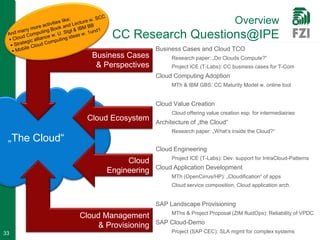
                       CC Research Questions@IPE
                                     Business Cases and Cloud TCO
                  Business Cases          Research paper: „Do Clouds Compute?“
                   & Perspectives         Project ICE (T-Labs): CC business cases for T-Com
                                     Cloud Computing Adoption
                                          MTh & IBM GBS: CC Maturity Model w. online tool


                                     Cloud Value Creation
                                          Cloud offering value creation esp. for intermediairies
                 Cloud Ecosystem     Architecture of „the Cloud“
                                          Research paper: „What‘s inside the Cloud?“
 „The Cloud“
                                     Cloud Engineering
                                          Project ICE (T-Labs): Dev. support for IntraCloud-Patterns
                           Cloud
                                     Cloud Application Development
                      Engineering
                                          MTh (OpenCirrus/HP): „Cloudification“ of apps
                                          Cloud service composition, Cloud application arch.


                                     SAP Landscape Provisioning
                                          MThs & Project Proposal (ZIM fluidOps): Reliability of VPDC
               Cloud Management
                                     SAP Cloud-Demo
                    & Provisioning
33                                        Project (SAP CEC): SLA mgmt for complex systems
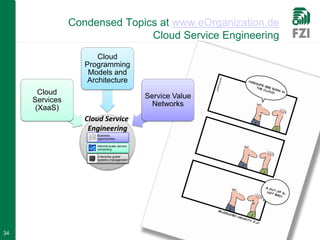
Condensed Topics at www.eOrganization.de
                               Cloud Service Engineering
                       Cloud
                   Programming
                    Models and
                    Architecture
       Cloud
                                               Service Value
     Services
                                                 Networks
      (XaaS)
                   Cloud Service
                    Engineering
                      Business
                      opportunities

                      Internet-scale service
                      computing

                      Enterprise-grade
                      systems management


34
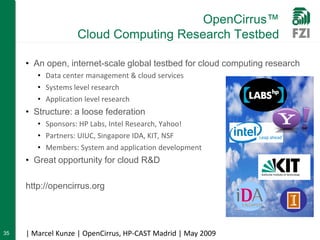
OpenCirrus™
                   Cloud Computing Research Testbed

     • An open, internet-scale global testbed for cloud computing research
        • Data center management & cloud services
        • Systems level research
        • Application level research
     • Structure: a loose federation
        • Sponsors: HP Labs, Intel Research, Yahoo!
        • Partners: UIUC, Singapore IDA, KIT, NSF
        • Members: System and application development
     • Great opportunity for cloud R&D

     http://opencirrus.org


35   | Marcel Kunze | OpenCirrus, HP-CAST Madrid | May 2009
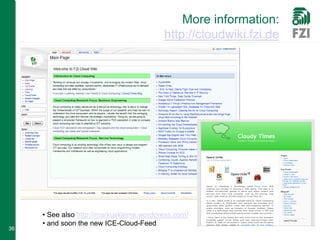
More information:
                                         http://cloudwiki.fzi.de


     • See also http://markusklems.wordpress.com/
     • and soon the new ICE-Cloud-Feed
36
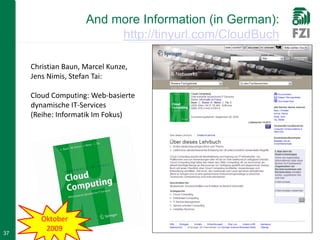
And more Information (in German):
                          http://tinyurl.com/CloudBuch

     Christian Baun, Marcel Kunze,
     Jens Nimis, Stefan Tai:

     Cloud Computing: Web-basierte
     dynamische IT-Services
     (Reihe: Informatik Im Fokus)


        Oktober
         2009
37

Cloud Computing Tutorial - Jens Nimis

  • 1.
    Cloud Computing Tutorial Jens Nimis Tutorial, IPE-Klausurtagung 30. Juli 2009, Freudenstadt
  • 2.
    Sources • [JB] Dr. James Broberg, U. Melbourne, CC-Tutorial at CCGrid 2009 http://www.slideshare.net/jamesbroberg/introduction-to-cloud-computing-ccgrid-2009 • [MM] Michael Maximilien, IBM • [MK] Dr. Marcel Kunze und Christian Baun (comics), SCC Karlsruhe • Stefan Tai, Alex Lenk, Markus Klems, Sebastian Schmidt & many more... 2
  • 3.
    Agenda • Part 1: What is Cloud Computing? • Part 2: The Cloud Ecosystem • Part 3: Current research questions and interesting directions 3
  • 4.
    Agenda – Part1 • Part 1: What is Cloud Computing? • Definitions • Cloud vs. Grid • Challenges and Oportunities • Part 2: The Cloud Ecosystem • Part 3: Current research questions and interesting directions 4
  • 5.
    Some remarks onCloud Definitions • Anonymous: „[…] unfortunately the marketing guys got hold of the term before the technicians had known what Cloud Computing is […]“ • A lot of semi-serious definitions: • Cloud = Grid made right / Grid made easy • Grid: from Science for Science Cloud: from Business for Business • Let‘s get serious (first…) 5
  • 6.
    Some serious definitions • UCBerkeley RADLabs: “Cloud computing has the following characteristics: (1) The illusion of infinite computing resources… (2) The elimination of an up-front commitment by Cloud users… (3). The ability to pay for use…as needed…”  business perspective • McKinsey: “Clouds are hardware-based services offering compute, network and storage capacity where: Hardware management is highly abstracted from the buyer, Buyers incur infrastructure costs as variable OPEX, and Infrastructure capacity is highly elastic”  only one kind of Cloud • Wikipedia: “.. a style of computing in which dynamically scalable and often virtualized resources are provided as a service over the Internet”  technical perspective [JB] 6
  • 7.
    Our definition “Building on compute and storage virtualization, cloud computing provides scalable, network-centric, abstracted IT infrastructure, platforms, and applications as on-demand services that are billed by consumption.“ Common ground: • Web Service and Web Portal access • Scalability • Pay per use • Virtualisation/abstraction • XaaS  Technical enablers: • WS-Technology: SOAP, REST,… 7 • Virtualization: VMWare, XEN, Virtual Box,…
  • 8.
    Grid vs. Cloud [MK] • Cloud has replaced Grid in public visibility, but for the last time: Cloud <> Grid V2 !!! • Foster‘s Grid Definition “What is the Grid? A Three Point Checklist” • Computing resources are not administered centrally • Open standards are used • Nontrivial quality of service is achieved 8  Big differences in definitions, but unfortunately promises and the metapher are similar…
  • 9.
    Cloud Computing providessolutions to a variety of challenges and opportunities The classical problem • Under-utilized server resources waste computing power (and energy) • Over-utilized servers cause interruption or degradation of service levels …today in an Internet setting • Resource demands are increasingly of highly dynamic nature and Internet-scale • On-demand resources are a means for faster time-to-market, and cost-effective innovation processes …and tomorrow in the next-gen Web • Leveraging the Web as a combined technology, business, and people collaboration platform: • Making effective use of sophisticated infrastructure which is increasingly available as (Web) services • Enabling dynamic (trans-)formation of open service and business networks 9
  • 10.
    This was ourstarting point: Cloud TCO (single consumer viewpoint) Collect real-world Examine key Understand and use cases and aspects from valuate benefits identify typical business and IT from cloud scenarios perspective computing business objectives Estimate costs • foster innovation • variable costs • rapid prototyping • fixed costs • leverage Web as platform • time to market demand behavior • seasonal Estimate value • temporary spikes • Business value • unpredictable • Economic value IT requirements Derive strategies • scalability • Decision processes • reliable and stable platform • Recommendations • high availability • Business transformation 10
  • 11.
    A Framework forEstimating the Value of Cloud Computing „Do Clouds Compute? A Framework for Estimating the Value of Cloud Computing“ 11 by M. Klems, J. Nimis, and S. Tai. Procs. WeB‘08, Springer LNBIP, January 2009.
  • 12.
    Agenda – Part2 • Part 1: What is Cloud Computing? • Part 2: The Cloud Ecosystem • Cloud Architecture • Cloud Players • Change ahead! • Part 3: Current research questions and interesting directions 12
  • 13.
    Organizational Cloud Architecture: Public-/Hybrid-/Private-Cloud 13
  • 14.
    Technical Cloud Architecture: Cloud Computing Stack  Generic Approach  Layered architecture  Everything as a Service concept  Standard layers  Infrastructure as a Service  Platform as a Service  Software as a Service  Extra Layers  Human as a Service  Administration/Business Support „What's Inside the Cloud? An Architectural Map of the Cloud Landscape“, 14 A. Lenk, T. Sandholm, M. Klems, J. Nimis, S. Tai (ICSE Cloud 09 Workshop, 25.05.2009)
  • 15.
    Infrastructure as aService  Infrastructure Services  Storage  Computational  Network  Database  e.g. Google Bigtable, GoogleFS, Hadoop MapReduce, HadoopFS  Resource Set  Machine Images  e.g. EC2, Eucalyptus 15
  • 16.
    Platform as aService  Programming Environment  Programming Language, Libraries  e.g. Django, Java  Execution Environment  Runtime Environment  e.g. Google App Engine, Java Virtual Machine 16
  • 17.
    Software as aService  Applications  User Interface  Frontend Application  e.g. Google Docs, Yahoo Email  Application Services  Webservices Interface  Basic or Composite  e.g. Opensocial, Google Maps 17
  • 18.
    Human as aService  Crowdsourcing  Enabling Collective Intelligence  e.g. Mechanical Turk  Information Markets  Prediction of events  e.g. Iowa Electronic Markets 18
  • 19.
    Administration/Business Support  Available on all layers  Administration  Deployment  Configuration  Monitoring  Life cycle management  Business support  Metering  Billing  Authentication  User management 19
  • 20.
    Cloud Architecture Cloud Players High-value SPs Intermediaries Basic SPs Infrastructure SPs 20
  • 21.
    Players Cloud infrastructure service providers – raw cloud resources IaaS (infrastructure-as-a-service) Cloud platform providers – resources + frameworks; PaaS (platform- as-a-service) Cloud intermediares – help broker some aspect of raw resources and frameworks, e.g., server managers, application assemblers, application hosting Cloud application providers (SaaS) Cloud consumers – users of the above [MM] 21
  • 22.
    Players: Providers Programmatic access via Web Services and/or Web APIs “Pure” virtualized resources CPU, memory, storage, and bandwidth Data store versus Virtualized resources plus application framework (e.g., RoR, Python, .NET) Imposes an application and data architecture Constrains how application is built 22 [MM]
  • 23.
    Players: Cloud Intermediaires Resells (aspects of) raw cloud resources, with added value propositions Packaging resources as bundles Facilitating cloud resource management, e.g., setup, updates, backup, load balancing, etc. Providing tools and dashboards Enabler of the cloud ecosystem [MM] 23
  • 24.
    Players: Application Providers Software as a Service (SaaS): Applications provided and consumed over the Web Infrastructure usage (mostly) hidden 24 [MM] 24
  • 25.
    Cloud computing byexample: Amazon AWS Amazon AWS Cloud Offerings: • Amazon Elastic Compute Cloud (Amazon EC2) • Amazon Simple Storage Service (Amazon S3 • Amazon Simple Queuing Service (Amazon SQS) • Amazon SimpleDB • Amazon Elastic MapReduce • Amazon CloudFront • Amazon DevPay • AWS Import/Export 25
  • 26.
    Cloud computing byexample: Amazon EC2 Typical Workflow: • Selection of AMI selection • Selection of instance size and availability zone • Generation of Key-pair • Start of Instance • Definition of Security Zone / Accessibility • Persistence of States  EBS • Generation of individual AMIs  E.g. GUI tool support 26
  • 27.
    Cloud computing byexample: Amazon S3 Typical Workflow: • Anlegen von Buckets s3cmd mb s3://Bucket • Hochladen von Objekten in einen Bucket s3cmd put LokaleDatei s3://Bucket/EntfernteDatei • Auslesen von Meta-Daten z.B. Bucketinhalten s3cmd ls s3://Bucket • Herunterladen von Objekten aus einem Bucket s3cmd get s3://Bucket/EntfernteDatei LokaleDatei • Löschen von Dateien s3cmd del s3://Bucket/EntfernteDatei • Löschen von (leeren) Buckets s3cmd rb s3://Bucket  E.g. command line tool support 27
  • 28.
    Cloud computing byexample: Amazon SQS Typical Workflow: • CreateQueue: Anlegen einer Queue im AWSBenutzerkontext • ListQueues: Aufzählung der existierenden Queues • DeleteQueue: Löschen einer Queue • SendMessage: Einstellen einer Nachricht in eine Queue • ReceiveMessage: Auslesen einer (oder mehrerer) Nachrichten aus einer Queue • ChangeMessageVisibility: Einstellen weitere Sichtbarkeit gelesener Nachrichten • DeleteMessage: Löschen einer gelesenen Nachricht • SetQueueAttributes: z.B. Zeit zw. zwei Leseoperationen auf dieselbe Nachricht • GetQueueAttributes: z.B. Anzahl der aktuell in der Queue befindlichen Nachrichten • AddPermission: Freigabe von Queues zum geteilten Zugriff verschiedener Benutzer • RemovePermission: Widerrufen der Freigabe für andere Benutzerkontexte 28
  • 29.
    Cloud computing byexample: Amazon SimpleDB Typical Workflow: • CreateDomain, ListDomains, DeleteDomain: Domäne ≈ Relation • DomainMetadata: Auslesen z.B. von aktuellem Speicherplatzbedarf • PutAttributes: Hinzufügen oder Aktualisieren eines Datensatzes basierend auf einem Datensatzidentifikator und Attribut/Wert-Paaren • BatchPutAttributes: Gleichzeitiges Anstoßen mehrer Einfügeoperationen zur Performance-Erhöhung • GetAttributes: Lesen eines identifizierten (Teil-)Datensatzes • DeleteAttributes: Löschen von Datensätzen, Attributen oder Werten • Select: Anfrage in SQL-ähnlicher Syntax (ohne Joins!) 29
  • 30.
    Change Ahead! Caveat: AWS are not 1:1 replacements for traditional IT infrastructure components – they change the way how to build systems! 30 E.g. GrepTheWeb
  • 31.
    Agenda – Part3 • Part 1: What is Cloud Computing? • Part 2: The Cloud Ecosystem • Part 3: Current research questions and interesting directions • In general • At IPE • „Near“ IPE 31
  • 32.
    Open Issues inGeneral  Reliability, Portability, Security/Trust, Scalability, SLAs, Licenses,... Above the Clouds: A Berkeley View of Cloud Computing. Armbrust M, Fox A, Griffith R, Joseph A, Katz R, Konwinski A, Lee G, Patterson D, Rabkin A, Stoica I und ZahariaM. Technical Report No. UCB/EECS-2009-28. Electrical Engineering and Computer Sciences. 32 University of California at Berkeley. USA. 2009
  • 33.
    Overview CC Research Questions@IPE Business Cases and Cloud TCO Business Cases Research paper: „Do Clouds Compute?“ & Perspectives Project ICE (T-Labs): CC business cases for T-Com Cloud Computing Adoption MTh & IBM GBS: CC Maturity Model w. online tool Cloud Value Creation Cloud offering value creation esp. for intermediairies Cloud Ecosystem Architecture of „the Cloud“ Research paper: „What‘s inside the Cloud?“ „The Cloud“ Cloud Engineering Project ICE (T-Labs): Dev. support for IntraCloud-Patterns Cloud Cloud Application Development Engineering MTh (OpenCirrus/HP): „Cloudification“ of apps Cloud service composition, Cloud application arch. SAP Landscape Provisioning MThs & Project Proposal (ZIM fluidOps): Reliability of VPDC Cloud Management SAP Cloud-Demo & Provisioning 33 Project (SAP CEC): SLA mgmt for complex systems
  • 34.
    Condensed Topics atwww.eOrganization.de Cloud Service Engineering Cloud Programming Models and Architecture Cloud Service Value Services Networks (XaaS) Cloud Service Engineering Business opportunities Internet-scale service computing Enterprise-grade systems management 34
  • 35.
    OpenCirrus™ Cloud Computing Research Testbed • An open, internet-scale global testbed for cloud computing research • Data center management & cloud services • Systems level research • Application level research • Structure: a loose federation • Sponsors: HP Labs, Intel Research, Yahoo! • Partners: UIUC, Singapore IDA, KIT, NSF • Members: System and application development • Great opportunity for cloud R&D http://opencirrus.org 35 | Marcel Kunze | OpenCirrus, HP-CAST Madrid | May 2009
  • 36.
    More information: http://cloudwiki.fzi.de • See also http://markusklems.wordpress.com/ • and soon the new ICE-Cloud-Feed 36
  • 37.
    And more Information(in German): http://tinyurl.com/CloudBuch Christian Baun, Marcel Kunze, Jens Nimis, Stefan Tai: Cloud Computing: Web-basierte dynamische IT-Services (Reihe: Informatik Im Fokus) Oktober 2009 37